Mixed Dark Matter: Limits from the Milky Way Satellite Galaxies
Pith reviewed 2026-06-27 15:26 UTC · model grok-4.3
The pith
Milky Way satellite galaxies set new bounds on mixed fuzzy and interacting dark matter models down to 50 percent exotic fraction.
A machine-rendered reading of the paper's core claim, the machinery that carries it, and where it could break.
Core claim
By demanding that the linear matter power spectra of mixed models remain less suppressed than those of a reference model already constrained by Milky Way satellites, the authors obtain 95 percent bounds on fuzzy dark matter mass and on interacting dark matter cross sections that weaken systematically with decreasing beyond-CDM fraction. At 50 percent fraction the interacting dark matter cross-section bounds weaken by factors of roughly 2 to 6 and the fuzzy dark matter mass bounds weaken by a factor of roughly 1.5 relative to the pure exotic case. Idealized future surveys matching approximate LSST sensitivity are forecast to improve the 100 percent bounds by factors of 1.6 to 14 for interacti
What carries the argument
The linear matter power spectrum suppression criterion that keeps mixed-model spectra less suppressed than a reference model already excluded by satellite counts.
If this is right
- Bounds on fuzzy dark matter mass and interacting dark matter cross section weaken with decreasing exotic fraction according to distinct power-law scalings.
- At 50 percent exotic fraction the interacting dark matter cross-section limits loosen by a factor of 2 to 6 while fuzzy dark matter mass limits loosen by a factor of 1.5.
- Future satellite surveys with approximate LSST depth can strengthen the pure exotic bounds by factors between 1.6 and 14 for interacting dark matter and by a factor of 3 for fuzzy dark matter.
- Self-consistent cosmological simulations are required to test the degeneracy between particle parameters and fractional abundance at lower fractions.
Where Pith is reading between the lines
- The same power-spectrum comparison method could be applied to other small-scale probes such as the Lyman-alpha forest or strong-lensing flux ratios to cross-check the satellite-derived limits.
- If the linear criterion overestimates satellite survival in mixed models, the true allowed parameter space at fractions below 50 percent would be smaller than reported.
- The reported weakening of bounds with fraction implies that even modest exotic components can still be tested once simulations become available for those mixtures.
Load-bearing premise
That the linear power spectrum suppression level alone is enough to guarantee the mixed model will produce at least as many Milky Way satellites as observed.
What would settle it
A self-consistent N-body simulation of a 50 percent mixed fuzzy or interacting dark matter model whose satellite abundance falls below the number predicted by the linear power spectrum comparison alone.
Figures



read the original abstract
The Standard Model of particle physics contains a diverse set of particle species, motivating the possibility of a similarly complex dark sector. Here we study two-component dark matter (DM) mixtures, in which one component behaves as standard CDM while the other suppresses the formation of small-scale structure, either through an astrophysically relevant de~Broglie wavelength (fuzzy DM; FDM) or collisional damping from temperature-independent scattering (interacting DM; IDM). Using the observed population of Milky Way satellite galaxies, we derive new leading constraints on the parameter spaces of mixed FDM and of mixed IDM coupled to photons ($\gamma$-DM), neutrinos ($\nu$-DM), or baryons ($p$-DM), for beyond-CDM fractions down to $50\%$. We require that the linear matter power spectra of allowed models remain less suppressed than a constrained reference model. The resulting $95\%$ confidence bounds on FDM mass and IDM cross section weaken systematically with decreasing fraction, following distinct power-law scalings. At $50\%$ fraction, IDM cross section bounds weaken by a factor of $\sim$2--6 and FDM mass bounds by $\sim$1.5, relative to the $100\%$ case. We forecast that idealized future satellite surveys, which adopt approximate LSST sensitivity thresholds, can improve these $100\%$ bounds by a factor of $\sim$1.6--14 for IDM and $\sim$3 for FDM. Self-consistent cosmological simulations of mixed DM scenarios will be essential to more robustly characterize the degeneracy between particle physics parameters and fractional contribution, to extend constraints to lower fractions, and to identify signatures beyond satellite abundance to further inform these models.
Editorial analysis
A structured set of objections, weighed in public.
Referee Report
Summary. The manuscript derives new leading constraints on mixed dark matter models (CDM + FDM or CDM + IDM coupled to photons, neutrinos, or baryons) for beyond-CDM fractions down to 50%, using the Milky Way satellite population. The method requires that the linear matter power spectrum of each allowed mixed model remain less suppressed than that of a reference model already constrained by observations. This produces 95% confidence bounds on FDM mass and IDM cross sections that weaken with decreasing fraction according to distinct power-law scalings; forecasts for idealized future surveys (approximate LSST thresholds) are also given. The abstract explicitly notes that self-consistent N-body simulations will be needed to characterize degeneracies and extend to lower fractions.
Significance. If the linear P(k) proxy holds, the work supplies quantitative leading constraints on mixed DM scenarios down to 50% fraction, including explicit weakening factors (~2-6 for IDM cross sections and ~1.5 for FDM mass at 50%) and survey forecasts. This is a useful extension of existing pure-DM limits and highlights parameter-fraction degeneracies. The power-law scalings and the authors' own caveat on the need for simulations are strengths that aid follow-up work.
major comments (2)
- [Abstract] Abstract: The central 50% fraction limits and the reported weakening factors rest on the assumption that the linear matter power spectrum suppression criterion (relative to the reference model) is sufficient to bound the impact on the observed satellite population. This assumption is load-bearing because the translation from linear P(k) to satellite counts can be altered by the CDM component through non-linear collapse, reionization feedback, or dynamical friction, none of which are encoded in linear theory alone. The abstract itself states that self-consistent N-body simulations are essential, confirming this is the least-secured step.
- [Abstract] Abstract (reference model description): The allowed models are defined by comparison to a 'constrained reference model' whose bounds come from prior literature. While the fractional weakening is derived from the power-spectrum requirement, the central limits inherit dependence on that external reference; explicit validation is needed that the mapping from P(k) to satellite abundance remains identical when a CDM fraction is present, as the skeptic note identifies.
minor comments (2)
- Clarify the precise definition and construction of the 'constrained reference model' and how its suppression level is quantified (e.g., at which k-scale or integrated measure).
- The forecast section should specify the exact LSST sensitivity thresholds adopted and any approximations made in the idealized survey modeling.
Simulated Author's Rebuttal
We thank the referee for their thoughtful and constructive comments on our manuscript. We address each major comment below, clarifying the scope of our linear-theory proxy approach while acknowledging its limitations as already noted in the abstract.
read point-by-point responses
-
Referee: [Abstract] The central 50% fraction limits and the reported weakening factors rest on the assumption that the linear matter power spectrum suppression criterion (relative to the reference model) is sufficient to bound the impact on the observed satellite population. This assumption is load-bearing because the translation from linear P(k) to satellite counts can be altered by the CDM component through non-linear collapse, reionization feedback, or dynamical friction, none of which are encoded in linear theory alone. The abstract itself states that self-consistent N-body simulations are essential, confirming this is the least-secured step.
Authors: We agree that the linear P(k) proxy constitutes an approximation whose validity for mixed models ultimately requires validation through self-consistent simulations, as the abstract already states. This proxy is the standard method used in the literature to derive leading constraints on small-scale structure suppression from satellite counts. The reported weakening factors are obtained by applying the identical proxy consistently to both the reference and mixed models. We will add a clarifying paragraph in the methods section and strengthen the discussion of limitations in the conclusions to further emphasize the role of non-linear effects and the need for future N-body work. revision: partial
-
Referee: [Abstract] The allowed models are defined by comparison to a 'constrained reference model' whose bounds come from prior literature. While the fractional weakening is derived from the power-spectrum requirement, the central limits inherit dependence on that external reference; explicit validation is needed that the mapping from P(k) to satellite abundance remains identical when a CDM fraction is present, as the skeptic note identifies.
Authors: The central 95% limits do inherit their absolute scale from the reference model's literature constraints, while the fractional weakening factors are derived directly from the linear power-spectrum comparison. We concur that confirming the mapping from P(k) to satellite abundance remains unchanged in the presence of a CDM component requires simulations, which we explicitly flag as essential future work. The current results therefore represent leading constraints under the stated proxy assumption. We will insert a brief clarifying sentence in the abstract and introduction to make this dependence and the associated caveat more explicit. revision: partial
Circularity Check
No circularity: bounds derived from external reference threshold via explicit P(k) calculation
full rationale
The derivation requires that mixed-DM linear power spectra remain less suppressed than a reference model whose constraints originate in prior literature. This threshold is applied by direct computation of suppression levels for varying particle parameters and DM fractions, producing power-law scalings for the resulting bounds. No step equates the output bounds to the input reference by definition, renames a fit as a prediction, or reduces the central claim to a self-citation chain. The paper explicitly flags the linear-P(k) proxy as an approximation requiring future N-body validation, confirming the method is not self-contained by construction but rests on an external benchmark.
Axiom & Free-Parameter Ledger
free parameters (3)
- beyond-CDM fraction
- FDM particle mass
- IDM cross section
axioms (2)
- domain assumption Linear matter power spectrum suppression is a sufficient proxy for the effect on Milky Way satellite abundance
- standard math Standard linear perturbation theory in a Lambda-CDM background
Reference graph
Works this paper leans on
-
[1]
INTRODUCTION The standard cosmological paradigm assumes that dark matter (DM) is cold, collisionless, and interacts solely through gravity. This cold dark matter (CDM) framework broadly reproduces the large-scale structure of the Universe, as probed by observations of the cos- mic microwave background (CMB), galaxy clustering, and the Lyman-αforest [1, 2]...
Pith/arXiv arXiv 2026
-
[2]
We extend both frameworks to mixed scenarios, treating each DM subcomponent as a separate fluid within the Einstein-Boltzmann system
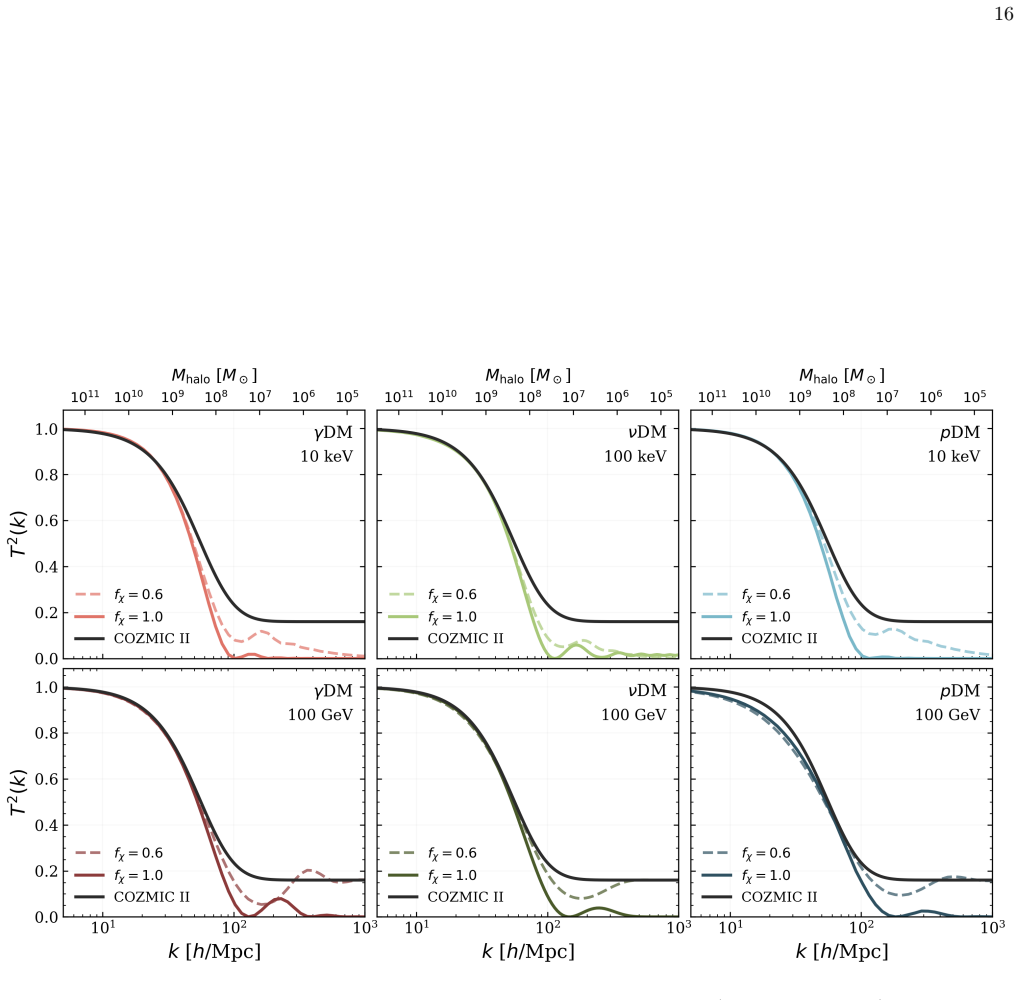
THEOR Y In this section, we review the theoretical foundations of FDM and IDM, focusing on the mechanisms by which each suppresses small-scale structure and the linear mat- ter power spectrum. We extend both frameworks to mixed scenarios, treating each DM subcomponent as a separate fluid within the Einstein-Boltzmann system. We begin with FDM in Section 2...
-
[3]
2 We exploit this to bypass dedicated simulations and map our bounds directly from existing MW satellite constraints on P(k)
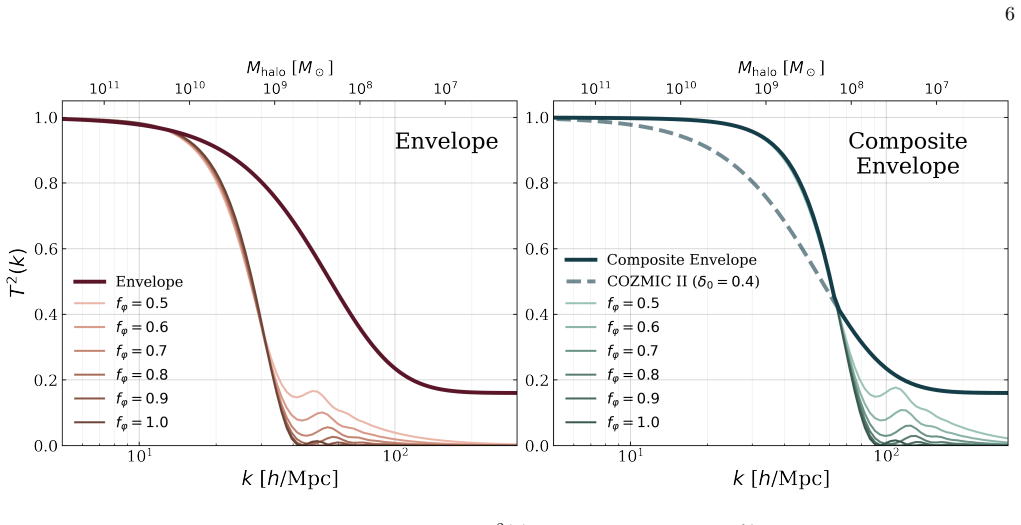
METHODS In all four scenarios under investigation, the key beyond-CDM physics modifies linearP(k) and thus af- fects only the initial conditions for structure formation; non-linear growth proceeds as in CDM cosmology. 2 We exploit this to bypass dedicated simulations and map our bounds directly from existing MW satellite constraints on P(k). Specifically,...
-
[4]
Section 4.2 presents 95% confidence up- per limits on IDM cross sections forγ-DM,ν-DM, and p-DM, likewise down tof χ = 0.5 and across a range of DM masses (see Tables II–IV)
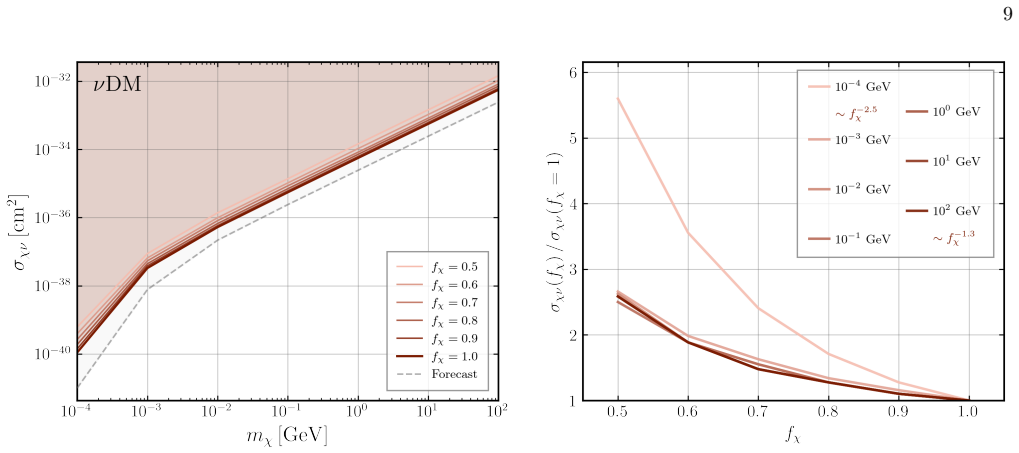
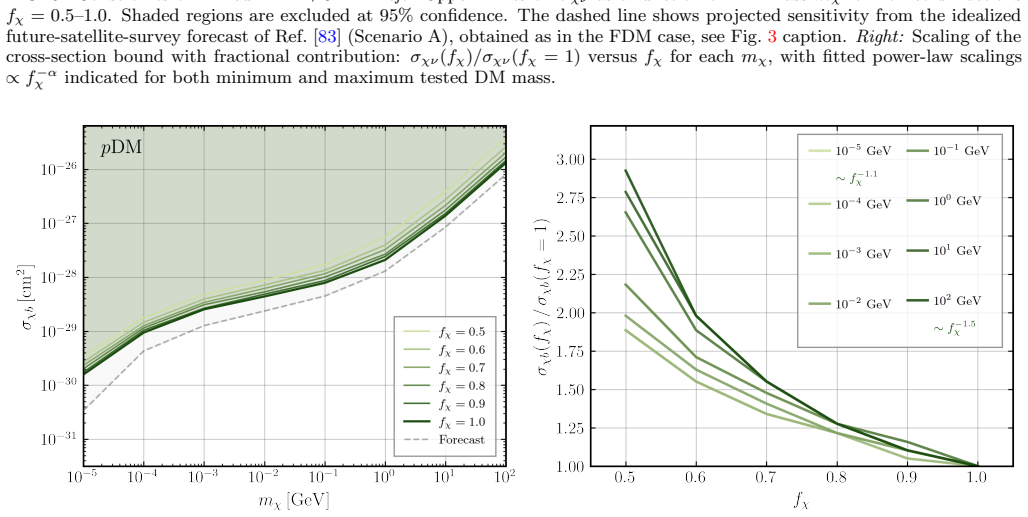
RESUL TS Section 4.1 reports 95% confidence lower limits on the FDM scalar field mass,m φ, for bothenvelopeandcom- posite envelopemethods, for fractions down tof φ = 0.5 (see Table I). Section 4.2 presents 95% confidence up- per limits on IDM cross sections forγ-DM,ν-DM, and p-DM, likewise down tof χ = 0.5 and across a range of DM masses (see Tables II–IV...
-
[5]
[83] (mWDM >8.8 keV) to our beyond-CDM transfer func- tions.7 They therefore inherit Ref
These projected limits were obtained by half-mode matching the 95% confidence WDM forecast of Ref. [83] (mWDM >8.8 keV) to our beyond-CDM transfer func- tions.7 They therefore inherit Ref. [83]’s assumptions of a “weak” galaxy formation cutoff and complete detec- tion of MW satellites within the virial radius down to approximate LSST sensitivity threshold...
-
[6]
We explore mixed DM scenarios in which only a fraction of DM ex- hibits non-CDM behavior, while the remainder behaves as CDM
DISCUSSION AND CONCLUSIONS Interactions between DM and SM particles, as well as ultralight scalar field dynamics, suppress linear matter perturbations in the early Universe and thereby reduce the abundance of present-day dwarf galaxies. We explore mixed DM scenarios in which only a fraction of DM ex- hibits non-CDM behavior, while the remainder behaves as...
2025
-
[7]
Aghanim, Y
N. Aghanim, Y. Akrami, M. Ashdown, J. Aumont, C. Baccigalupi, M. Ballardini, A. J. Banday, R. B. Bar- reiro, N. Bartolo, S. Basak, R. Battye, K. Benabed, J.-P. Bernard, M. Bersanelli, P. Bielewicz, J. J. Bock, J. R. Bond, J. Borrill, F. R. Bouchet, F. Boulanger, M. Bucher, C. Burigana, R. C. Butler, E. Calabrese, J.-F. Cardoso, J. Carron, A. Challinor, H....
2020
-
[8]
Chabanier, M
S. Chabanier, M. Millea, and N. Palanque-Delabrouille, Monthly Notices of the Royal Astronomical Society489, 2247–2253 (2019)
2019
-
[9]
Abdallaet al., Journal of High Energy Astrophysics 34, 49–211 (2022)
E. Abdallaet al., Journal of High Energy Astrophysics 34, 49–211 (2022)
2022
-
[10]
Di Valentino, O
E. Di Valentino, O. Mena, S. Pan, L. Visinelli, W. Yang, A. Melchiorri, D. F. Mota, A. G. Riess, and J. Silk, Clas- sical and Quantum Gravity38, 153001 (2021)
2021
-
[11]
Perivolaropoulos and F
L. Perivolaropoulos and F. Skara, New Astronomy Re- views95, 101659 (2022)
2022
-
[12]
E. O. Nadler, R. H. Wechsler, K. Bechtol, Y.-Y. Mao, G. Green, A. Drlica-Wagner, M. McNanna, S. Mau, A. B. Pace, J. D. Simon, A. Kravtsov, S. Dodelson, T. S. Li, A. H. Riley, M. Y. Wang, T. M. C. Abbott, M. Aguena, S. Allam, J. Annis, S. Avila, G. M. Bernstein, E. Bertin, D. Brooks, D. L. Burke, A. C. Rosell, M. C. Kind, J. Carretero, M. Costanzi, L. N. d...
2020
-
[13]
Jethwa, D
P. Jethwa, D. Erkal, and V. Belokurov, Monthly No- tices of the Royal Astronomical Society473, 2060–2083 (2017)
2060
-
[14]
Hsueh, W
J.-W. Hsueh, W. Enzi, S. Vegetti, M. W. Auger, C. D. Fassnacht, G. Despali, L. V. E. Koopmans, and J. P. McKean, Monthly Notices of the Royal Astronomical So- ciety492, 3047–3059 (2019)
2019
-
[15]
Gilman, S
D. Gilman, S. Birrer, A. Nierenberg, T. Treu, X. Du, and A. Benson, Monthly Notices of the Royal Astronomical Society491, 6077–6101 (2019)
2019
-
[16]
R. E. Keeleyet al., JWST Lensed quasar dark mat- ter survey II: Strongest gravitational lensing limit on the dark matter free streaming length to date (2024), arXiv:2405.01620 [astro-ph.CO]
arXiv 2024
-
[17]
Banik, G
N. Banik, G. Bertone, J. Bovy, and N. Bozorgnia, Jour- nal of Cosmology and Astroparticle Physics2018(07), 061–061
-
[18]
Bonaca, D
A. Bonaca, D. W. Hogg, A. M. Price-Whelan, and C. Conroy, The Astrophysical Journal880, 38 (2019). 12
2019
-
[19]
S. Y. Kim and A. H. G. Peter, arXiv e-prints , arXiv:2106.09050 (2021), arXiv:2106.09050 [astro- ph.GA]
arXiv 2021
-
[20]
I. Esteban, A. H. G. Peter, and S. Y. Kim, Milky Way satellite velocities reveal the Dark Matter power spec- trum at small scales (2023), arXiv:2306.04674 [astro- ph.CO]
arXiv 2023
-
[21]
J. S. Bullock, Notes on the missing satellites problem (2010), arXiv:1009.4505 [astro-ph.CO]
Pith/arXiv arXiv 2010
-
[22]
J. S. Bullock and M. Boylan-Kolchin, Annual Review of Astronomy and Astrophysics55, 343–387 (2017)
2017
-
[23]
Schaeffer and J
R. Schaeffer and J. Silk, Astrophys. J.332, 1 (1988)
1988
-
[24]
Sommer-Larsen and A
J. Sommer-Larsen and A. Dolgov, The Astrophysical Journal551, 608–623 (2001)
2001
-
[25]
W. Hu, R. Barkana, and A. Gruzinov, Physical Review Letters85, 1158–1161 (2000)
2000
-
[26]
C. Boehm and R. Schaeffer, Astron. Astrophys.438, 419 (2005), arXiv:astro-ph/0410591
Pith/arXiv arXiv 2005
-
[27]
C. Dvorkin, K. Blum, and M. Kamionkowski, Physical Review D89, 10.1103/physrevd.89.023519 (2014)
-
[28]
Vogelsberger, J
M. Vogelsberger, J. Zavala, F.-Y. Cyr-Racine, C. Pfrom- mer, T. Bringmann, and K. Sigurdson, Monthly No- tices of the Royal Astronomical Society460, 1399–1416 (2016)
2016
-
[29]
K. K. Boddy, V. Gluscevic, V. Poulin, E. D. Kovetz, M. Kamionkowski, and R. Barkana, Physical Review D 98, 10.1103/physrevd.98.123506 (2018)
-
[30]
E. O. Nadler, V. Gluscevic, K. K. Boddy, and R. H. Wechsler, The Astrophysical Journal878, L32 (2019)
2019
-
[31]
Maamari, V
K. Maamari, V. Gluscevic, K. K. Boddy, E. O. Nadler, and R. H. Wechsler, The Astrophysical Journal Letters 907, L46 (2021)
2021
-
[32]
E. O. Nadler, R. An, V. Gluscevic, A. Benson, and X. Du, Cozmic. i. cosmological zoom-in simulations with initial conditions beyond cdm (2024), arXiv:2410.03635 [astro- ph.CO]
arXiv 2024
-
[33]
R. An, E. O. Nadler, A. Benson, and V. Gluscevic, The Astrophysical Journal986, 128 (2025)
2025
-
[34]
Z. Zhou and N. Weiner, Searching for dark matter inter- actions with act, spt and des (2024), arXiv:2409.06771 [hep-ph]
arXiv 2024
-
[35]
K. K. Rogers, R. Hloˇ zek, A. Lagu¨ e, M. M. Ivanov, O. H. Philcox, G. Cabass, K. Akitsu, and D. J. Marsh, Journal of Cosmology and Astroparticle Physics2023(06), 023
-
[36]
K. K. Rogers and V. Poulin, Physical Review Research 7, 10.1103/physrevresearch.7.l012018 (2025)
- [37]
- [38]
-
[39]
E. Stuart and K. Pardo, Constraints on the dark matter- baryon interaction cross section from galaxy cluster ther- modynamics (2025), arXiv:2411.18706 [astro-ph.CO]
arXiv 2025
-
[40]
L. Zu, W. Giare, C. Zhang, E. Di Valentino, Y.-L. S. Tsai, and S. Trojanowski, Nature Astronomy10, 457–465 (2026)
2026
-
[41]
D. C. Hooper, N. Sch¨ oneberg, R. Murgia, M. Archidia- cono, J. Lesgourgues, and M. Viel, Journal of Cosmology and Astroparticle Physics2022(10), 032
-
[42]
A. He, M. M. Ivanov, R. An, and V. Gluscevic, The As- trophysical Journal Letters954, L8 (2023)
2023
-
[43]
Stadler, C
J. Stadler, C. Bœhm, and O. Mena, Journal of Cosmology and Astroparticle Physics2020(01), 039–039
-
[44]
M. C. Straight, T. Karwal, J. L. Bernal, and K. K. Boddy, Cmb constraints on dark matter-proton scattering: in- vestigating prior-volume effects using profile likelihoods (2026), arXiv:2603.25731 [astro-ph.CO]
arXiv 2026
-
[45]
E. O. Nadler, M. A. Amin, R. H. Wechsler, M. S. Delos, A. Benson, and V. Gluscevic, Warm, not fuzzy: General- ized ultralight dark matter limits from milky way satel- lites (2026), arXiv:2605.15371 [astro-ph.CO]
Pith/arXiv arXiv 2026
-
[46]
K. K. Rogers and H. V. Peiris, Physical Review Letters 126, 10.1103/physrevlett.126.071302 (2021)
-
[47]
N. Dalal and A. Kravtsov, Not so fuzzy: excluding fdm with sizes and stellar kinematics of ultra-faint dwarf galaxies (2022), arXiv:2203.05750 [astro-ph.CO]
arXiv 2022
-
[48]
T. Zimmermann, J. Alvey, D. J. Marsh, M. Fair- bairn, and J. I. Read, Physical Review Letters134, 10.1103/physrevlett.134.151001 (2025)
-
[49]
R. J. Wilkinson, C. Bœhm, and J. Lesgourgues, Journal of Cosmology and Astroparticle Physics2014(05), 011
-
[50]
R. J. Wilkinson, J. Lesgourgues, and C. Bœhm, Jour- nal of Cosmology and Astroparticle Physics2014(04), 026–026
-
[51]
Escudero, O
M. Escudero, O. Mena, A. C. Vincent, R. J. Wilkinson, and C. Bœhm, Journal of Cosmology and Astroparticle Physics2015(09), 034–034
-
[52]
Stadler and C
J. Stadler and C. Bœhm, Journal of Cosmology and As- troparticle Physics2018(10), 009
-
[53]
A. Paul, A. Chatterjee, A. Ghoshal, and S. Pal, Journal of Cosmology and Astroparticle Physics2021(10), 017
-
[54]
D. C. Hooper and M. Lucca, Physical Review D105, 10.1103/physrevd.105.103504 (2022)
-
[55]
A. He, M. M. Ivanov, R. An, T. Driskell, and V. Glusce- vic, Journal of Cosmology and Astroparticle Physics 2025(05), 087
2025
-
[56]
K. K. Rogers, C. Dvorkin, and H. V. Peiris, Physi- cal Review Letters128, 10.1103/physrevlett.128.171301 (2022)
-
[57]
C. Bœhm, P. Fayet, and R. Schaeffer, Physics Letters B 518, 8–14 (2001)
2001
-
[58]
C. Bœhm, J. A. Schewtschenko, R. J. Wilkinson, C. M. Baugh, and S. Pascoli, Monthly Notices of the Royal As- tronomical Society: Letters445, L31–L35 (2014)
2014
-
[59]
Escudero, L
M. Escudero, L. Lopez-Honorez, O. Mena, S. Palomares- Ruiz, and P. Villanueva-Domingo, Journal of Cosmology and Astroparticle Physics2018(06), 007–007
-
[60]
Akita and S
K. Akita and S. Ando, Journal of Cosmology and As- troparticle Physics2023(11), 037
-
[61]
W. Crumrine, E. O. Nadler, R. An, and V. Gluscevic, Physical Review D111, 10.1103/physrevd.111.023530 (2025)
-
[62]
A. Dey, A. Paul, and S. Pal, Monthly Notices of the Royal Astronomical Society524, 100–107 (2023)
2023
-
[63]
Ferrer, G
F. Ferrer, G. Herrera, and A. Ibarra, Journal of Cosmol- ogy and Astroparticle Physics2023(05), 057
-
[64]
Fujiwara and G
M. Fujiwara and G. Herrera, Physics Letters B851, 138573 (2024)
2024
-
[65]
J. M. Cline and M. Puel, Journal of Cosmology and As- troparticle Physics2023(06), 004
-
[66]
J. M. Cline, S. Gao, F. Guo, Z. Lin, S. Liu, M. Puel, P. Todd, and T. Xiao, Physical Review Letters130, 10.1103/physrevlett.130.091402 (2023)
- [67]
-
[68]
Becker, D
N. Becker, D. C. Hooper, F. Kahlhoefer, J. Lesgourgues, and N. Sch¨ oneberg, Journal of Cosmology and Astropar- ticle Physics2021(02), 019
-
[69]
P. Brax, C. van de Bruck, E. Di Valentino, W. Giar` e, and S. Trojanowski, Physics of the Dark Universe42, 101321 (2023)
2023
-
[70]
P. Brax, C. van de Bruck, E. D. Valentino, W. Giar´ e, and S. Trojanowski, Monthly Notices of the Royal Astronom- ical Society: Letters527, L122–L126 (2023)
2023
-
[71]
W. Giar` e, A. G´ omez-Valent, E. D. Valentino, and C. van de Bruck, Hints of neutrino dark matter scattering in the cmb? constraints from the marginalized and profile distributions (2023), arXiv:2311.09116 [astro-ph.CO]
arXiv 2023
-
[72]
V. Gluscevic and K. K. Boddy, Physical Review Letters 121, 10.1103/physrevlett.121.081301 (2018)
-
[73]
K. K. Boddy and V. Gluscevic, Physical Review D98, 10.1103/physrevd.98.083510 (2018)
-
[74]
Drlica-Wagner, K
A. Drlica-Wagner, K. Bechtol, S. Mau, M. McNanna, E. O. Nadler, A. B. Pace, T. S. Li, A. Pieres, E. Rozo, J. D. Simon, A. R. Walker, R. H. Wechsler, T. M. C. Abbott, S. Allam, J. Annis, E. Bertin, D. Brooks, D. L. Burke, A. C. Rosell, M. C. Kind, J. Carretero, M. Costanzi, L. N. da Costa, J. D. Vicente, S. Desai, H. T. Diehl, P. Doel, T. F. Eifler, S. Eve...
2020
-
[75]
S. Passaglia and W. Hu, Physical Review D105, 10.1103/physrevd.105.123529 (2022)
-
[76]
Ma and E
C.-P. Ma and E. Bertschinger, The Astrophysical Journal 455, 7 (1995)
1995
-
[77]
D. J. Marsh, Physics Reports643, 1–79 (2016)
2016
-
[78]
E. W. Kolb and M. S. Turner,The Early Universe (Addison-Wesley, Redwood City, USA, 1990)
1990
-
[79]
May and V
S. May and V. Springel, Monthly Notices of the Royal Astronomical Society524, 4256–4274 (2023)
2023
-
[80]
Y.-Y. Mao, M. Williamson, and R. H. Wechsler, The As- trophysical Journal810, 21 (2015)
2015
discussion (0)
Sign in with ORCID, Apple, or X to comment. Anyone can read and Pith papers without signing in.