Local controllability of heralded quantum linear optics
Pith reviewed 2026-06-26 20:40 UTC · model grok-4.3
The pith
The rank of the Jacobian with respect to the circuit unitary quantifies local controllability in heralded linear optical networks and identifies resources for full access.
A machine-rendered reading of the paper's core claim, the machinery that carries it, and where it could break.
Core claim
In heralded quantum linear optics, including auxiliary resources and conditional measurements allows the Jacobian rank of the output state with respect to the unitary to reach its maximal value, achieving full local controllability, whereas passive linear optics alone are constrained by bosonic symmetries to lower ranks.
What carries the argument
The Jacobian of the output state with respect to the parameters of the unitary circuit, whose rank gives the dimension of the accessible tangent space.
If this is right
- Passive linear optics alone yield a constrained accessible state space due to symmetries.
- Heralding with specific ancillary resources can enlarge this space to achieve maximal Jacobian rank.
- The framework provides criteria for resources needed in high-dimensional quantum state engineering.
- Maximal local rank serves as a necessary condition for assessing global reachability in measurement-based photonic systems.
Where Pith is reading between the lines
- Similar Jacobian analysis could be applied to other quantum control settings beyond photonics.
- Identifying exact resource thresholds might guide experimental designs for specific target states like high-dimensional entanglement.
- This local measure could be combined with global optimization techniques to verify reachability.
Load-bearing premise
That achieving the maximal possible rank of the Jacobian is a necessary condition for the global reachability of the target state space.
What would settle it
An example of a heralded linear optical circuit where the Jacobian has full rank at a point but some states in the target space remain unreachable from nearby configurations.
Figures



read the original abstract
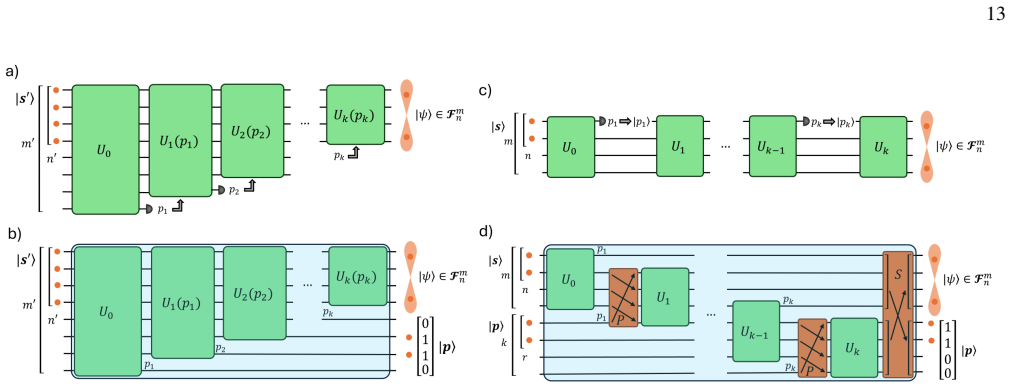
Photonic linear optical networks provide a versatile platform for quantum information processing and quantum state engineering. However, the set of states that can be generated using passive linear optics alone is fundamentally constrained by bosonic symmetries. Heralding, based on conditional measurements on auxiliary modes, is a widely used technique to overcome these limitations and effectively enlarge the set of accessible states. Despite the widespread use of heralding, it is often unclear how specific ancillary resources impact the overall reachability of the target space. In this work, we investigate the local controllability of photonic states in linear optical networks by analyzing the rank of the Jacobian of the output state with respect to the underlying unitary circuit, which provides a quantitative measure of the dimension of the accessible tangent space at a given configuration. Our analysis ranges from passive linear optics to heralded linear optics, where auxiliary resources and conditional measurements are included. Within this framework, we quantify how different resources enlarge the locally accessible state space beyond that of passive linear optics and determine the resources required for the Jacobian rank to reach its maximal value, thereby achieving full local controllability. As maximal local rank is a necessary condition for global reachability, our framework offers a systematic tool to assess and compare the accessible state space of measurement-based photonic architectures, and to establish practical criteria for the resources needed in high-dimensional quantum state engineering.
Editorial analysis
A structured set of objections, weighed in public.
Referee Report
Summary. The paper analyzes local controllability in photonic linear optical networks by computing the rank of the Jacobian of the output state map with respect to the unitary parameters. It compares passive linear optics to heralded setups that incorporate auxiliary modes and conditional measurements, quantifying how these resources increase the dimension of the locally accessible tangent space and identifying the minimal ancillary resources needed for the Jacobian to achieve maximal rank (full local controllability). The work treats maximal local rank as a necessary condition for global reachability of target states.
Significance. If the derivations hold, the framework supplies a concrete, differential-geometric criterion for comparing the reachable state spaces of different heralded linear-optical architectures and for determining resource thresholds in high-dimensional photonic state engineering. The explicit connection between ancillary resources, heralding, and Jacobian rank offers a systematic tool that goes beyond qualitative statements about bosonic symmetry constraints.
major comments (1)
- The abstract states that maximal local rank is a necessary condition for global reachability, but the manuscript should explicitly recall the differential-geometric theorem (e.g., constant-rank theorem or Sard’s theorem) that justifies this implication and confirm that the rank computation is performed at a generic point rather than a measure-zero set.
minor comments (2)
- Notation for the output state map and the precise definition of the Jacobian (with respect to which parameters) should be introduced in §2 or §3 with an explicit formula, even if the subsequent rank calculations are numerical.
- The abstract claims the analysis “ranges from passive linear optics to heralded linear optics”; a short table or diagram summarizing the resource configurations examined (number of auxiliary modes, detection patterns, etc.) would improve readability.
Simulated Author's Rebuttal
We thank the referee for the positive evaluation and the constructive comment on clarifying the differential-geometric justification. We address the point below and will revise the manuscript accordingly.
read point-by-point responses
-
Referee: The abstract states that maximal local rank is a necessary condition for global reachability, but the manuscript should explicitly recall the differential-geometric theorem (e.g., constant-rank theorem or Sard’s theorem) that justifies this implication and confirm that the rank computation is performed at a generic point rather than a measure-zero set.
Authors: We agree that the link between maximal Jacobian rank and global reachability requires an explicit reference to the underlying theorem. In the revised manuscript we will add a concise statement in the introduction (or a dedicated methods paragraph) recalling that, by the constant-rank theorem, full rank of the differential at a point implies the map is a submersion in a neighborhood, so the image of the parameter space contains an open set of the target manifold and therefore cannot lie in a lower-dimensional subvariety. We will also state explicitly that all rank computations are performed at generic points of the unitary parameter space (i.e., outside the measure-zero set where the rank may drop). These additions will be included in the next version. revision: yes
Circularity Check
No significant circularity detected
full rationale
The derivation computes the rank of the Jacobian of the output state map under unitary parameters for passive and heralded linear optics. This is a direct, standard application of differential geometry to quantify local accessibility; the necessity of full rank for local controllability follows from the definition of the differential and is not derived from the paper's own results or fits. No self-definitional equations, parameters fitted to data then renamed as predictions, or load-bearing self-citations appear. The framework remains self-contained against external mathematical benchmarks.
Axiom & Free-Parameter Ledger
axioms (2)
- domain assumption Bosonic symmetries fundamentally constrain the states reachable by passive linear optics.
- domain assumption Maximal local Jacobian rank is a necessary condition for global reachability.
Reference graph
Works this paper leans on
-
[1]
P. Kok, W. J. Munro, K. Nemoto, T. C. Ralph, J. P. Dowling, and G. J. Milburn, Linear optical quantum computing with photonic qubits, Reviews of Modern Physics79, 135–174 (2007)
2007
-
[2]
Knill, R
E. Knill, R. Laflamme, and G. J. Milburn, A scheme for ef- ficient quantum computation with linear optics, Nature409, 46–52 (2001)
2001
-
[3]
G. G. Lapaire, P. Kok, J. P. Dowling, and J. E. Sipe, Conditional linear-optical measurement schemes generate effective photon nonlinearities, Physical Review A68, 042314 (2003)
2003
-
[4]
Scheel, K
S. Scheel, K. Nemoto, W. J. Munro, and P. L. Knight, Measurement-induced nonlinearity in linear optics, Physical Review A68, 032310 (2003)
2003
-
[5]
Aaronson and A
S. Aaronson and A. Arkhipov, The computational complexity of linear optics, inProceedings of the forty-third annual ACM symposium on Theory of computing, STOC’11 (ACM, 2011) p. 333–342
2011
-
[6]
D. J. Brod, E. F. Galv ˜ao, A. Crespi, R. Osellame, N. Spagnolo, and F. Sciarrino, Photonic implementation of boson sampling: a review, Advanced Photonics1, 034001 (2019)
2019
-
[7]
Chabaud, D
U. Chabaud, D. Markham, and A. Sohbi, Quantum machine learning with adaptive linear optics, Quantum5, 496 (2021)
2021
-
[8]
Spagnolo, D
N. Spagnolo, D. J. Brod, E. F. Galv ˜ao, and F. Sciarrino, Non- linear boson sampling, npj Quantum Information9, 3 (2023)
2023
-
[9]
F. Hoch, E. Caruccio, G. Rodari, T. Francalanci, A. Suprano, T. Giordani, G. Carvacho, N. Spagnolo, S. Koudia, M. Proietti, C. Liorni, F. Cerocchi, R. Albiero, N. Di Giano, M. Gardina, F. Ceccarelli, G. Corrielli, U. Chabaud, R. Osellame, M. Dis- penza, and F. Sciarrino, Quantum machine learning with adap- tive boson sampling via post-selection, Nature Co...
2025
-
[10]
Monbroussou, E
L. Monbroussou, E. Z. Mamon, H. Thomas, V . Yacoub, U. Chabaud, and E. Kashefi, Toward quantum advantage with photonic state injection, Physical Review Research7, 033051 (2025)
2025
-
[11]
Monbroussou, B
L. Monbroussou, B. Polacchi, V . Yacoub, E. Caruccio, G. Ro- dari, F. Hoch, G. Carvacho, N. Spagnolo, T. Giordani, M. Bossi, A. Rajan, N. Di Giano, R. Albiero, F. Ceccarelli, R. Osellame, E. Kashefi, and F. Sciarrino, Photonic quantum convolutional neural networks with adaptive state injection, Advanced Pho- tonics7, 066012 (2025)
2025
-
[12]
Knill, Quantum gates using linear optics and postselection, Physical Review A66, 052306 (2002)
E. Knill, Quantum gates using linear optics and postselection, Physical Review A66, 052306 (2002)
2002
-
[13]
N. M. VanMeter, P. Lougovski, D. B. Uskov, K. Kieling, J. Eis- ert, and J. P. Dowling, General linear-optical quantum state generation scheme: Applications to maximally path-entangled states, Physical Review A76, 063808 (2007)
2007
- [14]
-
[15]
Aniello, C
P. Aniello, C. Lupo, M. Napolitano, and M. G. Paris, Engineer- ing multiphoton states for linear optics computation, The Euro- pean Physical Journal D41, 579–587 (2006)
2006
-
[16]
G. de Gliniasty, P. Bagourd, S. Draux, and B. Bourdoncle, Sim- ple rules for two-photon state preparation with linear optics (2024), arXiv:2405.01395 [quant-ph]
arXiv 2024
-
[17]
D. A. Kopylov, C. Offen, L. Ares, B. Wembe, S. Ober-Bl¨obaum, T. Meier, P. R. Sharapova, and J. Sperling, Multiphoton, multi- 11 mode state classification for nonlinear optical circuits, Physical Review Research7, 033062 (2025)
2025
-
[18]
Aralov, E
A. Aralov, E. Gillet, V . Nguyen, A. Cosentino, M. Walschaers, and M. Frigerio, Photon catalysis for general multimode multi- photon quantum state preparation, PRX Quantum7, 020323 (2026)
2026
-
[19]
Migdał, J
P. Migdał, J. Rodr´ıguez-Laguna, M. Oszmaniec, and M. Lewen- stein, Multiphoton states related via linear optics, Physical Re- view A89, 062329 (2014)
2014
-
[20]
J. C. Garcia-Escartin, V . Gimeno, and J. J. Moyano-Fern´andez, Method to determine which quantum operations can be realized with linear optics with a constructive implementation recipe, Physical Review A100, 022301 (2019)
2019
-
[21]
P. V . Parellada, V . G. i. Garcia, J. J. Moyano-Fern ´andez, and J. C. Garcia-Escartin, Lie algebraic invariants in quantum linear optics (2024), arXiv:2409.12223 [quant-ph]
Pith/arXiv arXiv 2024
-
[22]
E. Z. Mamon, Orbit dimensions in linear and gaussian quantum optics (2025), arXiv:2506.07995 [quant-ph]
arXiv 2025
- [23]
-
[24]
Rodari, T
G. Rodari, T. Francalanci, E. Caruccio, F. Hoch, G. Carvacho, T. Giordani, N. Spagnolo, R. Albiero, N. Di Giano, F. Cec- carelli, G. Corrielli, A. Crespi, R. Osellame, U. Chabaud, and F. Sciarrino, Observation of lie algebraic invariants in quantum linear optics, Physical Review Research7, 043325 (2025)
2025
-
[25]
Forbes, F
I. Forbes, F. Ghafari, E. C. R. Deacon, S. P. Singh, E. Lavie, P. Yard, R. D. Shaw, A. Laing, and N. Tischler, Heralded gen- eration of entanglement with photons, Reports on Progress in Physics88, 086002 (2025)
2025
-
[26]
Stanisic, N
S. Stanisic, N. Linden, A. Montanaro, and P. S. Turner, Gen- erating entanglement with linear optics, Physical Review A96, 043861 (2017)
2017
-
[27]
F. V . Gubarev, I. V . Dyakonov, M. Y . Saygin, G. I. Struchalin, S. S. Straupe, and S. P. Kulik, Improved heralded schemes to generate entangled states from single photons, Physical Review A102, 012604 (2020)
2020
-
[28]
S. A. Fldzhyan, M. Y . Saygin, and S. P. Kulik, Compact lin- ear optical scheme for bell state generation, Physical Review Research3, 043031 (2021)
2021
-
[29]
S. A. Fldzhyan, M. Y . Saygin, and S. P. Kulik, Programmable heralded linear optical generation of two-qubit states, Physical Review Applied20, 054030 (2023)
2023
-
[30]
Paesani, J
S. Paesani, J. F. Bulmer, A. E. Jones, R. Santagati, and A. Laing, Scheme for universal high-dimensional quantum computation with linear optics, Physical Review Letters126, 230504 (2021)
2021
-
[31]
S. Chin, J. Ryu, and Y .-S. Kim, Exponentially enhanced scheme for the heralded qudit greenberger-horne-zeilinger state in lin- ear optics, Physical Review Letters133, 253601 (2024)
2024
-
[32]
M. Kang, J. Kim, W. J. Munro, S. Chin, and J. Huh, Heralded linear optical generation of dicke states (2025), arXiv:2512.20881 [quant-ph]
arXiv 2025
-
[33]
Bouwmeester, J.-W
D. Bouwmeester, J.-W. Pan, M. Daniell, H. Weinfurter, and A. Zeilinger, Observation of three-photon greenberger-horne- zeilinger entanglement, Physical Review Letters82, 1345 (1999)
1999
-
[34]
J.-W. Pan, M. Daniell, S. Gasparoni, G. Weihs, and A. Zeilinger, Experimental demonstration of four-photon entan- glement and high-fidelity teleportation, Physical Review Letters 86, 4435 (2001)
2001
-
[35]
Lu, X.-Q
C.-Y . Lu, X.-Q. Zhou, O. G¨uhne, W.-B. B. Gao, J. Zhang, Z.-S. Yuan, A. Goebel, T. Yang, and J.-W. Pan, Experimental entan- glement of six photons in graph states, Nature Physics3, 91 (2007)
2007
-
[36]
G. Pont, G. Corrielli, A. Fyrillas, I. Agresti, G. Carvacho, N. Maring, P.-E. Emeriau, F. Ceccarelli, R. Albiero, P. H. Dias Ferreira, N. Somaschi, J. Senellart, I. Sagnes, M. Morassi, A. Lemaˆıtre, P. Senellart, F. Sciarrino, M. Liscidini, N. Belabas, and R. Osellame, High-fidelity four-photon ghz states on chip, npj Quantum Information10, 40 (2024)
2024
-
[37]
Carolan, M
J. Carolan, M. Mohseni, J. P. Olson, M. Prabhu, C. Chen, D. Bunandar, M. Y . Niu, N. C. Harris, F. N. C. Wong, M. Hochberg, S. Lloyd, and D. Englund, Variational quantum unsampling on a quantum photonic processor, Nature Physics 16, 322–327 (2020)
2020
-
[38]
B. Y . Gan, D. Leykam, and D. G. Angelakis, Fock state- enhanced expressivity of quantum machine learning models, EPJ Quantum Technology9, (2022)
2022
-
[39]
Maring, A
N. Maring, A. Fyrillas, M. Pont, E. Ivanov, P. Stepanov, N. Mar- garia, W. Hease, A. Pishchagin, A. Lema ˆıtre, I. Sagnes, T. H. Au, S. Boissier, E. Bertasi, A. Baert, M. Valdivia, M. Billard, O. Acar, A. Brieussel, R. Mezher, S. C. Wein, A. Salavrakos, P. Sinnott, D. A. Fioretto, P.-E. Emeriau, N. Belabas, S. Mans- field, P. Senellart, J. Senellart, and ...
2024
-
[40]
Y . Wang, Z. Yin, T. Haug, C. Pentangelo, S. Piacentini, A. Crespi, F. Ceccarelli, R. Osellame, and P. Walther, A scalable advantage in multi-photon quantum machine learning (2025), arXiv:2511.21951 [quant-ph]
arXiv 2025
-
[41]
Yalouz, B
S. Yalouz, B. Senjean, F. Miatto, and V . Dunjko, Encoding strongly-correlated many-boson wavefunctions on a photonic quantum computer: application to the attractive bose-hubbard model, Quantum5, 572 (2021)
2021
-
[42]
Aniello, C
P. Aniello, C. Lupo, and M. Napolitano, Exploring Representa- tion Theory of Unitary Groups via Linear Optical Passive De- vices, Open Systems & Information Dynamics13, 415 (2006)
2006
-
[43]
J. C. Garcia-Escartin, V . Gimeno, and J. J. Moyano-Fern´andez, Multiple photon effective Hamiltonians in linear quantum opti- cal networks, Optics Communications430, 434 (2019)
2019
-
[44]
B. C. Hall,Lie Groups, Lie Algebras, and Representations: An Elementary Introduction(Springer International Publishing, 2015)
2015
-
[45]
J. J. Moyano-Fern ´andez and J. C. Garcia-Escartin, Linear optics only allows every possible quantum operation for one photon or one port, Optics Communications382, 237 (2017)
2017
-
[46]
Boscain, J.-P
U. Boscain, J.-P. Gauthier, F. Rossi, and M. Sigalotti, Approx- imate controllability, exact controllability, and conical eigen- value intersections for quantum mechanical systems, Comm. Math. Phys.333, 1225 (2015)
2015
-
[47]
Sard, The measure of the critical values of differentiable maps, Bulletin of the American Mathematical Society48, 883–890 (1942)
A. Sard, The measure of the critical values of differentiable maps, Bulletin of the American Mathematical Society48, 883–890 (1942)
1942
-
[48]
Ambainis and J
A. Ambainis and J. Emerson, Quantum t-designs: t-wise independence in the quantum world, inTwenty-Second An- nual IEEE Conference on Computational Complexity (CCC07) (IEEE, 2007) p. 129–140
2007
-
[49]
A. A. Mele, Introduction to haar measure tools in quantum in- formation: A beginner’s tutorial, Quantum8, 1340 (2024). [50]https://github.com/TommasoFrancalanci/hlo_jacobian_ rank
2024
-
[50]
S. G. Krantz and H. R. Parks,A Primer of Real Analytic Func- tions(Birkh ¨auser Boston, 2002)
2002
-
[51]
Bochnak, M
J. Bochnak, M. Coste, and M.-F. Roy,Real Algebraic Geom- etry, Ergebnisse der Mathematik und ihrer Grenzgebiete (3), V ol. 36 (Springer-Verlag, Berlin, Heidelberg, 1998) pp. x+430, translated from the 1987 French original, revised by the authors. 12
1998
-
[52]
Kato,Perturbation Theory for Linear Operators, reprint of the 1980 edition ed., Classics in Mathematics (Springer-Verlag Berlin Heidelberg, 1995) pp
T. Kato,Perturbation Theory for Linear Operators, reprint of the 1980 edition ed., Classics in Mathematics (Springer-Verlag Berlin Heidelberg, 1995) pp. xxii+619
1980
-
[53]
Guillemin and A
V . Guillemin and A. Pollack,Differential Topology(American Mathematical Society, 2010)
2010
-
[54]
Y . Yao, F. Miatto, and N. Quesada, Riemannian optimization of photonic quantum circuits in phase and fock space, SciPost Physics17, (2024)
2024
-
[55]
S. Sim, P. D. Johnson, and A. Aspuru-Guzik, Expressibility and Entangling Capability of Parameterized Quantum Circuits for Hybrid Quantum-Classical Algorithms, Advanced Quantum Technologies2, 1900070 (2019)
2019
-
[56]
Nakaji and N
K. Nakaji and N. Yamamoto, Expressibility of the alternat- ing layered ansatz for quantum computation, Quantum5, 434 (2021). Appendix A: Mapping other schemes to HLO The focus of this work is the generation and controllability of pure photonic states conditioned on a fixed measurement outcome. Within this setting, linear optical architectures in- volving ...
2021
-
[57]
The heralded state factorizes as|Φ⟩=|ϕ⟩ D ⊗ |0⟩ H and depends only on the data-sector matrixV∈C n×m
Caser= 0 We consider first the caser= 0, and we consider in- put states of the form|s ′⟩=|s⟩ D ⊗ |0⟩ H, where|s⟩= |1⊗n0⊗(m−n)⟩, withn≤m. The heralded state factorizes as|Φ⟩=|ϕ⟩ D ⊗ |0⟩ H and depends only on the data-sector matrixV∈C n×m. Proof.The unnormalized state is |ϕ⟩= mX j1,...,jn=1 nY i=1 Vi,ji ˆa† j1 · · ·ˆa† jn |0⟩.(D1) The derivative with respec...
-
[58]
Caser >0,n >2,n+r≤m We now consider heralding configurations withr >0, con- sidering heralding patterns of the form|h⟩=|1 ⊗r0⊗(k−r)⟩. In this regime, the scattering submatrix isV∈C (n+r)×(m+r), where the firstmcolumns correspond to the data modes and the remainingrcolumns correspond to the occupied heralding modes. Proof.The unnormalized heralded state is...
discussion (0)
Sign in with ORCID, Apple, or X to comment. Anyone can read and Pith papers without signing in.