REVIEW 2 major objections 6 minor 56 references
Gate-tuned rhombohedral graphene hosts adjacent zero-resistance superconductivity and finite-resistance anomalous metal pockets with the same sharp critical transitions.
Reviewed by Pith at T0; open to challenge. T0 means a machine referee read the full paper against a public rubric. the ladder, T0–T4 →
T0 review · grok-4.5
2026-07-31 07:45 UTC pith:B34NPZD2
load-bearing objection Clean, systematic map of adjacent zero-R SC and finite-R AM pockets in rhombohedral graphene; data package is strong, microscopic claim stays open. the 2 major comments →
Anomalous metal and superconducting phases in rhombohedral graphene
The pith
A machine-rendered reading of the paper's core claim, the machinery that carries it, and where it could break.
Core claim
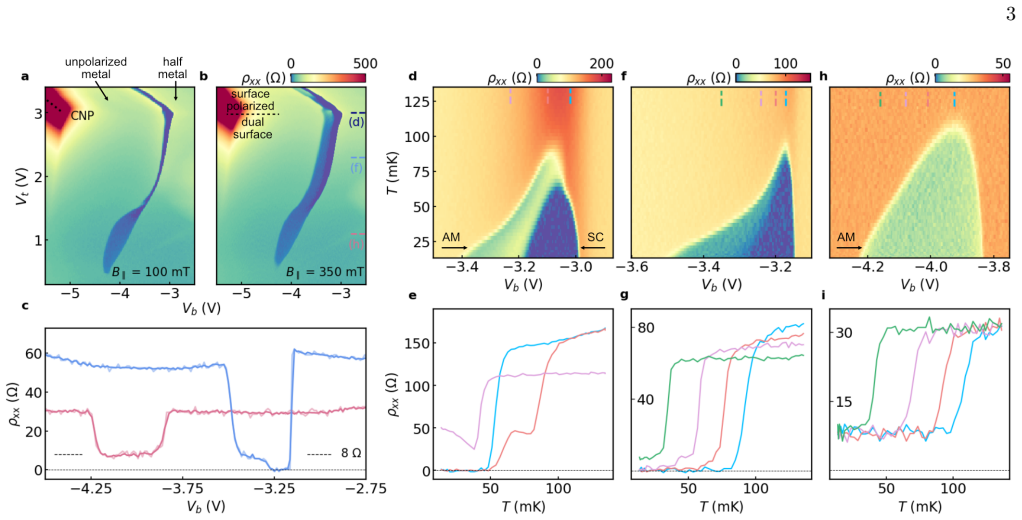
Rhombohedral graphene on WSe2 supports isolated gate-tuned pockets of zero-resistance superconductivity adjacent to pockets that exhibit essentially identical superconducting-like critical behavior in temperature, perpendicular field, and current yet saturate at finite low-temperature resistance; a small in-plane field merges the pockets into a contiguous region with an abrupt zero/finite-resistance boundary, and the finite-resistance state reproduces anomalous-metal phenomenology while remaining difficult to attribute to extrinsic noise or inhomogeneity.
What carries the argument
Gate-tuned SC and AM pockets in the (n, D) plane of dual-gated rhombohedral graphene, distinguished by whether low-T resistance reaches zero or saturates, and characterized by nested critical-current and critical-field domes whose characteristic perpendicular-field scales differ by roughly an order of magnitude.
Load-bearing premise
That stray high-frequency noise and mesoscopic inhomogeneity can be ruled out as the source of the finite saturation resistance, because neighboring zero- and finite-resistance pockets share similar critical temperatures at the same base temperature and because any normal strips should become dissipationless as temperature goes to zero.
What would settle it
A measurement showing that the finite-resistance pockets ultimately reach true zero resistance at still lower temperature or lower excitation, or a local probe that finds a reproducible ~30 nm superconducting texture whose size matches the anomalous-metal coherence length extracted from the perpendicular critical field.
If this is right
- Any viable theory of the anomalous metal must operate in a clean, highly conducting 2D metal whose normal-state resistance is far below the pair quantum.
- The order-of-magnitude difference in perpendicular critical field between adjacent SC and AM pockets implies distinct orbital or spin structure of the paired states rather than simple phase disorder of one condensate.
- The non-monotonic current response (moderate dc current sometimes restoring zero differential resistance) becomes a required signature that microscopic models must reproduce.
- Rhombohedral graphene supplies a continuously tunable platform in which the SC/AM boundary can be crossed by gate voltage, in-plane field, or temperature while holding other parameters fixed.
Where Pith is reading between the lines
- If the anomalous metal is a Bose metal of uncondensed pairs, stiffness or gap measurements should show finite pairing amplitude without long-range phase coherence precisely inside the finite-resistance pockets.
- The adjacency of the SC pocket to the half-metal and the AM pocket to the unpolarized metal suggests valley or spin polarization may tip the balance between coherent and fluctuating paired states.
- The same gate-space footprint appearing in a second, less homogeneous device implies the SC/AM distinction is set by band filling and displacement field rather than sample-specific disorder landscapes.
Editorial analysis
A structured set of objections, weighed in public.
Referee Report
Summary. The manuscript reports a systematic transport study of eight-layer rhombohedral graphene on WSe2, mapping isolated gate-tuned pockets that exhibit either true zero-resistance superconductivity (SC) or finite low-T resistance saturation (anomalous metal, AM). Both classes show sharp transitions versus T, B⊥, and Idc; a small in-plane field expands and merges the pockets while preserving a sharp SC/AM boundary at base temperature. The AM reproduces classic anomalous-metal phenomenology (finite saturation resistance, critical fields/currents) but with roughly an order-of-magnitude larger perpendicular critical field and a factor-of-four larger in-plane critical field than the adjacent SC, plus a non-monotonic current response. Multi-contact consistency and a second device reproduce the phase boundaries and hierarchy. The authors argue that extrinsic origins (noise, contacts, percolation, SNS domain walls) are strongly constrained, and that the platform’s cleanliness and tunability make it a useful setting for the long-standing anomalous-metal problem.
Significance. If the reported SC/AM adjacency, field hierarchy, and reproducibility hold, this is a substantial experimental contribution. Anomalous metals have been studied for decades without consensus; most prior systems are disordered thin films near RQ, whereas here the normal-state sheet conductivity reaches ~1000 e²/h in an ultra-clean, continuously gate-tunable platform. The ability to place zero-resistance SC and finite-resistance AM side-by-side under nearly identical external conditions, with distinct Bc scales and a non-monotonic Idc response, supplies concrete constraints that any microscopic theory must satisfy. Strengths include the multi-probe and two-device reproducibility, Landau-fan placement relative to half-metal vs unpolarized metal, BKT comparison, and an explicit Methods treatment of extrinsic alternatives. The work does not solve the microscopic origin of the AM, but it meaningfully reframes the problem in a cleaner setting.
major comments (2)
- [Methods; Discussion; Fig. 4] Methods, “Considerations of extrinsic origins of the finite resistance”: the argument that residual non-equilibrium excitation (e.g. stray photons) should affect adjacent SC and AM pockets comparably rests on their similar Tc as a proxy for pairing robustness. This sits in mild tension with the Discussion and Fig. 4, which conclude from the ~10× B⊥c and ~4× B∥c hierarchy that the paired states are “not identical in their orbital and/or spin structure.” If gap structure, DOS available for pair-breaking, or vortex pinning differ, external pair-breaking need not hit both pockets equally. Please either (i) qualify the similar-Tc argument explicitly in light of the distinct critical-field scales, or (ii) add a concrete control (e.g. excitation-amplitude / filtering dependence comparing SC vs AM at matched Tc) that closes this loophole. This does not overturn the phenomenology, but it is load-
- [Distinct magnetic field scales; Discussion] Main text and Methods on the AM orbital length ξ_AM ≈ 30 nm (from B⊥c ≈ 300 mT via ξ = √(Φ0/2πB⊥c)): the manuscript correctly notes that an inhomogeneous SC/normal texture of this scale cannot be fully excluded, and that simple percolation is hard to reconcile with multi-probe and two-device reproducibility. Given that this length is the main quantitative handle distinguishing AM from SC, the paper should state more clearly what future measurement (superfluid stiffness, gap spectroscopy, or real-space imaging) would falsify a ~30 nm electronic texture versus a homogeneous Bose-metal-like state. A short, explicit falsification criterion would strengthen the Discussion without requiring new data in this manuscript.
minor comments (6)
- [Fig. 1] Fig. 1a inset and device schematic: layer stack order is stated in Methods but a labeled cross-section in the main figure would help readers unfamiliar with the dual-graphite-gated WSe2 geometry.
- [Methods, BKT analysis; Extended Data Fig. 6] Extended Data Fig. 6 and Methods BKT analysis: the authors already note that BKT is of questionable validity for micron-scale samples. Consider moving that caveat into the main-text sentence that introduces the BKT comparison, so readers do not over-interpret α→3 in the SC pocket.
- [Methods; Figs. 2–4] Estimation of key superconducting parameters: the 90% normal-state resistance criterion for Tc and Bc is standard but should be stated once in the main text (or figure captions) where Tc ≈ 100 mK and the Bc hierarchy are quoted, not only in Methods.
- [Throughout] Typographical/spacing issues in the compiled text (e.g. “regionsappearasisolatedpockets”, “differenceintheirlow-temperatureresistance”, “superconductingstateisfullysuppressed”) should be cleaned in production; they do not affect substance but reduce readability.
- [Fig. 2] Fig. 2c: light vs dark traces (single vs averaged) are useful; a one-line note in the caption that averaging is over nine adjacent Vt would make the figure self-contained.
- [Discussion] References to related rhombohedral-graphene SC work are thorough; a brief pointer in the Discussion to how the present AM differs from finite-resistance reports in those works (beyond the WSe2 substrate) would help non-specialists.
Circularity Check
No significant circularity: experimental phenomenology with operational SC/AM labels and standard textbook estimates
full rationale
This is an experimental transport paper. The SC vs AM distinction is an operational classification (zero vs finite low-T saturation resistance) applied to measured ρxx(T,B,I,n,D), not a quantity derived from a model that is then re-predicted. Coherence-length estimates use the standard mean-field formula ξ=√(Φ0/2πB⊥c) on measured critical fields; Pauli-limit comparisons use the textbook BP≈1.25 kBTc/μB. Arguments against extrinsic origins (noise, contacts, percolation, SNS domain walls) are qualitative constraints from multi-probe and two-device reproducibility, not self-referential derivations. Prior self-citations document related rhombohedral-graphene superconductivity but do not supply uniqueness theorems or ansätze that force the present claims. No fitted input is relabeled a prediction, and no central result reduces to its inputs by construction. Score 0 is the appropriate honest finding.
Axiom & Free-Parameter Ledger
free parameters (4)
- Geometric factor W/L for resistivity conversion =
device geometry; few-percent uncertainty
- Gate capacitances Ct, Cb =
from QH fan slopes
- 90% normal-state resistance criterion for Tc and Bc =
90% threshold
- Residual B⊥ nulling at finite B∥ =
≲10 mT possible offset
axioms (6)
- domain assumption Vanishing four-terminal ρxx below noise, with critical T/B/I, indicates a superconducting state; finite low-T saturation with similar critical phenomenology indicates an anomalous metal.
- domain assumption Mean-field orbital scale ξ ≈ √(Φ0/2πB⊥c) meaningfully compares SC and AM paired states.
- domain assumption Standard dissipative/Caldeira-Leggett models predict quantum phase fluctuations are strongly suppressed when R□ ≪ RQ ≈ 6.45 kΩ.
- domain assumption In the clean BCS limit, normal-state coherence length ξN diverges as T→0, so wide SNS domain-wall junctions should become dissipationless rather than show extended resistance saturation.
- domain assumption Superconductivity in this n–D regime is likely spin-triplet (or otherwise protected), consistent with large Pauli-limit violation.
- domain assumption Four-terminal lock-in transport at 0.5–1 nA and base sensor T≈11–14 mK reflects electron temperature low enough to expose intrinsic saturation.
invented entities (1)
-
Anomalous-metal phase as a distinct neighboring state to SC in rhombohedral graphene (vs intermediate regime on a SIT)
no independent evidence
read the original abstract
Two-dimensional superconductivity is now well established in graphene-based systems, with many such realizations showing evidence for unconventional pairing. Yet in several of the gate-tuned phases that otherwise exhibit clear signatures of superconductivity, the resistance does not vanish as temperature is lowered, instead saturating at a finite value. Here we report a systematic study of this behavior in rhombohedral graphene on a WSe$_2$ substrate, finding regions of gate space with zero-resistance superconductivity alongside others with finite saturation resistance. At zero magnetic field, these regions appear as isolated pockets in gate space that otherwise exhibit strikingly similar phenomenology, including abrupt transitions to the normal state as temperature, perpendicular magnetic field, and current are raised above critical values. A small in-plane field expands and merges these pockets without qualitatively altering their behavior, producing a sharp boundary at millikelvin base temperature between states of zero or finite resistance. The finite-resistance state reproduces key phenomenology associated with the anomalous metal, a state that has been observed in thin-film superconductors for decades but lacks an accepted theoretical explanation. The tunability and reproducibility of ultra-clean rhombohedral graphene place strong constraints on extrinsic explanations and provide a new platform for understanding this behavior.
Figures



Reference graph
Works this paper leans on
-
[1]
Cao, Y.et al.Unconventional superconductivity in magic-angle graphene superlattices.Nature556, 43–50 (2018)
2018
-
[2]
& Young, A
Zhou, H., Xie, T., Taniguchi, T., Watanabe, K. & Young, A. F. Superconductivity in rhombohedral trilayer graphene.Nature598, 434–438 (2021)
2021
-
[3]
Zhou, H.et al.Isospin magnetism and spin-polarized superconductivity in bernal bilayer graphene.Science 375, 774–778 (2022)
2022
-
[4]
Zhang, Y.et al.Enhanced superconductivity in spin- orbit proximitized bilayer graphene.Nature613, 268– 273 (2023)
2023
-
[5]
Han, T.et al.Signatures of chiral superconductivity in rhombohedral graphene.Nature643, 654–661 (2025)
2025
-
[6]
Kumar, M.et al.Superconductivity from dual-surface carriers in rhombohedral graphene.arXiv:2507.18598 (2025)
Pith/arXiv arXiv 2025
-
[7]
& Doniach, S
Das, D. & Doniach, S. Existence of a Bose metal at T= 0.Physical Review B60, 1261 (1999)
1999
-
[8]
Kapitulnik, A., Kivelson, S. A. & Spivak, B. Colloquium: Anomalous metals: Failed superconductors.Reviews of Modern Physics91, 011002 (2019)
2019
-
[9]
Holleis, L.et al.Nematicity and orbital depairing in superconducting bernal bilayer graphene.Nature Physics 21, 444–450 (2025)
2025
-
[10]
Li, C.et al.Tunable superconductivity in electron- and hole-doped bernal bilayer graphene.Nature631, 300– 306 (2024)
2024
-
[11]
Yang, J.et al.Impact of spin-orbit coupling on supercon- ductivity in rhombohedral graphene.Nature Materials (2025)
2025
-
[12]
L.et al.Superconductivity and spin cant- ing in spin-orbit-coupled trilayer graphene.Nature641, 632–638 (2025)
Patterson, C. L.et al.Superconductivity and spin cant- ing in spin-orbit-coupled trilayer graphene.Nature641, 632–638 (2025)
2025
-
[13]
Zhang, Y.et al.Twist-programmable superconductivity in spin-orbit-coupled bilayer graphene.Nature641, 625– 631 (2025)
2025
-
[14]
Choi, Y.et al.Superconductivity and quantized anoma- lous hall effect in rhombohedral graphene.Nature639, 342–347 (2025). 10
2025
-
[15]
Morisette, E.et al.Superconductivity, anomalous hall effect, and stripe order in rhombohedral hexalayer graphene.arXiv:2504.05129(2025)
Pith/arXiv arXiv 2025
-
[16]
Nguyen, R.Q.et al.Ahierarchyofsuperconductivityand topological charge density wave states in rhombohedral graphene.arXiv:2507.22026(2025)
Pith/arXiv arXiv 2025
-
[17]
Deng, J.et al.Superconductivity and ferroelectric or- bital magnetism in semimetallic rhombohedral hexalayer graphene.arXiv:2508.15909(2025)
arXiv 2025
-
[18]
Seo, J.et al.Family of unconventional superconductivi- ties in crystalline graphene.arXiv:2509.03295(2025)
Pith/arXiv arXiv 2025
-
[19]
Yang, J.et al.Magnetic field-enhanced graphene superconductivity with record pauli-limit violation. arXiv:2510.10873(2025)
arXiv 2025
-
[20]
Kumar, M.et al.Pervasivespin-tripletsuperconductivity in rhombohedral graphene.arXiv:2511.16578(2025)
arXiv 2025
-
[21]
Guo, Y.et al.Flat band surface state superconductiv- ity in thick rhombohedral graphene.arXiv:2511.17423 (2025)
arXiv 2025
-
[22]
Xie, J.et al.Magnetic-field-driven insulator- superconductor transition in rhombohedral graphene. arXiv:2512.24306(2025)
arXiv 2025
-
[23]
Deng, J.et al.Magnetic-field-induced superconductivity in hexalayer rhombohedral graphene.arXiv:2603.13498 (2026)
arXiv 2026
-
[24]
E., Dynes, R
White, A. E., Dynes, R. C. & Garno, J. P. Destruction of superconductivity in quench-condensed two-dimensional films.Physical Review B33, 3549 (1986)
1986
-
[25]
M., Haviland, D
Jaeger, H. M., Haviland, D. B., Orr, B. G. & Goldman, A. M. Onset of superconductivity in ultrathin granular metal films.Physical Review B40, 182–196 (1989)
1989
-
[26]
Merchant, L., Ostrick, J., Barber, R. P., Jr. & Dynes, R. C. Crossover from phase fluctuation to amplitude- dominated superconductivity: A model system.Physical Review B63, 134508 (2001)
2001
-
[27]
Observation of quantum dissipation in the vortex state of a highly disordered superconducting thin film.Physical Review Letters76, 1529 (1996)
Ephron, D., Yazdani, A., Kapitulnik, A.&Beasley, M.R. Observation of quantum dissipation in the vortex state of a highly disordered superconducting thin film.Physical Review Letters76, 1529 (1996)
1996
-
[28]
& Kapitulnik, A
Mason, N. & Kapitulnik, A. True superconductivity in a two-dimensional superconducting-insulating system. Physical Review B64, 060504(R) (2001)
2001
-
[29]
Breznay, N. P. & Kapitulnik, A. Particle-hole symme- try reveals failed superconductivity in the metallic phase of two-dimensional superconducting films.Science Ad- vances3, e1700612 (2017)
2017
-
[30]
Garcia-Barriocanal, J.et al.Electronically driven superconductor-insulator transition in electrostatically doped La2CuO4+δ thin films.Physical Review B87, 024509 (2013)
2013
-
[31]
T.et al.Superconducting dome in a gate-tuned band insulator.Science338, 1193–1196 (2012)
Ye, J. T.et al.Superconducting dome in a gate-tuned band insulator.Science338, 1193–1196 (2012)
2012
-
[32]
& Nojima, T
Saito, Y., Kasahara, Y., Ye, J., Iwasa, Y. & Nojima, T. Metallic ground state in an ion-gated two-dimensional superconductor.Science350, 409–413 (2015)
2015
-
[33]
J.et al.Dissipation-driven superconductor- insulator transition in a two-dimensional Josephson- junction array.Physical Review Letters78, 2632 (1997)
Rimberg, A. J.et al.Dissipation-driven superconductor- insulator transition in a two-dimensional Josephson- junction array.Physical Review Letters78, 2632 (1997)
1997
-
[34]
Eley, S., Gopalakrishnan, S., Goldbart, P. M. & Ma- son, N. Approaching zero-temperature metallic states in mesoscopic superconductor-normal-superconductor ar- rays.Nature Physics8, 59–62 (2012)
2012
-
[35]
Han, Z.et al.Collapse of superconductivity in a hybrid tin-graphene Josephson junction array.Nature Physics 10, 380–386 (2014)
2014
-
[36]
Böttcher, C. G. L.et al.Superconducting, insulating and anomalous metallic regimes in a gated two-dimensional semiconductor-superconductor array.Nature Physics14, 1138–1144 (2018)
2018
-
[37]
Bøttcher, C. G. L., Nichele, F., Shabani, J., Palm- strøm, C. J. & Marcus, C. M. Berezinskii-kosterlitz- thouless transition and anomalous metallic phase in a hybrid josephson junction array.Physical Review B110, L180502 (2024)
2024
-
[38]
Sasmal, S.et al.Voltage-tunedanomalous-metaltometal transition in hybrid josephson junction arrays.Physical Review Letters135, 156301 (2025)
2025
-
[39]
B., Liu, Y
Haviland, D. B., Liu, Y. & Goldman, A. M. Onset of superconductivity in the two-dimensional limit.Phys. Rev. Lett.62, 2180–2183 (1989)
1989
-
[40]
& Kapitulnik, A
Yazdani, A. & Kapitulnik, A. Superconducting- insulating transition in two-dimensional a-MoGe thin films.Physical Review Letters74, 3037 (1995)
1995
-
[41]
& Kapitulnik, A
Mason, N. & Kapitulnik, A. Dissipation effects on the superconductor-insulator transition in 2D superconduc- tors.Physical Review Letters82, 5341 (1999)
1999
-
[42]
Chen, Z.et al.Carrier density and disorder tuned superconductor-metal transition in a two-dimensional electron system.Nature Communications9, 4008 (2018)
2018
-
[43]
Couëdo, F.et al.Dissipative phases across the superconductor-to-insulator transition.Scientific Re- ports6, 35834 (2016)
2016
-
[44]
& Dalidovich, D
Phillips, P. & Dalidovich, D. The elusive Bose metal. Science302, 243–247 (2003)
2003
-
[45]
Tamir, I.et al.Sensitivity of the superconducting state in thin films.Science Advances5, eaau3826 (2019)
2019
-
[46]
Sacépé, B., Feigel’man, M. V. & Klapwijk, T. M. Quan- tum breakdown of superconductivity in low-dimensional materials.Nature Physics16, 734–746 (2020)
2020
-
[47]
Aslamazov, L. G. & Larkin, A. I. The influence of fluctu- ation pairing of electrons on the conductivity of normal metal.Phys. Lett. A26, 238–239 (1968)
1968
-
[48]
& Varlamov, A.Theory of Fluctuations in Superconductors(Oxford University Press, 2005)
Larkin, A. & Varlamov, A.Theory of Fluctuations in Superconductors(Oxford University Press, 2005)
2005
-
[49]
Caldeira, A. O. & Leggett, A. J. Influence of dissipation on quantum tunneling in macroscopic systems.Phys. Rev. Lett.46, 211 (1981)
1981
-
[50]
Kapitulnik, A., Mason, N., Kivelson, S. A. & Chakravarty, S. Effects of dissipation on quantum phase transitions.Physical Review B63, 125322 (2001)
2001
-
[51]
& Kivelson, S
Spivak, B., Oreto, P. & Kivelson, S. A. Theory of quan- tum metal to superconductor transitions in highly con- ducting systems.Physical Review B77, 214523 (2008)
2008
-
[52]
Benyamini, A.et al.Fragility of the dissipationless state in clean two-dimensional superconductors.Nature Physics15, 947–953 (2019)
2019
-
[53]
Waters, D.et al.Chern insulators at integer and frac- tional filling in moiré pentalayer graphene.Phys. Rev. X 15, 011045 (2025)
2025
-
[54]
Li, H.et al.Electrode-free anodic oxidation nanolithog- raphy of low-dimensional materials.Nano Letters18, 8011–8015 (2018)
2018
-
[55]
Xia, L.-Q.et al.Magic continuum in multi-moiré twisted trilayer graphene.arXiv:2509.03583(2025)
Pith/arXiv arXiv 2025
-
[56]
Mahapatra, P. S.et al.Quantum criticality and tun- able griffiths phase in superconducting twisted trilayer graphene.arXiv:2507.10687(2025). 11 EXTENDED DATA Extended Data Fig. 1.Device image and reproduction of selected measurements across contact pairs. a, Optical micrograph of the device from the main text with the source, drain, and voltage probes lab...
arXiv 2025
discussion (0)
Sign in with ORCID, Apple, or X to comment. Anyone can read and Pith papers without signing in.