REVIEW 3 major objections 5 minor 3 cited by
Three-dimensional nature of anomalous Hall conductivity in YMn6Sn6-xGax, x ~ 0.55
T0 review · 3 major / 5 minor · reviewed 2026-08-12 · deepseek-v4-flash
Pith's one-line read The paper establishes that the intrinsic anomalous Hall conductivity in YMn6Sn5.45Ga0.55 is fully three-dimensional and comparable to TbMn6Sn6, ruling out 2D Chern gaps as its origin in the RMn6Sn6 family.
desk verdict The experimental case against 2D Chern-gap AHE in this kagome family is strong; the quantitative in-plane intrinsic value is weakened by an unvalidated fit and a large DFT mismatch. read the letter →
The pith
A machine-rendered reading of the paper's core claim, the machinery that carries it, and where it could break.
The reading
What carries the argument
The central device is the empirical scaling law $\sigma_{xy}=a\sigma_{xx}^2+d/\sigma_{xx}+c$, which extends the standard Berry-phase-plus-impurity scaling by adding a term that grows when $\sigma_{xx}$ is small, i.e., at high temperature. Fitting the measured Hall conductivity to this law partitions it into impurity scattering ($a\sigma_{xx}^2$), spin-fluctuation scattering ($d/\sigma_{xx}$), and an intrinsic part $c$ identified with the Berry-curvature integral. The second device is geometric: comparing the $B\parallel[001]$ configuration, in which a 2D Chern gap would contribute, with the $B\parallel[120]$ configuration, in which it cannot, converts the scaling fit into a dimensional test of the intrinsic AHC.
What would settle it
A first-principles calculation that includes explicit Ga disorder at the experimental composition and still predicts the in-plane intrinsic AHC far below the fitted 310 S/cm — the paper's own rigid-band estimate is 36.76 S/cm — would undercut the claim that the fitted in-plane value is intrinsic; if the discrepancy persists with disorder properly treated, the three-dimensionality conclusion is not supported by the data.
Extended reading notes
Core claim
The central claim is that, in YMn6Sn5.45Ga0.55, the intrinsic (Berry-curvature) contribution to the anomalous Hall conductivity is fully three-dimensional. Fitting the Hall conductivity over 1.8–300 K to $\sigma_{xy}=a\sigma_{xx}^2+d/\sigma_{xx}+c$ gives $c=121$ S/cm for $B\parallel[001]$, comparable to the TbMn6Sn6 value of 140 S/cm, and $c=310$ S/cm for $B\parallel[120]$. Because a 2D Chern gap, an energy gap in a two-dimensional band with a nonzero Chern number, would contribute only in the out-of-plane geometry, the large in-plane value shows that the Hall conductivity does not originate from those gaps. The nonzero fitted $d$ in a Tb-free compound is presented as confirmation that the extra $d/\sigma_{xx}$ term is a spin-fluctuation contribution universal to the RMn6Sn6 family.
Load-bearing premise
Everything rests on the empirically fitted three-term formula $\sigma_{xy}=a\sigma_{xx}^2+d/\sigma_{xx}+c$ being the true decomposition of the measured Hall conductivity; the 'intrinsic' values are fitted coefficients $c$, not directly measured quantities, and the paper gives no microscopic derivation of the $d$ term. If that decomposition is wrong, the comparison with TbMn6Sn6 and the 3D claim lose their quantitative footing.
Editorial extensions
If this is right
- If the decomposition is correct, the 2D Chern gap near 130 meV above the Fermi energy cannot be the source of the measured AHC, because the in-plane geometry does not couple to it yet gives a comparable or larger intrinsic value.
- The three-term scaling law should replace the two-term law when extracting intrinsic AHC from spin-fluctuating magnets; the two-term law would misattribute the high-temperature $d/\sigma_{xx}$ contribution.
- The nonzero fitted $d$ in YMn6Sn5.45Ga0.55, a compound without Tb, means the spin-fluctuation term is not tied to a specific rare earth and is expected throughout the RMn6Sn6 ferrimagnets.
- Ga substitution is a practical route to a saturable kagome ferromagnet whose in-plane and out-of-plane AHC can both be measured in a 9 T laboratory magnet, as opposed to TbMn6Sn6 whose in-plane saturation would require much higher fields.
- First-principles calculations for YMn6Sn6 reproduce the same 3D pattern—appreciable $\sigma_{xy}$ for out-of-plane magnetization and appreciable $\sigma_{yz}/\sigma_{zx}$ for in-plane magnetization—consistent with the experimental conclusion.
Reading between the lines
- Editorial inference: if the fitted $c$ values are true Berry-curvature contributions, the larger in-plane value (310 vs 121 S/cm) implies the dominant Berry-curvature hot spots are most active when the moment lies in the kagome planes; this could be checked with momentum-resolved Berry-curvature maps for in-plane magnetization.
- Editorial inference: the $d/\sigma_{xx}$ term is empirical and not microscopically derived here; a controlled test would tune the Mn moment fluctuation amplitude (by pressure, doping, or field) and check that the fitted $|d|$ tracks the fluctuation strength rather than the residual resistivity.
- Editorial inference: the same two-geometry protocol applied to a compound whose Fermi level genuinely sits in a 2D Chern gap should show a strong out-of-plane intrinsic AHC and a near-zero in-plane one; finding such a compound would sharpen the contrast the paper draws.
Signed reviews
Editorial analysis
A structured set of objections, weighed in public.
Referee Report
Summary. This manuscript reports a combined experimental and first-principles study of the ferromagnetic kagome compound YMn6Sn5.45Ga0.55. Single crystals are characterized by X-ray diffraction, magnetization, resistivity, angular magnetoresistance, and Hall-effect measurements in two field geometries (B||[001] and B||[120]). The anomalous Hall conductivity (AHC) is fitted to the empirical scaling law σxy = aσxx^2 + d/σxx + c, yielding intrinsic AHC values c = 121 S/cm (out-of-plane) and c = 310 S/cm (in-plane). DFT Berry-curvature calculations give σxy = 77.62 S/cm and σzx = 36.76 S/cm for the assumed hole doping. The authors conclude that the intrinsic AHC is three-dimensional and comparable in magnitude to TbMn6Sn6, and that the d/σxx term reflects spin fluctuations.
Significance. The paper addresses a topical debate: whether the anomalous Hall effect in RMn6Sn6 kagome magnets arises from 2D Chern gaps or from a bulk 3D Berry-curvature distribution. The experimental observation of a large in-plane AHC in a Tb-free compound is a direct and convincing falsification of a purely 2D Chern-gap origin, independent of any scaling analysis. The DFT AHC calculation is a state-of-the-art parameter-free integration of Berry curvature over a dense k mesh using Wannier interpolation, with Ueff fixed from earlier work. The paper also provides an independent test of the scaling law proposed in Ref. [12]. However, the quantitative intrinsic AHC values, especially the in-plane value, rest on an empirical three-parameter decomposition that is not yet adequately justified.
major comments (3)
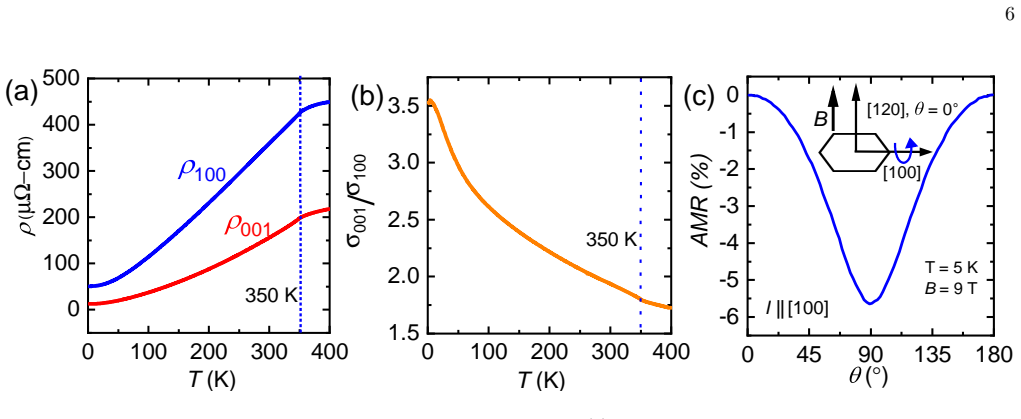
- [III.E, Table III, Eq. (2)] The central quantitative claim in the abstract—that the intrinsic AHC in YMn6Sn5.45Ga0.55 is comparable in magnitude to TbMn6Sn6 and is fully three-dimensional—relies on the fitted coefficient c in Eq. (2): c = 121 S/cm for B||[001] and c = 310 S/cm for B||[120] (Table III). No uncertainty estimates for a, d, or c are provided, and no alternative decomposition forms are tested. The in-plane fitted value is nearly an order of magnitude larger than the authors' own DFT value σzx = 36.76 S/cm (Sec. III.F, Fig. 8), and the brief caveat about rigid-band shifts does not quantify whether this discrepancy is consistent with the experimental c. Because this discrepancy directly affects the comparison to TbMn6Sn6 (140 S/cm), the manuscript needs either a robust statistical and systematic error analysis of the fit, or a reformulation of the quantitative claims.
- [III.E, Eq. (2)] The three-term scaling relation σxy = aσxx^2 + d/σxx + c is introduced as an empirical formula from Ref. [12]; the d/σxx term is attributed to spin fluctuations, but no microscopic derivation or independent verification is given in the present manuscript. The nonzero d observed in the Tb-free Y166-Ga is suggestive, but the manuscript does not analyze whether the magnitude and temperature dependence of d correlate with any spin-fluctuation measure, nor does it report goodness-of-fit statistics. Since this empirical relation is the only basis for extracting the intrinsic c values, its lack of a derivation or falsifiable test is a load-bearing assumption for the paper's quantitative conclusions.
- [III.D, III.E] The scaling law in Eq. (2) is written for a single longitudinal conductivity σxx, but the material is strongly anisotropic in transport: σ[001]/σ[100] > 2 over the whole temperature range (Sec. III.D, Fig. 3(b)). For the in-plane Hall geometry (B||[120], I||[100]), the Hall resistivity is converted to conductivity using σzx = -ρzx/(ρxxρzz), and the scaling plot in Fig. 6(c) uses the same σxx = 1/ρxx as in the out-of-plane case. The manuscript does not justify that the isotropic form of Eq. (2) remains valid for an anisotropic conductor, or that the appropriate longitudinal conductivity for the in-plane geometry is σxx rather than some combination of σxx and σzz. Without such a justification, the in-plane fitted c = 310 S/cm is not a reliable intrinsic AHC.
minor comments (5)
- [Section I] The text gives the composition as 'YMn6Sn6.45Ga0.55' in the sentence 'selected one particular composition YMn6Sn6.45Ga0.55 for the study'; this should be 'YMn6Sn5.45Ga0.55' to match the abstract and the rest of the paper.
- [Section III.E and Fig. 6] The Hall conductivity component is denoted inconsistently; the text defines σzx (and Table III uses |σxz|), while the caption of Fig. 6 labels it |σA_xz|. Please use a single convention throughout.
- [Section III.E] The statement 'σxx = 1/ρxx' is imprecise; in the in-plane geometry the longitudinal resistivity is ρxx but the Hall-conductivity conversion uses both ρxx and ρzz, so the notation should distinguish the tensor components.
- [Fig. 4 caption] The calculation is described as performed for 'YMn6Sn5Ga', but the experimental composition is YMn6Sn5.45Ga0.55; please clarify whether the calculation uses an ordered x=1 model and whether this is intended.
- [Section IV] The conclusion contains a duplicated word: 'may be important for not only for the large family' should read 'for not only the large family'.
Circularity Check
No significant circularity: the scaling relation is tested on new data, and the 3D claim is independently supported by direct in-plane Hall measurements and first-principles Berry-curvature calculations.
full rationale
The paper's central claims are not circular. Equation (2), sigma_xy = a sigma_xx^2 + d/sigma_xx + c, was proposed in the authors' prior work [12], but here it is applied to a new compound, YMn6Sn5.45Ga0.55, with independently measured transport data. Fitting this equation to new data and finding that it works is an external test of the phenomenological form, not a self-citation bootstrap. The fitted coefficient c is labeled the intrinsic AHC, but that identification follows from the prior Crépieux-Bruno framework and is not defined in terms of the conclusion being drawn. The 'fully three-dimensional' claim rests on direct observation of a large anomalous Hall signal in the in-plane geometry (Fig. 6) and on DFT calculations that yield nonzero in-plane AHC components by integrating Berry curvature (Eq. 4, Fig. 8); the DFT and experiment are independent lines of evidence. The quantitative discrepancy for sigma_zx (36.76 S/cm calculated vs. 310 S/cm fitted) is acknowledged, which shows the comparison is not forced. The only hand-set parameter, U_eff = 0.6, was fixed in earlier work on YMn6Sn6, not fitted to the target AHC values. No equation in the paper reduces to another by construction, no fitted parameter is renamed as an independent prediction, and no load-bearing conclusion is imported solely from a self-citation. The paper is self-contained against external structural, magnetic, transport, and DFT benchmarks; the scaling-law concern is a question of model validity, not circularity.
Assumptions & free parameters
free parameters (7)
- intrinsic AHC c (out-of-plane B) =
121 S/cm
- intrinsic AHC c (in-plane B) =
310 S/cm
- impurity-scattering coefficient a =
3.25e-8 S/cm (out-of-plane), 1.89e-7 S/cm (in-plane)
- spin-fluctuation coefficient d =
-1.75e5 S^2/cm^2 (out-of-plane), -5.41e5 S^2/cm^2 (in-plane)
- U_eff for DFT =
0, 0.6, and 2 eV
- Fermi-energy shift for Ga doping =
-0.037 eV
- Exchange couplings J1, J2, J3 =
e.g., J1 = -11.9 meV, J2 = -10.6 meV, J3 = 1.5 meV for U_eff = 0.6
assumptions (5)
- ad hoc to paper The empirical scaling relation Eq. 2 (sigma_xy = a sigma_xx^2 + d/sigma_xx + c) is the correct decomposition of the measured anomalous Hall conductivity.
- domain assumption The measured transverse resistivity rho_zx in the in-plane geometry is an intrinsic anomalous Hall response and is adequately described by sigma_zx = -rho_zx/(rho_xx rho_zz).
- domain assumption Kohn-Sham DFT with PBE+U and the Wannier-interpolated tight-binding Hamiltonian accurately describes the electronic structure and Berry curvature of these compounds.
- domain assumption The J1-J3 spin Hamiltonian Eq. 3 with exchange couplings fitted to DFT total energies captures the magnetic ground states.
- domain assumption Rigid-band approximation: Ga substitution only shifts the Fermi energy by -0.037 eV without changing the band structure.
Cite this review
Pith. "Pith review of Three-dimensional nature of anomalous Hall conductivity in YMn6Sn6-xGax, x ~ 0.55." pith.science (2026). https://pith.science/paper/BBZIOMCD
@misc{pith2026241112134,
  author       = {Pith},
  title        = {Pith review of: Three-dimensional nature of anomalous Hall conductivity in YMn6Sn6-xGax, x ~ 0.55},
  year         = {2026},
  howpublished = {\url{https://pith.science/paper/BBZIOMCD}},
  note         = {Machine review of arXiv:2411.12134}
}
abstract
The unique connectivity of kagome lattices gives rise to topological properties, such as flat bands and Dirac cones. When combined with ferromagnetism and a chemical potential near the 2D Dirac points, this structure offers the potential to realize the highly sought-after topological Chern magnetotransport. Recently, there was considerable excitement surrounding this possibility in the ferrimagnetic kagome metal TbMn$_\mathbf{6}$Sn$_\mathbf{6}$. However, density functional theory (DFT) calculations reveal that the 2D Chern gap lies well above the Fermi energy, challenging its relevance in the observed anomalous Hall conductivity. Here, we investigate YMn$_\mathbf{6}$Sn$_\mathbf{5.45}$Ga$_\mathbf{0.55}$, a compound with similar crystallographic, magnetic, and electronic properties to TbMn$_\mathbf{6}$Sn$_\mathbf{6}$. Our findings show that the intrinsic anomalous Hall conductivity in this material, while comparable in magnitude to that in TbMn$_\mathbf{6}$Sn$_\mathbf{6}$, is fully three-dimensional, thus providing experimental evidence that Hall conductivity in this class of materials does not originate from 2D Chern gaps. Additionally, we confirm that the newly proposed empirical scaling relation for extrinsic Hall conductivity is universally governed by spin fluctuations.
Figures


Figures from the paper (5 more)


Forward citations
Cited by 3 Pith papers
-
Room temperature quantum metric effect in TbMn6Sn6
TbMn6Sn6 shows strong, field-tunable second-harmonic transport at room temperature, attributed to the quantum metric dipole and Berry curvature dipole.
-
Giant coercivity and enhanced intrinsic anomalous Hall effect at vanishing magnetization in a compensated kagome ferrimagnet
Adding chromium to TbMn6Sn6 produces a near-zero net moment, a coercive field above 14 T, and an increased intrinsic anomalous Hall effect tied to a Fermi-level shift.
-
Doping-induced Spin Reorientation in Kagome Magnet TmMn6Sn6
Gallium doping gradually reorients magnetism in TmMn6Sn6 from easy-plane to easy-axis, with the reorientation temperature rising until it merges with the magnetic ordering temperature near x=2.
Reference graph
Works this paper leans on
-
[1]
Z.-Y. Zhang, Quantum Hall effect in kagom´ e lattices un- der staggered magnetic field, Journal of Physics: Con- densed Matter 23, 425801 (2011)
work page 2011
-
[12]
D. C. Jones, S. Das, H. Bhandari, X. Liu, P. Siegfried, M. P. Ghimire, S. S. Tsirkin, I. I. Mazin, and N. J. Ghimire, Origin of spin reorientation and intrin- sic anomalous Hall effect in the kagome ferrimagnet 10 TbMn6Sn6, Phys. Rev. B 110, 115134 (2024)
work page 2024
-
[2]
N. J. Ghimire and I. I. Mazin, Topology and correlations on the kagome lattice, Nature Materials 19, 137 (2020)
2020
-
[3]
M. Kang, L. Ye, S. Fang, J.-S. You, A. Levitan, M. Han, J. I. Facio, C. Jozwiak, A. Bostwick, E. Rotenberg, et al., Dirac fermions and flat bands in the ideal kagome metal FeSn, Nature materials 19, 163 (2020)
work page 2020
-
[4]
L. Ye, M. Kang, J. Liu, F. Von Cube, C. R. Wicker, T. Suzuki, C. Jozwiak, A. Bostwick, E. Rotenberg, D. C. Bell, et al., Massive Dirac fermions in a ferromagnetic kagome metal, Nature 555, 638 (2018)
work page 2018
-
[5]
J.-X. Yin, S. S. Zhang, G. Chang, Q. Wang, S. S. Tsirkin, Z. Guguchia, B. Lian, H. Zhou, K. Jiang, I. Belopol- ski, et al., Negative flat band magnetism in a spin–orbit- coupled correlated kagome magnet, Nature Physics 15, 443 (2019)
2019
- [6]
-
[7]
I. I. Mazin, H. O. Jeschke, F. Lechermann, H. Lee, M. Fink, R. Thomale, and R. Valent ´ ı, Theoretical predic- tion of a strongly correlated Dirac metal, Nature Com- munications 5, 4261 (2014)
work page 2014
Show all 54 references
-
[8]
Bolens and N
A. Bolens and N. Nagaosa, Topological states on the breathing kagome lattice, Physical Review B 99, 165141 (2019)
2019
-
[9]
Asaba, S
T. Asaba, S. M. Thomas, M. Curtis, J. D. Thompson, E. D. Bauer, and F. Ronning, Anomalous Hall effect in the kagome ferrimagnet GdMn 6Sn6, Physical Review B 101, 174415 (2020)
2020
-
[10]
Bhandari, R
H. Bhandari, R. L. Dally, P. E. Siegfried, R. B. Regmi, K. C. Rule, S. Chi, J. W. Lynn, I. Mazin, and N. J. Ghimire, Magnetism and fermiology of kagome magnet YMn6Sn4Ge2, npj Quantum Materials 9, 6 (2024)
2024
-
[11]
Pokharel, S
G. Pokharel, S. M. Teicher, B. R. Ortiz, P. M. Sarte, G. Wu, S. Peng, J. He, R. Seshadri, and S. D. Wilson, Electronic properties of the topological kagome metals YV6Sn6 and GdV 6Sn6, Physical Review B 104, 235139 (2021)
2021
-
[13]
Pokharel, B
G. Pokharel, B. Ortiz, J. Chamorro, P. Sarte, L. Kautzsch, G. Wu, J. Ruff, and S. D. Wilson, Highly anisotropic magnetism in the vanadium-based kagome metal TbV 6Sn6, Physical Review Materials 6, 104202 (2022)
2022
-
[14]
H. W. S. Arachchige, W. R. Meier, M. Marshall, T. Mat- suoka, R. Xue, M. A. McGuire, R. P. Hermann, H. Cao, and D. Mandrus, Charge Density Wave in Kagome Lat- tice Intermetallic ScV6Sn6, Physical Review Letters 129, 216402 (2022)
2022
-
[15]
Riberolles, T
S. Riberolles, T. J. Slade, R. Dally, P. Sarte, B. Li, T. Han, H. Lane, C. Stock, H. Bhandari, N. Ghimire, et al., Orbital character of the spin-reorientation tran- sition in TbMn 6Sn6, Nature Communications 14, 2658 (2023)
2023
-
[16]
Y. Lee, R. Skomski, X. Wang, P. P. Orth, Y. Ren, B. Kang, A. K. Pathak, A. Kutepov, B. N. Harmon, R. J. McQueeney, I. I. Mazin, and L. Ke, Interplay between magnetism and band topology in the kagome magnets RMn6Sn6, Phys. Rev. B 108, 045132 (2023)
2023
-
[17]
N. J. Ghimire, R. L. Dally, L. Poudel, D. Jones, D. Michel, N. T. Magar, M. Bleuel, M. A. McGuire, J. Jiang, J. Mitchell, et al., Competing magnetic phases and fluctuation-driven scalar spin chirality in the kagome metal YMn6Sn6, Science Advances 6, eabe2680 (2020)
2020
-
[18]
Q. Wang, K. J. Neubauer, C. Duan, Q. Yin, S. Fujitsu, H. Hosono, F. Ye, R. Zhang, S. Chi, K. Krycka, et al., Field-induced topological Hall effect and double-fan spin structure with a c-axis component in the metallic kagome antiferromagnetic compound YMn6Sn6, Physical Review B...
2021
-
[19]
P. E. Siegfried, H. Bhandari, D. C. Jones, M. P. Ghimire, R. L. Dally, L. Poudel, M. Bleuel, J. W. Lynn, I. I. Mazin, and N. J. Ghimire, Magnetization-driven Lifshitz transition and charge-spin coupling in the kagome metal YMn6Sn6, Communications Physics 5, 1 (2022)
2022
-
[20]
J.-X. Yin, W. Ma, T. A. Cochran, X. Xu, S. S. Zhang, H.-J. Tien, N. Shumiya, G. Cheng, K. Jiang, B. Lian, et al., Quantum-limit Chern topological magnetism in TbMn6Sn6, Nature 583, 533 (2020)
2020
-
[21]
Riberolles, T
S. Riberolles, T. J. Slade, D. Abernathy, G. Granroth, B. Li, Y. Lee, P. Canfield, B. G. Ueland, L. Ke, and R. J. McQueeney, Low-Temperature Competing Magnetic En- ergy Scales in the Topological Ferrimagnet TbMn 6Sn6, Physical Review X 12, 021043 (2022)
2022
-
[22]
Mielke III, W
C. Mielke III, W. Ma, V. Pomjakushin, O. Zaharko, S. Sturniolo, X. Liu, V. Ukleev, J. White, J.-X. Yin, S. Tsirkin, et al., Low-temperature magnetic crossover in the topological kagome magnet TbMn 6Sn6, Commu- nications Physics 5, 107 (2022)
2022
-
[23]
Z. Li, Q. Yin, Y. Jiang, Z. Zhu, Y. Gao, S. Wang, J. Shen, T. Zhao, J. Cai, H. Lei, et al., Discovery of Topologi- cal Magnetic Textures near Room Temperature in Quan- tum Magnet TbMn 6Sn6, Advanced Materials , 2211164 (2023)
2023
-
[24]
Xu, J.-X
X. Xu, J.-X. Yin, W. Ma, H.-J. Tien, X.-B. Qiang, P. S. Reddy, H. Zhou, J. Shen, H.-Z. Lu, T.-R. Chang, et al. , Topological charge-entropy scaling in kagome Chern magnet TbMn 6Sn6, Nature communications 13, 1197 (2022)
2022
-
[25]
L. Gao, S. Shen, Q. Wang, W. Shi, Y. Zhao, C. Li, W. Cao, C. Pei, J.-Y. Ge, G. Li, et al., Anomalous Hall effect in ferrimagnetic metal RMn 6Sn6 (R= Tb, Dy, Ho) with clean Mn kagome lattice, Applied Physics Letters 119 (2021)
2021
-
[26]
Wenzel, A
M. Wenzel, A. A. Tsirlin, O. Iakutkina, Q. Yin, H. C. Lei, M. Dressel, and E. Uykur, Effect of magnetism and phonons on localized carriers in the ferrimagnetic kagome metals GdMn 6Sn6 and TbMn 6Sn6, Phys. Rev. B 106, L241108 (2022)
2022
-
[27]
Zhang, J
H. Zhang, J. Koo, C. Xu, M. Sretenovic, B. Yan, and X. Ke, Exchange-biased topological transverse thermo- electric effects in a Kagome ferrimagnet, Nature commu- nications 13, 1091 (2022)
2022
-
[28]
Cr´ epieux and P
A. Cr´ epieux and P. Bruno, Theory of the anomalous Hall effect from the Kubo formula and the Dirac equation, Phys. Rev. B 64, 014416 (2001)
2001
-
[29]
Y. Tian, L. Ye, and X. Jin, Proper Scaling of the Anoma- lous Hall Effect, Phys. Rev. Lett. 103, 087206 (2009)
2009
-
[30]
V. L. Grigoryan, J. Xiao, X. Wang, and K. Xia, Anoma- lous Hall effect scaling in ferromagnetic thin films, Phys. Rev. B 96, 144426 (2017)
2017
-
[31]
C. Xu, T. Heitmann, H. Zhang, X. Xu, and X. Ke, Mag- netic phase transition, magnetoresistance, and anoma- lous Hall effect in Ga-substituted YMn 6Sn6 with a ferro- magnetic kagome lattice, Physical Review B 104, 024413 (2021)
2021
-
[32]
Bruker AXS, APEX-4, Bruker AXS, Madison, Wiscon- sin, USA (2021)
2021
-
[33]
Krause, R
L. Krause, R. Herbst-Irmer, G. M. Sheldrick, and D. Stalke, Comparison of silver and molybdenum micro- focus X-ray sources for single-crystal structure determi- nation, Journal of applied crystallography 48, 3 (2015)
2015
-
[34]
G. M. Sheldrick, Shelxt–integrated space-group and crystal-structure determination, Acta Crystallographica Section A: Foundations and Advances 71, 3 (2015)
2015
-
[35]
G. M. Sheldrick, Crystal structure refinement with shelxl, Acta Crystallographica Section C: Structural Chemistry 71, 3 (2015)
2015
-
[36]
Kresse and J
G. Kresse and J. Furthm¨ uller, Efficient iterative schemes for ab initio total-energy calculations using a plane-wave basis set, Phys. Rev. B 54, 11169 (1996)
1996
-
[37]
P. E. Bl¨ ochl, Projector augmented-wave method, Phys. Rev. B 50, 17953 (1994)
1994
-
[38]
Kresse and D
G. Kresse and D. Joubert, From ultrasoft pseudopoten- tials to the projector augmented-wave method, Phys. Rev. B 59, 1758 (1999)
1999
-
[39]
J. P. Perdew, K. Burke, and M. Ernzerhof, Generalized Gradient Approximation Made Simple, Phys. Rev. Lett. 77, 3865 (1996)
1996
-
[40]
V. I. Anisimov and O. Gunnarsson, Density-functional calculation of effective Coulomb interactions in metals, Phys. Rev. B 43, 7570 (1991)
1991
-
[41]
Zhang, P
S.-y. Zhang, P. Zhao, Z.-h. Cheng, R.-w. Li, J.-r. Sun, H.-w. Zhang, and B.-g. Shen, Magnetism and giant mag- netoresistance of YMn6Sn6−xGax (x= 0-1.8) compounds, Physical Review B 64, 212404 (2001)
2001
-
[42]
R. L. Dally, J. W. Lynn, N. J. Ghimire, D. Michel, P. Siegfried, and I. I. Mazin, Chiral properties of the zero-field spiral state and field-induced magnetic phases of the itinerant kagome metal YMn6Sn6, Physical Review B 103, 094413 (2021)
2021
-
[43]
B. C. E. Idrissi, G. Venturini, and B. Malaman, Magnetic structures of TbMn6Sn6 and HoMn6Sn6 compounds from neutron diffraction study, Journal of the Less Common Metals 175, 143 (1991)
1991
-
[44]
Rosenfeld and N
E. Rosenfeld and N. Mushnikov, Double-flat-spiral mag- 11 netic structures: Theory and application to the RMn 6X6 compounds, Physica B: Condensed Matter 403, 1898 (2008)
2008
-
[45]
Blaha, K
P. Blaha, K. Schwarz, G. K. H. Madsen, D. Kvasnicka, and J. Luitz, WIEN2K (2002), ISBN 3-9501031-1-2
2002
-
[46]
Zhang, J
H. Zhang, J. Koo, C. Xu, M. Sretenovic, B. Yan, and X. Ke, Exchange-biased topological transverse thermo- electric effects in a Kagome ferrimagnet, Nature Com- munications 13, 1091 (2022)
2022
-
[47]
M. Li, Q. Wang, G. Wang, Z. Yuan, W. Song, R. Lou, Z. Liu, Y. Huang, Z. Liu, H. Lei, et al., Dirac cone, flat band and saddle point in kagome magnet YMn 6Sn6, Na- ture communications 12, 1 (2021)
2021
-
[48]
Kimura, A
S. Kimura, A. Matsuo, S. Yoshii, K. Kindo, L. Zhang, E. Br¨ uck, K. Buschow, F. De Boer, C. Lef` evre, and G. Venturini, High-field magnetization of RMn6Sn6 com- pounds with R= Gd, Tb, Dy and Ho, Journal of alloys and compounds 408, 169 (2006)
2006
-
[49]
X. Wang, J. R. Yates, I. Souza, and D. Vanderbilt, Ab initio calculation of the anomalous Hall conductivity by Wannier interpolation, Physical Review B 74, 195118 (2006)
2006
-
[50]
Ke, Intersublattice magnetocrystalline anisotropy us- ing a realistic tight-binding method based on maxi- mally localized Wannier functions, Physical Review B99, 054418 (2019)
L. Ke, Intersublattice magnetocrystalline anisotropy us- ing a realistic tight-binding method based on maxi- mally localized Wannier functions, Physical Review B99, 054418 (2019)
2019
-
[51]
Marzari and D
N. Marzari and D. Vanderbilt, Maximally localized gen- eralized Wannier functions for composite energy bands, Physical review B 56, 12847 (1997)
1997
-
[52]
Souza, N
I. Souza, N. Marzari, and D. Vanderbilt, Maximally lo- calized Wannier functions for entangled energy bands, Physical Review B 65, 035109 (2001)
2001
-
[53]
Marzari, A
N. Marzari, A. A. Mostofi, J. R. Yates, I. Souza, and D. Vanderbilt, Maximally localized Wannier functions: Theory and applications, Reviews of Modern Physics 84, 1419 (2012)
2012
-
[54]
A. A. Mostofi, J. R. Yates, G. Pizzi, Y.-S. Lee, I. Souza, D. Vanderbilt, and N. Marzari, An updated version of wannier90: A tool for obtaining maximally-localised Wannier functions, Computer Physics Communications 185, 2309 (2014)
2014
Reviewed August 12, 2026 · model on record in the stance chip above.
Discussion (0). Continue with ORCID to comment.