REVIEW 3 major objections 4 minor 2 references
FlatCAD: Fast Curvature Regularization of Neural SDFs for CAD Models
T0 review · 3 major / 4 minor · reviewed 2026-08-15 · deepseek-v4-flash
Pith's one-line read Penalizing only the off-diagonal Weingarten term of a neural SDF's shape operator is claimed to match full-Hessian curvature regularization on CAD shapes while halving memory and training time.
desk verdict FlatCAD's curvature-gap regularizer is not a true developability prior—it penalizes cylinders—but the finite-difference variant is fast, the math is correct, and the empirical parity mostly holds; the abstract oversells ODW-AD. read the letter →
The pith
A machine-rendered reading of the paper's core claim, the machinery that carries it, and where it could break.
The reading
What carries the argument
The load-bearing object is the off-diagonal Weingarten entry $S_{12}$, the mixed second derivative of the SDF projected onto a randomly rotated orthonormal tangent frame; it measures the gap between the two principal curvatures. Penalizing $|S_{12}|$ drives $\kappa_1$ and $\kappa_2$ together without ever building the full Hessian. The finite-difference route uses the symmetric stencil $D^{(c)}_{uv} = \tfrac12(D^{(+)}_{uv} + D^{(-)}_{uv}) = u^\top H_f v + O(h^2)$, costing six SDF evaluations plus one gradient, while the auto-diff route computes $u^\top H_f v$ exactly in two reverse-mode sweeps. The Eikonal constraint is what ties these expressions to the shape operator: since $\|\nabla f\| \approx 1$, dividing by the gradient norm is optional, and the Hessian deficiency $n^\top H_f n = 0$ on the surface motivates evaluating the loss on a near-surface shell rather than exactly on the zero level set.
What would settle it
A direct test: train the same ODW-FD pipeline with $\lambda_{\text{ODW}} = 10$ on a point cloud of a triaxial ellipsoid. If the reconstructed surface's principal-curvature ratio moves toward 1 and the Chamfer distance rises relative to the same pipeline without the ODW term, then the loss deforms non-spherical doubly-curved geometry, confirming that the piecewise-developability prior is the load-bearing assumption.
Extended reading notes
Core claim
The paper's central claim is that minimizing the off-diagonal Weingarten entry $S_{12}$ of the shape operator is sufficient curvature regularization for CAD reconstruction, and that this term can be evaluated without assembling the $3\times 3$ Hessian. In a tangent frame rotated by angle $\theta$, the off-diagonal entry satisfies $S_{12}(\theta) = \tfrac12(\kappa_2-\kappa_1)\sin 2\theta$, so its expectation over random frame rotations satisfies $\mathbb{E}_\theta[S_{12}^2] = \tfrac18(\kappa_2-\kappa_1)^2$, which vanishes exactly when the principal curvatures coincide. The paper derives a maximum-likelihood interpretation for the squared loss under Gaussian noise and for the absolute-value loss under Laplace noise, and ends up using $|S_{12}|$ for stable SIREN training. Two implementations are proposed: a finite-difference version using six extra SDF evaluations plus one gradient, with symmetric averaging giving $O(h^2)$ truncation error, and an auto-diff version using one Hessian-vector product. On the ABC benchmarks, the finite-difference variant achieves Chamfer distance 3.84 versus 3.92 on the 1 MB subset and 4.93 versus 4.99 on the 5 MB subset, with convergence time 170.54 s versus 334.10 s and GPU memory 3.70 GB versus 6.16 GB against the Hessian-based baseline.
Load-bearing premise
The method assumes that the target geometry is mostly piecewise-developable, so driving the two principal curvatures together flattens patches instead of deforming them; on legitimately doubly-curved non-spherical surfaces, only the data term stops the regularizer from pushing the shape toward planes or spheres.
Editorial extensions
If this is right
- If the claim is correct, curvature-aware SDF training can run at roughly half the GPU memory and half the convergence time of full Gaussian-curvature regularization, enabling larger batches and higher-resolution reconstructions.
- The finite-difference variant makes curvature regularization usable when second-order automatic differentiation is unavailable or too expensive, since it needs only forward evaluations and one gradient.
- The loss is drop-in for existing SIREN-based reconstruction pipelines because it does not change the data terms or the network architecture.
- Sparse and incomplete inputs degrade gracefully: the paper reports that 10k and 5k point clouds reconstruct comparably to the full 30k input, and a missing region increases Chamfer distance by 64% while preserving global topology.
- On non-CAD organic shapes the regularizer still produces smooth, topologically coherent surfaces, with the expected side effect that fine details are partially smoothed away.
Reading between the lines
- Because the derivation does not depend on sine activations, the same curvature-gap proxy should transfer to other implicit representations, such as hash-grid or Fourier-feature fields, where a six-point stencil is particularly attractive.
- The loss's purely local character suggests a spatially adaptive weight: a learned or locally estimated $\lambda_{\text{ODW}}$ could flatten planar zones while leaving doubly-curved bosses untouched, directly addressing the ellipsoid-distortion limitation the paper itself acknowledges.
- The identity $\mathbb{E}_\theta[S_{12}^2] \propto (\kappa_2-\kappa_1)^2$ could be reused as a cheap test-time developability diagnostic for a reconstructed neural surface, not just as a training objective.
- Combining the ODW loss with a long-range fairness term, such as a parallel-face constraint, could fix the paper's noted failure to keep opposite faces of thin sheets parallel.
Signed reviews
Editorial analysis
A structured set of objections, weighed in public.
Referee Report
Summary. FlatCAD proposes a curvature regularizer for neural signed-distance fields based on the off-diagonal entry S12 of the Weingarten map. The paper derives E[S12^2] = (1/8)(kappa1-kappa2)^2, gives a maximum-likelihood interpretation for the squared and absolute losses, and presents two computational routes: a symmetric finite-difference stencil using six additional SDF evaluations and an auto-diff route using one Hessian-vector product. On two 100-shape subsets of the ABC dataset, the finite-difference variant (ODW-FD) reaches Chamfer distances close to or slightly better than the NeurCADRecon baseline (3.84 vs 3.92 on the 1 MB set, 4.93 vs 4.99 on the 5 MB set) while roughly halving convergence time and GPU memory. The auto-diff variant (ODW-AD) is clearly behind NeurCADRecon on most metrics. The mathematical derivation is sound and the efficiency measurements are plausible, but the geometric interpretation of the loss as a developability regularizer is questionable and needs to be reexamined.
Significance. If the central claims are confirmed for the finite-difference variant, the paper offers a genuinely practical efficiency improvement: it avoids full Hessian assembly, roughly halves memory and convergence time on a standard CAD benchmark, ships with public code, and is drop-in for SIREN-based reconstruction. Credit should be given for the clean derivation of Eq. (2), the O(h^2) stencil analysis, the explicit comparison against three baselines, and the reproducible experimental setup. However, the contribution is framed as 'CAD-style developability' regularization, which is not the actual zero set of the loss: L_ODW penalizes kappa1-kappa2, not Gaussian curvature, and therefore penalizes cylinders and cones. This mismatch between the geometric claim and the loss definition is load-bearing for the paper's motivation. The aggregate ABC results also do not support the claim that 'the losses' (plural) match or exceed the baselines, because ODW-AD does not on the 1 MB subset. The paper is best served by a major revision that either supplies per-shape evidence that curved developable primitives are not deformed, or reframes the contribution as curvature-gap regularization.
major comments (3)
- [Sections 3.2 and 6] Equation (2) shows that L_ODW vanishes iff kappa1 = kappa2, i.e., at planar and umbilic (spherical) points, not on general developable surfaces. A cylinder or cone has K = 0 but |kappa1 - kappa2| = 1/r > 0, so the loss actively penalizes the most common curved CAD primitives. Section 6 explicitly concedes this: 'it assigns a non-zero penalty to developable but curved primitives such as cylinders and cones.' This is load-bearing because the abstract and Section 1 describe the method as enforcing 'CAD-style developability', and the comparison baseline NeurCADRecon penalizes |K|, which does not penalize cylinders or cones. The aggregate parity in Table 7 therefore needs per-shape evidence that ODW does not systematically deform cylindrical and conical patches. This concern is reinforced by the ablation in Table 4: raising lambda_ODW from 10 to 100 increases CD from 0.0024900 to 0.0035313, a relative degradation of about 40%. The paper should either provide the requested per-shape analysis or reframe the contribution as curvature-gap regularization rather than developability.
- [Table 7 and Section 5.6] The abstract's claim that 'the losses match or exceed Hessian-based baselines' is not supported for both variants. On the 1 MB set, ODW-AD is worse than NeurCADRecon on every metric (CD 4.59 vs 3.92, NC 93.79 vs 95.43, F1 83.80 vs 87.74); on the 5 MB set, ODW-AD is worse on CD and F1 (5.27 vs 4.99 and 86.82 vs 88.29). Only ODW-FD attains parity on CD, and even ODW-FD trails NCR slightly on NC and F1 in both subsets. Section 5.6 states that 'both Weingarten variants deliver reconstructions that are either on par with or superior to NCR,' which is contradicted by the table. The accuracy claim should be restricted to ODW-FD or the two variants should be analyzed separately rather than jointly.
- [Section 4.1 and Table 7] The finite-difference step h is the one free parameter of the variant that achieves parity, yet no value is reported in the text or in the experimental section. Without h, the O(h^2) approximation in Eq. (10) cannot be reproduced, and the reported CD numbers for ODW-FD are not fully specified. Please report the chosen h and include a short sensitivity study around it, since the stencil accuracy and the final reconstruction quality both depend on this scale.
minor comments (4)
- [Abstract and Section 4.1] The phrase 'both converge to the exact mixed term' is too strong for the finite-difference variant: Eq. (10) states that the symmetric stencil is only an O(h^2) approximation unless one takes the limit h -> 0. The wording should be changed to 'approximate' or to 'converge to the exact term as h -> 0.'
- [Table 6 and Section 5.2] The column header 'iter time (s)' is confusing because the text describes the quantity as convergence time, computed as mean iteration time times the number of iterations. The table should label per-iteration time and total convergence time separately.
- [Tables 1 and 2] The sparse-point and incomplete-input experiments appear to be reported on a single unnamed shape (the 'apple' shape in Table 2). If this is a single-model experiment, that should be stated explicitly, and ideally the robustness results should be averaged over several models so the reader can judge how representative they are.
- [Section 3.3] The statement that the Hessian is exactly rank-deficient relies on the Eikonal condition holding exactly, whereas during training only an Eikonal penalty is minimized. The singularity is therefore approximate, and this should be noted for precision.
Circularity Check
No circularity: the off-diagonal Weingarten loss is derived from a self-contained mathematical identity and the benchmark comparisons are empirical, externally validated results.
full rationale
The paper's derivation chain is self-contained and does not reduce to its own inputs. The central regularizer is defined mathematically: rotating the shape operator gives S12(theta) = (1/2)(kappa2 - kappa1) sin(2 theta) (Eq. 1), and taking expectations yields E[S12^2] = (1/8)(kappa2 - kappa1)^2 (Eq. 2) and E[|S12|] = (1/pi)|kappa2 - kappa1| (Eq. 3). These identities are pure linear algebra and trigonometry, not fitted quantities. The finite-difference variant is justified by a Taylor expansion whose error is O(h^2) (Eq. 9-11), and the auto-diff variant is an exact Hessian-vector product obtained by two reverse sweeps; neither depends on the evaluation data. The loss L_ODW = mean |S12| is a deliberately chosen regularizer, and its effect follows from the mathematics, not from fitting a parameter to the test set. The only tuned quantity is the scalar weight lambda_ODW, which is a conventional hyperparameter selected by ablation (Table 4), not a prediction derived from the loss. Benchmark gains on the ABC subsets are empirical comparisons against external baselines (NeurCADRecon, NSH, DiGS), reported with held-out shapes; the paper does not fit the loss to those metrics. There are no load-bearing self-citations: the cited prior works, including NeurCADRecon and Neural-Singular-Hessian, are by different author groups and are used for standard supervision terms and shell sampling, not to establish the paper's core claim. The acknowledged limitation that the loss penalizes developable but curved primitives such as cylinders and cones (Section 6) is a geometric correctness concern, not a circularity: it is an honest consequence of Eq. (2), which the paper explicitly states, and it does not make the prediction equivalent to the input. Overall, the derivation is independent and the central claims are tested against external benchmarks, so the circularity score is 0.
Assumptions & free parameters
free parameters (2)
- lambda_ODW (Weingarten loss weight) =
10
- finite-difference step h =
not reported
assumptions (4)
- domain assumption Target CAD geometry is piecewise-developable (zero Gaussian curvature almost everywhere except sharp features).
- domain assumption The learned field approximately satisfies the Eikonal constraint ||grad f|| = 1 in the shell, making the projected Hessian a valid shape operator and allowing the division by ||grad f|| to be omitted.
- standard math f is C^3 near the shell points.
- standard math Sampling frame angle theta ~ U[0,2pi) gives unbiased Monte-Carlo estimates of E[|S12|] and E[S12^2].
Cite this review
Pith. "Pith review of FlatCAD: Fast Curvature Regularization of Neural SDFs for CAD Models." pith.science (2026). https://pith.science/paper/BCELRMWI
@misc{pith2026250616627,
  author       = {Pith},
  title        = {Pith review of: FlatCAD: Fast Curvature Regularization of Neural SDFs for CAD Models},
  year         = {2026},
  howpublished = {\url{https://pith.science/paper/BCELRMWI}},
  note         = {Machine review of arXiv:2506.16627}
}
read the original abstract
Neural signed-distance fields (SDFs) are a versatile backbone for neural geometry representation, but enforcing CAD-style developability usually requires Gaussian-curvature penalties with full Hessian evaluation and second-order differentiation, which are costly in memory and time. We introduce an off-diagonal Weingarten loss that regularizes only the mixed shape operator term that represents the gap between principal curvatures and flattens the surface. We present two variants: a finite-difference version using six SDF evaluations plus one gradient, and an auto-diff version using a single Hessian-vector product. Both converge to the exact mixed term and preserve the intended geometric properties without assembling the full Hessian. On the ABC benchmarks the losses match or exceed Hessian-based baselines while cutting GPU memory and training time by roughly a factor of two. The method is drop-in and framework-agnostic, enabling scalable curvature-aware SDF learning for engineering-grade shape reconstruction. Our code is available at https://flatcad.github.io/.
Figures


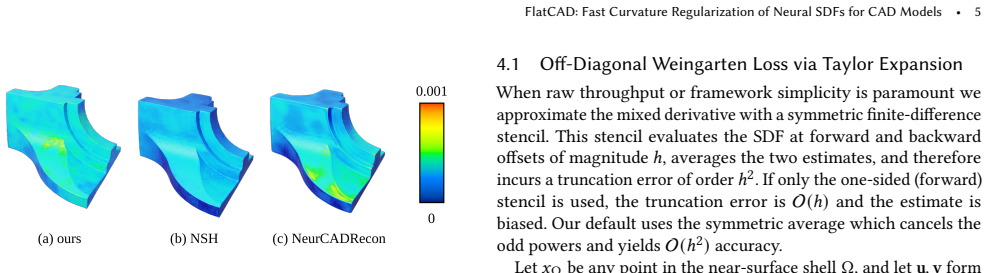
Figures from the paper (6 more)


Reference graph
Works this paper leans on
-
[2017]
ParSeNet: A Parametric Surface Fitting Network for 3D Point Clouds
CSGNet: Neural Shape Parser for Constructive Solid Geometry. 2018 IEEE/CVF Conference on Computer Vision and Pattern Recognition (2017), 5515–5523. https: //api.semanticscholar.org/CorpusID:4939249 Gopal Sharma, Difan Liu, Evangelos Kalogerakis, Subhransu Maji, Siddhartha Chaud- huri, and Radom’ir Mvech. 2020. ParSeNet: A Parametric Surface Fitting Networ...
work page Pith review arXiv 2017
-
[2020]
Fourier Features Let Networks Learn High Frequency Functions in Low Dimensional Domains. ArXiv abs/2006.10739 (2020). https://api.semanticscholar. 12 • Haotian Yin, Aleksander Plocharski, Michał Jan Włodarczyk, Mikołaj Kida, and Przemyslaw Musialski org/CorpusID:219791950 Jiapeng Tang, Weikai Chen, Jie Yang, Bo Wang, Songrun Liu, Bo Yang, and Lin Gao. 202...
arXiv 2020
Reviewed August 15, 2026 · model on record in the stance chip above.
Discussion (0). Continue with ORCID to comment.