REVIEW 3 major objections 4 minor 28 references
Don't Cut Corners: How Training Outside the Prior Makes Simulation-Based Inference More Robust
T0 review · 3 major / 4 minor · reviewed 2026-08-16 · deepseek-v4-flash
Pith's one-line read The paper claims that sampling training simulations from a Tailed-Uniform proposal—a flat core with decaying tails—makes neural posterior estimators more accurate near and beyond the boundaries of the training box, even when the assumed…
desk verdict Useful proposal-distribution study with a clean Gaussian-prior result, but the Uniform-prior headline claim is undercut by an importance-weight inconsistency and a prior mismatch in the cosmology demo. read the letter →
The pith
A machine-rendered reading of the paper's core claim, the machinery that carries it, and where it could break.
The reading
What carries the argument
Tailed-Uniform is a family of hybrid proposal distributions that replaces the hard-truncated proposal $\tilde{P} = U([a,b]^d)$ with a product of one-dimensional marginals, each flat with density $B/W$ on the core $[a,b]$ and decaying beyond it according to a unit-normalized tail profile $h$. Four profiles are compared: Gaussian, exponential, linear, and flat-tailed, with a shared half-normal scale $\sigma$ that sets the tail probability mass; as $\sigma \to 0$, Tailed-Uniform recovers the Uniform baseline. The machinery works by concentrating samples in the shell where the density estimator previously had no support, at a cost quantified by the cube probability $P_{\text{cube}} = B(\sigma)^d$, which falls exponentially with dimension and drives the crossover dimension beyond which most of the budget lands in the tails.
What would settle it
Rerun the cosmological benchmark with MCMC reference posteriors drawn under the same hard-truncated Uniform prior that the NPE assumes, rather than the truncated log-normal prior used in Section V; if the Tailed-Uniform advantage over the Uniform baseline disappears, the reported gain is confounded by prior mismatch.
Extended reading notes
Core claim
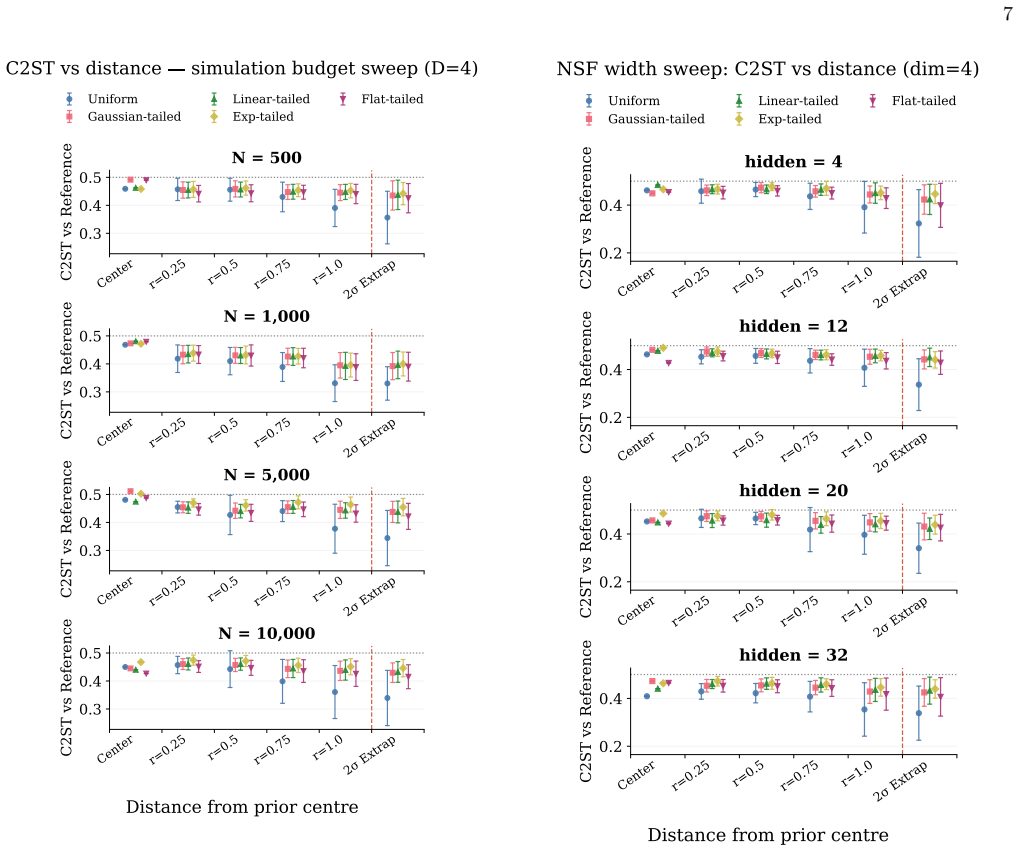
The central claim is that boundary degradation of NPE-trained posteriors is a structural property of the proposal's support, not a data-volume or capacity problem. Tailed-Uniform-trained networks match reference posteriors better near and beyond the training-box edge, even under a hard-truncated Uniform assumed prior; Uniform-trained networks leak probability mass and under-constrain parameters there. In the cosmological matter-power-spectrum test, all four tail variants outperform the Uniform baseline at boundary points, and the advantage persists across tail-width, budget, and architecture sweeps until very high dimensions. The paper also shows that increasing simulation count by two orders of magnitude or network width eightfold does not heal the Uniform boundary pathology, because no amount of interior data supplies information about the region beyond the edge.
Load-bearing premise
The cosmological comparison assumes the Markov-chain reference and the neural networks are answering the same question, but they are trained under different priors, so a mismatch in the reference prior could masquerade as a boundary effect.
Editorial extensions
If this is right
- Public simulation suites that currently populate a hard-truncated Latin hypercube could reallocate part of their fixed budget into tail samples and expect better boundary posteriors without retraining.
- Increasing simulation count or network width alone does not fix boundary degradation; changing the proposal's support is the effective lever.
- In four dimensions, tail widths that put more than half the samples outside the box still improve boundary accuracy, and only near dimension twelve does the advantage disappear.
- Smooth tails such as Gaussian, exponential, and linear are preferable to a widened uniform box at large tail width, because the smooth density transition itself matters.
- The importance-weight correction in the NPE loss allows the proposal to differ from the assumed prior, so tail padding is directly compatible with a Uniform assumed prior.
Reading between the lines
- If the mechanism is simply that the density estimator needs gradient information across the support edge, the same tail-padding should help neural likelihood and neural ratio estimators, not just NPE.
- A testable extension is to allocate tail samples adaptively, starting with a uniform core and adding points only where a validation metric degrades near the boundary, preserving interior coverage at a fixed budget.
- Per-dimension tail widths could be tuned along posterior degeneracy directions rather than independently along parameter axes, using the rotated-coordinate idea the paper lists as future work.
- The boundary benefit may be strongest for compactly supported assumed priors whose probability mass sits near the truncation, where sharp density transitions are worst.
Signed reviews
Editorial analysis
A structured set of objections, weighed in public.
Referee Report
Summary. The manuscript introduces Tailed-Uniform, a family of proposal distributions for simulation-based inference that replace the hard edge of a Uniform simulation box with decaying tails, and studies whether training neural posterior estimators on such proposals improves posterior accuracy near and beyond the original boundaries. The paper reports consistent C2ST improvements over a Uniform-trained baseline in two analytic Gaussian toy problems, in sensitivity sweeps over dimension, simulation budget, and network architecture, and in a cosmological matter-power-spectrum example. The central claim is that tail samples help even when the assumed prior is uniform, and that the benefits grow with dimensionality.
Significance. The practical question is timely: boundary artifacts in NPE training are a known nuisance in astrophysical simulation suites, and a data-efficient proposal fix would be widely useful. The paper has real strengths: the toy problems are analytically tractable and evaluated against external references, the code is public, and the sensitivity analysis covers tail shapes, widths, budgets, architectures, and dimensions in a systematic way. If the mechanism were established, this would be a solid methods contribution. However, the abstract's 'even for Uniform assumed priors' claim is in direct tension with the importance-weighting loss stated in Eq. (1), and the cosmological validation uses different priors for the MCMC reference and the NPEs; these issues are load-bearing and need to be resolved.
major comments (3)
- [Section II, Eq. (1); Section III.B, Table II] The central claim that Tailed-Uniform improves NPEs 'even for Uniform assumed priors' is not consistent with the loss defined in Eq. (1). When the assumed prior is P(theta)=U([-1,1]^d), every tail sample with theta outside the box has P(theta)=0, so its importance weight P(theta)/Ptilde(theta) and hence its contribution to L_NPE and its gradient are exactly zero. The mechanism described in Section III.B, that 'extra samples outside the original boundaries ... constrain network behavior as it approaches the boundary,' therefore cannot operate under the stated objective: the effective training objective is the standard uniform-prior NPE loss evaluated only on in-box samples. The reported advantage in Table II must then be either a finite-sample/seed effect or evidence that the implementation does not actually apply Eq. (1) (e.g., it trains unweighted on the proposal, in which case q_w targets the posterior under the proposal prior, not the assumed Uniform prior, and the comparison to the analytic truncated reference is invalid). Please clarify exactly which loss is implemented, and add a seed-controlled experiment in which the same in-box samples are used for Uniform and Tailed-Uniform training, with weights applied and then removed, to isolate any real mechanism.
- [Section V.A, Fig. 9, Table III] The cosmological validation is confounded by a prior mismatch. The MCMC reference posteriors are generated under a log-normal prior on (Omega_m,h) truncated at ±3 sigma, while all NPE networks are trained with a Uniform assumed prior on the boxes Omega_m in [0.27,0.37] and h in [0.63,0.71]. The C2ST comparisons in Figure 10 and Table III therefore measure not only boundary handling but also differences between the priors, and a Uniform-trained NPE may be penalized at the test point simply because the MCMC prior permits support outside the box. Please either generate the MCMC reference under the same Uniform box prior used by the NPEs, train the NPEs under the log-normal prior, or otherwise demonstrate that the comparison is insensitive to the prior choice.
- [Section IV.A, Fig. 5; Abstract] The abstract states that 'these benefits increase in high dimensions,' but the paper's own Figure 5 shows that at d=8 the Tailed-Uniform variants perform better near the boundary and extrapolation bin but degrade in the interior, and at d=12 the advantage disappears entirely (93% of the budget is in the tails). The claim should be qualified to reflect the crossover dimension d*(sigma) and the bias-variance trade-off described by Eq. (5); as written, the abstract overstates the high-dimensional benefit.
minor comments (4)
- [Section II.B, Table I] The continuity condition is stated verbally, but the derivation of the normalization constants A and B from normalization plus continuity is not shown; a one-line derivation would make the construction easier to verify.
- [Figures 5-8] The x-axis label '2 Extrap' is ambiguous; it should read '2σ Extrap' or be explicitly defined in the caption.
- [Section V.A] The mean and standard deviation of the log-normal prior on (Omega_m,h) are not specified; please provide the full prior definition so the reader can assess the overlap with the Uniform training box.
- [Section VI, Conclusion] The sentence 'Uniform posteriors leak probability mass beyond the prior support' is misleading for the uniform-assumed-prior task: the true posterior has no support outside the box, so what leaks is the NPE estimate. Please state this explicitly.
Circularity Check
No significant circularity: central claims are validated against analytic and MCMC references, and the minor self-citations are not load-bearing.
full rationale
The paper's derivation chain is largely self-contained. Tailed-Uniform proposals are defined explicitly in Eq. (2) and Table I as mixtures of a uniform core with calibrated tail profiles; no target result is baked into that definition. The toy-task validations compare against analytic reference posteriors from the sbibm benchmark suite, and the cosmological application compares against independent MCMC references obtained from the syren-new emulator, not from the authors' own code. The sensitivity analyses vary tail width, simulation budget, network architecture, and dimensionality, and the claimed advantages are reported as empirical results rather than derived consequences of the proposal definition. The only self-citations are to the LtU-ILI pipeline [23] and DegenDetector [28], both used as software tools rather than as evidence for the central claim. Neither is invoked as a uniqueness theorem or as a justification that forbids alternatives. One potentially serious issue is internal consistency rather than circularity: under the stated importance-weighted loss in Eq. (1), tail samples outside the support of a Uniform assumed prior have exactly zero weight, so the reported Uniform-prior improvements in Section III.B are not mechanistically explained by the paper's own equations. That concern bears on correctness or implementation fidelity, but it does not make the derivation circular, because the improvement is not assumed or fitted; it is claimed from experiments. Therefore the circularity score is low.
Assumptions & free parameters
free parameters (1)
- tail width sigma_i =
0.1 x box width (default); varied in sensitivity analysis
assumptions (3)
- standard math The importance-weighted NPE loss in Eq. (1) correctly targets the posterior under the assumed prior P(theta) regardless of the proposal P_tilde(theta).
- domain assumption The syren-new emulator and the cosmic variance noise model accurately simulate the matter power spectrum for the cosmological test.
- domain assumption MCMC samples under the specified prior provide a faithful reference posterior for the cosmological test.
Cite this review
Pith. "Pith review of Don't Cut Corners: How Training Outside the Prior Makes Simulation-Based Inference More Robust." pith.science (2026). https://pith.science/paper/BCTM4JJ2
@misc{pith2026260812470,
  author       = {Pith},
  title        = {Pith review of: Don't Cut Corners: How Training Outside the Prior Makes Simulation-Based Inference More Robust},
  year         = {2026},
  howpublished = {\url{https://pith.science/paper/BCTM4JJ2}},
  note         = {Machine review of arXiv:2608.12470}
}
read the original abstract
Large astrophysical simulation campaigns often generate training data by sampling parameters across a Uniform prior box. Due to the proposal's sharp edge, neural posterior estimators struggle to learn accurate approximations near the boundaries. We propose Tailed-Uniform, a family of hybrid proposal distributions for sampling training simulations for robust simulation-based inference. By padding the original hard-truncated training box with decaying tails, Tailed-Uniform-trained networks yield more accurate posteriors near and beyond the edges. We demonstrate these improvements on a family of tail shapes, including a widened Uniform box as a control. Our results suggest that additional simulations near the prior boundary better constrain the networks as it approaches the edge of the training box, even for Uniform assumed priors. We show these advantages on a toy problem and cosmological parameter inference from the matter power spectrum. These benefits increase in high dimensions, where boundaries dominate parameter space volume.
Figures


Figures from the paper (5 more)




Reference graph
Works this paper leans on
-
[1]
Metropolis, A
N. Metropolis, A. W. Rosenbluth, M. N. Rosenbluth, A. H. Teller, and E. Teller, Equation of state calcula- tions by fast computing machines, The journal of chem- ical physics21, 1087 (1953)
1953
-
[2]
W. K. Hastings, Monte carlo sampling methods using markov chains and their applications (1970)
1970
-
[3]
R. Pakmor, V. Springel, J. P. Coles, T. Guillet, C. Pfrom- mer, S. Bose, M. Barrera, A. M. Delgado, F. Ferlito, C. Frenk,et al., The millenniumtng project: the hydro- dynamical full physics simulation and a first look at its galaxy clusters, Monthly Notices of the Royal Astronom- ical Society524, 2539 (2023)
work page 2023
- [4]
-
[5]
K. Cranmer, J. Brehmer, and G. Louppe, The frontier of simulation-based inference, Proceedings of the National Academy of Sciences117, 30055–30062 (2020)
work page 2020
- [6]
-
[7]
M. Dax, S. R. Green, J. Gair, J. H. Macke, A. Buonanno, and B. Sch¨ olkopf, Real-time gravitational wave science with neural posterior estimation, Physical Review Letters 127, 241103 (2021), arXiv:2106.12594
arXiv 2021
-
[8]
J. Brehmer, F. Kling, I. Espejo, and K. Cranmer, Mad- Miner: Machine learning-based inference for particle physics, Computing and Software for Big Science4, 3 (2020), arXiv:1907.10621
arXiv 2020
Show all 28 references
-
[9]
Papamakarios and I
G. Papamakarios and I. Murray, Fastϵ-free inference of simulation models with bayesian conditional density es- timation (2018), arXiv:1605.06376 [stat.ML]
2018 arXiv
-
[10]
Lueckmann, P
J.-M. Lueckmann, P. J. Goncalves, G. Bassetto, K. ¨Ocal, M. Nonnenmacher, and J. H. Macke, Flexible statisti- cal inference for mechanistic models of neural dynamics (2017), arXiv:1711.01861 [stat.ML]
2017 arXiv
-
[11]
Vasist, F
M. Vasist, F. Rozet, O. Absil, P. Molli` ere, E. Nasedkin, and G. Louppe, Neural posterior estimation for exoplan- etary atmospheric retrieval, Astronomy & Astrophysics 672, A147 (2023), arXiv:2301.06575
2023 arXiv
-
[12]
Crisostomi, K
M. Crisostomi, K. Dey, E. Barausse, and R. Trotta, Neu- ral posterior estimation with guaranteed exact coverage: The ringdown of GW150914, Physical Review D108, 044029 (2023), arXiv:2305.18528
2023 arXiv
-
[13]
Villaescusa-Navarro, D
F. Villaescusa-Navarro, D. Angl´ es-Alc´ azar, S. Genel, D. N. Spergel, R. S. Somerville, R. Dave, A. Pillepich, L. Hernquist, D. Nelson, P. Torrey,et al., The camels project: Cosmology and astrophysics with machine- learning simulations, The Astrophysical Journal915, 71 (2021)
2021
-
[14]
Villaescusa-Navarro, C
F. Villaescusa-Navarro, C. Hahn, E. Massara, A. Baner- jee, A. M. Delgado, D. K. Ramanah, T. Charnock, E. Giusarma, Y. Li, E. Allys,et al., The quijote sim- ulations, The Astrophysical Journal Supplement Series 11 250, 2 (2020)
2020
-
[15]
J. C. Rose, P. Torrey, F. Villaescusa-Navarro, M. Lisanti, T. Nguyen, S. Roy, K. E. Kollmann, M. Vogelsberger, F.- Y. Cyr-Racine, M. V. Medvedev,et al., Introducing the dreams project: Dark matter and astrophysics with ma- chine learning and simulations, The Astrophysical Jour...
2025
-
[16]
M. D. McKay, R. J. Beckman, and W. J. Conover, A comparison of three methods for selecting values of input variables in the analysis of output from a computer code, Technometrics42, 55 (2000)
2000
-
[17]
Cornish, A
R. Cornish, A. Caterini, G. Deligiannidis, and A. Doucet, Relaxing bijectivity constraints with continuously in- dexed normalising flows, inInternational conference on machine learning(PMLR, 2020) pp. 2133–2143
2020
-
[18]
D. Peng, Z. Gui, and H. Wu, Interpreting the curse of dimensionality from distance concentration and manifold effect (2025), arXiv:2401.00422 [cs.LG]
2025 arXiv
-
[19]
Lopez-Paz and M
D. Lopez-Paz and M. Oquab, Revisiting classifier two- sample tests (2018), arXiv:1610.06545 [stat.ML]
2018 arXiv
-
[20]
Lueckmann, J
J.-M. Lueckmann, J. Boelts, D. S. Greenberg, P. J. Gon¸ calves, and J. H. Macke, Benchmarking simulation- based inference (2021), arXiv:2101.04653 [stat.ML]
2021 arXiv
-
[21]
Papamakarios, T
G. Papamakarios, T. Pavlakou, and I. Murray, Masked autoregressive flow for density estimation (2018), arXiv:1705.07057 [stat.ML]
2018 arXiv
-
[22]
Germain, K
M. Germain, K. Gregor, I. Murray, and H. Larochelle, Made: Masked autoencoder for distribution estimation (2015), arXiv:1502.03509 [cs.LG]
2015 arXiv
-
[23]
M. Ho, D. J. Bartlett, N. Chartier, C. Cuesta-Lazaro, S. Ding, A. Lapel, P. Lemos, C. C. Lovell, T. L. Maki- nen, C. Modi,et al., Ltu-ili: An all-in-one framework for implicit inference in astrophysics and cosmology, arXiv preprint arXiv:2402.05137 (2024)
2024 arXiv
-
[24]
Durkan, A
C. Durkan, A. Bekasov, I. Murray, and G. Papamakarios, Neural spline flows (2019), arXiv:1906.04032 [stat.ML]
2019 arXiv
-
[25]
C. Sui, D. J. Bartlett, S. Pandey, H. Desmond, P. G. Fer- reira, and B. D. Wandelt, Syren-new: Precise formulae for the linear and nonlinear matter power spectra with massive neutrinos and dynamical dark energy, Astron- omy &; Astrophysics698, A1 (2025)
2025
-
[26]
Dodelson and F
S. Dodelson and F. Schmidt,Modern cosmology(Aca- demic press, 2020)
2020
-
[27]
Peacock and S
J. Peacock and S. Dodds, Non-linear evolution of cos- mological power spectra, Monthly Notices of the Royal Astronomical Society280, L19 (1996)
1996
-
[28]
Tirapongprasert and M
C. Tirapongprasert and M. Ho, DegenDetector: Sym- bolic Recovery of Parameter Degeneracies in Bayesian Posteriors, arXiv e-prints , arXiv:2607.08755 (2026), arXiv:2607.08755 [astro-ph.IM]
2026 arXiv
Reviewed August 16, 2026 · model on record in the stance chip above.
Discussion (0). Continue with ORCID to comment.