GsOQDC: A GUI-Driven Interactive Framework for End-to-End Simulation of Optical Quantum Data Centers
Pith reviewed 2026-07-02 12:08 UTC · model grok-4.3
The pith
GsOQDC supplies a single GUI that links optical network design, quantum circuit compilation, scheduling, and discrete-event simulation to assess optical quantum data centers end to end.
A machine-rendered reading of the paper's core claim, the machinery that carries it, and where it could break.
Core claim
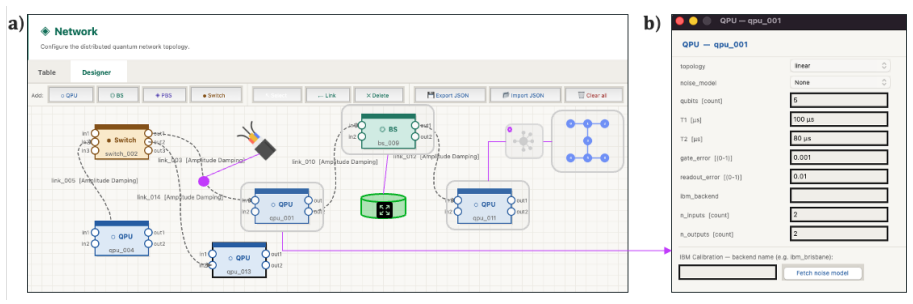
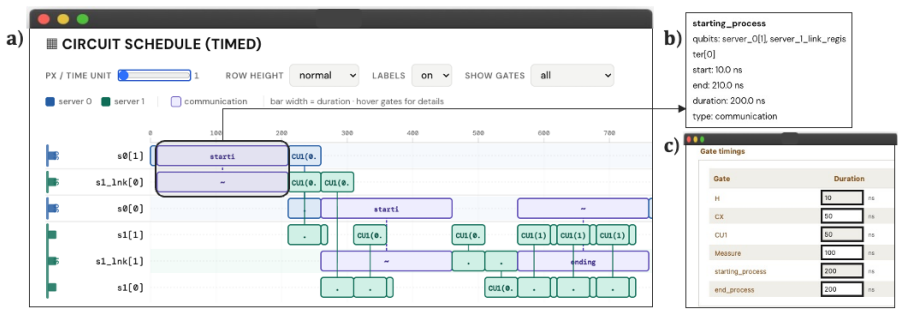
GsOQDC integrates optical-network design, distributed quantum-circuit compilation, scheduling, and DES-based remote-gate simulation, enabling end-to-end cross-layer evaluation of entanglement-resource dynamics and system-level performance in Optical Quantum Data Centers.
What carries the argument
The GsOQDC GUI framework, which unifies optical network design, circuit compilation, scheduling, and discrete-event simulation of remote gates into one interactive environment for cross-layer analysis.
If this is right
- Designers can adjust network topology, compilation choices, and scheduling rules in one interface and immediately see effects on entanglement consumption.
- System performance metrics such as remote-gate success rates and overall throughput become obtainable from a single discrete-event run.
- Researchers gain the ability to compare different entanglement-distribution strategies across the full stack without switching tools.
- Interactive visualization of resource dynamics during simulation runs supports quick identification of bottlenecks.
Where Pith is reading between the lines
- Adoption of the framework could shorten the iteration cycle between proposing a new quantum data center architecture and obtaining quantitative performance estimates.
- The integrated approach may make it easier to study how changes at the physical layer propagate to application-level metrics in quantum networks.
- Future users might extend the tool by adding new scheduling algorithms or optical-component models directly through the GUI.
Load-bearing premise
The separate simulation components can be combined into one working GUI whose outputs give reliable information about real optical quantum data center behavior.
What would settle it
Running the same network and circuit scenario in GsOQDC and on a physical optical quantum testbed and finding large mismatches in entanglement usage or latency numbers.
Figures

read the original abstract
We present GsOQDC, an open-source graphical framework integrating optical-network design, distributed quantum-circuit compilation, scheduling, and DES-based remote-gate simulation, enabling end-to-end cross-layer evaluation of entanglement-resource dynamics and system-level performance in Optical Quantum Data Centers.
Editorial analysis
A structured set of objections, weighed in public.
Referee Report
Summary. The manuscript presents GsOQDC, an open-source GUI framework integrating optical-network design, distributed quantum-circuit compilation, scheduling, and DES-based remote-gate simulation to support end-to-end cross-layer evaluation of entanglement-resource dynamics and system-level performance in Optical Quantum Data Centers.
Significance. If the described integration is realized with validated components, the framework could offer a practical, interactive platform for exploring quantum data center designs; the open-source release would further support reproducibility and community use. The contribution is primarily one of software engineering rather than new physical or algorithmic results.
major comments (1)
- Abstract: the claim that the framework enables 'end-to-end cross-layer evaluation' and 'reliable' insights into real optical quantum data center behavior is not supported by any architecture description, module interfaces, validation benchmarks, or example simulation outputs; without these the central claim reduces to an unverified assertion of successful component integration.
minor comments (2)
- The acronym GsOQDC is not expanded on first use in the title or abstract.
- No references are supplied to prior work on optical quantum network simulators or distributed quantum compilation tools, limiting context for the claimed novelty of the integration.
Simulated Author's Rebuttal
We thank the referee for the review. We address the single major comment below, noting that the manuscript provides architecture and interface details but lacks dedicated validation benchmarks.
read point-by-point responses
-
Referee: [—] Abstract: the claim that the framework enables 'end-to-end cross-layer evaluation' and 'reliable' insights into real optical quantum data center behavior is not supported by any architecture description, module interfaces, validation benchmarks, or example simulation outputs; without these the central claim reduces to an unverified assertion of successful component integration.
Authors: Sections 3 and 4 of the manuscript describe the overall architecture, module interfaces, and how the optical-network design, compilation, scheduling, and DES components are integrated. Section 5 presents example simulation outputs from the GUI. We agree, however, that the manuscript does not include validation benchmarks against physical hardware or independent simulators, so the claim of enabling 'reliable' insights into real-system behavior is not fully substantiated. We will revise the abstract to remove overstated language and clarify that the framework demonstrates integrated simulation rather than validated real-world predictions. revision: partial
Circularity Check
No significant circularity
full rationale
The manuscript presents GsOQDC as an open-source GUI framework that integrates pre-existing components (optical-network design, distributed quantum-circuit compilation, scheduling, and DES-based remote-gate simulation). No equations, derivations, fitted parameters, predictions, or uniqueness theorems appear in the provided text. The central claim reduces to a description of software engineering and integration rather than any mathematical result that could reduce to its own inputs by construction. No self-citation chains, ansatzes, or renamings of known results are load-bearing. The derivation chain is absent, so circularity cannot arise.
Axiom & Free-Parameter Ledger
Reference graph
Works this paper leans on
-
[1]
A framework for quantum data center emulation using digital quantum computers
S. N. Elyasi, P . Monti, J. Li, and R. Lin, “A framework for quantum data center emulation using digital quantum computers”,arXiv preprint, 2025. arXiv: 2509 . 04029. [Online]. Available: https://arxiv.org/abs/2509.04 029
2025
-
[2]
Distributed quantum computing across an optical network link
D. Main et al., “Distributed quantum computing across an optical network link”,Nature, vol. 638, pp. 383–388, 2025.DOI: 10 . 1038 / s41586 - 024 - 08404 - x[Online]. Available: https://doi.org/10.1038/s41586-024-08 404-x
-
[3]
Distributed quantum computing: A survey
M. Caleffi, M. Amoretti, D. Ferrari, J. Illiano, A. Manzalini, and A. S. Cacciapuoti, “Distributed quantum computing: A survey”,Computer Networks, vol. 254, p. 110 672, 2024.DOI: 10.1016/j.comnet.2024.110672 [Online]. Available: https://doi.org/10.1016/j.comnet.2024 .110672
-
[4]
A 1-km photonic link connecting super- conducting circuits in two dilution refrigerators
Y . Zhou et al., “A 1-km photonic link connecting super- conducting circuits in two dilution refrigerators”,Nature Photonics, 2026.DOI:10.1038/s41566-026-01866-7
-
[5]
Probing dark matter with future CMB measurements
V. Krutyanskiy et al., “Entanglement of trapped-ion qubits separated by 230 meters”,Physical Review Let- ters, vol. 130, no. 5, p. 050 803, 2023.DOI: 10.1103/Phy sRevLett.130.050803 [Online]. Available: https://li nk.aps.org/doi/10.1103/PhysRevLett.130.050803
work page doi:10.1103/phy 2023
-
[6]
Quantum transduction of optical photons from a super- conducting qubit
M. Mirhosseini, A. Sipahigil, M. Kalaee, and O. Painter, “Quantum transduction of optical photons from a super- conducting qubit”,Nature, vol. 588, pp. 599–603, 2020. DOI: 10.1038/s41586-020-3038-6 [Online]. Available: https://doi.org/10.1038/s41586-020-3038-6
-
[7]
Large-scale modular quantum- computer architecture with atomic memory and photonic interconnects
C. Monroe et al., “Large-scale modular quantum- computer architecture with atomic memory and photonic interconnects”,Physical Review A, vol. 89, p. 022 317, 2014.DOI: 10 . 1103 / PhysRevA . 89 . 022317[Online]. Available: https://doi.org/10.1103/PhysRevA.89.0 22317
-
[8]
t|ket>: A retargetable compiler for NISQ devices
S. Sivarajah, S. Dilkes, A. Cowtan, W. Sherburn, A. Misra, and R. Duncan, “t|ket>: A retargetable compiler for NISQ devices”,Quantum Science and T echnology, vol. 6, no. 1, p. 014 003, 2020.DOI: 10.1088/2058-956 5/ab8e92 [Online]. Available: https://doi.org/10.10 88/2058-9565/ab8e92
-
[9]
Javadi-Abhari et al.,Quantum computing with Qiskit,
A. Javadi-Abhari et al.,Quantum computing with Qiskit,
-
[10]
arXiv: 2405 . 08810. [Online]. Available: https : //arxiv.org/abs/2405.08810
work page internal anchor Pith review Pith/arXiv arXiv
-
[11]
Andres-Martinez, D
P . Andres-Martinez, D. Mills, T. Forrer, and L. Henaut, CQCL/pytket-dqc: Distributed quantum computing com- piler based on pytket, 2024. [Online]. Available: https: //github.com/CQCL/pytket-dqc
2024
-
[12]
[Online]
Cisco Systems,Cisco packet tracer, 2024. [Online]. Available: https : / / www . netacad . com / courses / pa cket-tracer
2024
-
[13]
NetSquid, a NETwork Simulator for QUantum Information using Discrete events
T. Coopmans et al., “NetSquid, a NETwork Simulator for QUantum Information using Discrete events”,Communi- cations Physics, vol. 4, p. 164, 2021.DOI: 10.1038/s42 005-021-00647-8arXiv:2010.12535
work page doi:10.1038/s42 2021
-
[14]
QuNetSim: A software framework for quantum net- works
S. DiAdamo, J. Nötzel, B. Zanger, and M. M. Bese, “QuNetSim: A software framework for quantum net- works”,IEEE T ransactions on Quantum Engineering, vol. 2, pp. 1–12, 2021.DOI: 10.1109/TQE.2021.309239 5arXiv:2003.06397
-
[15]
Simulating circuit layout for distributed quantum computing
S. Zhang, Y . Liu, B. Mark, W. Jiang, Z. Y ang, and L. Y ang, “Simulating circuit layout for distributed quantum computing”,arXiv preprint, 2024. arXiv: 2512 . 21403. [Online]. Available: https://arxiv.org/abs/2512.21 403
2024
-
[16]
SimDisQ: An end-to-end distributed quan- tum circuit simulator
Anonymous, “SimDisQ: An end-to-end distributed quan- tum circuit simulator”,arXiv preprint, 2025. arXiv: 251 1.19791. [Online]. Available: https://arxiv.org/abs /2511.19791
discussion (0)
Sign in with ORCID, Apple, or X to comment. Anyone can read and Pith papers without signing in.