Combined Analysis of Lattice QCD and Experimental Data on the Pion Transition Form Factor
Pith reviewed 2026-06-27 10:42 UTC · model grok-4.3
The pith
Combining lattice QCD and experimental data on the pion transition form factor reduces uncertainty by up to a factor of three in the singly-virtual limit.
A machine-rendered reading of the paper's core claim, the machinery that carries it, and where it could break.
Core claim
The inclusion of experimental data substantially tightens the constraints on the pion TFF, yielding up to a factor of three reduction in uncertainty in the singly-virtual limit. In contrast, the uncertainty of the resulting pion-pole contribution to the muon g-2 improves by a factor of 1.5. This more modest improvement reflects the fact that the g-2 integral is heavily dominated by the low-Q² region, which is already well constrained by physical normalization constraints.
What carries the argument
A global one-stage fitting approach based on the modified z-expansion parametrization, which simultaneously fits lattice QCD doubly-virtual data and experimental singly-virtual data using synthetic jackknife replicates and normalized chi-squared weighting.
Load-bearing premise
The modified z-expansion provides a sufficiently flexible and unbiased parametrization that can simultaneously describe both the lattice QCD doubly-virtual data and the experimental singly-virtual data without introducing significant systematic bias from the choice of functional form or from the synthetic jackknife procedure.
What would settle it
An independent high-precision measurement of the doubly-virtual pion TFF in a kinematic region covered by the combined fit that deviates from the fit prediction beyond the quoted uncertainties would indicate bias in the parametrization or combination method.
Figures






read the original abstract
The evaluation of the hadronic light-by-light scattering contribution to the muon anomalous magnetic moment requires precise knowledge of the pion transition form factor (TFF). In this work, we present a feasibility study for a combined analysis of lattice QCD (LQCD) and experimental data. Our methodology is driven by the goal of combining complementary datasets to leverage their respective kinematic advantages: while LQCD provides robust predictions for the doubly-virtual TFF, $e^+e^-$ scattering experiments offer high-precision singly-virtual measurements up to large momentum transfers. To ensure a statistically rigorous combination, we implement a global one-stage fitting approach based on the modified $z$-expansion, utilizing synthetic jackknife replicate sampling and a normalized $\chi^2$ weighting scheme. We demonstrate that the inclusion of experimental data substantially tightens the constraints on the pion TFF, yielding up to a factor of three reduction in uncertainty in the singly-virtual limit. In contrast, the uncertainty of the resulting pion-pole contribution to the muon $g-2$ improves by a factor of $1.5$. This more modest improvement reflects the fact that the $g-2$ integral is heavily dominated by the low-$Q^2$ region, which is already well constrained by physical normalization constraints.
Editorial analysis
A structured set of objections, weighed in public.
Referee Report
Summary. The paper presents a feasibility study for a combined analysis of lattice QCD doubly-virtual and experimental singly-virtual data on the pion transition form factor. It employs a global one-stage fit based on the modified z-expansion with synthetic jackknife sampling and normalized chi-squared weighting, claiming that inclusion of experimental data reduces uncertainties by up to a factor of three in the singly-virtual limit while improving the pion-pole contribution to muon g-2 by a factor of 1.5.
Significance. If validated, the approach demonstrates how complementary datasets can be rigorously combined to tighten constraints on the pion TFF relevant to hadronic light-by-light scattering in muon g-2 calculations. The explicit accounting for the modest g-2 improvement due to low-Q2 dominance is a strength, as is the data-driven nature of the numerical claims.
major comments (1)
- [Abstract] Abstract: The central numerical claims (factor-of-three and factor-of-1.5 uncertainty reductions) are reported without any fit-quality diagnostics, chi^2 values, covariance matrices, or validation against known limits such as the normalization at Q^2=0. This information is load-bearing for assessing whether the claimed improvements are supported by the data or affected by the synthetic jackknife procedure.
Simulated Author's Rebuttal
We thank the referee for their careful review and constructive feedback on our feasibility study. We address the major comment below and will revise the manuscript to incorporate the requested information.
read point-by-point responses
-
Referee: [Abstract] Abstract: The central numerical claims (factor-of-three and factor-of-1.5 uncertainty reductions) are reported without any fit-quality diagnostics, chi^2 values, covariance matrices, or validation against known limits such as the normalization at Q^2=0. This information is load-bearing for assessing whether the claimed improvements are supported by the data or affected by the synthetic jackknife procedure.
Authors: We agree that fit-quality diagnostics are essential to substantiate the numerical claims. The full manuscript reports normalized χ^{2} values (typically 1.05–1.25 for the combined fits) and associated p-values in Section 3.3, with covariance matrices for the z-expansion coefficients provided in Appendix B and as supplementary material. The Q^{2}=0 normalization is enforced by construction in the modified z-expansion (F(0,0) ≡ 1) and is explicitly verified in our results (deviations < 0.1%). The synthetic jackknife procedure was validated against independent bootstrap tests and known analytic limits to confirm it does not introduce bias. To address the referee’s concern directly, we will revise the abstract to include a concise statement on fit quality and add a pointer to the relevant sections and supplementary material. revision: yes
Circularity Check
No significant circularity detected
full rationale
The paper describes a global one-stage fit of the modified z-expansion to two independent external datasets (lattice QCD doubly-virtual points and experimental singly-virtual measurements). The reported uncertainty reductions (factor of three in singly-virtual limit, 1.5 in g-2 integral) are direct numerical outputs of that fit; they are not obtained by re-expressing fitted parameters as predictions or by any self-referential definition. No load-bearing self-citations, uniqueness theorems, or ansatz smuggling appear in the supplied methodology. The derivation chain is therefore self-contained against external benchmarks.
Axiom & Free-Parameter Ledger
free parameters (1)
- modified z-expansion coefficients
axioms (1)
- domain assumption The modified z-expansion is a valid and sufficiently flexible parametrization for the pion TFF across the relevant singly- and doubly-virtual kinematics
Reference graph
Works this paper leans on
-
[1]
Best-fit parameters 13
-
[2]
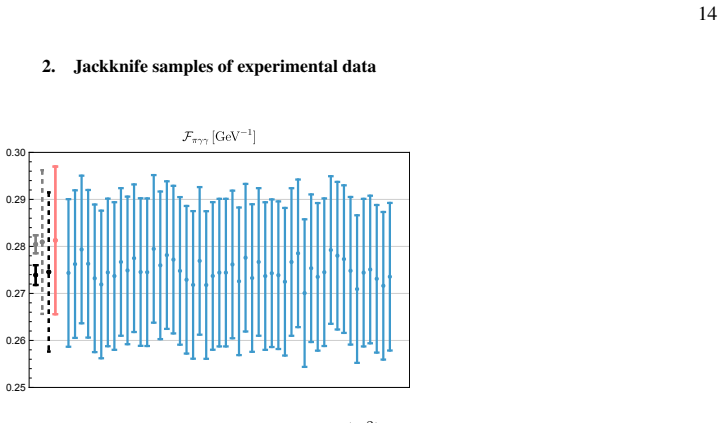
Jackknife samples of experimental data 14 I. THE PION TRANSITION FORM FACTOR: MOTIV ATION FOR A COMBINED ANALYSIS The muon anomalous magnetic moment aµ ≡ 1 2(g − 2)µ provides a stringent precision test of the Standard Model of Particle Physics (SM). Presently, this test is limited by the SM theory prediction, as published by the “Muon g-2 The- ory Initiat...
Pith/arXiv arXiv 2026
-
[3]
We conclude with a summary and out- look in Section VI
and aπ0-pole µ are presented in Sections IV and V, respectively. We conclude with a summary and out- look in Section VI. II. GLOBAL CONSTRAINTS The pion TFF Fπ0γ∗γ∗(Q2 1, Q2
-
[4]
Following the WP20 standard, a description of the pion TFF should meet three criteria [3]:
is defined through the ma- trix element of two electromagnetic currents between the vac- uum and the pion state: Z d4x eiq1·x ⟨0|T jµ(x)jν(0)|π0(q1 + q2)⟩ = ie2ϵµναβ qα 1 qβ 2 Fπ0γ∗γ∗(Q2 1, Q2 2), (5) where jµ = e X f Qf ¯qf γµqf , (6) denotes the electromagnetic current carried by the quarks of flavor f and charge Qf . Following the WP20 standard, a desc...
-
[5]
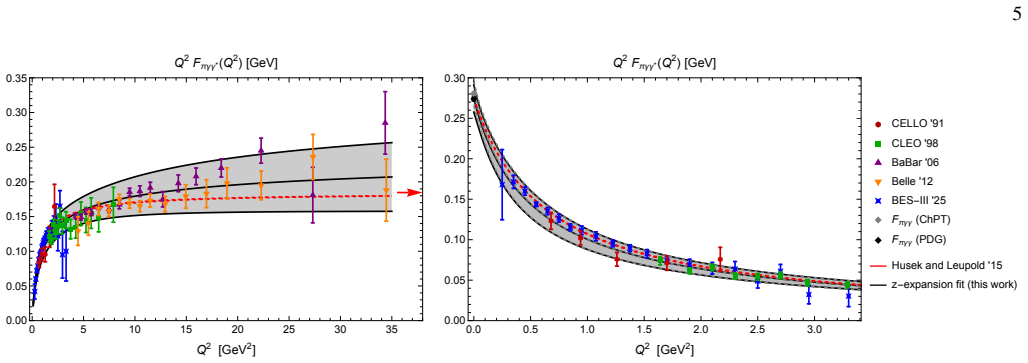
in addition to the TFF normalization given by the real- photon decay widths, high-energy constraints must also be fulfilled; 3 0 1 2 3 4 50.00 0.05 0.10 0.15 0.20 0.25 0.30 Q2 [GeV2] Fπγγ* (Q2) [GeV-1] Mainz/CLS '19 Hoferichter et al. '18 CELLO '91 CLEO '98 BaBar '06 Belle '12 BES-III '25 Fπγγ (ChPT) Fπγγ (PDG) 0 1 2 3 4 5 0.00 0.01 0.02 0.03 0.04 0.05 0....
-
[6]
at least the spacelike experimental data for the singly- virtual TFF must be reproduced
-
[7]
systematic uncertainties must be assessed with a rea- sonable procedure. According to this standard, two independent data-driven ap- proaches were considered in WP20: the dispersive prediction [29, 30], and a Canterbury approximants fit [41] of experi- mental data for the pseudoscalar-meson TFFs in the space- like region. Furthermore, an LQCD prediction o...
2016
-
[8]
and PrimEx-II [28] collaborations at Jefferson Labora- tory (JLab) with a combined accuracy of 1.5 %, see Table III. The neutral pion lifetime recommended by the Particle Data Group (PDG) [35]: τ = 8.43(13) × 10−17s, (8) is an average of five experiments: two Primakoff measure- ments (one at Cornell University [55] and aforementioned measurements at JLab ...
-
[9]
= 1 + Q2 1 + Q2 2 M 2ρ , (19) where Mρ = 775.26(23) MeV is the physical ρ meson mass, ensures that the modified z-expansion decreases asymptoti- cally as 1/Q2 in all directions in the(Q2 1, Q2
-
[10]
kj F (exp.) π0γγ ∗(Q2 i ) − F (th.) π0γγ ∗(Q2 i ) kj ∆F (exp.) π0γγ ∗(Q2 i ) #2 + kj − 1 kjδnorm,j 2) +
plane, in accor- dance with the BL and OPE limits defined in Eqs. (14a) and (14b). The modified z-expansion offers a flexible ansatz well suited to validate the methodology of our combined analy- sis. Furthermore, it allows us to directly compare our results with the original analysis of the employed LQCD dataset [31]. The authors of Ref. [31] concluded t...
-
[11]
Photon- photon interactions in the Standard Model and beyond - ex- ploiting the discovery potential from MESA to the LHC
simplifies substantially for pseudoscalar-meson poles: aπ0 µ = 2α3 3π2 Z ∞ 0 dQ1 Z ∞ 0 dQ2 Z 1 −1 dτ p 1 − τ 2 Q3 1Q3 2 × T1 Π1 + T2 Π2 (Q1, Q2, τ) with the HLbL scalar amplitudes Π1(Q1, Q2, τ) = − Fπ0γ∗γ∗(Q2 1, Q2 3)Fπ0γγ ∗(Q2 3) Q2 3 + M 2π , (28a) Π2(Q1, Q2, τ) = − Fπ0γ∗γ∗(Q2 1, Q2 3)Fπ0γγ ∗(Q2 2) Q2 2 + M 2π , (28b) the QED integral kernels T1 and T2 ...
-
[12]
Aliberti et al., The anomalous magnetic moment of the muon in the Standard Model: an update, Phys
R. Aliberti et al., The anomalous magnetic moment of the muon in the Standard Model: an update, Phys. Rept. 1143, 1 (2025), arXiv:2505.21476 [hep-ph]
Pith/arXiv arXiv 2025
-
[13]
D. P. Aguillard et al. (Muon g−2), Measurement of the Positive Muon Anomalous Magnetic Moment to 127 ppb, Phys. Rev. Lett. 135, 101802 (2025), arXiv:2506.03069 [hep-ex]
arXiv 2025
-
[14]
T. Aoyama et al. , The anomalous magnetic moment of the muon in the Standard Model, Phys. Rept. 887, 1 (2020), arXiv:2006.04822 [hep-ph]
Pith/arXiv arXiv 2020
-
[15]
T. Blum, P. A. Boyle, V . G¨ulpers, T. Izubuchi, L. Jin, C. Jung, A. J ¨uttner, C. Lehner, A. Portelli, and J. T. Tsang (RBC, UKQCD), Calculation of the hadronic vacuum polarization contribution to the muon anomalous magnetic moment, Phys. Rev. Lett. 121, 022003 (2018), arXiv:1801.07224 [hep-lat]
Pith/arXiv arXiv 2018
-
[16]
D. Giusti, V . Lubicz, G. Martinelli, F. Sanfilippo, and S. Sim- ula (ETM), Electromagnetic and strong isospin-breaking cor- rections to the muon g −2 from Lattice QCD+QED, Phys. Rev. D 99, 114502 (2019), arXiv:1901.10462 [hep-lat]
Pith/arXiv arXiv 2019
-
[17]
S. Bors ´anyi et al., Leading hadronic contribution to the muon magnetic moment from lattice QCD, Nature 593, 51 (2021), arXiv:2002.12347 [hep-lat]
arXiv 2021
-
[18]
C. Lehner and A. S. Meyer, Consistency of hadronic vacuum polarization between lattice QCD and theR-ratio, Phys. Rev. D 101, 074515 (2020), arXiv:2003.04177 [hep-lat]
arXiv 2020
-
[19]
G. Wang, T. Draper, K.-F. Liu, and Y .-B. Yang (χQCD), Muon g − 2 with overlap valence fermions, Phys. Rev. D107, 034513 (2023), arXiv:2204.01280 [hep-lat]
arXiv 2023
- [20]
-
[21]
M. C `e et al., Window observable for the hadronic vacuum po- larization contribution to the muon g − 2 from lattice QCD, Phys. Rev. D 106, 114502 (2022), arXiv:2206.06582 [hep-lat]
arXiv 2022
-
[22]
C. Alexandrou et al. (ETM), Lattice calculation of the short and intermediate time-distance hadronic vacuum polarization contributions to the muon magnetic moment using twisted-mass fermions, Phys. Rev. D 107, 074506 (2023), arXiv:2206.15084 [hep-lat]
arXiv 2023
-
[23]
T. Blum et al. (RBC, UKQCD), Update of Euclidean windows of the hadronic vacuum polarization, Phys. Rev. D108, 054507 (2023), arXiv:2301.08696 [hep-lat]
arXiv 2023
-
[24]
S. Kuberski, M. C `e, G. von Hippel, H. B. Meyer, K. Ottnad, A. Risch, and H. Wittig, Hadronic vacuum polarization in the muon g − 2: the short-distance contribution from lattice QCD, JHEP 03, 172, arXiv:2401.11895 [hep-lat]
-
[25]
A. Boccaletti et al., Hybrid calculation of hadronic vacuum po- larization in muon g − 2 to 0.48%, Nature 653, 373 (2026), arXiv:2407.10913 [hep-lat]
Pith/arXiv arXiv 2026
-
[26]
S. Spiegel and C. Lehner, High-precision continuum limit study of the HVP short-distance window, Phys. Rev. D 111, 114517 (2025), arXiv:2410.17053 [hep-lat]
arXiv 2025
-
[27]
T. Blum et al. (RBC, UKQCD), The long-distance window of the hadronic vacuum polarization for the muon g − 2, Phys. Rev. Lett. 134, 201901 (2025), arXiv:2410.20590 [hep-lat]
arXiv 2025
-
[28]
D. Djukanovic, G. von Hippel, S. Kuberski, H. B. Meyer, N. Miller, K. Ottnad, J. Parrino, A. Risch, and H. Wittig, The hadronic vacuum polarization contribution to the muong −2 at long distances, JHEP 04, 098, arXiv:2411.07969 [hep-lat]
-
[29]
C. Alexandrou et al. (ETM), Strange and charm quark contribu- tions to the muon anomalous magnetic moment in lattice QCD with twisted-mass fermions, Phys. Rev. D 111, 054502 (2025), arXiv:2411.08852 [hep-lat]
arXiv 2025
-
[30]
A. Bazavov et al. (Fermilab Lattice, HPQCD, MILC), Hadronic vacuum polarization for the muon g − 2 from lattice QCD: Complete short and intermediate windows, Phys. Rev. D 111, 094508 (2025), arXiv:2411.09656 [hep-lat]
arXiv 2025
-
[31]
A. Bazavov et al. (Fermilab Lattice, HPQCD, MILC), Hadronic Vacuum Polarization for the Muon g − 2 from Lattice QCD: Long-Distance and Full Light-Quark Connected Contribution, Phys. Rev. Lett. 135, 011901 (2025), arXiv:2412.18491 [hep- lat]
arXiv 2025
-
[32]
A. Keshavarzi, D. Nomura, and T. Teubner, Muon g − 2 and α(M 2 Z): a new data-based analysis, Phys. Rev. D 97, 114025 (2018), arXiv:1802.02995 [hep-ph]
Pith/arXiv arXiv 2018
-
[33]
A. Keshavarzi, D. Nomura, T. Teubner, and A. Wright, Muon g − 2: Blinding for data-driven hadronic vacuum polarization, Phys. Rev. D 111, L011901 (2025), arXiv:2409.02827 [hep- ph]
arXiv 2025
- [34]
-
[35]
F. V . Ignatov et al. (CMD-3), Measurement of the e+e− → π+π− cross section from threshold to 1.2 GeV with the CMD- 3 detector, Phys. Rev. D109, 112002 (2024), arXiv:2302.08834 [hep-ex]
arXiv 2024
-
[36]
F. V . Ignatov et al. (CMD-3), Measurement of the Pion Form Factor with CMD-3 Detector and its Implication to the Hadronic Contribution to Muon g − 2, Phys. Rev. Lett. 132, 231903 (2024), arXiv:2309.12910 [hep-ex]
arXiv 2024
-
[37]
R. Aliberti et al., Radiative corrections and Monte Carlo tools for low-energy hadronic cross sections in e+e− collisions, Sci- Post Phys. Comm. Rep. , 9 (2025), arXiv:2410.22882 [hep-ph]
arXiv 2025
-
[38]
I. Larin et al. (PrimEx), A New Measurement of the π0 Ra- diative Decay Width, Phys. Rev. Lett. 106, 162303 (2011), arXiv:1009.1681 [nucl-ex]
Pith/arXiv arXiv 2011
-
[39]
Larin et al
I. Larin et al. (PrimEx-II), Precision measurement of the neutral pion lifetime, Science 368, 506 (2020)
2020
-
[40]
M. Hoferichter, B.-L. Hoid, B. Kubis, S. Leupold, and S. P. Schneider, Dispersion relation for hadronic light-by-light scat- tering: pion pole, JHEP 10, 141, arXiv:1808.04823 [hep-ph]
-
[41]
M. Hoferichter, B.-L. Hoid, B. Kubis, S. Leupold, and S. P. Schneider, Pion-pole contribution to hadronic light-by-light scattering in the anomalous magnetic moment of the muon, Phys. Rev. Lett. 121, 112002 (2018), arXiv:1805.01471 [hep- ph]
Pith/arXiv arXiv 2018
-
[42]
A. G ´erardin, H. B. Meyer, and A. Nyffeler, Lattice calculation of the pion transition form factor with Nf = 2 + 1 Wilson quarks, Phys. Rev. D 100 , 034520 (2019), arXiv:1903.09471 [hep-lat]
arXiv 2019
-
[43]
E. J. Estrada, S. Gonz `alez-Sol´ıs, A. Guevara, and P. Roig, Improved π0, η, η’ transition form factors in resonance chiral theory and their aHLbL µ contribution, JHEP 12, 203, arXiv:2409.10503 [hep-ph]
-
[44]
A. G ´erardin, W. E. A. Verplanke, G. Wang, Z. Fodor, J. N. Guenther, L. Lellouch, K. K. Szabo, and L. Varnhorst, Lattice calculation of the π0, η and η′ transition form factors and the hadronic light-by-light contribution to the muon g − 2, Phys. Rev. D 111, 054511 (2025), arXiv:2305.04570 [hep-lat]
arXiv 2025
-
[45]
K. Kampf and B. Moussallam, Chiral expansions of the π0 life- time, Phys. Rev. D 79, 076005 (2009), arXiv:0901.4688 [hep- ph]
Pith/arXiv arXiv 2009
-
[46]
Navas et al
S. Navas et al. (Particle Data Group), Review of particle physics, Phys. Rev. D 110, 030001 (2024)
2024
-
[47]
H. J. Behrend et al. (CELLO), A Measurement of theπ0, η, and η′ electromagnetic form-factors, Z. Phys. C 49, 401 (1991)
1991
-
[48]
J. Gronberg et al. (CLEO), Measurements of the meson-photon transition form-factors of light pseudoscalar mesons at large momentum transfer, Phys. Rev. D 57 , 33 (1998), arXiv:hep- ex/9707031 [hep-ex]. 12
arXiv 1998
-
[49]
B. Aubert et al. (BaBar), Measurement of the γγ ∗ → π0 transition form factor, Phys. Rev. D 80 , 052002 (2009), arXiv:0905.4778 [hep-ex]
Pith/arXiv arXiv 2009
-
[50]
S. Uehara et al. (Belle), Measurement of γγ ∗ → π0 tran- sition form factor at Belle, Phys. Rev. D 86 , 092007 (2012), arXiv:1205.3249 [hep-ex]
Pith/arXiv arXiv 2012
-
[51]
M. Ablikim et al. (BESIII), Measurement of the space-like π0 transition form factor (2025), arXiv:2509.07685 [hep-ex]
arXiv 2025
-
[52]
P. Masjuan and P. Sanchez-Puertas, Pseudoscalar-pole contri- bution to the (gµ − 2): a rational approach, Phys. Rev. D 95, 054026 (2017), arXiv:1701.05829 [hep-ph]
Pith/arXiv arXiv 2017
-
[53]
A. G ´erardin, H. B. Meyer, and A. Nyffeler, Lattice calculation of the pion transition form factor π0 → γ∗γ∗, Phys. Rev. D94, 074507 (2016), arXiv:1607.08174 [hep-lat]
Pith/arXiv arXiv 2016
-
[54]
T. Lin, M. Bruno, X. Feng, L.-C. Jin, C. Lehner, C. Liu, and Q.-Y . Luo, Lattice QCD calculation of the π0-pole contribu- tion to the hadronic light-by-light scattering in the anomalous magnetic moment of the muon, Rept. Prog. Phys. 88, 080501 (2025), arXiv:2411.06349 [hep-lat]
arXiv 2025
-
[55]
C. Alexandrou et al. (Extended Twisted Mass), Pion transition form factor from twisted-mass lattice QCD and the hadronic light-by-light π0-pole contribution to the muon g − 2, Phys. Rev. D 108, 094514 (2023), arXiv:2308.12458 [hep-lat]
arXiv 2023
-
[56]
C. Alexandrou et al. (Extended Twisted Mass), η→γ∗γ∗transition form factor and the hadronic light-by- light η-pole contribution to the muon g − 2 from lattice QCD, Phys. Rev. D 108, 054509 (2023), arXiv:2212.06704 [hep-lat]
arXiv 2023
-
[57]
M. Bruno et al., Simulation of QCD with Nf = 2 + 1 flavors of non-perturbatively improved Wilson fermions, JHEP 02, 043, arXiv:1411.3982 [hep-lat]
-
[58]
M. Bruno, T. Korzec, and S. Schaefer, Setting the scale for the CLS 2 + 1 flavor ensembles, Phys. Rev. D 95, 074504 (2017), arXiv:1608.08900 [hep-lat]
Pith/arXiv arXiv 2017
-
[59]
T. Husek and S. Leupold, Two-hadron saturation for the pseu- doscalar–vector–vector correlator and phenomenological appli- cations, Eur. Phys. J. C75, 586 (2015), arXiv:1507.00478 [hep- ph]
Pith/arXiv arXiv 2015
-
[60]
P. Bickert and S. Scherer, Two-photon decays and transition form factors of π0, η, and η′ in large- Nc chiral perturbation theory, Phys. Rev. D 102, 074019 (2020), arXiv:2005.08550 [hep-ph]
arXiv 2020
-
[61]
P. Adlarson et al. (A2), Measurement of the π0 → e+e−γ Dalitz decay at the Mainz Microtron, Phys. Rev. C 95, 025202 (2017), arXiv:1611.04739 [hep-ex]
Pith/arXiv arXiv 2017
-
[62]
S. Prakhov et al. (A2), New high-statistics measurement of the π0 → e+e−γ Dalitz decay at the Mainz Microtron (2025), arXiv:2512.03431 [hep-ex]
Pith/arXiv arXiv 2025
-
[63]
C. Lazzeroni et al. (NA62), Measurement of theπ0 electromag- netic transition form factor slope, Phys. Lett. B 768, 38 (2017), arXiv:1612.08162 [hep-ex]
Pith/arXiv arXiv 2017
-
[64]
R. R. Akhmetshin et al. (CMD-2), Study of the processes e+e− → ηγ, π0γ → 3γ in the c.m. energy range 600 MeV to 1380 MeV at CMD-2, Phys. Lett. B 605, 26 (2005), arXiv:hep- ex/0409030
arXiv 2005
-
[65]
M. N. Achasov et al. (SND), Study of the reaction e+e− → π0γ with the SND detector at the VEPP-2M collider, Phys. Rev. D 93, 092001 (2016), arXiv:1601.08061 [hep-ex]
Pith/arXiv arXiv 2016
-
[66]
Browman, J
A. Browman, J. DeWire, B. Gittelman, K. M. Hanson, D. Lar- son, E. Loh, and R. Lewis, The Decay Width of the Neutral pi Meson, Phys. Rev. Lett. 33, 1400 (1974)
1974
-
[67]
H. W. Atherton et al. , DIRECT MEASUREMENT OF THE LIFETIME OF THE NEUTRAL PION, Phys. Lett. B 158, 81 (1985)
1985
-
[68]
Williams et al
D. Williams et al. (Crystal Ball), Formation of the Pseu- doscalars π0, η and η′ in the Reaction γγ → γγ, Phys. Rev. D 38, 1365 (1988)
1988
-
[69]
Bychkov et al., New Precise Measurement of the Pion Weak Form Factors in π+ → e+νγ Decay, Phys
M. Bychkov et al., New Precise Measurement of the Pion Weak Form Factors in π+ → e+νγ Decay, Phys. Rev. Lett. 103, 051802 (2009), arXiv:0804.1815 [hep-ex]
Pith/arXiv arXiv 2009
-
[70]
S. L. Adler, Axial vector vertex in spinor electrodynamics, Phys. Rev. 177, 2426 (1969)
1969
-
[71]
J. S. Bell and R. Jackiw, A PCAC puzzle: π0 → γγ in the σ model, Nuovo Cim. A 60, 47 (1969)
1969
-
[72]
W. A. Bardeen, Anomalous Ward identities in spinor field the- ories, Phys. Rev. 184, 1848 (1969)
1969
-
[73]
J. L. Goity, A. M. Bernstein, and B. R. Holstein, The Decay π0 → γγ to next to leading order in chiral perturbation theory, Phys. Rev. D 66, 076014 (2002), arXiv:hep-ph/0206007
Pith/arXiv arXiv 2002
-
[74]
B. Ananthanarayan and B. Moussallam, Electromagnetic cor- rections in the anomaly sector, JHEP 05, 052, arXiv:hep- ph/0205232
-
[75]
B. L. Ioffe and A. G. Oganesian, Axial anomaly and the precise value of the π0 → 2γ decay width, Phys. Lett. B 647, 389 (2007), arXiv:hep-ph/0701077
Pith/arXiv arXiv 2007
-
[76]
G. P. Lepage and S. J. Brodsky, Exclusive Processes in Per- turbative Quantum Chromodynamics, Phys. Rev. D 22, 2157 (1980)
1980
-
[77]
S. J. Brodsky and G. P. Lepage, Large Angle Two Photon Ex- clusive Channels in Quantum Chromodynamics, Phys. Rev. D 24, 1808 (1981)
1981
-
[78]
V . A. Nesterenko and A. V . Radyushkin, Comparison of the QCD Sum Rule Approach and Perturbative QCD Analysis for γ∗γ∗ → π0 Process, Sov. J. Nucl. Phys. 38, 284 (1983)
1983
-
[79]
V . A. Novikov, M. A. Shifman, A. I. Vainshtein, M. B. V oloshin, and V . I. Zakharov, Use and Misuse of QCD Sum Rules, Fac- torization and Related Topics, Nucl. Phys. B 237, 525 (1984)
1984
-
[80]
D. Djukanovic, G. von Hippel, H. B. Meyer, K. Ottnad, M. Salg, and H. Wittig, Electromagnetic form factors of the nu- cleon from Nf = 2 + 1lattice QCD, Phys. Rev. D109, 094510 (2024), arXiv:2309.06590 [hep-lat]
arXiv 2024
discussion (0)
Sign in with ORCID, Apple, or X to comment. Anyone can read and Pith papers without signing in.