REVIEW 1 major objections 1 cited by
Six decades of TIGRE and Mount Wilson chromospheric monitoring in the H and K lines: The quest for an understanding of solar-type activity
T0 review · 1 major / 0 minor · reviewed 2026-06-26 · grok-4.3
Pith's one-line read Stars more active than the Sun show cyclic variability more often and with greater regularity.
desk verdict The paper's real value is the five-decade consistently calibrated S-index series that doubles the cyclic-star sample and reports an activity-regularity trend, but that trend rests on unexamined calibration stability between Mount Wilson and TIGRE. read the letter →
The pith
A machine-rendered reading of the paper's core claim, the machinery that carries it, and where it could break.
The reading
What carries the argument
The S-index, a chromospheric activity indicator from H and K line monitoring, tracked over multi-decade time series to classify cycle regularity and compare activity levels.
What would settle it
Discovery of systematic calibration offsets between the Mount Wilson and TIGRE datasets that change the cycle grade or presence for several stars above or below solar activity levels.
Extended reading notes
Core claim
The combined Mount Wilson and TIGRE S-index time series, now spanning more than five decades, allow probing of long-term stability of solar-type magnetic cycles. Stars more active than the Sun are more likely to show cyclic variability than stars below solar activity. More active stars tend to have more regular cycles, while the solar mean S-value fits the lower end of the S-index range found for cyclic stars. This pattern is consistent with the occurrence of solar Maunder minima episodes. Eighteen stars with even lower activity and lower variability than the Sun provide a preview into the Sun's distant future.
Load-bearing premise
The combined Mount Wilson and TIGRE S-index time series are free of uncorrected instrumental drifts or calibration offsets that could affect cycle detection and grading over the full multi-decade baseline.
Editorial extensions
If this is right
- Stars exceeding solar activity are more prone to exhibit cyclic variability.
- Higher activity levels correlate with greater cycle regularity.
- The Sun's activity level sits at the lower end of cyclic star S-index values, consistent with possible Maunder minimum episodes.
- Eighteen identified stars with sub-solar activity and variability illustrate a possible future state for the Sun.
Reading between the lines
- Stellar cycle data may help forecast whether the Sun will enter a prolonged low-activity phase within centuries.
- The activity threshold separating regular cycles from irregular or minimal states could be tested by extending monitoring to additional low-activity stars.
- If the pattern holds, models of stellar magnetic evolution would need to incorporate activity-dependent stability of cycles.
Signed reviews
Editorial analysis
A structured set of objections, weighed in public.
Referee Report
Summary. The manuscript analyzes a combined, consistently calibrated S-index time series spanning more than five decades from Mount Wilson and TIGRE observations of the Sun and over 100 solar-like stars. It grades activity cycles (excellent/good/fair/poor) and reports that stars more active than the Sun are more likely to exhibit cyclic variability, with more regular cycles at higher activity levels; the solar mean S-value lies at the lower end of the cyclic-star range, consistent with Maunder-minimum episodes, while 18 stars show even lower activity and variability as a preview of the Sun's distant future.
Significance. If the instrumental calibration holds, the work supplies the longest available baseline for solar-type cycle stability, directly constraining the solar-stellar connection and the empirical frequency of grand-minima states; the doubling of known cyclic stars and the activity-cycle regularity trend constitute a substantial empirical advance.
major comments (1)
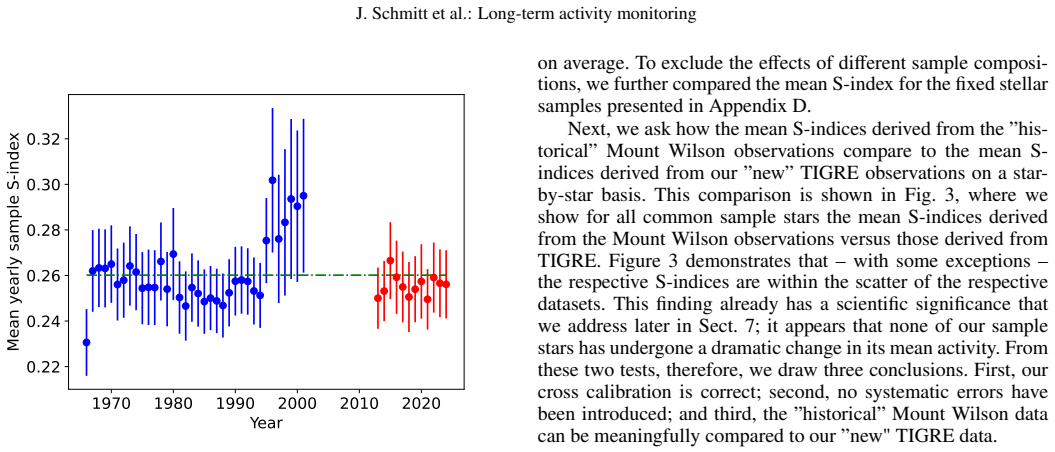
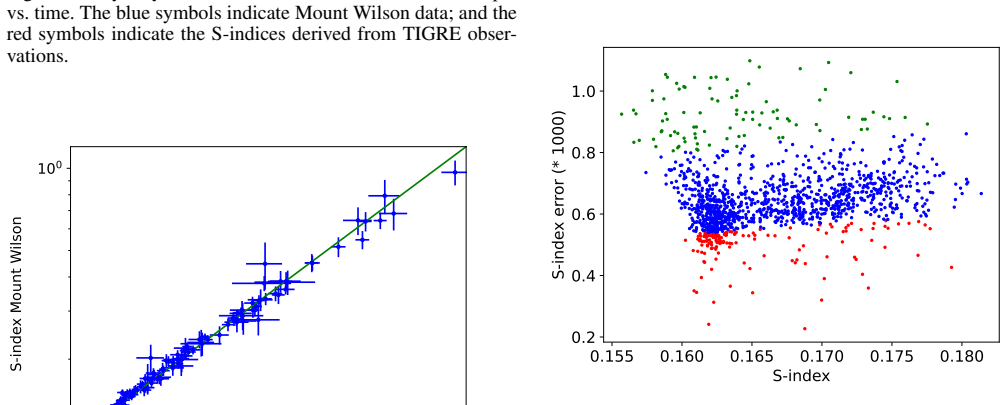
- [Abstract and data-combination description] The central claims on cycle frequency, regularity, and the Sun's position at the low-activity edge rest on the assumption that the Mount Wilson + TIGRE S-index series are free of uncorrected zero-point offsets or slow drifts. The abstract states that the data are 'consistently calibrated,' yet the manuscript provides no explicit overlap statistics, residual scatter after correction, or sensitivity tests showing that cycle grading remains stable under plausible residual offsets (especially near solar S-index levels where cycles are described as marginal).
Simulated Author's Rebuttal
We thank the referee for their detailed review and constructive feedback on our manuscript. We address the major comment point by point below.
read point-by-point responses
-
Referee: [Abstract and data-combination description] The central claims on cycle frequency, regularity, and the Sun's position at the low-activity edge rest on the assumption that the Mount Wilson + TIGRE S-index series are free of uncorrected zero-point offsets or slow drifts. The abstract states that the data are 'consistently calibrated,' yet the manuscript provides no explicit overlap statistics, residual scatter after correction, or sensitivity tests showing that cycle grading remains stable under plausible residual offsets (especially near solar S-index levels where cycles are described as marginal).
Authors: We agree that the presentation of the calibration can be strengthened for greater transparency. The methods section describes the alignment of the Mount Wilson and TIGRE S-index scales using the overlap period on common stars, but we did not include quantitative overlap statistics, rms residuals, or explicit sensitivity tests in the submitted version. We will revise the manuscript to add these elements: the number of overlapping targets, the measured residual scatter after correction, and a short sensitivity analysis confirming that the cycle grades (excellent/good/fair/poor) remain unchanged under offsets comparable to the typical measurement uncertainty. This will be placed in the data-combination subsection and referenced from the abstract. revision: yes
Circularity Check
No circularity: purely observational reporting of calibrated S-index time series and cycle classifications
full rationale
The paper presents combined Mount Wilson and TIGRE S-index time series spanning decades, classifies stellar cycles by quality (excellent/good/fair/poor), and reports empirical correlations between activity level and cycle presence/regularity. No equations, model derivations, fitted parameters renamed as predictions, or self-citation chains appear in the abstract or described content. The analysis relies on direct measurements and visual/qualitative grading rather than any self-referential definitions or reductions to inputs. The calibration consistency noted by the skeptic is an external data-quality assumption, not a circular step in any derivation chain. This is self-contained observational work with no load-bearing mathematical steps that reduce by construction.
Assumptions & free parameters
assumptions (1)
- domain assumption The S-index serves as a reliable, consistently calibrated proxy for chromospheric magnetic activity across instruments and decades.
Cite this review
Pith. "Pith review of Six decades of TIGRE and Mount Wilson chromospheric monitoring in the H and K lines: The quest for an understanding of solar-type activity." pith.science (2026). https://pith.science/paper/BIDUOD3S
@misc{pith2026260626283,
  author       = {Pith},
  title        = {Pith review of: Six decades of TIGRE and Mount Wilson chromospheric monitoring in the H and K lines: The quest for an understanding of solar-type activity},
  year         = {2026},
  howpublished = {\url{https://pith.science/paper/BIDUOD3S}},
  note         = {Machine review of arXiv:2606.26283}
}
read the original abstract
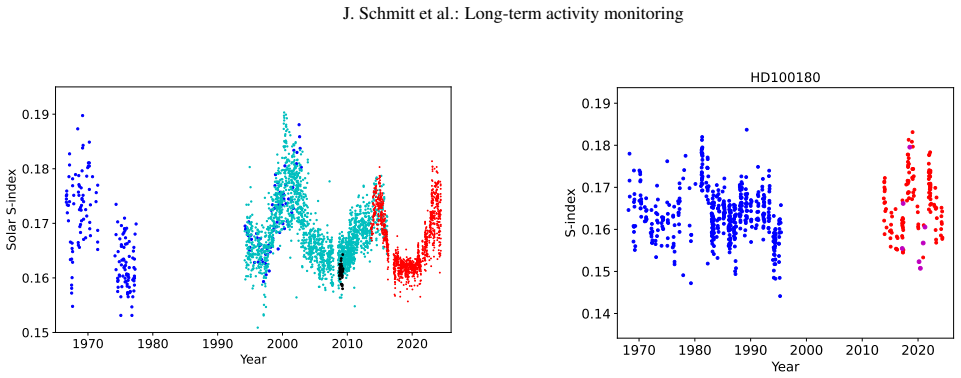
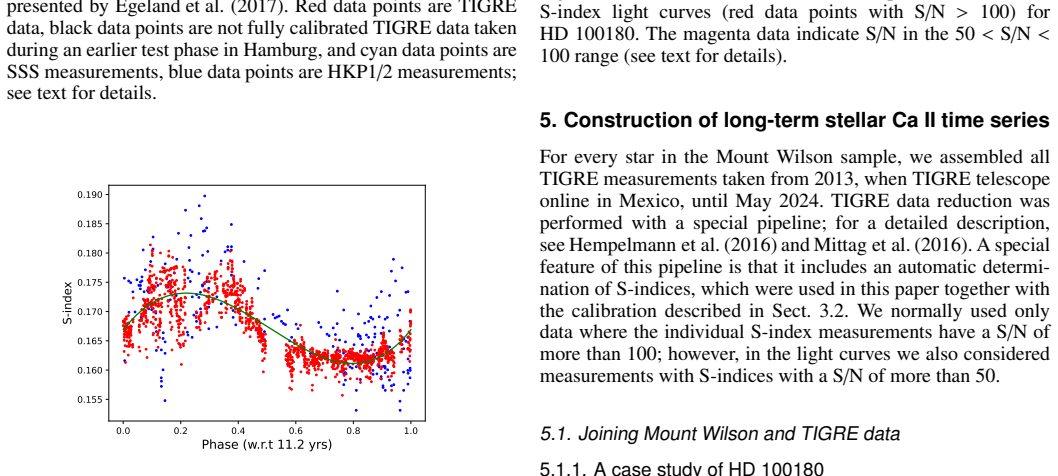
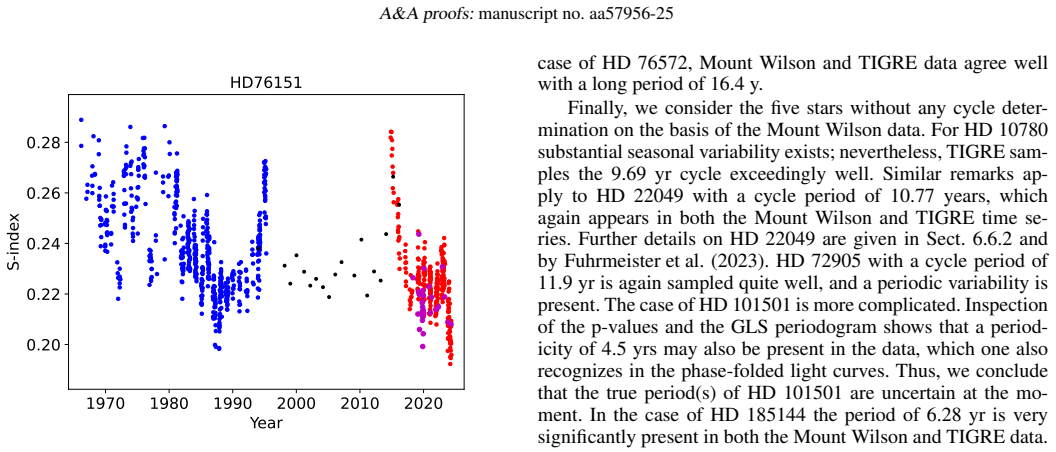
The combined time series of the consistently calibrated chromospheric activity indicator, the S-index -- derived from Mount Wilson and TIGRE data -- now spans more than five decades of monitoring observations of the Sun and of more than one hundred solar-like stars. For the first time, these data allow us to probe the long-term stability of solar-type magnetic cycles as well as their possible transition into other behavioral forms of stellar activity in the time domain. Such variability studies are an important input for solar-stellar connection research and for our empirical understanding of the long-term perspective of solar activity as well as of a wider empirical picture of the coevolution of magnetic activity with stellar structure. We here present and discuss a representative selection of cool main-sequence stars, for which such data are available. The excellent quality of our TIGRE data now more than doubles the number of known cyclic stars. Grading them (i.e., excellent, good, fair, and poor) and putting them into an evolutionary perspective, we find that stars more active than the Sun are also more likely to show cyclic variability than stars below solar activity. Furthermore, more active stars tend to have more regular cycles, while the solar mean S-value fits the lower end of the S-index range found for cyclic stars. This is consistent with the occurrence of solar Maunder minima episodes, hinting at a sometimes already unstable solar cycle. We find eighteen stars with even lower activity and lower variability than the Sun, which provide a preview into the latter's distant future.
Figures

Figures from the paper (12 more)






Forward citations
Cited by 1 Pith paper
-
Something new under the Sun: A magnetically driven CH/CN anti-correlation
The solar magnetic cycle produces a CH/CN anti-correlation in the integrated solar spectrum, which the authors scale up to argue that surface magnetism could mimic globular cluster multi-population signatures.
Reference graph
Works this paper leans on
-
[1]
L., Donahue, R
Baliunas, S. L., Donahue, R. A., Soon, W. H., et al. 1995, ApJ, 438, 269 Baum, A. C., Wright, J. T., Luhn, J. K., & Isaacson, H. 2022, AJ, 163, 183 Binder, B. A., Peacock, S., Schwieterman, E. W., et al. 2024, ApJS, 275, 1 Breakiron, L. A., Dabrowski, J. P., & Gatewood, G. 1975, AJ, 80, 714 Conover, W. J., Johnson, M. E., & Johnson, M. M. 1981, Technometr...
1995
-
[2]
Article number, page 18 J
and suggests it to be a ”coronal hole" star. Article number, page 18 J. Schmitt et al.: Long-term activity monitoring B.5. HD 187013 The case of HD 187013 is also a little more complicated. According to Hempelmann et al. (1996) and Schmitt & Liefke (2004) the star HD 187013 was detected in the ROSAT all-sky survey with an X-ray luminosity of log L X = 28....
1996
Reviewed June 26, 2026 · model on record in the stance chip above.
Discussion (0). Continue with ORCID to comment.