REVIEW 4 major objections 5 minor 97 references
Parallel Sequence Modeling via Generalized Spatial Propagation Network
T0 review · 4 major / 5 minor · reviewed 2026-08-10 · deepseek-v4-flash
Pith's one-line read GSPN claims that row-by-row 2D propagation can replace self-attention for images, cutting the effective sequence length to $\sqrt{N}$ and enabling 16K generation at up to 84x faster inference.
desk verdict Strong empirical architecture with a broken stability proof; referee it but require fixes. read the letter →
The pith
A machine-rendered reading of the paper's core claim, the machinery that carries it, and where it could break.
The reading
What carries the argument
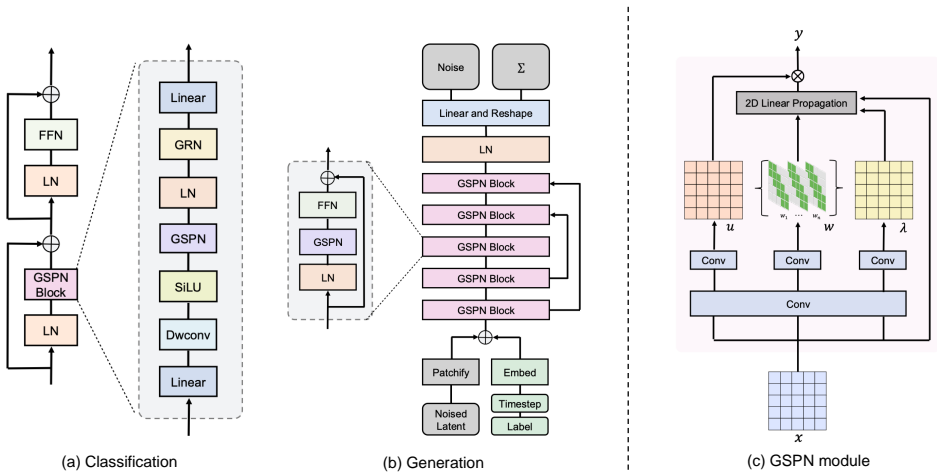
The Stability-Context Condition is the load-bearing mechanism: each propagation matrix $w_\tau$ is made row-stochastic by sigmoid activation followed by row normalization, and the condition asserts that products $W_{ij} = \prod_{\tau=j+1}^{i} w_\tau$ are then row-stochastic (context) with operator norm bounded by 1 (stability). The architecture uses a 3-way tridiagonal connection so that multiplying such matrices over many rows fills in off-diagonal entries and produces dense affinity; the four scanning directions make the pairwise graph complete. This machinery lets GSPN process rows in parallel, reducing the effective sequence length to $\sqrt{N}$, and a learnable merger aggregates the directional information.
What would settle it
Train any GSPN variant and inspect the learned tridiagonal propagation matrices: the Stability-Context Condition predicts that every row-stochastic weight matrix has largest singular value at most 1, in every direction and group configuration. Finding even one trained matrix whose largest singular value exceeds 1 would show that row-stochasticity alone does not deliver the stated stability guarantee, and long-range propagation could amplify rather than preserve signals.
Extended reading notes
Core claim
The discovery, on the paper's own terms, is that a sequence of tridiagonal row-stochastic matrices multiplied together becomes dense while staying row-stochastic, so a row-by-row scan can deliver dense pairwise interactions with only $\mathcal{O}(\sqrt{N})$ sequential steps. GSPN writes each output row as a weighted sum of the current input row and three neighbors in the previous row; because the weights are sigmoid-activated and row-normalized, the accumulated propagation matrices remain row-stochastic. With left-to-right, right-to-left, top-to-bottom, and bottom-to-top scans, each pixel receives connections from all pixels, and a learnable linear merger combines the four directional affinity maps. The paper reports that this design reaches 83.0% ImageNet top-1 accuracy at the tiny scale, 84.3% at base scale, FID 15.26 for GSPN-XL/2 class-conditional generation, and roughly 84x faster SD-XL text-to-image generation at 16K resolution.
Load-bearing premise
The load-bearing premise is that row-normalizing the three-way propagation weights keeps each step from amplifying the hidden state—that is, that the largest singular value of the weight matrix is at most 1—so long-range context accumulates stably.
Editorial extensions
If this is right
- GSPN can replace self-attention in vision architectures without positional embeddings, so the quadratic cost of softmax attention disappears while two-dimensional spatial structure is preserved.
- Effective sequence length drops from $N$ to $\sqrt{N}$ for square maps, and local GSPN reaches $\mathcal{O}(1)$ per-pixel work when each row is its own group, which is what makes 16K-resolution generation possible on a single A100.
- Reported results would make GSPN the strongest sub-quadratic attention alternative on ImageNet classification (83.0% top-1 at tiny scale) and class-conditional diffusion generation (FID 15.26), using fewer parameters than DiT-based rivals at matching FID.
- Because products of row-stochastic matrices are row-stochastic, inference adapts to unseen resolutions without extra normalization, avoiding the resolution-specific tuning that raster-scan state-space baselines need.
- The four-direction line scan plus learnable merger yields dense pairwise connections, so long-range context is available for both classification and generation, not only local texture.
Reading between the lines
- Because the same scan logic applies to any regular grid, a natural extension is to video or volumetric data: stacking planes or frames would reduce the effective sequence length to roughly $N^{1/3}$ for a cube, amplifying the efficiency gain.
- If a future version replaces the eigenvalue-based stability argument with a direct bound on the largest singular value of row-stochastic tridiagonal matrices, the theoretical foundation would extend cleanly to other propagation schemes and norms.
- A testable extension of the stability story is to monitor the largest singular value of trained propagation matrices across layers and directions; if the condition is doing the work, it should remain at or below 1 throughout training.
- The equivalence in Eq. (5) positions GSPN between causal linear attention and 2D recurrent state-space models, suggesting hybrid designs that use row scans for spatial axes and a separate temporal scan for video or long-context multimodal input.
Editorial analysis
A structured set of objections, weighed in public.
Referee Report
Summary. The paper introduces the Generalized Spatial Propagation Network (GSPN), a vision-oriented attention mechanism based on 2D linear propagation with learnable, input-dependent, row-stochastic tridiagonal weights. The authors propose a 'Stability-Context Condition' that, they claim, guarantees stable propagation and dense long-range pairwise connections while reducing the effective sequence length to sqrt(N) for an N-element square map. GSPN is evaluated on ImageNet classification, class-conditional ImageNet generation with DiT-like architectures, and text-to-image generation based on SD-v1.5 and SD-XL. The paper reports state-of-the-art or competitive results (e.g., GSPN-T 83.0% top-1, GSPN-XL/2 FID 15.26) and an over 84x speedup for SD-XL at 16K resolution.
Significance. If the theoretical and empirical claims hold, GSPN would be a practical, sub-quadratic alternative to softmax attention that respects 2D spatial structure, with demonstrated benefits in high-resolution generation. The paper's strengths include a broad experimental evaluation across discriminative and generative tasks, a custom CUDA implementation with reported speed measurements, and a detailed complexity analysis. The central theoretical guarantee, however, rests on a stability proof that is currently incorrect as written, and the headline speedup conflates multiple techniques. The significance of the empirical results is high, but the theoretical foundation needs repair before the claims can be accepted.
major comments (4)
- [Supplementary Section 7.2, Theorem 4] The proof of Theorem 4 uses Gershgorin's Circle Theorem to conclude that for a row-stochastic matrix w_i, the largest singular value satisfies sigma_max <= 1. Gershgorin's theorem bounds eigenvalues, not singular values, and the conclusion is false in general: a non-normal row-stochastic matrix such as [[0,1],[0.5,0.5]] has spectral norm approximately 1.144 > 1. Consequently, the stated norm condition ||w_i|| <= sigma_max <= 1 is not established, and the stability guarantee for the recurrence in Eq. (7) is unproven. The theorem may be repairable by using the infinity norm, since every row-stochastic matrix has unit infinity norm and products of row-stochastic matrices remain row-stochastic with unit infinity norm, but the proof as written is invalid.
- [Section 3.2, Theorem 2] Theorem 2's proof consists solely of a citation to [62] ('Making w_t row stochastic is a sufficient condition to ensure stability presented in [62]'). The paper's central claim relies on this theorem, and the supplementary material purported to provide comprehensive proofs; a self-contained derivation is needed. The later attempt in Section 7.2 does not fill this gap because it contains the flawed Gershgorin-to-singular-value step identified above.
- [Abstract and Section 5.6] The abstract and Section 5.6 state that 'GSPN accelerates SD-XL with softmax-attention by over 84x when generating 16K images.' However, the reported 84x speedup is obtained by building on the DemoFusion pipeline and additionally skipping 60% of the initial denoising steps in the high-resolution stage. These are separate modifications, not intrinsic to replacing softmax attention with GSPN. The paper should report an ablation that isolates the speedup attributable to GSPN alone, and the abstract should be rephrased to avoid attributing the entire speedup to the GSPN mechanism.
- [Section 5.3, Table 2] The text states that 'GSPN-B/2 achieves competitive performance at 20.3% of DiT-XL/2's parameter count.' In Table 2, GSPN-B/2 has FID 28.70, which is substantially worse than DiT-XL/2's FID 20.05 (and worse than all other listed models). Calling this 'competitive' is misleading; the claim should be limited to parameter efficiency, not performance parity.
minor comments (5)
- [Section 3.3] The phrase 'verse-visa' should be 'vice versa'.
- [Supplementary Section 7.2, Eq. (10)] The index 'k ∈ N' in Eq. (10) is ambiguous; it should be clarified as a neighborhood of pixel i (e.g., the three connected pixels in the previous row).
- [Abstract and Section 3.2] The phrase 'reduces the effective sequence length to sqrt(N)' is imprecise: the total number of elements is still N, and the total work is O(Nd). What is reduced is the sequential depth (number of propagation steps), which enables parallel row-wise processing. Consider rewording to 'reduces the sequential propagation depth to sqrt(N)'.
- [Section 5.4, Table 3] The comparison with Linfusion states that GSPN 'matches the performance of Linfusion without using any pretrained weights,' but SD-v1.5-GSPN w/o init has FID 36.89, which is slightly worse than Linfusion's 36.33. The wording should be adjusted to reflect that the gap is small but non-negligible.
- [Supplementary Section 9, Algorithm 1] The CUDA kernel description would benefit from a note on how the row-stochastic constraint is enforced in the gate tensors G1, G2, G3 during the forward pass, since the main text describes the sigmoid-and-normalize procedure in Eq. (6) but the algorithm listing does not show it.
Circularity Check
The Stability-Context Condition's stability guarantee is imported from the authors' SPN paper rather than independently derived; the external empirical benchmarks are not circular.
-
self citation load bearing
[Section 3.2, Theorem 2; Supplementary Section 7.2, Theorem 4]
"Theorem 2. The stability of Eq. (1) is ensured when all matrices wτ are row stochastic. Proof. Making wτ row stochastic is a sufficient condition to ensure stability presented in [62]. See the Appendix for the complete proof. ... Making wτ row stochastic ensures that the norm constraint ∥wi∥ ≤ 1 holds, which provides a sufficient condition for model stability, as presented in [62]."
The load-bearing theoretical claim that row-stochastic propagation matrices guarantee stable long-range propagation is not independently derived in this paper. The main-text proof is a citation to the authors' prior SPN paper [62], and the appendix proof again ends by citing [62]. The cited paper shares authors with the present paper, and the appendix's Gershgorin argument does not supply independent support because Gershgorin bounds eigenvalues, not singular values, so the asserted bound ||wi|| ≤ σmax ≤ 1 does not follow. The stability guarantee is therefore carried by a self-citation rather than by an external, machine-checked, or independently reproduced theorem.
full rationale
The paper's headline performance claims are benchmarked against external datasets and models (ImageNet, COCO, DiT, SD-XL), so there is no fitting-as-prediction circularity, and the line-scan complexity analysis is an architectural consequence rather than a disguised fit. However, the Stability-Context Condition has two halves: Theorem 1, that products of row-stochastic matrices remain row-stochastic, is a valid elementary proof, while Theorem 2, that row-stochasticity implies stability, is justified by citation to the authors' own SPN paper [62]. The appendix's attempted proof conflates Gershgorin eigenvalue bounds with singular-value bounds, so the cited prior work is doing the load-bearing work. This does not make the ImageNet, FID, or speedup results circular, because those are external empirical comparisons, and it does not erase the substantial independent engineering content. It does mean the central theoretical premise is not self-contained. The Gershgorin/singular-value issue is primarily a correctness risk; it is relevant to circularity only as evidence that the stability theorem is not independently proven here. Overall score 4 reflects partial self-citation load-bearing with substantial independent empirical content.
Assumptions & free parameters
free parameters (3)
- Local GSPN group size g =
2
- High-resolution denoising step skip fraction =
60%
- Distillation loss weights =
0.5, 0.5
assumptions (4)
- standard math Row-stochastic propagation matrices w_t ensure stability via sigma_max(w_t) <= 1.
- ad hoc to paper The 3-way tridiagonal connection is the minimal structure whose products become dense.
- domain assumption Sigmoid plus row normalization produces weights satisfying the Stability-Context Condition.
- domain assumption Positional information is fully encoded by the scan order, so positional embeddings can be removed.
Cite this review
Pith. "Pith review of Parallel Sequence Modeling via Generalized Spatial Propagation Network." pith.science (2026). https://pith.science/paper/BIN6XPLA
@misc{pith2026250112381,
  author       = {Pith},
  title        = {Pith review of: Parallel Sequence Modeling via Generalized Spatial Propagation Network},
  year         = {2026},
  howpublished = {\url{https://pith.science/paper/BIN6XPLA}},
  note         = {Machine review of arXiv:2501.12381}
}
abstract
We present the Generalized Spatial Propagation Network (GSPN), a new attention mechanism optimized for vision tasks that inherently captures 2D spatial structures. Existing attention models, including transformers, linear attention, and state-space models like Mamba, process multi-dimensional data as 1D sequences, compromising spatial coherence and efficiency. GSPN overcomes these limitations by directly operating on spatially coherent image data and forming dense pairwise connections through a line-scan approach. Central to GSPN is the Stability-Context Condition, which ensures stable, context-aware propagation across 2D sequences and reduces the effective sequence length to $\sqrt{N}$ for a square map with N elements, significantly enhancing computational efficiency. With learnable, input-dependent weights and no reliance on positional embeddings, GSPN achieves superior spatial fidelity and state-of-the-art performance in vision tasks, including ImageNet classification, class-guided image generation, and text-to-image generation. Notably, GSPN accelerates SD-XL with softmax-attention by over $84\times$ when generating 16K images.
Figures


Figures from the paper (8 more)


Reference graph
Works this paper leans on
-
[62]
Learning affinity via spatial propagation networks
Sifei Liu, Shalini De Mello, Jinwei Gu, Guangyu Zhong, Ming-Hsuan Yang, and Jan Kautz. Learning affinity via spatial propagation networks. NeurIPS, 2017. 2, 3, 4, 5, 8
work page 2017
-
[1]
Xcit: Cross-covariance image transformers
Alaaeldin Ali, Hugo Touvron, Mathilde Caron, Piotr Bo- janowski, Matthijs Douze, Armand Joulin, Ivan Laptev, Na- talia Neverova, Gabriel Synnaeve, Jakob Verbeek, et al. Xcit: Cross-covariance image transformers. Advances in neural information processing systems, 2021. 2
2021
-
[2]
Vision-lstm: xlstm as generic vision backbone
Benedikt Alkin, Maximilian Beck, Korbinian P¨oppel, Sepp Hochreiter, and Johannes Brandstetter. Vision-lstm: xlstm as generic vision backbone. arXiv preprint arXiv: 2406.04303,
-
[3]
Jimmy Lei Ba, Jamie Ryan Kiros, and Geoffrey E Hinton. Layer normalization. arXiv preprint arXiv:1607.06450, 2016. 4
arXiv 2016
-
[4]
Exploring alternatives to softmax function
Kunal Banerjee, Rishi Raj Gupta, Karthik Vyas, Biswajit Mishra, et al. Exploring alternatives to softmax function. arXiv preprint arXiv:2011.11538, 2020. 2
arXiv 2011
-
[5]
All are worth words: A vit backbone for diffusion models
Fan Bao, Shen Nie, Kaiwen Xue, Yue Cao, Chongxuan Li, Hang Su, and Jun Zhu. All are worth words: A vit backbone for diffusion models. In Proceedings of the IEEE/CVF Con- ference on Computer Vision and Pattern Recognition, 2023. 7
2023
-
[6]
Multidiffusion: Fusing diffusion paths for controlled image generation
Omer Bar-Tal, Lior Yariv, Yaron Lipman, and Tali Dekel. Multidiffusion: Fusing diffusion paths for controlled image generation. In ICML, 2023. 8
2023
-
[7]
2-d ssm: A general spatial layer for visual transformers
Ethan Baron, Itamar Zimerman, and Lior Wolf. 2-d ssm: A general spatial layer for visual transformers. arXiv preprint arXiv:2306.06635, 2023. 2
arXiv 2023
Show all 97 references
-
[8]
Language models are few-shot learners
Tom B Brown. Language models are few-shot learners. arXiv preprint arXiv:2005.14165, 2020. 1
2005 arXiv
-
[9]
Scene labeling with lstm recurrent neural net- works
Wonmin Byeon, Thomas M Breuel, Federico Raue, and Mar- cus Liwicki. Scene labeling with lstm recurrent neural net- works. In CVPR, 2015. 2
2015
-
[10]
End-to- end object detection with transformers
Nicolas Carion, Francisco Massa, Gabriel Synnaeve, Nicolas Usunier, Alexander Kirillov, and Sergey Zagoruyko. End-to- end object detection with transformers. In European confer- ence on computer vision, 2020. 1, 2
2020
-
[11]
Emerg- ing properties in self-supervised vision transformers
Mathilde Caron, Hugo Touvron, Ishan Misra, Herv´e J´egou, Julien Mairal, Piotr Bojanowski, and Armand Joulin. Emerg- ing properties in self-supervised vision transformers. ICCV,
-
[12]
Pixart- \α: Fast training of diffusion transformer for photorealistic text-to-image synthesis
Junsong Chen, Jincheng Yu, Chongjian Ge, Lewei Yao, Enze Xie, Yue Wu, Zhongdao Wang, James Kwok, Ping Luo, Huchuan Lu, et al. Pixart- \α: Fast training of diffusion transformer for photorealistic text-to-image synthesis. arXiv preprint arXiv:2310.00426, 2023. 7
-
[13]
Generating long sequences with sparse transformers
Rewon Child, Scott Gray, Alec Radford, and Ilya Sutskever. Generating long sequences with sparse transformers. arXiv preprint arXiv:1904.10509, 2019. 2
1904 arXiv
-
[14]
Xception: Deep learning with depthwise separable convolutions
Franc ¸ois Chollet. Xception: Deep learning with depthwise separable convolutions. In CVPR, 2017. 4
2017
-
[15]
Rethink- ing attention with performers
Krzysztof Choromanski, Valerii Likhosherstov, David Dohan, Xingyou Song, Andreea Gane, Tamas Sarlos, Peter Hawkins, Jared Davis, Afroz Mohiuddin, Lukasz Kaiser, et al. Rethink- ing attention with performers. In ICLR, 2021. 1, 2
2021
-
[16]
Twins: Re- visiting the design of spatial attention in vision transformers
Xiangxiang Chu, Zhi Tian, Yuqing Wang, Bo Zhang, Haibing Ren, Xiaolin Wei, Huaxia Xia, and Chunhua Shen. Twins: Re- visiting the design of spatial attention in vision transformers. NeurIPS, 2021. 6
2021
-
[17]
Empirical evaluation of gated recurrent neural networks on sequence modeling
Junyoung Chung, Caglar Gulcehre, KyungHyun Cho, and Yoshua Bengio. Empirical evaluation of gated recurrent neural networks on sequence modeling. In NeurIPS, 2014. 2
2014
-
[18]
Coatnet: Marrying convolution and attention for all data sizes
Zihang Dai, Hanxiao Liu, Quoc V Le, and Mingxing Tan. Coatnet: Marrying convolution and attention for all data sizes. NeurIPS, 2021. 2, 6, 7
2021
-
[19]
Transformers are ssms: Generalized models and efficient algorithms through structured state space duality
Tri Dao and Albert Gu. Transformers are ssms: Generalized models and efficient algorithms through structured state space duality. In ICML, 2024. 7
2024
-
[20]
Vision transformers need registers
Timoth´ee Darcet, Maxime Oquab, Julien Mairal, and Piotr Bojanowski. Vision transformers need registers. In ICLR,
-
[21]
Imagenet: A large-scale hierarchical image database
Jia Deng, Wei Dong, Richard Socher, Li-Jia Li, Kai Li, and Li Fei-Fei. Imagenet: A large-scale hierarchical image database. In CVPR, 2009. 6
2009
-
[22]
Diffusion models beat gans on image synthesis
Prafulla Dhariwal and Alexander Nichol. Diffusion models beat gans on image synthesis. Advances in neural information processing systems, 2021. 7
2021
-
[23]
Cswin transformer: A general vision transformer backbone with cross-shaped windows
Xiaoyi Dong, Jianmin Bao, Dongdong Chen, Weiming Zhang, Nenghai Yu, Lu Yuan, Dong Chen, and Baining Guo. Cswin transformer: A general vision transformer backbone with cross-shaped windows. In CVPR, 2022. 6, 7
2022
-
[24]
An image is worth 16x16 words: Trans- formers for image recognition at scale
Alexey Dosovitskiy, Lucas Beyer, Alexander Kolesnikov, Dirk Weissenborn, Xiaohua Zhai, Thomas Unterthiner, Mostafa Dehghani, Matthias Minderer, Georg Heigold, Syl- vain Gelly, et al. An image is worth 16x16 words: Trans- formers for image recognition at scale. In ICLR, 2020. 1, 2 10
2020
-
[25]
Demofusion: Democratising high- resolution image generation with no $$$
Ruoyi Du, Dongliang Chang, Timothy Hospedales, Yi-Zhe Song, and Zhanyu Ma. Demofusion: Democratising high- resolution image generation with no $$$. In CVPR, 2024. 8
2024
-
[26]
Vision-rwkv: Efficient and scalable visual per- ception with rwkv-like architectures
Yuchen Duan, Weiyun Wang, Zhe Chen, Xizhou Zhu, Lewei Lu, Tong Lu, Yu Qiao, Hongsheng Li, Jifeng Dai, and Wen- hai Wang. Vision-rwkv: Efficient and scalable visual per- ception with rwkv-like architectures. arXiv preprint arXiv: 2403.02308, 2024. 6, 7
2024 arXiv
-
[27]
Sigmoid- weighted linear units for neural network function approxi- mation in reinforcement learning
Stefan Elfwing, Eiji Uchibe, and Kenji Doya. Sigmoid- weighted linear units for neural network function approxi- mation in reinforcement learning. Neural networks, 2018. 4
2018
-
[28]
Hungry hungry hippos: Towards language modeling with state space models
Daniel Y Fu, Tri Dao, Khaled K Saab, Armin W Thomas, Atri Rudra, and Christopher R´e. Hungry hungry hippos: Towards language modeling with state space models. In ICLR, 2023. 2
2023
-
[29]
Levit: a vision transformer in convnet’s clothing for faster inference
Benjamin Graham, Alaaeldin El-Nouby, Hugo Touvron, Pierre Stock, Armand Joulin, Herv ´e J ´egou, and Matthijs Douze. Levit: a vision transformer in convnet’s clothing for faster inference. In Proceedings of the IEEE/CVF Interna- tional Conference on Computer Vision, pages 12259–12269,
-
[30]
Multi-dimensional recurrent neural networks
Alex Graves, Santiago Fern´andez, and J¨urgen Schmidhuber. Multi-dimensional recurrent neural networks. InInternational conference on artificial neural networks, 2007. 2
2007
-
[31]
Mamba: Linear-time sequence modeling with selective state spaces
Albert Gu and Tri Dao. Mamba: Linear-time sequence modeling with selective state spaces. arXiv preprint arXiv:2312.00752, 2023. 1, 2, 6, 7
2023 arXiv
-
[32]
Elasticdiffusion: Training-free arbitrary size image generation through global-local content separation
Moayed Haji-Ali, Guha Balakrishnan, and Vicente Ordonez. Elasticdiffusion: Training-free arbitrary size image generation through global-local content separation. In CVPR, 2024. 8
2024
-
[33]
Flatten transformer: Vision transformer using focused linear attention
Dongchen Han, Xuran Pan, Yizeng Han, Shiji Song, and Gao Huang. Flatten transformer: Vision transformer using focused linear attention. In Proceedings of the IEEE/CVF international conference on computer vision , pages 5961– 5971, 2023. 1
2023
-
[34]
Mambavision: A hybrid mamba-transformer vision backbone
Ali Hatamizadeh and Jan Kautz. Mambavision: A hybrid mamba-transformer vision backbone. arXiv preprint arXiv: 2407.08083, 2024. 6
2024 arXiv
-
[35]
Zhang, Shaoqing Ren, and Jian Sun
Kaiming He, X. Zhang, Shaoqing Ren, and Jian Sun. Deep residual learning for image recognition. In CVPR, 2016. 2
2016
-
[36]
Scalecrafter: Tuning-free higher- resolution visual generation with diffusion models
Yingqing He, Shaoshu Yang, Haoxin Chen, Xiaodong Cun, Menghan Xia, Yong Zhang, Xintao Wang, Ran He, Qifeng Chen, and Ying Shan. Scalecrafter: Tuning-free higher- resolution visual generation with diffusion models. In ICLR,
-
[37]
Gaussian error linear units (gelus)
Dan Hendrycks and Kevin Gimpel. Gaussian error linear units (gelus). arxiv. arXiv preprint arXiv:1606.08415, 2016. 4
2016 arXiv
-
[38]
Tenenbaum, Kfir Aberman, Y
Amir Hertz, Ron Mokady, J. Tenenbaum, Kfir Aberman, Y . Pritch, and D. Cohen-Or. Prompt-to-prompt image editing with cross attention control. ICLR, 2022. 2
2022
-
[39]
Gans trained by a two time-scale update rule converge to a local nash equilibrium
Martin Heusel, Hubert Ramsauer, Thomas Unterthiner, Bern- hard Nessler, and Sepp Hochreiter. Gans trained by a two time-scale update rule converge to a local nash equilibrium. NeurIPS, 2017. 7
2017
-
[40]
Classifier-free diffusion guidance
Jonathan Ho and Tim Salimans. Classifier-free diffusion guidance. In NeurIPS Workshop on Deep Generative Models and Downstream Applications, 2022. 7
2022
-
[41]
Axial attention in multidimensional transformers
Jonathan Ho, Nal Kalchbrenner, Dirk Weissenborn, and Tim Salimans. Axial attention in multidimensional transformers. arXiv preprint arXiv:1912.12180, 2019. 2
1912 arXiv
-
[42]
Untersuchungen zu dynamischen neu- ronalen netzen
Sepp Hochreiter. Untersuchungen zu dynamischen neu- ronalen netzen. Diploma, Technische Universit¨at M¨unchen,
-
[43]
Long short-term memory
S Hochreiter. Long short-term memory. Neural Computation MIT-Press, 1997. 2
1997
-
[44]
Trans- former quality in linear time
Weizhe Hua, Zihang Dai, Hanxiao Liu, and Quoc Le. Trans- former quality in linear time. In ICML, 2022. 2
2022
-
[45]
Fouriscale: A frequency perspective on training-free high-resolution image synthesis
Linjiang Huang, Rongyao Fang, Aiping Zhang, Guanglu Song, Si Liu, Yu Liu, and Hongsheng Li. Fouriscale: A frequency perspective on training-free high-resolution image synthesis. arXiv preprint arXiv:2403.12963, 2024. 8
2024 arXiv
-
[46]
Localmamba: Visual state space model with windowed selective scan
Tao Huang, Xiaohuan Pei, Shan You, Fei Wang, Chen Qian, and Chang Xu. Localmamba: Visual state space model with windowed selective scan. arXiv preprint arXiv:2403.09338,
-
[47]
Transformers are rnns: Fast autoregressive transformers with linear attention
Angelos Katharopoulos, Apoorv Vyas, Nikolaos Pappas, and Franc ¸ois Fleuret. Transformers are rnns: Fast autoregressive transformers with linear attention. In ICML, 2020. 1, 2, 3
2020
-
[48]
Bk-sdm: Architecturally compressed stable diffusion for efficient text-to-image generation
Bo-Kyeong Kim, Hyoung-Kyu Song, Thibault Castells, and Shinkook Choi. Bk-sdm: Architecturally compressed stable diffusion for efficient text-to-image generation. In Workshop on Efficient Systems for Foundation Models@ ICML2023 ,
-
[49]
Re- former: The efficient transformer
Nikita Kitaev, Łukasz Kaiser, and Anselm Levskaya. Re- former: The efficient transformer. In ICLR, 2020. 2
2020
-
[50]
Chatgpt: Jack of all trades, master of none
Jan Koco ´n, Igor Cichecki, Oliwier Kaszyca, Mateusz Kochanek, Dominika Szydło, Joanna Baran, Julita Bielaniewicz, Marcin Gruza, Arkadiusz Janz, Kamil Kan- clerz, et al. Chatgpt: Jack of all trades, master of none. Information Fusion, 2023. 1
2023
-
[51]
Im- agenet classification with deep convolutional neural networks
Alex Krizhevsky, Ilya Sutskever, and Geoffrey E Hinton. Im- agenet classification with deep convolutional neural networks. NeurIPS, 2012. 2
2012
-
[52]
Improved precision and recall metric for assessing generative models
Tuomas Kynk¨a¨anniemi, Tero Karras, Samuli Laine, Jaakko Lehtinen, and Timo Aila. Improved precision and recall metric for assessing generative models. In NeurIPS, 2019. 7
2019
-
[53]
Next-vit: Next generation vision transformer for efficient deployment in real- istic industrial scenarios
Jiashi Li, Xin Xia, Wei Li, Huixia Li, Xing Wang, Xuefeng Xiao, Rui Wang, Min Zheng, and Xin Pan. Next-vit: Next generation vision transformer for efficient deployment in real- istic industrial scenarios. arXiv preprint arXiv:2207.05501,
-
[54]
Savarese, and Steven C
Junnan Li, Dongxu Li, S. Savarese, and Steven C. H. Hoi. Blip-2: Bootstrapping language-image pre-training with frozen image encoders and large language models. ICML,
-
[55]
Uniformer: Unified transformer for efficient spatiotemporal representation learning
Kunchang Li, Yali Wang, Peng Gao, Guanglu Song, Yu Liu, Hongsheng Li, and Yu Qiao. Uniformer: Unified transformer for efficient spatiotemporal representation learning. In ICLR,
-
[56]
Distrifusion: Distributed parallel inference for high-resolution diffusion models
Muyang Li, Tianle Cai, Jiaxin Cao, Qinsheng Zhang, Han Cai, Junjie Bai, Yangqing Jia, Kai Li, and Song Han. Distrifusion: Distributed parallel inference for high-resolution diffusion models. In CVPR, 2024. 8 11
2024
-
[57]
Mamba-nd: Selective state space modeling for multi-dimensional data
Shufan Li, Harkanwar Singh, and Aditya Grover. Mamba-nd: Selective state space modeling for multi-dimensional data. arXiv preprint arXiv:2402.05892, 2024. 2, 6, 7
2024 arXiv
-
[58]
Cutdiffusion: A simple, fast, cheap, and strong diffusion extrapolation method
Mingbao Lin, Zhihang Lin, Wengyi Zhan, Liujuan Cao, and Rongrong Ji. Cutdiffusion: A simple, fast, cheap, and strong diffusion extrapolation method. arXiv preprint arXiv:2404.15141, 2024. 8
2024 arXiv
-
[59]
Microsoft coco: Common objects in context
Tsung-Yi Lin, Michael Maire, Serge Belongie, James Hays, Pietro Perona, Deva Ramanan, Piotr Doll´ar, and C Lawrence Zitnick. Microsoft coco: Common objects in context. In ECCV, 2014. 6
2014
-
[60]
Ac- cdiffusion: An accurate method for higher-resolution image generation
Zhihang Lin, Mingbao Lin, Meng Zhao, and Rongrong Ji. Ac- cdiffusion: An accurate method for higher-resolution image generation. arXiv preprint arXiv:2407.10738, 2024. 8
2024 arXiv
-
[61]
Transformer-vq: Linear-time transformers via vector quantization
Lucas D Lingle. Transformer-vq: Linear-time transformers via vector quantization. In ICLR, 2024. 2
2024
-
[63]
Linfusion: 1 gpu, 1 minute, 16k image
Songhua Liu, Weihao Yu, Zhenxiong Tan, and Xinchao Wang. Linfusion: 1 gpu, 1 minute, 16k image. arXiv preprint arXiv:2409.02097, 2024. 7, 8
2024 arXiv
-
[64]
Vmamba: Visual state space model
Yue Liu, Yunjie Tian, Yuzhong Zhao, Hongtian Yu, Lingxi Xie, Yaowei Wang, Qixiang Ye, and Yunfan Liu. Vmamba: Visual state space model. arXiv preprint arXiv:2401.10166,
-
[65]
Swin transformer: Hierarchical vision transformer using shifted windows
Ze Liu, Yutong Lin, Yue Cao, Han Hu, Yixuan Wei, Zheng Zhang, Stephen Lin, and Baining Guo. Swin transformer: Hierarchical vision transformer using shifted windows. In ICCV, 2021. 1, 2, 4, 6, 7
2021
-
[66]
A convnet for the 2020s
Zhuang Liu, Hanzi Mao, Chao-Yuan Wu, Christoph Feicht- enhofer, Trevor Darrell, and Saining Xie. A convnet for the 2020s. In CVPR, 2022. 2, 4, 6, 7
2022
-
[67]
Soft: Softmax-free transformer with linear complexity
Jiachen Lu, Jinghan Yao, Junge Zhang, Xiatian Zhu, Hang Xu, Weiguo Gao, Chunjing Xu, Tao Xiang, and Li Zhang. Soft: Softmax-free transformer with linear complexity. NeurIPS,
-
[68]
Sit: Exploring flow and diffusion-based generative models with scalable interpolant transformers
Nanye Ma, Mark Goldstein, Michael S Albergo, Nicholas M Boffi, Eric Vanden-Eijnden, and Saining Xie. Sit: Exploring flow and diffusion-based generative models with scalable interpolant transformers. In ECCV, 2024. 7
2024
-
[69]
Sdedit: Guided image synthesis and editing with stochastic differential equations
Chenlin Meng, Yutong He, Yang Song, Jiaming Song, Jiajun Wu, Jun-Yan Zhu, and Stefano Ermon. Sdedit: Guided image synthesis and editing with stochastic differential equations. arXiv preprint arXiv:2108.01073, 2021. 4, 8
2021 arXiv
-
[70]
Generating images with sparse representations
Charlie Nash, Jacob Menick, Sander Dieleman, and Peter W Battaglia. Generating images with sparse representations. arXiv preprint arXiv:2103.03841, 2021. 7
2021 arXiv
-
[71]
S4nd: Modeling images and videos as multidimensional signals with state spaces
Eric Nguyen, Karan Goel, Albert Gu, Gordon Downs, Preey Shah, Tri Dao, Stephen Baccus, and Christopher R´e. S4nd: Modeling images and videos as multidimensional signals with state spaces. NeurIPS, 2022. 2
2022
-
[72]
On aliased resizing and surprising subtleties in gan evaluation
Gaurav Parmar, Richard Zhang, and Jun-Yan Zhu. On aliased resizing and surprising subtleties in gan evaluation. In CVPR,
-
[73]
On the difficulty of training recurrent neural networks
Razvan Pascanu, Tomas Mikolov, and Yoshua Bengio. On the difficulty of training recurrent neural networks. In ICML,
-
[74]
Scalable diffusion models with transformers
William Peebles and Saining Xie. Scalable diffusion models with transformers. In ICCV, 2023. 1, 5, 7, 8
2023
-
[75]
Random feature attention
Hao Peng, Nikolaos Pappas, Dani Yogatama, Roy Schwartz, Noah A Smith, and Lingpeng Kong. Random feature attention. arXiv preprint arXiv:2103.02143, 2021. 1, 2
2021 arXiv
-
[76]
Self-attention does not need o(n2) memory
Markus N Rabe and Charles Staats. Self-attention does not need o(n2) memory. arXiv preprint arXiv:2112.05682, 2021. 1
2021 arXiv
-
[77]
High-resolution image synthesis with latent diffusion models
Robin Rombach, Andreas Blattmann, Dominik Lorenz, Patrick Esser, and Bj ¨orn Ommer. High-resolution image synthesis with latent diffusion models. In Proceedings of the IEEE/CVF conference on computer vision and pattern recognition, 2022. 7, 8
2022
-
[78]
Improved techniques for training gans
Tim Salimans, Ian Goodfellow, Wojciech Zaremba, Vicki Cheung, Alec Radford, and Xi Chen. Improved techniques for training gans. In NeurIPS, 2016. 7
2016
-
[79]
Laion-5b: An open large-scale dataset for training next gener- ation image-text models
Christoph Schuhmann, Romain Beaumont, Richard Vencu, Cade Gordon, Ross Wightman, Mehdi Cherti, Theo Coombes, Aarush Katta, Clayton Mullis, Mitchell Wortsman, et al. Laion-5b: An open large-scale dataset for training next gener- ation image-text models. NeurIPS, 2022. 6
2022
-
[80]
Efficient attention: Attention with linear complexities
Zhuoran Shen, Mingyuan Zhang, Haiyu Zhao, Shuai Yi, and Hongsheng Li. Efficient attention: Attention with linear complexities. In WACV, 2021. 2
2021
-
[81]
Roformer: Enhanced transformer with rotary position embedding
Jianlin Su, Murtadha Ahmed, Yu Lu, Shengfeng Pan, Wen Bo, and Yunfeng Liu. Roformer: Enhanced transformer with rotary position embedding. Neurocomputing, 2024. 6
2024
-
[82]
Training data-efficient image transformers & distillation through atten- tion
Hugo Touvron, Matthieu Cord, Matthijs Douze, Francisco Massa, Alexandre Sablayrolles, and Herv´e J´egou. Training data-efficient image transformers & distillation through atten- tion. In ICML, 2021. 1, 2, 6, 7
2021
-
[83]
Llama: Open and efficient foundation language models.arXiv preprint arXiv:2302.13971, 2023
Hugo Touvron, Thibaut Lavril, Gautier Izacard, Xavier Mar- tinet, Marie-Anne Lachaux, Timoth ´ee Lacroix, Baptiste Rozi`ere, Naman Goyal, Eric Hambro, Faisal Azhar, et al. Llama: Open and efficient foundation language models.arXiv preprint arXiv:2302.13971, 2023. 1
2023 arXiv
-
[84]
Pixel recurrent neural networks
A¨aron Van Den Oord, Nal Kalchbrenner, and Koray Kavukcuoglu. Pixel recurrent neural networks. In ICML,
-
[85]
Attention is all you need
A Vaswani. Attention is all you need. NeurIPS, 2017. 4, 6
2017
-
[86]
Linformer: Self-attention with linear complexity
Sinong Wang, Belinda Z Li, Madian Khabsa, Han Fang, and Hao Ma. Linformer: Self-attention with linear complexity. arXiv preprint arXiv:2006.04768, 2020. 2
2006 arXiv
-
[87]
Pyra- mid vision transformer: A versatile backbone for dense pre- diction without convolutions
Wenhai Wang, Enze Xie, Xiang Li, Deng-Ping Fan, Kaitao Song, Ding Liang, Tong Lu, Ping Luo, and Ling Shao. Pyra- mid vision transformer: A versatile backbone for dense pre- diction without convolutions. In ICCV, 2021. 2, 4
2021
-
[88]
Con- vnext v2: Co-designing and scaling convnets with masked autoencoders
Sanghyun Woo, Shoubhik Debnath, Ronghang Hu, Xinlei Chen, Zhuang Liu, In So Kweon, and Saining Xie. Con- vnext v2: Co-designing and scaling convnets with masked autoencoders. In CVPR, 2023. 4
2023
-
[89]
Cvt: Introducing convolutions to vision transformers
Haiping Wu, Bin Xiao, Noel Codella, Mengchen Liu, Xiyang Dai, Lu Yuan, and Lei Zhang. Cvt: Introducing convolutions to vision transformers. In Proceedings of the IEEE/CVF International Conference on Computer Vision (ICCV), 2021. 2
2021
-
[90]
Lite transformer with long-short range attention
Zhanghao Wu, Zhijian Liu, Ji Lin, Yujun Lin, and Song Han. Lite transformer with long-short range attention. In ICLR,
-
[91]
Nystr¨omformer: A nystr ¨om-based algorithm for approximat- ing self-attention
Yunyang Xiong, Zhanpeng Zeng, Rudrasis Chakraborty, Mingxing Tan, Glenn Fung, Yin Li, and Vikas Singh. Nystr¨omformer: A nystr ¨om-based algorithm for approximat- ing self-attention. In AAAI, 2021. 2
2021
-
[92]
Focal modulation networks
Jianwei Yang, Chunyuan Li, Xiyang Dai, and Jianfeng Gao. Focal modulation networks. NeurIPS, 2022. 6
2022
-
[93]
Emernerf: Emergent spatial- temporal scene decomposition via self-supervision
Jiawei Yang, Boris Ivanovic, Or Litany, Xinshuo Weng, Se- ung Wook Kim, Boyi Li, Tong Che, Danfei Xu, Sanja Fidler, Marco Pavone, and Yue Wang. Emernerf: Emergent spatial- temporal scene decomposition via self-supervision. arXiv preprint arXiv:2311.02077, 2023. 2, 6
2023 arXiv
-
[94]
Mambaout: Do we really need mamba for vision? arXiv preprint arXiv:2405.07992,
Weihao Yu and Xinchao Wang. Mambaout: Do we really need mamba for vision? arXiv preprint arXiv:2405.07992,
-
[95]
Tay, Jiashi Feng, and Shuicheng Yan
Li Yuan, Yunpeng Chen, Tao Wang, Weihao Yu, Yujun Shi, Zi-Hang Jiang, Francis E.H. Tay, Jiashi Feng, and Shuicheng Yan. Tokens-to-token vit: Training vision transformers from scratch on imagenet. In ICCV, 2021. 6
2021
-
[96]
Biformer: Vision transformer with bi-level routing attention
Lei Zhu, Xinjiang Wang, Zhanghan Ke, Wayne Zhang, and Rynson Lau. Biformer: Vision transformer with bi-level routing attention. CVPR, 2023. 2
2023
-
[97]
Vision mamba: Efficient visual representation learning with bidirectional state space model
Lianghui Zhu, Bencheng Liao, Qian Zhang, Xinlong Wang, Wenyu Liu, and Xinggang Wang. Vision mamba: Efficient visual representation learning with bidirectional state space model. arXiv preprint arXiv:2401.09417, 2024. 2, 6 13
2024 arXiv
Reviewed August 10, 2026 · model on record in the stance chip above.
Discussion (0). Continue with ORCID to comment.