Extracting the physical content of Liouvillian eigenmodes: Semiclassical quantization
Pith reviewed 2026-06-26 16:46 UTC · model grok-4.3
The pith
A quasiprobability measure from right and left Liouvillian eigenstates reveals quantized phase-space orbits in damped oscillators.
A machine-rendered reading of the paper's core claim, the machinery that carries it, and where it could break.
Core claim
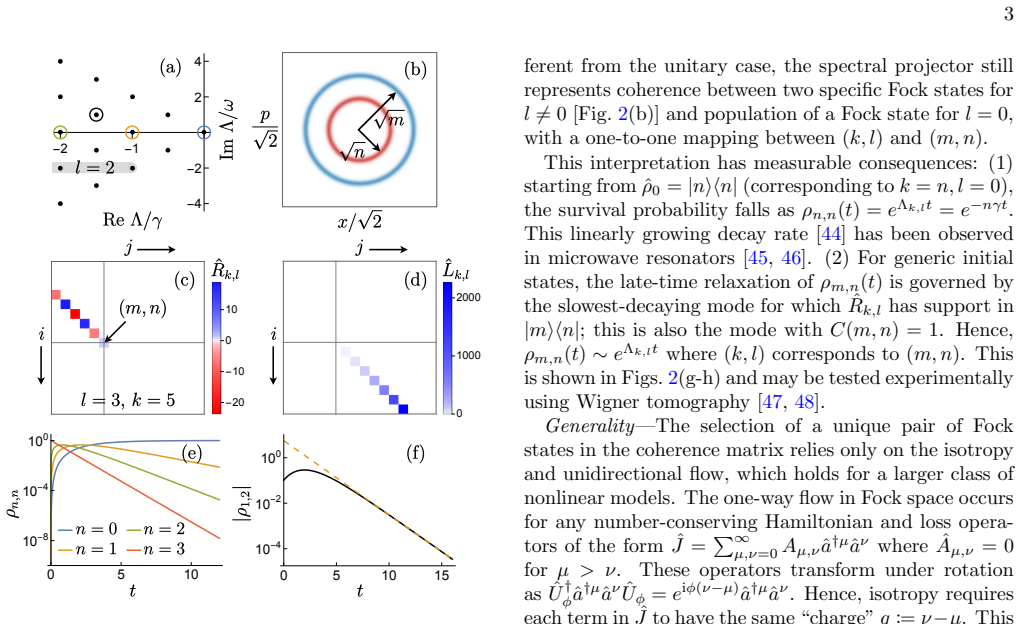
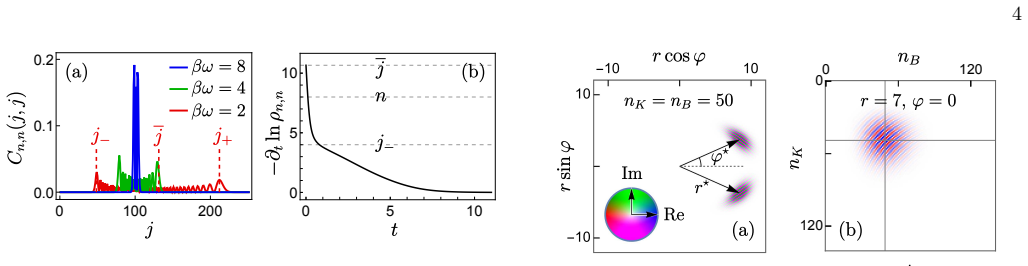
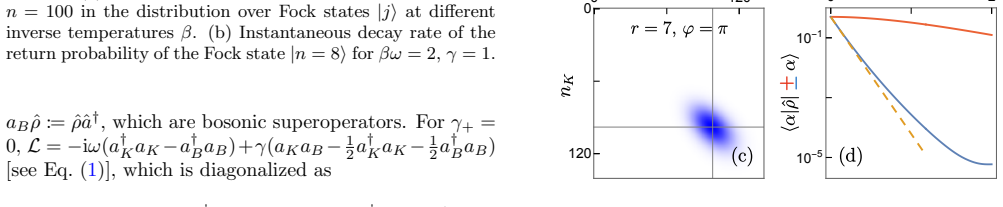
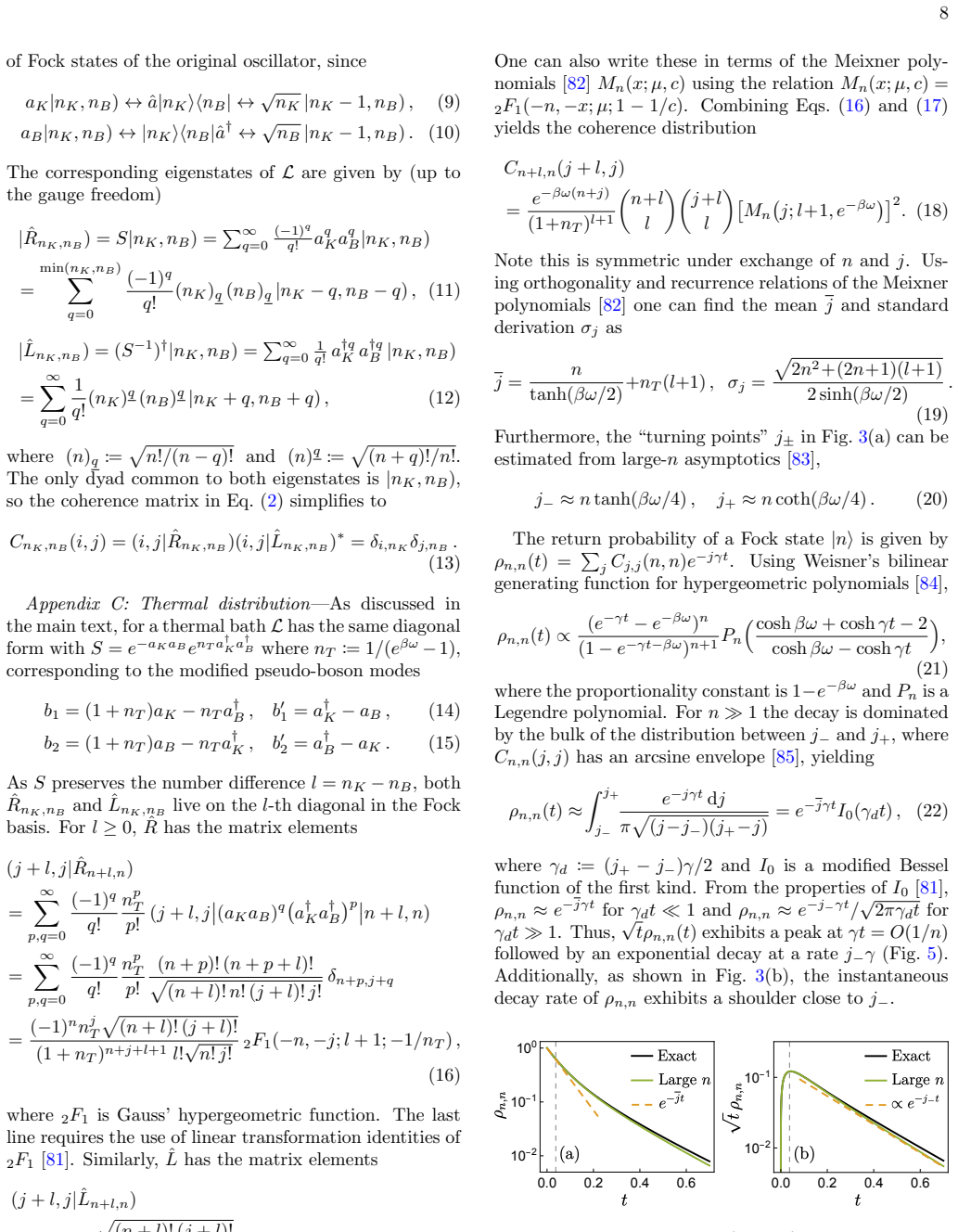
By defining a quasiprobability measure from the right and left eigenstates, Liouville eigenmodes are interpreted as coherences whose distributions in doubled phase space show that oscillators retain quantized orbits for a large class of damping, extending semiclassical quantization and the concept of invariant tori to open quadratic systems.
What carries the argument
Quasiprobability measure combining right and left Liouvillian eigenstates, which represents coherences and connects them to return probability for visualization in doubled phase space.
If this is right
- The quantized orbits have measurable dynamical signatures.
- Thermal baths broaden the orbits similar to how they affect energy levels.
- The approach extends the concept of invariant tori to open quadratic systems.
- Provides a formulation of semiclassical quantization for open systems.
Where Pith is reading between the lines
- This measure could be applied to other open quantum systems beyond oscillators to extract physical content from eigenmodes.
- Experimental tests in systems like damped cavity modes might confirm the dynamical signatures of these orbits.
- Nonlinear damping cases might reveal new behaviors not present in closed systems.
Load-bearing premise
The quasiprobability measure combining right and left eigenstates remains a valid physical representation of coherences whose connection to return probability holds under the damping models studied.
What would settle it
A direct computation or measurement showing that the phase-space distributions for a damped oscillator do not concentrate on the expected quantized orbits under linear or nonlinear damping would disprove the central claim.
Figures

read the original abstract
Unlike in closed quantum systems where individual energy eigenstates are understood as physical excitations, open quantum systems have distinct right and left eigenstates of the Liouvillian that decay with time and are difficult to interpret. Here we introduce a physically motivated quasiprobability measure combining the two types of eigenstates that interprets a Liouville eigenmode as a set of coherences. This coherence measure is intimately connected to the return probability and allows one to visualize the modes as quasiprobability distributions in a "doubled" phase space. Using this measure we show that, remarkably, an oscillator retains its quantized "orbits" in phase space for a large class of linear and nonlinear damping, thus providing a formulation of semiclassical quantization for open systems. The orbits have measurable dynamical signatures and are broadened in the presence of a thermal bath, similar to energy levels. For quadratic systems, our results yield an extension of the concept of invariant tori, which play a central role in Hamiltonian systems.
Editorial analysis
A structured set of objections, weighed in public.
Referee Report
Summary. The manuscript introduces a quasiprobability measure formed by combining right and left eigenstates of the Liouvillian, interpreting eigenmodes as coherences in a doubled phase space. This measure is linked to the return probability and is used to show that an oscillator retains quantized orbits under a large class of linear and nonlinear damping, thereby formulating semiclassical quantization for open systems; for quadratic systems the construction extends the notion of invariant tori.
Significance. If the central construction holds, the work supplies a concrete route to extract physical content from Liouvillian eigenmodes and yields measurable dynamical signatures of the retained orbits, together with a natural broadening of invariant tori to dissipative quadratic systems. The absence of machine-checked proofs or exhaustive parameter scans is noted, but the conceptual link between the coherence measure and return probability, if rigorously established, would constitute a genuine advance for open-system semiclassics.
major comments (2)
- [Abstract / measure-construction section] Abstract and the section deriving the measure: the claim that the quasiprobability remains connected to the return probability (and therefore yields quantized orbits) for nonlinear damping is load-bearing for the central result, yet the provided text supplies no explicit general proof that the doubled-phase-space representation preserves the required commutation or positivity properties when nonlinear terms are present. A concrete derivation or counter-example check for at least one nonlinear damping model is required.
- [orbit-extraction section] The section on orbit extraction: the level sets of the coherence measure are asserted to recover the quantized orbits; however, without an explicit demonstration that the measure definition does not embed the quantization condition by construction, the result risks circularity. An independent check against a known closed-system limit or an exactly solvable nonlinear case should be added.
minor comments (2)
- [Abstract] The abstract states the central result but supplies no derivation steps, error estimates, or explicit checks against known limits; a short paragraph summarizing the key technical steps would improve readability.
- [measure-definition paragraph] Notation for the doubled phase space and the precise definition of the quasiprobability (right ⊗ left combination) should be introduced with an equation number at first use to aid cross-reference.
Simulated Author's Rebuttal
We thank the referee for their careful reading and constructive comments on the manuscript. We address each major comment below, providing clarifications on the derivations and indicating revisions that will be incorporated to strengthen the presentation.
read point-by-point responses
-
Referee: [Abstract / measure-construction section] Abstract and the section deriving the measure: the claim that the quasiprobability remains connected to the return probability (and therefore yields quantized orbits) for nonlinear damping is load-bearing for the central result, yet the provided text supplies no explicit general proof that the doubled-phase-space representation preserves the required commutation or positivity properties when nonlinear terms are present. A concrete derivation or counter-example check for at least one nonlinear damping model is required.
Authors: The coherence measure is constructed from the general properties of right and left eigenstates of any Lindblad-form Liouvillian, with the connection to the return probability following directly from the trace operation in the doubled phase space; this holds for nonlinear damping because the canonical commutation relations and positivity of the resulting quasiprobability are preserved by the superoperator structure independent of the damping nonlinearity. Nevertheless, we agree that an explicit illustration would improve clarity. In the revised manuscript we will add a concrete derivation for a representative nonlinear damping model (e.g., cubic damping) in the measure-construction section, including verification that commutation and positivity are retained. revision: yes
-
Referee: [orbit-extraction section] The section on orbit extraction: the level sets of the coherence measure are asserted to recover the quantized orbits; however, without an explicit demonstration that the measure definition does not embed the quantization condition by construction, the result risks circularity. An independent check against a known closed-system limit or an exactly solvable nonlinear case should be added.
Authors: The measure is defined directly from the eigenstates without reference to any quantization condition; quantization emerges from the spectrum of the Liouvillian. In the closed-system limit the measure reduces exactly to the Wigner function, whose level sets recover the standard Bohr-Sommerfeld orbits, furnishing an independent check that the quantization is not built in by construction. We will expand the orbit-extraction section to include this explicit reduction and a brief discussion of an exactly solvable nonlinear case (e.g., the damped quartic oscillator) to further demonstrate the point. revision: yes
Circularity Check
No significant circularity; derivation self-contained
full rationale
The paper introduces a new quasiprobability measure from right and left Liouvillian eigenstates, explicitly links it to return probability as external grounding, and derives orbit retention as a consequence for damped oscillators. No quoted step reduces the central result to a fitted parameter, self-citation chain, or definitional equivalence. The measure construction and its application to linear/nonlinear cases remain independent of the target quantization claim.
Axiom & Free-Parameter Ledger
invented entities (1)
-
quasiprobability measure combining right and left Liouvillian eigenstates
no independent evidence
Reference graph
Works this paper leans on
-
[1]
W¨ olfle, Quasiparticles in condensed matter systems, Rep
P. W¨ olfle, Quasiparticles in condensed matter systems, Rep. Prog. Phys.81, 032501 (2018)
2018
-
[2]
Rigol, V
M. Rigol, V. Dunjko, and M. Olshanii, Thermalization and its mechanism for generic isolated quantum systems, Nature452, 854 (2008)
2008
-
[3]
D’Alessio, Y
L. D’Alessio, Y. Kafri, A. Polkovnikov, and M. Rigol, From quantum chaos and eigenstate thermalization to statistical mechanics and thermodynamics, Adv. Phys. 65, 239 (2016)
2016
-
[4]
Nandkishore and D
R. Nandkishore and D. A. Huse, Many-body localiza- tion and thermalization in quantum statistical mechan- ics, Annu. Rev. Condens. Matter Phys.6, 15 (2015)
2015
-
[5]
C. J. Turner, A. A. Michailidis, D. A. Abanin, M. Serbyn, and Z. Papi´ c, Weak ergodicity breaking from quantum many-body scars, Nat. Phys.14, 745 (2018)
2018
-
[6]
J. B. Keller, Semiclassical mechanics, SIAM Rev.27, 485 (1985)
1985
-
[7]
I. C. Percival, Semiclassical theory of bound states, Adv. Chem. Phys.36, 1 (1977)
1977
-
[8]
M. V. Berry and K. E. Mount, Semiclassical approxima- tions in wave mechanics, Rep. Prog. Phys.35, 315 (1972)
1972
-
[9]
P. M. Harrington, E. J. Mueller, and K. W. Murch, Engi- neered dissipation for quantum information science, Nat. Rev. Phys.4, 660 (2022)
2022
-
[10]
Sza´ nkowski, Introduction to the theory of open quan- tum systems, SciPost Phys
P. Sza´ nkowski, Introduction to the theory of open quan- tum systems, SciPost Phys. Lect. Notes68, 1 (2023)
2023
-
[11]
Dutta, An introduction to Markovian open quantum systems, arXiv:2510.26530
S. Dutta, An introduction to Markovian open quantum systems, arXiv:2510.26530
-
[12]
A. J. Daley, Quantum trajectories and open many-body quantum systems, Adv. Phys.63, 77 (2014)
2014
-
[13]
L. M. Sieberer, M. Buchhold, and S. Diehl, Keldysh field theory for driven open quantum systems, Rep. Prog. Phys.79, 096001 (2016)
2016
-
[14]
Weimer, A
H. Weimer, A. Kshetrimayum, and R. Or´ us, Simulation methods for open quantum many-body systems, Rev. Mod. Phys.93, 015008 (2021)
2021
-
[15]
Fazio, J
R. Fazio, J. Keeling, L. Mazza, and M. Schir` o, Many- body open quantum systems, SciPost Phys. Lect. Notes , 99 (2025)
2025
-
[16]
Carusotto, How to exploit driving and dissipation to stabilize and manipulate quantum many-body states, C
I. Carusotto, How to exploit driving and dissipation to stabilize and manipulate quantum many-body states, C. R. Phys.26, 533 (2025)
2025
-
[17]
M. Stefanini, A. A. Ziolkowska, D. Budker, U. Poschinger, F. Schmidt-Kaler, A. Browaeys, A. Imamoglu, D. Chang, and J. Marino, Is Lind- blad for me?, arXiv:2506.22436. 6
work page internal anchor Pith review Pith/arXiv arXiv
-
[18]
de Vega and D
I. de Vega and D. Alonso, Dynamics of non-Markovian open quantum systems, Rev. Mod. Phys.89, 015001 (2017)
2017
-
[19]
Demtr¨ oder,Laser Spectroscopy 1: Basic Principles (Springer, Berlin, 2014) Chap
W. Demtr¨ oder,Laser Spectroscopy 1: Basic Principles (Springer, Berlin, 2014) Chap. 3
2014
-
[20]
Gorini, A
V. Gorini, A. Kossakowski, and E. C. G. Sudarshan, Completely positive dynamical semigroups ofN-level systems, J. Math. Phys.17, 821 (1976)
1976
-
[21]
Lindblad, On the generators of quantum dynamical semigroups, Commun
G. Lindblad, On the generators of quantum dynamical semigroups, Commun. Math. Phys.48, 119 (1976)
1976
-
[22]
H. J. Carmichael,An Open Systems Approach to Quan- tum Optics(Springer, Berlin, 1993)
1993
-
[23]
H. J. Carmichael,Statistical Methods in Quantum Op- tics 1: Master Equations and Fokker-Planck Equations (Springer, Berlin, 1999)
1999
-
[24]
Gardiner and P
C. Gardiner and P. Zoller,Quantum Noise: A Handbook of Markovian and Non-Markovian Quantum Stochastic Methods with Applications to Quantum Optics(Springer, Berlin, 2000)
2000
-
[25]
Breuer and F
H.-P. Breuer and F. Petruccione,The Theory of Open Quantum Systems(Oxford University Press, Oxford, 2002)
2002
-
[26]
H. M. Wiseman and G. J. Milburn,Quantum Measure- ment and Control(Cambridge University Press, Cam- bridge, 2009)
2009
-
[27]
Prosen and T
T. Prosen and T. H. Seligman, Quantization over boson operator spaces, J. Phys. A43, 392004 (2010)
2010
-
[28]
J. Richter, M. Haque, and L. S´ a, Localization and delo- calization of quantum trajectories in the Liouvillian spec- trum, arXiv:2511.19700
-
[29]
Watrous,The Theory of Quantum Information(Cam- bridge University Press, Cambridge, 2018)
J. Watrous,The Theory of Quantum Information(Cam- bridge University Press, Cambridge, 2018)
2018
-
[30]
Kirton, M
P. Kirton, M. M. Roses, J. Keeling, and E. G. Dalla Torre, Introduction to the Dicke model: From equi- librium to nonequilibrium, andvice versa, Adv. Quantum Technol.2, 1800043 (2019)
2019
-
[31]
Aspelmeyer, T
M. Aspelmeyer, T. J. Kippenberg, and F. Marquardt, Cavity optomechanics, Rev. Mod. Phys.86, 1391 (2014)
2014
-
[32]
J. C. Louw, M. Kastner, and J. N. Kriel, Bosonic repre- sentation of a Lipkin-Meshkov-Glick model with Marko- vian dissipation, Phys. Rev. B102, 094430 (2020)
2020
-
[33]
A. K. Forbes, P. D. Blocher, and I. H. Deutsch, Mod- eling local decoherence of a spin ensemble using a gen- eralized Holstein–Primakoff mapping to a bosonic mode, Opt. Quantum2, 310 (2024)
2024
-
[34]
Husimi, Some formal properties of the density matrix, Proc
K. Husimi, Some formal properties of the density matrix, Proc. Phys.-Math. Soc. Jpn.22, 264 (1940)
1940
-
[35]
P. D. Drummond and D. F. Walls, Quantum theory of optical bistability. I. Nonlinear polarisability model, J. Phys. A13, 725 (1980)
1980
-
[36]
Buˇ ca and T
B. Buˇ ca and T. Prosen, A note on symmetry reductions of the Lindblad equation: transport in constrained open spin chains, New J. Phys.14, 073007 (2012)
2012
-
[37]
V. V. Albert and L. Jiang, Symmetries and conserved quantities in Lindblad master equations, Phys. Rev. A 89, 022118 (2014)
2014
-
[38]
Baumgartner and H
B. Baumgartner and H. Narnhofer, Analysis of quantum semigroups with GKS–Lindblad generators: II. General, J. Phys. A41, 395303 (2008)
2008
-
[39]
M. S. Zubairy and J. J. Yeh, Photon statistics in multi- photon absorption and emission processes, Phys. Rev. A 21, 1624 (1980)
1980
-
[40]
Briegel and B.-G
H.-J. Briegel and B.-G. Englert, Quantum optical master equations: The use of damping bases, Phys. Rev. A47, 3311 (1993)
1993
-
[41]
R. Endo, K. Fujii, and T. Suzuki, General solution of the quantum damped harmonic oscillator, Int. J. Geom. Methods Mod. Phys.05, 653 (2008)
2008
-
[42]
Honda, H
D. Honda, H. Nakazato, and M. Yoshida, Spectral resolu- tion of the Liouvillian of the Lindblad master equation for a harmonic oscillator, J. Math. Phys.51, 072107 (2010)
2010
-
[43]
Dutta, S
S. Dutta, S. Zhang, and M. Haque, Quantum origin of limit cycles, fixed points, and critical slowing down, Phys. Rev. Lett.134, 050407 (2025)
2025
-
[44]
Lu, Effects of dissipation on photon statistics and the lifetime of a pure number state, Phys
N. Lu, Effects of dissipation on photon statistics and the lifetime of a pure number state, Phys. Rev. A40, 1707 (1989)
1989
-
[45]
Brune, J
M. Brune, J. Bernu, C. Guerlin, S. Del´ eglise, C. Sayrin, S. Gleyzes, S. Kuhr, I. Dotsenko, J. M. Raimond, and S. Haroche, Process tomography of field damping and measurement of Fock state lifetimes by quantum nonde- molition photon counting in a cavity, Phys. Rev. Lett. 101, 240402 (2008)
2008
-
[46]
H. Wang, M. Hofheinz, M. Ansmann, R. C. Bialczak, E. Lucero, M. Neeley, A. D. O’Connell, D. Sank, J. Wen- ner, A. N. Cleland, and J. M. Martinis, Measurement of the decay of Fock states in a superconducting quantum circuit, Phys. Rev. Lett.101, 240401 (2008)
2008
-
[47]
Del´ eglise, I
S. Del´ eglise, I. Dotsenko, C. Sayrin, J. Bernu, M. Brune, J.-M. Raimond, and S. Haroche, Reconstruction of non- classical cavity field states with snapshots of their deco- herence, Nature455, 510 (2008)
2008
-
[48]
A. I. Lvovsky and M. G. Raymer, Continuous-variable optical quantum-state tomography, Rev. Mod. Phys.81, 299 (2009)
2009
-
[49]
V. V. Dodonov and S. S. Mizrahi, Competition between one- and two-photon absorption processes, J. Phys. A30, 2915 (1997)
1997
-
[50]
K. V. Kheruntsyan, Wigner function for a driven anhar- monic oscillator, J. Opt. B1, 225 (1999)
1999
-
[51]
Bartolo, F
N. Bartolo, F. Minganti, W. Casteels, and C. Ciuti, Ex- act steady state of a Kerr resonator with one- and two- photon driving and dissipation: Controllable Wigner- function multimodality and dissipative phase transitions, Phys. Rev. A94, 033841 (2016)
2016
-
[52]
Scarlatella, A
O. Scarlatella, A. A. Clerk, and M. Schiro, Spectral func- tions and negative density of states of a driven-dissipative nonlinear quantum resonator, New J. Phys.21, 043040 (2019)
2019
-
[53]
Roberts and A
D. Roberts and A. A. Clerk, Driven-dissipative quantum Kerr resonators: New exact solutions, photon blockade and quantum bistability, Phys. Rev. X10, 021022 (2020)
2020
-
[54]
M. Tokieda, Exact diagonalization of a non- quadratic bosonic Liouvillian with two-body loss, arXiv:2603.27480
-
[55]
P. D. Drummond and Z. Ficek,Quantum Squeezing (Springer, Berlin, 2004)
2004
-
[56]
M. S. Kim, F. A. M. de Oliveira, and P. L. Knight, Prop- erties of squeezed number states and squeezed thermal states, Phys. Rev. A40, 2494 (1989)
1989
-
[57]
Koczor, R
B. Koczor, R. Zeier, and S. J. Glaser, Continuous phase-space representations for finite-dimensional quan- tum states and their tomography, Phys. Rev. A101, 022318 (2020)
2020
-
[58]
G. S. Agarwal, Relation between atomic coherent-state representation, state multipoles, and generalized phase- space distributions, Phys. Rev. A24, 2889 (1981)
1981
-
[59]
J. P. Dowling, G. S. Agarwal, and W. P. Schleich, Wigner 7 distribution of a general angular-momentum state: Ap- plications to a collection of two-level atoms, Phys. Rev. A49, 4101–4109 (1994)
1994
-
[60]
J. C. V´ arilly and J. Gracia-Bond´ ıa, The Moyal represen- tation for spin, Ann. Phys.190, 107 (1989)
1989
-
[61]
Tilma, M
T. Tilma, M. J. Everitt, J. H. Samson, W. J. Munro, and K. Nemoto, Wigner functions for arbitrary quantum systems, Phys. Rev. Lett.117, 180401 (2016)
2016
-
[62]
Davis, M
J. Davis, M. Kumari, R. B. Mann, and S. Ghose, Wigner negativity in spin-jsystems, Phys. Rev. Res.3, 033134 (2021)
2021
-
[63]
Wang, Exact dynamical correlations of nonlocal operators in quadratic open fermion systems: a char- acteristic function approach, SciPost Phys
Q.-W. Wang, Exact dynamical correlations of nonlocal operators in quadratic open fermion systems: a char- acteristic function approach, SciPost Phys. Core5, 027 (2022)
2022
-
[64]
D. A. Trifonov, Pseudo-boson coherent and Fock states, inTrends in Differential Geometry, Complex Analysis and Mathematical Physics(World Scientific, Singapore, 2009)
2009
-
[65]
Bagarello, Pseudobosons, Riesz bases, and coherent states, J
F. Bagarello, Pseudobosons, Riesz bases, and coherent states, J. Math. Phys.51, 023531 (2010)
2010
-
[66]
Bagarello, A concise review of pseudobosons, pseud- ofermions, and their relatives, Theor
F. Bagarello, A concise review of pseudobosons, pseud- ofermions, and their relatives, Theor. Math. Phys.193, 1680 (2017)
2017
-
[67]
Bagarello,Pseudo-Bosons and Their Coherent States (Springer, Berlin, 2022)
F. Bagarello,Pseudo-Bosons and Their Coherent States (Springer, Berlin, 2022)
2022
-
[68]
W. T. Strunz and I. C. Percival, Classical mechanics from quantum state diffusion - a phase-space approach, J. Phys. A31, 1801 (1998)
1998
-
[69]
Dubois, U
J. Dubois, U. Saalmann, and J. M. Rost, Semi-classical Lindblad master equation for spin dynamics, J. Phys. A 54, 235201 (2021)
2021
-
[70]
Risken,The Fokker-Planck Equation: Methods of So- lution and Applications(Springer, Berlin, 1996)
H. Risken,The Fokker-Planck Equation: Methods of So- lution and Applications(Springer, Berlin, 1996)
1996
-
[71]
Gaspard, G
P. Gaspard, G. Nicolis, A. Provata, and S. Tasaki, Spec- tral signature of the pitchfork bifurcation: Liouville equa- tion approach, Phys. Rev. E51, 74 (1995)
1995
-
[72]
M. D. Chekroun, A. Tantet, H. A. Dijkstra, and J. D. Neelin, Ruelle–Pollicott resonances of stochastic systems in reduced state space. Part I: Theory, J. Stat. Phys.179, 1366 (2020)
2020
-
[73]
Eckmann and M
J.-P. Eckmann and M. Hairer, Spectral properties of hypoelliptic operators, Commun. Math. Phys.235, 233 (2003)
2003
-
[74]
H´ erau, M
F. H´ erau, M. Hitrik, and J. Sj¨ ostrand, Tunnel effect and symmetries for Kramers–Fokker–Planck type operators, J. Inst. Math. Jussieu10, 567 (2011)
2011
-
[75]
Edmunds and D
D. Edmunds and D. Evans,Spectral Theory and Differen- tial Operators(Oxford University Press, Oxford, 2018)
2018
-
[76]
E. B. Davies, Non-self-adjoint differential operators, Bull. Lond. Math. Soc.34, 513 (2002)
2002
-
[77]
Prosen, Third quantization: a general method to solve master equations for quadratic open Fermi systems, New J
T. Prosen, Third quantization: a general method to solve master equations for quadratic open Fermi systems, New J. Phys.10, 043026 (2008)
2008
-
[78]
Wolinsky and H
M. Wolinsky and H. J. Carmichael, Quantum noise in the parametric oscillator: From squeezed states to coherent- state superpositions, Phys. Rev. Lett.60, 1836 (1988)
1988
-
[79]
Axler,Linear Algebra Done Right(Springer, Cham,
S. Axler,Linear Algebra Done Right(Springer, Cham,
-
[80]
J. J. Sakurai and J. Napolitano,Modern Quantum Me- chanics(Cambridge University Press, Cambridge, 2020)
2020
discussion (0)
Sign in with ORCID, Apple, or X to comment. Anyone can read and Pith papers without signing in.