Constraints on long-range neutrino interactions from a variety of U(1)^prime symmetries using atmospheric neutrinos at IceCube DeepCore
Pith reviewed 2026-06-28 09:37 UTC · model grok-4.3
The pith
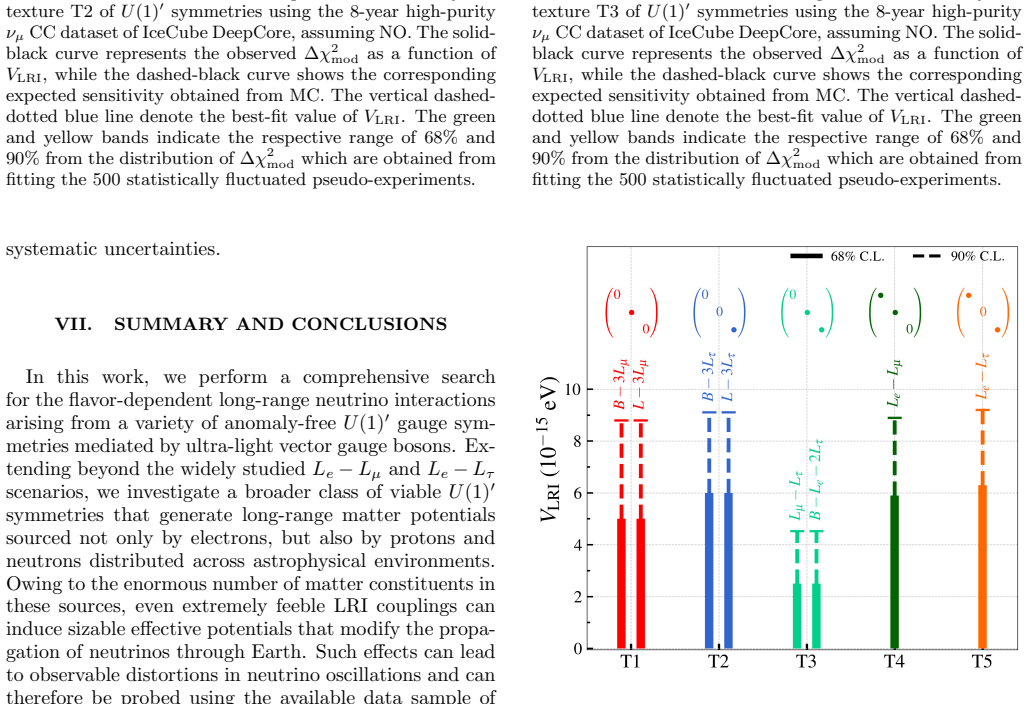
IceCube DeepCore atmospheric neutrino data yields no evidence for long-range interactions from gauged U(1)' symmetries and sets new bounds.
A machine-rendered reading of the paper's core claim, the machinery that carries it, and where it could break.
Core claim
No evidence is found for the long-range neutrino interactions predicted by a broad class of anomaly-free flavor-dependent U(1)' symmetries in eight years of IceCube DeepCore atmospheric neutrino data, leading to stringent constraints on the corresponding interaction potentials and on the coupling strength and mass of the mediating gauge boson.
What carries the argument
The long-range interaction potential arising from gauged U(1)' symmetries, which modifies the effective Hamiltonian for neutrino propagation through Earth matter.
If this is right
- No signal is observed, so the data exclude non-zero values of the LRI potential above certain thresholds for each symmetry considered.
- The bounds apply across a wide range of mediator masses and couplings for the various U(1)' models.
- These constraints are the first from atmospheric neutrinos for this class of symmetries.
- Future data can improve the sensitivity to smaller interaction strengths.
Where Pith is reading between the lines
- Similar searches could be extended to other neutrino sources such as solar or reactor neutrinos to provide independent checks.
- The method could be adapted to test other types of new interactions that produce constant potentials.
- If a future experiment detects a deviation matching one of the excluded potentials, it would indicate a specific U(1)' charge assignment.
- These limits help guide model building for neutrino-related extensions of the Standard Model.
Load-bearing premise
The long-range interaction can be treated as a uniform potential added to the standard oscillation Hamiltonian without significant uncertainties from the distribution of matter in the universe.
What would settle it
A clear mismatch between the observed event rates in IceCube DeepCore and the predictions of standard neutrino oscillations when the LRI term is included at a strength above the reported bounds.
Figures


read the original abstract
Neutrino oscillation experiments provide a unique probe to search for the physics beyond the Standard Model. In this work, we search for a broad class of anomaly-free flavor-dependent $U(1)^\prime$ symmetries using atmospheric neutrino data for the first time. Gauging these $U(1)^\prime$ symmetries give rise to ultra-light vector gauge bosons mediating long-range interactions (LRI) of neutrinos. These new interactions are sourced by the matter present in local and distant Universe, which can affect oscillations of neutrinos passing through the Earth. We use 8 years of high-purity $\nu_\mu$ charged-current neutrino events from IceCube DeepCore to search for these new interactions. We find no evidence for such new interactions in the data sample and place stringent constraints on the corresponding LRI potentials. These results are also translated as the bounds on the coupling strength and mass of mediator over their wide ranges for a plethora of $U(1)^\prime$ symmetries.
Editorial analysis
A structured set of objections, weighed in public.
Referee Report
Summary. The paper claims to search for long-range neutrino interactions (LRI) arising from anomaly-free flavor-dependent U(1)' symmetries using 8 years of high-purity atmospheric ν_μ charged-current events from IceCube DeepCore. No evidence for deviations from standard three-flavor oscillations is found, yielding constraints on the LRI potentials that are then translated into bounds on mediator coupling strength and mass over wide ranges for multiple U(1)' charge assignments taken from prior literature.
Significance. If the analysis is robust, the result supplies new experimental constraints on a broad class of BSM models via neutrino oscillations, using real detector data for the first time in this context. The modeling of the sourced potential (local Earth plus distant universe) and its insertion into the oscillation Hamiltonian follows standard effective-potential methods, and the translation of limits to mediator parameters is a useful output for model builders.
major comments (1)
- [Methods] Methods section: the description of the high-purity event selection, systematic uncertainties, background modeling, and statistical treatment is insufficient to verify the soundness of the upper limits on the LRI potentials and the derived bounds.
minor comments (1)
- [Abstract] Abstract: the phrase 'stringent constraints' is used without quantitative comparison to existing limits from other neutrino or non-neutrino probes.
Simulated Author's Rebuttal
We thank the referee for their careful reading of the manuscript and for recommending minor revisions. We address the major comment below.
read point-by-point responses
-
Referee: [Methods] Methods section: the description of the high-purity event selection, systematic uncertainties, background modeling, and statistical treatment is insufficient to verify the soundness of the upper limits on the LRI potentials and the derived bounds.
Authors: We agree that the Methods section would benefit from greater detail to allow independent verification of the analysis. In the revised manuscript we will expand the relevant subsections to include more explicit descriptions of the high-purity event selection criteria, the treatment and parameterization of systematic uncertainties, the background modeling, and the statistical procedure (including the likelihood construction and limit-setting method) used to obtain the constraints on the LRI potentials. revision: yes
Circularity Check
No significant circularity identified
full rationale
This is a standard experimental constraints analysis that uses 8 years of IceCube DeepCore atmospheric neutrino data to derive upper limits on LRI potentials (and translated mediator parameters) for multiple U(1)' charge assignments taken from external theory literature. The central result is a null finding against the standard three-flavor oscillation prediction; no derivation step, equation, or statistical procedure reduces by construction to a fitted input, self-citation chain, or ansatz. The modeling of the sourced potential follows the usual effective Hamiltonian approach and is not load-bearing on any internal circularity.
Axiom & Free-Parameter Ledger
axioms (2)
- domain assumption Standard three-flavor neutrino oscillation framework holds in the absence of new interactions.
- domain assumption The U(1)' symmetries under consideration are anomaly-free and flavor-dependent as defined in prior theory papers.
Reference graph
Works this paper leans on
-
[1]
Fukudaet al.(Super-Kamiokande), Phys
Y. Fukudaet al.(Super-Kamiokande), Phys. Rev. Lett. 81, 1562 (1998), arXiv:hep-ex/9807003
Pith/arXiv arXiv 1998
-
[2]
M. G. Aartsenet al.(IceCube), Phys. Rev. D91, 072004 (2015), arXiv:1410.7227 [hep-ex]
Pith/arXiv arXiv 2015
-
[3]
X. G. He, G. C. Joshi, H. Lew, and R. R. Volkas, Phys. Rev. D43, 22 (1991)
1991
-
[4]
Foot, Mod
R. Foot, Mod. Phys. Lett. A6, 527 (1991)
1991
-
[5]
R. Foot, G. C. Joshi, H. Lew, and R. R. Volkas, Mod. Phys. Lett. A5, 2721 (1990)
1990
-
[6]
X.-G. He, G. C. Joshi, H. Lew, and R. R. Volkas, Phys. Rev. D44, 2118 (1991)
1991
-
[7]
R. Foot, X. G. He, H. Lew, and R. R. Volkas, Phys. Rev. D50, 4571 (1994), arXiv:hep-ph/9401250
Pith/arXiv arXiv 1994
-
[8]
T. D. Lee and C.-N. Yang, Phys. Rev.98, 1501 (1955)
1955
- [9]
-
[10]
A. D. Dolgov, Phys. Rept.320, 1 (1999)
1999
-
[11]
P. Langacker, Rev. Mod. Phys.81, 1199 (2009), arXiv:0801.1345 [hep-ph]
Pith/arXiv arXiv 2009
-
[12]
A. S. Joshipura and S. Mohanty, Phys. Lett. B584, 103 (2004), arXiv:hep-ph/0310210
Pith/arXiv arXiv 2004
-
[13]
A. Bandyopadhyay, A. Dighe, and A. S. Joshipura, Phys. Rev. D75, 093005 (2007), arXiv:hep-ph/0610263
Pith/arXiv arXiv 2007
-
[14]
M. Bustamante and S. K. Agarwalla, Phys. Rev. Lett. 122, 061103 (2019), arXiv:1808.02042 [astro-ph.HE]
Pith/arXiv arXiv 2019
- [15]
-
[16]
S. K. Agarwalla, M. Bustamante, S. Das, and A. Narang, JHEP08, 113 (2023), arXiv:2305.03675 [hep-ph]
arXiv 2023
-
[17]
G. Garg, J. Krishnamoorthi, A. Kumar, and S. K. Agar- walla, (2026), arXiv:2601.01220 [hep-ph]
arXiv 2026
-
[18]
J. A. Grifols and E. Masso, Phys. Lett. B579, 123 (2004), arXiv:hep-ph/0311141
Pith/arXiv arXiv 2004
-
[19]
J. Heeck and W. Rodejohann, J. Phys. G38, 085005 (2011), arXiv:1007.2655 [hep-ph]
Pith/arXiv arXiv 2011
-
[20]
H. Davoudiasl, H.-S. Lee, and W. J. Marciano, Phys. Rev. D84, 013009 (2011), arXiv:1102.5352 [hep-ph]
Pith/arXiv arXiv 2011
- [21]
-
[22]
S. K. Agarwalla, M. Bustamante, M. Singh, and P. Swain, JHEP09, 055 (2024), arXiv:2404.02775 [hep- ph]
arXiv 2024
-
[23]
Wolfenstein, Phys
L. Wolfenstein, Phys. Rev. D17, 2369 (1978)
1978
-
[24]
J. W. F. Valle, Phys. Lett. B199, 432 (1987)
1987
-
[25]
M. M. Guzzo, A. Masiero, and S. T. Petcov, Phys. Lett. B260, 154 (1991)
1991
-
[26]
Roulet, Phys
E. Roulet, Phys. Rev. D44, R935 (1991)
1991
-
[27]
T. Ohlsson, Rept. Prog. Phys.76, 044201 (2013), arXiv:1209.2710 [hep-ph]
Pith/arXiv arXiv 2013
-
[28]
S. K. Agarwalla, F. Lombardi, and T. Takeuchi, JHEP 12, 079 (2012), arXiv:1207.3492 [hep-ph]
Pith/arXiv arXiv 2012
-
[29]
S. K. Agarwalla, P. Bagchi, D. V. Forero, and M. T´ ortola, JHEP07, 060 (2015), arXiv:1412.1064 [hep- ph]
Pith/arXiv arXiv 2015
-
[30]
S. K. Agarwalla, Y. Kao, D. Saha, and T. Takeuchi, JHEP11, 035 (2015), arXiv:1506.08464 [hep-ph]
Pith/arXiv arXiv 2015
-
[31]
Y. Farzan and M. Tortola, Front. in Phys.6, 10 (2018), arXiv:1710.09360 [hep-ph]
Pith/arXiv arXiv 2018
-
[32]
P. S. Bhupal Devet al., SciPost Phys. Proc.2, 001 (2019), arXiv:1907.00991 [hep-ph]
arXiv 2019
- [33]
- [34]
-
[35]
J. Krishnamoorthi, A. Kumar, and S. K. Agarwalla, (2025), arXiv:2512.22632 [hep-ph]
arXiv 2025
-
[36]
J. Krishnamoorthi, A. Kumar, and S. K. Agarwalla, (2026), arXiv:2604.16157 [hep-ph]
Pith/arXiv arXiv 2026
-
[37]
M. C. Gonzalez-Garcia, P. C. de Holanda, E. Masso, and R. Zukanovich Funchal, JCAP01, 005 (2007), arXiv:hep- ph/0609094
arXiv 2007
-
[38]
M. B. Wise and Y. Zhang, JHEP06, 053 (2018), arXiv:1803.00591 [hep-ph]
Pith/arXiv arXiv 2018
-
[39]
J. A. Dror, Phys. Rev. D101, 095013 (2020), arXiv:2004.04750 [hep-ph]
arXiv 2020
-
[40]
G. Alonso- ´Alvarez, K. Bleau, and J. M. Cline, Phys. Rev. D107, 055045 (2023), arXiv:2301.04152 [hep-ph]
arXiv 2023
-
[41]
E. G. Adelberger, J. H. Gundlach, B. R. Heckel, S. Hoedl, and S. Schlamminger, Prog. Part. Nucl. Phys.62, 102 (2009)
2009
-
[42]
E. J. Salumbides, W. Ubachs, and V. I. Korobov, J. Molec. Spectrosc.300, 65 (2014), arXiv:1308.1711 [hep- ph]
Pith/arXiv arXiv 2014
-
[43]
S. Schlamminger, K. Y. Choi, T. A. Wagner, J. H. Gund- lach, and E. G. Adelberger, Phys. Rev. Lett.100, 041101 (2008), arXiv:0712.0607 [gr-qc]
Pith/arXiv arXiv 2008
-
[44]
M. Baryakhtar, R. Lasenby, and M. Teo, Phys. Rev. D 96, 035019 (2017), arXiv:1704.05081 [hep-ph]
Pith/arXiv arXiv 2017
-
[45]
T. Kumar Poddar, S. Mohanty, and S. Jana, Phys. Rev. D100, 123023 (2019), arXiv:1908.09732 [hep-ph]
arXiv 2019
-
[46]
T. Kumar Poddar, S. Mohanty, and S. Jana, Eur. Phys. J. C81, 286 (2021), arXiv:2002.02935 [hep-ph]
arXiv 2021
-
[47]
M. Honda, M. Sajjad Athar, T. Kajita, K. Kasahara, and S. Midorikawa, Phys. Rev. D92, 023004 (2015), arXiv:1502.03916 [astro-ph.HE]
Pith/arXiv arXiv 2015
-
[48]
Abbasiet al.(IceCube), Astropart
R. Abbasiet al.(IceCube), Astropart. Phys.35, 615 (2012), arXiv:1109.6096 [astro-ph.IM]
Pith/arXiv arXiv 2012
-
[49]
M. G. Aartsenet al.(IceCube), Phys. Rev. Lett.120, 071801 (2018), arXiv:1707.07081 [hep-ex]
Pith/arXiv arXiv 2018
-
[50]
R. Abbasiet al.(IceCube), Phys. Rev. D108, 012014 (2023), arXiv:2304.12236 [hep-ex]
arXiv 2023
-
[51]
R. Abbasiet al.(IceCube), Phys. Rev. Lett.134, 091801 (2025), arXiv:2405.02163 [hep-ex]
arXiv 2025
-
[52]
M. G. Aartsenet al.(IceCube), Phys. Rev. D99, 032007 (2019), arXiv:1901.05366 [hep-ex]
Pith/arXiv arXiv 2019
-
[53]
M. G. Aartsenet al.(IceCube), Phys. Rev. D95, 112002 (2017), arXiv:1702.05160 [hep-ex]
Pith/arXiv arXiv 2017
-
[54]
M. G. Aartsenet al.(IceCube), Phys. Rev. Lett.125, 141801 (2020), arXiv:2005.12942 [hep-ex]
arXiv 2020
-
[55]
M. G. Aartsenet al.(IceCube), Phys. Rev. D102, 052009 (2020), arXiv:2005.12943 [hep-ex]
arXiv 2020
-
[56]
R. Abbasiet al.(IceCube), Phys. Rev. Lett.133, 201804 (2024), arXiv:2405.08070 [hep-ex]
arXiv 2024
-
[57]
R. Abbasiet al.(IceCube), Phys. Lett. B858, 139077 (2024), arXiv:2406.00905 [hep-ex]
arXiv 2024
-
[58]
R. Abbasiet al.(IceCube), Phys. Rev. D110, 072007 (2024), arXiv:2407.01314 [hep-ex]
arXiv 2024
-
[59]
M. G. Aartsenet al.(IceCube), Phys. Rev. D97, 072009 (2018), arXiv:1709.07079 [hep-ex]
Pith/arXiv arXiv 2018
-
[60]
R. Abbasiet al.(IceCube), Phys. Rev. D104, 072006 (2021), arXiv:2106.07755 [hep-ex]
arXiv 2021
-
[61]
Abbasiet al.(IceCube), (2025), arXiv:2502.09454 [hep-ex]
R. Abbasiet al.(IceCube), (2025), arXiv:2502.09454 [hep-ex]
arXiv 2025
-
[62]
Replication Data for: Mea- surement of atmospheric neutrino mixing with improved IceCube DeepCore calibration and data processing,
R. Abbasiet al.(IceCube), “Replication Data for: Mea- surement of atmospheric neutrino mixing with improved IceCube DeepCore calibration and data processing,” (2025)
2025
-
[63]
Mitsukaet al.(Super-Kamiokande), Phys
G. Mitsukaet al.(Super-Kamiokande), Phys. Rev. D84, 113008 (2011), arXiv:1109.1889 [hep-ex]
Pith/arXiv arXiv 2011
-
[64]
M. C. Gonzalez-Garcia and M. Maltoni, JHEP09, 152 (2013), arXiv:1307.3092 [hep-ph]
Pith/arXiv arXiv 2013
-
[65]
N. Arkani-Hamed, L. Motl, A. Nicolis, and C. Vafa, JHEP06, 060 (2007), arXiv:hep-th/0601001
Pith/arXiv arXiv 2007
- [66]
-
[67]
T. Araki, J. Heeck, and J. Kubo, JHEP07, 083 (2012), arXiv:1203.4951 [hep-ph]
Pith/arXiv arXiv 2012
-
[68]
B. C. Allanach, J. Davighi, and S. Melville, JHEP 02, 082 (2019), [Erratum: JHEP 08, 064 (2019)], arXiv:1812.04602 [hep-ph]
arXiv 2019
-
[69]
L. M. G. de la Vega, L. J. Flores, N. Nath, and 16 E. Peinado, JHEP09, 146 (2021), arXiv:2107.04037 [hep- ph]
arXiv 2021
-
[70]
A. S. Joshipura, N. Mahajan, and K. M. Patel, JHEP 03, 001 (2020), arXiv:1909.02331 [hep-ph]
arXiv 2020
-
[71]
K. S. Babu, C. F. Kolda, and J. March-Russell, Phys. Rev. D57, 6788 (1998), arXiv:hep-ph/9710441
Pith/arXiv arXiv 1998
-
[72]
A. M. Dziewonski and D. L. Anderson, Phys. Earth Planet. Interiors25, 297 (1981)
1981
-
[73]
M. G. Aartsenet al.(IceCube), Nucl. Instrum. Meth. A 977, 164332 (2020), arXiv:1803.05390 [physics.data-an]
arXiv 2020
-
[74]
M. G. Aartsenet al.(IceCube), JINST12, P03012 (2017), [Erratum: JINST 19, E05001 (2024)], arXiv:1612.05093 [astro-ph.IM]
arXiv 2017
-
[75]
R. Abbasiet al.(IceCube), Nucl. Instrum. Meth. A618, 139 (2010), arXiv:1002.2442 [astro-ph.IM]
Pith/arXiv arXiv 2010
-
[76]
M. G. Aartsenet al.(IceCube), JINST15, P06032 (2020), arXiv:2002.00997 [physics.ins-det]
arXiv 2020
-
[77]
Chirkin (IceCube), Nucl
D. Chirkin (IceCube), Nucl. Instrum. Meth. A725, 141 (2013)
2013
-
[78]
R. Abbasiet al.(IceCube), Eur. Phys. J. C82, 807 (2022), arXiv:2203.02303 [hep-ex]
arXiv 2022
-
[79]
J. P. Y´ a˜ nez,Measurement of neutrino oscillations in atmospheric neutrinos with the IceCube DeepCore de- tector, Ph.D. thesis, Humboldt-Universit¨ at zu Berlin, Mathematisch-Naturwissenschaftliche Fakult¨ at I (2014)
2014
-
[80]
Terliuk,Measurement of atmospheric neutrino oscilla- tions and search for sterile neutrino mixing with IceCube DeepCore, Ph.D
A. Terliuk,Measurement of atmospheric neutrino oscilla- tions and search for sterile neutrino mixing with IceCube DeepCore, Ph.D. thesis, Humboldt-Universit¨ at zu Berlin, Mathematisch-Naturwissenschaftliche Fakult¨ at I (2018)
2018
discussion (0)
Sign in with ORCID, Apple, or X to comment. Anyone can read and Pith papers without signing in.