REVIEW 2 major objections 5 minor 27 references
Geometry-aware RL for Manipulation of Varying Shapes and Deformable Objects
T0 review · 2 major / 5 minor · reviewed 2026-08-08 · deepseek-v4-flash
Pith's one-line read A heterogeneous graph policy whose actuator and object nodes are updated separately and constrained to be SE(3)-equivariant outperforms Transformer-based and homogeneous equivariant policies across seven rigid and deformable manipulation…
desk verdict Solid empirical RL paper with a new benchmark, but the scalar target-distance feature likely makes the tasks partially observable and needs clarification. read the letter →
The pith
A machine-rendered reading of the paper's core claim, the machinery that carries it, and where it could break.
The reading
What carries the argument
The central object is HEPi's heterogeneous graph: nodes split into actuator nodes and object nodes, with intra-edges inside each set and directed fully connected inter-edges from objects to actuators, and with separate kernel parameters per edge type. The backbone is an efficient approximately SE(3)-equivariant message-passing network, based on lifting positions to position-orientation space and factorized kernels; the paper's Proposition 3.1 argues that because actuators connect to all object nodes, any actuator-object pair can exchange information in one layer, which the ablations link to avoiding oversquashing. Target information is absorbed into object-node features as a scalar distance to target, and the value function is a permutation-invariant DeepSets readout. Training uses a trust-region projection layer rather than clipped PPO to keep policy updates inside a KL constraint.
What would settle it
Train and evaluate HEPi on Rigid-Insertion-Two-Agents with object features restricted to the scalar distance to target (and no global target vector or orientation feature) and with target direction varied while distance is held fixed; if the policy's success tracks the unobserved direction, the observation is not Markovian and the reported returns would not reflect a policy that knows where the target is. The comparison that would settle it: add the full target vector to the object features and show the gap in success rate closes.
Extended reading notes
Core claim
The paper claims that manipulation tasks with diverse geometries and deformable bodies can be cast as a single heterogeneous graph with disjoint actuator and object node sets, and that a policy built from that graph—HEPi—is more expressive than a homogeneous equivariant message-passing network and more sample-efficient than a Transformer. On its new GPU-simulated benchmark of seven tasks, HEPi reports higher average returns and better generalization to unseen objects, with the largest gains in tasks with large 3D search spaces: two-agent insertion, pushing, and cloth hanging. The authors attribute the gains to three design choices acting together: SE(3)-equivariant message passing, separate parameters for object-object, actuator-actuator, and object-actuator interactions, and a trust-region projection layer for stable on-policy updates. They support the graph design with Proposition 3.1, which shows that fully connected object-to-actuator edges let any actuator respond to any object node in one hop, while k-nearest-neighbour local connectivity can make that response independent of distant object nodes. They also report that adding attention to the graph does not improve performance and roughly doubles training time.
Load-bearing premise
The load-bearing premise is that the policy's observations fully specify the manipulation target: target information enters object nodes as a scalar distance to target, with absolute target coordinates only in the value function for cloth hanging, so for tasks with sampled target positions or orientations the agent must effectively have enough information elsewhere to reconstruct the target; if it does not, the benchmark results are not interpretable as solving the intended task.
Editorial extensions
If this is right
- If the benchmark results hold, explicit heterogeneity—at least one parameter set per edge type—is a larger win than adding attention in on-policy graph RL; the paper's attention ablation shows no gain and about double training time.
- The actuator-as-virtual-node design means one message-passing step suffices for global information flow, so deeper stacks are unnecessary and can hurt through oversquashing—a direct corollary of Proposition 3.1 supported by the paper's ablations.
- SE(3) equivariance is the main driver of sample efficiency in large 3D search spaces; the cloth-hanging ablations show heterogeneous but non-equivariant GNNs need more samples to reach similar final performance.
- The policy transfers across object resolutions: a model trained on roughly 20-node meshes evaluates on roughly 1200-node meshes with only mild degradation, and tolerates added position and velocity noise.
Reading between the lines
- Editorial: in the rigid-insertion and cloth-hanging tasks where the target pose is sampled, a scalar distance-to-target object feature is not Markovian by itself; the paper's reported performance implicitly requires target direction or orientation to be recoverable from other inputs or the scalar to be interpreted as a vector, and this should be stated explicitly when reusing the benchmark.
- Editorial: the same heterogeneous-graph recipe could apply to multi-arm assembly or human-robot collaboration where each robot is an actuator sub-graph, since the paper's formulation already allows multiple actuators with complete intra-actuator edges.
- Editorial: because the EMPN backbone is only approximately equivariant (orientations are sampled on a grid over the sphere), a direct test of the equivalence claim would be to compare performance as the orientation grid is refined; the paper reports gains up to 24 samples, so even finer grids are a natural stress test.
- Editorial: the benchmark's use of keypoint coordinates as observations presumes a perception front-end; a testable extension is to plug learned keypoint extractors into the same policy to measure how much of the equivariance advantage survives visual noise.
Editorial analysis
A structured set of objections, weighed in public.
Referee Report
Summary. The paper introduces HEPi, an SE(3)-equivariant heterogeneous graph policy for manipulation of rigid and deformable objects. It represents actuators and objects as disjoint node sets with separate message-passing kernels per edge type, uses a PONITA-style EMPN backbone, and Trust Region Projection Layers for stable on-policy RL. The authors propose a seven-task IsaacLab benchmark covering rigid insertion/sliding/pushing, rope closing/shaping, and cloth hanging, and report IQM returns with 95% confidence intervals over 10 seeds. They claim HEPi outperforms Transformer and homogeneous EMPN baselines in final return, sample efficiency, and generalization to unseen geometries, with ablations on attention, number of message-passing steps, k-NN connectivity, orientation discretization, sample-space size, and PPO vs. TRPL.
Significance. If the results hold, the benchmark and architecture are a useful contribution: the tasks address a real gap (geometry-aware RL for varying and deformable shapes), the evaluation is more careful than typical (10 seeds, IQM and confidence intervals, held-out objects, noise robustness, several ablations), and the heterogeneous graph design is a sensible way to combine equivariance with global information flow to actuators. However, the paper's central empirical claim is only interpretable if each task is a well-posed MDP; the scalar target feature problem discussed below casts doubt on this for orientation-dependent tasks. The relative ranking may survive because all policies see the same partial observations, but the benchmark's ability to support conclusions about precise orientation alignment is reduced.
major comments (2)
- [Section 3.2 and Appendix B] The observation for object nodes is stated to include 'the relative distance to the target, d_{v,target}' in Section 3.2, and Appendix B lists only the scalar 'distance to target dtarget' as the target-related feature for every task. For all rigid tasks, Rope-Shaping, and Cloth-Hanging, the target orientation is uniformly sampled and the reward explicitly depends on orientation (e.g., Rrotation, |cos(θalign)-1|, and the Dshape descriptor). A scalar distance from each object node to a target reference point is invariant under rotations of the target about that point, so distinct MDP states with different optimal actions and different rewards map to the same policy observation. Thus these tasks are partially observable as specified, and the reported returns cannot be interpreted as evidence that any method solves the intended orientation-sensitive manipulation problem. Please either include the target pose (e.g., a target vector or quaternion as a node or global feature) in the policy observation, restrict target sampling to position-only tasks, or explicitly reformulate the problem as a POMDP and make the memory and observation assumptions clear. This affects the benchmark's validity and should be addressed before the main comparative claim is accepted.
- [Appendix A, Proposition 3.1] The theoretical justification for the heterogeneous full-connectivity design is not fully established. The proof gives an explicit Jacobian for HEPi (Eq. 5) but only asserts, without derivation, that for MPNN+VNLocal the Jacobian becomes independent of u when u and v are 'more than 2 hops' apart. The notion of hop distance is not formalized for the mixed edge types (obj-obj, act-act, obj-act), and no equation is provided for the MPNN+VNLocal Jacobian. In a residual message-passing network, the Jacobian can depend on u through longer paths even when the direct connection is absent, so the claim needs a precise argument or a counterexample. Since Proposition 3.1 is presented as a contribution and used to justify the local-vs-global connection design, this gap should be closed.
minor comments (5)
- [Section 4.2, Figure 5 (right)] The generalization bar plots are reported without confidence intervals or an explicit number of seeds; please add error bars and seed counts for consistency with Figure 3.
- [Throughout] There are several typos, including 'NIVIDA IsaacLab' in Section 4.1 and 'rigid-slding' in Section 4.2; please proofread.
- [Section 3.2] The phrase 'one-hot scalar-vector' is ambiguous; clarify whether the node type is a scalar one-hot encoding or a concatenated vector.
- [Experimental evaluation] The paper reports only composite IQM returns, not task success rates. Adding a success-rate metric (e.g., thresholded on Rgoal/Rrotation or hole-hanger alignment) would make the benchmark more directly interpretable and strengthen the comparative claim.
- [Appendix B.7, Cloth-Hanging] The value function is given absolute target and initial coordinates while the policy receives only scalar distances; please explain why this asymmetry does not undermine the intended equivariance inductive bias or describe how the value function handles coordinate-frame dependence.
Circularity Check
No significant circularity: HEPi's empirical claims rest on independent benchmark comparisons; the scalar target-distance issue is a correctness concern, not a circular one.
full rationale
The paper's central claims are empirical: HEPi outperforms Transformer and EMPN baselines in average return, sample efficiency, and generalization (Section 4, Figures 3-5, 7-8). These results come from independent evaluations on a newly built IsaacLab benchmark, with held-out objects and narrowed sample spaces, so they do not reduce to fitted parameters or to the architecture definition by construction. Proposition 3.1 is a mathematical statement proved from the update equations in Appendix A; although the HEPi half follows immediately from the full object-to-actuator aggregation in Eq. 2, proving a property of one's own architecture from its definitions is not circular reasoning about empirical performance. The paper adopts TRPL from Otto et al. (2021), whose authors overlap with the present paper, and cites Otto et al. (2023), Li et al. (2023), and Celik et al. (2024) in support; however, TRPL is a training component, not the central contribution, and the paper re-evaluates TRPL against PPO in Section 4.2, so these self-citations are not load-bearing. No equation fits a parameter and then renames that fit as a prediction. The potential issue flagged in the reader's take is a partial-observability risk: Section 3.2 and Appendix B list only a scalar 'distance to target dtarget' per object node, while rewards for rigid and cloth tasks depend on target orientation; this could make some benchmark tasks not fully observable, but that is a correctness/validity concern, not circularity. The Limitation paragraph in Section 6 acknowledges keypoint availability but does not mention this observability gap, which is a completeness gap rather than a circular step. Overall, the derivation chain is self-contained against external baselines and benchmarks.
Assumptions & free parameters
free parameters (5)
- trust region coefficient (per task) =
1.0 or 4.0 depending on task
- orientation discretization dimension (ori dim) =
16
- object graph KNN k =
3
- cloth hole boundary k =
10
- number of message passing steps per edge type =
1
assumptions (3)
- domain assumption The MDP transition and reward are SE(3)-equivariant under global transformations.
- domain assumption The target is fully specified by the node features, i.e., the observation is Markovian.
- standard math PONITA kernel factorizations preserve the universal approximation property for equivariant functions.
Cite this review
Pith. "Pith review of Geometry-aware RL for Manipulation of Varying Shapes and Deformable Objects." pith.science (2026). https://pith.science/paper/BKJ46OE3
@misc{pith2026250207005,
  author       = {Pith},
  title        = {Pith review of: Geometry-aware RL for Manipulation of Varying Shapes and Deformable Objects},
  year         = {2026},
  howpublished = {\url{https://pith.science/paper/BKJ46OE3}},
  note         = {Machine review of arXiv:2502.07005}
}
abstract
Manipulating objects with varying geometries and deformable objects is a major challenge in robotics. Tasks such as insertion with different objects or cloth hanging require precise control and effective modelling of complex dynamics. In this work, we frame this problem through the lens of a heterogeneous graph that comprises smaller sub-graphs, such as actuators and objects, accompanied by different edge types describing their interactions. This graph representation serves as a unified structure for both rigid and deformable objects tasks, and can be extended further to tasks comprising multiple actuators. To evaluate this setup, we present a novel and challenging reinforcement learning benchmark, including rigid insertion of diverse objects, as well as rope and cloth manipulation with multiple end-effectors. These tasks present a large search space, as both the initial and target configurations are uniformly sampled in 3D space. To address this issue, we propose a novel graph-based policy model, dubbed Heterogeneous Equivariant Policy (HEPi), utilizing $SE(3)$ equivariant message passing networks as the main backbone to exploit the geometric symmetry. In addition, by modeling explicit heterogeneity, HEPi can outperform Transformer-based and non-heterogeneous equivariant policies in terms of average returns, sample efficiency, and generalization to unseen objects. Our project page is available at https://thobotics.github.io/hepi.
Figures


Figures from the paper (21 more)


Reference graph
Works this paper leans on
-
[1]
B T ASKS DETAILS Here, we provide detailed specifications for each of the seven manipulation tasks introduced in the main paper. B.1 R IGID -SLIDING The goal of the Rigid-Sliding task is to control an object using a suction gripper and slide it on a 2D plane to a desired target position and orientation. The agent controls the object’s linear velocity v an...
work page 2025
-
[2]
The agent controls the object’s linear velocity v
B.2 R IGID -PUSHING The goal of the Rigid-Pushing task is to control an object using a rod and push it on a 2D plane to a desired target position and orientation. The agent controls the object’s linear velocity v. Figure 11: Example trajectory of Rigid Pushing task. Input and Output The input space for each node includes: • Gripper nodes: node type, posit...
work page 2025
-
[3]
Explicitly, we compute its Jacobian w.r.t object nodes as ∂f act,(l+1) v ∂f obj,L u =2∇f act,(l) v + σ′(zlocal,(l) v )W local,(l) a X w∈N (v)act k(xv, xw; θact-act)∇f act,(l) v + σ′(z(l) v )W (l) a k(xv, xu; θobj-act) (5) with z(l) v = W (l) a P u∈Vobj k(·, ·; θobj-act)f obj,L u and zlocal,(l) v =W local,(l) a P w∈N (v)act k(·, ·; θact-act)f act,(l) w be ...
work page 2024
-
[4]
Vitaly Kurin, Maximilian Igl, Tim Rockt ¨aschel, Wendelin Boehmer, and Shimon Whiteson
1109/TRO.2011.2159412. Vitaly Kurin, Maximilian Igl, Tim Rockt ¨aschel, Wendelin Boehmer, and Shimon Whiteson. My body is a cage: the role of morphology in graph-based incompatible control. In International Conference on Learning Representations,
arXiv 2011
-
[5]
Pokorny, and Yiannis Karayiannidis
Rita Laezza, Robert Gieselmann, Florian T. Pokorny, and Yiannis Karayiannidis. Reform: A robot learning sandbox for deformable linear object manipulation. In 2021 IEEE International Confer- ence on Robotics and Automation (ICRA), pp. 4717–4723,
work page 2021
-
[6]
doi: 10.1109/ICRA48506.2021. 9561766. 12 Published as a conference paper at ICLR 2025 Ge Li, Hongyi Zhou, Dominik Roth, Serge Thilges, Fabian Otto, Rudolf Lioutikov, and Gerhard Neumann. Open the black box: Step-based policy updates for temporally-correlated episodic reinforcement learning. In The Twelfth International Conference on Learning Representations ,
arXiv 2021
-
[8]
Hai Huu Nguyen, Andrea Baisero, David Klee, Dian Wang, Robert Platt, and Christopher Am- ato
doi: 10.1109/LRA.2023.3270034. Hai Huu Nguyen, Andrea Baisero, David Klee, Dian Wang, Robert Platt, and Christopher Am- ato. Equivariant reinforcement learning under partial observability. In 7th Annual Conference on Robot Learning,
arXiv 2023
-
[10]
Haojie Huang, Owen Lewis Howell, Dian Wang, Xupeng Zhu, Robert Platt, and Robin Walters
15607/RSS.2022.XVIII.007. Haojie Huang, Owen Lewis Howell, Dian Wang, Xupeng Zhu, Robert Platt, and Robin Walters. Fourier transporter: Bi-equivariant robotic manipulation in 3d. In The Twelfth International Con- ference on Learning Representations,
work page 2022
Show all 27 references
-
[11]
Proximal policy optimization algorithms
John Schulman, Filip Wolski, Prafulla Dhariwal, Alec Radford, and Oleg Klimov. Proximal policy optimization algorithms. CoRR, abs/1707.06347,
-
[12]
Gregor N
doi: 10.1177/02783649231219020. Gregor N. C. Simm, Robert Pinsler, G´abor Cs´anyi, and Jos´e Miguel Hern´andez-Lobato. Symmetry- aware actor-critic for 3d molecular design. In International Conference on Learning Representa- tions,
-
[13]
Joshua Southern, Francesco Di Giovanni, Michael Bronstein, and Johannes F Lutzeyer
URL https://openreview.net/forum?id=jEYKjPE1xYN. Joshua Southern, Francesco Di Giovanni, Michael Bronstein, and Johannes F Lutzeyer. Under- standing virtual nodes: Oversmoothing, oversquashing, and node heterogeneity. arXiv preprint arXiv:2405.13526,
-
[14]
Sukhatme, Fabio Ramos, and Yashraj Narang
13 Published as a conference paper at ICLR 2025 Bingjie Tang, Iretiayo Akinola, Jie Xu, Bowen Wen, Ankur Handa, Karl Van Wyk, Dieter Fox, Gaurav S. Sukhatme, Fabio Ramos, and Yashraj Narang. Automate: Specialist and generalist assembly policies over diverse geometries. In Robo...
2025
-
[15]
14 Published as a conference paper at ICLR 2025 A P ROOFS OF PROPOSITION 3.1 Proof. We write simplified updates of HEPi and MPNN + VNlocal as follows, HEPi: f obj,(l+1) v = f obj,(l) v + σ W (l) o X u∈N (v)obj k(·, ·; θobj-obj)f obj,(l) u , v ∈ Vobj, f act, new,(l+1) v ...
2025
-
[18]
22 Published as a conference paper at ICLR 2025 Figure 18: Sample space of the Cloth-Hanging task. Reward Function The total reward consists of the following sub-rewards: • Hole-hanger alignment reward: Rhole-hanger = ∥chole − changer∥ + 0.1 · |cos(θalign) − 1| where chole and...
2021
-
[19]
The state space includes (x, y, z, θ), and precise alignment is required near the hole before sliding and rotating the object into place
B.3 R IGID -I NSERTION The Rigid-Insertion task extends Rigid-Sliding to 3D, where the agent must control both linear and angular velocities to move an object along the z-axis and insert it into a hole. The state space includes (x, y, z, θ), and precise alignment is required n...
2025
-
[20]
19 Published as a conference paper at ICLR 2025 Figure 14: Sample space of the Rigid-Insertion-Two-Agents task. B.5 R OPE -C LOSING In Rope-Closing, two actuators manipulate the endpoints of a deformable rope in a 2D plane, with the goal of wrapping the rope around a cylindric...
2025
-
[21]
The rope is segmented into 80 links, with each node representing the pose of a link
B.6 R OPE -SHAPING This task requires the rope to form a specific shape (e.g., a “W”) to a desired orientation by control- ling the actuators. The rope is segmented into 80 links, with each node representing the pose of a link. Figure 16: Example trajectory of Rope Shaping tas...
2025
-
[23]
From left to right: Triangle, Heart, Diamond, Pentagon, Hexagon, Plus, Star, A-shape, T-shape, and E-shape
23 Published as a conference paper at ICLR 2025 Figure 19: Overview of all objects used in the rigid manipulation tasks. From left to right: Triangle, Heart, Diamond, Pentagon, Hexagon, Plus, Star, A-shape, T-shape, and E-shape. In sliding tasks, all objects are used, while th...
2025
-
[24]
As shown, when k is small, there are no-overlapping nodes, the actuator nodes can miss the infor- mation from distant nodes
On the other hand, rope-shaping task has 80 nodes, so k is picked from {1, 10, 20, 50}. As shown, when k is small, there are no-overlapping nodes, the actuator nodes can miss the infor- mation from distant nodes. Meanwhile, when k is bigger, the number of overlapping nodes inc...
2025
-
[25]
As shown in Figure 24, increasing ori dim generally improves performance in 3D tasks, as a finer discretization better captures orientation changes. However, this comes at the cost of increased 25 Published as a conference paper at ICLR 2025 #MPs=4 #MPs=3 #MPs=2 HEPi EMPN -1.4...
2025
-
[27]
In EMPN, the number of layers (*) corresponds to the number of message-passing steps
Table 4: Hyperparameters used for all tasks. In EMPN, the number of layers (*) corresponds to the number of message-passing steps. HEPi EMPN Transformer contextual std true true true latent dim. 64 64 64 activation GELU GELU ReLU dropout false false false num layers n.a. 2 ∗ 2...
2025
-
[2017]
(b) No overlapping node
can be viewed as fully connected GNNs under the Message Passing Neural Network (MPNN) framework (Battaglia et al., 2018), since self-attention can be seen as a mechanism to aggregate 15 Published as a conference paper at ICLR 2025 (a) Overlapping node. (b) No overlapping node....
2018
-
[2019]
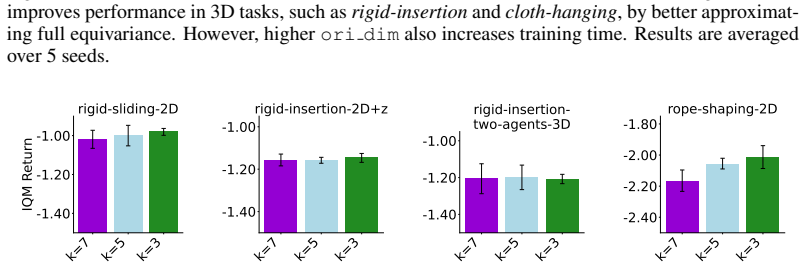
Increasing ori dim improves performance in 3D tasks, such asrigid-insertion and cloth-hanging, by better approximat- ing full equivariance
for han- 26 Published as a conference paper at ICLR 2025 O=24 O=16 O=8 HEPi EMPN -1.40 -1.20 -1.00IQM Return rigid-insertion-2D+z HEPi EMPN -1.40 -1.20 -1.00 rigid-insertion- two-agents-3D HEPi EMPN -1.40 -1.20 -1.00 cloth-hanging-3D Figure 24: Ablation on the orientation disc...
2025
-
[2020]
Softgym: Benchmarking deep rein- forcement learning for deformable object manipulation
Xingyu Lin, Yufei Wang, Jake Olkin, and David Held. Softgym: Benchmarking deep rein- forcement learning for deformable object manipulation. In Jens Kober, Fabio Ramos, and Claire Tomlin (eds.), Proceedings of the 2020 Conference on Robot Learning , volume 155 of Proceedings of...
2020
-
[2021]
net/forum?id=WcY35wjmCBA
URL https://openreview. net/forum?id=WcY35wjmCBA. Peter W. Battaglia, Jessica B. Hamrick, Victor Bapst, Alvaro Sanchez-Gonzalez, Vin ´ıcius Flores Zambaldi, Mateusz Malinowski, Andrea Tacchetti, David Raposo, Adam Santoro, Ryan Faulkner, C ¸ aglar G¨ulc ¸ehre, H. Francis Song,...
-
[2023]
On over-squashing in message passing neural networks: the impact of width, depth, and topology
11 Published as a conference paper at ICLR 2025 Francesco Di Giovanni, Lorenzo Giusti, Federico Barbero, Giulia Luise, Pietro Li `o, and Michael Bronstein. On over-squashing in message passing neural networks: the impact of width, depth, and topology. In Proceedings of the 40t...
2025
-
[2024]
Diffusion-edfs: Bi-equivariant denoising generative modeling on se(3) for visual robotic manipulation
Hyunwoo Ryu, Jiwoo Kim, Junwoo Chang, Hyun Seok Ahn, Joohwan Seo, Taehan Kim, Jongeun Choi, and Roberto Horowitz. Diffusion-edfs: Bi-equivariant denoising generative modeling on se(3) for visual robotic manipulation. arXiv preprint arXiv:2309.02685,
Reviewed August 8, 2026 · model on record in the stance chip above.
Discussion (0). Continue with ORCID to comment.