Event shapes and Inclusive Hadron Spectra at FCC-ee energies
Pith reviewed 2026-05-21 18:08 UTC · model grok-4.3
The pith
Event shape fits to NNLO QCD in PYTHIA-generated FCC-ee collisions extract the strong coupling α_s while mapping high-energy systematics.
A machine-rendered reading of the paper's core claim, the machinery that carries it, and where it could break.
Core claim
Event-shape distributions produced by PYTHIA at FCC-ee center-of-mass energies can be fitted to NNLO perturbative QCD calculations to extract α_s, with explicit quantification of the additional systematic uncertainties that appear once initial-state radiation and heavy-particle backgrounds become sizable at the higher energies.
What carries the argument
Fitting of thrust and C-parameter distributions generated by PYTHIA to next-to-next-to-leading-order perturbative QCD predictions across four FCC-ee energies.
If this is right
- Systematic uncertainties on the extracted α_s grow with increasing center-of-mass energy, driven mainly by initial-state radiation and heavy-particle decays.
- Mean values of thrust and C-parameter follow the expected energy evolution seen in earlier experiments.
- Charged-particle multiplicity and momentum spectra probe soft-gluon dynamics across the full FCC-ee energy range.
- Background processes from Z, W, top, and Higgs pairs produce measurable distortions that must be subtracted or modeled for precision QCD work.
Where Pith is reading between the lines
- The generated reference distributions can be used to optimize analysis cuts and unfolding procedures before real FCC-ee data arrive.
- Repeating the same exercise with different Monte Carlo tunes or parton-shower models would quantify how generator choice propagates into the α_s uncertainty.
- The same framework could be applied to other infrared-safe observables such as jet rates or energy-energy correlators at the same energies.
Load-bearing premise
PYTHIA with its default tuning produces hadronic final states whose event-shape and multiplicity distributions are close enough to real data that the resulting α_s fit and uncertainty estimate remain reliable.
What would settle it
Direct comparison of the fitted α_s value and its quoted uncertainty band with an independent extraction performed on actual collision data taken at any of the same center-of-mass energies.
Figures




read the original abstract
We analyze hadronic final states of $e^+e^-$ annihilation through event shape observables, Thrust and C-parameter, and inclusive hadron spectra at the planned center-of-mass (c.m.) energies of the Future Circular Electron-Positron Collider (FCC-ee). Collision data is produced using Monte Carlo event generation in PYTHIA at 91.2, 160, 240, and 365 GeV. Distortions of event shapes due to initial-state photon radiation and background decays of Z pairs, W pairs, top-quark pairs, and Higgs bosons are investigated. An extraction of the strong coupling $\alpha_{\text{s}}$ is performed by fitting event shape distributions to perturbative QCD predictions at next-to-next-to-leading-order (NNLO) accuracy, and the sources of systematic uncertainties at high c.m. energies are discussed. Soft gluon dynamics is examined through charged particle multiplicities and momentum distributions, and energy evolution of mean values is compared with prior experimental results. The inferences from this phenomenological study provide a reference to QCD studies at future high-energy $e^+e^-$ colliders.
Editorial analysis
A structured set of objections, weighed in public.
Referee Report
Summary. The manuscript uses PYTHIA Monte Carlo event generation to simulate hadronic final states in e+e- annihilation at FCC-ee energies of 91.2, 160, 240, and 365 GeV. It analyzes event-shape observables (Thrust and C-parameter) and inclusive hadron spectra, investigates distortions from initial-state radiation and backgrounds (Z/Z, W/W, tt, Higgs decays), extracts the strong coupling α_s by fitting the simulated event-shape distributions to NNLO perturbative QCD predictions, discusses associated systematic uncertainties at high energies, and examines soft-gluon dynamics through charged-particle multiplicities and their energy evolution compared to prior data.
Significance. If the Monte Carlo modeling proves reliable, the study supplies a useful phenomenological reference for QCD analyses at future high-energy e+e- colliders, particularly by mapping background-induced distortions and highlighting issues in α_s extraction at 240–365 GeV. The multiplicity and mean-value comparisons add modest value as cross-checks against existing LEP and lower-energy results.
major comments (2)
- [α_s extraction procedure] The α_s extraction fits PYTHIA-generated (default-tune) Thrust and C-parameter distributions directly to NNLO perturbative expressions. Because the default tune incorporates an α_s value and hadronization parameters constrained primarily by LEP data near 91 GeV, the fit at higher energies risks absorbing modeling discrepancies into the extracted α_s; the manuscript does not report any variation of the PYTHIA tune parameters or comparison with an alternative generator to quantify this bias.
- [Systematic uncertainties and background studies] The claimed systematic uncertainties from ISR and pair-production backgrounds rest on the assumption that the PYTHIA hadron-level distributions faithfully represent the true non-perturbative corrections. No explicit hadronization correction factors, fit ranges, or data-selection cuts are provided, nor is the sensitivity of the fitted α_s to these choices demonstrated; this directly affects the reliability of the uncertainty estimates.
minor comments (2)
- The abstract would be clearer if it stated the numerical value and uncertainty of the extracted α_s.
- Figures comparing event-shape distributions at different energies should explicitly label the perturbative NNLO curves versus the full hadron-level PYTHIA results.
Simulated Author's Rebuttal
We thank the referee for the careful reading of our manuscript and the constructive comments. We respond to each major comment below and indicate the revisions made to address the concerns.
read point-by-point responses
-
Referee: [α_s extraction procedure] The α_s extraction fits PYTHIA-generated (default-tune) Thrust and C-parameter distributions directly to NNLO perturbative expressions. Because the default tune incorporates an α_s value and hadronization parameters constrained primarily by LEP data near 91 GeV, the fit at higher energies risks absorbing modeling discrepancies into the extracted α_s; the manuscript does not report any variation of the PYTHIA tune parameters or comparison with an alternative generator to quantify this bias.
Authors: We agree that the default PYTHIA tune, constrained mainly by LEP data near 91 GeV, carries the risk that modeling discrepancies at higher energies could be absorbed into the extracted α_s. Our study is a phenomenological Monte Carlo investigation using a standard generator setup to explore event shapes, backgrounds, and the extraction procedure at FCC-ee energies. The extracted values are presented with this context in mind rather than as precision results. In the revised manuscript we have added an explicit discussion of this limitation and its implications for interpretation at 240–365 GeV. We have also performed and reported a limited variation of key hadronization parameters at one representative energy to illustrate the sensitivity. revision: yes
-
Referee: [Systematic uncertainties and background studies] The claimed systematic uncertainties from ISR and pair-production backgrounds rest on the assumption that the PYTHIA hadron-level distributions faithfully represent the true non-perturbative corrections. No explicit hadronization correction factors, fit ranges, or data-selection cuts are provided, nor is the sensitivity of the fitted α_s to these choices demonstrated; this directly affects the reliability of the uncertainty estimates.
Authors: We acknowledge that the original manuscript did not provide sufficient detail on the assumptions underlying the systematic uncertainties. The revised version now specifies the fit ranges used for the NNLO α_s extraction, the event-selection cuts applied to the generated samples, and the hadronization correction factors adopted. We have added a dedicated study quantifying the sensitivity of the fitted α_s to reasonable variations in these choices, which supports the quoted uncertainties associated with ISR and background processes. revision: yes
Circularity Check
α_s extraction relies on PYTHIA-generated distributions embedding prior tuned α_s
specific steps
-
fitted input called prediction
[Abstract]
"Collision data is produced using Monte Carlo event generation in PYTHIA at 91.2, 160, 240, and 365 GeV. [...] An extraction of the strong coupling α_s is performed by fitting event shape distributions to perturbative QCD predictions at next-to-next-to-leading-order (NNLO) accuracy"
The input distributions for the α_s fit are produced by PYTHIA whose default tune already encodes a specific α_s value (plus non-perturbative corrections) constrained by earlier experiments. Fitting these MC distributions to NNLO expressions therefore recovers a value whose central result and uncertainty are statistically influenced by the generator's prior tuning rather than arising solely from the perturbative calculation.
full rationale
The paper generates event-shape distributions via PYTHIA default tune (which incorporates α_s and hadronization parameters fitted to LEP data) and then fits those same distributions to NNLO pQCD to extract α_s. This is a standard phenomenological approach for future-collider studies but creates partial dependence on the generator's embedded parameters rather than purely independent data. No self-citation chain or definitional loop is present; the central result retains independent content from the NNLO calculation and background studies, but the fit input is not external.
Axiom & Free-Parameter Ledger
free parameters (1)
- PYTHIA strong-coupling and hadronization parameters
axioms (1)
- domain assumption NNLO perturbative QCD predictions plus standard hadronization corrections describe event shapes and multiplicities at FCC-ee energies
Reference graph
Works this paper leans on
-
[1]
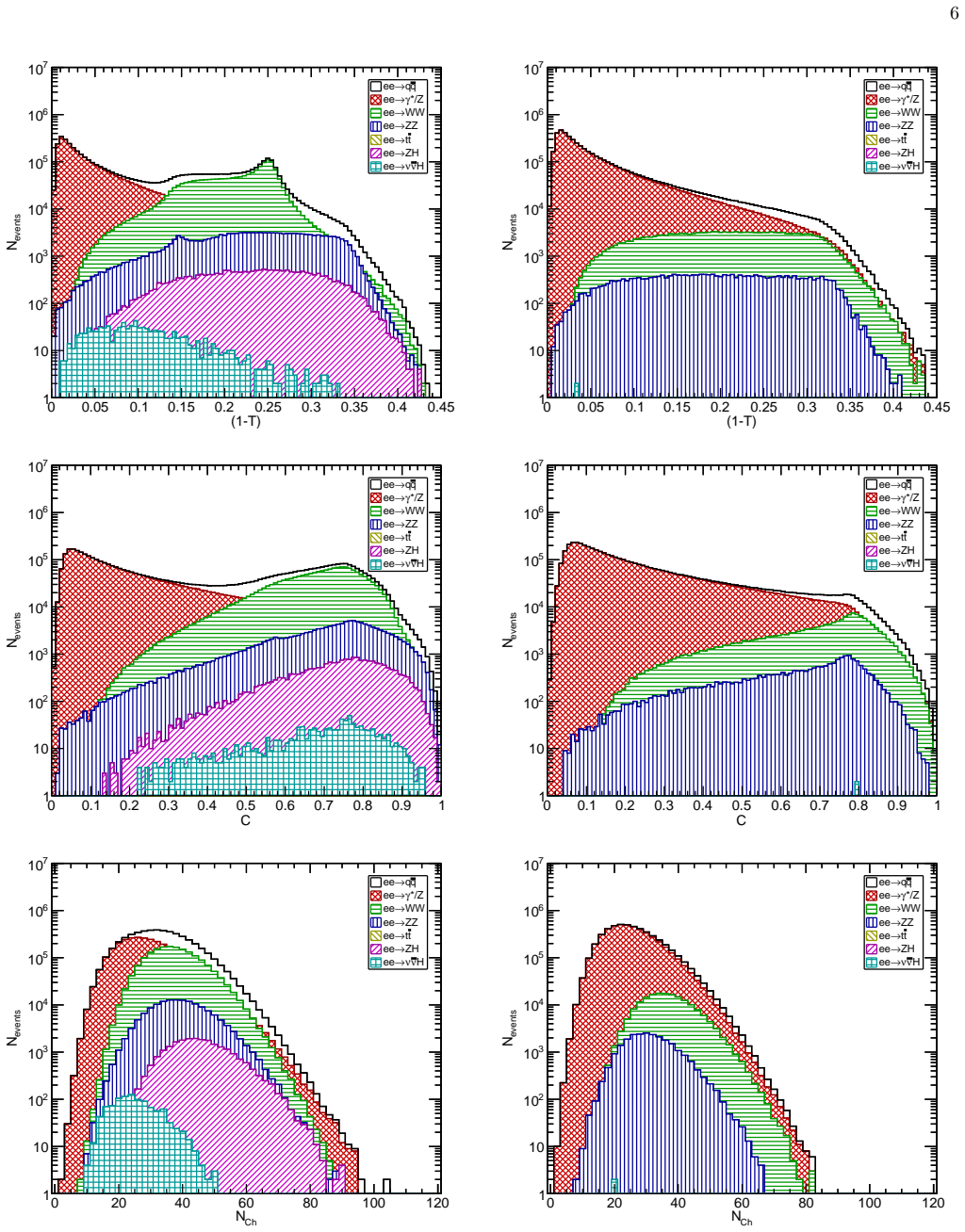
in Fig. 3. Good agreement is observed in the 3-jet re- gion (0.1<(1−T)<0.3 and 0.3<C<0.7). Deviations in the higher-jet regions (right of the 3-jet region) are due to limited statistics of experimental data. As a veri- fication of hadronisation models, obtained mean charged hadron multiplicities were within 0.5% of experiment. Fermion production WW produc...
-
[2]
r1 + 2a2c2 + β1 β2 0 ln(2y) + 2 # (10) A3NLO(y) = c2 y
and the C-parameter [35]. The use of hadronisa- tion correction factors on experimental measurements to relate parton-level and hadron-level data introduce an additional source of systematic uncertainty. These have been computed in PYTHIA for each FCC-ee energy and show a reduced impact at higher c.m. energies in Fig. 11 [36]. The removal of distortions f...
-
[3]
S. Kluth, Tests of quantum chromo dynamics ate +e− colliders, Reports on Progress in Physics69, R04 (2006)
work page 2006
-
[4]
F. Grosset al., 50 years of quantum chromodynamics: Introduction and review, The European Physical Journal C83, 10.1140/epjc/s10052-023-11949-2 (2023)
-
[5]
G. Arnisonet al.(UA1), Some Observations on the First Events Seen at the CERN Proton-anti-Proton Collider, Phys. Lett. B107, 320 (1981), [Erratum: Phys.Lett.B 109, 510 (1982)]
work page 1981
-
[6]
R. Bala, I. Bautista, J. Bielcikova, and A. Ortiz, Heavy- ion physics at the LHC: Review of Run I results, Int. J. Mod. Phys. E25, 1642006 (2016), arXiv:1605.03939 [hep-ex]
work page internal anchor Pith review Pith/arXiv arXiv 2016
-
[7]
O. L. Kodolova, Review of QCD Physics with ALICE, ATLAS, and CMS Experiments, Phys. Part. Nucl.56, 1117 (2025)
work page 2025
-
[8]
H. Stone, Review of QCD results from LEP, Nuclear Physics B - Proceedings Supplements39, 184 (1995), QCD 94
work page 1995
-
[9]
H. Abramowicz and A. C. Caldwell, HERA collider physics, Rev. Mod. Phys.71, 1275 (1999)
work page 1999
-
[10]
V. Shiltsev and F. Zimmermann, Modern and future col- liders, Rev. Mod. Phys.93, 015006 (2021)
work page 2021
-
[11]
Ploerer, QCD at the future circular e +e− collider (2022), arXiv:2208.08250 [hep-ex]
E. Ploerer, QCD at the future circular e +e− collider (2022), arXiv:2208.08250 [hep-ex]
-
[12]
Manganoet al.,FCC Physics Opportunities, Tech
M. Manganoet al.,FCC Physics Opportunities, Tech. Rep. 6 (CERN, Geneva, 2019)
work page 2019
-
[13]
T. Sj¨ ostrand, Challenges for QCD theory: some personal reflections, Physica ScriptaT158, 014002 (2013)
work page 2013
-
[14]
W. Bartmann, J.-P. Burnet, C. Carli,et al., Future cir- cular collider feasibility study report volume 1: Physics and experiments (2025)
work page 2025
-
[15]
High-precision $\alpha_s$ measurements from LHC to FCC-ee
D. d’Enterriaet al., High-precisionα s measurements from LHC to FCC-ee (2015), arXiv:1512.05194 [hep-ph]
work page internal anchor Pith review Pith/arXiv arXiv 2015
-
[16]
Parton Radiation and Fragmentation from LHC to FCC-ee
D. d’Enterriaet al., Parton radiation and fragmentation from lhc to fcc-ee (2017), arXiv:1702.01329 [hep-ph]
work page internal anchor Pith review Pith/arXiv arXiv 2017
-
[17]
Bambahet al., QCD GENERATORS FOR LEP, in LEP Physics Workshop(1989)
B. Bambahet al., QCD GENERATORS FOR LEP, in LEP Physics Workshop(1989)
work page 1989
-
[18]
Skands, QCD and event generators, inAIP Conference Proceedings, Vol
P. Skands, QCD and event generators, inAIP Conference Proceedings, Vol. 792 (AIP, 2005) p. 73–84
work page 2005
-
[19]
R. K. Ellis, D. A. Ross, and A. E. Terrano, The Pertur- bative Calculation of Jet Structure ine +e− Annihilation, Nucl. Phys. B178, 421 (1981)
work page 1981
-
[20]
T. Sj¨ ostrand, S. Ask, J. R. Christiansen, R. Corke, N. De- sai, P. Ilten, S. Mrenna, S. Prestel, C. O. Rasmussen, and P. Z. Skands, An introduction to pythia 8.2, Computer Physics Communications191, 159–177 (2015)
work page 2015
-
[21]
Heisteret al.(ALEPH), Studies of QCD ate +e− centre-of-mass energies between 91-GeV and 209-GeV, Eur
A. Heisteret al.(ALEPH), Studies of QCD ate +e− centre-of-mass energies between 91-GeV and 209-GeV, Eur. Phys. J. C35, 457 (2004)
work page 2004
-
[22]
P. Achardet al.(L3), Studies of hadronic event struc- ture ine +e− annihilation from 30-GeV to 209-GeV with the L3 detector, Phys. Rept.399, 71 (2004), arXiv:hep- ex/0406049
-
[23]
Measurement of alpha_s in radiative hadronic events at OPAL
J. Schieck, Measurement ofα s in radiative hadronic events at OPAL (2003), arXiv:hep-ex/0312036 [hep-ex]
work page internal anchor Pith review Pith/arXiv arXiv 2003
-
[24]
M. Acciarriet al.(L3), QCD studies and determination of alpha-s ine +e− collisions at √s= 161-GeV and 172- 13 GeV, Phys. Lett. B404, 390 (1997)
work page 1997
-
[25]
Navaset al.(Particle Data Group Collaboration), Review of particle physics, Phys
S. Navaset al.(Particle Data Group Collaboration), Review of particle physics, Phys. Rev. D110, 030001 (2024). [24]Physics at LEP2, CERN (CERN, Geneva, 1996) com- posed by 3 sessions
work page 2024
-
[26]
Electroweak corrections to hadronic event shapes
A. Denner, S. Dittmaier, T. Gehrmann, and C. Kurz, Electroweak corrections to hadronic event shapes (2010), arXiv:1001.4467 [hep-ph]
work page internal anchor Pith review Pith/arXiv arXiv 2010
- [27]
-
[28]
M. Dam, Detector requirements, design, and technologies for the fcc-ee higgs, electroweak, and top factory, Nuclear Instruments and Methods in Physics Research Section A: Accelerators, Spectrometers, Detectors and Associated Equipment1080, 170648 (2025)
work page 2025
-
[29]
R. Barate et al., A measurement of the b-quark mass from hadronic Z decays, The European Physical Journal C18, 1–13 (2000)
work page 2000
-
[30]
K. Chetyrkin, A. Kataev, and F. Tkachov, Higher-order corrections toσ tot(e+e− →hadrons) in quantum chro- modynamics, Physics Letters B85, 277 (1979)
work page 1979
-
[31]
S. Weinzierl, Event shapes and jet rates in electron- positron annihilation at nnlo, Journal of High Energy Physics2009, 041–041 (2009)
work page 2009
- [32]
-
[33]
G. Dissertori, A. G.-D. Ridder, T. Gehrmann, E. Glover, G. Heinrich, G. Luisoni, and H. Stenzel, Determination of the strong coupling constant using matched nnlo+nlla predictions for hadronic event shapes ine +e− annihi- lations, Journal of High Energy Physics2009, 036–036 (2009)
work page 2009
-
[34]
R. W. L. Jones, M. Ford, G. P. Salam, H. Stenzel, and D. Wicke, Theoretical uncertainties onα s from event- shape variables ine +e− annihilations, Journal of High Energy Physics2003, 007–007 (2003)
work page 2003
- [35]
-
[36]
A. H. Hoang, D. W. Kolodrubetz, V. Mateu, and I. W. Stewart, Precise determination ofα s from the c- parameter distribution, Phys. Rev. D91, 094018 (2015)
work page 2015
-
[37]
Determination of alpha_S at 500 GeV from Event Shapes and Jet Rates
O. Biebel, Determination ofα s at 500 GeV from event shapes and jet rates (1999), arXiv:hep-ex/9912051 [hep- ex]
work page internal anchor Pith review Pith/arXiv arXiv 1999
-
[38]
DELPHES 3, A modular framework for fast simulation of a generic collider experiment
J. de Favereau, C. Delaere, P. Demin, A. Giammanco, V. Lemaˆ ıtre, A. Mertens, and M. Selvaggi, Delphes 3: a modular framework for fast simulation of a generic col- lider experiment, Journal of High Energy Physics2014, 10.1007/jhep02(2014)057 (2014)
work page internal anchor Pith review doi:10.1007/jhep02(2014)057 2014
-
[39]
Y. I. Azimov, Y. L. Dokshitzer, V. A. Khoze, and S. Trovan, Similarity of parton and hadron spectra in QCD jets, Zeitschrift f¨ ur Physik C Particles and Fields 27, 65 (1985)
work page 1985
-
[40]
Y. I. Azimov, Y. L. Dokshitzer, V. A. Khoze, and S. Troyan, Hump-backed QCD plateau in hadron spec- tra, Zeitschrift f¨ ur Physik C Particles and Fields31, 213 (1986)
work page 1986
-
[41]
S. Lupia and W. Ochs, Unified QCD description of hadron and jet multiplicities, Physics Letters B418, 214–222 (1998)
work page 1998
-
[42]
I. Dremin and J. Gary, Hadron multiplicities, Physics Reports349, 301–393 (2001)
work page 2001
-
[43]
A. Capella, I. M. Dremin, J. W. Gary, V. A. Nechi- tailo, and J. T. T. Van, Evolution of average multiplic- ities of quark and gluon jets, Physical Review D61, 10.1103/physrevd.61.074009 (2000)
-
[44]
W. Braunschweiget al.(TASSO), Charged Multiplicity Distributions and Correlations ine +e− Annihilation at PETRA Energies, Z. Phys. C45, 193 (1989)
work page 1989
-
[45]
H. W. Zhenget al.(The AMY Collaboration), Charged- particle multiplicities ine +e− annihilations at √s= 50− 61.4 GeV, Phys. Rev. D42, 737 (1990)
work page 1990
-
[46]
C. Fong and B. Webber, Higher-order qcd corrections to hadron energy distributions in jets, Physics Letters B 229, 289 (1989)
work page 1989
-
[47]
V. A. Khoze and W. Ochs, Perturbative-qcd approach to multiparticle production, International Journal of Mod- ern Physics A12, 2949–3120 (1997)
work page 1997
-
[48]
W. Braunschweiget al.(TASSO), Global Jet Properties at 14-GeV to 44-GeV Center-of-mass Energy ine +e− Annihilation, Z. Phys. C47, 187 (1990)
work page 1990
-
[49]
A. Kardos, G. Somogyi, and A. Verbytskyi, Determina- tion ofα s beyond nnlo using event shape averages, The European Physical Journal C81, 10.1140/epjc/s10052- 021-08975-3 (2021)
discussion (0)
Sign in with ORCID, Apple, or X to comment. Anyone can read and Pith papers without signing in.