REVIEW 3 major objections 5 minor 2 cited by
ReconDreamer-RL: Enhancing Reinforcement Learning via Diffusion-based Scene Reconstruction
T0 review · 3 major / 5 minor · reviewed 2026-08-05 · deepseek-v4-flash
Pith's one-line read ReconDreamer-RL claims a 5x collision-ratio reduction for end-to-end driving by training in diffusion-reconstructed scenes.
desk verdict Useful RL-in-3DGS driving framework whose headline collision gains are probably inflated because the evaluation scenes come from the same generator used to create training tasks. read the letter →
The pith
A machine-rendered reading of the paper's core claim, the machinery that carries it, and where it could break.
The reading
What carries the argument
The operating core is the ReconSimulator loop: 3D Gaussian Splatting scene reconstruction for appearance, a video diffusion prior (DriveRestorer) that restores rendered novel-trajectory videos and is used to refine the reconstruction, and a kinematic bicycle model that updates each vehicle pose $W_t=[R_t|P_t]$ via $P_{t+1}=P_t+v_t\Delta t\,\hat{d}_t$ and $R_{t+1}=\mathrm{Rot}_z(\Delta\theta_t)R_t$ with $\Delta\theta_t=\frac{v_t}{L}\tan(\delta_t)\Delta t$, so edited trajectories stay physically plausible. Around this core, DAA is the mechanism that injects corner cases into both training stages, and CTG is the mechanism that rebalances the action distribution.
What would settle it
Run the trained policy on a disjoint set of corner-case scenarios produced by an independent generator, or on a real closed-loop test track, with DAA-edited scenes excluded from evaluation; if the collision-ratio gap over RAD collapses, the reported 3x-5x reductions are largely distribution overfitting.
Extended reading notes
Core claim
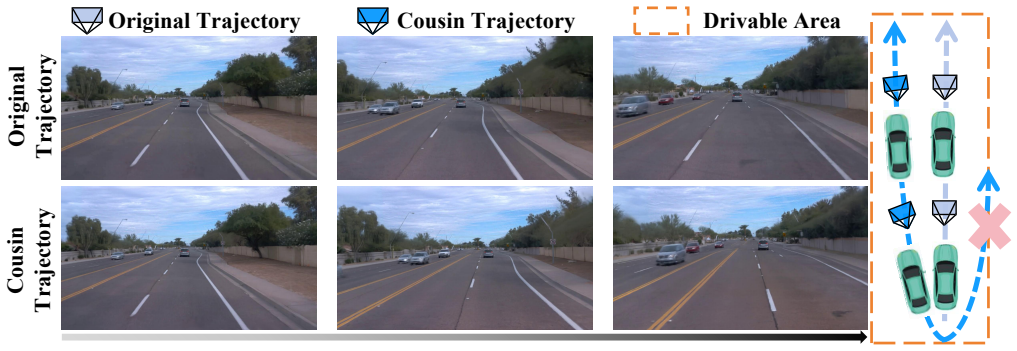
The paper's central discovery is that integrating a video diffusion prior into a 3DGS-based simulator removes the reconstruction-quality bottleneck that stops reinforcement learning from exploiting novel trajectories, and that adversarial trajectory editing plus trajectory interpolation supplies the missing corner-case and action diversity. ReconSimulator separates static background and rigid moving-vehicle Gaussians, renders novel paths, and uses the DriveRestorer from ReconDreamer to clean artifacts and fine-tune the reconstruction. DAA selects target vehicles in BEV, generates behavior-conditioned trajectories, checks them against drivable-region, kinematic, and inter-vehicle constraints,
Load-bearing premise
The load-bearing premise is that the closed-loop evaluation benchmark, which includes corner-case scenes edited by the same DAA machinery used in training, is an unbiased test of collision avoidance rather than a test of familiarity with the scenario generator.
Editorial extensions
If this is right
- If ReconSimulator renders faithfully enough on novel trajectories, reinforcement learning can be run in closed loop on scenes reconstructed from real sensor data, without a game-engine simulator.
- DAA-style adversarial trajectory generation can populate imitation-learning datasets with cut-in and hard-brake cases that are rare in human driving logs.
- CTG's trajectory extension and interpolation counters the straight-line bias in expert data, which should improve behavior-cloning initialization before RL.
- The reported collision-ratio numbers imply that the diffusion prior, not just RL itself, is a major driver of safety in corner cases.
- The framework extends to Waymo reconstructed scenes, suggesting the recipe is dataset-general rather than nuScenes-specific.
Reading between the lines
- The evaluation scenes are edited with the same DAA trajectory-edit machinery used in training, so the 3x-5x collision-ratio reductions may partly measure familiarity with the scenario generator; a held-out split generated by an independent simulator would test this.
- Because CTG generates kinematically checked trajectories from expert data, the same interpolation-and-extension idea could be applied as a standalone data augmentation for imitation-only driving pipelines, with or without RL.
- The kinematic bicycle-model constraint is what makes DAA edits physically plausible; if the constraint is too permissive or too strict, the difficulty distribution of generated corner cases shifts, so tuning it could directly trade off training difficulty against realism.
- A natural extension is to use the same diffusion prior to render sensor data for perception fine-tuning on novel routes, such as evaluating sensor failure or weather shifts, which the paper does not test.
Editorial analysis
A structured set of objections, weighed in public.
Referee Report
Summary. The paper proposes ReconDreamer-RL, a framework for training end-to-end autonomous driving policies in closed-loop, photorealistic 3DGS-based simulators. The method has three components: (i) ReconSimulator, which augments 3D Gaussian Splatting scene reconstruction with a video diffusion prior (DriveRestorer) and enforces physical plausibility through a kinematic bicycle model; (ii) the Dynamic Adversary Agent (DAA), which generates corner-case trajectories such as cut-ins by modifying surrounding vehicles' paths in both the imitation-learning and reinforcement-learning stages; and (iii) the Cousin Trajectory Generator (CTG), which extends and interpolates expert trajectories to create a more action-diverse training set (Cousin-nuScenes). The authors train a RAD-style driving policy with a two-stage IL+RL procedure and evaluate it in closed-loop 3DGS environments reconstructed from nuScenes and Waymo, including edited corner-case scenes. The headline results are a Collision Ratio of 0.077, a 3x reduction relative to RAD (0.238) and roughly a 5x reduction relative to imitation-learning baselines. Ablations show each module reducing CR in the expected direction, and a Waymo experiment reports a similar improvement over RAD (0.093 vs 0.140).
Significance. If the results are taken at face value, the paper makes a useful empirical contribution: it demonstrates that combining diffusion-based appearance restoration with kinematic constraints in a reconstructed 3DGS simulator can improve closed-loop RL training for driving, and that adversarial trajectory augmentation plus trajectory diversity is helpful. The mathematical components are standard and clearly described, and the ablations in Tab. 2 are internally consistent. The cross-dataset Waymo check, though using the same evaluation protocol, is a positive sign. However, the central safety claim rests on an evaluation benchmark whose edited scenarios are generated by the same DAA module used during training, so the reported improvements may reflect train/test overlap rather than safer generalizable driving. Because no disjoint held-out scenario split or independent closed-loop evaluation is reported, the main quantitative conclusion is currently not adequately supported. The paper is nevertheless a reasonable candidate after a major revision that adds unbiased evaluation.
major comments (3)
- [Method, 'Dynamic Adversary Agent'; Experiments, 'Main Results'; Supplement, 'Details of Edited Scenes' and 'Visualizatio] The evaluation benchmark and the training data are not independent. The test benchmark includes edited scenarios such as DynamicCutIn and HardBrake (Supplement, 'Details of Edited Scenes'), while the same DAA module is used in both training stages: the method states DAA 'can be used in both imitation learning and reinforcement learning stages' and during RL it 'continues to dynamically alter surrounding vehicle trajectories to create corner cases.' The supplement further states that 'DAA has a certain probability of fine-tuning the trajectories in the edited scenes' during RL. Thus the test scenarios are sampled from the same generator that produced the training tasks. The IL/RL baselines (VAD, GenAD, VADv2, RAD) were not trained on DAA-generated corner cases, so their higher CR in Tabs. 1 and 4 may simply reflect lack of exposure to the test generator's output, not poorer driving abilit
- [Experiments, 'Evaluation Metrics'; Tabs. 1 and 4] The paper reports CR, DCR, SCR, DR, PDR, and HDR as ratios over clips but does not state the total number of evaluation clips, the number of repeated runs or seeds, or any confidence intervals. Given that the main claim is a large reduction in collision ratio from 0.238 to 0.077, the lack of uncertainty quantification makes it impossible to assess whether the difference is statistically significant or stable. In addition, the PDR and HDR thresholds in Eqs. (15)-(16) are not specified, so the DR numbers in Tab. 1 cannot be reproduced. Please provide the evaluation corpus size, per-scenario breakdown, variance over seeds, and the exact deviation thresholds.
- [Main Results, 'Corner Case Results', Tab. 4] The statement that ReconDreamer-RL achieves a '404.5% improvement in Collision Ratio over imitation methods' is not a standard usage. The CR improves from, e.g., 0.449 to 0.089, which is an 80.2% relative reduction, not a 404.5% improvement. If the authors intend the reciprocal ratio, that should be stated explicitly and consistently with the abstract's '5x reduction' phrasing. As written, the percentage claim is misleading and should be corrected.
minor comments (5)
- [Experiments, 'Ablation Studies', Tab. 3] The text says 'without ReconSimulator,' but the ablation actually removes the video diffusion prior, not the entire ReconSimulator. Rephrase to 'w/o video diffusion prior' or clarify the component under study.
- [Method, 'Dynamic Adversary Agent', Eq. (9)] The sentence 'avoid collisions with other vehicles (collisions with the ego-vehicle are allowed)' is ambiguous. Does the set {o_j} include the ego vehicle? If collisions with the ego are allowed, the condition should clearly exclude the ego from the set; otherwise the text contradicts the constraint.
- [Abstract and Introduction] Minor typographical issues: 'InReconDreamer-RL' missing a space; the abstract states 'a 5x reduction in the Collision Ratio' while the introduction says 'a 5× reduction in collision rate.' Use consistent terminology and formatting.
- [Supplement, 'Visualization of DAA'] The probability of DAA fine-tuning trajectories in the RL stage is mentioned but never quantified, and the effect of the fine-tuning probability is not ablated. Please state the value used and, ideally, include a sensitivity analysis.
- [Figure 6] The claim that Cousin-nuScenes has '4x more non-straight-line driving maneuvers' is based on the bar chart, but the definition of 'Others' and the exact counting procedure are not given. Please define the categories and report the composition of the final training set.
Circularity Check
Headline collision-ratio reductions are measured on edited scenes whose trajectories are produced/fine-tuned by the same DAA mechanism used during training, so the benchmark partially overlaps the training distribution; otherwise the paper's components are validated by ablations and not derivationally circular.
-
fitted input called prediction
[Experiments (Experimental Setup); Method (Dynamic Adversary Agent); Supplement (Visualization of DAA)]
"Finally, we build an evaluation benchmark including edited 3DGS environments... DAA can be used in both imitation learning and reinforcement learning stages. In the first stage, DAA generates corner case scenarios... ReconSimulator then renders offline autonomous driving data... As mentioned in the main text, in the reinforcement learning stage, the Dynamic Adversary Agent (DAA) has a certain probability of fine-tuning the trajectories in the edited scenes... instead of directly reusing those generated during the imitation stage."
The headline 3x/5x collision-ratio reductions are computed on an evaluation benchmark that includes edited 3DGS scenes. Those edited scenes are the same ones in which DAA generates/fine-tunes trajectories during training: DAA generates corner cases for the imitation stage and continues to alter surrounding-vehicle trajectories in the RL stage, and the Supplement states that DAA fine-tunes trajectories in the edited scenes rather than reusing imitation-stage ones. Thus the test scenarios are drawn from the same generator that produced the training tasks. Reporting CR on this benchmark as evidence of safer driving is therefore partly a re-measurement of the policy's exposure to DAA-generated data, not an independent prediction of generalization. Baselines were not trained on DAA-generated co
full rationale
The paper is an empirical systems paper; there is no derivation whose equations reduce to its inputs. ReconSimulator's diffusion prior is supported by an internal ablation (Tab. 3) using detector-based and FID metrics, so citing ReconDreamer/DriveDreamer-2 is not load-bearing. CTG is validated by ablations on original scenes, and the Waymo experiment is on a different dataset (though it uses the same edited-scene protocol). The main circularity concern is the DAA train/test overlap: the evaluation benchmark's edited scenes are the same ones DAA operates in during training, so the headline collision-ratio numbers are not a clean held-out test. This is a validity threat, not a self-definitional derivation, so the score is 4.
Assumptions & free parameters
free parameters (6)
- DAA distance thresholds for target vehicle selection =
not specified (referenced to Kesting and Treiber 2013)
- dmin, minimum distance in DAA trajectory feasibility check (Eq. 9) =
not specified
- Per-vehicle-category kinematic constraints (wheelbase L, max steering angle, max velocity) =
not specified
- CTG interpolation density m (Eq. 11) =
not specified
- PDR and HDR deviation thresholds (Eqs. 15-16) =
not specified
- DAA trajectory fine-tuning probability in the RL stage =
not specified ('a certain probability')
assumptions (5)
- domain assumption 3DGS reconstruction of nuScenes/Waymo scenes is a faithful enough simulator that policies trained in it transfer to the evaluation benchmark and to real driving.
- domain assumption DriveRestorer's video-diffusion restoration improves novel-trajectory rendering without introducing plan-misleading artifacts.
- standard math The kinematic bicycle model (Eqs. 4-7) is sufficient to model physical feasibility of all vehicle trajectories in the simulator.
- domain assumption DAA-generated corner-case trajectories are representative of real dangerous traffic events, so training on them generalizes to reality.
- domain assumption The evaluation benchmark's edited scenes (DynamicCutIn, HardBrake, etc.) are a fair and unbiased test of collision avoidance.
Cite this review
Pith. "Pith review of ReconDreamer-RL: Enhancing Reinforcement Learning via Diffusion-based Scene Reconstruction." pith.science (2026). https://pith.science/paper/BMBG3XJW
@misc{pith2026250808170,
  author       = {Pith},
  title        = {Pith review of: ReconDreamer-RL: Enhancing Reinforcement Learning via Diffusion-based Scene Reconstruction},
  year         = {2026},
  howpublished = {\url{https://pith.science/paper/BMBG3XJW}},
  note         = {Machine review of arXiv:2508.08170}
}
read the original abstract
Reinforcement learning for training end-to-end autonomous driving models in closed-loop simulations is gaining growing attention. However, most simulation environments differ significantly from real-world conditions, creating a substantial simulation-to-reality (sim2real) gap. To bridge this gap, some approaches utilize scene reconstruction techniques to create photorealistic environments as a simulator. While this improves realistic sensor simulation, these methods are inherently constrained by the distribution of the training data, making it difficult to render high-quality sensor data for novel trajectories or corner case scenarios. Therefore, we propose ReconDreamer-RL, a framework designed to integrate video diffusion priors into scene reconstruction to aid reinforcement learning, thereby enhancing end-to-end autonomous driving training. Specifically, in ReconDreamer-RL, we introduce ReconSimulator, which combines the video diffusion prior for appearance modeling and incorporates a kinematic model for physical modeling, thereby reconstructing driving scenarios from real-world data. This narrows the sim2real gap for closed-loop evaluation and reinforcement learning. To cover more corner-case scenarios, we introduce the Dynamic Adversary Agent (DAA), which adjusts the trajectories of surrounding vehicles relative to the ego vehicle, autonomously generating corner-case traffic scenarios (e.g., cut-in). Finally, the Cousin Trajectory Generator (CTG) is proposed to address the issue of training data distribution, which is often biased toward simple straight-line movements. Experiments show that ReconDreamer-RL improves end-to-end autonomous driving training, outperforming imitation learning methods with a 5x reduction in the Collision Ratio.
Figures


Figures from the paper (12 more)



Forward citations
Cited by 2 Pith papers
-
GigaWorld-1: A Roadmap to Build World Models for Robot Policy Evaluation
Long-horizon action-faithful consistency, not short-term visual realism, dominates world-model reliability for robot policy evaluation; GigaWorld-1 implements that roadmap and gains 14.9% on evaluator-alignment metrics.
-
GigaWorld-Policy-0.5: A Faster and Stronger WAM Empowered by AutoResearch
GigaWorld-Policy-0.5 uses a Mixture-of-Transformers action-expert split and mixed world-model pretraining to reach 85 ms action-only inference with claimed success-rate gains.
Reference graph
Works this paper leans on
-
[3]
arXiv preprint arXiv:2311.18561
Periodic vibration gaussian: Dynamic urban scene reconstruction and real-time rendering. arXiv preprint arXiv:2311.18561. Chen, Z.; Yang, J.; Huang, J.; Lutio, R. d.; Esturo, J. M.; Ivanovic, B.; Litany, O.; Gojcic, Z.; Fidler, S.; Pavone, M.; Song, L.; and Wang, Y . 2024b. OmniRe: Omni Urban Scene Reconstruction. arXiv preprint arXiv:2408.16760. Cheng, J...
arXiv 2024
-
[6]
3D Gaussian splatting for real-time radiance field ren- dering. ACM Trans. Graph., 42(4): 139–1. Kesting, A.; and Treiber, M. 2013. Traffic flow dynamics: data, models and simulation. No. Book, Whole)(Springer Berlin Heidelberg, Berlin, Heidelberg. Khanam, R.; and Hussain, M. 2024. Yolov11: An overview of the key architectural enhancements. arXiv preprint...
arXiv 2013
-
[9]
Para-drive: Parallelized architecture for real-time au- tonomous driving. In Proceedings of the IEEE/CVF Confer- ence on Computer Vision and Pattern Recognition , 15449– 15458. Wu, Z.; Liu, T.; Luo, L.; Zhong, Z.; Chen, J.; Xiao, H.; Hou, C.; Lou, H.; Chen, Y .; Yang, R.; et al. 2023. Mars: An instance-aware, modular and realistic simulator for au- tonomo...
arXiv 2023
-
[10]
IEEE Transactions on Cy- bernetics
A survey of imitation learning: Algorithms, recent developments, and challenges. IEEE Transactions on Cy- bernetics. Zhang, D.; Liang, J.; Guo, K.; Lu, S.; Wang, Q.; Xiong, R.; Miao, Z.; and Wang, Y . 2025. Carplanner: Consistent auto- regressive trajectory planning for large-scale reinforcement learning in autonomous driving. In Proceedings of the Com- p...
arXiv 2025
-
[158]
Li, Z.; Li, K.; Wang, S.; Lan, S.; Yu, Z.; Ji, Y .; Li, Z.; Zhu, Z.; Kautz, J.; Wu, Z.; et al
Springer. Li, Z.; Li, K.; Wang, S.; Lan, S.; Yu, Z.; Ji, Y .; Li, Z.; Zhu, Z.; Kautz, J.; Wu, Z.; et al. 2024b. Hydra-mdp: End-to-end mul- timodal planning with multi-target hydra-distillation. arXiv preprint arXiv:2406.06978. Li, Z.; Wang, W.; Li, H.; Xie, E.; Sima, C.; Lu, T.; Yu, Q.; and Dai, J. 2024c. Bevformer: learning bird’s-eye-view rep- resentati...
arXiv 2024
-
[2019]
CARIL: Confidence-Aware Regression in Imitation Learning for Autonomous Driving
Exploring the limitations of behavior cloning for au- tonomous driving. In Proceedings of the IEEE/CVF inter- national conference on computer vision, 9329–9338. Delavari, E.; Khalil, A.; and Kwon, J. 2025. CARIL: Confidence-Aware Regression in Imitation Learning for Au- tonomous Driving. arXiv preprint arXiv:2503.00783. Di Palo, N.; and Johns, E. 2024. Ke...
work page Pith review arXiv 2025
-
[2020]
nuscenes: A multimodal dataset for autonomous driv- ing. In CVPR. Caesar, H.; Kabzan, J.; Tan, K. S.; Fong, W. K.; Wolff, E.; Lang, A.; Fletcher, L.; Beijbom, O.; and Omari, S. 2021. nuplan: A closed-loop ml-based planning benchmark for au- tonomous vehicles. arXiv preprint arXiv:2106.11810. Che, Q.-H.; Nguyen, D.-P.; Pham, M.-Q.; and Lam, D.-K
arXiv 2021
-
[2021]
Advances in Neural Informa- tion Processing Systems, 34: 11702–11716
Bridging offline reinforcement learning and imitation learning: A tale of pessimism. Advances in Neural Informa- tion Processing Systems, 34: 11702–11716. Rombach, R.; Blattmann, A.; Lorenz, D.; Esser, P.; and Om- mer, B. 2022. High-resolution image synthesis with latent diffusion models. In Proceedings of the IEEE/CVF confer- ence on computer vision and ...
arXiv 2022
Show all 10 references
-
[2023]
TwinLiteNet: An efficient and lightweight model for driveable area and lane segmentation in self-driving cars. In MAPR. Chen, S.; Jiang, B.; Gao, H.; Liao, B.; Xu, Q.; Zhang, Q.; Huang, C.; Liu, W.; and Wang, X. 2024a. Vadv2: End-to- end vectorized autonomous driving via proba...
-
[2024]
Advances in Neural Information Processing Systems, 37: 819–844
Bench2drive: Towards multi-ability benchmarking of closed-loop end-to-end autonomous driving. Advances in Neural Information Processing Systems, 37: 819–844. Jiang, B.; Chen, S.; Xu, Q.; Liao, B.; Chen, J.; Zhou, H.; Zhang, Q.; Liu, W.; Huang, C.; and Wang, X. 2023. Vad: Vecto...
2023 arXiv
Reviewed August 5, 2026 · model on record in the stance chip above.
Discussion (0). Sign in to comment.