REVIEW 3 major objections 4 minor 2 cited by
Benchmarking nuclear matrix elements of $0\nu\beta\beta$ decay with high-energy nuclear collisions
T0 review · 3 major / 4 minor · reviewed 2026-08-08 · deepseek-v4-flash
Pith's one-line read The nuclear matrix element for the neutrinoless double beta decay transition 150Nd→150Sm is strongly correlated with collective flow observables in ultra-central 150Nd+150Nd collisions, meaning collider measurements of those observables…
desk verdict A clever, honest proof-of-principle connecting 0νββ NMEs to heavy-ion flow, but the benchmark claim is only as strong as the assumption that β2 alone mediates the correlation. read the letter →
The pith
A machine-rendered reading of the paper's core claim, the machinery that carries it, and where it could break.
The reading
What carries the argument
The key object is the quadrupole deformation parameter β2, extracted from the B(E2) transition strength via the relation β2 = (4π)/(3ZR0²) √B(E2), which acts as a common cause: it quenches the NME (through the overlap of the initial and final nuclear states) and it enhances the spatial ellipticity ε2 and the energy-per-entropy ratio E/S of the quark-gluon plasma formed in an ultra-central collision. The chain connecting the NME to collider observables runs from the energy-density-functional parameters, through the ground-state wave functions and β2, into the initial-condition simulation that yields ε2 and E/S, and finally to the final-state elliptic flow v2 and mean transverse momentum [pT].
What would settle it
A calculation that extends the same Bayesian framework to include triaxial and octupole deformations and then re-evaluates the Pearson coefficients would settle whether the correlations survive; if |r| for cov($v2^{2}$,[pT]) drops below about 0.7, the collider benchmark would lose its quantitative resolving power.
Extended reading notes
Core claim
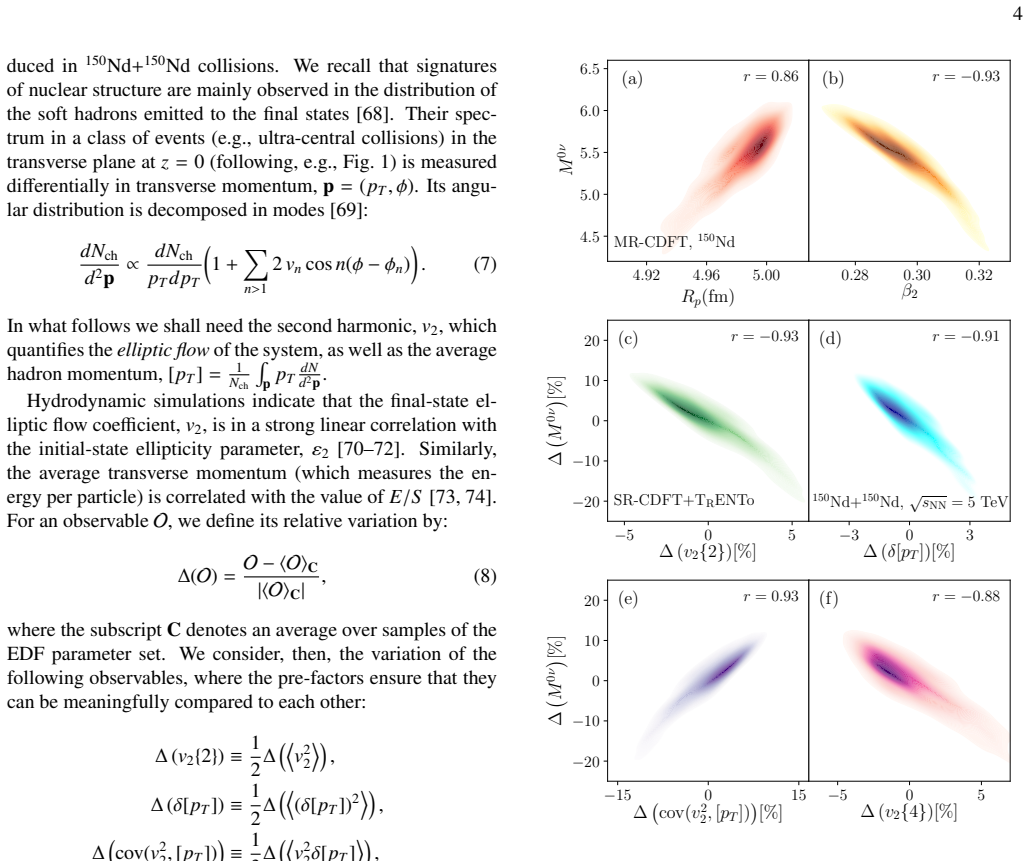
The central claim is that the nuclear matrix element M0ν for the 0νββ decay of 150Nd is strongly anti-correlated with the quadrupole deformation β2 of the parent nucleus, and that the same β2 controls the magnitude of elliptic flow and transverse-momentum fluctuations in ultra-central 150Nd+150Nd collisions. By varying the parameters of the covariant energy density functional across a Bayesian sample and feeding the resulting nuclear shapes into initial-condition simulations, the authors obtain Pearson correlation coefficients of r = -0.93 for v2{2}, r = -0.91 for δ[pT], r = +0.93 for cov($v2^{2}$,[pT]), and r = -0.88 for v2{4} against the NME. They conclude that a measurement of these observables in high-energy collisions, with an experimental precision of about 1% or better, would pin down β2 and thereby benchmark theoretical NME predictions.
Load-bearing premise
The load-bearing premise is that the quadrupole deformation β2 taken from the measured B(E2) strength is the only nuclear-structure degree of freedom that matters for both the NME and the flow observables, so that triaxial, octupole, and radial-density variations do not decorrelate the two sides.
Editorial extensions
If this is right
- A measurement of v2{2} in ultra-central 150Nd+150Nd collisions at the LHC or RHIC would directly constrain β2 of 150Nd, shrinking the spread of NME predictions.
- The covariance cov(v2^2,[pT]) shows the largest variation with β2 (about 10%) and the strongest correlation with the NME (r = +0.93), making it the most sensitive single collider observable for this purpose.
- Combining flow data from 150Nd+150Nd with a near-spherical reference such as 208Pb+208Pb suppresses quark-gluon-plasma uncertainties, so the proposed benchmark remains robust even without a perfectly faithful hydrodynamic model.
- A short special run at the LHC of only a few hours, using detectors capable of ultra-central event selection, could collect enough statistics to measure v2{4} to about 1% precision, the level needed to distinguish among NME models.
Reading between the lines
- The same logic should apply to other strongly deformed 0νββ candidates, such as 76Ge, 130Te, or 136Xe, as long as their quadrupole deformation produces a measurable flow signature; the paper only demonstrates the correlation for 150Nd.
- A joint Bayesian fit of low-energy structure data and high-energy flow data would yield a substantially tighter posterior for β2 and hence for the NME than either dataset alone—this is the natural next step the authors sketch.
- A negative result—flow observables that barely vary across the EDF sample—would signal that some other degree of freedom decorrelates the NME from geometry, and would therefore falsify the proposed benchmark.
Editorial analysis
A structured set of objections, weighed in public.
Referee Report
Summary. The paper proposes that collective-flow measurements in ultra-central high-energy 150Nd+150Nd collisions can be used to benchmark the nuclear matrix element (NME) of the 0νββ decay transition 150Nd→150Sm. The authors generate ~10^3 samples of a relativistic covariant density functional by varying nine coupling constants around the PC-PK1 values, compute the MR-CDFT NME for each sample, and use the B(E2)-derived quadrupole deformation β2 (Eq. (4)) to initialize TRENTo simulations of 150Nd+150Nd collisions. They report strong Pearson correlations (|r| = 0.88–0.93) between the NME and initial-state proxies for v2, δ[pT], their covariance, and v2{4}, and argue that collider data can therefore constrain β2 and reduce NME uncertainty.
Significance. If the effect survives a more complete treatment, this is a genuinely new and complementary bridge between high-energy collider physics and neutrinoless double-beta decay, with concrete implications for the LHC ion program and for the interpretation of ton-scale 0νββ experiments. The workflow (Fig. 2) is clearly described, the forward-modeling logic is transparent, and the authors are explicit about the main limitations, which is commendable. The correlation coefficients are internally consistent with the stated model. However, the central claim is currently supported only within an axially symmetric, reflection-symmetric quadrupole model and for initial-state geometric quantities rather than full final-state observables; the robustness of the correlations to omitted shape degrees of freedom and to hydrodynamic response effects remains to be demonstrated.
major comments (3)
- [NME, nuclear structure, and heavy-ion collisions (Eq. (4); Fig. 3)] The collider-side input is reduced to a single scalar, β2, obtained from B(E2) via the rotor formula (4), while the MR-CDFT NME is computed from full projected wave functions that can in principle depend on triaxiality γ, octupole deformation β3, and higher multipoles. If the 10^3 EDF samples contain variations in these omitted degrees of freedom that affect M0ν but are not transmitted to the collision simulation, the correlations in Fig. 3(c)–(f) could be inflated or biased. The Summary acknowledges that octupole and triaxial deformation are 'expected to impact the values of the matrix elements,' but the manuscript does not quantify how much these omitted degrees of freedom decorrelate the NME from the flow proxies. This is load-bearing: without such a test, the claim that collider experiments can benchmark NMEs is demonstrated only within a restricted shape model. I recommend adding a sensitivity study that varies γ and β3 in both the NME and collision calculations (even for a subset of samples), or a formal argument for why β2 is a sufficient mediator.
- [Results and discussion (Eq. (9))] The observables labeled v2{2}, δ[pT], cov(v2^2,[pT]), and v2{4} are not actual final-state observables: they are the initial-state moments ⟨ε2^2⟩, ⟨(δ(E/S))^2⟩, ⟨ε2^2 δ(E/S)⟩, and 2⟨ε2^2⟩^2−⟨ε2^4⟩, mapped through linear-response relations v2 ∝ ε2 and [pT] ∝ E/S. The proportionality factors are assumed to be independent of the EDF parameters and therefore to cancel in relative variations. In practice the hydrodynamic response is weakly nonlinear and can depend on the shape of the initial profile, which changes with β2; final-state fluctuations also contribute to the measured cumulants, especially v2{4}. The reported Pearson coefficients therefore quantify correlations with initial-state geometry, not directly with measured flow observables. A validation for at least a few samples using a full hydrodynamic code, or a demonstration that published response parametrizations are insensitive to the EDF variations, would materially strengthen the claim that collider measurements, rather than just initial-state proxies, are correlated with the NME.
- [NME, nuclear structure, and heavy-ion collisions (sampling procedure)] The text states that the 10^3 EDF parameter sets are 'obtained by varying the nine parameters C around their optimal values of the PC-PK1 using quasi-Monte Carlo sampling with a uniform distribution [25]' and refers to a 'Bayesian analysis' in the Introduction and in Fig. 2. As written, this is a uniform parameter scan, not a posterior sample conditioned on the low-energy nuclear-structure data. The spread in M0ν and β2 and the derived 'theoretical uncertainty' are therefore prior-driven. Please clarify whether these samples are the posterior samples of Ref. [25]; if so, state the likelihood and the data used. If they are not posterior samples, the manuscript should avoid the term 'Bayesian' in describing the generation of the ensemble and should temper the conclusion that the spread represents the relevant theoretical uncertainty.
minor comments (4)
- [Fig. 3 caption] The caption lists '(d)' twice and omits '(e)'; the panel for cov(v2^2,[pT]) is not correctly labeled.
- [Introduction] There is a typo in the full text: 'effc-tive' should read 'effective'.
- [Eq. (9)] The pre-factors 1/2, 1/3, and 1/4 in Eq. (9) are introduced without derivation; please add a sentence or a reference explaining why these particular factors ensure that the observables can be meaningfully compared.
- [Summary and outlook] The statement that octupole and triaxial deformation should be included in future work appears only in the final paragraph; moving this caveat to the Results section would better calibrate the reader's expectations about the scope of the current correlations.
Circularity Check
No significant circularity: the reported flow–NME correlations are forward-model predictions from a shared EDF ensemble, not fits or definitions.
full rationale
The derivation chain is self-contained and non-circular. The NME M0ν is computed via MR-CDFT (Eqs. 1–3) for each EDF parameter set C. The quadrupole deformation β2 is obtained from the model’s B(E2) via Eq. (4) and then used to constrain the SR-CDFT intrinsic density that feeds the TRENTo initial-state simulation. The flow-related quantities in Eq. (6) are deterministic forward-model outputs of each β2; they are never fitted to the NME, and the NME is never defined in terms of the flow observables. The strong Pearson correlations in Fig. 3 emerge because both M0ν and the flow observables are strongly correlated with the same structural parameter β2 across the Bayesian ensemble—this is a physical propagation of sensitivity, not a circular reduction. The self-cited Bayesian analysis (Refs. [24, 25]) provides the ensemble of C and is a methodological input; the present paper recomputes both the NME and the flow observables from first principles within that ensemble, so the citation is not load-bearing for the correlation result. The Summary's caveat about omitted octupole and triaxial deformations is a model limitation that could dilute the correlation in a more complete theory, but it does not make the present derivation circular. No equation in the paper reduces to its own input, and no fitted parameter is relabeled as a prediction.
Assumptions & free parameters
free parameters (2)
- CDFT coupling constants C = {α_S, β_S, γ_S, δ_S, α_V, γ_V, δ_V, α_TV, δ_TV} =
PC-PK1 values (not listed in text)
- TRENTo initial-condition parameters =
Not stated in text; adopted from previous studies
assumptions (6)
- domain assumption The MR-CDFT framework with the PC-PK1 functional provides accurate ground-state wave functions for 150Nd and 150Sm required to compute M0ν.
- domain assumption The 0νββ decay operator is the standard light-Majorana-neutrino-exchange operator, with two-body currents and the contact operator neglected.
- ad hoc to paper The intrinsic quadrupole deformation of the nucleus for the collision simulation is correctly obtained from the B(E2) value via Eq. (4), with R0 = 1.2 A^1/3 fm.
- domain assumption TRENTo initial conditions with an ideal-gas energy-density prescription e ∝ s^(4/3) describe the QGP initial state at √sNN = 5 TeV.
- domain assumption Final-state flow observables are linearly proportional to the initial-state quantities ε2 and E/S, so relative variations in the observables can be computed without full hydrodynamic evolution.
- ad hoc to paper Triaxial and octupole deformations of 150Nd can be neglected in this first study.
Cite this review
Pith. "Pith review of Benchmarking nuclear matrix elements of $0\nu\beta\beta$ decay with high-energy nuclear collisions." pith.science (2026). https://pith.science/paper/BMS6IK22
@misc{pith2026250208027,
  author       = {Pith},
  title        = {Pith review of: Benchmarking nuclear matrix elements of $0\nu\beta\beta$ decay with high-energy nuclear collisions},
  year         = {2026},
  howpublished = {\url{https://pith.science/paper/BMS6IK22}},
  note         = {Machine review of arXiv:2502.08027}
}
abstract
Reducing uncertainties in the nuclear matrix elements (NMEs) remains a critical challenge in designing and interpreting experiments aimed at discovering neutrinoless double beta ($0\nu\beta\beta$) decay. Here, we identify a class of observables, distinct from those employed in low-energy nuclear structure applications, that are strongly correlated with the NMEs: momentum correlations among hadrons produced in high-energy nuclear collisions. Focusing on the $^{150}$Nd$\rightarrow$$^{150}$Sm transition, we combine a Bayesian analysis of the structure of $^{150}$Nd with simulations of high-energy $^{150}$Nd+$^{150}$Nd collisions. We reveal prominent correlations between the NMEs and features of the quark-gluon plasma (QGP) formed in these processes, such as spatial gradients and anisotropies, which are accessible via collective flow measurements. Our findings demonstrate collider experiments involving $0\nu\beta\beta$ decay candidates as a platform for benchmarking theoretical predictions of the NMEs.
Figures


Forward citations
Cited by 2 Pith papers
-
Nonlinear collective flow reveals the breakdown of quadrupole--hexadecapole scaling in heavy ion collisions
The nonlinear flow coefficient ξ6,222 in simulated U+U collisions separates the four (β2, β4) nuclear topology classes, making the sign of the hexadecapole deformation β4 experimentally accessible.
-
Nuclear Physics Confronts Relativistic Collisions Of Isobars
RHIC isobar data are explained by different shapes of 96Ru and 96Zr, with 96Zr showing a large octupole deformation, so nuclear structure uncertainty, not the magnetic field, dominates the observed ratios.
Reference graph
Works this paper leans on
- [25]
-
[1]
Q. R. Ahmad et al. (SNO), Measurement of the rate ofν e + d→p+p+e − interactions produced by 8B solar neutrinos at the Sudbury Neutrino Observatory, Phys. Rev. Lett.87, 071301 (2001), arXiv:nucl-ex/0106015
arXiv 2001
-
[2]
K. Eguchi et al. (KamLAND), First results from KamLAND: Evidence for reactor anti-neutrino disappearance, Phys. Rev. Lett.90, 021802 (2003), arXiv:hep-ex/0212021
arXiv 2003
-
[3]
F. P. An et al. (Daya Bay), Observation of electron-antineutrino disappearance at Daya Bay, Phys. Rev. Lett.108, 171803 (2012), arXiv:1203.1669 [hep-ex]
arXiv 2012
-
[4]
W. H. Furry, On transition probabilities in double beta- disintegration, Phys. Rev.56, 1184 (1939)
1939
-
[5]
Schechter and J
J. Schechter and J. W. F. Valle, Neutrinoless Double beta Decay in SU(2) x U(1) Theories, Phys. Rev. D25, 2951 (1982)
1982
-
[6]
Fukugita and T
M. Fukugita and T. Yanagida, Baryogenesis Without Grand Unification, Phys. Lett. B174, 45 (1986)
1986
-
[7]
M. Agostini, G. Benato, J. A. Detwiler, J. Menéndez, and F. Vissani, Toward the discovery of matter creation with neutrinolessββdecay, Rev. Mod. Phys.95, 025002 (2023), arXiv:2202.01787 [hep-ex]
arXiv 2023
Show all 90 references
-
[8]
Engel and J
J. Engel and J. Menéndez, Status and Future of Nuclear Ma- trix Elements for Neutrinoless Double-Beta Decay: A Review, Rept. Prog. Phys.80, 046301 (2017), arXiv:1610.06548 [nucl- th]
2017 arXiv
-
[9]
J. M. Yao, J. Meng, Y . F. Niu, and P. Ring, Beyond-mean- field approaches for nuclear neutrinoless double beta decay in the standard mechanism, Prog. Part. Nucl. Phys.126, 103965 (2022), arXiv:2111.15543 [nucl-th]
2022 arXiv
-
[10]
J. M. Yao, B. Bally, J. Engel, R. Wirth, T. R. Rodríguez, and H. Hergert, Ab initio treatment of collective correlations and the neutrinoless double beta decay of48Ca, Phys. Rev. Lett.124, 232501 (2020)
2020
-
[11]
Belley, C
A. Belley, C. G. Payne, S. R. Stroberg, T. Miyagi, and J. D. Holt,AbInitioNeutrinoless Double-Beta Decay Matrix Ele- ments for 48Ca , 76Ge , and 82Se, Phys. Rev. Lett.126, 042502 (2021), arXiv:2008.06588 [nucl-th]
2021 arXiv
-
[12]
Novario, P
S. Novario, P. Gysbers, J. Engel, G. Hagen, G. R. Jansen, T. D. Morris, P. Navrátil, T. Papenbrock, and S. Quaglioni, Coupled- Cluster Calculations of Neutrinoless Double-βDecay in 48Ca, Phys. Rev. Lett.126, 182502 (2021), arXiv:2008.09696 [nucl- th]
2021 arXiv
-
[13]
Belley, J
A. Belley, J. Pitcher, T. Miyagi, S. R. Stroberg, and J. D. Holt, Correlation of neutrinoless double-beta decay nuclear matrix elements with nucleon-nucleon phase shifts, (2024), arXiv:2408.02169 [nucl-th]
2024 arXiv
-
[14]
Belley, J
A. Belley, J. M. Yao, B. Bally, J. Pitcher, J. Engel, H. Hergert, 6 J. D. Holt, T. Miyagi, T. R. Rodríguez, A. M. Romero, S. R. Stroberg, and X. Zhang, Ab initio uncertainty quantification of neutrinoless double-beta decay in 76Ge, Phys. Rev. Lett.132, 182502 (2024)
2024
-
[15]
Shimizu, J
N. Shimizu, J. Menéndez, and K. Yako, Double Gamow-Teller Transitions and its Relation to NeutrinolessββDecay, Phys. Rev. Lett.120, 142502 (2018), arXiv:1709.01088 [nucl-th]
2018 arXiv
-
[16]
J. M. Yao, I. Ginnett, A. Belley, T. Miyagi, R. Wirth, S. Bogner, J. Engel, H. Hergert, J. D. Holt, and S. R. Stroberg, Ab ini- tio studies of the double–Gamow-Teller transition and its cor- relation with neutrinoless double-βdecay, Phys. Rev. C106, 014315 (2022), arXiv:2204.1...
2022 arXiv
-
[17]
Jokiniemi and J
L. Jokiniemi and J. Menéndez, Correlations between neutri- noless double-β, double Gamow-Teller, and double-magnetic decays in the proton-neutron quasiparticle random-phase ap- proximation framework, Phys. Rev. C107, 044316 (2023), arXiv:2302.05399 [nucl-th]
2023 arXiv
-
[18]
Y . K. Wang, P. W. Zhao, and J. Meng, Correlation between neu- trinoless double-βdecay and double Gamow-Teller transitions, Phys. Lett. B855, 138796 (2024), arXiv:2403.06455 [nucl-th]
2024 arXiv
-
[19]
Romeo, J
B. Romeo, J. Menéndez, and C. Peña Garay,γγdecay as a probe of neutrinolessββdecay nuclear matrix elements, Phys. Lett. B827, 136965 (2022), arXiv:2102.11101 [nucl-th]
2022 arXiv
-
[20]
Romeo, D
B. Romeo, D. Stramaccioni, J. Menéndez, and J. J. Valiente- Dobón, A pathway to unveiling neutrinolessββdecay nu- clear matrix elements viaγγdecay, Phys. Lett. B860, 139186 (2025), arXiv:2411.03539 [nucl-th]
2025 arXiv
-
[21]
Horoi, A
M. Horoi, A. Neacsu, and S. Stoica, Statistical analysis for the neutrinoless double-β-decay matrix element of Ca48, Phys. Rev. C106, 054302 (2022), arXiv:2203.10577 [nucl-th]
2022 arXiv
-
[22]
Horoi, A
M. Horoi, A. Neacsu, and S. Stoica, Predicting the neutrino- less double-β-decay matrix element of Xe136 using a statistical approach, Phys. Rev. C107, 045501 (2023), arXiv:2302.03664 [nucl-th]
2023 arXiv
-
[23]
Belley, T
A. Belley, T. Miyagi, S. R. Stroberg, and J. D. Holt, Constraining Neutrinoless Double-Beta Decay Ma- trix Elements from Ab Initio Nuclear Theory, in Matrix Elements for the Double-beta-decay EXperiments (2022) arXiv:2210.05809 [nucl-th]
2022 arXiv
-
[24]
Zhang, C
X. Zhang, C. C. Wang, C. R. Ding, and J. M. Yao, Subspace- projected multireference covariant density functional theory, (2024), arXiv:2408.00691 [nucl-th]
2024 arXiv
-
[26]
T. R. Rodríguez and G. Martínez-Pinedo, Energy density func- tional study of nuclear matrix elements for neutrinolessββde- cay, Phys. Rev. Lett.105, 252503 (2010)
2010
-
[27]
J. M. Yao, L. S. Song, K. Hagino, P. Ring, and J. Meng, System- atic study of nuclear matrix elements in neutrinoless double- βdecay with a beyond-mean-field covariant density functional theory, Phys. Rev. C91, 024316 (2015)
2015
-
[28]
C. Jiao, C. Yuan, and J. Yao, Correlation of Neutrinoless Double-βDecay Nuclear Matrix Element with E2 Strength, Symmetry15, 552 (2023)
2023
-
[29]
Adamczyk et al
L. Adamczyk et al. (STAR), Azimuthal anisotropy in U+U and Au+Au collisions at RHIC, Phys. Rev. Lett.115, 222301 (2015), arXiv:1505.07812 [nucl-ex]
2015 arXiv
-
[30]
Acharya et al
S. Acharya et al. (ALICE), Anisotropic flow in Xe-Xe col- lisions at √sNN =5.44TeV, Phys. Lett. B784, 82 (2018), arXiv:1805.01832 [nucl-ex]
2018 arXiv
-
[31]
A. M. Sirunyan et al. (CMS), Charged-particle angular correla- tions in XeXe collisions at√sNN =5.44 TeV, Phys. Rev. C100, 044902 (2019), arXiv:1901.07997 [hep-ex]
2019 arXiv
-
[32]
Aad et al
G. Aad et al. (ATLAS), Measurement of the azimuthal anisotropy of charged-particle production inXe+Xecollisions at √sNN =5.44 TeV with the ATLAS detector, Phys. Rev. C 101, 024906 (2020), arXiv:1911.04812 [nucl-ex]
2020 arXiv
-
[33]
Abdallah et al
M. Abdallah et al. (STAR), Search for the chiral magnetic effect with isobar collisions at√sNN =200 GeV by the STAR Collab- oration at the BNL Relativistic Heavy Ion Collider, Phys. Rev. C105, 014901 (2022), arXiv:2109.00131 [nucl-ex]
2022
-
[34]
Acharya et al
S. Acharya et al. (ALICE), Characterizing the initial conditions of heavy-ion collisions at the LHC with mean transverse mo- mentum and anisotropic flow correlations, Phys. Lett. B834, 137393 (2022), arXiv:2111.06106 [nucl-ex]
2022 arXiv
-
[35]
Aad et al
G. Aad et al. (ATLAS), Correlations between flow and trans- verse momentum in Xe+Xe and Pb+Pb collisions at the LHC with the ATLAS detector: A probe of the heavy-ion initial state and nuclear deformation, Phys. Rev. C107, 054910 (2023), arXiv:2205.00039 [nucl-ex]
2023 arXiv
-
[36]
M. I. Abdulhamid et al. (STAR), Imaging shapes of atomic nu- clei in high-energy nuclear collisions, Nature635, 67 (2024), arXiv:2401.06625 [nucl-ex]
2024 arXiv
-
[37]
Acharya et al
S. Acharya et al. (ALICE), Exploring nuclear structure with multiparticle azimuthal correlations at the LHC, (2024), arXiv:2409.04343 [nucl-ex]
2024
-
[38]
Giacalone, J
G. Giacalone, J. Jia, and V . Somà, Accessing the shape of atomic nuclei with relativistic collisions of isobars, Phys. Rev. C104, L041903 (2021), arXiv:2102.08158 [nucl-th]
2021 arXiv
-
[39]
H.-j. Xu, W. Zhao, H. Li, Y . Zhou, L.-W. Chen, and F. Wang, Probing nuclear structure with mean transverse momentum in relativistic isobar collisions, Phys. Rev. C108, L011902 (2023), arXiv:2111.14812 [nucl-th]
2023 arXiv
-
[40]
Nijs and W
G. Nijs and W. van der Schee, Inferring nuclear structure from heavy isobar collisions using Trajectum, SciPost Phys.15, 041 (2023), arXiv:2112.13771 [nucl-th]
2023 arXiv
-
[41]
Zhang, S
C. Zhang, S. Bhatta, and J. Jia, Ratios of collective flow ob- servables in high-energy isobar collisions are insensitive to final-state interactions, Phys. Rev. C106, L031901 (2022), arXiv:2206.01943 [nucl-th]
2022 arXiv
-
[42]
Zhao, H.-j
S. Zhao, H.-j. Xu, Y .-X. Liu, and H. Song, Probing the nuclear deformation with three-particle asymmetric cumulant in RHIC isobar runs, Phys. Lett. B839, 137838 (2023), arXiv:2204.02387 [nucl-th]
2023 arXiv
-
[43]
F. G. Gardim, A. V . Giannini, F. Grassi, K. P. Pala, and W. M. Serenone, Impact of the pre-equilibrium stage for the deter- mination of nuclear geometry in high-energy isobar collisions, Phys. Rev. C110, 064907 (2024), arXiv:2305.03703 [nucl-th]
2024 arXiv
-
[44]
G. Giacalone et al., The unexpected uses of a bowling pin: ex- ploiting 20Ne isotopes for precision characterizations of collec- tivity in small systems, (2024), arXiv:2402.05995 [nucl-th]
2024 arXiv
-
[45]
Giacalone et al., Anisotropic Flow in Fixed-Target Pb208+Ne20 Collisions as a Probe of Quark-Gluon Plasma, Phys
G. Giacalone et al., Anisotropic Flow in Fixed-Target Pb208+Ne20 Collisions as a Probe of Quark-Gluon Plasma, Phys. Rev. Lett.134, 082301 (2025), arXiv:2405.20210 [nucl- th]
2025 arXiv
-
[46]
H.-j. Xu, J. Zhao, and F. Wang, Hexadecapole Deformation of U238 from Relativistic Heavy-Ion Collisions Using a Nonlin- ear Response Coefficient, Phys. Rev. Lett.132, 262301 (2024), arXiv:2402.16550 [nucl-th]
2024 arXiv
-
[47]
Mäntysaari, B
H. Mäntysaari, B. Schenke, C. Shen, and W. Zhao, Probing nu- clear structure of heavy ions at energies available at the CERN Large Hadron Collider, Phys. Rev. C110, 054913 (2024), arXiv:2409.19064 [nucl-th]
2024 arXiv
-
[48]
L. S. Song, J. M. Yao, P. Ring, and J. Meng, Relativistic de- scription of nuclear matrix elements in neutrinoless double-β decay, Phys. Rev. C90, 054309 (2014). 7
2014
-
[49]
See supplemental material [https://link.aps.org/supplemental/] for a detailed introduction to the MR-CDFT approach, the ex- pression for the transition operators of neutrinoless double-beta decay, as well as collision simulations and observables. the sup- plemental information...
-
[50]
Cirigliano, W
V . Cirigliano, W. Dekens, J. de Vries, M. L. Graesser, E. Mereghetti, S. Pastore, and U. van Kolck, New leading con- tribution to neutrinoless double-βdecay, Phys. Rev. Lett.120, 202001 (2018)
2018
-
[51]
Yang and P
Y . Yang and P. Zhao, Relativistic model-free prediction for neu- trinoless double beta decay at leading order, Physics Letters B 855, 138782 (2024)
2024
-
[52]
L.-J. Wang, J. Engel, and J. M. Yao, Quenching of nuclear ma- trix elements for 0νββdecay by chiral two-body currents, Phys. Rev. C98, 031301 (2018), arXiv:1805.10276 [nucl-th]
2018 arXiv
-
[53]
Burvenich, D
T. Burvenich, D. G. Madland, J. A. Maruhn, and P. G. Rein- hard, Nuclear ground state observables and QCD scaling in a re- fined relativistic point coupling model, Phys. Rev. C65, 044308 (2002), arXiv:nucl-th/0111012
2002 arXiv
-
[54]
P. W. Zhao, Z. P. Li, J. M. Yao, and J. Meng, New parametriza- tion for the nuclear covariant energy density functional with point-coupling interaction, Phys. Rev. C82, 054319 (2010), arXiv:1002.1789 [nucl-th]
2010 arXiv
-
[55]
J. M. Yao, L. S. Song, K. Hagino, P. Ring, and J. Meng, System- atic study of nuclear matrix elements in neutrinoless double- βdecay with a beyond-mean-field covariant density functional theory, Phys. Rev. C91, 024316 (2015), arXiv:1410.6326 [nucl- th]
2015 arXiv
-
[56]
Raman, C
S. Raman, C. Nestor, and P. Tikkanen, Transition probability from the ground to the first-excited 2+state of even–even nu- clides, Atomic Data and Nuclear Data Tables78, 1 (2001)
2001
-
[57]
Bally, M
B. Bally, M. Bender, G. Giacalone, and V . Somà, Evidence of the triaxial structure of 129Xe at the Large Hadron Collider, Phys. Rev. Lett.128, 082301 (2022), arXiv:2108.09578 [nucl- th]
2022 arXiv
-
[58]
Bally, G
B. Bally, G. Giacalone, and M. Bender, The shape of gold, Eur. Phys. J. A59, 58 (2023), arXiv:2301.02420 [nucl-th]
2023 arXiv
-
[59]
Ryssens, G
W. Ryssens, G. Giacalone, B. Schenke, and C. Shen, Evidence of Hexadecapole Deformation in Uranium-238 at the Relativis- tic Heavy Ion Collider, Phys. Rev. Lett.130, 212302 (2023), arXiv:2302.13617 [nucl-th]
2023 arXiv
-
[60]
J. S. Moreland, J. E. Bernhard, and S. A. Bass, Alternative ansatz to wounded nucleon and binary collision scaling in high- energy nuclear collisions, Phys. Rev. C92, 011901 (2015), arXiv:1412.4708 [nucl-th]
2015 arXiv
-
[61]
Teaney and L
D. Teaney and L. Yan, Triangularity and Dipole Asymme- try in Heavy Ion Collisions, Phys. Rev. C83, 064904 (2011), arXiv:1010.1876 [nucl-th]
2011 arXiv
-
[62]
Giacalone, J
G. Giacalone, J. Jia, and C. Zhang, Impact of Nuclear Defor- mation on Relativistic Heavy-Ion Collisions: Assessing Con- sistency in Nuclear Physics across Energy Scales, Phys. Rev. Lett.127, 242301 (2021), arXiv:2105.01638 [nucl-th]
2021 arXiv
-
[63]
Chaturvedi, R
K. Chaturvedi, R. Chandra, P. K. Rath, P. K. Raina, and J. G. Hirsch, Nuclear deformation and neutrinoless double-beta de- cay of Zr-94, Zr-96, Mo-98, Mo-100, Ru-104, Pd-110, Te-128, Te-130, and Nd-150 nuclei within a mechanism involving neu- trino mass, Phys. Rev. C78, 054302 (2008)
2008
-
[64]
D.-L. Fang, A. Faessler, V . Rodin, and F. Simkovic, Neutri- noless double-beta decay of 150Nd accounting for deformation, Phys. Rev. C82, 051301 (2010), arXiv:1009.5579 [nucl-th]
2010 arXiv
-
[65]
M. T. Mustonen and J. Engel, Large-scale calculations of the double-βdecay of 76Ge,130 Te, 136 Xe, and 150Ndin the deformed self-consistent Skyrme quasiparticle random-phase approxima- tion, Phys. Rev. C87, 064302 (2013), arXiv:1301.6997 [nucl- th]
2013 arXiv
-
[66]
Sahu and V
R. Sahu and V . K. B. Kota, Deformed shell model results for neutrinoless double beta decay of nuclei in A=60 - 90 re- gion, Int. J. Mod. Phys. E24, 1550022 (2015), arXiv:1409.4929 [nucl-th]
2015 arXiv
-
[67]
D.-L. Fang, A. Faessler, and F. Simkovic, 0νββ-decay nuclear matrix element for light and heavy neutrino mass mechanisms from deformed quasiparticle random-phase approximation cal- culations for 76Ge, 82Se, 130Te, 136Xe , and 150Nd with isospin restoration, Phys. Rev. C97, 045...
2018 arXiv
-
[68]
Giacalone, Many-body correlations for nuclear physics across scales: from nuclei to quark-gluon plasmas to hadron distributions, Eur
G. Giacalone, Many-body correlations for nuclear physics across scales: from nuclei to quark-gluon plasmas to hadron distributions, Eur. Phys. J. A59, 297 (2023), arXiv:2305.19843 [nucl-th]
2023 arXiv
-
[69]
Ollitrault, Measures of azimuthal anisotropy in high-energy collisions, Eur
J.-Y . Ollitrault, Measures of azimuthal anisotropy in high-energy collisions, Eur. Phys. J. A59, 236 (2023), arXiv:2308.11674 [nucl-ex]
2023 arXiv
-
[70]
Niemi, G
H. Niemi, G. S. Denicol, H. Holopainen, and P. Huovinen, Event-by-event distributions of azimuthal asymmetries in ul- trarelativistic heavy-ion collisions, Phys. Rev. C87, 054901 (2013), arXiv:1212.1008 [nucl-th]
2013 arXiv
-
[71]
Noronha-Hostler, L
J. Noronha-Hostler, L. Yan, F. G. Gardim, and J.-Y . Ollitrault, Linear and cubic response to the initial eccentricity in heavy-ion collisions, Phys. Rev. C93, 014909 (2016), arXiv:1511.03896 [nucl-th]
2016 arXiv
-
[72]
Sousa, J
J. Sousa, J. Noronha, and M. Luzum, Initial energy-momentum to final flow: A general framework for heavy-ion collisions, Phys. Rev. C110, 044909 (2024), arXiv:2405.13600 [nucl-th]
2024 arXiv
-
[73]
Schenke, C
B. Schenke, C. Shen, and D. Teaney, Transverse momentum fluctuations and their correlation with elliptic flow in nuclear collision, Phys. Rev. C102, 034905 (2020), arXiv:2004.00690 [nucl-th]
2020 arXiv
-
[74]
Giacalone, F
G. Giacalone, F. G. Gardim, J. Noronha-Hostler, and J.-Y . Ol- litrault, Correlation between mean transverse momentum and anisotropic flow in heavy-ion collisions, Phys. Rev. C103, 024909 (2021), arXiv:2004.01765 [nucl-th]
2021 arXiv
-
[75]
N. M. Fortier, S. Jeon, and C. Gale, Comparisons and predic- tions for collisions of deformed U238 nuclei at sNN=193 GeV, Phys. Rev. C111, 014901 (2025), arXiv:2308.09816 [nucl-th]
2025 arXiv
-
[76]
N. M. Fortier, S. Jeon, and C. Gale, Heavy-ion collisions as probes of nuclear structure, Phys. Rev. C111, L011901 (2025), arXiv:2405.17526 [nucl-th]
2025 arXiv
-
[77]
Giacalone, Elliptic flow fluctuations in central collisions of spherical and deformed nuclei, Phys
G. Giacalone, Elliptic flow fluctuations in central collisions of spherical and deformed nuclei, Phys. Rev. C99, 024910 (2019), arXiv:1811.03959 [nucl-th]
2019 arXiv
-
[78]
Mehrabpour and S
H. Mehrabpour and S. M. A. Tabatabaee, Flow distribution analysis as a probe of nuclear deformation, Phys. Rev. C108, 034902 (2023), arXiv:2301.07770 [nucl-th]
2023 arXiv
-
[79]
Giacalone, Observing the deformation of nuclei with rela- tivistic nuclear collisions, Phys
G. Giacalone, Observing the deformation of nuclei with rela- tivistic nuclear collisions, Phys. Rev. Lett.124, 202301 (2020), arXiv:1910.04673 [nucl-th]
2020 arXiv
-
[80]
Giacalone, Constraining the quadrupole deformation of atomic nuclei with relativistic nuclear collisions, Phys
G. Giacalone, Constraining the quadrupole deformation of atomic nuclei with relativistic nuclear collisions, Phys. Rev. C 102, 024901 (2020), arXiv:2004.14463 [nucl-th]
2020 arXiv
-
[81]
J. Jia, S. Huang, and C. Zhang, Probing nuclear quadrupole de- formation from correlation of elliptic flow and transverse mo- 8 mentum in heavy ion collisions, Phys. Rev. C105, 014906 (2022), arXiv:2105.05713 [nucl-th]
2022 arXiv
-
[82]
Jia, Probing triaxial deformation of atomic nuclei in high- energy heavy ion collisions, Phys
J. Jia, Probing triaxial deformation of atomic nuclei in high- energy heavy ion collisions, Phys. Rev. C105, 044905 (2022), arXiv:2109.00604 [nucl-th]
2022 arXiv
-
[83]
Zhang and J
C. Zhang and J. Jia, Evidence of Quadrupole and Octupole Deformations in Zr96+Zr96 and Ru96+Ru96 Collisions at Ul- trarelativistic Energies, Phys. Rev. Lett.128, 022301 (2022), arXiv:2109.01631 [nucl-th]
2022 arXiv
-
[84]
E. G. D. Nielsen, F. K. Rømer, K. Gulbrandsen, and Y . Zhou, Generic multi-particle transverse momentum correlations as a new tool for studying nuclear structure at the energy frontier, Eur. Phys. J. A60, 38 (2024), arXiv:2312.00492 [nucl-th]
2024 arXiv
-
[85]
Letter of intent for ALICE 3: A next-generation heavy-ion ex- periment at the LHC, (2022), arXiv:2211.02491 [physics.ins- det]
2022 arXiv
-
[86]
Alemany Fernandez, Prospects for light-ion operation at the HL-LHC: machine developments and physics opportunities, PoSLHCP2024, 335 (2025)
R. Alemany Fernandez, Prospects for light-ion operation at the HL-LHC: machine developments and physics opportunities, PoSLHCP2024, 335 (2025)
2025
-
[87]
Álvarez-Rodríguez, P
R. Álvarez-Rodríguez, P. Sarriguren, E. M. de Guerra, L. Pacearescu, A. Faessler, and F. Šimkovic, Deformed quasi- particle random phase approximation formalism for single- and two-neutrino doubleβdecay, Phys. Rev. C70, 064309 (2004)
2004
-
[88]
Šimkovic, L
F. Šimkovic, L. Pacearescu, and A. Faessler, Two-neutrino dou- ble beta decay of 76ge within deformed qrpa, Nuclear Physics A733, 321 (2004)
2004
-
[89]
M. S. Yousef, V . Rodin, A. Faessler, and F. Simkovic, Two- neutrino double beta decay of deformed nuclei within QRPA with realistic interaction, Phys. Rev. C79, 014314 (2009), arXiv:0806.0964 [nucl-th]
2009 arXiv
-
[90]
Pacearescu, A
L. Pacearescu, A. Faessler, and F. Simkovic, Nuclear deforma- tion and the double-beta decay, Phys. Atom. Nucl.67, 1210 (2004)
2004
Reviewed August 8, 2026 · model on record in the stance chip above.
Discussion (0). Continue with ORCID to comment.