REVIEW 3 major objections 5 minor 3 cited by
Diffusion-LAM: Probabilistic Limited Area Weather Forecasting with Diffusion
T0 review · 3 major / 5 minor · reviewed 2026-08-08 · deepseek-v4-flash
Pith's one-line read Regional diffusion forecasts conditioned on the next step's boundary state beat a graph baseline on the MEPS Nordic data.
desk verdict Future-boundary conditioning is a genuinely new idea for LAM, but the paper's central operational claim is supported only by same-model boundary inputs; the evidence is good enough for serious review, not for uncritical adoption. read the letter →
The pith
A machine-rendered reading of the paper's core claim, the machinery that carries it, and where it could break.
The reading
What carries the argument
The core is a conditional denoising diffusion model using the Karras et al. (2022) framework, with a U-Net backbone. Interior and boundary are encoded by separate pixel-wise MLPs: the interior encoder processes $X_I^{t-1:t}$, forcing and static features plus the noised residual, while the boundary encoder processes $B^t = \{X_B^{t-1:t+1}, F_B^{t-1:t+1}, S_B\}$. The full grid is reassembled and denoised over 20 Heun solver steps; the model predicts the residual $X_I^{t+1} - X_I^t$, and longer forecasts come from autoregressive roll-out. The future boundary $X_B^{t+1}$ is the novel conditioning channel that keeps the interior consistent with the surrounding global forecast.
What would settle it
Re-run the MEPS evaluation with the next-step boundary field $X_B^{t+1}$ taken from an independently initialized global forecast valid at $t+1$, instead of from the same MEPS forecast archive, and compare edge-continuity and short-lead RMSE/CRPS with the no-boundary variant; if the advantage disappears, the reported benefit relied on boundary information from the verifying forecast.
Extended reading notes
Core claim
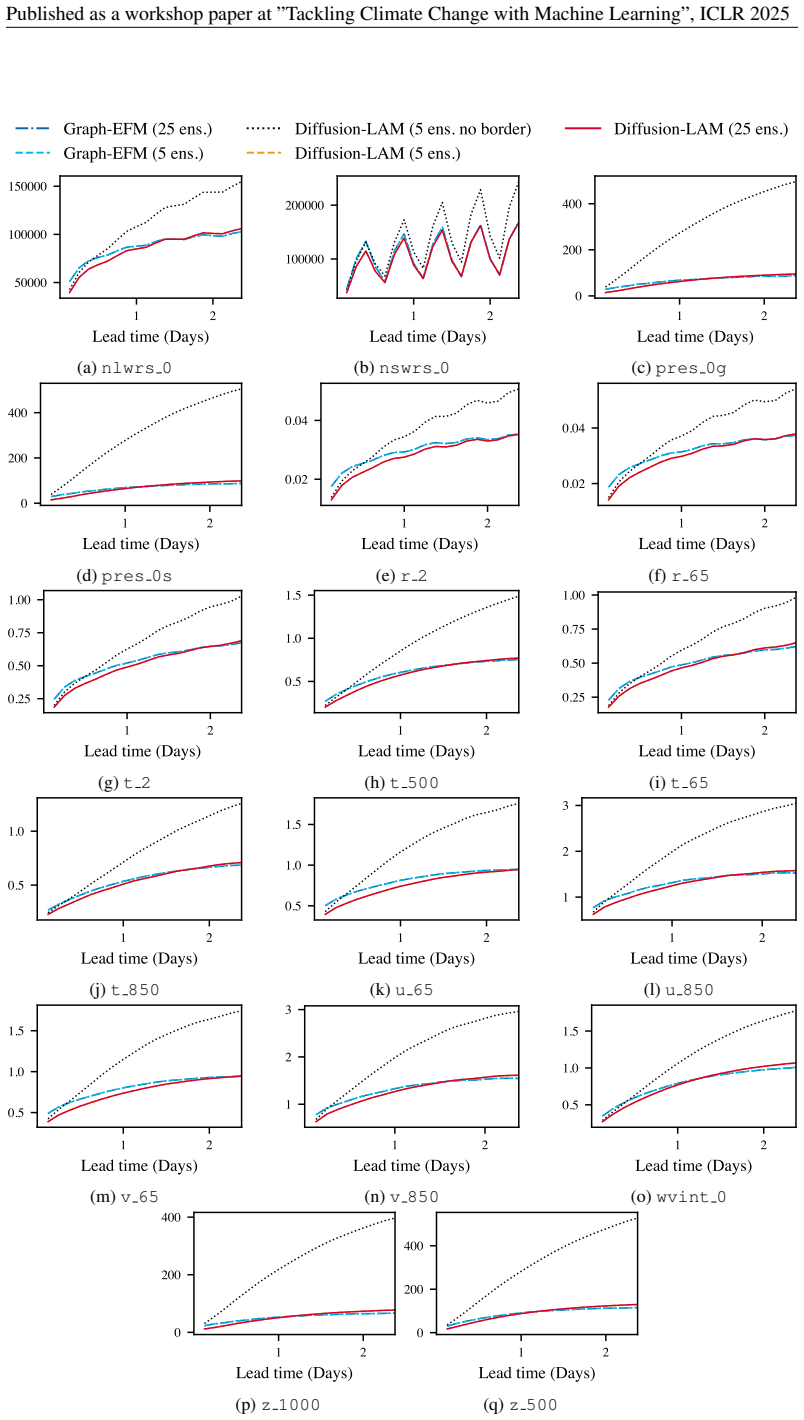
Diffusion-LAM establishes that a conditional diffusion model can serve as a probabilistic limited-area weather emulator, and that feeding the future boundary state $X_B^{t+1}$ into the conditioning signal improves agreement with the boundary and forecast quality at short lead times. On the MEPS dataset, the model outperforms Graph-EFM in RMSE and CRPS for shorter lead times, matches it at longer lead times, and produces ensemble members that are less smooth and more physically realistic. The paper also reports that both models underestimate ensemble spread, with Diffusion-LAM's spread-skill ratio declining at longer lead times.
Load-bearing premise
The method's advantage relies on a global model handing over the boundary weather state at the next forecast step in time for the regional run; if that future field is late, missing, or on a different grid, the gain over boundary-up-to-present conditioning disappears, as the paper's own no-boundary experiment shows.
Editorial extensions
If this is right
- Conditioning on the next-step boundary state $X_B^{t+1}$ keeps regional forecasts aligned with the surrounding global model, reducing the edge discontinuities seen in earlier boundary-up-to-current-time methods.
- Diffusion-LAM can generate 57-hour probabilistic forecasts at 3-hour resolution with 25 ensemble members in about 8 minutes on a single GPU, making larger ensembles practical for operational use.
- The no-boundary ablation shows that future boundary information is essential for stable long roll-outs, not just a minor refinement, so any operational system must guarantee its availability.
- The model's underdispersed ensembles at longer lead times indicate that spread calibration, rather than raw accuracy, is the main remaining barrier to fully reliable probabilistic regional forecasts.
- The approach opens the door to coupling fast machine-learning regional emulators with global NWP output, potentially lowering the computational cost of high-resolution ensemble forecasts.
Reading between the lines
- The paper's experiments draw the future boundary from the same MEPS forecast archive used for verification; an operational test with $X_B^{t+1}$ taken from an independently initialized global model would be a stricter and more realistic validation, a step the paper itself lists as future work.
- The boundary-conditioning idea is not tied to diffusion specifically, so the same encoding of $X_B^{t+1}$ could be applied to flow-matching or latent-variable regional forecasters, potentially giving them the same edge-consistency benefit.
- If global model output arrives with a delay, the 'future' boundary would be stale by the time a regional forecast initializes; the paper does not quantify how much of the benefit survives that latency.
- Because the no-boundary variant degrades mainly on long roll-outs, a testable extension would be to feed the future boundary only intermittently during sampling and measure how much skill is retained if the boundary update is skipped.
Editorial analysis
A structured set of objections, weighed in public.
Referee Report
Summary. The paper introduces Diffusion-LAM, a conditional diffusion model for probabilistic limited-area weather forecasting on the MEPS dataset. Its proposed novelty is to condition not only on past and current boundary states X_B^{t-1:t} but also on the future boundary state X_B^{t+1}, which the authors argue can be obtained from a global forecasting model in an operational setting. The model is a U-Net-based denoiser trained with a weighted MSE loss, rolled out autoregressively to 57 h lead times. Experiments compare Diffusion-LAM with 5 and 25 ensemble members against Graph-EFM and against a no-future-boundary ablation, reporting RMSE, CRPS, and SSR averaged over 2678 test forecasts. The paper reports that Diffusion-LAM improves short-lead RMSE/CRPS over Graph-EFM, produces visually more detailed fields, and better matches the boundary, while acknowledging underdispersion and the need for further operational realism.
Significance. If the claimed results hold, the paper would make a useful contribution to probabilistic limited-area ML weather forecasting: the future-boundary conditioning idea is simple, plausible, and clearly motivated by the LAM setting, and the paper includes a large held-out test evaluation, per-variable results, and a direct comparison to the most similar publicly available baseline (Graph-EFM). The authors also deserve credit for openly reporting the underdispersion of their ensembles and for providing detailed appendices on data, training, and inference. The main significance hinges, however, on whether the future-boundary advantage survives when the boundary is not the same MEPS forecast used for evaluation but instead comes from a different, re-gridded global model, and on whether the qualitative boundary-consistency claim can be made quantitative. The current evidence is suggestive but not yet sufficient to establish the operational claim emphasized in the introduction and conclusion.
major comments (3)
- [Section 1 and Appendix J] The central novelty is conditioning on X_B^{t+1}, justified as obtainable from a global forecasting model in an operational setting. However, all experiments feed the model the MEPS boundary fields themselves, which come from the same model, same 10 km grid, and the same forecast cycle as the verification target. The no-border ablation in Fig. 4 shows that removing X_B^{t+1} has a large effect on long-lead RMSE, so the benefit of the future boundary is at least partly an anchoring effect whose magnitude depends on the boundary being nearly perfect. Since Appendix J explicitly defers incorporating boundary information from a global model with different resolutions, variables, or timeframes to future work, the operational transfer of the main claimed advantage is untested. I would like to see at least one experiment with boundary fields taken from a coarser or otherwise degraded source, or with noise/coarsening augmentation at training time, to assess robustness.
- [Section 4.1 and Fig. 3] The paper's first stated contribution is that conditioning on X_B^{t+1} 'results in forecasts that better agree with the boundary input', and Section 4.1 repeats that Diffusion-LAM shows 'significantly better consistency with the boundary conditions'. Yet no quantitative metric is computed on the boundary or near-boundary region; all reported RMSE, CRPS, and SSR are computed on the interior set G_I only (Appendix H). The support for the boundary-consistency claim is therefore qualitative and based on a single displayed forecast. A quantitative measure such as boundary-region RMSE, continuity error across the interior/boundary interface, or a comparison of predicted near-boundary values against X_B^{t+1} should be added to substantiate the main contribution.
- [Section 4.1 and Fig. 4] The empirical comparison rests on a single baseline (Graph-EFM) with no error bars, confidence intervals, or significance tests. The text states that Diffusion-LAM outperforms Graph-EFM for shorter lead times and is similar at longer lead times, but without any estimate of uncertainty it is unclear whether the observed differences, especially at short lead times, are robust. The test set contains 2678 forecasts, so bootstrap confidence intervals or paired tests are feasible and should be reported for the headline RMSE/CRPS curves. This is necessary to support the quantitative claims in Sections 1 and 4.1.
minor comments (5)
- [Section 4.1] The sentence 'Both models struggle to generate an adequate spread (SSR ≈ 1), indicating that the uncertainty captured by the model is somewhat underestimated' appears internally inconsistent: for the bias-corrected spread-skill ratio defined in Appendix H, SSR ≈ 1 indicates well-calibrated spread, while underdispersion would correspond to SSR < 1. Please clarify the intended statement and the direction of the plotted SSR curves.
- [Appendix E] There is a typo in the description of the Fourier noise embedding: 'since/cosine features' should be 'sine/cosine features'.
- [Appendix F, Table 8] The table header contains the typo 'Height/Preassure'; it should be 'Height/Pressure'.
- [Appendix F and G] The training hyperparameters use σmax = 88 and σmin = 0.02 (Table 6) while the inference hyperparameters use σmax = 80 and σmin = 0.03 (Table 9). No explanation is given for the discrepancy; please state whether this is intentional and how it affects the sampling schedule.
- [Appendix G] The paper states that code will be made publicly available upon acceptance and gives a GitHub URL, but no versioned code or training configuration is currently available for inspection; a reproducibility appendix with exact data splits, seeds, and model checkpoints would strengthen the work.
Circularity Check
No significant circularity: the central claims are empirical evaluations on held-out MEPS data; self-citations are baseline and setup choices, not load-bearing reductions.
full rationale
Diffusion-LAM's central claims (accurate probabilistic limited-area forecasts, and improved boundary consistency from conditioning on X_B^{t+1}) are supported by held-out test-set experiments against Graph-EFM, not by a derivation that reduces to its own inputs. The model is trained with a weighted MSE denoising loss on interior residuals (Eq. 1) and evaluated with RMSE, CRPS, and SSR on the test split; no parameter is fitted to the reported skill metrics. The future boundary is indeed provided as an input rather than predicted (Appendix E: 'the model only makes predictions on the interior of the grid as the boundary X_B^{t+1} is provided as an input'), so 'consistency with the boundary' is partly a design property rather than a discovered prediction, but the paper does not present this as a derived theorem, and the interior forecast skill is not forced by construction. Self-citations to Oskarsson et al. (2023; 2024) supply the data split, the Graph-EFM baseline, and loss-weighting conventions; these are reproducible external artifacts with publicly available code and are not used to justify the main result via authority. Appendix J explicitly defers coupling to operational global-model boundaries to future work, which is a stated limitation rather than a circular step. No uniqueness theorem imported from the authors, no ansatz smuggled in by citation, and no fitted input renamed as a prediction appears in the paper. Overall circularity is negligible; the only inherited elements are minor experimental conventions from prior same-group work.
Assumptions & free parameters
free parameters (5)
- Loss weights per pressure level h_l =
2m:1.0, surface:0.1, level65:0.065, 1000hPa:0.1, 850hPa:0.05, 500hPa:0.03
- Variable scaling weights lambda_d =
reciprocal residual standard deviations of normalized training residuals (values in Table 3)
- Diffusion noise schedule sigma_max, sigma_min, rho =
train: 88, 0.02, 7; inference: 80, 0.03, 7
- Number of diffusion solver steps N =
20 (39 forward passes with 2nd-order Heun solver)
- Boundary width =
10 grid points
assumptions (5)
- standard math Standard diffusion ODE framework and preconditioning from Karras et al. (2022) correctly model the data distribution.
- domain assumption MEPS NWP forecasts serve as ground truth for training and evaluation.
- domain assumption Future boundary states X_B^{t+1} from a global model are available at forecast initialization.
- domain assumption A 10-grid-point boundary strip is sufficient to constrain interior forecasts.
- domain assumption Single-step training transfers to stable autoregressive roll-outs.
Cite this review
Pith. "Pith review of Diffusion-LAM: Probabilistic Limited Area Weather Forecasting with Diffusion." pith.science (2026). https://pith.science/paper/BN6HJZZA
@misc{pith2026250207532,
  author       = {Pith},
  title        = {Pith review of: Diffusion-LAM: Probabilistic Limited Area Weather Forecasting with Diffusion},
  year         = {2026},
  howpublished = {\url{https://pith.science/paper/BN6HJZZA}},
  note         = {Machine review of arXiv:2502.07532}
}
read the original abstract
Machine learning methods have been shown to be effective for weather forecasting, based on the speed and accuracy compared to traditional numerical models. While early efforts primarily concentrated on deterministic predictions, the field has increasingly shifted toward probabilistic forecasting to better capture the forecast uncertainty. Most machine learning-based models have been designed for global-scale predictions, with only limited work targeting regional or limited area forecasting, which allows more specialized and flexible modeling for specific locations. This work introduces Diffusion-LAM, a probabilistic limited area weather model leveraging conditional diffusion. By conditioning on boundary data from surrounding regions, our approach generates forecasts within a defined area. Experimental results on the MEPS limited area dataset demonstrate the potential of Diffusion-LAM to deliver accurate probabilistic forecasts, highlighting its promise for limited-area weather prediction.
Figures


Figures from the paper (6 more)




Forward citations
Cited by 3 Pith papers
-
Accurate Mediterranean Sea forecasting via graph-based deep learning
SeaCast, a graph neural network, makes 15-day Mediterranean Sea forecasts that outperform the operational MedFS system over the evaluated period, while producing a forecast in 20 seconds on one GPU.
-
HRRRCast: a data-driven emulator for regional weather forecasting at convection allowing scales
A diffusion-based neural network trained on HRRR analysis beats HRRR forecast skill on 20 dBZ composite reflectivity across CONUS and is competitive at 30 dBZ.
-
A multi-scale loss formulation for learning a probabilistic model with proper score optimisation
Adding a multi-scale loss to proper-score-trained AIFS-CRPS reduces small-scale variability in forecasts without changing skill scores.
Reference graph
Works this paper leans on
-
[1]
José R. Andrade and Ricardo J. Bessa. Improving renewable energy forecasting with a grid of numerical weather predictions. IEEE Transactions on Sustainable Energy, 8 0 (4): 0 1571--1580, Oct 2017. ISSN 1949-3037. doi:10.1109/TSTE.2017.2694340
-
[2]
Continuous ensemble weather forecasting with diffusion models, 2024
Martin Andrae, Tomas Landelius, Joel Oskarsson, and Fredrik Lindsten. Continuous ensemble weather forecasting with diffusion models, 2024. URL https://arxiv.org/abs/2410.05431
arXiv 2024
- [3]
-
[4]
The quiet revolution of numerical weather prediction
Peter Bauer, Alan Thorpe, and Gilbert Brunet. The quiet revolution of numerical weather prediction. Nature, 525: 0 47--55, 09 2015 b . doi:10.1038/nature14956
-
[5]
Accurate medium-range global weather forecasting with 3d neural networks
Kaifeng Bi, Lingxi Xie, Hengheng Zhang, Xin Chen, Xiaotao Gu, and Qi Tian. Accurate medium-range global weather forecasting with 3d neural networks. Nature, 619 0 (7970): 0 533--538, 2023 a
work page 2023
-
[6]
Accurate medium-range global weather forecasting with 3d neural networks
Kaifeng Bi, Lingxi Xie, Hengheng Zhang, Xin Chen, Xiaotao Gu, and Qi Tian. Accurate medium-range global weather forecasting with 3d neural networks. Nature, 619 0 (7970): 0 533--538, 2023 b
work page 2023
-
[7]
Spherical F ourier neural operators: Learning stable dynamics on the sphere
Boris Bonev, Thorsten Kurth, Christian Hundt, Jaideep Pathak, Maximilian Baust, Karthik Kashinath, and Anima Anandkumar. Spherical F ourier neural operators: Learning stable dynamics on the sphere. In Proceedings of the 40th International Conference on Machine Learning, volume 202 of Proceedings of Machine Learning Research, pp.\ 2806--2823. PMLR, 23--29 Jul 2023
work page 2023
-
[8]
Uncertainty quantification for data-driven weather models
Christopher B \"u lte, Nina Horat, Julian Quinting, and Sebastian Lerch. Uncertainty quantification for data-driven weather models. arXiv preprint arXiv:2403.13458, 2024
arXiv 2024
Show all 52 references
-
[9]
Fuxi: A cascade machine learning forecasting system for 15-day global weather forecast
Lei Chen, Xiaohui Zhong, Feng Zhang, Yuan Cheng, Yinghui Xu, Yuan Qi, and Hao Li. Fuxi: A cascade machine learning forecasting system for 15-day global weather forecast. npj Climate and Atmospheric Science, 6 0 (1): 0 190, 2023
2023
-
[10]
Fundamentals of numerical weather prediction
Jean Coiffier. Fundamentals of numerical weather prediction. Cambridge University Press, 2011
2011
-
[11]
Archesweather & archesweathergen: a deterministic and generative model for efficient ml weather forecasting, 2024
Guillaume Couairon, Renu Singh, Anastase Charantonis, Christian Lessig, and Claire Monteleoni. Archesweather & archesweathergen: a deterministic and generative model for efficient ml weather forecasting, 2024. URL https://arxiv.org/abs/2412.12971
2024 arXiv
-
[12]
Why should ensemble spread match the rmse of the ensemble mean? Journal of Hydrometeorology, 15 0 (4): 0 1708--1713, 2014
Vincent Fortin, Mabrouk Abaza, Francois Anctil, and Raphael Turcotte. Why should ensemble spread match the rmse of the ensemble mean? Journal of Hydrometeorology, 15 0 (4): 0 1708--1713, 2014
2014
-
[13]
Strictly proper scoring rules, prediction, and estimation
Tilmann Gneiting and Adrian E Raftery. Strictly proper scoring rules, prediction, and estimation. Journal of the American statistical Association, 102 0 (477): 0 359--378, 2007
2007
-
[14]
Calibration of large neural weather models
Andre Graubner, Kamyar Kamyar Azizzadenesheli, Jaideep Pathak, Morteza Mardani, Mike Pritchard, Karthik Kashinath, and Anima Anandkumar. Calibration of large neural weather models. In NeurIPS 2022 Workshop on Tackling Climate Change with Machine Learning, 2022
2022
-
[15]
Gaussian error linear units (gelus), 2023
Dan Hendrycks and Kevin Gimpel. Gaussian error linear units (gelus), 2023. URL https://arxiv.org/abs/1606.08415
2023 arXiv
-
[16]
Swinvrnn: A data‐driven ensemble forecasting model via learned distribution perturbation
Yuan Hu, Lei Chen, Zhibin Wang, and Hao Li. Swinvrnn: A data‐driven ensemble forecasting model via learned distribution perturbation. Journal of Advances in Modeling Earth Systems, 15, 02 2023. doi:10.1029/2022MS003211
2023 doi
-
[17]
Climate change 2023: Synthesis report
IPCC . Climate change 2023: Synthesis report. contribution of working groups i, ii and iii to the sixth assessment report of the intergovernmental panel on climate change. Technical report, Intergovernmental Panel on Climate Change (IPCC), 2023. 2023
2023
-
[18]
Elucidating the design space of diffusion-based generative models
Tero Karras, Miika Aittala, Timo Aila, and Samuli Laine. Elucidating the design space of diffusion-based generative models. In Alice H. Oh, Alekh Agarwal, Danielle Belgrave, and Kyunghyun Cho (eds.), Advances in Neural Information Processing Systems, 2022. URL https://openrevi...
2022
-
[19]
Forecasting global weather with graph neural networks, 2022
Ryan Keisler. Forecasting global weather with graph neural networks, 2022. URL https://arxiv.org/abs/2202.07575
2022 arXiv
-
[20]
o wer, James Lottes, Stephan Rasp, Peter D \
Dmitrii Kochkov, Janni Yuval, Ian Langmore, Peter Norgaard, Jamie Smith, Griffin Mooers, Milan Kl \"o wer, James Lottes, Stephan Rasp, Peter D \"u ben, Sam Hatfield, Peter Battaglia, Alvaro Sanchez-Gonzalez, Matthew Willson, Michael P Brenner, and Stephan Hoyer. Neural general...
2024
-
[21]
Learning skillful medium-range global weather forecasting
Remi Lam, Alvaro Sanchez-Gonzalez, Matthew Willson, Peter Wirnsberger, Meire Fortunato, Ferran Alet, Suman Ravuri, Timo Ewalds, Zach Eaton-Rosen, Weihua Hu, et al. Learning skillful medium-range global weather forecasting. Science, 382 0 (6677): 0 1416--1421, 2023
2023
-
[22]
Simon Lang, Mihai Alexe, Matthew Chantry, Jesper Dramsch, Florian Pinault, Baudouin Raoult, Mariana C. A. Clare, Christian Lessig, Michael Maier-Gerber, Linus Magnusson, Zied Ben Bouallègue, Ana Prieto Nemesio, Peter D. Dueben, Andrew Brown, Florian Pappenberger, and Florence ...
2024 arXiv
-
[23]
Ensemble forecasting
Martin Leutbecher and Tim N Palmer. Ensemble forecasting. Journal of computational physics, 227 0 (7): 0 3515--3539, 2008
2008
-
[24]
Decoupled weight decay regularization
Ilya Loshchilov and Frank Hutter. Decoupled weight decay regularization. In International Conference on Learning Representations, 2019. URL https://openreview.net/forum?id=Bkg6RiCqY7
2019
-
[25]
Data driven weather forecasts trained and initialised directly from observations, 2024
Anthony McNally, Christian Lessig, Peter Lean, Eulalie Boucher, Mihai Alexe, Ewan Pinnington, Matthew Chantry, Simon Lang, Chris Burrows, Marcin Chrust, Florian Pinault, Ethel Villeneuve, Niels Bormann, and Sean Healy. Data driven weather forecasts trained and initialised dire...
2024 arXiv
-
[26]
Malte M\" u ller, Mariken Homleid, Karl-Ivar Ivarsson, Morten A. K ltzow, Magnus Lindskog, Knut Helge Midtb , Ulf Andrae, Trygve Aspelien, Lars Berggren, Dag Bj rge, Per Dahlgren, J rn Kristiansen, Roger Randriamampianina, Martin Ridal, and Ole Vignes. AROME - MetCoOp : A nord...
2017
-
[27]
Regional data-driven weather modeling with a global stretched-grid, 2024
Thomas Nils Nipen, Håvard Homleid Haugen, Magnus Sikora Ingstad, Even Marius Nordhagen, Aram Farhad Shafiq Salihi, Paulina Tedesco, Ivar Ambjørn Seierstad, Jørn Kristiansen, Simon Lang, Mihai Alexe, Jesper Dramsch, Baudouin Raoult, Gert Mertes, and Matthew Chantry. Regional da...
2024 arXiv
-
[28]
NOAA NCEI . U.s. billion-dollar weather and climate disasters, 2025. URL https://www.ncei.noaa.gov/access/billions/. Accessed: 2025-01-18
2025
-
[29]
Graph-based neural weather prediction for limited area modeling
Joel Oskarsson, Tomas Landelius, and Fredrik Lindsten. Graph-based neural weather prediction for limited area modeling. In NeurIPS 2023 Workshop on Tackling Climate Change with Machine Learning, 2023
2023
-
[30]
Probabilistic weather forecasting with hierarchical graph neural networks
Joel Oskarsson, Tomas Landelius, Marc Peter Deisenroth, and Fredrik Lindsten. Probabilistic weather forecasting with hierarchical graph neural networks. In Advances in Neural Information Processing Systems, volume 37, 2024
2024
-
[31]
Fourcastnet: A global data-driven high-resolution weather model using adaptive fourier neural operators
Jaideep Pathak, Shashank Subramanian, Peter Harrington, Sanjeev Raja, Ashesh Chattopadhyay, Morteza Mardani, Thorsten Kurth, David Hall, Zongyi Li, Kamyar Azizzadenesheli, Pedram Hassanzadeh, Karthik Kashinath, and Animashree Anandkumar. Fourcastnet: A global data-driven high-...
2022 arXiv
-
[32]
Kilometer-scale convection allowing model emulation using generative diffusion modeling, 2024
Jaideep Pathak, Yair Cohen, Piyush Garg, Peter Harrington, Noah Brenowitz, Dale Durran, Morteza Mardani, Arash Vahdat, Shaoming Xu, Karthik Kashinath, and Michael Pritchard. Kilometer-scale convection allowing model emulation using generative diffusion modeling, 2024. URL http...
2024 arXiv
-
[33]
Probabilistic weather forecasting with machine learning
Ilan Price, Alvaro Sanchez-Gonzalez, Ferran Alet, Tom R Andersson, Andrew El-Kadi, Dominic Masters, Timo Ewalds, Jacklynn Stott, Shakir Mohamed, Peter Battaglia, et al. Probabilistic weather forecasting with machine learning. Nature, 637 0 (8044): 0 84--90, 2025
2025
-
[34]
Weatherbench 2: A benchmark for the next generation of data-driven global weather models, 2023
Stephan Rasp, Stephan Hoyer, Alexander Merose, Ian Langmore, Peter Battaglia, Tyler Russel, Alvaro Sanchez-Gonzalez, Vivian Yang, Rob Carver, Shreya Agrawal, Matthew Chantry, Zied Ben Bouallegue, Peter Dueben, Carla Bromberg, Jared Sisk, Luke Barrington, Aaron Bell, and Fei Sh...
2023
-
[35]
U-net: Convolutional networks for biomedical image segmentation
Olaf Ronneberger, Philipp Fischer, and Thomas Brox. U-net: Convolutional networks for biomedical image segmentation. In Nassir Navab, Joachim Hornegger, William M. Wells, and Alejandro F. Frangi (eds.), Medical Image Computing and Computer-Assisted Intervention -- MICCAI 2015,...
2015
-
[36]
Leveraging weather forecasts in renewable energy systems
Navin Sharma, Jeremy Gummeson, David Irwin, Ting Zhu, and Prashant Shenoy. Leveraging weather forecasts in renewable energy systems. Sustainable Computing: Informatics and Systems, 4 0 (3): 0 160--171, 2014. ISSN 2210-5379. doi:https://doi.org/10.1016/j.suscom.2014.07.005. URL...
2014 doi
-
[37]
Codicast: Conditional diffusion model for weather prediction with uncertainty quantification, 2024
Jimeng Shi, Bowen Jin, Jiawei Han, and Giri Narasimhan. Codicast: Conditional diffusion model for weather prediction with uncertainty quantification, 2024. URL https://arxiv.org/abs/2409.05975
2024 arXiv
-
[38]
Exploring the design space of deep-learning-based weather forecasting systems, 2024
Shoaib Ahmed Siddiqui, Jean Kossaifi, Boris Bonev, Christopher Choy, Jan Kautz, David Krueger, and Kamyar Azizzadenesheli. Exploring the design space of deep-learning-based weather forecasting systems, 2024. URL https://arxiv.org/abs/2410.07472
2024 arXiv
-
[39]
Score-based generative modeling through stochastic differential equations
Yang Song, Jascha Sohl-Dickstein, Diederik P Kingma, Abhishek Kumar, Stefano Ermon, and Ben Poole. Score-based generative modeling through stochastic differential equations. arXiv preprint arXiv:2011.13456, 2020
2011 arXiv
-
[40]
Bessa, Jethro Browell, and Pierre Pinson
Conor Sweeney, Ricardo J. Bessa, Jethro Browell, and Pierre Pinson. The future of forecasting for renewable energy. WIREs Energy and Environment, 9 0 (2): 0 e365, 2020. doi:https://doi.org/10.1002/wene.365. URL https://wires.onlinelibrary.wiley.com/doi/abs/10.1002/wene.365
2020 doi
-
[41]
Clim ODE : Climate forecasting with physics-informed neural ODE s
Yogesh Verma, Markus Heinonen, and Vikas Garg. Clim ODE : Climate forecasting with physics-informed neural ODE s. In The Twelfth International Conference on Learning Representations, 2024. URL https://openreview.net/forum?id=xuY33XhEGR
2024
-
[42]
Weyn, Dale R
Jonathan A. Weyn, Dale R. Durran, and Rich Caruana. Improving data-driven global weather prediction using deep convolutional neural networks on a cubed sphere. Journal of Advances in Modeling Earth Systems, 12 0 (9): 0 e2020MS002109, 2020. doi:https://doi.org/10.1029/2020MS002...
2020 doi
-
[43]
Whitt and S
J. Whitt and S. Gordon. This is the economic cost of extreme weather. In World Economic Forum Annual Meeting, January 2023. URL https://www.weforum.org/agenda/2023/01/extreme-weather-economic-cost-wef23/. Accessed: 2025-01-23
2023
-
[44]
Designing inclusive, accessible early warning systems: Good practices and entry points, 2023
World Bank . Designing inclusive, accessible early warning systems: Good practices and entry points, 2023. URL https://documents1.worldbank.org/curated/en/099050123155016375/pdf/P1765160197f400b80947e0af8c48049151.pdf. Accessed: 2025-01-23
2023
-
[45]
Yinglong: Skillful high resolution regional short term forecasting with boundary smoothing, 2024
Pengbo Xu, Tianyan Gao, Yu Wang, Junping Yin, Juan Zhang, Xiaogu Zheng, Zhimin Zhang, Xiaoguang Hu, and Xiaoxu Chen. Yinglong: Skillful high resolution regional short term forecasting with boundary smoothing, 2024. URL https://arxiv.org/abs/2401.16254
2024 arXiv
-
[46]
Scientific challenges of convective-scale numerical weather prediction
Jun-Ichi Yano, Micha Z Ziemia \'n ski, Mike Cullen, Piet Termonia, Jeanette Onvlee, Lisa Bengtsson, Alberto Carrassi, Richard Davy, Anna Deluca, Suzanne L Gray, et al. Scientific challenges of convective-scale numerical weather prediction. Bulletin of the American Meteorologic...
2018
-
[47]
Estimation of the continuous ranked probability score with limited information and applications to ensemble weather forecasts
Micha \"e l Zamo and Philippe Naveau. Estimation of the continuous ranked probability score with limited information and applications to ensemble weather forecasts. Mathematical Geosciences, 50 0 (2): 0 209--234, 2018
2018
-
[48]
write newline
" write newline "" before.all 'output.state := FUNCTION n.dashify 't := "" t empty not t #1 #1 substring "-" = t #1 #2 substring "--" = not "--" * t #2 global.max substring 't := t #1 #1 substring "-" = "-" * t #2 global.max substring 't := while if t #1 #1 substring * t #2 gl...
-
[49]
Accurate medium-range global weather forecasting with 3d neural networks
Kaifeng Bi, Lingxi Xie, Hengheng Zhang, Xin Chen, Xiaotao Gu, and Qi Tian. Accurate medium-range global weather forecasting with 3d neural networks. Nature, 619 0 (7970): 0 533--538, 2023
2023
-
[50]
@esa (Ref
\@ifxundefined[1] #1\@undefined \@firstoftwo \@secondoftwo \@ifnum[1] #1 \@firstoftwo \@secondoftwo \@ifx[1] #1 \@firstoftwo \@secondoftwo [2] @ #1 \@temptokena #2 #1 @ \@temptokena \@ifclassloaded agu2001 natbib The agu2001 class already includes natbib coding, so you should ...
-
[51]
\@lbibitem[] @bibitem@first@sw\@secondoftwo \@lbibitem[#1]#2 \@extra@b@citeb \@ifundefined br@#2\@extra@b@citeb \@namedef br@#2 \@nameuse br@#2\@extra@b@citeb \@ifundefined b@#2\@extra@b@citeb @num @parse #2 @tmp #1 NAT@b@open@#2 NAT@b@shut@#2 \@ifnum @merge>\@ne @bibitem@firs...
-
[52]
Tackling Climate Change with Machine Learning
@open @close @open @close and [1] URL: #1 \@ifundefined chapter * \@mkboth \@ifxundefined @sectionbib * \@mkboth * \@mkboth\@gobbletwo \@ifclassloaded amsart * \@ifclassloaded amsbook * \@ifxundefined @heading @heading NAT@ctr thebibliography [1] @ \@biblabel @NAT@ctr \@bibset...
2025
Reviewed August 8, 2026 · model on record in the stance chip above.
Discussion (0). Continue with ORCID to comment.