REVIEW 3 major objections 4 minor 31 references
Acceleration of RANS Solver Convergence via Initialization with Wake Extension Models
T0 review · 3 major / 4 minor · reviewed 2026-08-10 · deepseek-v4-flash
Pith's one-line read A CNN wake-extender trained on one flow solution cuts RANS solver wall-clock time 16.4x when used as initialization.
desk verdict A cleanly-demonstrated upper bound: the speedup is real for the stated setup, but the abstract needs the caveat that the initialization is built from the target solution itself. read the letter →
The pith
A machine-rendered reading of the paper's core claim, the machinery that carries it, and where it could break.
The reading
What carries the argument
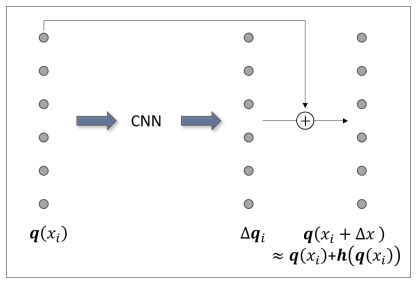
The load-bearing object is the partition-of-unity (POFU) blend $\tilde{q} = W_N \tilde{q}_N + (1-W_N)[W_W \tilde{q}_W + (1-W_W) \tilde{q}_O]$, where smooth window functions select the near-body, wake, and off-body model predictions and sum to one over $\mathbb{R}^2$. The wake model itself is a CNN that takes the field values $q(x_i)$ at $n$ points on a vertical slice and predicts the field increment $\Delta q_i = q(x_{i+1})-q(x_i)$; the field one step downstream is reconstructed as $q(x_{i+1}) = q(x_i)+h(q(x_i))$, and this step is repeated recursively across the wake. Training minimizes the mean squared error between predicted and true increments over $m$ slices from a single high-fidelity solution. The CNN therefore converts a one-slice profile into a full wake to the downstream mesh boundary, and the POFU construction lets that wake be combined smoothly with whatever near-body model is available.
What would settle it
Repeat the NACA0012 test at Re = 6e6, M = 0.15 using the same OpenFOAM simpleFoam/Spalart-Allmaras settings, truncate the near-body field at $x_{\mathrm{interface}}=10$, append the CNN-trained wake to the boundary, and count iterations to the $1\times10^{-7}$ residual target; if the solver does not converge in roughly 1,400 iterations, the reported acceleration does not reproduce.
Extended reading notes
Core claim
The central claim is that the downstream wake, which prior initialization models often truncate or replace with freestream conditions, is the main obstacle to fast RANS convergence, and that a cheap recursive CNN can remove that obstacle. The authors decompose the domain into near-body, wake, and off-body regions, blend the three predictions with partition-of-unity functions, and use a CNN to map the flow profile at one x-slice to the change in that profile over a downstream step. Training needs only the converged solution of one simulation; the trained model is rolled out recursively from the near-body/wake interface to the downstream boundary. With the high-fidelity solution used as the near-body model, this initialization reaches the $1\times10^{-7}$ residual target in about 1,400 iterations whereas freestream initialization requires 36,887, corresponding to a 16.4x wall-clock speedup. Simpler wake treatments (freestream, uniform extension) only accelerate convergence when the near-body/wake interface is placed far downstream, whereas the CNN model helps even when the interface is close to the body.
Load-bearing premise
The demonstration assumes the near-body flow is already known accurately: the paper uses the interpolated high-fidelity converged solution as the near-body model, so the initialization is already close to the target RANS answer before the wake model is added.
Editorial extensions
If this is right
- For the demonstrated NACA0012 turbulent case, full-domain initialization with the CNN wake model reaches convergence in about 1,400 iterations versus 36,887 from freestream, a 26.3x reduction.
- Wall-clock time drops 16.4x, making warm-started RANS much cheaper to embed in design loops.
- The extent of wake coverage matters more than the wake model choice: simple wake treatments need a far-downstream interface, while the CNN model works from $x_{\mathrm{interface}}=2.0$ onward and peaks at $x_{\mathrm{interface}}=10.0$.
- One converged simulation is enough to train the wake model, so data collection cost is one CFD run rather than a large dataset.
- The measured accelerations are an upper bound under an exact near-body model, so achievable speedups with learned near-body surrogates will be lower.
Reading between the lines
- If the near-body surrogate is a learned model with realistic errors, the 16.4x figure likely shrinks; the method's practical value depends on the quality of that surrogate, not just the wake model.
- The same slice-to-increment CNN idea could be lifted to three-dimensional wakes by treating each spanwise plane as a slice, although recursive rollout error would need monitoring over long distances.
- A testable extension is a parametric study varying angle of attack, Reynolds number, and Mach number to see how far the wake model generalizes beyond its single training condition.
- The result points toward initialization research that budgets modeling effort by region, spending the hardest learning on the near-body field and a cheap recurrent model on the wake, rather than learning the full domain at once.
Editorial analysis
A structured set of objections, weighed in public.
Referee Report
Summary. The paper proposes using a convolutional neural network as a wake-extension model to initialize steady RANS simulations of external flow. The computational domain is split into near-body, wake, and off-body regions, and fields from separate models are blended with partition-of-unity functions. The CNN is trained on slices of a single converged high-fidelity simulation and is applied recursively to predict the wake downstream of a user-selected interface. In the numerical demonstration for turbulent flow around a NACA0012 airfoil, the near-body field is taken from the interpolated converged solution, and the CNN wake model is trained on that same solution. The authors report 26.3x fewer iterations and a 16.4x wall-clock speedup relative to freestream initialization, and they conclude that maximal acceleration requires representing the wake to the downstream boundary. The paper explicitly labels the near-body choice as an upper bound on near-body model quality, but the wake model is also trained on and evaluated against the same converged solution used as the initialization target.
Significance. If the claimed acceleration holds under realistic conditions, the proposed decomposition and single-simulation training strategy would be a useful contribution to the CFD initialization literature, where previous CNN-based warm-start methods report roughly 2-4x speedups. The paper is clearly written, provides detailed training and solver settings, and includes convergence histories and comparisons among three wake models. The wake-extension idea is interesting and the three-region POFU formulation is a clean way to combine near-body, wake, and freestream models. However, the headline speedup is currently an in-sample upper bound: both the near-body field and the CNN training data are derived from the converged target solution, so the experiment measures the benefit of starting from a near-exact copy of the target state. The manuscript does not yet demonstrate acceleration in a setting where the target solution is not already available, which is the setting that matters for the stated application.
major comments (3)
- [Sec. 2, Sec. 3.1.2, Sec. 3.2] The experimental setup is circular with respect to the central acceleration claim. In Sec. 3.2 the near-body model is the interpolated high-fidelity converged solution, and in Sec. 3.1.2 the CNN wake model is trained on slices of that same converged solution using Eq. (3) with delta-q values computed from the HF solution. The initialization is therefore constructed from the target solution itself, before the wake model is even applied. The paper honestly notes in Sec. 2 and Sec. 3.2 that the near-body choice gives an upper bound, but the same caveat applies to the wake model because its training data come from the target solution. The abstract and conclusion state the 26.3x/16.4x results without this caveat. To support the practical claim, at least one experiment is needed in which neither the near-body field nor the CNN training data come from the converged solution that is being warmed up.
- [Sec. 3.2, Figs. 14-16] The speedup estimate is based on a single converged solution and a single baseline run, with no repeated trials or error bars. Because the convergence criterion (residual 1e-7) and wall-clock time can be sensitive to run-to-run variation, solver state, and system load, the quantitative reliability of the reported 16.4x wall-clock speedup is not established. The interface-location sweep provides some related data, but every point still uses the same HF solution and same single baseline. Reporting at least a small number of repeated runs, or bootstrapped statistics over initialization fields, would materially strengthen the claim.
- [Sec. 3.2, Sec. 4] The conclusion that maximal acceleration requires representing the entire wake to the downstream boundary is derived entirely from experiments with an interpolated HF near-body field. With a realistic learned near-body model, errors in the near-body field will be propagated and potentially amplified by the recursive CNN rollout in Algorithm 1, so the conclusion may not transfer. The paper should either test the wake model with a perturbed or approximate near-body field or explicitly restrict the conclusion to the perfect-near-body upper-bound setting.
minor comments (4)
- [Appendix, Eq. (8)] The transition function T(r) as printed, 6r^5 - 15r^4 + 1 - r^3, is not the standard smoothstep function; it does not satisfy T(1/2)=1/2 and may not be C^1 at the endpoints. Please check the formula, which should likely be 6r^5 - 15r^4 + 10r^3.
- [Sec. 2.3] The text refers to a 'NACA0102 airfoil'; this appears to be a typo for NACA0012, as used elsewhere in the paper.
- [Sec. 3.2] The sentence 'The residuals for the CFD runs using the CNN model are plotted without the comparison to standard runs in Fig. 14 for a closer look' should refer to Fig. 16(c) and (d), not Fig. 14, which shows iterations versus interface location.
- [Sec. 1, reference [29]] Reference [29] is listed as a preprint without a year or repository identifier; please provide the arXiv identifier or update the citation if it has been published.
Circularity Check
The 26.3x/16.4x speedup is an in-sample upper bound: the wake model is trained on the converged target solution's own slice-to-slice differences and then used to reconstruct that same solution as the initialization.
-
fitted input called prediction
[Sec. 2.2.3 (Eq. (3), Algorithm 1) and Sec. 3.1.2]
"The loss function for the model training is defined as: L = 1/m Σ ||∆qi − h(q(xi))||2 ... The CNN training data is generated using ∆ q0, ∆q1, · · ·, ∆qm−1 from the HF solution."
The CNN h is trained on the target HF solution's own slice-to-slice changes Δq_i. Algorithm 1 then initializes the wake by recursively applying h starting from q(x0), which in the experiment is evaluated from the same HF solution. Thus the 'predicted' downstream wake is a reconstruction of the training target, not a prediction of an unknown flow. The measured 26.3x/16.4x acceleration therefore measures the cost of starting from a near-exact copy of the converged solution, so the central speedup claim is an in-sample fit rather than an independent demonstration.
-
fitted input called prediction
[Sec. 2 (near-body surrogate) and Sec. 3.2]
"in order to establish an upper bound on performance in the CFD initialization task with respect to near-body model quality, interpolated high-fidelity (HF) solution data is used as a surrogate near-body model in the numerical experiments presented in this work. ... To isolate the impact of the wake model and the POFU window selection from the effects of the near-body model accuracy, interpolated HF solution is used as the near-body model in the following studies."
The near-body model in the actual demonstration is the converged target solution itself, interpolated onto the mesh; the wake model is trained on the same solution. Consequently, the initialization field is built from the exact answer the RANS solver is supposed to find. The paper openly labels this an upper bound for the near-body component, but the abstract states the 16.4x speedup without this qualification, and the wake model's dependence on the target solution is not included in the stated caveat. The comparison is thus between warm-starting from the target solution and cold-starting from freestream, which is forced by construction.
full rationale
No load-bearing self-citation chains or imported uniqueness theorems are present; the central difficulty is experimental in-sample reconstruction. The paper is methodologically honest in Secs. 2 and 3.2 that the near-body model is interpolated high-fidelity solution data, but the CNN wake extender is trained on and evaluated against the same high-fidelity solution, and the recursive application in Algorithm 1 reconstructs that same wake. Thus the reported acceleration is an upper bound for a warm start that already knows the converged answer, and it does not demonstrate acceleration for a RANS solve whose target is unknown. Because this is disclosed as an upper bound rather than concealed, the circularity is partial rather than complete; the score reflects that the headline speedup reduces by construction to an in-sample fit.
Assumptions & free parameters
free parameters (4)
- CNN hyperparameters (kernel size 2, 3 conv blocks, batch size 8, initial learning rate 1e-3, cosine annealing T0=10…
- Training grid parameters: n=128 y-points, slice spacing Δx=1.0, y-range [-1,1], start slice x0=2.0 =
n=128, Δx=1.0, y in [-1,1], x0=2.0
- POFU transition widths sx, sy
- Near-body/wake interface location x_interface =
2.0 to 100.0
assumptions (4)
- domain assumption 2D incompressible RANS with the Spalart-Allmaras turbulence model adequately represents the NASA NACA0012 validation case at Re=6e6 and M=0.15.
- domain assumption The OpenFOAM simpleFoam converged solution with the settings in Table 1 is an accurate enough reference for the CFD initialization task.
- ad hoc to paper The wake evolution is Markovian in x: q(x_i + Δx) depends only on q(x_i) via the learned h.
- ad hoc to paper A single converged simulation provides enough diversity to train a wake model that is useful for the same flow condition.
Cite this review
Pith. "Pith review of Acceleration of RANS Solver Convergence via Initialization with Wake Extension Models." pith.science (2026). https://pith.science/paper/BNNPZJ2Q
@misc{pith2026250114699,
  author       = {Pith},
  title        = {Pith review of: Acceleration of RANS Solver Convergence via Initialization with Wake Extension Models},
  year         = {2026},
  howpublished = {\url{https://pith.science/paper/BNNPZJ2Q}},
  note         = {Machine review of arXiv:2501.14699}
}
read the original abstract
Use of appropriate initialization to warm-start Reynolds-averaged Navier-Stokes (RANS) simulations of turbulent flow can facilitate convergence and lead to efficient use of computational resources. In this work, a method to model downstream wake development in external turbulent flow is proposed and used for RANS solver convergence acceleration. To balance the model accuracy and cost, the proposed method divides the analysis domain into three regions: near-body, wake and off-body. An approach based on a convolutional neural network is introduced as an efficient method to predict the downstream wake development. The model training only requires data from a single simulation, and its use is demonstrated to be effective in accelerating the RANS simulation when combined with an accurate flow prediction in the near-body region. The simulation using the proposed method took 26.3x fewer iterations, achieving 16.4x speedup in wall-clock time, compared to a baseline run using freestream initialization.
Figures


Figures from the paper (12 more)


Reference graph
Works this paper leans on
-
[1]
Computational fluid dynamics: the basics with applications
D Anderson John Jr. “Computational fluid dynamics: the basics with applications”. In: Science/Engineering/Math. McGraw-Hill Science (1995)
work page 1995
-
[2]
Best practices for reduction of uncertainty in CFD results
Michael Mendenhall, Robert Childs, and Joseph Morrison. “Best practices for reduction of uncertainty in CFD results”. In: 41st Aerospace Sciences Meeting and Exhibit . 2003, p. 411. 13 Figure 15: Comparison of CFD wall-clock time to convergence using different wake models in initialization. (a) Freestream vs CNN model rollout A (b) Freestream vs CNN model...
work page 2003
-
[3]
Verification and Validation in Scientific Computing
William L Oberkampf and Christopher J Roy. Verification and Validation in Scientific Computing . 2010
work page 2010
-
[4]
Convolutional Neural Networks for Steady Flow Approxi- mation
Xiaoxiao Guo, Wei Li, and Francesco Iorio. “Convolutional Neural Networks for Steady Flow Approxi- mation”. In: Proceedings of the 22nd ACM SIGKDD International Conference on Knowledge Discovery and Data Mining. KDD ’16. San Francisco, California, USA: Association for Computing Machinery, 2016, 14 pp. 481–490. isbn: 9781450342322. doi: 10.1145/2939672.293...
arXiv 2016
-
[5]
On the role and challenges of CFD in the aerospace industry
P. R. Spalart and V. Venkatakrishnan. “On the role and challenges of CFD in the aerospace industry”. en. In: The Aeronautical Journal 120.1223 (Jan. 2016), pp. 209–232. issn: 0001-9240, 2059-6464. doi: 10.1017/aer.2015.10
-
[6]
SGDR: Stochastic Gradient Descent with Warm Restarts
Ilya Loshchilov and Frank Hutter. SGDR: Stochastic Gradient Descent with Warm Restarts . Tech. rep. arXiv:1608.03983 [cs, math] type: article. arXiv, May 2017. doi: 10.48550/arXiv.1608.03983 . url: http://arxiv.org/abs/1608.03983
-
[7]
State-of-the-art in aerodynamic shape optimisation methods
S. N. Skinner and H. Zare-Behtash. “State-of-the-art in aerodynamic shape optimisation methods”. In: Applied Soft Computing 62 (Jan. 2018), pp. 933–962. issn: 1568-4946. doi: 10.1016/j.asoc.2017.09. 030
-
[8]
Prediction of Aerodynamic Flow Fields Using Convolutional Neural Networks
Yaser Afshar et al. “Prediction of Aerodynamic Flow Fields Using Convolutional Neural Networks”. en. In: Computational Mechanics 64.2 (May 2019), pp. 525–545. issn: 1432-0924. doi: 10.1007/s00466- 019-01740-0 . arXiv: 1905.13166 [physics.flu-dyn]. url: https://doi.org/10.1007/s00466-019- 01740-0
work page Pith review arXiv 2019
Show all 31 references
-
[9]
NN-SVG: Publication-Ready Neural Network Architecture Schematics
Alexander LeNail. “NN-SVG: Publication-Ready Neural Network Architecture Schematics”. en. In: Jour- nal of Open Source Software 4.33 (Jan. 2019), p. 747. issn: 2475-9066. doi: 10.21105/joss.00747. url: https://joss.theoj.org/papers/10.21105/joss.00747
2019 doi
-
[10]
Combining Differentiable PDE Solvers and Graph Neural Networks for Fluid Flow Prediction
Filipe De Avila Belbute-Peres, Thomas Economon, and Zico Kolter. “Combining Differentiable PDE Solvers and Graph Neural Networks for Fluid Flow Prediction”. en. In: (Nov. 2020), pp. 2402–2411. issn: 2640-3498
2020
-
[11]
CFDNet: A Deep Learning-Based Accelerator for Fluid Simulations
Octavi Obiols-Sales et al. “CFDNet: A Deep Learning-Based Accelerator for Fluid Simulations”. In: Proceedings of the 34th ACM International Conference on Supercomputing . ICS ’20. Barcelona, Spain: Association for Computing Machinery, 2020. isbn: 9781450379830. doi: 10 . 1145 ...
2020
-
[12]
Generalizability of Convolutional Encoder–Decoder Networks for Aerodynamic Flow-Field Prediction Across Geometric and Physical- Fluidic Variations
Kaustubh Tangsali, Vinayak R. Krishnamurthy, and Zohaib Hasnain. “Generalizability of Convolutional Encoder–Decoder Networks for Aerodynamic Flow-Field Prediction Across Geometric and Physical- Fluidic Variations”. In: Journal of Mechanical Design 143.051704 (Nov. 2020). issn:...
2020 doi
-
[13]
Deep Learning Methods for Reynolds-Averaged Navier-Stokes Simulations of Airfoil Flows
Nils Thuerey et al. “Deep Learning Methods for Reynolds-Averaged Navier-Stokes Simulations of Airfoil Flows”. In: AIAA Journal 58.1 (2020), pp. 25–36. issn: 0001-1452. doi: 10 . 2514 / 1 . J058291. url: https://doi.org/10.2514/1.J058291
2020 doi
-
[14]
Physics-informed neural networks (PINNs) for fluid mechanics: a review
Shengze Cai et al. “Physics-informed neural networks (PINNs) for fluid mechanics: a review”. en. In: Acta Mechanica Sinica 37.12 (Dec. 2021), pp. 1727–1738. issn: 1614-3116. doi: 10.1007/s10409-021- 01148-1. url: https://doi.org/10.1007/s10409-021-01148-1
2021 doi
-
[15]
NSFnets (Navier-Stokes flow nets): Physics-informed neural networks for the incom- pressible Navier-Stokes equations
Xiaowei Jin et al. “NSFnets (Navier-Stokes flow nets): Physics-informed neural networks for the incom- pressible Navier-Stokes equations”. en. In: Journal of Computational Physics 426 (Feb. 2021), p. 109951. issn: 0021-9991. doi: 10.1016/j.jcp.2020.109951. url: https://www.sci...
2021
-
[16]
A point-cloud deep learning framework for prediction of fluid flow fields on irregular geometries
Ali Kashefi, Davis Rempe, and Leonidas J. Guibas. “A point-cloud deep learning framework for prediction of fluid flow fields on irregular geometries”. In: Physics of Fluids 33.2 (Feb. 2021), p. 027104. issn: 1070-
2021
-
[17]
SURFNet: Super-Resolution of Turbulent Flows with Transfer Learning us- ing Small Datasets
Octavi Obiols-Sales et al. “SURFNet: Super-Resolution of Turbulent Flows with Transfer Learning us- ing Small Datasets”. In: 2021 30th International Conference on Parallel Architectures and Compilation Techniques (PACT). Sept. 2021, pp. 331–344. doi: 10.1109/PACT52795.2021.00031
2021
-
[18]
Experience report of physics-informed neural networks in fluid simulations: pitfalls and frustration
Pi-Yueh Chuang and Lorena A. Barba. “Experience report of physics-informed neural networks in fluid simulations: pitfalls and frustration”. In: Proceedings of the 21st Python in Science Conference . Ed. by Meghann Agarwal et al. 2022, pp. 28–36. doi: 10.25080/majora-212e5952-005
2022 doi
-
[19]
Physics-informed neural networks for solving Reynolds-averaged Navier-Stokes equations
Hamidreza Eivazi et al. “Physics-informed neural networks for solving Reynolds-averaged Navier-Stokes equations”. In: Physics of Fluids 34.7 (July 2022), p. 075117. issn: 1070-6631. doi: 10.1063/5.0095270. url: https://aip.scitation.org/doi/full/10.1063/5.0095270. 15
2022 doi
-
[20]
Multi-Fidelity Machine Learning Applied to Steady Fluid Flows
Kazuko W. Fuchi et al. “Multi-Fidelity Machine Learning Applied to Steady Fluid Flows”. In: Interna- tional Journal of Computational Fluid Dynamics 36.7 (Aug. 2022), pp. 618–640. issn: 1061-8562. doi: 10.1080/10618562.2022.2154758. url: https://doi.org/10.1080/10618562.2022.2154758
2022
-
[21]
OpenFOAM v10. en-GB. 2022. url: https://openfoam.org/
2022
-
[22]
Towards high-accuracy deep learning inference of compressible flows over aerofoils
Li-Wei Chen and Nils Thuerey. “Towards high-accuracy deep learning inference of compressible flows over aerofoils”. en. In: Computers & Fluids 250 (Jan. 2023), p. 105707. issn: 0045-7930. doi: 10 . 1016/j.compfluid.2022.105707 . url: https://www.sciencedirect.com/science/artic...
2023
- [23]
-
[24]
Fourth AIAA High-Lift Prediction Workshop: Fixed-Grid Reynolds-Averaged Navier–Stokes Summary
Carl F. Ollivier-Gooch and James G. Coder. “Fourth AIAA High-Lift Prediction Workshop: Fixed-Grid Reynolds-Averaged Navier–Stokes Summary”. In: Journal of Aircraft 0.0 (2023), pp. 1–13. issn: 0021-
2023
-
[25]
Evolutionary Multi-Objective Aerodynamic Design Optimization Using CFD Simulation Incorporating Deep Neural Network
Yukito Tsunoda and Akira Oyama. Evolutionary Multi-Objective Aerodynamic Design Optimization Using CFD Simulation Incorporating Deep Neural Network . Tech. rep. arXiv:2304.14973 [physics] type: article. arXiv, Apr. 2023. doi: 10.48550/arXiv.2304.14973. url: http://arxiv.org/ab...
- [26]
-
[27]
2D NACA 0012 Airfoil Validation Case
NASA Langley Research Center Turbulence Modeling Resource. 2D NACA 0012 Airfoil Validation Case . url: %7Bhttps://turbmodels.larc.nasa.gov/naca0012%7B%5C_%7Dval.html%7D
-
[28]
Accuracy Improvement Technique of DNN for Accelerating CFD Simulator
Yukito Tsunoda et al. “Accuracy Improvement Technique of DNN for Accelerating CFD Simulator”. In: AIAA SCITECH 2022 Forum . American Institute of Aeronautics and Astronautics. doi: 10.2514/6. 2022-1437. url: https://arc.aiaa.org/doi/abs/10.2514/6.2022-1437
2022 doi
-
[29]
Neural operator-based super-fidelity: A warm-start approach for accelerating steady- state simulations
Xu-Hui Zhou et al. “Neural operator-based super-fidelity: A warm-start approach for accelerating steady- state simulations”. (pre-print). Appendix Window Functions in POFU 2D and 1D window functions W2D and W1D in Fig. 2 are defined as W2D (x, y) = T ((x − xmin) /sx) T ((xmax ...
-
[6631]
url: https://aip.scitation.org/doi/abs/10.1063/5.0033376
doi: 10.1063/5.0033376. url: https://aip.scitation.org/doi/abs/10.1063/5.0033376
-
[8669]
url: https://doi.org/10.2514/1.C037184
doi: 10.2514/1.C037184. url: https://doi.org/10.2514/1.C037184
Reviewed August 10, 2026 · model on record in the stance chip above.
Discussion (0). Continue with ORCID to comment.