REVIEW 3 major objections 6 minor 134 references
Optical and hard X-ray emission move in opposite directions in the black hole transient Swift J1727.8–1613, while the QPO delay stays flat at ~60–80 ms across 2–150 keV.
Reviewed by Pith at T0; open to challenge. T0 means a machine referee read the full paper against a public rubric. the ladder, T0–T4 →
T0 review · deepseek-v4-flash
2026-08-03 01:29 UTC pith:BNZCJWJN
load-bearing objection Solid timing work with a new hard-X-ray energy dimension, but the headline optical anti-correlation with hard X-rays is not yet established—it could be an artifact of the soft-hard lag in the time-domain DCF. the 3 major comments →
Energy-dependent Optical/Near-infrared and X-ray Correlations in Swift J1727.8-1613
The pith
A machine-rendered reading of the paper's core claim, the machinery that carries it, and where it could break.
Core claim
The central claim is that the optical/near-infrared emission of Swift J1727.8–1613 is coupled to at least two distinct X-ray components. Cross-correlation shows the infrared K_s, optical i_s, and optical g_s bands all positively correlated with 2–10 keV X-rays, while i_s and g_s anti-correlate with 27–150 keV X-rays — the first reported hard-X-ray anti-correlation of its kind. Frequency-resolved lags strengthen the point: the broadband noise shows an optical lead that grows with X-ray energy, whereas the QPO lag is flat at ~0.18π rad (~60–80 ms) from 2 to 150 keV. The authors interpret the energy dependence as evidence for multiple Comptonisation regions and the flat QPO lag as a geometric,
What carries the argument
The analysis hinges on discrete correlation functions and Fourier cross-spectra (coherence, phase lag, time lag) computed between optical/IR and X-ray light curves split into narrow energy bands, plus a lag–energy spectrum across 2–150 keV. The key observational identity is the near-constant QPO phase lag of ~0.18π rad across the full X-ray band, which is used to argue that the QPO delay is set by geometry, while the energy-dependent broadband lags trace distinct Comptonisation components.
Load-bearing premise
The interpretation rests on the assumption that the hard-X-ray anti-correlation seen in the discrete correlation function is a genuine broadband component and not an artifact created by the mixing of the quasi-periodic oscillation's phase lag with the underlying variability.
What would settle it
Simulate light curves consisting of a coherent QPO with a known phase lag plus broadband noise, run them through the same DCF pipeline, and check whether a spurious hard-X-ray anti-correlation dip appears at the optical lag. Alternatively, filter the X-ray light curve to remove the QPO band and re-compute the DCF: a real anti-correlation should persist.
If this is right
- Optical emission must be driven by at least two separate X-ray components, not a single reprocessing or jet channel.
- The hard-X-ray anti-correlation, if real, provides a new diagnostic for the hot-flow synchrotron self-Compton component and may be common in other black hole transients observed with hard X-ray coverage.
- A flat QPO lag up to 150 keV rules out energy-dependent Comptonisation delays as the dominant QPO timing mechanism in this source, favoring precession of a hot flow or jet.
- The wavelength dependence (infrared positive correlation versus optical anti-correlation at hard X-rays) maps a transition from jet-dominated to hot-flow-dominated OIR emission.
- The steep high-energy decline of the QPO-modulated absolute rms disfavors a simple unbroken jet synchrotron spectrum, constraining the emitting particle distribution.
Where Pith is reading between the lines
- If the QPO lag is geometric, extending the same lag–energy measurement to different QPO frequencies (and thus different radii) could map the size and precession profile of the inner flow, a testable prediction of Lense-Thirring precession models.
- The paper's decomposition of the DCF into broadband anti-correlation plus additive QPO modulation could be tested with simulated light curves; if the anti-correlation survives QPO filtering, the multiple-Comptonisation reading is secure.
- A natural extension is to look for the same optical–hard-X-ray anti-correlation in other black hole transients with simultaneous OIR and hard X-ray coverage; its presence would link the phenomenon to state and spectral hardness rather than to source-specific geometry.
- The flat QPO lag across energy implies that the optical and hard-X-ray QPO modulations are produced in the same geometric frame; polarimetric QPO-phase measurements could directly check for a precessing emitter.
Editorial analysis
A structured set of objections, weighed in public.
Referee Report
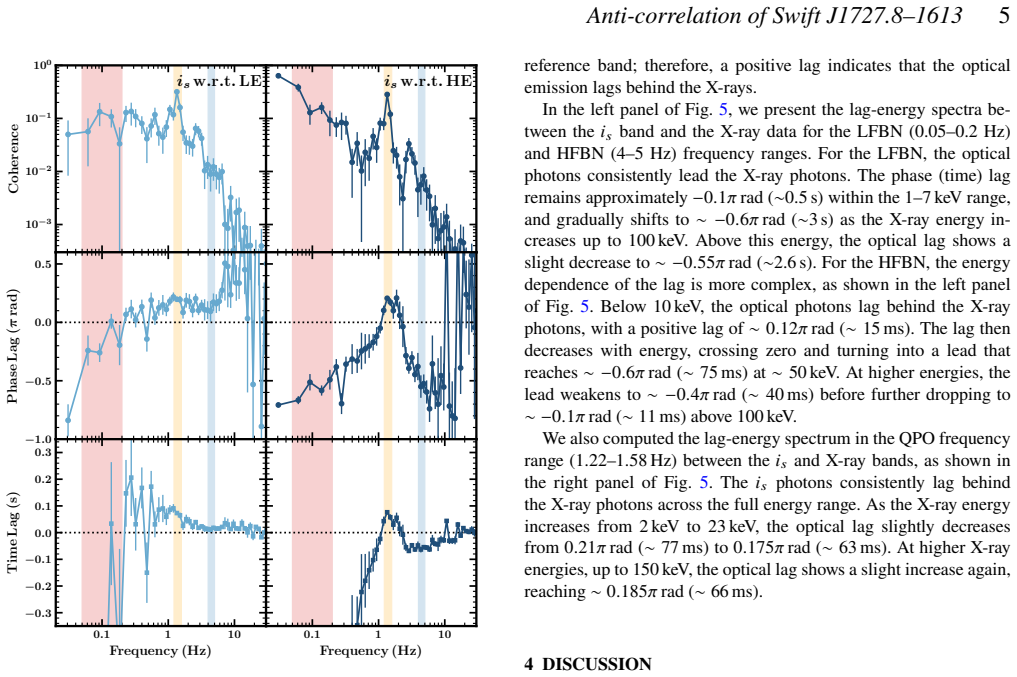
Summary. The paper presents a multiwavelength timing analysis of the black hole transient Swift J1727.8–1613 using simultaneous Insight-HXMT (2–150 keV), ULTRACAM (g_s, i_s) and HAWK-I (K_s) observations on 2023 September 9. Power spectra show a ~1.4 Hz QPO in the X-ray bands and marginal QPOs in i_s and K_s. The discrete correlation functions (DCFs) show positive OIR–LE correlations for all three bands, while g_s and i_s show an anti-correlation with the HE band. Cross-spectral analysis yields an i_s QPO lag of ~60–80 ms relative to the X-rays that is approximately constant from 2 to 150 keV, while the LFBN and HFBN lags show strong energy dependence. The authors interpret the energy-dependent coupling as evidence for multiple Comptonisation regions, with the QPO originating from a geometric process.
Significance. If the hard-X-ray anti-correlation is established, this is a new observational result for this source and would provide a strong constraint on the coupling of optical synchrotron emission to a hard Comptonising component. The near-flat QPO phase lag across 2–150 keV is also striking and, if robust, supports a geometric origin rather than energy-dependent Comptonisation delays. The paper uses standard, carefully applied timing tools; the QPO lag values are internally consistent (71±7 ms vs LE, 67±6 ms vs HE). Its main limitation is that the central DCF claim is presented without significance estimates or tests against the trivial model in which the optical band is correlated only with the soft X-rays.
major comments (3)
- [§3.2, Fig. 3] The central 'strong anti-correlation' of i_s and g_s with HE is reported without confidence intervals, bootstrap, or Monte Carlo significance. The only quoted uncertainty is half a DCF bin for the peak lag. This is insufficient to support a 'first time' claim. Please provide DCF uncertainties (e.g., bootstrap on segments, or simulations preserving each band's PDS and the observed LE–HE coherence) and state the significance of the anti-correlation dips, including a quantitative comparison with the LE DCF.
- [§4.1, Fig. 7] The paper does not rule out the null hypothesis that the optical–HE anti-correlation arises purely from the hard–soft lag. Since HE lags LE by a phase that can approach π at low frequencies, any optical component that is positively correlated with LE will appear anti-correlated with HE in a time-domain DCF that mixes all Fourier frequencies. The spectral 'harder-when-brighter' behaviour in Fig. 6 is not a timing decomposition. Please simulate the null model (e.g., optical light curve = a*LE(t) + noise, possibly with the observed QPO and lag) and compare the resulting optical–HE DCF with Fig. 3. This is load-bearing for the multiple-Comptonisation interpretation.
- [§4.1, right panel of Fig. 4] The interpretation that the DCF consists of a broadband anti-correlated component plus an additive coherent QPO component is not tested quantitatively. The text itself concedes (Section 3.3) that the HE-referenced lag spectra 'may also be interpreted' as a QPO lag on a broadband lag. The authors should fit this two-component model to the cross-spectrum or phase-lag versus frequency, or perform an injection-recovery simulation, and show that the observed DCF is reproduced. Without this, the flat QPO lag and the separate anti-correlated component are not independently established.
minor comments (6)
- [Abstract] The phrase 'delayed optical anti-correlation' is unclear; specify that the anti-correlation appears at small positive lags and quantify it in the text.
- [§3.2] The DCF peak lags are quoted without uncertainties; state the bin size and whether the only uncertainty is half a bin, and give errors in the text rather than only in the figures.
- [§3.4] The energy sub-bands overlap between instruments (e.g., 7–11 keV in both LE and ME). Clarify whether these are independent measurements or a consistency check, and how errors were propagated.
- [Fig. 8] The power-law fit to the QPO absolute-rms spectrum is quoted with a slope (-1.61±0.14) but the fit range and method are not given; please provide details.
- [§4.1] The statement that an approximately constant phase lag close to -0.5π rad would produce the anti-correlation is not obviously consistent with the LFBN phase lag varying from about -0.1π rad to -0.6π rad with energy in §3.4; please clarify what is meant.
- [Throughout] The paper uses 'DCF' and 'CCF' interchangeably; define the acronyms at first use and use a consistent term.
Circularity Check
No circular derivation; the central lag and anti-correlation claims are direct measurements, with only non-load-bearing self-citations.
full rationale
The paper's headline results — the optical anti-correlation with the hard X-ray band and the ~60–80 ms flat QPO lag across 2–150 keV — are obtained directly from DCFs and cross-spectra of the observed light curves (Sections 3.2–3.4), not from a fitted model that is then relabelled as a prediction. No equation in the paper defines the output in terms of an input parameter fitted to the same data; there is no equivalent-input/output step to exhibit. The self-citations (Vincentelli et al. 2025; Ma et al. 2025; Veledina et al. 2018, 2021) are used for data-reduction details and for interpretive context, and the central numbers do not reduce to those references. Section 4.1's decomposition of the DCF into a broadband anti-correlated component plus a coherent QPO modulation is an interpretation, and the paper itself notes in Section 3.3 that the lag spectra 'may also be interpreted as consisting of a QPO phase lag superimposed on an underlying broadband lag component'; however, an untested or ambiguous decomposition is a statistical-validity concern, not circular reasoning. No uniqueness theorem, ansatz smuggled via citation, or renaming of a known result as a new derivation is present. The only mild issue is reliance on earlier papers by overlapping authors for pipeline and model context, but that reliance is not load-bearing for the measured lag values.
Axiom & Free-Parameter Ledger
free parameters (4)
- QPO centroid frequency (ν_c) per band =
i_s: 1.36±0.04 Hz; LE: 1.392±0.008 Hz
- QPO FWHM per band =
Resulting integration band 1.22–1.58 Hz
- LFBN/HFBN frequency intervals =
0.05–0.2 Hz; 4–5 Hz
- Power-law index of X-ray QPO absolute-rms spectrum =
-1.61±0.14
axioms (4)
- domain assumption Poisson noise can be estimated and subtracted in each band, and HXMT small-FOV background is negligible.
- domain assumption The variability is stationary over the 0.99–2.34 ks simultaneous intervals.
- domain assumption The HE (27–150 keV) band is dominated by Comptonisation and is a cleaner probe of the hot flow/jet than softer bands.
- domain assumption The hot-flow SSC and jet internal-shock models (Veledina et al. 2011, 2013a; Malzac et al. 2018) are valid descriptions of OIR/X-ray coupling.
read the original abstract
We present a timing analysis of the black hole transient Swift J1727.8-1613 during its intermediate state. We use coordinated broadband X-ray observations from Insight-HXMT (2-150 keV), together with optical data from ULTRACAM (g_s and i_s bands) and near-infrared data from HAWK-I (K_s band), obtained on 2023 September 9. As shown by previous studies, the Fourier power spectrum shows a strong quasi-periodic oscillation (QPO) in the K_s, i_s and X-ray bands. Cross-correlation analysis reveals a complex coupling between the optical/near-infrared (OIR) and X-ray emission, including a delayed optical anti-correlation, a strong infrared correlation, and a pronounced dependence of these features on X-ray energy, suggesting multiple Comptonisation regions. In contrast, the lag properties do not change at the QPO frequency, displaying an OIR lag of ~60-80 ms up to 150 keV. We discuss these results in the context of small-scale jet and hot accretion flow scenarios.
Figures




Reference graph
Works this paper leans on
-
[1]
Belloni T., Hasinger G., 1990, , https://ui.adsabs.harvard.edu/abs/1990A&A...227L..33B 227, L33
1990
-
[2]
Belloni T., Psaltis D., van der Klis M., 2002, @doi [ ] 10.1086/340290 , https://ui.adsabs.harvard.edu/abs/2002ApJ...572..392B 572, 392
doi:10.1086/340290 2002
-
[3]
Bollemeijer N., Uttley P., You B., 2025, @doi [ ] 10.1093/mnras/staf750 , https://ui.adsabs.harvard.edu/abs/2025MNRAS.540.1394B 540, 1394
-
[4]
Cao X., et al., 2020, @doi [Science China Physics, Mechanics, and Astronomy] 10.1007/s11433-019-1506-1 , https://ui.adsabs.harvard.edu/abs/2020SCPMA..6349504C 63, 249504
-
[6]
Chand S., Zdziarski A. A., Dewangan G. C., Sahu P., 2026, @doi [ ] 10.3847/1538-4357/ae45aa , https://ui.adsabs.harvard.edu/abs/2026ApJ..1000..137C 1000, 137
-
[7]
Chen Y., et al., 2020, @doi [Science China Physics, Mechanics, and Astronomy] 10.1007/s11433-019-1469-5 , https://ui.adsabs.harvard.edu/abs/2020SCPMA..6349505C 63, 249505
-
[9]
Done C., Gierli \'n ski M., Kubota A., 2007, @doi [ ] 10.1007/s00159-007-0006-1 , https://ui.adsabs.harvard.edu/abs/2007A&ARv..15....1D 15, 1
-
[10]
Du D., You B., Yan Z., Cao X., Hameury J.-M., Wu Y., 2025, @doi [ ] 10.1093/mnras/staf1607 , https://ui.adsabs.harvard.edu/abs/2025MNRAS.543.2575D 543, 2575
-
[11]
Durant M., Gandhi P., Shahbaz T., Fabian A. P., Miller J., Dhillon V. S., Marsh T. R., 2008, @doi [ ] 10.1086/590906 , https://ui.adsabs.harvard.edu/abs/2008ApJ...682L..45D 682, L45
doi:10.1086/590906 2008
-
[14]
Fan X., You B., Du D., He H., Yang S., 2026, @doi [ ] 10.3847/1538-4357/ae2a2d , https://ui.adsabs.harvard.edu/abs/2026ApJ...997....7F 997, 7
-
[16]
Fragile P. C., Blaes O. M., Anninos P., Salmonson J. D., 2007, @doi [ ] 10.1086/521092 , https://ui.adsabs.harvard.edu/abs/2007ApJ...668..417F 668, 417
doi:10.1086/521092 2007
-
[19]
Gandhi P., et al., 2017, @doi [Nature Astronomy] 10.1038/s41550-017-0273-3 , https://ui.adsabs.harvard.edu/abs/2017NatAs...1..859G 1, 859
-
[25]
Ingram A., et al., 2024, @doi [ ] 10.3847/1538-4357/ad3faf , https://ui.adsabs.harvard.edu/abs/2024ApJ...968...76I 968, 76
-
[26]
Jin P., M \'e ndez M., Garc \' a F., Altamirano D., Zhang G., Rout S. K., 2025, @doi [ ] 10.1051/0004-6361/202554353 , https://ui.adsabs.harvard.edu/abs/2025A&A...699A...9J 699, A9
-
[27]
Kalamkar M., Casella P., Uttley P., O'Brien K., Russell D., Maccarone T., van der Klis M., Vincentelli F., 2016, @doi [ ] 10.1093/mnras/stw1211 , https://ui.adsabs.harvard.edu/abs/2016MNRAS.460.3284K 460, 3284
-
[29]
Li Z.-X., et al., 2026, @doi [ ] 10.1051/0004-6361/202555276 , https://ui.adsabs.harvard.edu/abs/2026A&A...707A..33L 707, A33
-
[30]
Liu C., et al., 2020, @doi [Science China Physics, Mechanics, and Astronomy] 10.1007/s11433-019-1486-x , https://ui.adsabs.harvard.edu/abs/2020SCPMA..6349503L 63, 249503
-
[32]
Ma X., et al., 2021, @doi [Nature Astronomy] 10.1038/s41550-020-1192-2 , https://ui.adsabs.harvard.edu/abs/2021NatAs...5...94M 5, 94
-
[33]
Ma R., M \'e ndez M., Garc \' a F., Sai N., Zhang L., Zhang Y., 2023, @doi [ ] 10.1093/mnras/stad2284 , https://ui.adsabs.harvard.edu/abs/2023MNRAS.525..854M 525, 854
-
[35]
Malzac J., 2014, @doi [ ] 10.1093/mnras/stu1144 , https://ui.adsabs.harvard.edu/abs/2014MNRAS.443..299M 443, 299
-
[37]
Malzac J., et al., 2018, @doi [ ] 10.1093/mnras/sty2006 , https://ui.adsabs.harvard.edu/abs/2018MNRAS.480.2054M 480, 2054
-
[38]
Markoff S., Falcke H., Fender R., 2001, @doi [ ] 10.1051/0004-6361:20010420 , https://ui.adsabs.harvard.edu/abs/2001A&A...372L..25M 372, L25
-
[39]
Mastichiadis A., Petropoulou M., Kylafis N. D., 2022, @doi [ ] 10.1051/0004-6361/202243397 , https://ui.adsabs.harvard.edu/abs/2022A&A...662A.118M 662, A118
-
[40]
Mata S \'a nchez D., Torres M. A. P., Casares J., Mu \ n oz-Darias T., Armas Padilla M., Yanes-Rizo I. V., 2025, @doi [ ] 10.1051/0004-6361/202451960 , https://ui.adsabs.harvard.edu/abs/2025A&A...693A.129M 693, A129
-
[42]
J., Page C
Motch C., Ricketts M. J., Page C. G., Ilovaisky S. A., Chevalier C., 1983, , https://ui.adsabs.harvard.edu/abs/1983A&A...119..171M 119, 171
1983
-
[43]
Paice J. A., et al., 2019, @doi [ ] 10.1093/mnrasl/slz148 , https://ui.adsabs.harvard.edu/abs/2019MNRAS.490L..62P 490, L62
-
[44]
Paice J. A., et al., 2021, @doi [ ] 10.1093/mnras/stab1531 , https://ui.adsabs.harvard.edu/abs/2021MNRAS.505.3452P 505, 3452
-
[45]
M., Parsotan T
Palmer D. M., Parsotan T. M., 2023, The Astronomer's Telegram, https://ui.adsabs.harvard.edu/abs/2023ATel16215....1P 16215, 1
2023
-
[47]
Poutanen J., Veledina A., 2014, @doi [ ] 10.1007/s11214-013-0033-3 , https://ui.adsabs.harvard.edu/abs/2014SSRv..183...61P 183, 61
-
[48]
Poutanen J., Vurm I., 2009, @doi [ ] 10.1088/0004-637X/690/2/L97 , https://ui.adsabs.harvard.edu/abs/2009ApJ...690L..97P 690, L97
-
[49]
Poutanen J., Veledina A., Revnivtsev M. G., 2014, @doi [ ] 10.1093/mnras/stu1989 , https://ui.adsabs.harvard.edu/abs/2014MNRAS.445.3987P 445, 3987
-
[51]
Russell D. M., et al., 2013, @doi [ ] 10.1093/mnras/sts377 , https://ui.adsabs.harvard.edu/abs/2013MNRAS.429..815R 429, 815
-
[52]
Thomas J. K., et al., 2022, @doi [ ] 10.1093/mnrasl/slab132 , https://ui.adsabs.harvard.edu/abs/2022MNRAS.513L..35T 513, L35
-
[53]
Uttley P., Casella P., 2014, @doi [ ] 10.1007/s11214-014-0072-4 , https://ui.adsabs.harvard.edu/abs/2014SSRv..183..453U 183, 453
-
[54]
Veledina A., 2018, @doi [ ] 10.1093/mnras/sty2556 , https://ui.adsabs.harvard.edu/abs/2018MNRAS.481.4236V 481, 4236
-
[55]
Veledina A., Poutanen J., Vurm I., 2011, @doi [ ] 10.1088/2041-8205/737/1/L17 , https://ui.adsabs.harvard.edu/abs/2011ApJ...737L..17V 737, L17
-
[56]
Veledina A., Poutanen J., Vurm I., 2013a, @doi [ ] 10.1093/mnras/stt124 , https://ui.adsabs.harvard.edu/abs/2013MNRAS.430.3196V 430, 3196
-
[57]
Veledina A., Poutanen J., Ingram A., 2013b, @doi [ ] 10.1088/0004-637X/778/2/165 , https://ui.adsabs.harvard.edu/abs/2013ApJ...778..165V 778, 165
-
[58]
Veledina A., Revnivtsev M. G., Durant M., Gandhi P., Poutanen J., 2015, @doi [ ] 10.1093/mnras/stv2201 , https://ui.adsabs.harvard.edu/abs/2015MNRAS.454.2855V 454, 2855
-
[59]
Veledina A., Gandhi P., Hynes R., Kajava J. J. E., Tsygankov S. S., Revnivtsev M. G., Durant M., Poutanen J., 2017, @doi [ ] 10.1093/mnras/stx1207 , https://ui.adsabs.harvard.edu/abs/2017MNRAS.470...48V 470, 48
-
[60]
Veledina A., et al., 2023, @doi [ ] 10.3847/2041-8213/ad0781 , https://ui.adsabs.harvard.edu/abs/2023ApJ...958L..16V 958, L16
-
[61]
Vincentelli F. M., et al., 2019, @doi [ ] 10.3847/2041-8213/ab5860 , https://ui.adsabs.harvard.edu/abs/2019ApJ...887L..19V 887, L19
-
[62]
Vincentelli F. M., et al., 2021, @doi [ ] 10.1093/mnras/stab475 , https://ui.adsabs.harvard.edu/abs/2021MNRAS.503..614V 503, 614
-
[63]
Vincentelli F. M., et al., 2025, @doi [ ] 10.1093/mnras/staf600 , https://ui.adsabs.harvard.edu/abs/2025MNRAS.539.2347V 539, 2347
-
[65]
Xu S.-E., You B., Long Y., He H., 2025, @doi [ ] 10.3847/1538-4357/ae058a , https://ui.adsabs.harvard.edu/abs/2025ApJ...993...40X 993, 40
-
[66]
Yang Z.-X., et al., 2024, @doi [ ] 10.3847/2041-8213/ad60bd , https://ui.adsabs.harvard.edu/abs/2024ApJ...970L..33Y 970, L33
-
[67]
Yang S.-K., et al., 2026, @doi [ ] 10.3847/1538-4357/ae4724 , https://ui.adsabs.harvard.edu/abs/2026ApJ..1000...20Y 1000, 20
-
[68]
You B., Bursa M., \.Z ycki P. T., 2018, @doi [ ] 10.3847/1538-4357/aabd33 , https://ui.adsabs.harvard.edu/abs/2018ApJ...858...82Y 858, 82
-
[69]
You B., et al., 2021, @doi [Nature Communications] 10.1038/s41467-021-21169-5 , https://ui.adsabs.harvard.edu/abs/2021NatCo..12.1025Y 12, 1025
-
[70]
You B., et al., 2023, @doi [Science] 10.1126/science.abo4504 , https://ui.adsabs.harvard.edu/abs/2023Sci...381..961Y 381, 961
-
[71]
You B., Yu W., Ingram A., De Marco B., Qu J.-L., Zhu Z.-H., Santangelo A., Xu S.-E., 2026, @doi [Nature Communications] 10.1038/s41467-026-69604-9 , https://ui.adsabs.harvard.edu/abs/2026NatCo..17.2860Y 17, 2860
-
[72]
Yu W., et al., 2024, @doi [ ] 10.1093/mnras/stae835 , https://ui.adsabs.harvard.edu/abs/2024MNRAS.529.4624Y 529, 4624
-
[73]
Zdziarski A. A., Gierli \'n ski M., 2004, @doi [Progress of Theoretical Physics Supplement] 10.1143/PTPS.155.99 , https://ui.adsabs.harvard.edu/abs/2004PThPS.155...99Z 155, 99
-
[74]
Zhang S.-N., et al., 2020, @doi [Science China Physics, Mechanics, and Astronomy] 10.1007/s11433-019-1432-6 , https://ui.adsabs.harvard.edu/abs/2020SCPMA..6349502Z 63, 249502
-
[75]
Zhao Q.-C., et al., 2024, @doi [ ] 10.3847/2041-8213/ad1e6c , https://ui.adsabs.harvard.edu/abs/2024ApJ...961L..42Z 961, L42
-
[76]
Echo mapping of Swift J1753.5-0127. , keywords =. doi:10.1111/j.1365-2966.2009.15260.x , archivePrefix =. 0906.2773 , primaryClass =
arXiv 2009
-
[77]
Interplay of spectral components in timing properties of accreting compact objects. , keywords =. doi:10.1093/mnras/sty2556 , archivePrefix =. 1809.06053 , primaryClass =
-
[78]
Modelling Spectral and Timing Properties of Accreting Black Holes: The Hybrid Hot Flow Paradigm. , keywords =. doi:10.1007/s11214-013-0033-3 , archivePrefix =. 1312.2761 , primaryClass =
-
[79]
Discovery of X-Ray Polarization from the Black Hole Transient Swift J1727.8-1613. , keywords =. doi:10.3847/2041-8213/ad0781 , archivePrefix =. 2309.15928 , primaryClass =
Pith/arXiv arXiv 2041
-
[80]
, keywords =
Variability in the noise properties of Cygnus X-1. , keywords =
-
[81]
A Unified Description of the Timing Features of Accreting X-Ray Binaries. , keywords =. doi:10.1086/340290 , archivePrefix =. astro-ph/0202213 , primaryClass =
-
[82]
A broad-band spectral-timing study of QPOs in the bright black hole X-ray binary Swift J1727.8 - 1613. , keywords =. doi:10.1093/mnras/staf750 , archivePrefix =. 2505.05060 , primaryClass =
-
[83]
Fast infrared variability from a relativistic jet in GX 339-4. , keywords =. doi:10.1111/j.1745-3933.2010.00826.x , archivePrefix =. 1002.1233 , primaryClass =
arXiv 2010
-
[84]
Science China Physics, Mechanics, and Astronomy , keywords =
The Medium Energy X-ray telescope (ME) onboard the Insight-HXMT astronomy satellite. Science China Physics, Mechanics, and Astronomy , keywords =. doi:10.1007/s11433-019-1506-1 , archivePrefix =. 1910.04451 , primaryClass =
arXiv 1910
-
[85]
Evolution of the Inner Accretion Flow in Swift J1727.8─1613 across Intermediate States: Insights from Broadband Spectral and Timing Analysis. , keywords =. doi:10.3847/1538-4357/ae45aa , archivePrefix =. 2512.05544 , primaryClass =
-
[86]
Science China Physics, Mechanics, and Astronomy , keywords =
The Low Energy X-ray telescope (LE) onboard the Insight-HXMT astronomy satellite. Science China Physics, Mechanics, and Astronomy , keywords =. doi:10.1007/s11433-019-1469-5 , archivePrefix =. 1910.08319 , primaryClass =
Pith/arXiv arXiv 1910
-
[87]
ULTRACAM: an ultrafast, triple-beam CCD camera for high-speed astrophysics. , keywords =. doi:10.1111/j.1365-2966.2007.11881.x , archivePrefix =. 0704.2557 , primaryClass =
arXiv 2007
-
[88]
Everything you always wanted to know about accretion but were afraid to ask
Modelling the behaviour of accretion flows in X-ray binaries. Everything you always wanted to know about accretion but were afraid to ask. , keywords =. doi:10.1007/s00159-007-0006-1 , archivePrefix =. 0708.0148 , primaryClass =
-
[89]
A comprehensive study of time delay between optical/near-infrared and X-ray emissions in black hole X-ray binaries. , keywords =. doi:10.1093/mnras/staf1607 , archivePrefix =. 2507.00578 , primaryClass =
-
[90]
SWIFT J1753.5-0127: A Surprising Optical/X-Ray Cross-Correlation Function. , keywords =. doi:10.1086/590906 , archivePrefix =. 0806.2530 , primaryClass =
-
[91]
Multiwavelength spectral and high time resolution observations of SWIFTJ1753.5-0127: new activity?. , keywords =. doi:10.1111/j.1365-2966.2008.14044.x , archivePrefix =. 0810.1141 , primaryClass =
arXiv 2008
-
[92]
The Discrete Correlation Function: A New Method for Analyzing Unevenly Sampled Variability Data. , keywords =. doi:10.1086/166773 , adsurl =
-
[93]
On the Optical Emission in the Minioutburst of the Black Hole X-Ray Binary MAXI J1348-630. , keywords =. doi:10.3847/1538-4357/ae2a2d , archivePrefix =. 2508.19645 , primaryClass =
-
[95]
Global General Relativistic Magnetohydrodynamic Simulation of a Tilted Black Hole Accretion Disk. , keywords =. doi:10.1086/521092 , archivePrefix =. 0706.4303 , primaryClass =
-
[96]
Rapid optical and X-ray timing observations of GX 339-4: flux correlations at the onset of a low/hard state. , keywords =. doi:10.1111/j.1745-3933.2008.00529.x , archivePrefix =. 0807.1529 , primaryClass =
arXiv 2008
-
[97]
Rapid optical and X-ray timing observations of GX339-4: multicomponent optical variability in the low/hard state. , keywords =. doi:10.1111/j.1365-2966.2010.17083.x , archivePrefix =. 1005.4685 , primaryClass =
arXiv 2010
-
[98]
An elevation of 0.1 light-seconds for the optical jet base in an accreting Galactic black hole system. Nature Astronomy , keywords =. doi:10.1038/s41550-017-0273-3 , archivePrefix =. 1710.09838 , primaryClass =
-
[99]
Estimating black hole spin from AGN SED fitting: the impact of general-relativistic ray tracing. , keywords =. doi:10.1093/mnras/stad2499 , archivePrefix =. 2304.01253 , primaryClass =
-
[100]
Dynamic disk-corona coupling during the state transition of Swift J1727.8-1613. arXiv e-prints , keywords =. doi:10.48550/arXiv.2508.01384 , archivePrefix =. 2508.01384 , primaryClass =
-
[101]
The remarkable rapid X-ray, ultraviolet, optical and infrared variability in the black hole XTE J1118+480. , keywords =. doi:10.1046/j.1365-8711.2003.06938.x , archivePrefix =. astro-ph/0306626 , primaryClass =
arXiv 2003
discussion (0)
Sign in with ORCID, Apple, or X to comment. Anyone can read and Pith papers without signing in.