Bounds on Λ at the Galactic Center
Pith reviewed 2026-06-27 06:13 UTC · model grok-4.3
The pith
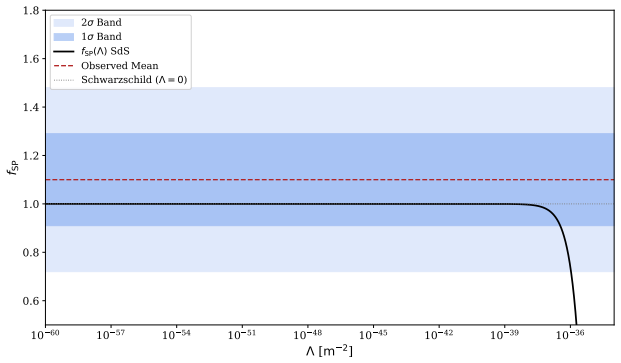
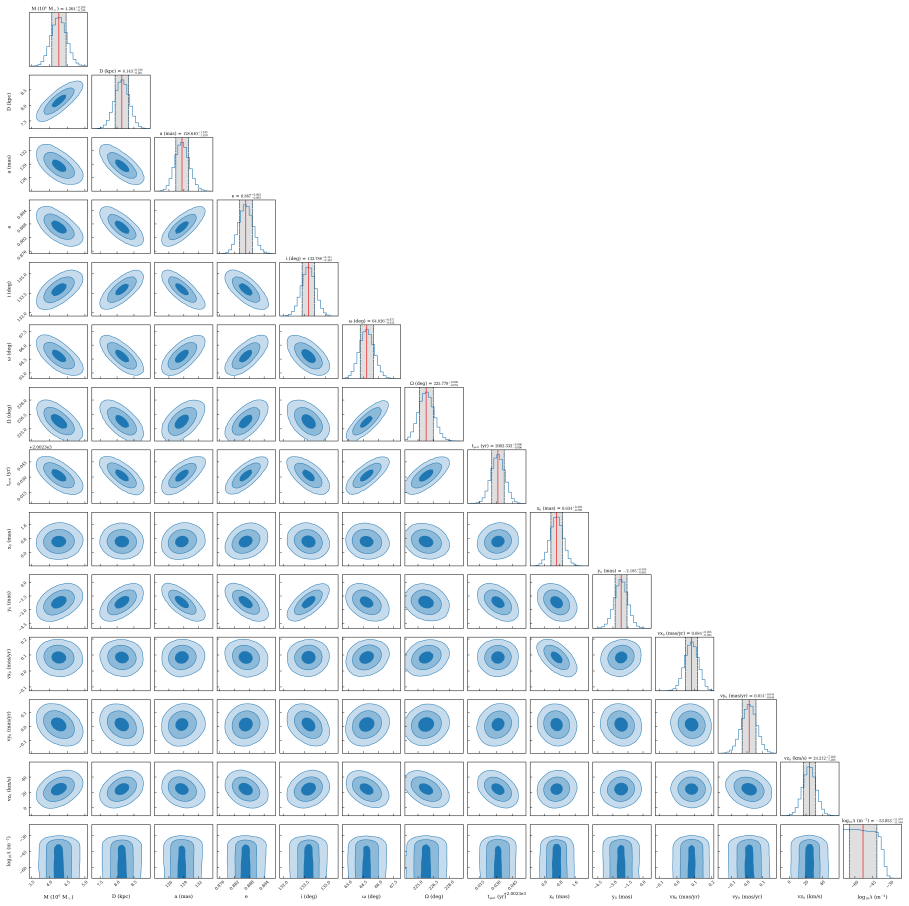
Observations of three stars orbiting Sgr A* yield upper bounds on the cosmological constant of 6.9×10^{-48} m^{-2} at 68% credibility and 1.0×10^{-38} m^{-2} at 95% credibility.
A machine-rendered reading of the paper's core claim, the machinery that carries it, and where it could break.
Core claim
The central claim is that the posterior distributions obtained from the MCMC analysis of the three stellar orbits in Schwarzschild-de Sitter spacetime place upper bounds on the magnitude of Lambda at the galactic center of Lambda ≲ 6.9×10^{-48} m^{-2} at 68% credibility and Lambda ≲ 1.0×10^{-38} m^{-2} at 95% credibility.
What carries the argument
Numerical integration of timelike geodesics in Schwarzschild-de Sitter spacetime together with Bayesian MCMC inference of orbital and spacetime parameters from astrometric and spectroscopic data.
If this is right
- The bound on Lambda applies at the radial scale of the observed stellar orbits around Sgr A*.
- Combining independent constraints from multiple stars produces a stronger limit than any single orbit alone.
- The model must reproduce the observed relativistic redshift and time-delay effects only if Lambda remains below the stated thresholds.
Where Pith is reading between the lines
- The same geodesic-fitting approach could be applied to additional stars with future high-precision data to tighten the limit further.
- The derived upper bound remains many orders of magnitude above the value of Lambda inferred from cosmology, leaving room for consistency between local and global measurements.
- If Lambda were found to differ between the galactic center and cosmological scales, that difference would require an explanation beyond standard general relativity with a constant term.
Load-bearing premise
The stellar motion is accurately described by numerically integrating timelike geodesics in Schwarzschild-de Sitter spacetime that include relativistic redshift and time-delay corrections.
What would settle it
A precise measurement of the S2 star's radial velocity or sky position that deviates from the geodesic prediction by an amount larger than the 95% upper limit on Lambda would falsify the reported bound.
Figures



read the original abstract
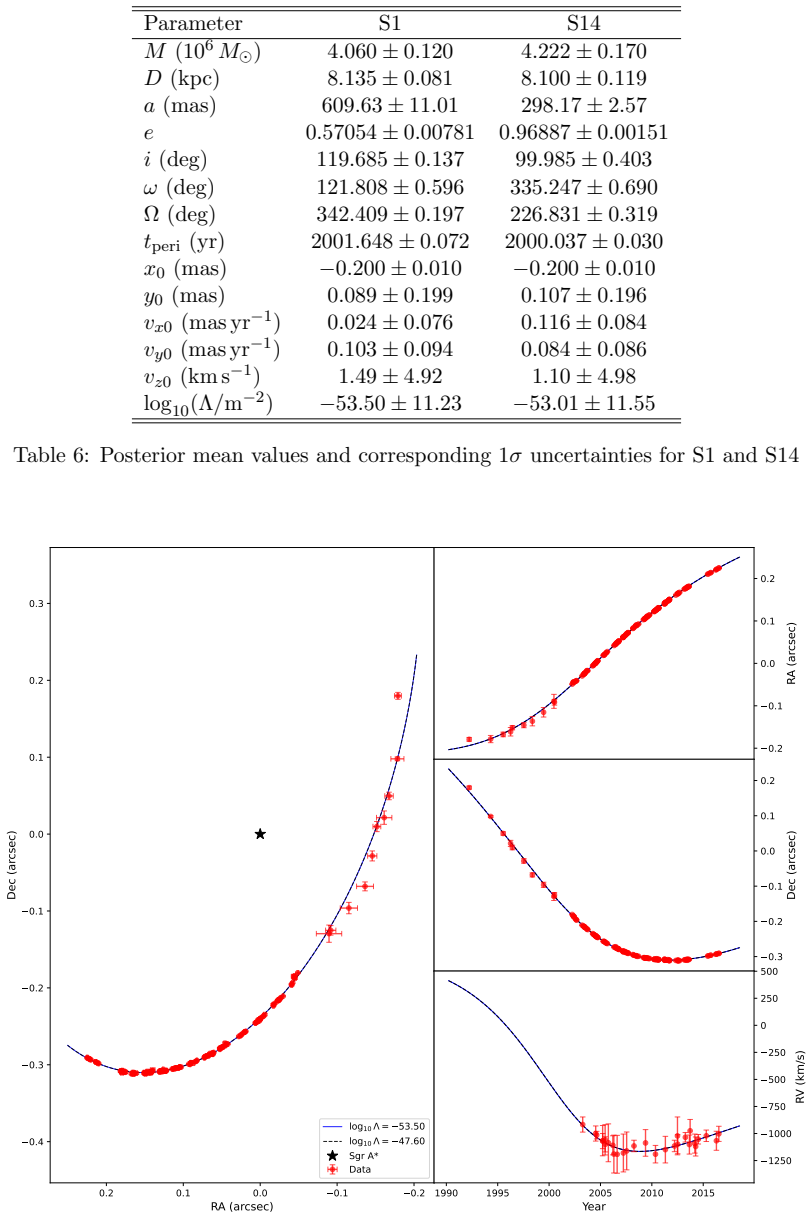
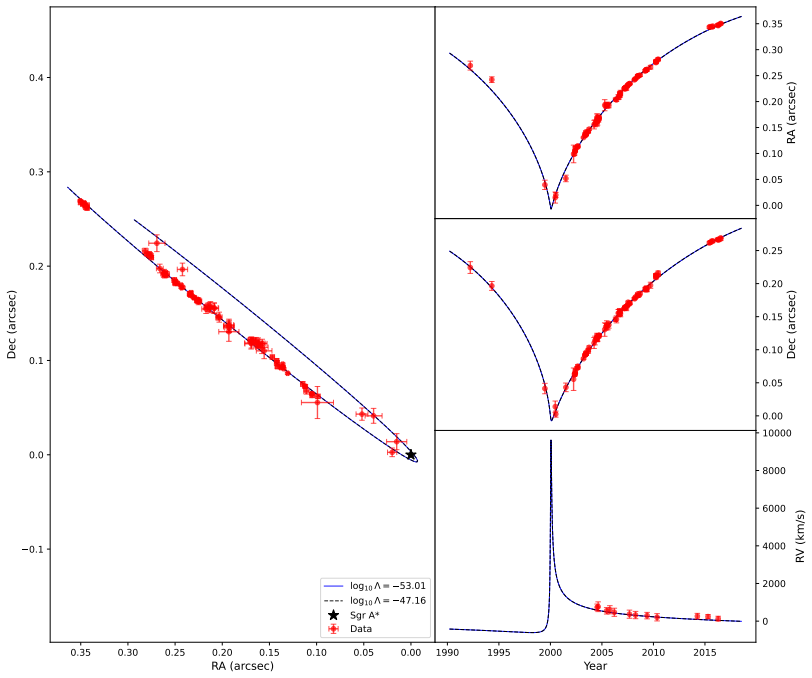
We constrain the cosmological constant $\Lambda$ using astrometric and spectroscopic observations of the S2, S1, and S14 stars orbiting Sgr A$^*$. The stellar motion is modelled by numerically integrating timelike geodesics in Schwarzschild-de Sitter spacetime, including relativistic redshift and time-delay corrections. Orbital and spacetime parameters are inferred using a Bayesian MCMC analysis. The resulting posterior distributions place upper bounds on the magnitude of $\Lambda$ at the Galactic Center (GC). Combining the independent constraints from the S2, S1, and S14 orbits yields upper bounds of $\Lambda \lesssim 6.9\times10^{-48} \mathrm{m}^{-2}$ at 68\% credibility and $\Lambda \lesssim 1.0\times10^{-38} \mathrm{m}^{-2}$ at 95\% credibility.
Editorial analysis
A structured set of objections, weighed in public.
Referee Report
Summary. The manuscript claims to constrain the cosmological constant Λ at the Galactic Center by numerically integrating timelike geodesics in Schwarzschild-de Sitter spacetime for the S2, S1, and S14 stars, incorporating relativistic redshift and time-delay effects, and performing Bayesian MCMC inference on astrometric and spectroscopic data. It reports upper bounds obtained by combining constraints from the three orbits: Λ ≲ 6.9×10^{-48} m^{-2} at 68% credibility and Λ ≲ 1.0×10^{-38} m^{-2} at 95% credibility.
Significance. If the statistical procedure is corrected, the work would offer a useful test of whether a non-zero Λ is consistent with stellar dynamics at the scale of Sgr A*, providing local bounds that can be compared to cosmological values. The modeling choice of Schwarzschild-de Sitter geodesics with standard relativistic corrections is a clear strength, as is the use of multiple independent stellar datasets.
major comments (1)
- [Abstract] Abstract: the procedure of 'combining the independent constraints from the S2, S1, and S14 orbits' is not statistically valid. Because the central mass M, distance D, and Λ are shared across all three stars, separate per-star MCMC runs (each marginalizing over its own M and D) followed by multiplication of the resulting one-dimensional Λ posteriors undercounts the joint uncertainty on the common parameters and produces an overly tight combined upper limit.
Simulated Author's Rebuttal
We thank the referee for the constructive review and for identifying a statistical issue in our analysis. We address the major comment below and will revise the manuscript accordingly.
read point-by-point responses
-
Referee: [Abstract] Abstract: the procedure of 'combining the independent constraints from the S2, S1, and S14 orbits' is not statistically valid. Because the central mass M, distance D, and Λ are shared across all three stars, separate per-star MCMC runs (each marginalizing over its own M and D) followed by multiplication of the resulting one-dimensional Λ posteriors undercounts the joint uncertainty on the common parameters and produces an overly tight combined upper limit.
Authors: We agree with the referee that multiplying one-dimensional Λ posteriors obtained from separate per-star MCMC runs is not statistically rigorous, as it fails to properly marginalize over the shared parameters M and D and can produce an overly tight combined constraint. In the revised manuscript we will replace this procedure with a single joint MCMC analysis that simultaneously models the three stellar datasets while sharing M, D, and Λ. The resulting joint posterior on Λ will be reported in place of the current combined bounds. revision: yes
Circularity Check
No circularity: bounds obtained via MCMC fitting to external astrometric/spectroscopic data.
full rationale
The paper's derivation consists of numerically integrating timelike geodesics in Schwarzschild-de Sitter spacetime and performing Bayesian MCMC inference on observed stellar positions, velocities, and redshifts for S2/S1/S14. No step reduces a claimed prediction to a fitted input by construction, invokes a self-citation as the sole justification for a uniqueness claim, or renames a known result. The combination of per-orbit posteriors is a statistical procedure applied to external observations rather than an internal redefinition; the result is therefore not equivalent to its inputs.
Axiom & Free-Parameter Ledger
free parameters (2)
- orbital elements and spacetime parameters for S2, S1, S14
- Λ magnitude
axioms (2)
- domain assumption Spacetime around Sgr A* is exactly Schwarzschild-de Sitter
- domain assumption Relativistic redshift and time-delay corrections are sufficient and correctly implemented
Reference graph
Works this paper leans on
-
[1]
Riess et al
Adam G. Riess et al. Observational evidence from supernovae for an accelerating universe and a cosmological constant.Astron. J., 116:1009–1038, 1998
1998
-
[2]
Perlmutter et al
S. Perlmutter et al. Measurements of Ω and Λ from 42 High Redshift Supernovae.Astro- phys. J., 517:565–586, 1999. 17
1999
-
[3]
The 2dF Galaxy Redshift Survey: Power-spectrum analysis of the final dataset and cosmological implications.Mon
Shaun Cole et al. The 2dF Galaxy Redshift Survey: Power-spectrum analysis of the final dataset and cosmological implications.Mon. Not. Roy. Astron. Soc., 362:505–534, 2005
2005
-
[4]
Eisenstein et al
Daniel J. Eisenstein et al. Detection of the Baryon Acoustic Peak in the Large-Scale Correlation Function of SDSS Luminous Red Galaxies.Astrophys. J., 633:560–574, 2005
2005
-
[5]
The clustering of galaxies in the completed SDSS-III Baryon Oscillation Spectroscopic Survey: cosmological analysis of the DR12 galaxy sample.Mon
Shadab Alam et al. The clustering of galaxies in the completed SDSS-III Baryon Oscillation Spectroscopic Survey: cosmological analysis of the DR12 galaxy sample.Mon. Not. Roy. Astron. Soc., 470(3):2617–2652, 2017
2017
-
[6]
Aghanim et al
N. Aghanim et al. Planck 2018 results. VI. Cosmological parameters.Astron. Astrophys., 641:A6, 2020. [Erratum: Astron.Astrophys. 652, C4 (2021)]
2018
-
[7]
Calderon et al
R. Calderon et al. DESI 2024: reconstructing dark energy using crossing statistics with DESI DR1 BAO data.JCAP, 10:048, 2024
2024
-
[8]
A. G. Adame et al. DESI 2024 VII: cosmological constraints from the full-shape modeling of clustering measurements.JCAP, 07:028, 2025
2024
-
[9]
Lodha et al
K. Lodha et al. Extended dark energy analysis using DESI DR2 BAO measurements.Phys. Rev. D, 112(8):083511, 2025
2025
-
[10]
Abdul Karim et al
M. Abdul Karim et al. DESI DR2 results. II. Measurements of baryon acoustic oscillations and cosmological constraints.Phys. Rev. D, 112(8):083515, 2025
2025
-
[11]
Chernin, P
A. Chernin, P. Teerikorpi, and Yu. Baryshev. Why is the Hubble flow so quiet?Advances in Space Research, 31(2):459–467, January 2003
2003
-
[12]
The Local Hubble flow: A Mani- festation of dark energy.Astron
Yurij Baryshev, Arthur Chernin, and Pekka Teerikorpi. The Local Hubble flow: A Mani- festation of dark energy.Astron. Astrophys., 11 2000
2000
-
[13]
Karachentsev, Arthur D
Igor D. Karachentsev, Arthur D. Chernin, and Pekka Teerikorpi. The Hubble Flow: Why does the cosmological expansion preserve its kinematical identity from a few Mpc distance to the observation horizon?Astrofiz., 46:399, 2003
2003
-
[14]
Chernin, and Yurij V
Pekka Teerikorpi, Arthur D. Chernin, and Yurij V. Baryshev. The Quiescent Hubble flow, local dark energy tests, and pairwise velocity dispersion in a Omega = 1 Universe.Astron. Astrophys., 440:791, 2005
2005
-
[15]
Chernin, Pekka Teerikorpi, Mauri J
Arthur D. Chernin, Pekka Teerikorpi, Mauri J. Valtonen, G. Byrd, V. P. Dolgachev, and L. M. Domozhilova. Dark energy and the mass of the local group.arXiv: Cosmology and Nongalactic Astrophysics, 2009
2009
-
[16]
Chernin, Igor D
Arthur D. Chernin, Igor D. Karachentsev, Olga G. Nasonova, Pekka Teerikorpi, Mauri J. Valtonen, V. P. Dolgachev, L. M. Domozhilova, and G. Byrd. Dark energy domination in the virgocentric flow.Astronomy and Astrophysics, 520, 2010
2010
-
[17]
A. D. Chernin, N. V. Emelyanov, and I. D. Karachentsev. Dark energy domination in the local flow of giant galaxies.Mon. Not. Roy. Astron. Soc., 449(2):2069–2078, 2015
2069
-
[18]
Wyn Evans
David Benisty, Anne-Christine Davis, and N. Wyn Evans. Constraining Dark Energy from the Local Group Dynamics.Astrophys. J. Lett., 953(1):L2, 2023
2023
-
[19]
SpringerBriefs in Physics
Alexander Silbergleit and Arthur Chernin.Kepler Problem in the Presence of Dark Energy, and the Cosmic Local Flow. SpringerBriefs in Physics. Springer, 2019
2019
-
[20]
F. D. Kahn and L. Woltjer. Intergalactic Matter and the Galaxy.ApJ, 130:705, November 1959. 18
1959
-
[21]
Princeton University Press, 1987
James Binney and Scott Tremaine.Galactic dynamics. Princeton University Press, 1987
1987
-
[22]
Yang-Shyang Li and Simon D. M. White. Masses for the Local Group and the Milky Way. Mon. Not. Roy. Astron. Soc., 384:1459–1468, 2008
2008
-
[23]
Weighing the Local Group in the Presence of Dark Energy.Mon
Candace Partridge, Ofer Lahav, and Yehuda Hoffman. Weighing the Local Group in the Presence of Dark Energy.Mon. Not. Roy. Astron. Soc., 436:45, 2013
2013
-
[24]
Libeskind, Ofer Lahav, and Yehuda Hoffman
Michael McLeod, Noam I. Libeskind, Ofer Lahav, and Yehuda Hoffman. Estimating the mass of the local group using machine learning applied to numerical simulations.Journal of Cosmology and Astroparticle Physics, 2017:034 – 034, 2016
2017
-
[25]
Libeskind, and Yehuda Hoffman
Pablo Lemos, Niall Jeffrey, Lorne Whiteway, Ofer Lahav, Noam I. Libeskind, and Yehuda Hoffman. Sum of the masses of the Milky Way and M31: A likelihood-free inference approach.Phys. Rev. D, 103(2):023009, 2021
2021
-
[26]
Weighing Milky Way and Andromeda in an expanding ΛCDM Universe - Decreasing the Local Group mass.Astron
David Benisty. Weighing Milky Way and Andromeda in an expanding ΛCDM Universe - Decreasing the Local Group mass.Astron. Astrophys., 689:L1, 2024
2024
-
[27]
Chaichian, and Anca Tureanu
David Benisty, Moshe M. Chaichian, and Anca Tureanu. Galaxy groups in the presence of cosmological constant: Increasing the masses of groups.Phys. Lett. B, 858:139033, 2024
2024
-
[28]
First M87 Event Horizon Telescope Results
Kazunori Akiyama et al. First M87 Event Horizon Telescope Results. I. The Shadow of the Supermassive Black Hole.Astrophys. J. Lett., 875:L1, 2019
2019
-
[29]
First Sagittarius A* Event Horizon Telescope Results
Kazunori Akiyama et al. First Sagittarius A* Event Horizon Telescope Results. I. The Shadow of the Supermassive Black Hole in the Center of the Milky Way.Astrophys. J. Lett., 930(2):L12, 2022
2022
-
[30]
Horizon-scale tests of gravity theories and fundamental physics from the Event Horizon Telescope image of Sagittarius A.Class
Sunny Vagnozzi et al. Horizon-scale tests of gravity theories and fundamental physics from the Event Horizon Telescope image of Sagittarius A.Class. Quant. Grav., 40(16):165007, 2023
2023
-
[31]
A. M. Ghez, S. Salim, Seth D. Hornstein, A. Tanner, M. Morris, E. E. Becklin, and G. Duchene. Stellar orbits around the galactic center black hole.Astrophys. J., 620:744– 757, 2005
2005
-
[32]
Hees et al
A. Hees et al. Testing General Relativity with stellar orbits around the supermassive black hole in our Galactic center.Phys. Rev. Lett., 118(21):211101, 2017
2017
-
[33]
Gillessen et al
S. Gillessen et al. An Update on Monitoring Stellar Orbits in the Galactic Center.Astro- phys. J., 837(1):30, 2017
2017
-
[34]
Abuter et al
R. Abuter et al. Mass distribution in the Galactic Center based on interferometric astrom- etry of multiple stellar orbits.Astron. Astrophys., 657:L12, 2022
2022
-
[35]
The galactic center massive black hole and nuclear star cluster.Reviews of Modern Physics, 82:3121–3195, 2010
Reinhard Genzel, Frank Eisenhauer, and Stefan Gillessen. The galactic center massive black hole and nuclear star cluster.Reviews of Modern Physics, 82:3121–3195, 2010
2010
-
[36]
Nobel lecture: A forty-year journey.Rev
Reinhard Genzel. Nobel lecture: A forty-year journey.Rev. Mod. Phys., 94:020501, 6 2022
2022
-
[37]
Abuter et al
R. Abuter et al. Detection of the gravitational redshift in the orbit of the star S2 near the Galactic centre massive black hole.Astron. Astrophys., 615:L15, 2018
2018
-
[38]
Relativistic redshift of the star S0-2 orbiting the Galactic center supermas- sive black hole.Science, 365(6454):664–668, 2019
Tuan Do et al. Relativistic redshift of the star S0-2 orbiting the Galactic center supermas- sive black hole.Science, 365(6454):664–668, 2019. 19
2019
-
[39]
Abuter et al
R. Abuter et al. Detection of the Schwarzschild precession in the orbit of the star S2 near the Galactic centre massive black hole.Astron. Astrophys., 636:L5, 2020
2020
-
[40]
Orbital precession of the S2 star in Scalar–Tensor–Vector Gravity.Mon
Riccardo Della Monica, Ivan de Martino, and Mariafelicia de Laurentis. Orbital precession of the S2 star in Scalar–Tensor–Vector Gravity.Mon. Not. Roy. Astron. Soc., 510(4):4757– 4766, 2022
2022
-
[41]
Constraining MOdified Gravity with the S2 Star.Universe, 8(2):137, 2022
Riccardo Della Monica, Ivan de Martino, and Mariafelicia de Laurentis. Constraining MOdified Gravity with the S2 Star.Universe, 8(2):137, 2022
2022
-
[42]
f(R) gravity after the detection of the orbital precession of the S2 star around the Galactic Center massive black hole.Phys
Ivan de Martino, Riccardo della Monica, and Mariafelicia de Laurentis. f(R) gravity after the detection of the orbital precession of the S2 star around the Galactic Center massive black hole.Phys. Rev. D, 104(10):L101502, 2021
2021
-
[43]
Testing horndeski gravity with S2 star orbit.Mon
Riccardo Della Monica, Ivan de Martino, Daniele Vernieri, and Mariafelicia de Laurentis. Testing horndeski gravity with S2 star orbit.Mon. Not. Roy. Astron. Soc., 519(2):1981– 1988, 2022
1981
-
[44]
Constraining a disformal Schwarzschild black hole in DHOST theories with the orbit of the S2 star.Eur
Zelin Zhang, Songbai Chen, and Jiliang Jing. Constraining a disformal Schwarzschild black hole in DHOST theories with the orbit of the S2 star.Eur. Phys. J. C, 84(8):827, 2024
2024
-
[45]
Unveiling the nature of SgrA* with the geodesic motion of S-stars.JCAP, 03(03):007, 2022
Riccardo Della Monica and Ivan de Martino. Unveiling the nature of SgrA* with the geodesic motion of S-stars.JCAP, 03(03):007, 2022
2022
-
[46]
Joshi, Dipanjan Dey, Pankaj S
Parth Bambhaniya, Ashok B. Joshi, Dipanjan Dey, Pankaj S. Joshi, Arindam Mazumdar, Tomohiro Harada, and Ken-ichi Nakao. Relativistic orbits of S2 star in the presence of scalar field.Eur. Phys. J. C, 84(2):124, 2024
2024
-
[47]
Testing black hole space–times with the S2 star orbit: a Bayesian comparison.Mon
C´ esar Navarrete, Fernando V´ azquez-Ch´ avez, Alejandro Cruz-Osorio, and N´ estor Ortiz. Testing black hole space–times with the S2 star orbit: a Bayesian comparison.Mon. Not. Roy. Astron. Soc., 546(3):stag059, 2026
2026
-
[48]
Vicentin, Riccardo Della Monica, Elisabete M
Parth Bambhaniya, Preet Dalal, Giovani H. Vicentin, Riccardo Della Monica, Elisabete M. de Gouveia Dal Pino, and Bina Patel. Testing the spacetime geometry of sgr a* with the relativistic orbit of s2 star, 2026
2026
-
[49]
Narrowing the allowed mass range of ultralight bosons with the S2 star.Astron
Riccardo Della Monica and Ivan de Martino. Narrowing the allowed mass range of ultralight bosons with the S2 star.Astron. Astrophys., 670:L4, 2023
2023
-
[50]
Bounding the mass of ultralight bosonic dark matter particles with the motion of the S2 star around Sgr A*.Phys
Riccardo Della Monica and Ivan de Martino. Bounding the mass of ultralight bosonic dark matter particles with the motion of the S2 star around Sgr A*.Phys. Rev. D, 108(10):L101303, 2023
2023
-
[51]
Exploring dark matter spike distribution around the Galactic centre with stellar orbits.Mon
Zhao-Qiang Shen, Guan-Wen Yuan, Cheng-Zi Jiang, Yue-Lin Sming Tsai, Qiang Yuan, and Yi-Zhong Fan. Exploring dark matter spike distribution around the Galactic centre with stellar orbits.Mon. Not. Roy. Astron. Soc., 527(2):3196–3207, 2023
2023
-
[52]
C. R. Arg¨ uelles, M. F. Mestre, E. A. Becerra-Vergara, V. Crespi, A. Krut, J. A. Rueda, and R. Ruffini. What does lie at the Milky Way centre? Insights from the S2-star orbit precession.MNRAS, 511(1):L35–L39, March 2022
2022
-
[53]
Crespi, C
V. Crespi, C. R. Arg¨ uelles, E. A. Becerra-Vergara, M. F. Mestre, F. Peißker, J. A. Rueda, and R. Ruffini. The dynamics of S-stars and G-sources orbiting a supermassive compact object made of fermionic dark matter.MNRAS, 546(1):staf1854, February 2026
2026
-
[54]
Zakharov
Alexander F. Zakharov. Testing the Galactic Centre potential with S-stars.MNRAS, 513(1):L6–L9, 2022. 20
2022
-
[55]
Solar system effects in Schwarzschild-de Sitter spacetime.Phys
Valeria Kagramanova, Jutta Kunz, and Claus Lammerzahl. Solar system effects in Schwarzschild-de Sitter spacetime.Phys. Lett. B, 634:465–470, 2006
2006
-
[56]
Solar and stellar system tests of the cosmological constant.Phys
Mauro Sereno and Philippe Jetzer. Solar and stellar system tests of the cosmological constant.Phys. Rev. D, 73:063004, 2006
2006
-
[57]
Dark energy as a critical period in binary motion: Bounds from multi-scale binaries.Astron
David Benisty, Jenny Wagner, and Denitsa Staicova. Dark energy as a critical period in binary motion: Bounds from multi-scale binaries.Astron. Astrophys., 683:A83, 2024
2024
-
[58]
Two-body problem with the cosmological constant and observational constraints.Phys
Philippe Jetzer and Mauro Sereno. Two-body problem with the cosmological constant and observational constraints.Phys. Rev. D, 73:044015, 2006
2006
-
[59]
A New Independent Limit on the Cosmological Constant/Dark Energy from the Relativistic Bending of Light by Galaxies and Clusters of Galaxies.Mon
Mustapha Ishak, Wolfgang Rindler, Jason Dossett, Jacob Moldenhauer, and Chris Allison. A New Independent Limit on the Cosmological Constant/Dark Energy from the Relativistic Bending of Light by Galaxies and Clusters of Galaxies.Mon. Not. Roy. Astron. Soc., 388:1279–1283, 2008
2008
-
[60]
Bounding the cos- mological constant using galactic rotation curves from SPARC dataset.Phys
David Benisty, David Vasak, J¨ urgen Struckmeier, and Horst Stoecker. Bounding the cos- mological constant using galactic rotation curves from SPARC dataset.Phys. Rev. D, 110(6):063028, 2024
2024
-
[61]
Riess et al
Adam G. Riess et al. A Comprehensive Measurement of the Local Value of the Hubble Constant with 1 km s −1 Mpc−1 Uncertainty from the Hubble Space Telescope and the SH0ES Team.Astrophys. J. Lett., 934(1):L7, 2022
2022
-
[62]
The Pantheon+ Analysis: Cosmological Constraints.Astrophys
Dillon Brout et al. The Pantheon+ Analysis: Cosmological Constraints.Astrophys. J., 938(2):110, 2022
2022
-
[63]
¨Uber die physikalischen Grundlagen der Einsteinschen Gravitationsthe- orie.Annalen Phys., 361(14):401–462, 1918
Friedrich Kottler. ¨Uber die physikalischen Grundlagen der Einsteinschen Gravitationsthe- orie.Annalen Phys., 361(14):401–462, 1918
1918
-
[64]
Stuchl´ ık and S
Z. Stuchl´ ık and S. Hled´ ık. Some properties of the Schwarzschild-de Sitter and Schwarzschild-anti-de Sitter spacetimes.Phys. Rev. D, 60(4):044006, August 1999
1999
-
[65]
Zakharov
Alexander F. Zakharov. Are signatures of anti-de-sitter black hole at the galactic center?, 2014
2014
-
[66]
Construct- ing Regular Lovelock Black Holes with Degenerate Vacuum and Λ<0 Using the Gravita- tional Tension—Shadow Analysis.Universe, 11(10):338, 2025
Reginaldo Prado-Fuentes, Rodrigo Aros, Milko Estrada, and Bastian Astudillo. Construct- ing Regular Lovelock Black Holes with Degenerate Vacuum and Λ<0 Using the Gravita- tional Tension—Shadow Analysis.Universe, 11(10):338, 2025
2025
-
[67]
Oxford University Press, 2001
Wolfgang Rindler.Relativity: special, general, and cosmological. Oxford University Press, 2001
2001
-
[68]
Volker Perlick and Oleg Yu. Tsupko. Calculating black hole shadows: Review of analytical studies.Phys. Rept., 947:1–39, 2022
2022
-
[69]
Firouzjaee and Alireza Allahyari
Javad T. Firouzjaee and Alireza Allahyari. Black hole shadow with a cosmological constant for cosmological observers.Eur. Phys. J. C, 79(11):930, 2019
2019
-
[70]
Study on black hole shadows in asymptotically de Sitter spacetimes.Phys
Rittick Roy and Sayan Chakrabarti. Study on black hole shadows in asymptotically de Sitter spacetimes.Phys. Rev. D, 102(2):024059, 2020
2020
-
[71]
Tsupko, and Gennady S
Volker Perlick, Oleg Yu. Tsupko, and Gennady S. Bisnovatyi-Kogan. Black hole shadow in an expanding universe with a cosmological constant.Phys. Rev. D, 97(10):104062, 2018
2018
-
[72]
G. S. Bisnovatyi-Kogan, O. Yu. Tsupko, and V. Perlick. Shadow of a black hole at local and cosmological distances.PoS, MULTIF2019:009, 2019. 21
2019
-
[73]
Kerr, John C
Andrew W. Kerr, John C. Hauck, and Bahram Mashhoon. Standard clocks, orbital pre- cession and the cosmological constant.Class. Quant. Grav., 20:2727, 2003
2003
-
[74]
Solar System motions and the cosmological constant: A New approach
Lorenzo Iorio. Solar System motions and the cosmological constant: A New approach. Adv. Astron., 2012:268647, 2012. [Erratum: Adv.Astron. 2012, 507892 (2012)]
2012
-
[75]
Perturbations of Keplerian Orbits in Stationary Spherically Sym- metric Spacetimes.Int
Matteo Luca Ruggiero. Perturbations of Keplerian Orbits in Stationary Spherically Sym- metric Spacetimes.Int. J. Mod. Phys. D, 23:1450049, 2014
2014
-
[76]
Note on the perihelion/periastron advance due to cosmological con- stant.Int
Hideyoshi Arakida. Note on the perihelion/periastron advance due to cosmological con- stant.Int. J. Theor. Phys., 52:1408–1414, 2013
2013
-
[77]
Springer-Verlag, Berlin, Heidelberg, 2 edition, 1993
Ernst Hairer, Syvert Paul Nørsett, and Gerhard Wanner.Solving Ordinary Differential Equations I: Nonstiff Problems, volume 8 ofSpringer Series in Computational Mathematics. Springer-Verlag, Berlin, Heidelberg, 2 edition, 1993
1993
-
[78]
W. D. Heintz.Double stars, volume 15 ofGEOPHYSICS AND ASTROPHYSICS MONO- GRAPHS, AN INTERNATIONAL SERIES OF FUNDAMENTAL TEXTBOOKS. D. Reidel Publishing Company, DORDRECHT, HOLLAND / BOSTON, U.S.A/ LONDON, ENGLAND, 1978
1978
-
[79]
Sanjar Shaymatov, Bobomurat Ahmedov, Mariafelicia De Laurentis, Mubasher Jamil, Qiang Wu, Anzhong Wang, and Mustapha Azreg-A¨ ınou. On the Parameters of the Spheri- cally Symmetric Parameterized Rezzolla–Zhidenko Spacetime through Solar System Tests, the Orbit of the S2 Star about Sgr A*, and Quasiperiodic Oscillations.Astrophys. J., 959(1):6, 2023
2023
-
[80]
P. M. Plewa, S. Gillessen, F. Eisenhauer, T. Ott, O. Pfuhl, E. George, J. Dexter, M. Habibi, R. Genzel, M. J. Reid, and K. M. Menten. Pinpointing the near-infrared location of Sgr A* by correcting optical distortion in the NACO imager.MNRAS, 453(3):3234–3244, November 2015
2015
discussion (0)
Sign in with ORCID, Apple, or X to comment. Anyone can read and Pith papers without signing in.