REVIEW 5 major objections 5 minor 2 cited by
Mars-PO: Multi-Agent Reasoning System Preference Optimization
T0 review · 5 major / 5 minor · reviewed 2026-08-12 · deepseek-v4-flash
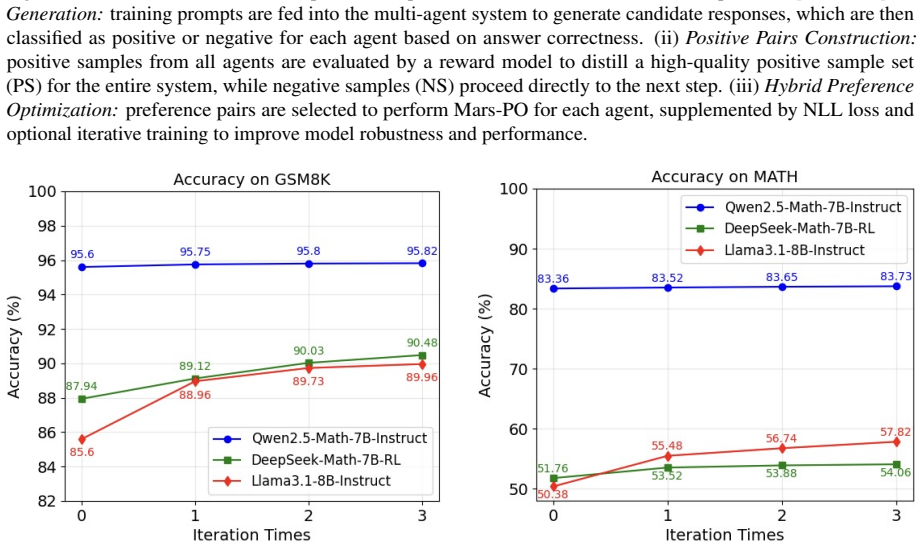
Pith's one-line read Mars-PO pools the best correct answers from several agents and pairs them with each agent's mistakes, lifting Llama3.1-8B-Instruct on MATH from 50.38% to 57.82%.
desk verdict A plausible multi-agent DPO variant with consistent reported gains, but the paper never states whether it trained on the GSM8K/MATH test splits—and that omission is decisive. read the letter →
The pith
A machine-rendered reading of the paper's core claim, the machinery that carries it, and where it could break.
The reading
What carries the argument
The load-bearing object is the hybrid positive sample set: correct answers sampled from all agents, scored by a reward model, and reduced to a shared high-quality subset. The paper pairs this shared positive set with each agent's own negative samples and optimizes $\mathcal{L} = \mathcal{L}_{\mathrm{DPO}} + \alpha \mathcal{L}_{\mathrm{NLL}}$ over three iterations of sampling and retraining. This construction is what converts multi-agent diversity into stronger preference pairs and is the claimed reason Mars-PO outperforms single-agent DPO and positive-sample SFT.
What would settle it
Run the full pipeline twice with everything fixed except the hybrid positive set: once with reward-model-selected correct answers and once with a same-size random sample of correct answers; if the MATH accuracy matches, reward-model selection is not what carries the result.
Extended reading notes
Core claim
The central discovery is that the quality and diversity of positive samples, not just the contrast with negatives, is what makes preference optimization work for mathematical reasoning. By merging correct outputs across agents and filtering them with a reward model, the authors construct what they call a hybrid positive sample set; pairing it with agent-specific negative samples avoids the degradation that vanilla DPO causes on already fine-tuned models. The paper reports consistent gains across all three agents on both GSM8K and MATH, with the largest gains on the weakest agent, and shows that supervised fine-tuning on the same positive samples without the contrastive negatives gives much smaller improvements.
Load-bearing premise
The method assumes the reward model reliably ranks the quality of correct solutions, so the highest-scoring correct answers across agents genuinely teach each agent better than its own correct answers.
Editorial extensions
If this is right
- If the mechanism holds, improving math reasoning by preference optimization does not require step-level error annotations; final-answer correctness plus reward-model selection is enough.
- Multi-agent alignment can amplify the weakest model in the group, since the largest reported gains are on Llama3.1-8B-Instruct, the weakest of the three agents.
- Vanilla DPO should be expected to hurt already math-tuned models, while shared positives paired with agent-specific negatives should improve them.
- Iterative retraining on freshly sampled responses continues to add accuracy, so the framework can be run as a loop rather than a one-shot post-training step.
Reading between the lines
- A natural testable extension is to replace the 72-billion-parameter reward model with a smaller or process-based scorer; if the gains shrink, reward-model quality is the real driver rather than multi-agent pooling itself.
- The method implicitly assumes the reward model's score tracks solution quality; a version using human-rated correct solutions could separate those two factors.
- The same hybrid-positive, agent-specific-negative recipe could transfer to other verdictable generation tasks, such as code generation, where correctness can be checked and a scorer exists.
Editorial analysis
A structured set of objections, weighed in public.
Referee Report
Summary. Mars-PO proposes a multi-agent preference optimization framework for improving mathematical reasoning of instruction-tuned LLMs. The method (i) samples multiple responses per prompt from each of three agents (Qwen2.5-Math-7B-Instruct, DeepSeek-Math-7B-RL, Llama3.1-8B-Instruct), (ii) classifies responses by final-answer correctness, (iii) selects a hybrid positive set by scoring correct responses with an external reward model (Qwen2.5-Math-RM-72B), and (iv) trains each agent with DPO using the shared hybrid positives and agent-specific negatives, plus an NLL term, over three iterations. The authors report accuracy gains on GSM8K and MATH for all three agents, with the largest gain for Llama3.1-8B-Instruct on MATH (50.38% to 57.82%).
Significance. If the reported gains are reproducible and not an artifact of data leakage, the framework is a simple and potentially useful extension of DPO to multi-agent settings: sharing correct solutions across agents in preference pairs is a plausible way to transfer reasoning strengths, and the gains for DeepSeek-Math and Llama are nontrivial. The paper also includes a useful negative result for vanilla DPO (large degradation on these benchmarks) and an SFT-with-positive-samples baseline. However, the significance is currently limited by missing train/test split details, absent statistical uncertainty quantification, and a likely sign error in the NLL loss, all of which prevent a reader from verifying the central empirical claim.
major comments (5)
- [§3.1, §4.2, §4.4] The manuscript never states whether the training dataset D in §3.1 is the official train split of GSM8K/MATH or includes the evaluation problems. Since the method trains on the correct answers yi from D, any overlap between D and the test sets used to produce Table 1 would make all reported accuracy gains reflect memorization rather than improved reasoning. The authors must explicitly specify the train/test split, state how prompts were sampled, and ideally release code/data to allow verification. This is the most load-bearing issue: without this clarification, every quantitative conclusion in the paper is unverifiable.
- [Table 1, §5.1] No error bars, confidence intervals, or significance tests are reported. For Qwen2.5-Math-7B-Instruct, the Mars-PO iter1 gains are only +0.15 on GSM8K and +0.16 on MATH; on a benchmark with hundreds to thousands of problems, these differences are within the scale of one or two questions and are indistinguishable from sampling noise. The paper's claim of 'consistent' improvements across all agents is therefore not statistically supported for the strongest baseline model. The authors should report variance across seeds or a significance test, especially for small-magnitude gains.
- [§3.3, Eq. (4)] The NLL term is written as L_NLL = log Mtheta(cw, aw|xi) / (|cw| + |yw|). This is a positive (length-normalized) log-likelihood of the chosen response. Since the total loss is L = L_DPO + alpha * L_NLL and the objective is minimization, this term would minimize the likelihood of the chosen response, which is the opposite of the intended NLL regularization described in the text. A missing minus sign appears likely. The sign convention must be corrected and clarified, and the broken reference 'Equation ??' in §4.4 should be fixed.
- [§3.2, §4.1] The reward model Qwen2.5-Math-RM-72B belongs to the same model family as one of the three agents (Qwen2.5-Math-7B-Instruct). The paper does not analyze the composition of the hybrid positive sample set or ablate the reward model choice. If the reward model systematically favors Qwen-style solutions, the observed pattern of tiny gains for Qwen and larger gains for DeepSeek/Llama could stem from style transfer toward Qwen-like reasoning rather than from the claimed diversity-based benefit. The authors should report the distribution of selected positives across the three agents and add an ablation with a different reward model or no reward-model selection.
- [§3.3, §5.2] Eq. (3) uses Mk as the reference model in the DPO ratio, but the paper does not state whether Mk is frozen at its initial weights or updated across the three iterations. In iterative preference optimization, the choice of reference model changes the DPO objective; using the current policy as reference would break the standard DPO derivation. Please specify the reference-modelling procedure for each iteration and justify it.
minor comments (5)
- [Table 1] The header 'Postive SFT' is a typo and should read 'Positive SFT'.
- [§5.1, Table 1] The sentence 'Note that these are the results after the first iteration of training' is contradicted by Table 1, which reports iter1, iter2, and iter3 results. The authors should clarify whether the numbers discussed in §5.1 refer to iter1 only or to all iterations, and which iteration is used in the abstract's headline gain.
- [§1] The sentence 'To sum up, our main contribution are as follows' should be 'our main contributions are as follows'.
- [§5.1] The phrase 'as shown in in Table 1' contains a duplicated 'in'.
- [References] The paper cites Touvron et al. (2023) for Llama3.1-8B-Instruct, but the cited reference is the original Llama paper; the Llama3.1 technical report or a proper citation for the 8B Instruct model should be used.
Circularity Check
No circular derivation: Mars-PO's empirical gains are not forced by its own construction; the reward-model entanglement and unstated data split are correctness concerns, not demonstrated circularity.
full rationale
The paper presents an empirical training pipeline rather than an equation-level derivation, and no load-bearing step reduces to its own inputs by construction. In Section 3.1–3.3, the hybrid positive sample set is selected by final-answer correctness (b_i^n = 1) and by scores from an external reward model, while negative samples are each agent's own incorrect outputs. The DPO loss (Eq. 3) and NLL term (Eq. 4) are optimized against these constructed preference pairs. Nothing in the construction consumes the reported GSM8K or MATH accuracies as an input; the Table 1 deltas are post-training measurements on benchmarks, not quantities reconstructed from the training set by definition. The only mild entanglement is Section 4.1, where Qwen2.5-Math-RM-72B, used to select positive samples, belongs to the same model family as one of the three agents; this could bias sample selection toward Qwen-style reasoning, but the reward model is an external fixed signal and does not force the reported improvements. The manuscript never states whether the GSM8K/MATH problems used to generate training responses are disjoint from the evaluation problems, and no code or data is released; if the sets overlap, every accuracy gain in Table 1 would be invalidated. That is a serious data-hygiene and reproducibility concern, but the paper provides no quote or equation exhibiting such overlap, so under the hard rules it cannot be counted as demonstrated circularity. No load-bearing self-citation or imported uniqueness theorem appears in the derivation chain.
Assumptions & free parameters
free parameters (5)
- beta (DPO temperature) =
0.1, then 0.2, then 0.4 across iterations
- alpha (NLL coefficient) =
1.0
- number of preference pairs per prompt =
15
- number of sampled responses N =
40 for GSM8K, 30 for MATH
- sampling temperature schedule =
0.8 for iteration 1, 1.2 for iterations 2 to 3
assumptions (4)
- domain assumption Correctness of a response can be determined by exact match of the final answer, so b_i^n = 1 iff a_i^n = a_i.
- domain assumption Qwen2.5-Math-RM-72B reward scores reliably rank solution quality, so taking the highest-scoring correct outputs yields the best hybrid positive set.
- domain assumption DPO with the hybrid positive set and agent-specific negatives, regularized by the NLL term, improves each agent's reasoning without degrading base knowledge.
- domain assumption The training dataset D does not overlap with the GSM8K and MATH test sets used for evaluation.
Cite this review
Pith. "Pith review of Mars-PO: Multi-Agent Reasoning System Preference Optimization." pith.science (2026). https://pith.science/paper/BOBY76GF
@misc{pith2026241119039,
  author       = {Pith},
  title        = {Pith review of: Mars-PO: Multi-Agent Reasoning System Preference Optimization},
  year         = {2026},
  howpublished = {\url{https://pith.science/paper/BOBY76GF}},
  note         = {Machine review of arXiv:2411.19039}
}
read the original abstract
Mathematical reasoning is a fundamental capability for large language models (LLMs), yet achieving high performance in this domain remains a significant challenge. The auto-regressive generation process often makes LLMs susceptible to errors, hallucinations, and inconsistencies, particularly during multi-step reasoning. In this paper, we propose Mars-PO, a novel framework to improve the mathematical reasoning capabilities of LLMs through a multi-agent system. It combines high-quality outputs from multiple agents into a hybrid positive sample set and pairs them with agent-specific negative samples to construct robust preference pairs for training. By aligning agents with shared positive samples while addressing individual weaknesses, Mars-PO achieves substantial performance improvements on mathematical reasoning benchmarks. For example, it increases the accuracy on the MATH benchmark of the state-of-the-art instruction-tuned LLM, Llama3.1-8B-Instruct, from 50.38% to 57.82%. Experimental results further demonstrate that our method consistently outperforms other baselines, such as supervised fine-tuning, vanilla DPO, and its enhanced versions, highlighting the effectiveness of our approach.
Figures


Forward citations
Cited by 2 Pith papers
-
Learning Sexism Detection Using Multi-Agent Perspectivist Preference Optimization
MAP-PO trains one LLM per annotator cluster for sexism detection, and shows that a shared team-level reward stops agents from overshooting their cluster's labeling behavior.
-
Artificial Intelligence for Mathematical Reasoning: An Integrated Survey of Language Models, Neuro-symbolic Systems, and Verified Discovery
An integrated survey organizing AI mathematical reasoning into informal, formal, discovery, and technique axes while cataloging benchmarks and assessing failure modes.
Reference graph
Works this paper leans on
-
[1]
online" 'onlinestring :=
ENTRY address archivePrefix author booktitle chapter edition editor eid eprint eprinttype howpublished institution journal key month note number organization pages publisher school series title type volume year doi pubmed url lastchecked label extra.label sort.label short.list INTEGERS output.state before.all mid.sentence after.sentence after.block STRING...
-
[2]
write newline
" write newline "" before.all 'output.state := FUNCTION n.dashify 't := "" t empty not t #1 #1 substring "-" = t #1 #2 substring "--" = not "--" * t #2 global.max substring 't := t #1 #1 substring "-" = "-" * t #2 global.max substring 't := while if t #1 #1 substring * t #2 global.max substring 't := if while FUNCTION word.in bbl.in capitalize " " * FUNCT...
-
[3]
Zhangir Azerbayev, Hailey Schoelkopf, Keiran Paster, Marco Dos Santos, Stephen McAleer, Albert Q Jiang, Jia Deng, Stella Biderman, and Sean Welleck. 2023. Llemma: An open language model for mathematics. arXiv preprint arXiv:2310.10631
arXiv 2023
-
[4]
Wenhu Chen, Xueguang Ma, Xinyi Wang, and William W Cohen. 2022. Program of thoughts prompting: Disentangling computation from reasoning for numerical reasoning tasks. arXiv preprint arXiv:2211.12588
arXiv 2022
-
[5]
Karl Cobbe, Vineet Kosaraju, Mohammad Bavarian, Mark Chen, Heewoo Jun, Lukasz Kaiser, Matthias Plappert, Jerry Tworek, Jacob Hilton, Reiichiro Nakano, et al. 2021. Training verifiers to solve math word problems. arXiv preprint arXiv:2110.14168
arXiv 2021
-
[6]
Luyu Gao, Aman Madaan, Shuyan Zhou, Uri Alon, Pengfei Liu, Yiming Yang, Jamie Callan, and Graham Neubig. 2023. Pal: Program-aided language models. In International Conference on Machine Learning, pages 10764--10799. PMLR
2023
-
[7]
Zhibin Gou, Zhihong Shao, Yeyun Gong, Yelong Shen, Yujiu Yang, Minlie Huang, Nan Duan, and Weizhu Chen. 2023. Tora: A tool-integrated reasoning agent for mathematical problem solving. arXiv preprint arXiv:2309.17452
arXiv 2023
-
[8]
Dan Hendrycks, Collin Burns, Saurav Kadavath, Akul Arora, Steven Basart, Eric Tang, Dawn Song, and Jacob Steinhardt. 2021. Measuring mathematical problem solving with the math dataset. arXiv preprint arXiv:2103.03874
arXiv 2021
Show all 30 references
-
[9]
Fangkai Jiao, Chengwei Qin, Zhengyuan Liu, Nancy F Chen, and Shafiq Joty. 2024. Learning planning-based reasoning by trajectories collection and process reward synthesizing. arXiv preprint arXiv:2402.00658
2024 arXiv
-
[10]
Xin Lai, Zhuotao Tian, Yukang Chen, Senqiao Yang, Xiangru Peng, and Jiaya Jia. 2024. Step-dpo: Step-wise preference optimization for long-chain reasoning of llms. arXiv preprint arXiv:2406.18629
2024 arXiv
-
[11]
Zimu Lu, Aojun Zhou, Houxing Ren, Ke Wang, Weikang Shi, Junting Pan, Mingjie Zhan, and Hongsheng Li. 2024 a . Mathgenie: Generating synthetic data with question back-translation for enhancing mathematical reasoning of llms. arXiv preprint arXiv:2402.16352
2024 arXiv
-
[12]
Zimu Lu, Aojun Zhou, Ke Wang, Houxing Ren, Weikang Shi, Junting Pan, Mingjie Zhan, and Hongsheng Li. 2024 b . Step-controlled dpo: Leveraging stepwise error for enhanced mathematical reasoning. arXiv preprint arXiv:2407.00782
2024 arXiv
-
[13]
Haipeng Luo, Qingfeng Sun, Can Xu, Pu Zhao, Jianguang Lou, Chongyang Tao, Xiubo Geng, Qingwei Lin, Shifeng Chen, and Dongmei Zhang. 2023. Wizardmath: Empowering mathematical reasoning for large language models via reinforced evol-instruct. arXiv preprint arXiv:2308.09583
2023 arXiv
-
[14]
Richard Yuanzhe Pang, Weizhe Yuan, Kyunghyun Cho, He He, Sainbayar Sukhbaatar, and Jason Weston. 2024. Iterative reasoning preference optimization. arXiv preprint arXiv:2404.19733
2024 arXiv
-
[15]
Qwen. 2024. Qwen2.5-math-rm-72b. https://huggingface.co/Qwen/Qwen2.5-Math-RM-72B
2024
-
[16]
Rafael Rafailov, Archit Sharma, Eric Mitchell, Christopher D Manning, Stefano Ermon, and Chelsea Finn. 2024. Direct preference optimization: Your language model is secretly a reward model. Advances in Neural Information Processing Systems, 36
2024
-
[17]
John Schulman, Filip Wolski, Prafulla Dhariwal, Alec Radford, and Oleg Klimov. 2017. Proximal policy optimization algorithms. arXiv preprint arXiv:1707.06347
2017 arXiv
-
[18]
Zhihong Shao, Peiyi Wang, Qihao Zhu, Runxin Xu, Junxiao Song, Xiao Bi, Haowei Zhang, Mingchuan Zhang, YK Li, Y Wu, et al. 2024. Deepseekmath: Pushing the limits of mathematical reasoning in open language models. arXiv preprint arXiv:2402.03300
2024 arXiv
-
[19]
Hugo Touvron, Thibaut Lavril, Gautier Izacard, Xavier Martinet, Marie-Anne Lachaux, Timoth \'e e Lacroix, Baptiste Rozi \`e re, Naman Goyal, Eric Hambro, Faisal Azhar, et al. 2023. Llama: Open and efficient foundation language models. arXiv preprint arXiv:2302.13971
2023 arXiv
-
[20]
Ke Wang, Houxing Ren, Aojun Zhou, Zimu Lu, Sichun Luo, Weikang Shi, Renrui Zhang, Linqi Song, Mingjie Zhan, and Hongsheng Li. 2023 a . Mathcoder: Seamless code integration in llms for enhanced mathematical reasoning. arXiv preprint arXiv:2310.03731
2023 arXiv
-
[21]
Zengzhi Wang, Rui Xia, and Pengfei Liu. 2023 b . Generative ai for math: Part i--mathpile: A billion-token-scale pretraining corpus for math. arXiv preprint arXiv:2312.17120
2023 arXiv
-
[22]
Jason Wei, Xuezhi Wang, Dale Schuurmans, Maarten Bosma, Fei Xia, Ed Chi, Quoc V Le, Denny Zhou, et al. 2022. Chain-of-thought prompting elicits reasoning in large language models. Advances in neural information processing systems, 35:24824--24837
2022
-
[23]
Yifan Xu, Xiao Liu, Xinghan Liu, Zhenyu Hou, Yueyan Li, Xiaohan Zhang, Zihan Wang, Aohan Zeng, Zhengxiao Du, Wenyi Zhao, et al. 2024. Chatglm-math: Improving math problem-solving in large language models with a self-critique pipeline. arXiv preprint arXiv:2404.02893
2024 arXiv
-
[24]
An Yang, Beichen Zhang, Binyuan Hui, Bofei Gao, Bowen Yu, Chengpeng Li, Dayiheng Liu, Jianhong Tu, Jingren Zhou, Junyang Lin, et al. 2024. Qwen2. 5-math technical report: Toward mathematical expert model via self-improvement. arXiv preprint arXiv:2409.12122
2024 arXiv
-
[25]
Zhen Yang, Ming Ding, Qingsong Lv, Zhihuan Jiang, Zehai He, Yuyi Guo, Jinfeng Bai, and Jie Tang. 2023. Gpt can solve mathematical problems without a calculator. arXiv preprint arXiv:2309.03241
2023 arXiv
-
[26]
Shunyu Yao, Dian Yu, Jeffrey Zhao, Izhak Shafran, Tom Griffiths, Yuan Cao, and Karthik Narasimhan. 2024. Tree of thoughts: Deliberate problem solving with large language models. Advances in Neural Information Processing Systems, 36
2024
-
[27]
Longhui Yu, Weisen Jiang, Han Shi, Jincheng Yu, Zhengying Liu, Yu Zhang, James T Kwok, Zhenguo Li, Adrian Weller, and Weiyang Liu. 2023. Metamath: Bootstrap your own mathematical questions for large language models. arXiv preprint arXiv:2309.12284
2023 arXiv
-
[28]
Zheng Yuan, Hongyi Yuan, Chengpeng Li, Guanting Dong, Keming Lu, Chuanqi Tan, Chang Zhou, and Jingren Zhou. 2023. Scaling relationship on learning mathematical reasoning with large language models. arXiv preprint arXiv:2308.01825
2023 arXiv
-
[29]
Xiang Yue, Xingwei Qu, Ge Zhang, Yao Fu, Wenhao Huang, Huan Sun, Yu Su, and Wenhu Chen. 2023. Mammoth: Building math generalist models through hybrid instruction tuning. arXiv preprint arXiv:2309.05653
2023 arXiv
-
[30]
Aojun Zhou, Ke Wang, Zimu Lu, Weikang Shi, Sichun Luo, Zipeng Qin, Shaoqing Lu, Anya Jia, Linqi Song, Mingjie Zhan, et al. 2023. Solving challenging math word problems using gpt-4 code interpreter with code-based self-verification. arXiv preprint arXiv:2308.07921
2023 arXiv
Reviewed August 12, 2026 · model on record in the stance chip above.
Discussion (0). Continue with ORCID to comment.