REVIEW 3 minor 29 references
Not All Uniform B-Fields Are The Same!
T0 review · 0 major / 3 minor · reviewed 2026-08-06 · deepseek-v4-flash
Pith's one-line read When a uniform magnetic field is ramped off, a charge's final momentum is set by the vector potential at its location, so identical B-fields from different sources produce different dynamics.
desk verdict Careful worked examples showing uniform B-fields from different sources give different impulses and torques; the main insight is not new, but the explicit calculations are, and the only real flaw is in the point-charge section. read the letter →
The pith
A machine-rendered reading of the paper's core claim, the machinery that carries it, and where it could break.
The reading
What carries the argument
The load-bearing object is the quasistatic vector potential $\mathbf{A}(\mathbf{r},t) = (1/c)\int \mathbf{J}(\mathbf{r}',t)/|\mathbf{r}-\mathbf{r}'|\,d^3r'$, together with the force law in potential form, $\mathbf{F} = q(-\nabla\phi - (1/c)\partial\mathbf{A}/\partial t + \mathbf{v}\times(\nabla\times\mathbf{A}))$. In the high-mass, quasistatic limit the velocity term is negligible and $\phi$ is static, so the entire force is the induction field $\mathbf{E}_{\rm ind} = -(1/c)\partial\mathbf{A}/\partial t$; integrating over the ramp gives $\mathbf{p}_f = (q/c)\mathbf{A}_i$. The machinery converts the causal chain—currents generate $\mathbf{A}$, then changing $\mathbf{A}$ pushes charges—into a direct formula for impulse and torque that keeps the source explicit.
What would settle it
Build the same uniform $\mathbf{B}$ field with two different sources—opposing planar currents and a solenoid—place identical charged capacitors inside, ramp both down identically, and compare impulses and plate angular momenta. The paper predicts the solenoid case has half the total impulse of the planar-current case and different per-plate torques; if the measured impulse and torque distribution are the same for both sources, the central claim that the vector potential carries the dynamical information would be falsified.
Extended reading notes
Core claim
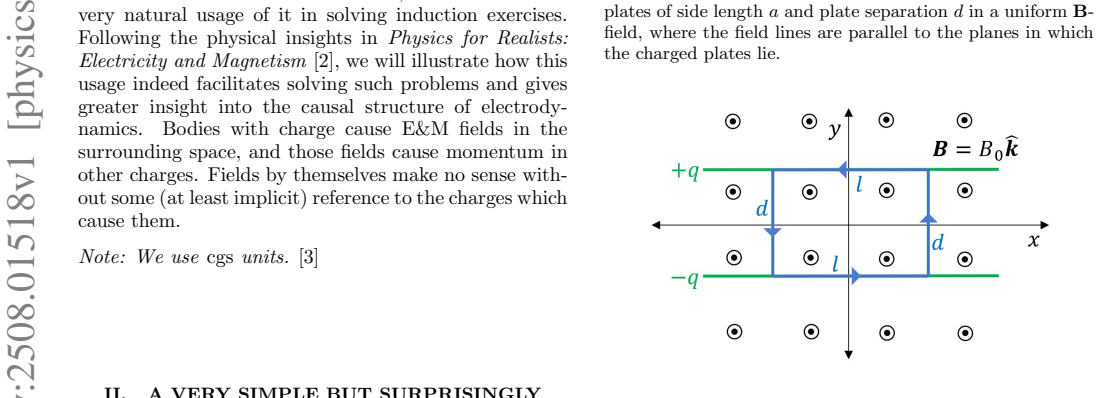
The paper's central claim is that in quasistatic induction the dynamical effect of switching off a magnetic field is carried entirely by the vector potential: for a charged body initially at rest and heavy enough not to move appreciably, the final momentum is $\mathbf{p}_f = (q/c)\mathbf{A}_i$, where $\mathbf{A}_i$ is the initial vector potential at the body. Because $\mathbf{A}$ is an integral over the current source, it contains information about where and how the currents are arranged, while the local field $\mathbf{B} = \nabla\times\mathbf{A}$ does not. The paper demonstrates this by placing the same charged capacitor in the same uniform $\mathbf{B}$ field produced by different sources: opposing planar currents (centered or shifted) give the same total impulse but different angular momentum; the same currents rotated by $90^\circ$ give zero net impulse but opposite plate torques; and a solenoid gives half the impulse of the planar-current case. It concludes that the common flux-form induction-law solution smuggles in a source assumption, and that the problem as originally stated is underdetermined.
Load-bearing premise
The key assumption is that the charged body hardly moves while the field is being turned off: the derivation keeps only the $-(q/c)\partial\mathbf{A}/\partial t$ force and drops the magnetic $q\mathbf{v}\times\mathbf{B}$ force, so if the capacitor accelerates appreciably during the ramp, Eq. (7) no longer describes its final momentum.
Editorial extensions
If this is right
- The textbook exercise as normally stated is underdetermined: the answer changes with the source, so a well-posed version must specify how the uniform field is produced.
- In identical uniform $\mathbf{B}$-fields, measured impulses and angular momenta can differ by factors of two or by even/odd distribution between plates, so integrating field momentum alone does not predict the motion of an object inside the field.
- Teaching the vector potential as potential momentum per unit charge gives students a direct way to solve induction problems and explains why local field values are not causally sufficient.
- The point-charge version of the problem, which has no convenient closed loop, is solved immediately by $\mathbf{p}_f = (q/c)\mathbf{A}_i$, showing that the approach generalizes beyond capacitor geometries.
- A field-momentum conservation calculation, although it can account for the impulse, does not reveal which part of the source drives the motion.
Reading between the lines
- Because $\mathbf{p}_f=(q/c)\mathbf{A}_i$ ties a measurable impulse to the vector potential at one point, a controlled field-ramp experiment could serve as a local probe of $\mathbf{A}$, a use the paper does not explicitly propose.
- The same source-dependence critique applies to any quasistatic 'uniform field' problem: wherever only local fields are matched but source geometry is not, the dynamics is not unique, so the lesson generalizes beyond magnetic fields.
- For a light test charge, Eq. (7) should be the leading term in an expansion; adding the $\mathbf{v}\times\mathbf{B}$ correction gives a solvable equation for a chosen ramp and a quantitative, testable extension that the paper leaves implicit.
Editorial analysis
A structured set of objections, weighed in public.
Referee Report
Summary. The manuscript revisits a textbook induction problem in which a charged parallel-plate capacitor sits in a uniform magnetic field that is turned off quasi-statically. The authors argue that the mechanical effect (impulse and torque) on the capacitor is not fixed by the local B-field alone but depends on the current-source configuration. Using the Lorentz force in potential form, F = q(-∇φ - (1/c)∂A/∂t + v×(∇×A)), and assuming the high-mass quasistatic limit so the v×(∇×A) term is negligible, they obtain p_f = qA_i/c (Eq. 7). They then compute the impulse and torque for three sources that produce the same uniform B-field at the capacitor: infinite planar currents (centered and shifted), the planar currents rotated by 90°, and an infinite solenoid. The results differ: the net impulse is -qdB0/c for the two planar-current arrangements, but -qdB0/(2c) for the solenoid, with different angular-momentum transfers in each case. Section IV extends the argument to a point charge, and the paper concludes that the source must be specified for the problem to be well-posed.
Significance. The paper provides a clean, analytically explicit demonstration that local field values are insufficient to determine induction forces; the source configuration matters. The derivations in Sections III.B-III.E are internally consistent: integrating -q/c ∂A/∂t over the ramp gives the stated impulses, and the torque expressions follow from the force distributions. The paper is transparent about its main idealizations (infinite sources, quasistatic ramp, high mass) and computes all results from a single, non-circular argument with no fitted parameters. If the caveats are stated precisely, the paper is a useful pedagogical contribution that makes a subtle and frequently missed point accessible.
minor comments (3)
- [Section IV, Eq. (28)] The point-charge example applies Eq. (7) without repeating the heavy-mass/quasistatic restriction stated in the derivation of Eq. (7) (text before Eq. (6) and footnote [4]). For a finite-mass charge, the v×(∇×A) term in Eq. (5) becomes non-negligible once the charge is set in motion, so Eq. (28) is not the general final momentum; please add an explicit 'in the infinite-mass limit' qualifier or provide the finite-mass analysis.
- [Section II.A and Section III.B] The label 'false' for Eq. (4) is misleading because Eq. (16), the correct result for the planar-current source, is numerically identical to Eq. (4). The flaw is the hidden assumption about the source in step (2), not the numerical value; suggest rewording 'false' to 'not generally valid' and noting that the value coincides with the planar-current answer.
- [Section III.E] The infinite-solenoid example should explicitly state that the capacitor is placed well inside the solenoid and that the same quasistatic and high-mass assumptions used in Sections III.B-III.D carry over; currently this must be inferred by the reader.
Circularity Check
No significant circularity: the paper's derivation is self-contained and parameter-free; the heavy-mass caveat affects validity, not circularity.
full rationale
No load-bearing step reduces to its own inputs. Eq. (7) follows by integrating Eq. (6), which is the -q/c dA/dt term of the standard Lorentz force (Eq. (5)) under the explicitly stated quasistatic/high-mass approximation; the v x B term is dropped on a stated physical assumption (text before Eq. (6) and footnote [4]), not by assuming the conclusion. The different impulses and torques in Secs. III.B-III.E are computed from distinct source configurations using the independent retarded-potential formula (Eq. (12)), and the fact that different sources give different dynamics is the paper's claim, not an input. The authors explicitly warn that the source variations are not gauge transformations (footnote [27]), so the alternative A-fields encode genuinely different current sources rather than relabelings. There are no fitted parameters, no prediction reverse-engineered from a fitted subset, and no load-bearing self-citations: the cited supporting works ([2], [15]-[17]) are standard external references and do not supply a uniqueness theorem that forces the result. The finite-mass limitation of Eq. (7) raised by a skeptical reader is a scope condition on the high-mass limit, not circular reasoning.
Assumptions & free parameters
assumptions (5)
- domain assumption Quasistatic approximation: retarded potentials are replaced by instantaneous integrals (Eq. 12).
- domain assumption Infinite planar current sheets and infinite solenoid are used as sources.
- domain assumption Charges are fixed on insulating plates of high mass.
- standard math Lorenz gauge retarded potentials (Eq. 11) are valid solutions.
- standard math Lorentz force in potential form, Eq. (5).
Cite this review
Pith. "Pith review of Not All Uniform B-Fields Are The Same!." pith.science (2026). https://pith.science/paper/BPFOMT2K
@misc{pith2026250801518,
  author       = {Pith},
  title        = {Pith review of: Not All Uniform B-Fields Are The Same!},
  year         = {2026},
  howpublished = {\url{https://pith.science/paper/BPFOMT2K}},
  note         = {Machine review of arXiv:2508.01518}
}
abstract
Set up a charged rectangular-plate capacitor in a uniform $\mathbf{B}$-field. Quasi-statically turn off the $\mathbf{B}$-field - what happens? We show that this seemingly simple induction problem (which appears in a famous undergraduate electrodynamics textbook) highlights the causal structure of electrodynamics. It may be (as it is in this problem) that different source configurations can produce the same uniform $\mathbf{B}$-field over some finite region, but very different dynamics when the source is turned off. We see also that the vector potential gives more information about the source of the $\mathbf{B}$-field, and is a very useful (and under-appreciated) way to understand induction and other key aspects of electrodynamics.
Figures


Figures from the paper (7 more)


Reference graph
Works this paper leans on
-
[1]
A.C.T. Wu and Chen Ning Yang, Evolution of the Con- cept of the Vector Potential in the Description of Fun- damental Interactions , International Journal of Modern Physics A, v. 21, no. 16, pp. 3235-3277, 2006
work page 2006
-
[2]
Anthony Rizzi, Physics for Realists: Electricity and Mag- netism, IAP Press, 2011
work page 2011
-
[3]
John David Jackson, Classical Electrodynamics , 1962, John Wiley & Sons, Inc
work page 1962
-
[4]
Though the textbook source [6] for this problem does state it for a ’capacitor’, we have found it cleaner to demonstrate the principles involved using two uniformly charged insulator plates. The case of an insulator does not bring up the possible issue of mobile charges moving inside the plates, which would needlessly complicate the problem and make it mo...
-
[5]
Specif- ically, one would like to know over what region the uni- form B-field is being specified
This vagueness should be disturbing to the reader. Specif- ically, one would like to know over what region the uni- form B-field is being specified. To have a unique answer to the question, we must specify some finite region within which the B-field is arbitrarily uniform. We delay this discussion for reasons that will become apparent shortly
-
[6]
(3rd edition only) in the chapter dealing with (among other things) the Poynting vector. [7] In particular, the line of solution suggested in that textbook was to calcu- late (approximately) the volume integral of the Poynting Vector between the plates and to show that the impulse imparted to the plates while the B-field is turned off can be calculated us...
-
[7]
Griffiths, Introduction to Electrodynamics; 3rd ed., Prentice-Hall, 1999
David J. Griffiths, Introduction to Electrodynamics; 3rd ed., Prentice-Hall, 1999
work page 1999
-
[8]
It should be noted that this textbook is excellent in train- ing students in the equations of electromagnetism, which is the reason for its just fame - a problem from this par- ticular book is only singled out to illustrate the generic point about all physicists’ understanding of electromag- netism broadly and would apply even more so to other authors of ...
Show all 29 references
-
[9]
McDonald, Electromagnetic Momentum of a Ca- pacitor in a Uniform Magnetic Field , 2023
Kirk T. McDonald, Electromagnetic Momentum of a Ca- pacitor in a Uniform Magnetic Field , 2023
2023
- [10]
-
[11]
, Hidden momentum, field momen- tum, and electromagnetic impulse , American Journal of Physics, v
David Babson et al. , Hidden momentum, field momen- tum, and electromagnetic impulse , American Journal of Physics, v. 77, no. 9, pp. 826-833, 2009
2009
-
[12]
It was clarified by Hu in the above manuscript that find- ing the hidden momentum of the source of the B-field is not necessary to obtain the impulse on the capacitor
-
[13]
As the electron was not discovered until 1897, the understanding of a fundamental unit of charge at that time was not quite the same as the modern under- standing
In his treatise A Dynamical Theory of the Electromag- netic Field , Maxwell writes this equation in the form of an electromotive force, which would be force per unit charge. As the electron was not discovered until 1897, the understanding of a fundamental unit of charge at tha...
-
[14]
Niven, The Scientific Papers of James Clerk Maxwell, James Clerk Maxwell, A Dynamical Theory of the Electromagnetic Field , v
W.D. Niven, The Scientific Papers of James Clerk Maxwell, James Clerk Maxwell, A Dynamical Theory of the Electromagnetic Field , v. 1, pp. 559, Cambridge Li- brary Collection - Physical Sciences, Cambridge Univer- sity Press, 2011
2011
-
[15]
E. J. Konopinski, What the electromagnetic vector poten- tial describes, American Journal of Physics, v. 46, no. 5, pp. 499-502, 1978
1978
-
[16]
Semon and John R
Mark D. Semon and John R. Taylor, Thoughts on the magnetic vector potential , American Journal of Physics, v. 64, no. 11, pp. 1361-1369, 1996
1996
-
[17]
Bertrand Berche, Daniel Malterre, and Ernesto Med- ina, Gauge transformations and conserved quantities in classical and quantum mechanics , American Journal of Physics, v. 84, no. 8, pp. 616-625, 2016
2016
-
[18]
Konopinski, Electromagnetic Fields and Rela- tivistic Particles , 0-07-035264-X, International series in pure and applied physics , 1981, McGraw-Hill, Inc
Emil J. Konopinski, Electromagnetic Fields and Rela- tivistic Particles , 0-07-035264-X, International series in pure and applied physics , 1981, McGraw-Hill, Inc
1981
-
[19]
Andrew Zangwill, Modern Electrodynamics, 2013, Cam- bridge University Press
2013
-
[20]
The fourth edition very briefly mentions interpreting the vector potential as potential momentum
-
[21]
Griffiths, Introduction to Electrodynamics; 4th ed., 0-321-85656-2, 2013, Pearson Education, Inc
David J. Griffiths, Introduction to Electrodynamics; 4th ed., 0-321-85656-2, 2013, Pearson Education, Inc
2013
-
[22]
Jefimenko, Electricity and Magnetism: An In- troduction to the Theory of Electric and Magnetic Fields , Appleton-Century-Crofts, pp
Oleg D. Jefimenko, Electricity and Magnetism: An In- troduction to the Theory of Electric and Magnetic Fields , Appleton-Century-Crofts, pp. 516, 1966
1966
-
[23]
This is misspelled in Jackson [3] and various other treat- ments: the force law is named after Hendrik Lorentz (1853-1928), whereas the gauge condition is named af- ter Ludvig Lorenz (1829-1891)
1928
-
[24]
These solutions of the inhomogeneous wave equations re- quire that all of the sources are localized within some finite volume (that is, there are no sources ρ or J at in- finity)
-
[25]
(10), reduces to ∇ · A = 0, which is, interestingly, identical in form with the Coulomb gauge condition
It should be noted that since the scalar potential in the cases that we will consider does not change, the Lorenz gauge condition, Eq. (10), reduces to ∇ · A = 0, which is, interestingly, identical in form with the Coulomb gauge condition
-
[26]
Note that this is a zeroth-order approximation to a set of finite sheet currents in 1 /L, where L is half the length of each of the sides of the plates
-
[27]
Gauge differences do not and cannot imply differences in dynamics
Do not be deceived - this and the other changes in source mentioned do NOT constitute a difference of gauge. Gauge differences do not and cannot imply differences in dynamics
-
[28]
Even if one does not wish to use the vector potential, one cannot avoid the (at least implicit) consideration of the source, as one clearly sees in the expression for E in the Jefimenko equations
-
[29]
(11) (and Eq
In general, A will point in the direction of the cur- rent source (superposition), as is stated on page 248 of the fourth edition of Griffiths [21], and as can easily be sketched based on Eq. (11) (and Eq. (12) in the qua- sistatic condition)
Reviewed August 6, 2026 · model on record in the stance chip above.
Discussion (0). Continue with ORCID to comment.