The QCD phase diagram for three-flavor M\"obius domain-wall fermions
Pith reviewed 2026-06-29 01:51 UTC · model grok-4.3
The pith
Lattice QCD simulations with Möbius domain-wall fermions indicate a continuous crossover for the three-flavor phase transition at the examined quark masses.
A machine-rendered reading of the paper's core claim, the machinery that carries it, and where it could break.
Core claim
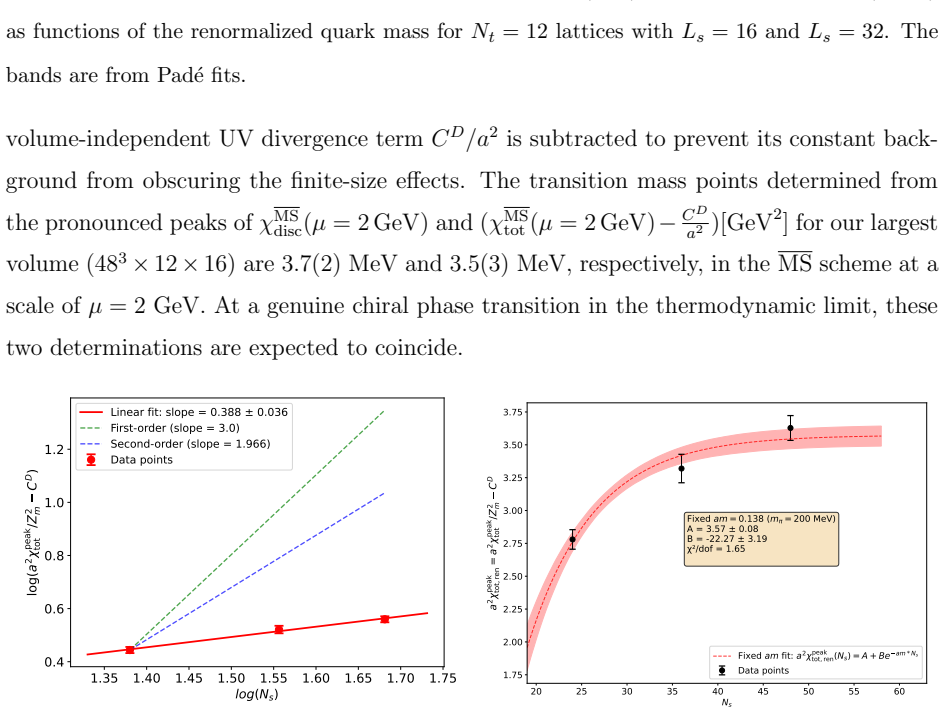
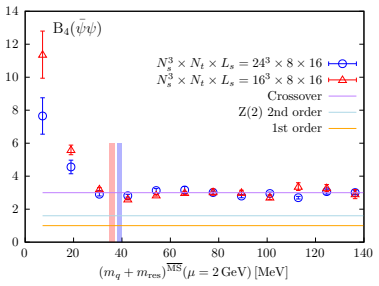
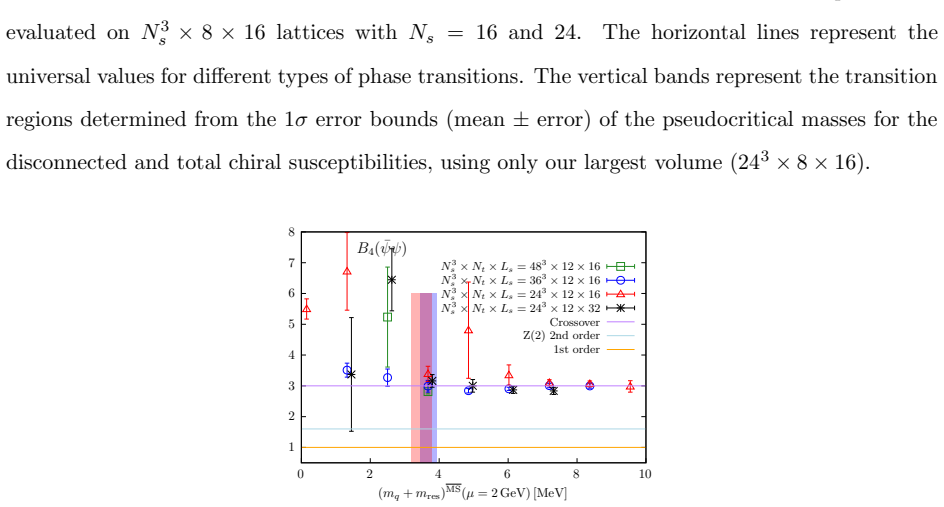
At fixed lattice spacing a ≈ 0.136 fm, corresponding to temperatures 242, 181 and 121 MeV for Nt = 6, 8 and 12, the pseudocritical quark masses are determined to be 184(10) MeV, 36-39 MeV and 3.5-3.7 MeV in the MSbar scheme. The volume dependence of key observables remains weak, and finite-size scaling at Nt=12 shows growth much slower than expected for a true phase transition, establishing that the transition is a continuous crossover at these mass values.
What carries the argument
Finite-size scaling analysis of the Binder cumulant and chiral susceptibilities on volumes with aspect ratios Ns/Nt = 2 to 4.
If this is right
- The transition is a crossover at quark masses as low as a few MeV.
- Residual chiral symmetry breaking effects from finite Ls do not change the crossover nature.
- The pseudocritical masses decrease rapidly with decreasing temperature.
- No first-order transition is observed in the simulated regime.
Where Pith is reading between the lines
- Similar behavior may hold for physical non-degenerate quark masses.
- These results constrain the location of any critical endpoint at finite density.
- Simulations at still larger volumes would further test the scaling.
Load-bearing premise
The spatial volumes used are sufficient to reveal the expected scaling signatures of a first- or second-order transition if one were present.
What would settle it
If the Binder cumulant or susceptibilities at Nt=12 exhibited the volume scaling characteristic of a second-order transition when larger volumes are simulated, that would contradict the crossover interpretation.
Figures




read the original abstract
We investigate the phase transition of Quantum Chromodynamics (QCD) with three degenerate quark flavors at zero baryon chemical potential. Using M\"{o}bius domain-wall fermions as the lattice fermion formulation, we ensure excellent chiral symmetry preservation. Our simulations are performed at three different temporal lattice extents, $N_{t}=6, 8, 12$, with a fixed lattice spacing $a=0.1361(20)$ fm, corresponding to temperatures of 242(4), 181(3), and 121(2) MeV, respectively. We explore a range of quark masses and spatial volumes with aspect ratios $N_{s}/N_{t}$ spanning from 2 to 4. By analyzing the mass and volume dependencies of the plaquette, plaquette susceptibility, chiral condensate, chiral susceptibilities, and Binder cumulant, we identify the pseudocritical transition quark masses from our largest lattice volumes. For $N_t=6$, this is 184(10) MeV (determined from the plaquette susceptibility). For $N_t=8$ and 12, the transition points vary slightly depending on whether the total or disconnected chiral susceptibility is used, yielding ranges of 36(1)-39.1(9) MeV and 3.5(3)-3.7(2) MeV, respectively, in the $\overline{\text{MS}}$ scheme at a scale of $\mu=2$ GeV. The negligible volume dependence at $N_t=6$ and 8, combined with finite-size scaling analysis at $N_t=12$ revealing volume growth significantly weaker than expected for a first- or second-order phase transition, points to a continuous crossover at these specific quark mass points. Additionally, we study the effects of residual chiral symmetry breaking on the chiral condensate and chiral susceptibilities using two different values of $L_s$.
Editorial analysis
A structured set of objections, weighed in public.
Referee Report
Summary. The paper simulates three-flavor QCD with Möbius domain-wall fermions at fixed a=0.1361(20) fm for Nt=6,8,12 (T=242,181,121 MeV), using volumes with Ns/Nt=2–4. It extracts pseudocritical quark masses from plaquette and chiral susceptibilities (184(10) MeV at Nt=6; 36–39 MeV at Nt=8; 3.5–3.7 MeV at Nt=12 in MSbar at 2 GeV) and concludes the transition is a continuous crossover on the basis of negligible volume dependence at Nt=6,8 plus finite-size scaling at Nt=12 that shows volume growth weaker than expected for first- or second-order transitions. Residual chiral symmetry breaking is also examined via two values of Ls.
Significance. If the central claim holds, the work supplies lattice evidence on the order of the three-flavor transition at these masses using a formulation with controlled chiral symmetry. Standard observables (plaquette susceptibility, disconnected/total chiral susceptibilities, Binder cumulant) are employed with reported error bars and finite-size scaling, which are positive features for a numerical study.
major comments (2)
- [Abstract] Abstract and results paragraphs on volume dependence: the claim that finite-size scaling at Nt=12 reveals volume growth 'significantly weaker than expected for a first- or second-order phase transition' rests on Ns/Nt ratios of only 2–4 (largest L=48). No independent estimate of the correlation length ξ is provided, so it remains possible that ξ is already comparable to L near the quoted masses (3.5–3.7 MeV). In that regime both susceptibility peaks and Binder cumulants can appear crossover-like even for a weak first-order transition once finite-volume rounding is taken into account. An explicit consistency check against the first-order scaling limit (peak height ~V, Binder dip depth growing with V) after finite-volume corrections would be required to make the conclusion load-bearing.
- [Results paragraphs on volume dependence] Results paragraphs on volume dependence (Nt=6 and Nt=8): the statement of 'negligible volume dependence' is used to support the crossover interpretation, but the same limitation on aspect ratio (Ns/Nt≤4) applies; without an estimate of ξ/L the observed flatness cannot yet be taken as decisive evidence against a weak first-order scenario.
minor comments (2)
- The distinction between total and disconnected chiral susceptibilities is used to quote ranges of pseudocritical masses at Nt=8 and 12; the precise definitions and any fitting procedures (including autocorrelation handling) should be stated explicitly in the methods or results section for reproducibility.
- The study of residual chiral symmetry breaking via two Ls values is mentioned but its quantitative impact on the extracted susceptibilities and Binder cumulant is not shown in detail; a short table or figure comparing the two Ls would clarify whether this affects the crossover conclusion.
Simulated Author's Rebuttal
We thank the referee for the thorough review and valuable comments on our manuscript. We address the concerns regarding finite-size scaling and volume dependence below, providing clarifications based on our analysis while acknowledging limitations in the current data.
read point-by-point responses
-
Referee: [Abstract] Abstract and results paragraphs on volume dependence: the claim that finite-size scaling at Nt=12 reveals volume growth 'significantly weaker than expected for a first- or second-order phase transition' rests on Ns/Nt ratios of only 2–4 (largest L=48). No independent estimate of the correlation length ξ is provided, so it remains possible that ξ is already comparable to L near the quoted masses (3.5–3.7 MeV). In that regime both susceptibility peaks and Binder cumulants can appear crossover-like even for a weak first-order transition once finite-volume rounding is taken into account. An explicit consistency check against the first-order scaling limit (peak height ~V, Binder dip depth growing with V) after finite-volume corrections would be required to make the conclusion load-bearing.
Authors: We appreciate the referee pointing out the constraints of our aspect ratios (Ns/Nt ≤ 4) and the absence of an independent ξ estimate. Our finite-size scaling at Nt=12 shows susceptibility peak heights increasing far more slowly than linearly with volume, and the Binder cumulant exhibits no volume-dependent deepening of a minimum, which would be required for even a weak first-order transition. These observations across plaquette and chiral observables are inconsistent with first-order scaling expectations even after accounting for possible finite-volume effects. While we agree an explicit ξ/L estimate would strengthen the argument, the multi-observable consistency at the largest volumes supports the crossover conclusion. We will add a dedicated paragraph in the revised manuscript discussing this limitation and why the observed scaling remains incompatible with first-order behavior. revision: partial
-
Referee: [Results paragraphs on volume dependence] Results paragraphs on volume dependence (Nt=6 and Nt=8): the statement of 'negligible volume dependence' is used to support the crossover interpretation, but the same limitation on aspect ratio (Ns/Nt≤4) applies; without an estimate of ξ/L the observed flatness cannot yet be taken as decisive evidence against a weak first-order scenario.
Authors: For Nt=6 and Nt=8 the observed volume independence of the susceptibility peaks and Binder cumulant holds across the full range of available aspect ratios. Although we concur that an ξ/L estimate would allow a more quantitative statement, the lack of any detectable volume growth—combined with the stronger finite-size scaling results at Nt=12—collectively indicates that the transition remains in the crossover regime at these quark masses. We will expand the discussion in the revised manuscript to explicitly note the aspect-ratio limitation and its implications for interpreting the volume independence at these coarser lattices. revision: partial
Circularity Check
No significant circularity: purely numerical lattice results
full rationale
The paper reports direct lattice QCD simulations with Möbius domain-wall fermions at fixed a=0.1361 fm and varying Nt=6,8,12. Conclusions on crossover vs. transition rest on measured volume dependence of plaquette susceptibility, chiral susceptibilities, and Binder cumulant (abstract and results sections). No equations reduce a claimed prediction to a fitted input by construction, no self-citation chains justify uniqueness theorems, and no ansatz is smuggled via prior work. Finite-size scaling is applied to the simulation data itself; the analysis is self-contained against external benchmarks.
Axiom & Free-Parameter Ledger
free parameters (1)
- pseudocritical quark mass
axioms (2)
- domain assumption Möbius domain-wall fermions provide sufficiently small residual chiral symmetry breaking for the observables studied
- domain assumption Finite-size scaling of Binder cumulant and susceptibilities can reliably distinguish crossover from first- or second-order transitions on the volumes used
Reference graph
Works this paper leans on
-
[1]
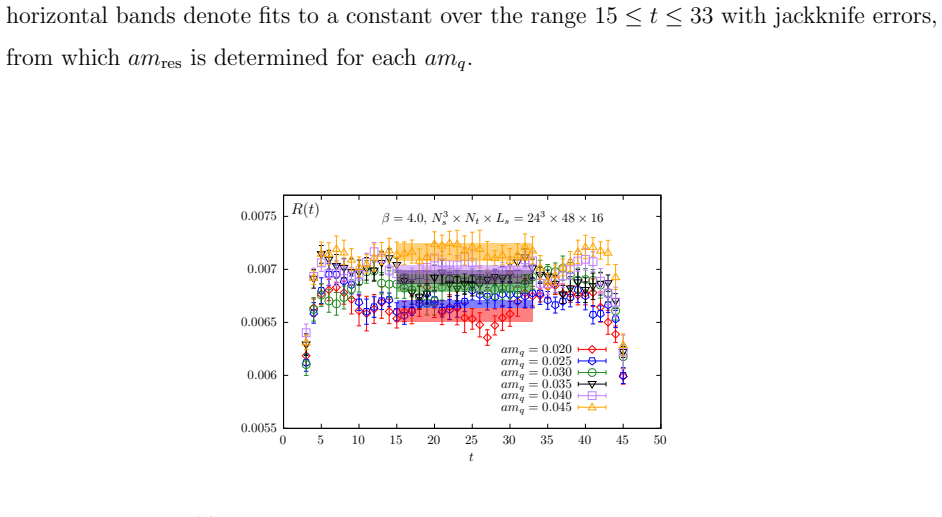
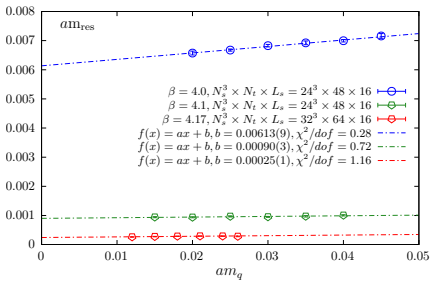
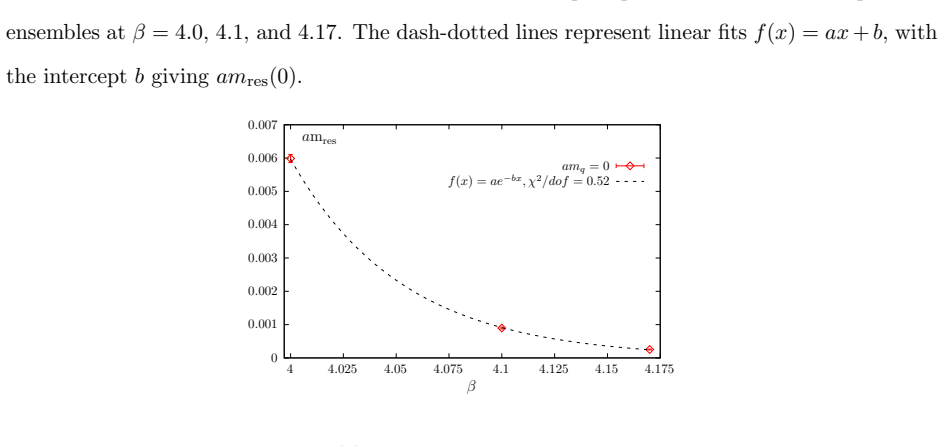
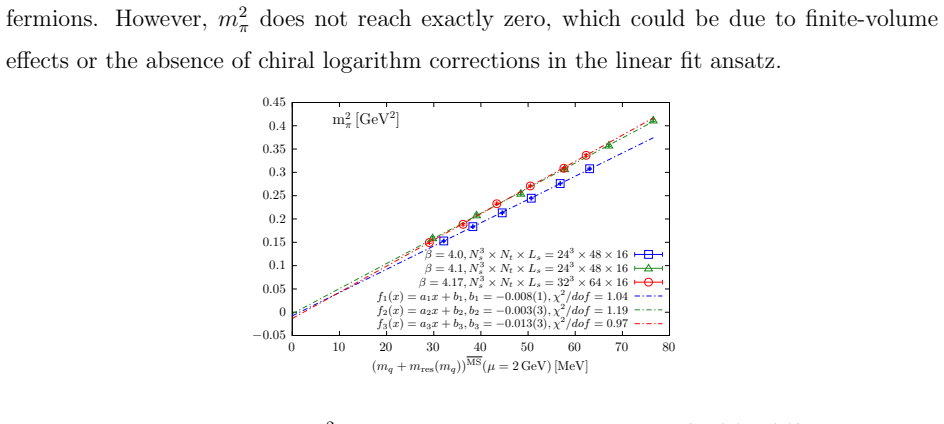
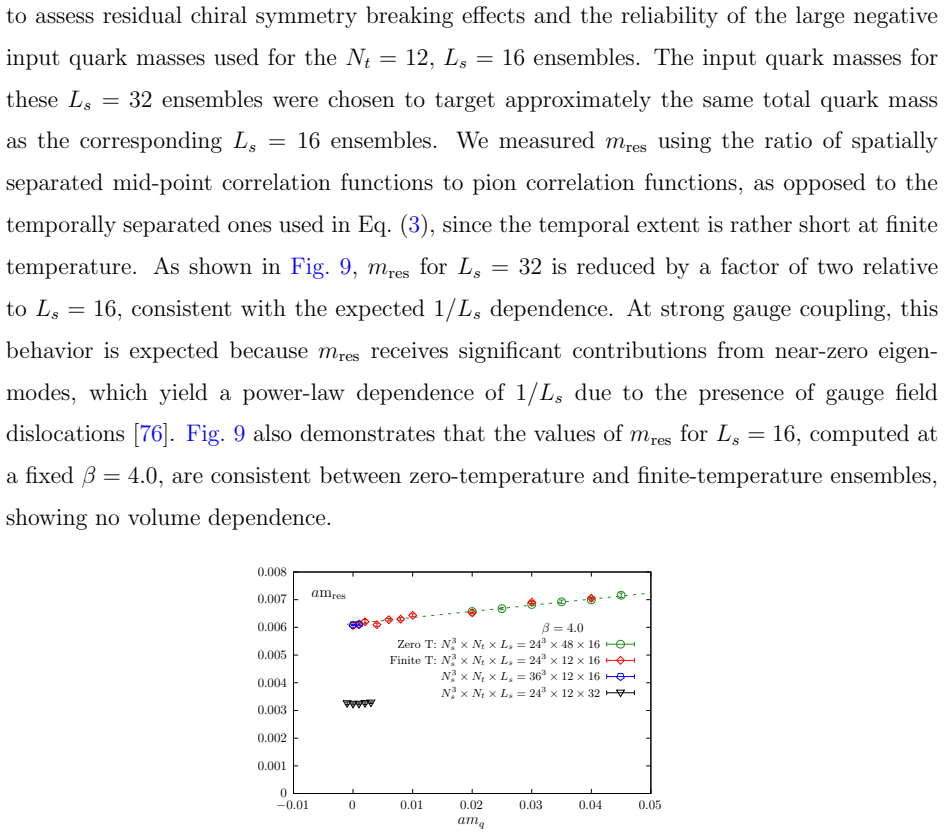
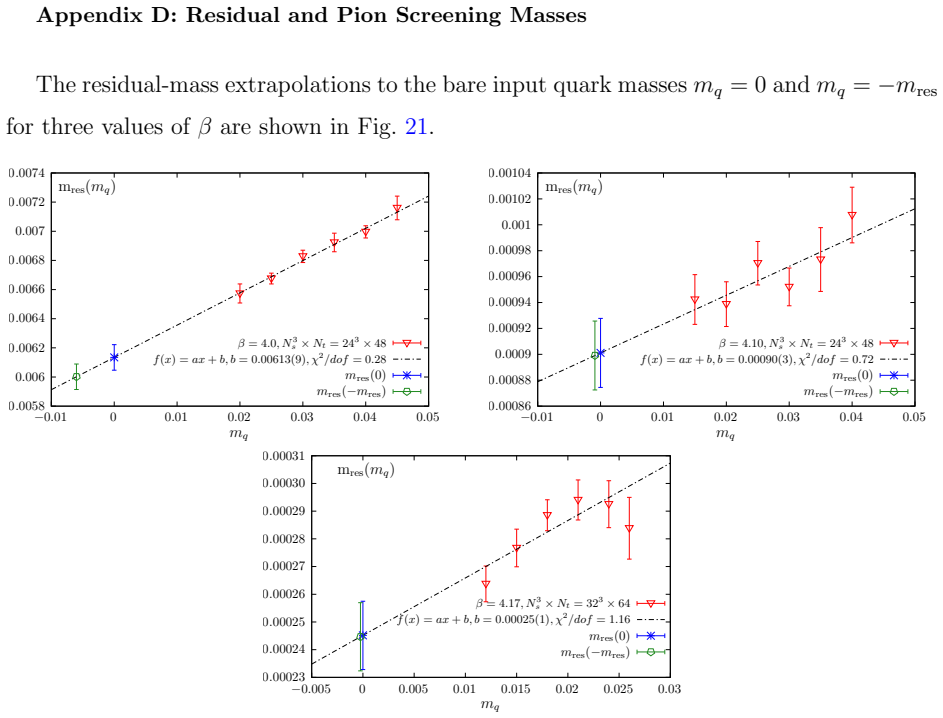
The residual mass To quantify the residual chiral symmetry breaking of M¨ obius domain-wall fermions with finiteL s, we measurem res using the ratioR(t) in Eq. (3). The correlation functions are computed using aZ 2 wall source. The ratioR(t) is shown in Fig. 1 for the zero-temperature 243 ×48×16 ensembles atβ= 4.0 with several different quark masses. In t...
-
[2]
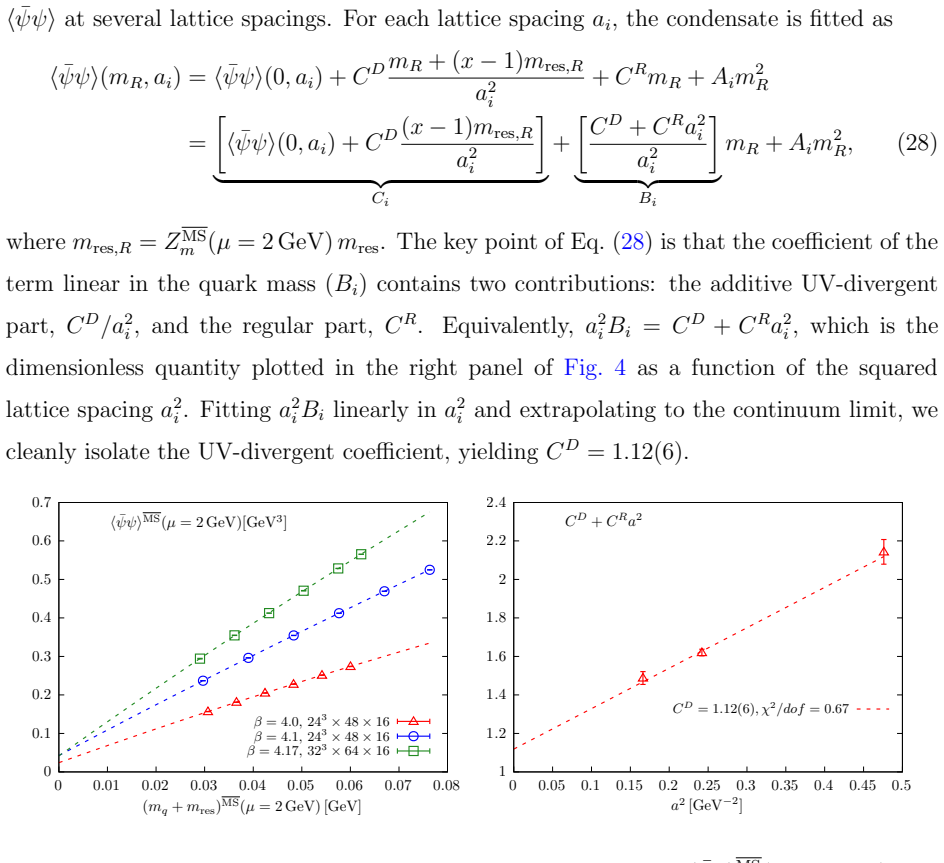
Chiral condensate The left panel of Fig. 4 shows the chiral condensate⟨ ¯ψψ⟩, renormalized in the MS scheme atµ= 2 GeV, as a function of the renormalized quark mass mR ≡(m q +m res)MS(µ= 2 GeV) =Z MS m (µ= 2 GeV) (m q +m res) forβ= 4.0,4.1, and 4.17, with dashed lines showing quadratic fits. Even after multiplica- tive renormalization, the chiral condensa...
-
[3]
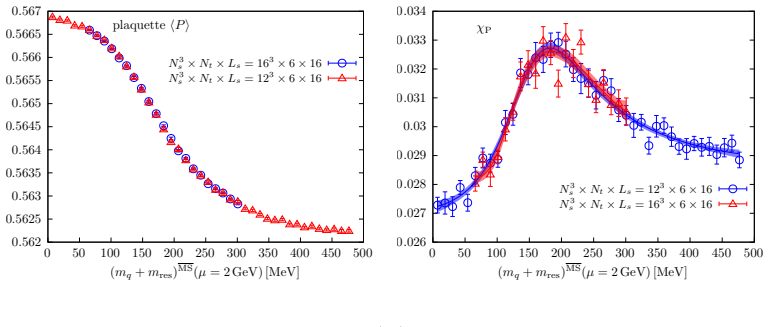
Plaquette and plaquette susceptibility We utilize the plaquette expectation value⟨P⟩and its susceptibilityχ P to determine the transition point. These quantities are defined as follows: ⟨P⟩= 1 6N 3 s Nt X ⃗ x,t X µ<ν 1− 1 3Re TrUµν(⃗ x, t) ,(29) χP =N 3 s Nt ⟨P 2⟩ − ⟨P⟩ 2 .(30) Figure 6 shows the plaquette and its susceptibility plotted as a function of t...
-
[4]
7 depicts the multiplicatively renormalized chiral condensate ⟨ ¯ψψ⟩MS(µ= 2 GeV), without subtracting the additive divergence, as a function of the renormalized quark mass
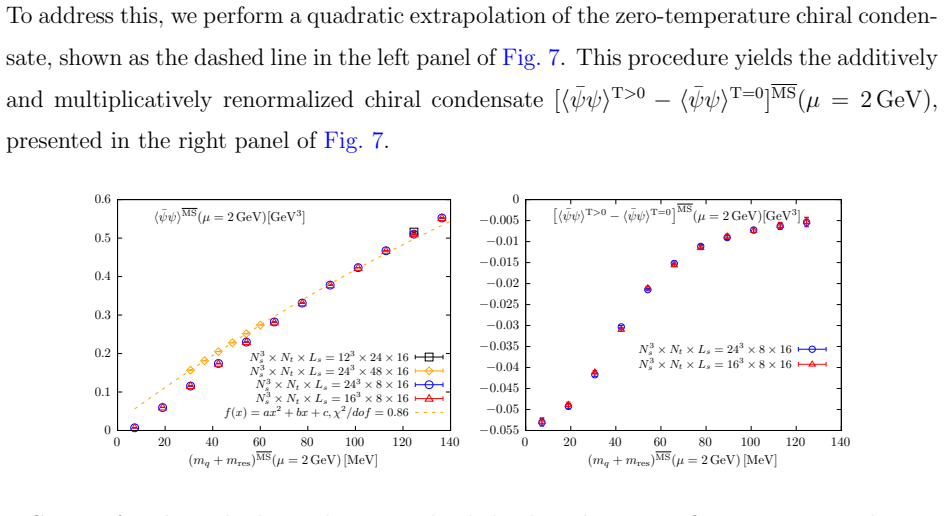
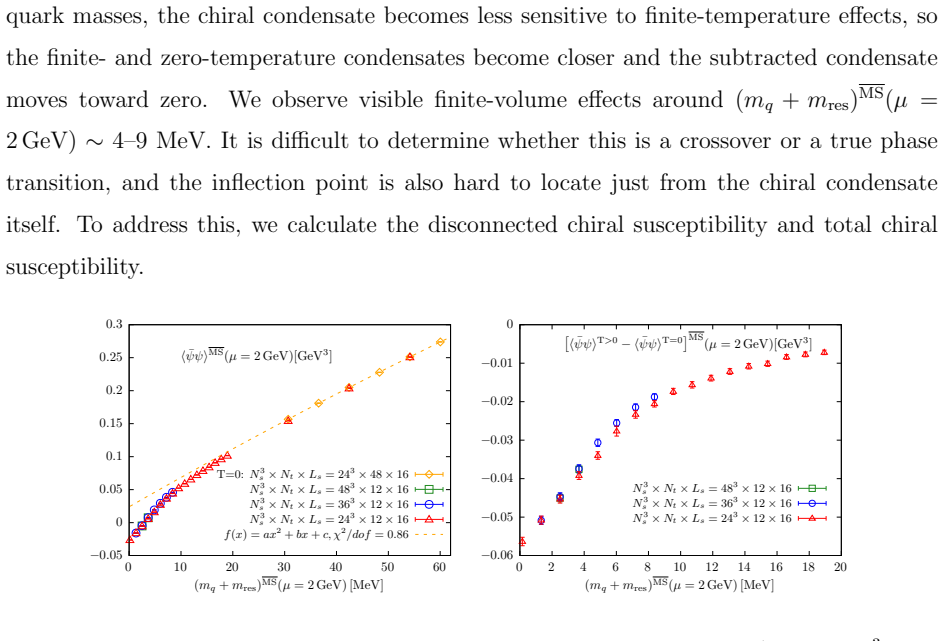
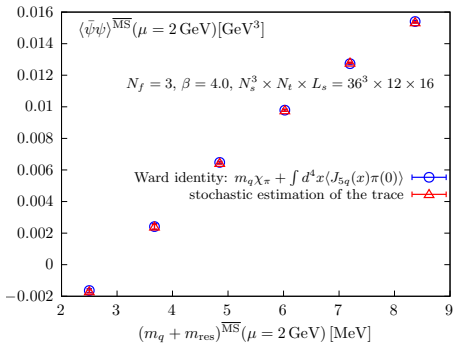
Chiral condensate The left panel of Fig. 7 depicts the multiplicatively renormalized chiral condensate ⟨ ¯ψψ⟩MS(µ= 2 GeV), without subtracting the additive divergence, as a function of the renormalized quark mass. The data are obtained on zero-temperature lattices and finite- temperature lattices withN t = 8, both atβ= 4.0, where the finite-temperature la...
-
[5]
This allows us to estimate the fluctuations of the chiral condensate—in other words, the disconnected chiral susceptibility—in an unbiased way
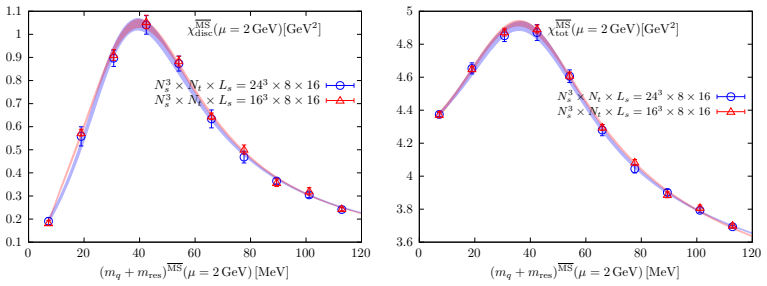
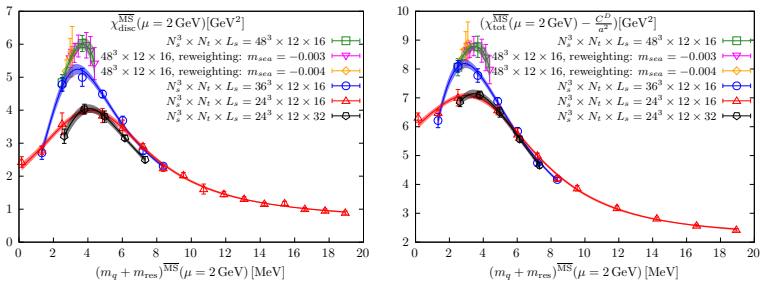
Chiral susceptibility On our finite-temperature lattices, we calculate the chiral condensate using 10 stochastic noise vectors for each gauge configuration. This allows us to estimate the fluctuations of the chiral condensate—in other words, the disconnected chiral susceptibility—in an unbiased way. The left and right panels of Fig. 12 show the renormaliz...
-
[6]
Due to limited computational resources, we simulated only two mass points for 48 3 ×12×16 lattices, positioned near the transition region
Quark mass reweighting Generating gauge configurations with M¨ obius domain-wall fermions is computationally expensive for large volumes and light quark masses. Due to limited computational resources, we simulated only two mass points for 48 3 ×12×16 lattices, positioned near the transition region. To precisely locate the transition point, additional mass...
-
[7]
Strong-interaction matter under extreme conditions
Binder cumulant Examining the distribution of the chiral condensate provides additional evidence for the nature of the phase transition. For example, if the transition were first-order, one would expect the histogram of the chiral condensate to develop a double-peak structure at the transition point. In Fig. 15, we show normalized histograms of the chiral...
2063
-
[8]
Rational approximation For simplicity, we illustrate the reweighting of the rational functions for the case of a single flavor of domain-wall fermions. The pseudofermion action for one flavor, approximated by a rational function, reads Spf =ϕ †D(1)1/4D(mq)−1/2D(1)1/4ϕ(C1) ≈ϕ † a0 + X i ai D(1) +b i ! ˜a0 + X i ˜ai D(mq) + ˜bi ! a0 + X i ai D(1) +b i ! ϕ ,...
-
[9]
Reweighting to correct the rational function For 363 ×12×16 runs, it turned out that the number of terms for the rational function is not large enough. The following numbers come from a run for 36 3 ×12×16 configurations with 12 poles for the rational functions: •the errors are 1.387188049647018×10 −6 (x1/2 andx −1/2), and 9.662807343093718× 10⁻⁷ (x1/4 an...
-
[10]
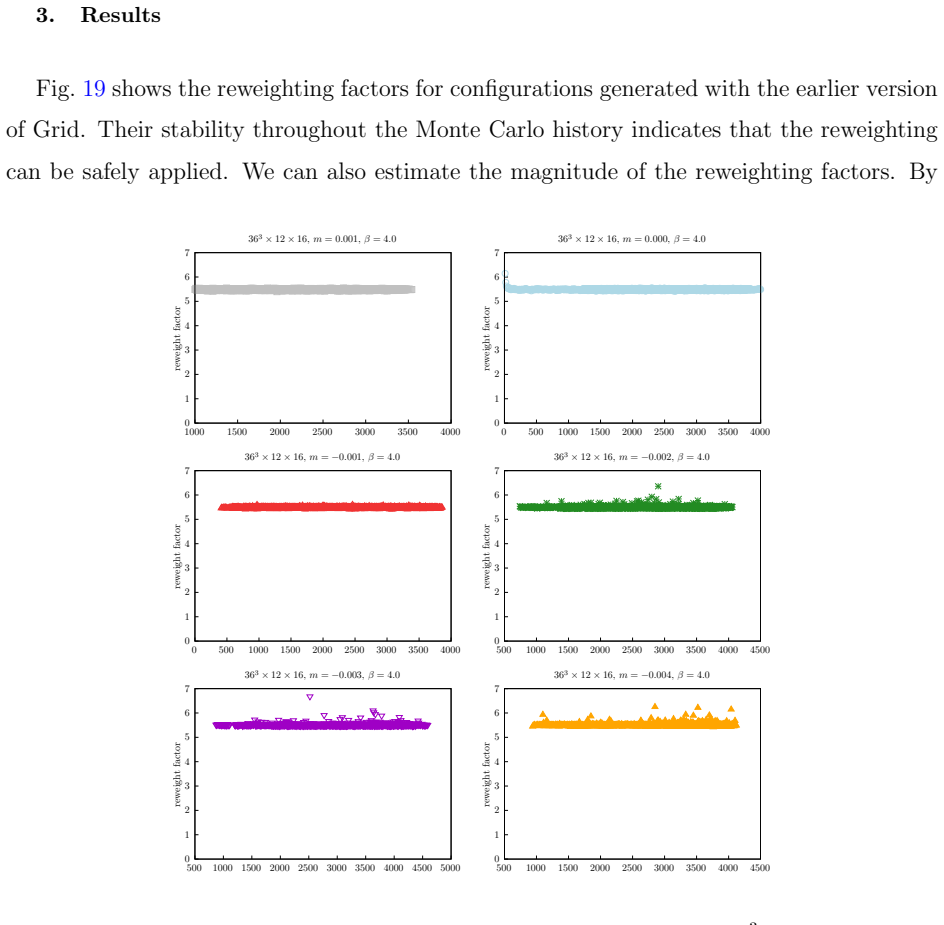
19 shows the reweighting factors for configurations generated with the earlier version of Grid
Results Fig. 19 shows the reweighting factors for configurations generated with the earlier version of Grid. Their stability throughout the Monte Carlo history indicates that the reweighting can be safely applied. We can also estimate the magnitude of the reweighting factors. By 0 1 2 3 4 5 6 7 1000 1500 2000 2500 3000 3500 4000 reweight factor 363 × 12 ×...
2000
-
[11]
F. R. Brown, F. P. Butler, H. Chen, N. H. Christ, Z.-h. Dong, W. Schaffer, L. I. Unger, and A. Vaccarino, Phys. Rev. Lett.65, 2491 (1990)
1990
-
[12]
Y. Aoki, G. Endrodi, Z. Fodor, S. D. Katz, and K. K. Szabo, Nature443, 675 (2006)
2006
-
[13]
The chiral and deconfinement aspects of the QCD transition
A. Bazavov, T. Bhattacharya, M. Cheng, C. DeTar, H. Ding,et al., Phys.Rev.D85, 054503 (2012), arXiv:1111.1710 [hep-lat]
work page internal anchor Pith review Pith/arXiv arXiv 2012
-
[14]
The QCD phase transition with physical-mass, chiral quarks
T. Bhattacharyaet al., Phys. Rev. Lett.113, 082001 (2014), arXiv:1402.5175 [hep-lat]
work page internal anchor Pith review Pith/arXiv arXiv 2014
-
[15]
A. Bazavovet al.(HotQCD), Phys. Lett. B795, 15 (2019), arXiv:1812.08235 [hep-lat]
-
[16]
S. Borsanyi, Z. Fodor, J. N. Guenther, R. Kara, S. D. Katz, P. Parotto, A. Pasztor, C. Ratti, and K. K. Szabo, Phys. Rev. Lett.125, 052001 (2020), arXiv:2002.02821 [hep-lat]
-
[17]
R. D. Pisarski and F. Wilczek, Phys. Rev. D29, 338 (1984)
1984
-
[18]
On the nature of the finite-temperature transition in QCD
A. Butti, A. Pelissetto, and E. Vicari, JHEP08, 029 (2003), arXiv:hep-ph/0307036
work page internal anchor Pith review Pith/arXiv arXiv 2003
-
[19]
Relevance of the axial anomaly at the finite-temperature chiral transition in QCD
A. Pelissetto and E. Vicari, Phys. Rev. D88, 105018 (2013), arXiv:1309.5446 [hep-lat]
work page internal anchor Pith review Pith/arXiv arXiv 2013
-
[20]
U(2)xU(2)-symmetric fixed point from the Functional Renormalization Group
M. Grahl, Phys. Rev.D90, 117904 (2014), arXiv:1410.0985 [hep-th]
work page internal anchor Pith review Pith/arXiv arXiv 2014
-
[21]
H. Ohno, U. Heller, F. Karsch, and S. Mukherjee, PoSLA TTICE2012, 095 (2012), arXiv:1211.2591 [hep-lat]
work page internal anchor Pith review Pith/arXiv arXiv 2012
-
[22]
The chiral transition and U(1)_A symmetry restoration from lattice QCD using Domain Wall Fermions
A. Bazavovet al.(HotQCD), Phys. Rev. D86, 094503 (2012), arXiv:1205.3535 [hep-lat]
work page internal anchor Pith review Pith/arXiv arXiv 2012
-
[23]
Finite temperature study of the axial U(1) symmetry on the lattice with overlap fermion formulation
G. Cossu, S. Aoki, H. Fukaya, S. Hashimoto, T. Kaneko,et al., Phys.Rev.D87, 114514 (2013), arXiv:1304.6145 [hep-lat]
work page internal anchor Pith review Pith/arXiv arXiv 2013
-
[24]
Chiral symmetry and axial U(1) symmetry in finite temperature QCD with domain-wall fermion
T.-W. Chiu, W.-P. Chen, Y.-C. Chen, H.-Y. Chou, and T.-H. Hsieh (TWQCD), PoSLA T- TICE2013, 165 (2014), arXiv:1311.6220 [hep-lat]
work page internal anchor Pith review Pith/arXiv arXiv 2014
-
[25]
V. Dick, F. Karsch, E. Laermann, S. Mukherjee, and S. Sharma, Phys. Rev.D91, 094504 (2015), arXiv:1502.06190 [hep-lat]
work page internal anchor Pith review Pith/arXiv arXiv 2015
-
[26]
Evidence of effective axial U(1) symmetry restoration at high temperature QCD
A. Tomiya, G. Cossu, S. Aoki, H. Fukaya, S. Hashimoto, T. Kaneko, and J. Noaki, Phys. Rev. D96, 034509 (2017), [Addendum: Phys.Rev.D 96, 079902 (2017)], arXiv:1612.01908 [hep-lat]
work page internal anchor Pith review Pith/arXiv arXiv 2017
-
[27]
B. B. Brandt, A. Francis, H. B. Meyer, O. Philipsen, D. Robaina, and H. Wittig, JHEP12, 158 (2016), arXiv:1608.06882 [hep-lat]
work page internal anchor Pith review Pith/arXiv arXiv 2016
- [28]
- [29]
- [30]
- [31]
-
[32]
O. Kaczmarek, L. Mazur, and S. Sharma, Phys. Rev. D104, 094518 (2021), arXiv:2102.06136 [hep-lat]
- [33]
- [34]
- [35]
-
[36]
O. Kaczmarek, R. Shanker, and S. Sharma, Phys. Rev. D108, 094501 (2023), arXiv:2301.11610 [hep-lat]
- [37]
-
[38]
Lattice determination of the critical point of QCD at finite T and \mu
Z. Fodor and S. D. Katz, JHEP03, 014 (2002), arXiv:hep-lat/0106002
work page internal anchor Pith review Pith/arXiv arXiv 2002
-
[39]
Critical point of QCD at finite T and \mu, lattice results for physical quark masses
Z. Fodor and S. Katz, JHEP0404, 050 (2004), arXiv:hep-lat/0402006 [hep-lat]
work page internal anchor Pith review Pith/arXiv arXiv 2004
-
[40]
The chiral critical line of N_f=2+1 QCD at zero and non-zero baryon density
P. de Forcrand and O. Philipsen, JHEP01, 077 (2007), arXiv:hep-lat/0607017 [hep-lat]
work page internal anchor Pith review Pith/arXiv arXiv 2007
-
[41]
S. Datta, R. V. Gavai, and S. Gupta, Phys. Rev. D95, 054512 (2017), arXiv:1612.06673 [hep-lat]
work page internal anchor Pith review Pith/arXiv arXiv 2017
-
[42]
The QCD Equation of State to $\mathcal{O}(\mu_B^6)$ from Lattice QCD
A. Bazavovet al., Phys. Rev. D95, 054504 (2017), arXiv:1701.04325 [hep-lat]
work page internal anchor Pith review Pith/arXiv arXiv 2017
-
[43]
A. Bazavovet al.(HotQCD), Phys. Rev. D96, 074510 (2017), arXiv:1708.04897 [hep-lat]
work page internal anchor Pith review Pith/arXiv arXiv 2017
-
[44]
M. Abdulhamidet al.(STAR), Phys. Rev. Lett.130, 202301 (2023), arXiv:2209.08058 [nucl- ex]
-
[45]
Mass sensitivity of the three-flavor chiral phase transition
S. Resch, F. Rennecke, and B.-J. Schaefer, Phys. Rev. D99, 076005 (2019), arXiv:1712.07961 [hep-ph]
work page internal anchor Pith review Pith/arXiv arXiv 2019
-
[46]
G. Fejos, Phys. Rev. D105, L071506 (2022), arXiv:2201.07909 [hep-ph]
-
[47]
G. Fejos and T. Hatsuda, Phys. Rev. D110, 016021 (2024), arXiv:2404.00554 [hep-ph]. 50
- [48]
- [49]
-
[50]
F. Giacosa, G. Kov´ acs, P. Kov´ acs, R. D. Pisarski, and F. Rennecke, Phys. Rev. D111, 016014 (2025), arXiv:2410.08185 [hep-ph]
-
[51]
J. Bernhardt and C. S. Fischer, Phys. Rev. D108, 114018 (2023), arXiv:2309.06737 [hep-ph]
-
[52]
Phase structure of lattice QCD at finite temperature for 2+1 flavors of Kogut-Susskind quarks
S. Aokiet al.(JLQCD), Nucl. Phys. B Proc. Suppl.73, 459 (1999), arXiv:hep-lat/9809102
work page internal anchor Pith review Pith/arXiv arXiv 1999
-
[53]
X. Liao,Lattice field theory. Proceedings, 19th International Symposium, Lattice 2001, Berlin, Germany, August 19-24, 2001, Nucl. Phys. Proc. Suppl.106, 426 (2002), arXiv:hep- lat/0111013 [hep-lat]
- [54]
-
[55]
The QCD Phase Diagram for Three Degenerate Flavors and Small Baryon Density
P. de Forcrand and O. Philipsen, Nucl. Phys. B673, 170 (2003), arXiv:hep-lat/0307020
work page internal anchor Pith review Pith/arXiv arXiv 2003
-
[56]
Y. Iwasaki, K. Kanaya, S. Sakai, and T. Yoshie, Z. Phys.C71, 337 (1996), arXiv:hep- lat/9504019 [hep-lat]
-
[57]
X.-Y. Jin, Y. Kuramashi, Y. Nakamura, S. Takeda, and A. Ukawa, Phys. Rev. D91, 014508 (2015), arXiv:1411.7461 [hep-lat]
work page internal anchor Pith review Pith/arXiv arXiv 2015
-
[58]
Where is the chiral critical point in 3-flavor QCD?
F. Karsch, C. Allton, S. Ejiri, S. Hands, O. Kaczmarek,et al., Nucl.Phys.Proc.Suppl.129, 614 (2004), arXiv:hep-lat/0309116 [hep-lat]
work page internal anchor Pith review Pith/arXiv arXiv 2004
-
[59]
A QCD chiral critical point at small chemical potential: is it there or not?
P. de Forcrand, S. Kim, and O. Philipsen, PoSLA TTICE2007, 178 (2007), arXiv:0711.0262 [hep-lat]
work page internal anchor Pith review Pith/arXiv arXiv 2007
-
[60]
The nature of the finite temperature QCD transition as a function of the quark masses
G. Endrodi, Z. Fodor, S. D. Katz, and K. K. Szabo, PoSLA TTICE2007, 182 (2007), arXiv:0710.0998 [hep-lat]
work page internal anchor Pith review Pith/arXiv arXiv 2007
-
[61]
H.-T. Ding, A. Bazavov, P. Hegde, F. Karsch, S. Mukherjee,et al., PoSLA TTICE2011, 191 (2011), arXiv:1111.0185 [hep-lat]
work page internal anchor Pith review Pith/arXiv arXiv 2011
-
[62]
Varnhorst, PoSLA TTICE2014, 193 (2015)
L. Varnhorst, PoSLA TTICE2014, 193 (2015)
2015
-
[63]
Chiral phase structure of three flavor QCD at vanishing baryon number density
A. Bazavov, H. T. Ding, P. Hegde, F. Karsch, E. Laermann, S. Mukherjee, P. Petreczky, and C. Schmidt, Phys. Rev. D95, 074505 (2017), arXiv:1701.03548 [hep-lat]
work page internal anchor Pith review Pith/arXiv arXiv 2017
-
[64]
X.-Y. Jin, Y. Kuramashi, Y. Nakamura, S. Takeda, and A. Ukawa, Phys. Rev. D96, 034523 (2017), arXiv:1706.01178 [hep-lat]
work page internal anchor Pith review Pith/arXiv arXiv 2017
-
[65]
Y. Kuramashi, Y. Nakamura, H. Ohno, and S. Takeda, Phys. Rev. D101, 054509 (2020), 51 arXiv:2001.04398 [hep-lat]
-
[66]
Continuum limit and universality of the Columbia plot
P. de Forcrand and M. D’Elia,Proceedings, 34th International Symposium on Lattice Field Theory (Lattice 2016): Southampton, UK, July 24-30, 2016, PoSLA TTICE2016, 081 (2017), arXiv:1702.00330 [hep-lat]
work page internal anchor Pith review Pith/arXiv arXiv 2016
- [67]
- [68]
- [69]
-
[70]
R. C. Brower, H. Neff, and K. Orginos, Comput. Phys. Commun.220, 1 (2017), arXiv:1206.5214 [hep-lat]
work page internal anchor Pith review Pith/arXiv arXiv 2017
-
[71]
Nakamura, Y
Y. Nakamura, Y. Aoki, S. Hashimoto, I. Kanamori, T. Kaneko, and Y. Zhang, PoSLA T- TICE2021, 080 (2022)
2022
- [72]
- [73]
- [74]
-
[75]
D. J. Antonioet al.(RBC, UKQCD), Phys. Rev. D75, 114501 (2007), arXiv:hep-lat/0612005
work page internal anchor Pith review Pith/arXiv arXiv 2007
-
[76]
2+1 flavor domain wall QCD on a (2 fm)^3 lattice: light meson spectroscopy with Ls = 16
C. Alltonet al.(RBC, UKQCD), Phys. Rev. D76, 014504 (2007), arXiv:hep-lat/0701013
work page internal anchor Pith review Pith/arXiv arXiv 2007
-
[77]
S. R. Sharpe, inWorkshop on Domain Wall Fermions at Ten Years(2007) arXiv:0706.0218 [hep-lat]
work page internal anchor Pith review Pith/arXiv arXiv 2007
-
[78]
K. G. Chetyrkin and A. Retey, Nucl. Phys. B583, 3 (2000), arXiv:hep-ph/9910332
work page internal anchor Pith review Pith/arXiv arXiv 2000
-
[79]
Binder, Zeitschrift f¨ ur Physik B Condensed Matter43, 119 (1981)
K. Binder, Zeitschrift f¨ ur Physik B Condensed Matter43, 119 (1981)
1981
-
[80]
Alternatives to the stochastic "noise vector" approach
P. de Forcrand and B. Jager,Proceedings, 35th International Symposium on Lattice Field Theory (Lattice 2017): Granada, Spain, June 18-24, 2017, EPJ Web Conf.175, 14022 (2018), arXiv:1710.07305 [hep-lat]
work page internal anchor Pith review Pith/arXiv arXiv 2017
discussion (0)
Sign in with ORCID, Apple, or X to comment. Anyone can read and Pith papers without signing in.