REVIEW 2 major objections 6 minor 107 references
Spectral properties of the neutron star low-mass X-ray binary 4U 1636-53, XTE J1739-285 and MAXI J1816-195
T0 review · 2 major / 6 minor · reviewed 2026-08-10 · deepseek-v4-flash
Pith's one-line read In hard-state neutron-star X-ray binaries, over half of the star's seed photons feed a corona just 2–3 Rg out.
desk verdict Useful first l-theta diagram for NS LMXBs and a stable cover-fraction asymmetry, but the compactness conclusion rests on an untested R=10 Rg assumption and the small-corona evidence is partly circular. read the letter →
The pith
A machine-rendered reading of the paper's core claim, the machinery that carries it, and where it could break.
The reading
What carries the argument
The argument rests on two coupled modeling tools. The first is the relativistic reflection model family relxill, specifically relxillCp and relxilllpCp — where 'lp' denotes a lamp-post geometry with the corona as a point source at height $h$ above the compact object — together with relxillns for a disk illuminated by the neutron-star blackbody, and the thermal Comptonization component thcomp, whose fractional coverage parameter $f_{\rm cov}$ measures what fraction of the seed photons (from the neutron star or the disk) are intercepted by the corona. The second is the compactness–temperature ($\ell$–$\theta$) diagram, in which $\ell = 4\pi (m_{\rm p}/m_{\rm e})(R_g/R)(L/L_{\rm Edd})$ measures the radiation compactness of the corona and $\theta = kT_{\rm e}/m_{\rm e} c^2$ its electron temperature; the paper computes $\ell$ assuming a corona radius $R = 10 R_g$ and compares the points with pair-production runaway limits for slab, hemisphere, and spherical geometries. The small fitted $h$ and the large $f_{\rm cov}$ for neutron-star seed photons locate the corona near the star, and the position of the points relative to the pair-production forbidden region supports the not-pair-dominated conclusion.
What would settle it
Measure the actual size of the corona in one of these systems, for instance from the energy-dependent time delay between continuum and reflected photons (reverberation), and recompute the compactness with that radius. If the radius is close to the fitted lamp-post height of 2–3 $R_g$, the points would move into or near the pair-production forbidden region, which would falsify the claim that neutron-star coronae are not pair-dominated; if the measured radius is near 10 $R_g$, the paper's placement holds.
Extended reading notes
Core claim
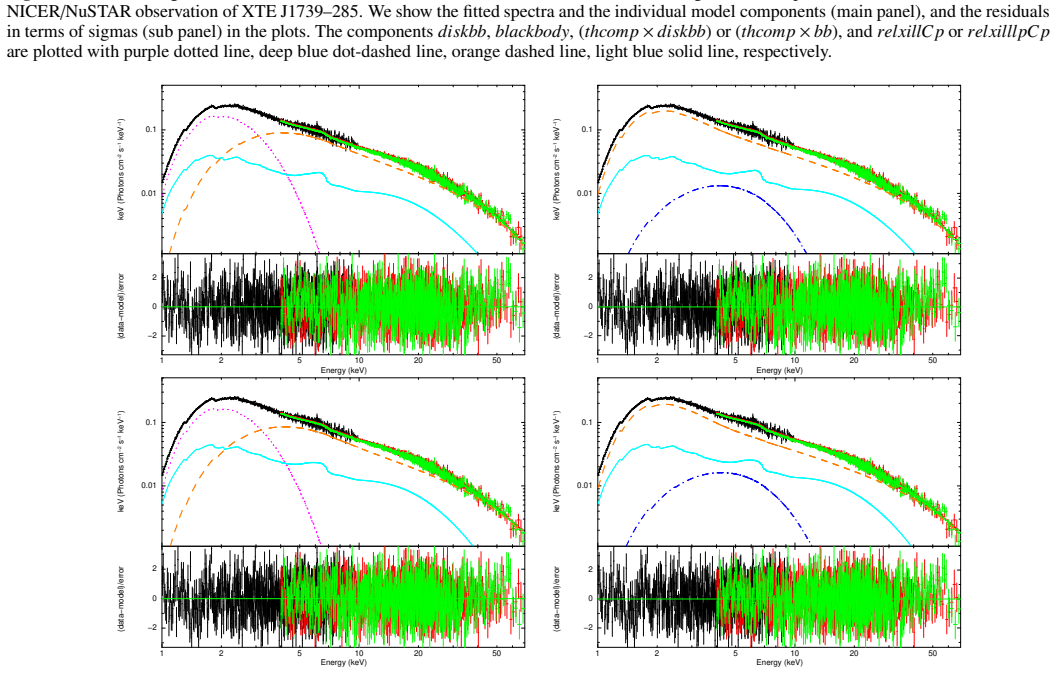
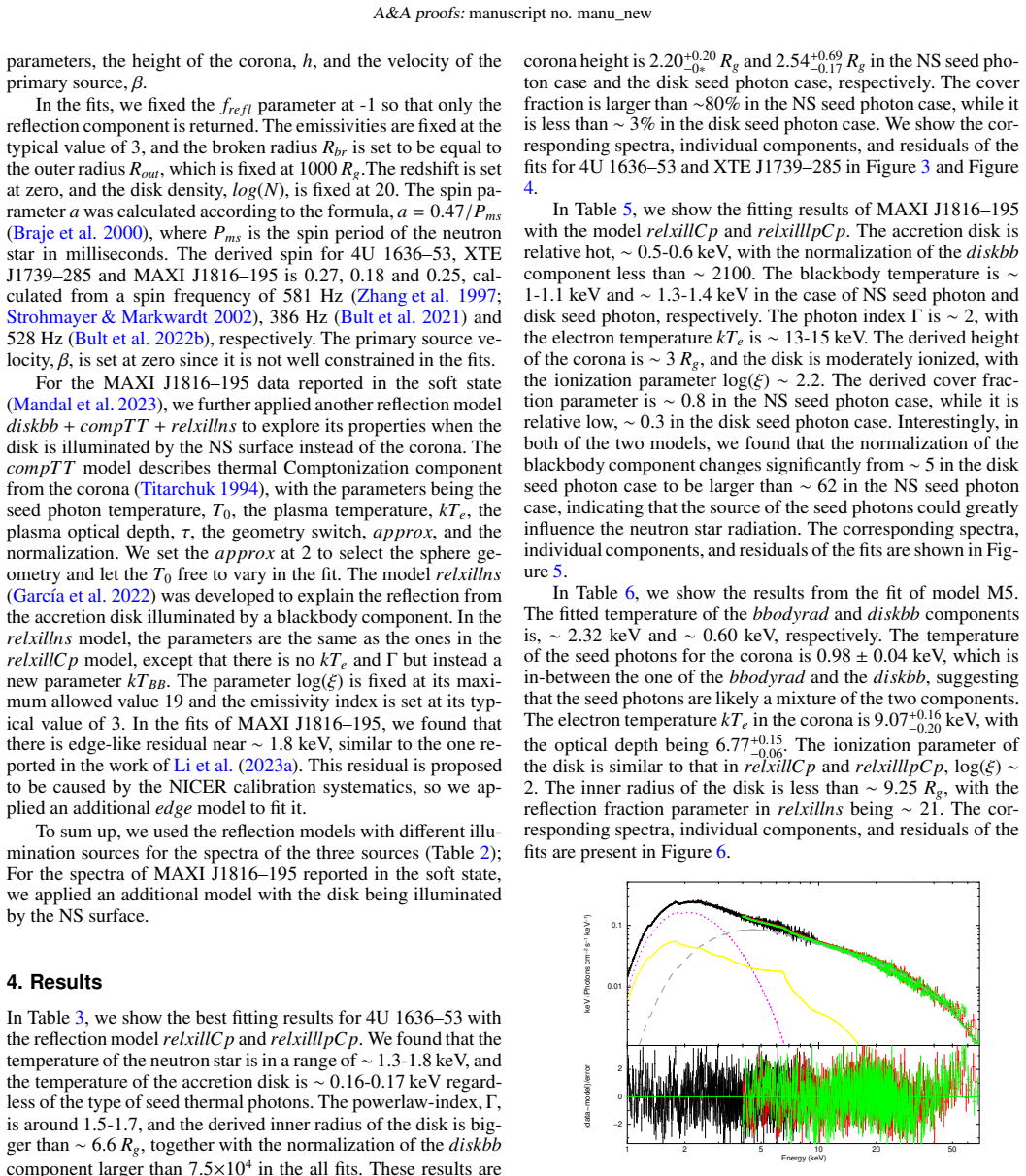
The central discovery is that choosing the seed-photon source changes the inferred corona and neutron-star emission in a way that pins the corona close to the star. In the hard-state sources 4U 1636–53 and XTE J1739–285, the fractional coverage parameter $f_{\rm cov}$ is larger than about 0.5 when the seed photons come from the neutron star but only about 0.03–0.05 when they come from the disk; for MAXI J1816–195 the values are about 0.8 and 0.3, respectively. The lamp-post height $h$ is small, roughly 2–3 $R_g$, and the boundary-layer radius estimated from the accretion rate is comparable, supporting a compact corona near the stellar surface. The paper further claims, from the first $\ell$–$\theta$ diagram assembled for neutron star LMXBs, that all nine systems lie to the left of the pair-production runaway line, so the coronae are not pair-dominated; the preferred explanation is extra cooling by neutron star surface photons, with a hybrid thermal/non-thermal corona as the alternative. A corollary is that the seed-photon source strongly affects how significant the neutron-star blackbody appears, which the authors use to explain why the neutron-star radiation in MAXI J1816–195 looked weak in earlier work.
Load-bearing premise
The load-bearing premise is that every corona is 10 gravitational radii across when computing the compactness; if a corona is as small as the fitted height of 2–3 gravitational radii, the same data points shift several-fold toward the pair-production boundary, and the paper does not test that shift.
Editorial extensions
If this is right
- For hard-state neutron star LMXBs, a corona within a few gravitational radii of the star means the boundary layer or a jet-base lamp-post should dominate the hard X-ray emission, and reflection models of the disk must include neutron-star illumination alongside coronal illumination.
- Because the inferred size of the neutron star's emitting region depends on which seed-photon source is assumed, identifying that source is a prerequisite for measuring blackbody-emitting areas on the neutron star surface.
- Neutron-star seed photons provide additional cooling that keeps the corona far from pair production, giving a physical reason why neutron-star LMXB coronae differ from some black-hole binary coronae in the compactness diagram.
- For MAXI J1816–195, the low electron temperature, small inner disk radius, and relatively high blackbody temperature together place the source in a soft or transitional state rather than the typical hard state of accreting millisecond X-ray pulsars.
Reading between the lines
- Editorial inference: the paper computes the compactness with a corona radius of $10 R_g$ for all sources; if the corona is as compact as the fitted height of $2$–$3 R_g$, then $\ell$ is larger by a factor of roughly 3–5, shifting the points rightward and potentially toward the pair-production boundary, a sensitivity the paper does not test.
- Editorial inference: if neutron-star seed photons cool the corona, then sources with brighter neutron-star blackbody emission should sit further from the pair-production line; this correlation could be tested by expanding the sample.
- Editorial inference: applying the same seed-photon-aware reflection models to higher-resolution spectra from upcoming X-ray missions could break the degeneracy between a static lamp-post and a rotating boundary-layer corona, for example through iron-line reverberation.
Editorial analysis
A structured set of objections, weighed in public.
Referee Report
Summary. The paper analyzes simultaneous NICER and NuSTAR spectra of three neutron star low-mass X-ray binaries (4U 1636-53, XTE J1739-285, MAXI J1816-195) using reflection models with seed photons supplied either by the neutron star or by the accretion disk. It reports that in the hard spectral state the thcomp cover fraction is high (~50-80%) when the seed photons originate from the NS and low (~3-5%) when they originate from the disk, that the fitted lamp-post height is small (~2-3 Rg), and that the inferred NS blackbody normalization depends strongly on the seed-photon assumption. It also presents, for the first time, a compactness-temperature diagram for nine NS LMXBs, concluding that their coronae all lie to the left of the pair-production forbidden region and are therefore not pair-dominated, possibly because of cooling by NS seed photons, or alternatively contain hybrid thermal/non-thermal electrons.
Significance. If established, the cover-fraction asymmetry would provide a useful observational constraint on the location and geometry of the corona in NS LMXBs, and the compactness diagram would be a novel extension of a tool previously applied mainly to AGN and BH binaries. The data reduction and spectral fitting are generally careful: the fits are statistically acceptable (reduced chi-square 1.02-1.24), the model comparison is clearly presented in Tables 3-6, and Appendix A provides a welcome consistency check using the nthratio correction, which confirms the fcov results. However, the headline compactness conclusion rests on an unvaried assumption about the corona radius that the paper's own fitted scales call into question, and the interpretation of the fitted lamp-post height as independent geometric evidence is partly circular. These issues must be addressed before the central claims can be accepted.
major comments (2)
- [Section 5.2 and Tables 3-5] The compactness is computed as l = 4*pi*(mp/me)*(Rg/R)*(L/LE) with the corona radius R fixed to 10 Rg for all nine sources. This is not a harmless convention for NS LMXBs: the same paper fits lamp-post heights h = 2.2-3.0 Rg for the three new sources (Tables 3-5) and estimates boundary-layer radii of ~5-7 Rg (Section 5.1). Since l scales as 1/R, adopting R = 3 Rg would increase l by a factor ~3.3 (about 0.5 dex) for the three new sources, and the literature point for 4U 1636-53 with Ecut = 135.9 keV (theta ~0.13) would move substantially toward or into the pair-production forbidden region. The paper presents no sensitivity analysis, no error bars on Figure 7, and no physical justification for choosing 10 Rg in NS systems. Because the claim that all nine NS systems lie safely to the left of the forbidden region is the load-bearing support for the 'not pair-dominated' and 'additional cooling from NS photons' interpretation, this assumption must be tested against the smaller scales inferred in this work before that conclusion can be accepted.
- [Section 5.2 and Tables 3-5] The small corona height h is a fitted parameter of relxilllpCp, a model that already assumes a lamp-post point-source geometry. Using this fitted height as independent evidence favoring the lamp-post geometry or a boundary-layer scenario is partly circular: the model cannot distinguish a point source at height h from an alternative extended geometry, and the boundary-layer scenario is not directly described by relxilllpCp at all. The cover-fraction result from thcomp already supports a compact corona close to the neutron star without this geometric prior; the h value should be presented as a model-dependent scale, not as an independent confirmation. A comparison with an extended-corona or slab reflection model, or an explicit statement of this limitation, would remove the circularity concern.
minor comments (6)
- [Figure 7] No error bars are shown on the l and theta values in Figure 7; given the uncertainties in distances, fluxes, and kTe/Ecut listed in Table 7, error bars are essential for judging whether points are indeed 'safely' left of the forbidden region.
- [Figure 7 caption] The conversion theta = Ecut/(2 mec^2) for sources without a fitted kTe is model-dependent; the relation between Ecut and kTe depends on the Comptonization model used in the original references. The authors should justify this factor or use a consistent model-dependent conversion.
- [Table 7] The literature sample mixes total unabsorbed fluxes with power-law fluxes and uses approximate distances (some marked with *); this heterogeneity should be stated more prominently in Section 5.3, since it directly affects the computed l values.
- [Abstract] The statement that 'more than ~50% of the NS photons enter into the corona' refers to the fitted thcomp parameter fcov; the abstract should explicitly note that this is a model-dependent cover fraction, not a direct measurement.
- [Conclusion] Item (2) of the Conclusion says the corona height is '~3 Rg', while the fits give 2.2-3.0 Rg across the three sources; the range should be quoted consistently.
- [Throughout] There are several typographical issues, including 'bina ry' in the title, 'di erent' for 'different', and 'in the all fits' for 'in all fits'; these should be corrected during revision.
Circularity Check
No significant circularity: the reported cover fractions and corona heights are fitted parameters presented as fit results, and the compactness diagram is an application of an external formalism; the untested R=10 Rg assumption is a robustness caveat, not a circular reduction.
full rationale
The cover-fraction claim ('more than ~50% of the NS photons enter into the corona') restates the thcomp parameter fcov, but this is a spectral-fit result reported as such, not a quantity derived from a separate first-principles input; no subset fitting or forced identity is involved. The corona height h ~2-3 Rg is a free parameter in relxilllpCp; the model assumes a lamp-post geometry but does not force h to be small, so using the small fitted h as evidence for a compact corona is model-dependent interpretation rather than self-definition. The l-theta compactness diagram is an application of the external Fabian et al. (2015) formalism to nine sources, with R=10 Rg explicitly assumed. The paper's own fitted h ~2-3 Rg and boundary-layer radii ~5-7 Rg imply that a sensitivity test with smaller R is needed, and the 'left of the forbidden region' conclusion is not shown to be robust to that choice; however, this is an unexamined assumption, not a circular step. Self-citations (García et al. 2022; Lyu et al. 2023) introduce model codes used as tools; they are not invoked as uniqueness theorems or to forbid alternative geometries. No equation reduces to its own input by construction, so no circular step is exhibited.
Assumptions & free parameters
free parameters (6)
- thcomp cover fraction fcov =
0.79 to 1.00 (NS seed) and 0.03 to 0.30 (disk seed) across Tables 3 to 5
- Corona height h in relxilllpCp =
2.20 to 2.54 Rg for 4U 1636-53 and XTE J1739-285, 2.99 Rg for MAXI J1816-195
- Electron temperature kTe =
9 to 40 keV across fits
- Corona luminosity L =
Derived from model normalization and unabsorbed flux in 0.1 to 100 keV
- Assumed corona radius R in compactness diagram =
10 Rg by hand
- Fixed spectral parameters =
q=3, Rbr=Rout=1000 Rg, log(N)=20, spin from a=0.47/Pms
assumptions (6)
- domain assumption relxill, relxilllp, and relxillns reflection models accurately describe disk reflection in NS LMXBs.
- domain assumption Seed photons can be cleanly separated into a pure NS blackbody and a pure disk blackbody.
- domain assumption The thcomp fcov parameter is a direct geometric measure of the fraction of seed photons intercepted by the corona.
- domain assumption The lamp-post geometry in relxilllpCp is a valid description of the corona in these sources.
- domain assumption The pair-production runaway lines of Stern et al. (1995) apply to NS coronae.
- domain assumption Distances and bolometric flux conversions taken from the literature are accurate.
Cite this review
Pith. "Pith review of Spectral properties of the neutron star low-mass X-ray binary 4U 1636-53, XTE J1739-285 and MAXI J1816-195." pith.science (2026). https://pith.science/paper/BQOUTDB5
@misc{pith2026250114272,
  author       = {Pith},
  title        = {Pith review of: Spectral properties of the neutron star low-mass X-ray binary 4U 1636-53, XTE J1739-285 and MAXI J1816-195},
  year         = {2026},
  howpublished = {\url{https://pith.science/paper/BQOUTDB5}},
  note         = {Machine review of arXiv:2501.14272}
}
abstract
We investigated simultaneous NICER plus NuSTAR observations of three neutron star low-mass X-ray binary 4U 1636-53, XTE J1739-285 and MAXI J1816-195 using the latest reflection models, with the seed photons feeding into the corona originating from either the neutron star (NS) or the accretion disk. We found that, for the sources in the hard spectral state, more than $\sim$ 50% of the NS photons enter into the corona if NS provides seed photons, while only $\sim$ 3%-5% disk photons go to the corona if seed photons come from the disk. This finding, together with the derived small height of the corona, favors the lamp-post geometry or boundary layer scenario where the corona is close to the central neutron star. Additionally, we found that the source of the seed photons has big influence in the significance of the NS radiation, especially for the soft spectral state. This result may help explain why the NS radiation in MAXI J1816-195 is weak in the previous work. More importantly, for the first time, we explored the properties of the corona in the NS systems with the compactness ($l-\theta$) diagram. We found that the corona in the NS systems all lie in the left side of the pair-production forbidden region, away from the predicted pair-production lines. This finding indicates that either the corona in these NS systems is not pair-dominated, possibly due to the additional cooling from NS photons, or the corona is composed of both thermal and non-thermal electrons.
Figures


Figures from the paper (4 more)


Reference graph
Works this paper leans on
-
[1]
, " * write output.state after.block = add.period write newline
ENTRY address archiveprefix author booktitle chapter edition editor howpublished institution eprint journal key month note number organization pages publisher school series title type volume year label extra.label sort.label short.list INTEGERS output.state before.all mid.sentence after.sentence after.block FUNCTION init.state.consts #0 'before.all := #1 ...
-
[2]
write newline
" write newline "" before.all 'output.state := FUNCTION n.dashify 't := "" t empty not t #1 #1 substring "-" = t #1 #2 substring "--" = not "--" * t #2 global.max substring 't := t #1 #1 substring "-" = "-" * t #2 global.max substring 't := while if t #1 #1 substring * t #2 global.max substring 't := if while FUNCTION word.in bbl.in " " * FUNCTION format....
-
[3]
2008, , 685, 436
Altamirano , D., van der Klis , M., M \'e ndez , M., et al. 2008, , 685, 436
2008
-
[4]
Bailer-Jones , C. A. L., Rybizki , J., Fouesneau , M., Mantelet , G., & Andrae , R. 2018, , 156, 58
2018
-
[5]
2007, , 379, 247
Belloni , T., Homan , J., Motta , S., Ratti , E., & M \'e ndez , M. 2007, , 379, 247
2007
-
[6]
Beloborodov , A. M. 1999, , 510, L123
1999
-
[7]
2022, , 662, A98
Bertola , E., Vignali , C., Lanzuisi , G., et al. 2022, , 662, A98
2022
-
[8]
Bilous , A. V. & Watts , A. L. 2019, , 245, 19
2019
Show all 107 references
-
[9]
M., Romani , R
Braje , T. M., Romani , R. W., & Rauch , K. P. 2000, , 531, 447
2000
-
[10]
2021, , 907, 79
Bult , P., Altamirano , D., Arzoumanian , Z., et al. 2021, , 907, 79
2021
-
[11]
2022 a , , 935, L32
Bult , P., Altamirano , D., Arzoumanian , Z., et al. 2022 a , , 935, L32
2022
-
[12]
M., Ng , M., Iwakiri , W., et al
Bult , P. M., Ng , M., Iwakiri , W., et al. 2022 b , The Astronomer's Telegram, 15425, 1
2022
-
[13]
M., Altamirano , D., Patruno , A., et al
Cackett , E. M., Altamirano , D., Patruno , A., et al. 2009, , 694, L21
2009
-
[14]
M., Miller , J
Cackett , E. M., Miller , J. M., Ballantyne , D. R., et al. 2010, , 720, 205
2010
-
[15]
2022, , 936, L21
Chen , Y.-P., Zhang , S., Ji , L., et al. 2022, , 936, L21
2022
-
[16]
2010, , 516, A36
D'A \` , A., di Salvo , T., Ballantyne , D., et al. 2010, , 516, A36
2010
-
[17]
2016, Astronomische Nachrichten, 337, 362
Dauser , T., Garc \' a , J., & Wilms , J. 2016, Astronomische Nachrichten, 337, 362
2016
-
[18]
2013, , 430, 1694
Dauser , T., Garcia , J., Wilms , J., et al. 2013, , 430, 1694
2013
-
[19]
S., & Brenneman , L
Dauser , T., Wilms , J., Reynolds , C. S., & Brenneman , L. W. 2010, , 409, 1534
2010
-
[20]
& Sanna , A
Di Salvo , T. & Sanna , A. 2022, in Astrophysics and Space Science Library, Vol. 465, Astrophysics and Space Science Library, ed. S. Bhattacharyya , A. Papitto , & D. Bhattacharya , 87--124
2022
-
[21]
2019, , 483, 767
Di Salvo , T., Sanna , A., Burderi , L., et al. 2019, , 483, 767
2019
-
[22]
D., Vaughan , S., Lefkir , M., & Wynn , G
Dias , S. D., Vaughan , S., Lefkir , M., & Wynn , G. 2024, , 529, 1752
2024
-
[23]
& Gierli \'n ski , M
Done , C. & Gierli \'n ski , M. 2003, , 342, 1041
2003
-
[24]
2007, , 15, 1
Done , C., Gierli \'n ski , M., & Kubota , A. 2007, , 15, 1
2007
-
[25]
C., Lohfink , A., Belmont , R., Malzac , J., & Coppi , P
Fabian , A. C., Lohfink , A., Belmont , R., Malzac , J., & Coppi , P. 2017, , 467, 2566
2017
-
[26]
C., Lohfink , A., Kara , E., et al
Fabian , A. C., Lohfink , A., Kara , E., et al. 2015, , 451, 4375
2015
-
[27]
O., Henri , G., Saug \'e , L., & Pelletier , G
Ferreira , J., Petrucci , P. O., Henri , G., Saug \'e , L., & Pelletier , G. 2006, , 447, 813
2006
-
[28]
K., Muno , M
Galloway , D. K., Muno , M. P., Hartman , J. M., Psaltis , D., & Chakrabarty , D. 2008, , 179, 360
2008
-
[29]
K., Psaltis , D., Chakrabarty , D., & Muno , M
Galloway , D. K., Psaltis , D., Chakrabarty , D., & Muno , M. P. 2003, , 590, 999
2003
-
[30]
K., Psaltis , D., Muno , M
Galloway , D. K., Psaltis , D., Muno , M. P., & Chakrabarty , D. 2006, , 639, 1033
2006
-
[31]
2014, , 782, 76
Garc \' a , J., Dauser , T., Lohfink , A., et al. 2014, , 782, 76
2014
-
[32]
S., et al
Garc \' a , J., Dauser , T., Reynolds , C. S., et al. 2013, , 768, 146
2013
-
[33]
& Kallman , T
Garc \' a , J. & Kallman , T. R. 2010, , 718, 695
2010
-
[34]
A., Dauser , T., Ludlam , R., et al
Garc \' a , J. A., Dauser , T., Ludlam , R., et al. 2022, , 926, 13
2022
-
[35]
C., Arzoumanian , Z., Adkins , P
Gendreau , K. C., Arzoumanian , Z., Adkins , P. W., et al. 2016, in Society of Photo-Optical Instrumentation Engineers (SPIE) Conference Series, Vol. 9905, Space Telescopes and Instrumentation 2016: Ultraviolet to Gamma Ray, ed. J.-W. A. den Herder , T. Takahashi , & M. Bautz , 99051H
2016
-
[36]
& Poutanen , J
Gierli \'n ski , M. & Poutanen , J. 2005, , 359, 1261
2005
-
[37]
T., Gudennavar , S
Giridharan , L., Thomas , N. T., Gudennavar , S. B., & Bubbly , S. G. 2024, , 527, 11855
2024
-
[38]
W., Fabian , A
Guilbert , P. W., Fabian , A. C., & Rees , M. J. 1983, , 205, 593
1983
-
[39]
1994, , 432, L95
Haardt , F., Maraschi , L., & Ghisellini , G. 1994, , 432, L95
1994
-
[40]
A., Craig , W
Harrison , F. A., Craig , W. W., Christensen , F. E., et al. 2013, , 770, 103
2013
-
[41]
Heger , A., Cumming , A., & Woosley , S. E. 2007, , 665, 1311
2007
-
[42]
Hinkle , J. T. & Mushotzky , R. 2021, , 506, 4960
2021
-
[43]
Inogamov , N. A. & Sunyaev , R. A. 1999, Astronomy Letters, 25, 269
1999
-
[44]
Kaaret , P., Prieskorn , Z., in 't Zand , J. J. M., et al. 2007, , 657, L97
2007
-
[45]
A., et al
Kamraj , N., Brightman , M., Harrison , F. A., et al. 2022, , 927, 42
2022
-
[46]
& Wang , J.-X
Kang , J.-L. & Wang , J.-X. 2022, , 929, 141
2022
-
[47]
2021, , 502, 80
Kang , J.-L., Wang , J.-X., & Kang , W.-Y. 2021, , 502, 80
2021
-
[48]
2023, , 958, 79
Kargaltsev , O., Hare , J., Volkov , I., & Lange , A. 2023, , 958, 79
2023
-
[49]
L., Lohfink , A., & Kara , E
King , A. L., Lohfink , A., & Kara , E. 2017, , 835, 226
2017
-
[50]
Lewin , W. H. G., van Paradijs , J., & Taam , R. E. 1993, , 62, 223
1993
-
[51]
P., Tao , L., Zhang , L., et al
Li , P. P., Tao , L., Zhang , L., et al. 2023 a , , 525, 595
2023
-
[52]
2023 b , , 958, 177
Li , Z., Kuiper , L., Ge , M., et al. 2023 b , , 958, 177
2023
-
[53]
M., & Lovelace , R
Long , M., Romanova , M. M., & Lovelace , R. V. E. 2005, , 634, 1214
2005
-
[54]
M., Cackett , E
Ludlam , R. M., Cackett , E. M., Garc \' a , J. A., et al. 2020, , 895, 45
2020
-
[55]
M., Cackett , E
Ludlam , R. M., Cackett , E. M., Garc \' a , J. A., et al. 2022, , 927, 112
2022
-
[56]
M., Miller , J
Ludlam , R. M., Miller , J. M., Barret , D., et al. 2019, , 873, 99
2019
-
[57]
M., Miller , J
Ludlam , R. M., Miller , J. M., Cackett , E. M., et al. 2016, , 824, 37
2016
-
[58]
M., Miller , J
Ludlam , R. M., Miller , J. M., Degenaar , N., et al. 2017, , 847, 135
2017
-
[59]
2014, , 440, 1165
Lyu , M., M \'e ndez , M., Sanna , A., et al. 2014, , 440, 1165
2014
-
[60]
2015, , 454, 541
Lyu , M., M \'e ndez , M., Zhang , G., & Keek , L. 2015, , 454, 541
2015
-
[61]
2019, , 484, 3434
Lyu , M., M \'e ndez , M., Zhang , J.-F., & Xiang , F.-Y. 2019, , 484, 3434
2019
-
[62]
B., Wang , H
Lyu , M., Zhang , G. B., Wang , H. G., & Garc \' a , F. 2023, , 677, A156
2023
-
[63]
K., Grefenstette , B
Madsen , K. K., Grefenstette , B. W., Pike , S., et al. 2020, arXiv e-prints, arXiv:2005.00569
2020 arXiv
-
[64]
1986, , 308, 635
Makishima , K., Maejima , Y., Mitsuda , K., et al. 1986, , 308, 635
1986
-
[65]
2023, , 521, 881
Mandal , M., Pal , S., Chauhan , J., Lohfink , A., & Bharali , P. 2023, , 521, 881
2023
-
[66]
M., et al
Marino , A., Anitra , A., Mazzola , S. M., et al. 2022, , 515, 3838
2022
-
[67]
2001, , 372, L25
Markoff , S., Falcke , H., & Fender , R. 2001, , 372, L25
2001
-
[68]
A., & Wilms , J
Markoff , S., Nowak , M. A., & Wilms , J. 2005, , 635, 1203
2005
-
[69]
1984, , 36, 741
Mitsuda , K., Inoue , H., Koyama , K., et al. 1984, , 36, 741
1984
-
[70]
S., Dewangan , G
Mondal , A. S., Dewangan , G. C., & Raychaudhuri , B. 2019, , 487, 5441
2019
-
[71]
S., Raychaudhuri , B., & Dewangan , G
Mondal , A. S., Raychaudhuri , B., & Dewangan , G. C. 2021, , 504, 1331
2021
-
[72]
S., Raychaudhuri , B., Dewangan , G
Mondal , A. S., Raychaudhuri , B., Dewangan , G. C., & Beri , A. 2022, , 516, 1256
2022
-
[73]
2015, , 452, 3994
Mukherjee , D., Bult , P., van der Klis , M., & Bhattacharya , D. 2015, , 452, 3994
2015
-
[74]
& McClintock , J
Narayan , R. & McClintock , J. E. 2008, , 51, 733
2008
-
[75]
2022, The Astronomer's Telegram, 15418, 1
Negoro , H., Serino , M., Iwakiri , W., et al. 2022, The Astronomer's Telegram, 15418, 1
2022
-
[76]
2016, , 457, 2988
Pintore , F., Sanna , A., Di Salvo , T., et al. 2016, , 457, 2988
2016
-
[77]
& Sunyaev , R
Popham , R. & Sunyaev , R. 2001, , 547, 355
2001
-
[78]
& Paul , B
Rai , B. & Paul , B. C. 2019, , 489, 5858
2019
-
[79]
N., Braito , V., Porquet , D., et al
Reeves , J. N., Braito , V., Porquet , D., et al. 2021, , 500, 1974
2021
-
[80]
A., Loewenstein , M., Steiner , J
Remillard , R. A., Loewenstein , M., Steiner , J. F., et al. 2022, , 163, 130
2022
-
[81]
2001, , 372, 138
Revnivtsev , M., Churazov , E., Gilfanov , M., & Sunyaev , R. 2001, , 372, 138
2001
-
[82]
A., Garc \' a , F., Fogantini , F
Saavedra , E. A., Garc \' a , F., Fogantini , F. A., et al. 2023, , 522, 3367
2023
-
[83]
2022, , 516, L76
Sanna , A., Bult , P., Ng , M., et al. 2022, , 516, L76
2022
-
[84]
2013, , 432, 1144
Sanna , A., Hiemstra , B., M \'e ndez , M., et al. 2013, , 432, 1144
2013
-
[85]
2017, , 466, 2910
Sanna , A., Pintore , F., Bozzo , E., et al. 2017, , 466, 2910
2017
-
[86]
2018, , 481, 1658
Sanna , A., Pintore , F., Riggio , A., et al. 2018, , 481, 1658
2018
-
[87]
2020, , 496, 197
Sharma , P., Sharma , R., Jain , C., & Dutta , A. 2020, , 496, 197
2020
-
[88]
C., Bird , A
Shih , I. C., Bird , A. J., Charles , P. A., Cornelisse , R., & Tiramani , D. 2005, , 361, 602
2005
-
[89]
E., Poutanen , J., Svensson , R., Sikora , M., & Begelman , M
Stern , B. E., Poutanen , J., Svensson , R., Sikora , M., & Begelman , M. C. 1995, , 449, L13
1995
-
[90]
& Bildsten , L
Strohmayer , T. & Bildsten , L. 2006, in Compact stellar X-ray sources, Vol. 39, 113--156
2006
-
[91]
Strohmayer , T. E. 1999, , 523, L51
1999
-
[92]
Strohmayer , T. E. & Markwardt , C. B. 2002, , 577, 337
2002
-
[93]
Syunyaev , R. A. & Shakura , N. I. 1986, Soviet Astronomy Letters, 12, 117
1986
-
[94]
Tauris , T. M. & van den Heuvel , E. P. J. 2006, in Compact stellar X-ray sources, Vol. 39, 623--665
2006
-
[95]
T., Gudennavar , S
Thomas , N. T., Gudennavar , S. B., & Bubbly , S. G. 2023, , 525, 2355
2023
-
[96]
Thompson , T. W. J., Rothschild , R. E., Tomsick , J. A., & Marshall , H. L. 2005, , 634, 1261
2005
-
[97]
1994, , 434, 570
Titarchuk , L. 1994, , 434, 570
1994
-
[98]
2022, , 509, 3599
Tortosa , A., Ricci , C., Tombesi , F., et al. 2022, , 509, 3599
2022
-
[99]
1990, , 234, 181
van Paradijs , J., van der Klis , M., van Amerongen , S., et al. 1990, , 234, 181
1990
-
[100]
A., Ferland , G
Verner , D. A., Ferland , G. J., Korista , K. T., & Yakovlev , D. G. 1996, , 465, 487
1996
-
[101]
M., Casella , P., Borghese , A., et al
Vincentelli , F. M., Casella , P., Borghese , A., et al. 2023, , 525, 2509
2023
-
[102]
Wang , Y., M \'e ndez , M., Sanna , A., Altamirano , D., & Belloni , T. M. 2017, , 468, 2256
2017
-
[103]
Wilkins , D. R. 2018, , 475, 748
2018
-
[104]
2000, , 542, 914
Wilms , J., Allen , A., & McCray , R. 2000, , 542, 914
2000
-
[105]
A., De Marco , B., Szanecki , M., Nied \'z wiecki , A., & Markowitz , A
Zdziarski , A. A., De Marco , B., Szanecki , M., Nied \'z wiecki , A., & Markowitz , A. 2021, , 906, 69
2021
-
[106]
A., Szanecki , M., Poutanen , J., Gierli \'n ski , M., & Biernacki , P
Zdziarski , A. A., Szanecki , M., Poutanen , J., Gierli \'n ski , M., & Biernacki , P. 2020, , 492, 5234
2020
-
[107]
H., White , N
Zhang , W., Lapidus , I., Swank , J. H., White , N. E., & Titarchuk , L. 1997, , 6541, 1
1997
Reviewed August 10, 2026 · model on record in the stance chip above.
Discussion (0). Continue with ORCID to comment.