Massless Islands in Wedge Holography
Pith reviewed 2026-06-28 18:41 UTC · model grok-4.3
The pith
A defect CFT at the wedge corner supplies an auxiliary entropy term that stabilizes massless islands without ghosts.
A machine-rendered reading of the paper's core claim, the machinery that carries it, and where it could break.
Core claim
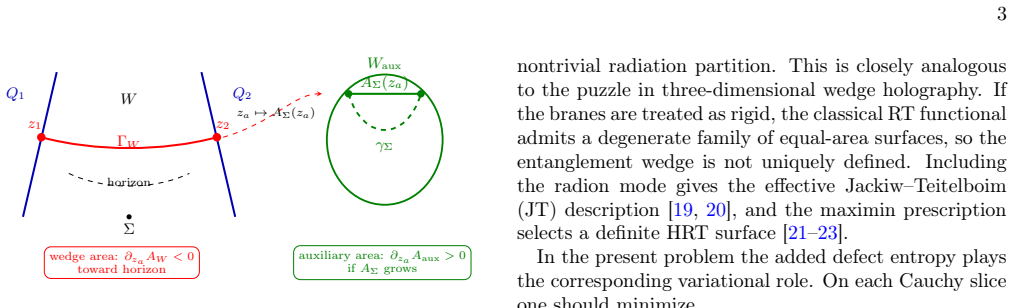
When the wedge endpoint position determines the defect entangling region, the auxiliary area can have the opposite variation to the wedge area while all couplings and central charges remain positive. The quantum extremality condition then replaces the pure orthogonality condition and allows a non-horizon island saddle in a long-range, massless, ghost-free gravitational theory.
What carries the argument
The auxiliary bulk Ryu-Takayanagi surface that computes the entropy of the additional defect CFT localized at the codimension-two corner.
If this is right
- The quantum extremality condition replaces orthogonality and permits a non-horizon island saddle.
- A local endpoint model exhibits an isolated stable saddle.
- This saddle dominates over the Hartman-Maldacena surface at late times.
- All couplings and central charges remain positive with no ghosts introduced.
Where Pith is reading between the lines
- Corner-localized CFTs may supply balancing entropy terms in other brane or wedge setups with massless modes.
- The same auxiliary-surface construction could be checked for stability when the defect is dynamical rather than fixed.
- Explicit calculations in concrete defect CFTs would test whether the opposing variation holds beyond the local model.
- The approach suggests examining whether similar corner sectors resolve island obstructions in non-holographic massless gravity models.
Load-bearing premise
The defect theory is holographic so its entropy is given by an auxiliary surface whose area variation opposes the wedge area when the wedge endpoint sets the defect region, while couplings and central charges stay positive.
What would settle it
An explicit computation of the auxiliary surface area as a function of the wedge endpoint in the local model, checking whether its variation opposes the wedge area and produces a stable saddle that dominates late times.
Figures

read the original abstract
Entanglement islands are usually easiest to realize in doubly holographic models with massive gravitons or non-gravitating baths. In wedge holography, by contrast, Neumann boundary conditions on both branes give a normalizable massless graviton, but the island saddle of the purely geometric Ryu-Takayanagi problem collapses to the horizon. Negative Dvali-Gabadadze-Porrati (DGP) terms can restore nontrivial islands by changing the endpoint condition of the extremal surface, but this branch contains a massive ghost. We propose a different, manifestly healthy mechanism. We keep the wedge gravitational action free of DGP terms and add a unitary defect conformal field theory localized at the codimension-two corner. This sector is distinct from the standard corner CFT dual to the undeformed wedge, whose entropy is already represented by the wedge RT area; hence no double counting is involved. The entropy of this additional defect sector contributes to the generalized entropy. If the defect theory is holographic, this entropy is computed by an auxiliary bulk Ryu-Takayanagi surface. We show that when the wedge endpoint position determines the defect entangling region, the auxiliary area can have the opposite variation to the wedge area while all couplings and central charges remain positive. A local endpoint model exhibits an isolated stable saddle and its late-time dominance over the Hartman-Maldacena surface. The quantum extremality condition then replaces the pure orthogonality condition and allows a non-horizon island saddle in a long-range, massless, ghost-free gravitational theory. This demonstrates that the obstruction to massless islands in minimal wedge holography is not masslessness itself, but the absence of an additional healthy entropy term capable of balancing the horizon-minimizing area variation.
Editorial analysis
A structured set of objections, weighed in public.
Referee Report
Summary. The manuscript proposes realizing entanglement islands in wedge holography with a massless graviton by introducing an additional unitary defect CFT localized at the codimension-two corner, distinct from the standard corner CFT. The entropy of this defect sector is computed via an auxiliary holographic RT surface; when the wedge endpoint determines the defect entangling region, the auxiliary area variation opposes the wedge area while couplings and central charges remain positive. This replaces the orthogonality condition with quantum extremality, yielding a stable non-horizon island saddle that dominates at late times over the Hartman-Maldacena surface in a ghost-free theory.
Significance. If the explicit calculations confirm the opposite variation and stable saddle, the result would demonstrate that massless islands are possible in healthy long-range gravity by supplying an additional balancing entropy term, rather than requiring massive gravitons or DGP terms. This addresses a key obstruction in minimal wedge holography and provides a concrete, falsifiable construction using a holographic defect sector.
major comments (1)
- [Abstract and local endpoint model] Abstract and the section describing the local endpoint model: the central claim that the auxiliary area has opposite variation to the wedge area (while keeping all couplings and central charges positive) is load-bearing for the proposal, yet the provided description states the result without explicit computation of the variations, the endpoint mapping, or the resulting quantum extremality condition; the manuscript must supply these derivations to substantiate the claim.
minor comments (1)
- Clarify with a diagram or explicit notation how the auxiliary bulk for the defect CFT is embedded relative to the wedge without introducing new gravitational degrees of freedom.
Simulated Author's Rebuttal
We thank the referee for their detailed review and for highlighting the need for explicit derivations to support the central claim. We agree that the manuscript requires additional calculations to substantiate the opposite variation of the auxiliary area and the resulting quantum extremality condition. We will revise the paper to include these derivations in the local endpoint model section.
read point-by-point responses
-
Referee: [Abstract and local endpoint model] Abstract and the section describing the local endpoint model: the central claim that the auxiliary area has opposite variation to the wedge area (while keeping all couplings and central charges positive) is load-bearing for the proposal, yet the provided description states the result without explicit computation of the variations, the endpoint mapping, or the resulting quantum extremality condition; the manuscript must supply these derivations to substantiate the claim.
Authors: We agree that the load-bearing claim requires explicit support. In the revised manuscript we will add the full computation of the auxiliary-area and wedge-area variations with respect to the endpoint position, the explicit mapping between the wedge endpoint and the defect entangling region, and the derivation of the quantum extremality condition that replaces the orthogonality condition. These additions will be placed in the local endpoint model section (and referenced from the abstract) while preserving the positivity of all couplings and central charges. revision: yes
Circularity Check
No significant circularity in the derivation chain
full rationale
The paper presents an explicit model construction: a defect CFT is added at the codimension-two corner, its entropy is computed by the standard (externally grounded) holographic RT prescription, and a specific endpoint-to-entangling-region mapping is chosen so that the auxiliary area variation opposes the wedge area while keeping couplings positive. This is a model-building demonstration that an additional healthy entropy term can balance the variation, not a derivation in which a claimed prediction or first-principles result reduces by construction to the inputs. No self-citations, uniqueness theorems, fitted parameters renamed as predictions, or smuggled ansatze appear in the load-bearing steps. The auxiliary RT surface and quantum extremality condition are independent of the target result.
Axiom & Free-Parameter Ledger
axioms (2)
- standard math Ryu-Takayanagi formula computes holographic entanglement entropy for both the wedge and auxiliary surfaces
- domain assumption The defect CFT is unitary and distinct from the standard corner CFT
invented entities (1)
-
Additional unitary defect CFT sector localized at the codimension-two corner
no independent evidence
Reference graph
Works this paper leans on
-
[1]
Entanglement Wedge Reconstruction and the Information Paradox
G. Penington, Entanglement wedge reconstruction and the information paradox, JHEP09, 002 (2020), arXiv:1905.08255
work page internal anchor Pith review Pith/arXiv arXiv 2020
-
[2]
The entropy of bulk quantum fields and the entanglement wedge of an evaporating black hole
A. Almheiri, N. Engelhardt, D. Marolf, and H. Maxfield, The entropy of bulk quantum fields and the entanglement wedgeofanevaporatingblackhole, JHEP12, 063(2019), arXiv:1905.08762
work page internal anchor Pith review Pith/arXiv arXiv 2019
-
[3]
The Page curve of Hawking radiation from semiclassical geometry
A. Almheiri, R. Mahajan, J. Maldacena, and Y. Zhao, The Page curve of Hawking radiation from semiclassical geometry, JHEP03, 149 (2020), arXiv:1908.10996
work page internal anchor Pith review Pith/arXiv arXiv 2020
-
[4]
A. Almheiri, T. Hartman, J. Maldacena, E. Shaghoulian, and A. Tajdini, The entropy of Hawking radiation, Rev. Mod. Phys.93, 035002 (2021), arXiv:2006.06872
-
[5]
A. Karch and L.Randall, Locally localized gravity, JHEP 05, 008 (2001), arXiv:hep-th/0011156
work page internal anchor Pith review Pith/arXiv arXiv 2001
-
[6]
T. Takayanagi, Holographic dual of BCFT, Phys. Rev. Lett.107, 101602 (2011), arXiv:1105.5165
work page internal anchor Pith review Pith/arXiv arXiv 2011
-
[7]
A. Almheiri, R. Mahajan, and J. E. Santos, Entangle- ment islands in higher dimensions, SciPost Phys.9, 001 (2020), arXiv:1911.09666
-
[8]
H. Geng and A. Karch, Massive islands, JHEP09, 121 (2020), arXiv:2006.02438
- [9]
-
[10]
P.-J. Hu and R.-X. Miao, Effective action, spectrum and first law of wedge holography, JHEP03, 145 (2022), arXiv:2201.02014
-
[11]
J. M. Maldacena, The LargeNlimit of superconformal field theories and supergravity, Adv. Theor. Math. Phys. 2, 231–252 (1998), arXiv:hep-th/9711200
work page internal anchor Pith review Pith/arXiv arXiv 1998
-
[12]
Witten, Anti de Sitter space and holography, Adv
E. Witten, Anti de Sitter space and holography, Adv. Theor. Math. Phys.2, 253–291 (1998), arXiv:hep- th/9802150
- [13]
- [14]
-
[15]
G. R. Dvali, G. Gabadadze, and M. Porrati, 4D gravity on a brane in 5D Minkowski space, Phys. Lett. B485, 208 (2000), arXiv:hep-th/0005016
work page internal anchor Pith review Pith/arXiv arXiv 2000
-
[16]
Miao, Entanglement Island versus Massless Grav- ity, Eur
R.-X. Miao, Entanglement Island versus Massless Grav- ity, Eur. Phys. J. C84, 123 (2024), arXiv:2212.07645
-
[17]
Miao, Entanglement Island and Page Curve in Wedge Holography, JHEP03, 214 (2023), arXiv:2301.06285
R.-X. Miao, Entanglement Island and Page Curve in Wedge Holography, JHEP03, 214 (2023), arXiv:2301.06285
-
[18]
Holographic Derivation of Entanglement Entropy from AdS/CFT
S. Ryu and T. Takayanagi, Holographic derivation of en- tanglement entropy from AdS/CFT, Phys. Rev. Lett.96, 181602 (2006), arXiv:hep-th/0603001
work page internal anchor Pith review Pith/arXiv arXiv 2006
-
[19]
R.Jackiw, Lowerdimensionalgravity, Nucl.Phys.B252, 343 (1985)
1985
-
[20]
Teitelboim, Gravitation and Hamiltonian structure in two space-time dimensions, Phys
C. Teitelboim, Gravitation and Hamiltonian structure in two space-time dimensions, Phys. Lett. B126, 41 (1983)
1983
-
[21]
V. E. Hubeny, M. Rangamani, and T. Takayanagi, A covariant holographic entanglement entropy proposal, JHEP07, 062 (2007), arXiv:0705.0016
work page internal anchor Pith review Pith/arXiv arXiv 2007
- [22]
-
[23]
A. C. Wall, Maximin surfaces, and the strong subaddi- tivity of the covariant holographic entanglement entropy, Class. Quant. Grav.31, 225007 (2014), arXiv:1211.3494
work page internal anchor Pith review Pith/arXiv arXiv 2014
-
[24]
Time Evolution of Entanglement Entropy from Black Hole Interiors
T. Hartman and J. Maldacena, Time Evolution of En- tanglement Entropy from Black Hole Interiors, JHEP05, 014 (2013), arXiv:1303.1080
work page internal anchor Pith review Pith/arXiv arXiv 2013
discussion (0)
Sign in with ORCID, Apple, or X to comment. Anyone can read and Pith papers without signing in.