REVIEW 4 major objections 6 minor 67 references
CORAL: Concept Drift Representation Learning for Co-evolving Time-series
T0 review · 4 major / 6 minor · reviewed 2026-08-10 · deepseek-v4-flash
Pith's one-line read A kernel-induced self-representation matrix whose blocks track latent concepts can identify, track, and forecast concept drift in co-evolving time series.
desk verdict CORAL's cross-window transition model is a modest novelty, but its core derivation and Theorem 4.1 don't survive contact with the paper's own formulas. read the letter →
The pith
A machine-rendered reading of the paper's core claim, the machinery that carries it, and where it could break.
The reading
What carries the argument
The central object is the kernel-induced self-representation matrix Z, together with the block-diagonal regularizer built from its Laplacian. Z is an n×n nonnegative symmetric matrix that reconstructs each series from the others after a kernel mapping into a reproducing kernel Hilbert space. The regularizer ||Z||_k sums the k smallest eigenvalues of the Laplacian L_Z; Theorem 4.1 ties this quantity to exact k-block diagonality. Around this object, CORAL builds a complete pipeline: an eigengap threshold on the Laplacian spectrum estimates the number of concepts, a spectral clustering step assigns series to blocks, a transition-probability rule blends each series' own concept history with the ecosystem's aggregate transition frequencies, and a recency-weighted forecast produces future values from the series' past under the predicted concept.
What would settle it
Run the optimization in Eq. 3 on a synthetic dataset with a known number of concepts from many initializations; if the resulting matrices retain sizable entries outside the diagonal blocks, or the count of near-zero Laplacian eigenvalues departs from the true concept count, the claimed block-diagonal equivalence does not hold.
Extended reading notes
Core claim
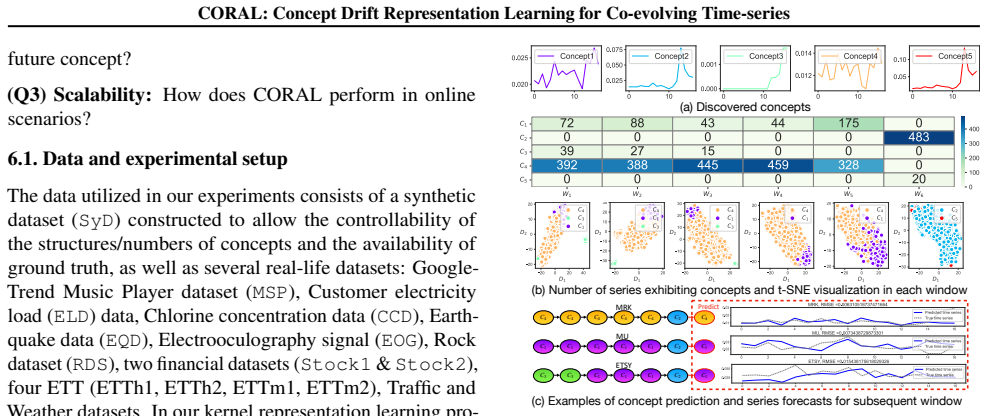
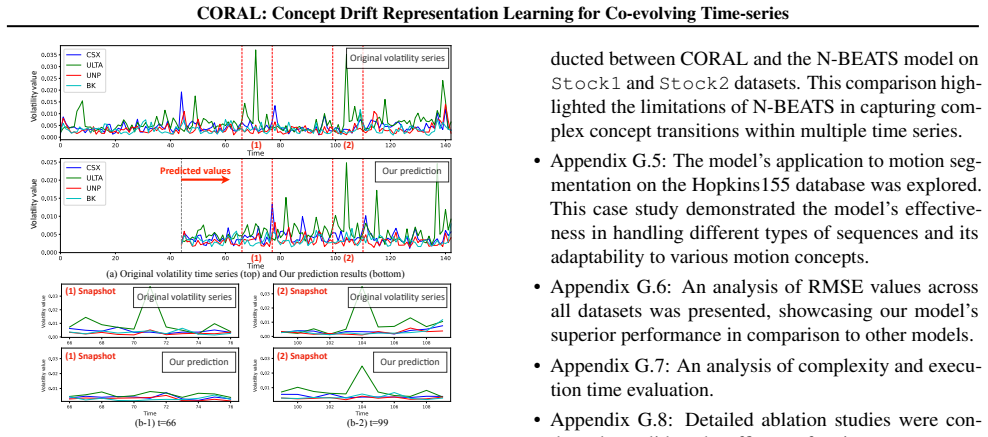
On the paper's own terms, the discovery is that the right representation turns concept drift into a visible, countable object. For each sliding window over an n-variable time series, CORAL learns an n×n matrix Z with nonnegative symmetric entries, expressing every series as a combination of the others in a kernel feature space; the ideal Z is block diagonal, with each diagonal block containing exactly the series that share a latent concept. Theorem 4.1 asserts that minimizing the sum of the k smallest eigenvalues of the Laplacian of Z is equivalent to Z being k-block diagonal, so the number of concepts can be read off from the zero eigenvalues. By re-solving the problem in consecutive windows, CORAL traces each series as it moves between blocks—this trajectory is the drift—and uses per-series transition counts combined with ecosystem-wide transition frequencies to forecast which concept a series will enter next and what its future values will be. The empirical sections show the block structure separating recognizable regimes (for example, calm versus volatile financial periods) and report forecasting errors at or near the best among the compared models on synthetic and real datasets.
Load-bearing premise
The load-bearing premise is that the mathematical penalty actually pushes the learned representation matrix toward clean, separated diagonal blocks; the paper proves that blocks produce zero penalty but leaves unproven that minimizing the penalty forces the optimization to produce blocks.
Editorial extensions
If this is right
- The number of latent concepts can be estimated automatically from the eigengap of the Laplacian of Z, so CORAL requires no prior knowledge of how many concepts exist.
- Drift becomes observable per series: by reading which block each series belongs to in each window, CORAL shows an individual series moving from one concept to another over time.
- Forecasting uses both the series' own past concept transitions and transition frequencies across the whole ecosystem, letting it predict a concept that has never appeared in that series before.
- Because the kernel representation layer can be inserted into autoencoder-style networks, deep learning backbones can gain drift-awareness without changing their training data.
Reading between the lines
- A natural extension the paper does not develop is using the rate of block rearrangement as a drift-speed estimator: slow block shifts would indicate gradual drift and sudden reorderings abrupt regime breaks.
- For datasets with few series, where the authors say the block regularizer weakens, a hierarchical prior or pairwise coupling across windows could restore structure; this is an inference, not a claim in the paper.
- The transition-probability forecast could be run online, updating the ecosystem-level frequencies as each new window arrives, giving an anytime forecasting rule for streaming co-evolving series.
Editorial analysis
A structured set of objections, weighed in public.
Referee Report
Summary. The paper proposes CORAL, a method for concept drift identification and forecasting in co-evolving time series. For each sliding window, CORAL learns a nonnegative symmetric self-representation matrix Z of the series in a kernel-induced feature space, regularized by the sum of the k smallest eigenvalues of the graph Laplacian of Z. The authors claim that this regularizer enforces a k-block diagonal structure, which enables automatic discovery of the number k of concepts, tracking of concept drift through transition probabilities between blocks across windows, and forecasting of future concept values via a weighted average of past subseries. The paper evaluates the method on one synthetic dataset and several real datasets, comparing against both forecasting and concept-drift baselines.
Significance. If the central claims were sound, CORAL would provide an interpretable, unsupervised approach to regime discovery in high-dimensional co-evolving time series, with a matrix-optimization formulation and an explicit mathematical guarantee for concept-count recovery. The paper also demonstrates an extension to deep learning backbones and reports competitive or superior RMSE on several benchmarks. However, the load-bearing theoretical result, Theorem 4.1, is incorrect as stated; the algebraic expansion of the objective in Eq. (2) is inconsistent with the chosen parameter values; and the evaluation of concept detection on real financial data is not grounded in any defined ground truth. As a result, the validity of the paper's main claims is not established, and the empirical results cannot be taken as supporting the proposed mechanism.
major comments (4)
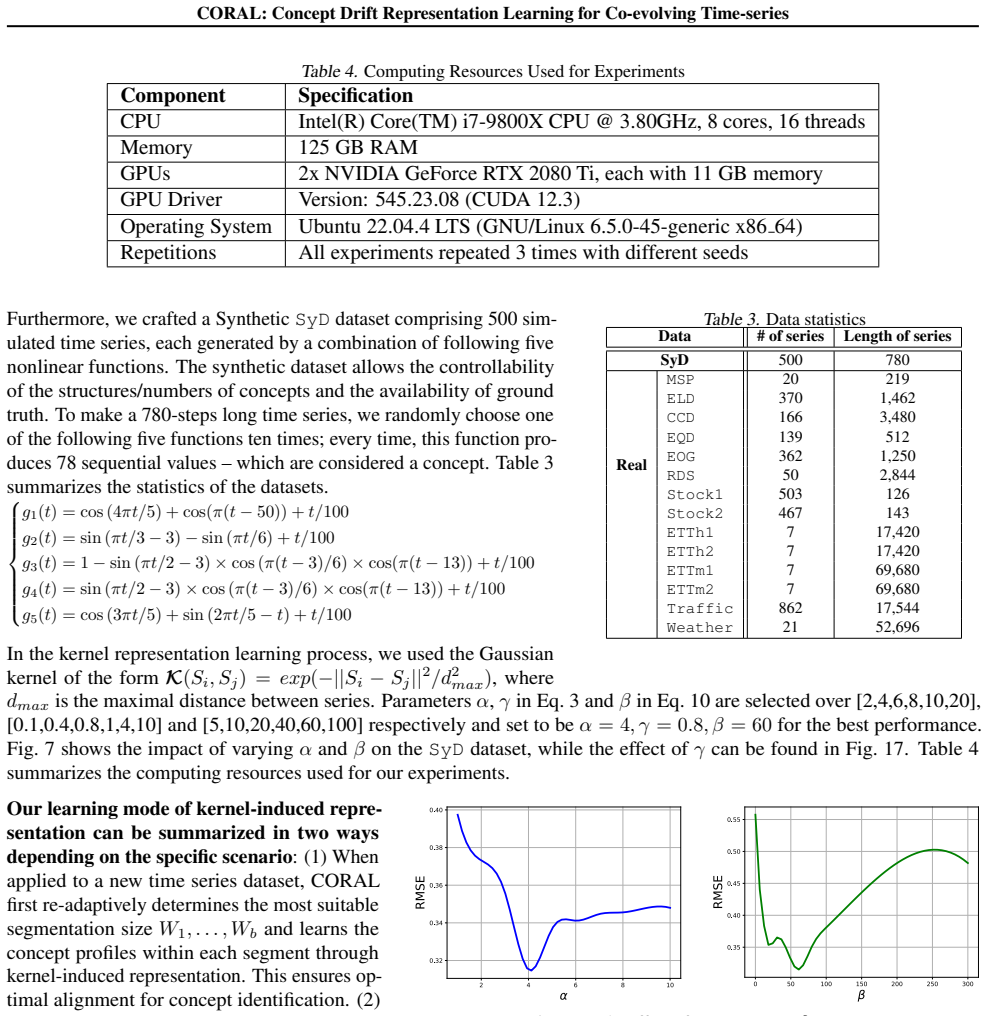
- [Sec. 4.1, Eq. (2)] The claimed expansion is algebraically incorrect. Expanding 1/2 ||Φ(S) − (α/2)Φ(S)Z||^2 gives 1/2 Tr(K) − (α/2)Tr(KZ) + (α^2/8)Tr(Z^T K Z). The printed right-hand side, 1/2 Tr(K − αKZ + Z^T K Z), has quadratic coefficient 1/2, which matches α^2/8 only for α=2. The paper later fixes α=4 (Appendix F), for which the printed quadratic coefficient is off by a factor of 4. The same inconsistency appears in Eq. (10), and the V-update in Eq. (15) uses αK rather than (α/2)K as required by Eq. (13). The exact objective being minimized is therefore ambiguous, and the reported regularization may not correspond to the stated loss.
- [Sec. 4.1, Theorem 4.1] The theorem claims that minimizing ||Z||_k = sum_{i=N-k+1}^N λ_i(L_Z) is equivalent to Z being k-block diagonal. The proof shows only that a block-diagonal Z with k blocks yields k zero eigenvalues. Since the Laplacian of any symmetric nonnegative Z with zero diagonal is positive semidefinite and its zero-eigenvalue multiplicity equals the number of connected components, the regularizer is zero for every Z with at least k connected components. The optimization in Eq. (3) is therefore not constrained to produce exactly k blocks, and the eigengap estimator of Eqs. (8)-(9) has no support: additional zero eigenvalues remove the gap used to determine k. This is the central guarantee for concept identification, so the main theoretical claim of the paper is not established.
- [Sec. G.3, Tables 5-6] The concept-detection evaluation reports TP/FP/TN/FN and Type I/II errors for Stock1 and Stock2, with a column labeled 'Ground Truth Concepts' equal to 5. However, Section 6.3 states that for real datasets 'we lack the ground truth for validating the obtained concepts.' No method is given for obtaining the financial ground-truth concepts. Without such a definition, the detection-accuracy numbers for these two datasets are uninterpretable.
- [Sec. 6.1, Table 1] The forecasting evaluation does not specify a clean train/validation/test split. The text says that a fixed window slides over all the series and that a kernel representation is learned for the subseries in each window; this suggests representations are learned on windows that are later used for evaluation. Eq. (6) forecasts a test window as a weighted average of observed subseries from past windows assigned to the predicted concept, so the extent to which the comparison reflects out-of-sample generalization is unclear. The paper should state exactly which windows are used for representation learning, for estimating transition probabilities, and for computing the reported RMSE.
minor comments (6)
- [Fig. 1 caption and Sec. 1] The caption and the accompanying text contain the stray string 'g♀be', which appears to be a rendering artifact; it should read 'ecosystem' or be removed.
- [Sec. 4.3, loss function] The displayed loss L(Θ) contains only λ1 and λ2, but the text says λ1, λ2, and λ3 balance the loss components. If λ3 was intended for a temporal smoothness term, that term is missing from the displayed equation.
- [Sec. 4.2, Eq. (6)] The condition sum_{l=1}^p τ^{p-l+1} = 1 is stated, but no specific form of τ is given; without specifying τ, the forecasting procedure is not fully reproducible.
- [Appendix B, Eq. (8)] The set-builder notation {i | g(σ_i) ≤ τ}_{i=1}^{N-1} is unusual and should be rewritten as a standard argmin over i ∈ {1,...,N-1} with the constraint g(σ_i) ≤ τ.
- [Supplementary title] The supplementary document title reads 'CORLA', which appears to be a typo for 'CORAL'.
- [Sec. 6.2] The claim that the exclusive appearance of C2 and C5 in the sixth window of Stock1 may be 'possibly induced by the COVID-19 pandemic' is presented without supporting evidence or a specific date; as a claim about financial regimes it should be stated more cautiously.
Circularity Check
The concept count is both an input to Eq. 3's k-block regularizer and the quantity "estimated" from the eigengaps of the resulting Z, and the Eq. 6 value forecast is a convex combination of the series' own past values selected by CORAL's own cluster labels, so the central discoveries are partially fixed by construction.
-
self definitional
[Sec. 4.1 (Eq. 3 and Theorem 4.1); Appendix B (Eqs. 8-9 and footnote 4)]
"where γ>0 balances the loss function with regularization term, ||Z||_k = Σ_{i=N−k+1}^N λ_i(L_Z) ... Here, the regularization term is equal to 0 if and only if Z is k-block diagonal (see Theorem 4.1 for details). ... In this paper, we simply initialize the number of concepts for each window as 3 to obtain the initial representation Z, and then estimate k."
The regularizer in Eq. 3 takes k as a free parameter: ||Z||_k is the sum of the k smallest Laplacian eigenvalues, and the paper states it is zero 'if and only if Z is k-block diagonal.' Minimizing it therefore manufactures (up to) k zero eigenvalues in L_Z. Appendix B then 'estimates' k by counting zero eigenvalues/eigengaps of L_Z of this very solution. The discovered concept count is the k fed into the objective, so the claimed autonomous identification of k is self-referential. The theorem's proof covers only the direction from k-block structure to k zero eigenvalues, never that the Eq. 3 minimizer has exactly k blocks, so the eigengap readout is not an independent data-driven identification.
-
fitted input called prediction
[Sec. 4.2 (Eq. 6); Sec. 6.3 validation protocol]
"The predicted values of Si under the window Wp+1 can be calculated as: PreSi = Σ_{l=1}^p Δ(Cm|Si, Wl) · τ^{p−l+1} · {Si|Wl} ... In this context, we simply require Σ_{l=1}^p τ^{p−l+1} = 1, which implies that the subseries closer to the predicted window is deemed more significant. ... For real datasets, we lack the ground truth for validating the obtained concepts. Instead, we validate the value and gain of the discovered concepts for time series forecasting as they are employed in Eq. 6."
By construction PreSi is a convex combination of the same series' observed subseries {Si|Wl}; the only fitted inputs are the concept labels Δ(Cm|Si,Wl) produced by CORAL's own clustering, and τ is a hand-set decay. Thus the 'forecast' is a label-conditioned moving average of the input windows, not a prediction generated from the learned kernel representation or from inter-series interactions. The paper then uses this forecast accuracy as the evidence for the discovered concepts, so the validation signal reduces to the model's own labels smoothing the data it was given.
full rationale
The only load-bearing circularity I can exhibit by the paper's own equations is the k-in/k-out loop. Eq. 3 asks for ||Z||_k, the sum of the k smallest Laplacian eigenvalues of Z, and the paper states this term is zero iff Z is k-block diagonal; hence solving Eq. 3 with an initialized k (Appendix B: 'we simply initialize the number of concepts for each window as 3') builds (at least) k zero eigenvalues into L_Z. Appendix B then counts zero eigenvalues/eigengaps of L_Z and presents that count as the discovered number of concepts. The discovered k is therefore the supplied k, not an independent quantity. The proof of Theorem 4.1 establishes only the direction from k-block structure to zero eigenvalues, never that the Eq. 3 minimizer has exactly k blocks, so the circular readout is also unsupported. Second, Eq. 6 defines the forecast for W_{p+1} as a weighted sum of {Si|Wl} over past windows, requiring the weights to sum to 1. This is, by construction, a convex combination of the same series' observed values, with the only model-dependent input being the cluster membership Δ(Cm|Si,Wl) produced by CORAL's own clustering. Using the accuracy of this forecast to validate the discovered concepts (Sec. 6.3) therefore validates the concepts through a smoothing of the data using those same concepts. I do not treat the self-citations as circular: the eigenvalue-reformulation property is also attributed to Dattorro (2010), an external source, and the earlier papers by the same group are used mainly for comparisons and motivation, not as the load-bearing justification. The algebraic inconsistency between Eq. 2's two displayed forms at α=4, and the similar issue in Eq. 10, are correctness defects that make the exact objective ambiguous; they are not themselves a reduction to inputs and do not affect the circularity score. External benchmarks (Table 1, Stock2 online setting) give the method some independent empirical content, so the score is 6 rather than higher.
Assumptions & free parameters
free parameters (7)
- alpha =
4
- gamma =
0.8
- beta =
60
- rho (concept granularity) =
not reported
- tau (eigengap threshold) =
not reported
- window size =
dataset-specific (e.g., 78 for SyD, 17 for Stock1)
- initial concept count per window =
3
assumptions (5)
- standard math Spectral clustering eigenvalue properties: the number of zero eigenvalues of a graph Laplacian equals the number of connected components.
- standard math The reproducing kernel Hilbert space and kernel trick are valid for representing nonlinear similarities.
- domain assumption Co-evolving time series can be segmented into non-overlapping windows such that each window contains a coherent and stationary concept structure.
- domain assumption Concept transitions between consecutive windows follow a first-order Markov process whose probabilities can be estimated from past windows.
- domain assumption The Gaussian kernel with a global bandwidth captures the true similarity structure of concepts across all datasets.
invented entities (1)
-
Concept (profile pattern)
Cite this review
Pith. "Pith review of CORAL: Concept Drift Representation Learning for Co-evolving Time-series." pith.science (2026). https://pith.science/paper/BWUMGV25
@misc{pith2026250101480,
  author       = {Pith},
  title        = {Pith review of: CORAL: Concept Drift Representation Learning for Co-evolving Time-series},
  year         = {2026},
  howpublished = {\url{https://pith.science/paper/BWUMGV25}},
  note         = {Machine review of arXiv:2501.01480}
}
read the original abstract
In the realm of time series analysis, tackling the phenomenon of concept drift poses a significant challenge. Concept drift -- characterized by the evolving statistical properties of time series data, affects the reliability and accuracy of conventional analysis models. This is particularly evident in co-evolving scenarios where interactions among variables are crucial. This paper presents CORAL, a simple yet effective method that models time series as an evolving ecosystem to learn representations of concept drift. CORAL employs a kernel-induced self-representation learning to generate a representation matrix, encapsulating the inherent dynamics of co-evolving time series. This matrix serves as a key tool for identification and adaptation to concept drift by observing its temporal variations. Furthermore, CORAL effectively identifies prevailing patterns and offers insights into emerging trends through pattern evolution analysis. Our empirical evaluation of CORAL across various datasets demonstrates its effectiveness in handling the complexities of concept drift. This approach introduces a novel perspective in the theoretical domain of co-evolving time series analysis, enhancing adaptability and accuracy in the face of dynamic data environments, and can be easily integrated into most deep learning backbones.
Figures


Figures from the paper (14 more)




Reference graph
Works this paper leans on
-
[1]
Automatic subspace clustering of high dimensional data
Agrawal, R., Gehrke, J., Gunopulos, D., and Raghavan, P. Automatic subspace clustering of high dimensional data. Data Mining and Knowledge Discovery, 11: 0 5--33, 2005
work page 2005
-
[2]
Markov-switching garch models in r: The msgarch package
Ardia, D., Bluteau, K., Boudt, K., Catania, L., and Trottier, D.-A. Markov-switching garch models in r: The msgarch package. Journal of Statistical Software, 91 0 (4), 2019
work page 2019
-
[3]
Bai, L. and Liang, J. Sparse subspace clustering with entropy-norm. In International conference on machine learning, pp.\ 561--568. PMLR, 2020
work page 2020
-
[4]
Bayram, F., Ahmed, B. S., and Kassler, A. From concept drift to model degradation: An overview on performance-aware drift detectors. Knowledge-Based Systems, 245: 0 108632, 2022
work page 2022
-
[5]
Bazzi, M., Blasques, F., Koopman, S. J., and Lucas, A. Time-varying transition probabilities for markov regime switching models. Journal of Time Series Analysis, 38 0 (3): 0 458--478, 2017
work page 2017
-
[6]
Bouguessa, M. and Wang, S. Mining projected clusters in high-dimensional spaces. IEEE Transactions on Knowledge and Data Engineering, 21 0 (4): 0 507--522, 2008
work page 2008
-
[7]
Box and jenkins: time series analysis, forecasting and control
Box, G. Box and jenkins: time series analysis, forecasting and control. In A Very British Affair: Six Britons and the Development of Time Series Analysis During the 20th Century, pp.\ 161--215. Springer, 2013
work page 2013
-
[8]
Cavalcante, R. C., Minku, L. L., and Oliveira, A. L. Fedd: Feature extraction for explicit concept drift detection in time series. In 2016 International Joint Conference on Neural Networks (IJCNN), pp.\ 740--747. IEEE, 2016
work page 2016
Show all 67 references
-
[9]
Self-expressive kernel subspace clustering algorithm for categorical data with embedded feature selection
Chen, H., Xu, K., Chen, L., and Jiang, Q. Self-expressive kernel subspace clustering algorithm for categorical data with embedded feature selection. Mathematics, 9 0 (14): 0 1680, 2021
2021
-
[10]
and Paschalidis, I
Chen, R. and Paschalidis, I. Selecting optimal decisions via distributionally robust nearest-neighbor regression. Advances in Neural Information Processing Systems, 32, 2019
2019
-
[11]
Clustering-based cross-sectional regime identification for financial market forecasting
Chen, R., Sun, M., Xu, K., Patenaude, J.-M., and Wang, S. Clustering-based cross-sectional regime identification for financial market forecasting. In International Conference on Database and Expert Systems Applications, pp.\ 3--16. Springer, 2022 a
2022
-
[12]
Dynamic cross-sectional regime identification for financial market prediction
Chen, R., Xun, K., Patenaude, J.-M., and Wang, S. Dynamic cross-sectional regime identification for financial market prediction. In 2022 IEEE 46th Annual Computers, Software, and Applications Conference (COMPSAC), pp.\ 295--300. IEEE, 2022 b
2022
-
[13]
Timemae: Self-supervised representations of time series with decoupled masked autoencoders
Cheng, M., Liu, Q., Liu, Z., Zhang, H., Zhang, R., and Chen, E. Timemae: Self-supervised representations of time series with decoupled masked autoencoders. arXiv preprint arXiv:2303.00320, 2023
2023
-
[14]
Convex optimization & Euclidean distance geometry
Dattorro, J. Convex optimization & Euclidean distance geometry. Lulu. com, 2010
2010
-
[15]
V., Xue, H., and Salim, F
Deldari, S., Smith, D. V., Xue, H., and Salim, F. D. Time series change point detection with self-supervised contrastive predictive coding. In Proceedings of the Web Conference 2021, pp.\ 3124--3135, 2021
2021
-
[16]
and Vidal, R
Elhamifar, E. and Vidal, R. Sparse subspace clustering: Algorithm, theory, and applications. IEEE TPAMI, 35 0 (11): 0 2765--2781, 2013
2013
-
[17]
Dish-ts: a general paradigm for alleviating distribution shift in time series forecasting
Fan, W., Wang, P., Wang, D., Wang, D., Zhou, Y., and Fu, Y. Dish-ts: a general paradigm for alleviating distribution shift in time series forecasting. In Proceedings of the AAAI Conference on Artificial Intelligence, pp.\ 7522--7529, 2023
2023
-
[18]
T-rep: Representation learning for time series using time-embeddings
Fraikin, A., Bennetot, A., and Allassonni \`e re, S. T-rep: Representation learning for time series using time-embeddings. arXiv preprint arXiv:2310.04486, 2023
2023 arXiv
-
[19]
Efficient dense subspace clustering
Ji, P., Salzmann, M., and Li, H. Efficient dense subspace clustering. In IEEE Winter conference on applications of computer vision, pp.\ 461--468. IEEE, 2014
2014
-
[20]
Reversible instance normalization for accurate time-series forecasting against distribution shift
Kim, T., Kim, J., Tae, Y., Park, C., Choi, J.-H., and Choo, J. Reversible instance normalization for accurate time-series forecasting against distribution shift. In International Conference on Learning Representations, 2021
2021
-
[21]
and Hong, Y
Li, H. and Hong, Y. Financial volatility forecasting with range-based autoregressive volatility model. Finance Research Letters, 8 0 (2): 0 69--76, 2011
2011
-
[22]
Ddg-da: Data distribution generation for predictable concept drift adaptation
Li, W., Yang, X., Liu, W., Xia, Y., and Bian, J. Ddg-da: Data distribution generation for predictable concept drift adaptation. In Proceedings of the AAAI Conference on Artificial Intelligence, pp.\ 4092--4100, 2022
2022
-
[23]
S parse TSF : Modeling long-term time series forecasting with *1k* parameters
Lin, S., Lin, W., Wu, W., Chen, H., and Yang, J. S parse TSF : Modeling long-term time series forecasting with *1k* parameters. In Proceedings of the 41st International Conference on Machine Learning, volume 235 of Proceedings of Machine Learning Research. PMLR, 21--27 Jul 2024
2024
-
[24]
Linearized alternating direction method with adaptive penalty for low-rank representation
Lin, Z., Liu, R., and Su, Z. Linearized alternating direction method with adaptive penalty for low-rank representation. Advances in neural information processing systems, 24, 2011
2011
-
[25]
Robust recovery of subspace structures by low-rank representation
Liu, G., Lin, Z., Yan, S., Sun, J., Yu, Y., and Ma, Y. Robust recovery of subspace structures by low-rank representation. IEEE TPAMI, 35 0 (1): 0 171--184, 2012
2012
-
[26]
and Chen, S
Liu, J. and Chen, S. Timesurl: Self-supervised contrastive learning for universal time series representation learning. In Proceedings of the AAAI Conference on Artificial Intelligence, pp.\ 13918--13926, 2024
2024
-
[27]
Anomaly and change point detection for time series with concept drift
Liu, J., Yang, D., Zhang, K., Gao, H., and Li, J. Anomaly and change point detection for time series with concept drift. World Wide Web, 26 0 (5): 0 3229--3252, 2023
2023
-
[28]
Subspace clustering by block diagonal representation
Lu, C., Feng, J., Lin, Z., Mei, T., and Yan, S. Subspace clustering by block diagonal representation. IEEE TPAMI, 41 0 (2): 0 487--501, 2018 a
2018
-
[29]
Learning under concept drift: A review
Lu, J., Liu, A., Dong, F., Gu, F., Gama, J., and Zhang, G. Learning under concept drift: A review. IEEE transactions on knowledge and data engineering, 31 0 (12): 0 2346--2363, 2018 b
2018
-
[30]
Regions of reliability in the evaluation of multivariate probabilistic forecasts
Marcotte, \'E ., Zantedeschi, V., Drouin, A., and Chapados, N. Regions of reliability in the evaluation of multivariate probabilistic forecasts. arXiv preprint arXiv:2304.09836, 2023
2023 arXiv
-
[31]
and Sakurai, Y
Matsubara, Y. and Sakurai, Y. Regime shifts in streams: Real-time forecasting of co-evolving time sequences. In ACM SIGKDD, pp.\ 1045--1054, 2016
2016
-
[32]
and Sakurai, Y
Matsubara, Y. and Sakurai, Y. Dynamic modeling and forecasting of time-evolving data streams. In ACM SIGKDD, pp.\ 458--468, 2019
2019
-
[33]
and Kajino, H
Miyaguchi, K. and Kajino, H. Cogra: Concept-drift-aware stochastic gradient descent for time-series forecasting. In Proceedings of the AAAI Conference on Artificial Intelligence, pp.\ 4594--4601, 2019
2019
-
[34]
On spectral clustering: Analysis and an algorithm
Ng, A., Jordan, M., and Weiss, Y. On spectral clustering: Analysis and an algorithm. Advances in neural information processing systems, 14, 2001
2001
-
[35]
Clustering and projected clustering with adaptive neighbors
Nie, F., Wang, X., and Huang, H. Clustering and projected clustering with adaptive neighbors. In Proceedings of ACM SIGKDD, pp.\ 977--986, 2014
2014
-
[36]
N., Carpov, D., Chapados, N., and Bengio, Y
Oreshkin, B. N., Carpov, D., Chapados, N., and Bengio, Y. N-beats: Neural basis expansion analysis for interpretable time series forecasting. arXiv preprint arXiv:1905.10437, 2019
1905 arXiv
-
[37]
Pham, Q., Liu, C., Sahoo, D., and Hoi, S. C. Learning fast and slow for online time series forecasting. arXiv preprint arXiv:2202.11672, 2022
2022 arXiv
-
[38]
Knowledge-maximized ensemble algorithm for different types of concept drift
Ren, S., Liao, B., Zhu, W., and Li, K. Knowledge-maximized ensemble algorithm for different types of concept drift. Information Sciences, 430: 0 261--281, 2018
2018
-
[39]
Stochastic complexity in statistical inquiry, volume 15
Rissanen, J. Stochastic complexity in statistical inquiry, volume 15. World scientific, 1998
1998
-
[40]
Stewart, G. W. Matrix perturbation theory. 1990
1990
-
[41]
and Hinton, G
Van der Maaten, L. and Hinton, G. Visualizing data using t-sne. Journal of machine learning research, 9 0 (11), 2008
2008
-
[42]
A tutorial on spectral clustering
Von Luxburg, U. A tutorial on spectral clustering. Statistics and computing, 17 0 (4): 0 395--416, 2007
2007
-
[43]
Card: Channel aligned robust blend transformer for time series forecasting
Wang, X., Zhou, T., Wen, Q., Gao, J., Ding, B., and Jin, R. Card: Channel aligned robust blend transformer for time series forecasting. In The Twelfth International Conference on Learning Representations, 2023
2023
-
[44]
I., Hyde, R., Cao, H., Nguyen, H
Webb, G. I., Hyde, R., Cao, H., Nguyen, H. L., and Petitjean, F. Characterizing concept drift. Data Mining and Knowledge Discovery, 30 0 (4): 0 964--994, 2016
2016
-
[45]
Onenet: Enhancing time series forecasting models under concept drift by online ensembling
Wen, Q., Chen, W., Sun, L., Zhang, Z., Wang, L., Jin, R., Tan, T., et al. Onenet: Enhancing time series forecasting models under concept drift by online ensembling. Advances in Neural Information Processing Systems, 36, 2024
2024
-
[46]
Etsformer: Exponential smoothing transformers for time-series forecasting
Woo, G., Liu, C., Sahoo, D., Kumar, A., and Hoi, S. Etsformer: Exponential smoothing transformers for time-series forecasting. arXiv preprint arXiv:2202.01381, 2022
2022 arXiv
-
[47]
Timesnet: Temporal 2d-variation modeling for general time series analysis
Wu, H., Hu, T., Liu, Y., Zhou, H., Wang, J., and Long, M. Timesnet: Temporal 2d-variation modeling for general time series analysis. In The eleventh international conference on learning representations, 2022
2022
-
[48]
A self-representation model for robust clustering of categorical sequences
Xu, K., Chen, L., Wang, S., and Wang, B. A self-representation model for robust clustering of categorical sequences. In Web and Big Data: APWeb-WAIM 2018 International Workshops: MWDA, BAH, KGMA, DMMOOC, DS, Macau, China, July 23--25, 2018, Revised Selected Papers 2, pp.\ 13--...
2018
-
[49]
Kernel subspace clustering algorithm for categorical data
Xu, K., Chen, L., Sun, H., and Wang, B. Kernel subspace clustering algorithm for categorical data. Journal of Software, 31 0 (11): 0 3492--3505, 2020
2020
-
[50]
Data-driven kernel subspace clustering with local manifold preservation
Xu, K., Chen, L., and Wang, S. Data-driven kernel subspace clustering with local manifold preservation. In 2022 IEEE International Conference on Data Mining Workshops (ICDMW), pp.\ 876--884. IEEE, 2022 a
2022
-
[51]
A multi-view kernel clustering framework for categorical sequences
Xu, K., Chen, L., and Wang, S. A multi-view kernel clustering framework for categorical sequences. Expert Systems with Applications, 197: 0 116637, 2022 b
2022
-
[52]
Kernel representation learning with dynamic regime discovery for time series forecasting
Xu, K., Chen, L., Patenaude, J.-M., and Wang, S. Kernel representation learning with dynamic regime discovery for time series forecasting. In Pacific-Asia Conference on Knowledge Discovery and Data Mining, pp.\ 251--263. Springer, 2024 a
2024
-
[53]
Rhine: A regime-switching model with nonlinear representation for discovering and forecasting regimes in financial markets
Xu, K., Chen, L., Patenaude, J.-M., and Wang, S. Rhine: A regime-switching model with nonlinear representation for discovering and forecasting regimes in financial markets. In Proceedings of the 2024 SIAM International Conference on Data Mining (SDM), pp.\ 526--534. SIAM, 2024 b
2024
-
[54]
Kan4drift: Are kan effective for identifying and tracking concept drift in time series? In NeurIPS Workshop on Time Series in the Age of Large Models, 2024 c
Xu, K., Chen, L., and Wang, S. Kan4drift: Are kan effective for identifying and tracking concept drift in time series? In NeurIPS Workshop on Time Series in the Age of Large Models, 2024 c
2024
-
[55]
Kolmogorov-arnold networks for time series: Bridging predictive power and interpretability
Xu, K., Chen, L., and Wang, S. Kolmogorov-arnold networks for time series: Bridging predictive power and interpretability. arXiv preprint arXiv:2406.02496, 2024 d
2024 arXiv
-
[56]
Wormhole: Concept-aware deep representation learning for co-evolving sequences
Xu, K., Chen, L., and Wang, S. Wormhole: Concept-aware deep representation learning for co-evolving sequences. arXiv preprint arXiv:2409.13857, 2024 e
2024 arXiv
-
[57]
Towards robust nonlinear subspace clustering: A kernel learning approach
Xu, K., Chen, L., and Wang, S. Towards robust nonlinear subspace clustering: A kernel learning approach. arXiv preprint arXiv:2501.06368, 2025
2025 arXiv
-
[58]
FITS : Modeling time series with \ 10k\ parameters
Xu, Z., Zeng, A., and Xu, Q. FITS : Modeling time series with \ 10k\ parameters. In The Twelfth International Conference on Learning Representations, 2024 f
2024
-
[59]
and Hong, S
Yang, L. and Hong, S. Unsupervised time-series representation learning with iterative bilinear temporal-spectral fusion. In International conference on machine learning, pp.\ 25038--25054. PMLR, 2022
2022
-
[60]
Learning to learn the future: Modeling concept drifts in time series prediction
You, X., Zhang, M., Ding, D., Feng, F., and Huang, Y. Learning to learn the future: Modeling concept drifts in time series prediction. In Proceedings of the 30th ACM International Conference on Information & Knowledge Management, pp.\ 2434--2443, 2021
2021
-
[61]
Online boosting adaptive learning under concept drift for multistream classification
Yu, E., Lu, J., Zhang, B., and Zhang, G. Online boosting adaptive learning under concept drift for multistream classification. In Proceedings of the AAAI Conference on Artificial Intelligence, pp.\ 16522--16530, 2024
2024
-
[62]
Are transformers effective for time series forecasting? In Proceedings of the AAAI conference on artificial intelligence, pp.\ 11121--11128, 2023
Zeng, A., Chen, M., Zhang, L., and Xu, Q. Are transformers effective for time series forecasting? In Proceedings of the AAAI conference on artificial intelligence, pp.\ 11121--11128, 2023
2023
-
[63]
Graph structure fusion for multiview clustering
Zhan, K., Niu, C., Chen, C., Nie, F., Zhang, C., and Yang, Y. Graph structure fusion for multiview clustering. IEEE Transactions on Knowledge and Data Engineering, 31 0 (10): 0 1984--1993, 2018
1984
-
[64]
Addressing concept shift in online time series forecasting: Detect-then-adapt
Zhang, Y., Chen, W., Zhu, Z., Qin, D., Sun, L., Wang, X., Wen, Q., Zhang, Z., Wang, L., and Jin, R. Addressing concept shift in online time series forecasting: Detect-then-adapt. arXiv preprint arXiv:2403.14949, 2024
2024 arXiv
-
[65]
Informer: Beyond efficient transformer for long sequence time-series forecasting
Zhou, H., Zhang, S., Peng, J., Zhang, S., Li, J., Xiong, H., and Zhang, W. Informer: Beyond efficient transformer for long sequence time-series forecasting. In Proceedings of the AAAI conference on artificial intelligence, pp.\ 11106--11115, 2021
2021
-
[66]
Fedformer: Frequency enhanced decomposed transformer for long-term series forecasting
Zhou, T., Ma, Z., Wen, Q., Wang, X., Sun, L., and Jin, R. Fedformer: Frequency enhanced decomposed transformer for long-term series forecasting. In International conference on machine learning, pp.\ 27268--27286. PMLR, 2022
2022
-
[67]
write newline
" write newline "" before.all 'output.state := FUNCTION n.dashify 't := "" t empty not t #1 #1 substring "-" = t #1 #2 substring "--" = not "--" * t #2 global.max substring 't := t #1 #1 substring "-" = "-" * t #2 global.max substring 't := while if t #1 #1 substring * t #2 gl...
Reviewed August 10, 2026 · model on record in the stance chip above.
Discussion (0). Continue with ORCID to comment.