REVIEW 3 major objections 5 minor 36 references
Intervals in a family of Fibonacci lattices
T0 review · 3 major / 5 minor · reviewed 2026-08-12 · deepseek-v4-flash
Pith's one-line read The paper proves that a family of Dyck-path lattices counted by Fibonacci numbers has meet-irreducibles matching Turán-graph edges and intervals encoded by Motzkin paths.
desk verdict Genuinely new Fibonacci lattices with a nice Turán-link result; the interval-Motzkin bijection needs real proofs before acceptance. read the letter →
The pith
A machine-rendered reading of the paper's core claim, the machinery that carries it, and where it could break.
The reading
What carries the argument
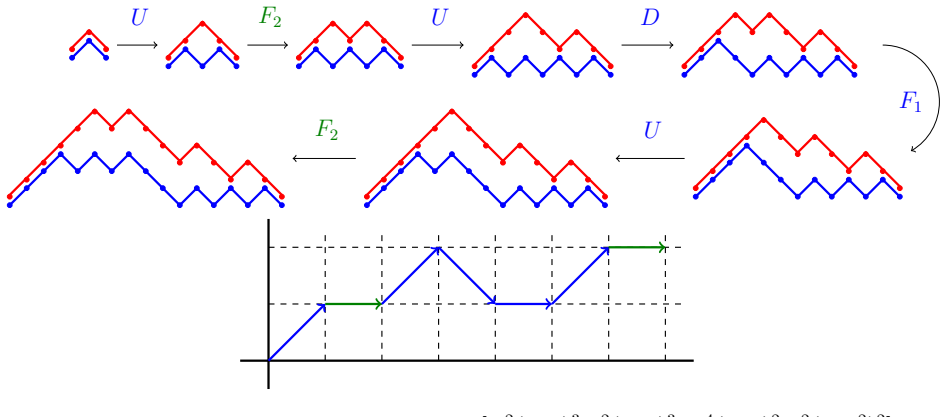
The argument is carried by a peak-insertion generating tree for intervals. Starting from the one-point interval $[UD,UD]$, every interval is obtained by inserting a peak $UD$ into the first ascents of the lower and upper endpoints; Facts 4.1–4.3 specify, by inspection, exactly which pairs of insertion heights preserve the interval property in $F^\infty_n$ and in $F^2_n$. Tracking the first-ascent heights $(a,b)$ turns this tree into a system of rewriting rules, which is then mapped bijectively to bicolored Motzkin paths (plain for $p=\infty$, avoiding the seven patterns $F_2F_2,F_2D,F_2U,DF_2,UF_2,UU,DD$ for $p=2$). Alongside this, the decomposition $P=U^{i-1}QU D^i$ by the type (length of the last descent run) supplies the systems of equations for the covering generating functions, while the distributive-lattice identity $B_p(x,y)=F_p(x,1+y)$ converts those into boolean interval counts and the Möbius function; the $p\to\infty$ results are obtained coefficientwise by the discrete continuity argument.
What would settle it
Enumerate intervals in $F^\infty_n$ and $F^2_n$ directly for $n\le 8$ and compare with the claimed coefficients: $F^\infty_n$ should give $1,3,10,35,126,462$ for $n=1,\ldots,6$ and $F^2_n$ should give $1,3,6,15,35,86,210,520$ for $n=1,\ldots,8$; a single mismatch shows that the peak-insertion rules or their Motzkin-path encoding misclassify some intervals.
Extended reading notes
Core claim
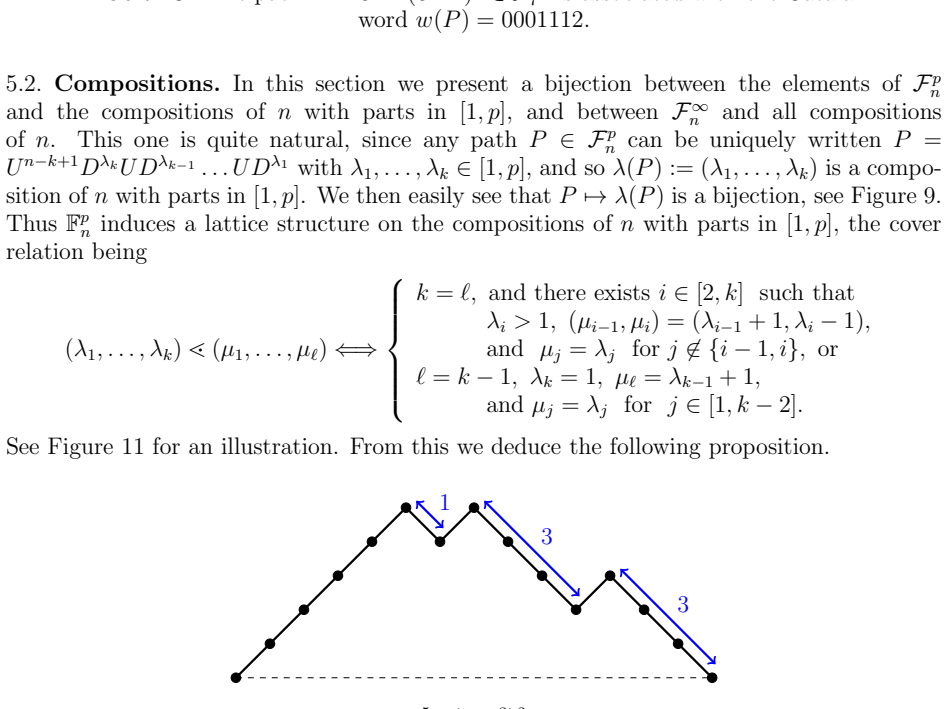
For each $p\ge 2$, let $F^p_n$ be the set of Dyck paths of semilength $n$ avoiding $DUU$ and $D^{p+1}$, ordered by the Stanley lattice (covering relation $DU\to UD$). The paper's central discovery is that $F^p_n$ is a distributive lattice, and that the same is true in the limiting case $p=\infty$, where only $DUU$ is forbidden. From the bivariate generating function $F_p(x,y)$ for elements weighted by their number of upper covers, the paper derives the boolean-interval generating function $B_p(x,y)=F_p(x,1+y)$, which also controls the Möbius function: $\mu(P,Q)=0$ unless $[P,Q]$ is boolean, in which case it is $(-1)^h$ for height $h$. The meet-irreducible count in $F^p_n$ is $b_p(n)=\lfloor n^2(p-1)/(2p)\rfloor$, matching the edge count of the $(n,p)$-Turán graph. Intervals are encoded by bicolored Motzkin paths: without extra restrictions for $p=\infty$ (yielding $\binom{2n-1}{n}$ intervals), and with seven forbidden patterns for $p=2$ (yielding an explicit algebraic generating function with the stated asymptotics). Finally, the lattice structure is transported to non-decreasing Catalan words, to compositions under dominance order, and to subsets of $[1,n-1]$ with no $p$ consecutive elements.
Load-bearing premise
The interval counts rest on Facts 4.1–4.3, which assert—by 'a simple observation'—that inserting a peak $UD$ into the first ascents of two paths yields an interval exactly in the stated cases; if any of those local rules is wrong, the Motzkin-path bijections and all derived interval numbers change.
Editorial extensions
If this is right
- For every $p\ge2$ and for $p=\infty$, the posets $F^p_n$ and $F^\infty_n$ are distributive lattices; consequently the Möbius function of every interval is either $0$ or $(-1)^h$ according as the interval is boolean of height $h$.
- The meet-irreducible count $\lfloor n^2(p-1)/(2p)\rfloor$ gives a lattice-theoretic counterpart to the Turán graph edge count, so the extremal-graph integer appears as an enumerative invariant of Dyck paths.
- The interval counts for $p=\infty$ and $p=2$ are explicit: $\binom{2n-1}{n}$ intervals in $F^\infty_n$, and the algebraic generating function $J(x,1)$ for $F^2_n$, whose coefficients grow like a constant times $n^{-1/2}((3+\sqrt5)/2)^n$.
- The linear interval counts have closed forms, including $(3n+1)2^{n-3}$ for $F^\infty_n$ and an explicit Fibonacci expression for $F^2_n$; the standardized height of a random boolean interval in $F^\infty_n$ is asymptotically standard normal.
- Because the same lattice structure appears on compositions under dominance order, non-decreasing Catalan words, and subsets of $[1,n-1]$, the interval and Möbius-function formulas transfer verbatim to those classical families.
Reading between the lines
- A principle implicit in the discrete continuity argument is that any statistic on $F^p_n$ whose generating function stabilizes coefficientwise as $p\to\infty$ has a well-defined limit on $F^\infty_n$; one could test this for other statistics, such as the height distribution of boolean intervals for fixed large $p$, to see whether the Gaussian limit of Theorem 2.8 has finite-$p$ analogs.
- The Turán-graph identity suggests asking whether the meet-irreducible paths themselves extremize some lattice statistic (for example area or number of peaks) among elements with exactly one upper cover; the paper does not address this extremal characterization.
- The peak-insertion generating tree is a natural basis for random generation and Boltzmann sampling of intervals in $F^\infty_n$ and $F^2_n$; the authors stop at enumeration, but the tree description is exactly what such algorithms need.
- The subset model of Section 5.3 gives an interval criterion (Proposition 5.5) whose conditions do not explicitly refer to $p$; this suggests the unresolved general-$p$ interval count might be attacked through subset combinatorics with the no-$p$-consecutive constraint added separately.
Editorial analysis
A structured set of objections, weighed in public.
Referee Report
Summary. The paper studies a family of posets F^p_n (p ≥ 2) and F^∞_n whose elements are Dyck paths of semilength n avoiding DUU and D^{p+1}, ordered by the Stanley lattice order. The authors prove that these posets are distributive lattices (sublattices of the Stanley lattice), give generating functions for elements by number of upper covers, count meet-irreducible elements in terms of the edges of the (n,p)-Turán graph, derive boolean and linear interval generating functions, obtain the Möbius function from distributivity, and provide bijections between intervals and pattern-avoiding bicolored Motzkin paths, with explicit interval counts for p=2 and p=∞. A discrete continuity argument, based on F^∞_n = F^n_n, transfers results from the finite p case to p=∞. The paper closes with bijections transporting the lattice structure to non-decreasing Catalan words, compositions, and subsets of [1,n-1].
Significance. If the results are fully established, the paper introduces a new family of Fibonacci-counted distributive lattices with a striking extremal-graph-theoretic parameter (the Turán graph edge count) as the number of meet-irreducibles. The explicit bivariate generating functions for coverings, boolean intervals, and linear intervals, together with the interval bijections for p=2 and p=∞, are concrete and checkable contributions. The discrete continuity argument is elegant and is used consistently. The main caveat is that the interval bijections in Section 4 rest on facts stated without proof, so the advertised interval enumerations for F^2_n and the generalized bijection for p≥3 are not yet fully supported.
major comments (3)
- [Section 4, Facts 4.1–4.3] Facts 4.1–4.3 are introduced as 'can be checked with a simple observation', but no proof is supplied. Fact 4.3 is the only justification for the rule system preceding Theorem 4.6, and that rule system is used to derive the interval generating function J(x,y) in Theorem 4.7. A missing allowed case or an incorrect boundary condition in any of the four cases would propagate directly into the interval count. The four-case 'if and only if' statement needs a proof, including the maximality assumptions on k and ℓ and the boundary cases where i or j is small.
- [Theorem 4.6] The proof of Theorem 4.6 only explains the forbidden pattern F2F2 and says the other six patterns (F2D, F2U, DF2, UF2, UU, DD) are obtained 'mutatis mutandis'. Because the target of the bijection is defined by exactly those seven patterns, and because the recursive decomposition in Theorem 4.7 (cases (i)–(ix)) is based on that target, the seven-pattern characterization is load-bearing. The paper should provide a table or argument showing, for each of the six remaining patterns, which sequence of rules is excluded and why no other obstruction can arise.
- [Theorem 4.8] The claim that intervals in F^p_n are in bijection with bicolored Motzkin paths avoiding the 2^{p+1}-1 patterns of {F2,U}^p ∪ {F2,D}^p is asserted in a single paragraph. The argument only notes that p consecutive insertions at the same height create D^{p+1}; it does not prove that these are the only obstructions or that the correspondence is bijective. As the theorem is announced as a generalization of Theorem 4.6, it needs a complete proof; otherwise it should be explicitly downgraded to a conjecture.
minor comments (5)
- [Section 4.2, first sentence] The sentence describing the rules for 'first descent lengths' says 'obtained from [P,Q]∈F∞_n', but the rules that follow are for the F^2_n lattice; this should read F^2_n.
- [Theorem 2.8] The normalization in the statement '4X_n−(2−√2)n / √n 4√2' is ambiguous. If the intended denominator is √n · √[4]{2}, matching the stated standard deviation √[4]{2}/4 in the proof, it should be written unambiguously as such.
- [Section 5.1, cover relation for Catalan words] The displayed cover relation v ⋖ w ⇔ v_i = w_i + 1 appears to have the direction reversed: the intended relation should be w_i = v_i + 1 with all other coordinates equal, as in the subset and composition analogues.
- [Theorem 4.8, notation] The notation {F2,U}^p and {F2,D}^p should be defined explicitly as sets of length-p words over the two-letter alphabets, since the superscript could be mistaken for a Cartesian power of individual steps.
- [References] Reference [4] has the page range '382–293', which is presumably a typo and should be corrected.
Circularity Check
No significant circularity: all central derivations are self-contained, and the unproved 'simple observation' facts are proof gaps rather than circular reductions.
full rationale
No significant circularity found. The enumerations are derived from explicit structural decompositions of Dyck paths (Eq. (1.1)) and from cover-counting recurrences (Theorem 2.1), not from the quantities they later produce. The Turán-graph identification in Theorem 2.3 is an a posteriori equality: the paper proves that the generating function for meet-irreducible elements equals the generating function for floor(n^2(p-1)/(2p)), which is independently known to count Turán graph edges. The p→∞ limit uses the explicit identity F∞_n = F^n_n and formal power-series valuation convergence, so it does not assume the target enumeration. Facts 4.1–4.3 are asserted as 'can be checked with a simple observation' and Theorem 4.6 says the remaining pattern avoidances follow 'mutatis mutandis'; these are omitted proofs or rigor gaps, which are correctness risks, not circularity, because the interval bijections and Motzkin-path generating functions are derived from those stated insertion conditions rather than from the interval counts they are used to establish. Self-citations such as [5] and [6] are contextual and are not load-bearing for the main theorems; the external lattice-theoretic inputs, e.g., Stanley's distributive-lattice exercise [33, Exercise 3.19], are standard. No equation is defined in terms of its own output, and no fitted parameter is relabeled as a prediction.
Assumptions & free parameters
assumptions (5)
- domain assumption Uniqueness of the decomposition P = U^(i-1) Q U D^i for paths in F^p_n
- standard math The Stanley lattice on Dyck paths is distributive and covers are DU to UD flips
- standard math In a finite distributive lattice, the boolean-interval generating function is F(x,1+y) where F counts elements by upper covers
- domain assumption For fixed n, the sets F^p_n stabilize to F^∞_n when p is at least n, so formal power series limits are coefficient-wise valid
- standard math Singularity analysis transfers local behavior of generating functions into coefficient asymptotics and limit laws
Cite this review
Pith. "Pith review of Intervals in a family of Fibonacci lattices." pith.science (2026). https://pith.science/paper/C47SSOTW
@misc{pith2026241117628,
  author       = {Pith},
  title        = {Pith review of: Intervals in a family of Fibonacci lattices},
  year         = {2026},
  howpublished = {\url{https://pith.science/paper/C47SSOTW}},
  note         = {Machine review of arXiv:2411.17628}
}
abstract
We focus on a family of subsets $(\F^p_n)_{p\geq 2}$ of Dyck paths of semilength $n$ that avoid the patterns $DUU$ and $D^{p+1}$, which are enumerated by the generalized Fibonacci numbers. We endow them with the partial order relation induced by the well-known Stanley lattice, and we prove that all these posets are sublattices of the Stanley lattice. We provide generating functions for the numbers of linear and boolean intervals and we deduce the M\"obius function for every $p\geq 2$. We count meet-irreducible elements in $\FF_n^p$ which establishes a surprising link with the edges of the $(n,p)$-Tur\'an graph. We also prove that intervals are in one-to-one correspondence with bicolored Motzkin paths avoiding some patterns, which allows to enumerate intervals for $p=2$. Using a discrete continuity argument ($p\rightarrow \infty$), we present a similar enumerative study in a poset of some Dyck paths of semilength $n$ counted by $2^{n-1}$. Finally, we give bijections that transport the lattice structure on other combinatorial objects, proving that those lattices can be seen as the well-known dominance order on some compositions.
Figures


Figures from the paper (8 more)






Reference graph
Works this paper leans on
-
[1]
M. Aigner. Tur´ an’s graph theorem. Am. Math. Monthly , 102 (1995), 808–816
work page 1995
-
[2]
E. Barcucci, A. Bernini, L. Ferrari, and M. Poneti. A distributive la ttice structure connecting Dyck paths, noncrossing partitions and 312-avoiding permutations. Order, 22(4) (2005), 311–328
work page 2005
-
[3]
J.-L. Baril, and J.-M. Pallo. The Phagocyte Lattice of Dyck Words. Order, 23(2-3) (2006), 97–107
work page 2006
-
[4]
J.-L. Baril, and J.-M. Pallo. The pruning-grafting lattice of binary t rees. Theoretical Computer Science, 409(3) (2008), 382–293. 23
work page 2008
-
[5]
A lattice on Dyck paths close to the Tamari lattice
J.-L. Baril, S. Kirgizov, and M. Naima. A lattice on Dyck paths close t o the Tamari lattice. https://arxiv.org/abs/2309.00426, 2024
work page Pith review arXiv 2024
-
[6]
The ascent lattice on Dyck paths
J.-L. Baril, M. Bousquet-M´ elou, S. Kirgizov, and M. Na ¨ ıma. The a scent lattice on Dyck paths. https://arxiv.org/abs/2409.15982, 2024
work page Pith review arXiv 2024
-
[7]
J.-L. Baril, and J.-M. Pallo. A Motzkin filter in the Tamari lattice. Discrete mathematics , 338 (2015), 1370–1378
work page 2015
-
[8]
F. Bergeron, and L.-F. Pr´ eville-Ratelle. Higher trivariate diagon al harmonics via generalized Tamari posets. J. comb. 3(3) (2012), 317–341
work page 2012
Show all 36 references
-
[9]
Bernardi, and N
O. Bernardi, and N. Bonichon. Intervals in Catalan lattices and re alizers of triangulations. Journal of Combinatorial Theory, Series A , 116 (2009), 55—75
2009
-
[10]
Bernini, S
A. Bernini, S. Bilotta, R. Pinzani, V. Vajnovszki. A trace partitio ned Gray code for q-ary generalized Fibonacci strings. Discrete Mathematical Sciences and Cryptography , 18(6) (2015) 751–761
2015
-
[11]
Blass, B.E
A. Blass, B.E. Sagan. M¨ obius Functions of Lattices. Advances in Mathematics , 127, (1997), 94–123
1997
-
[12]
Bollob´ as,Extremal graph theory , Academic Press, 1978
B. Bollob´ as,Extremal graph theory , Academic Press, 1978
1978
-
[13]
Bousquet-M´ elou, E
M. Bousquet-M´ elou, E. Fusy, and L.-F. Pr´ eville-Ratelle. The n umber of intervals in the m-Tamari lattices. Electron. J. Combin. , 18(2) (2011), paper 31
2011
-
[14]
Bousquet-M´ elou, and F
M. Bousquet-M´ elou, and F. Chapoton. Intervals in the greed y Tamari posets. https://arxiv.org/abs/2303.18077, 2024
2024 arXiv
-
[15]
Bouvel, L
M. Bouvel, L. Ferrari, and B.E. Tenner. Between weak and Bruh at: middle order on permutations. https://arxiv.org/abs/2405.08943, 2024
2024 arXiv
-
[16]
Chapoton
F. Chapoton. Sur le nombre d’intervalles dans les treillis de Tamari. S´ em. Lothar. Combin., 55 (2006), Art. B55f (electronic)
2006
-
[17]
Chapoton
F. Chapoton. Some properties of a new partial order on Dyck p aths. Algebraic combinatorics , 3(2) (2020), 433–463
2020
-
[18]
Chenevi` ere
C. Chenevi` ere. Linear intervals in the Tamari and the Dyck lat tices and in the alt-Tamari posets. https://arxiv.org/abs/2209.00418, 2022
2022 arXiv
-
[19]
Chenevi` ere
C. Chenevi` ere. Enumerative study of intervals in lattices of T amari type. PhD thesis, IRMA, Universit´ e de Strasbourg, 2023
2023
-
[20]
Fang, and L.-F
W. Fang, and L.-F. Pr´ eville-Ratelle. The enumeration of genera lized Tamari intervals. European J. Combin., 61 (2017), 69–84
2017
-
[21]
Flajolet and R
P. Flajolet and R. Sedgewick, Analytic Combinatorics . Cambridge University Press, 2005
2005
-
[22]
Gr¨ atzer.General Lattice Theory, Second edition, Birkh¨ auser, 1998
G. Gr¨ atzer.General Lattice Theory, Second edition, Birkh¨ auser, 1998
1998
-
[23]
Huang, and D
S. Huang, and D. Tamari. Problems of associativity: A simple proo f for the lattice property of systems ordered by a semi-associative law. J. Combinatorial Theory Ser. A , 13 (1972), 7–13
1972
-
[24]
Knuth, The Art of Computer Programming, Fundamental A lgorithms, Vol
D.E. Knuth, The Art of Computer Programming, Fundamental A lgorithms, Vol. I. Reading, Mass.: Addison-Wesley, 1973
1973
-
[25]
Koshy, Fibonacci and Lucas Numbers with Applications, A Wiley -Interscience Publication, 2001
T. Koshy, Fibonacci and Lucas Numbers with Applications, A Wiley -Interscience Publication, 2001
2001
-
[26]
Kremer, K
D. Kremer, K. O’Hara. A bijection between maximal chains in Fibon acci posets. J. Combin. The- ory(Series A) , 78(2) (1997) 268-–279
1997
-
[27]
D. Kremer. A bijection between intervals in the Fibonacci poset s. Discrete Math., 217 (2000) 225—235
2000
-
[28]
E. Miles. Generalized Fibonacci numbers and associated matrice s. The American Mathematical Monthly, 67(8), (1960) 745—752
1960
-
[29]
Simion, and D
R. Simion, and D. Ullman. On the structure of lattice of noncross ing partitions. Discrete Math. , 98 (1991), 193–206
1991
-
[30]
Sloane, OEIS Foundation Inc., The On-line Encyclopedia of I nteger Sequences, available elec- tronically at http://oeis.org
N.J.A. Sloane, OEIS Foundation Inc., The On-line Encyclopedia of I nteger Sequences, available elec- tronically at http://oeis.org
-
[31]
R.P. Stanley. The Fibonacci Lattice. Fibonacci Quart., 13 (1975) 215—232
1975
-
[32]
R.P. Stanley. Differential posets. Journal of the American Mathematical Society , 1(4) (1988), 919—961,
1988
-
[33]
Stanley, Enumerative Combinatorics, Volume 1 , Cambridge Studies in Advanced Mathematics 49, Cambridge University Press, Cambridge, 2012
R.P. Stanley, Enumerative Combinatorics, Volume 1 , Cambridge Studies in Advanced Mathematics 49, Cambridge University Press, Cambridge, 2012
2012
-
[34]
R.P. Stanley. Further Combinatorial Properties of Two Fibonac ci Lattices. European Journal of Com- binatorics, 11(2) (1990), 181–188. 24
1990
-
[35]
D. Tamari. The algebra of bracketings and their enumeration. Nieuw Archief voor Wiskunde , 10 (1962), 131–146
1962
-
[36]
P. Tur´ an. On an extremal problem in graph theory (in Hungaria n). Math. Fiz. Lapok , 48 (1941), 436— 452. LIB, Universit ´ e de Bourgogne Franche-Comt ´ e, B.P. 47 870, 21078, Dijon Cedex, France Email address : barjl@u-bourgogne.fr, nathanael.hassler@ens-rennes.f r 25
1941
Reviewed August 12, 2026 · model on record in the stance chip above.
Discussion (0). Continue with ORCID to comment.