REVIEW 3 major objections 5 minor 261 references
Deep Extragalactic VIsible Legacy Survey (DEVILS): The sSFR-M$_{\star}$ plane part II: Starbursts, SFHs and AGN Feedback
T0 review · 3 major / 5 minor · reviewed 2026-08-07 · deepseek-v4-flash
Pith's one-line read This paper claims that AGN feedback, traced by X-ray, radio, and SED-selected AGN, is the primary driver of the high specific star-formation rate dispersion at high stellar mass.
desk verdict Careful, honest DEVILS study that makes a plausible case for AGN feedback as the high-mass quenching driver; the ProSpect SFH shape caveat is real but the paper's independent AGN checks and mass-matched SFH comparison keep the claim standing. read the letter →
The pith
A machine-rendered reading of the paper's core claim, the machinery that carries it, and where it could break.
The reading
What carries the argument
The mechanical core is the $\Delta\mathrm{SFH}_{200\,\mathrm{Myr}}$ metric, the change in a galaxy's star-formation rate over the last 200 Myr, derived from ProSpect's parametric skew-log-normal truncated SFH fits. This reduces recent SFH shape to a single signed number, with negative values meaning declining star formation. The paper combines this with the $M_\star^{\sigma-\mathrm{min}}$ point, the stellar mass at which SFR dispersion is minimal, to separate two regimes, and with AGN selection from SED, X-ray, and radio to test correlations. The key identity is the proportionality between the AGN overabundance region and the high-dispersion region above $M_\star^{\sigma-\mathrm{min}}$.
What would settle it
Compare ProSpect-derived $\Delta\mathrm{SFH}_{200\,\mathrm{Myr}}$ for the same DEVILS galaxies against spectroscopically measured star-formation histories (for example from stacked high-signal-to-noise spectra) or against non-parametric SED fits; if the declining-SFH population shows no systematic negative $\Delta\mathrm{SFH}_{200\,\mathrm{Myr}}$ and no AGN overabundance, the central claim fails.
Extended reading notes
Core claim
The central discovery is that AGN activity and rapidly declining star formation are spatially coincident in the high-mass region of the sSFR-$M_\star$ plane, and that this coincidence tracks the evolving minimum-dispersion mass $M_\star^{\sigma-\mathrm{min}}$ at all epochs. Galaxies with strongly negative $\Delta\mathrm{SFH}_{200\,\mathrm{Myr}}$ above $M_\star^{\sigma-\mathrm{min}}$ show an overabundance of AGN whether selected by ProSpect SED fitting, Chandra X-ray, or MIGHTEE radio, while low-mass high-dispersion galaxies show flat SFHs and no AGN excess. The paper interprets this as direct observational support for AGN feedback causing quenching at high stellar masses.
Load-bearing premise
The argument collapses if ProSpect's smooth, skewed log-normal star-formation histories systematically misclassify real galaxies as declining in star formation, because then the rapidly quenching class and its AGN association are manufactured by the fitting method.
Editorial extensions
If this is right
- If AGN feedback quenches high-mass galaxies, the high stellar mass end of the star-forming main sequence is a population caught mid-quenching, not a self-regulated sequence.
- The minimum SFR dispersion point marks the threshold stellar mass below which AGN feedback is too weak to drive galaxies off the sequence.
- Different AGN selection methods probe different phases of the quenching process: X-ray AGN are associated with ongoing rapid decline, while radio AGN are associated with past or slower decline.
- The decline of the star-forming population toward low redshift is partly driven by AGN-triggered quenching that moves to lower stellar masses as the Universe evolves.
- The rapidly quenching population shows no strong morphological or structural difference from main-sequence galaxies, implying structure change follows, not precedes, the quenching event.
Reading between the lines
- A testable extension: if the parametric SFH form biases recent SFHs toward declining shapes, some of the rapidly quenching class would be an artifact, and a non-parametric SFH fit on the same photometry would settle whether the AGN association survives.
- The paper does not include environment, which could also drive quenching at intermediate masses; adding group halo masses might move some slow-quenching galaxies from AGN causality to environment causality.
- A prediction of the AGN-feedback picture is that the mass threshold $M_\star^{\sigma-\mathrm{min}}$ should correlate with the AGN luminosity function cutoff across cosmic time.
- If confirmed with direct spectroscopic SFHs from high-signal-to-noise spectra of the same galaxies, the result would turn AGN feedback from a simulation requirement into a directly observed quenching mechanism.
Editorial analysis
A structured set of objections, weighed in public.
Referee Report
Summary. This paper uses ProSpect-derived recent star-formation histories (SFH) for DEVILS D10 galaxies, quantified by ΔSFH_200Myr, to partition the sSFR–M* plane into regions of common recent SFH and to search for physical drivers of the measured σ_SFR–M* relation. The authors report two regimes separated by the minimum-dispersion stellar mass M*_σ-min: at lower stellar masses the large sSFR dispersion is attributed to a combination of stochastic star formation and constant-SFH galaxies with diverse sSFR normalizations, while at higher stellar masses galaxies with rapidly declining SFHs show a strong overabundance of AGN by ProSpect, Chandra X-ray, and MIGHTEE radio selections. The paper interprets this as observational evidence that AGN feedback is the primary driver of high σ_SFR at high stellar masses.
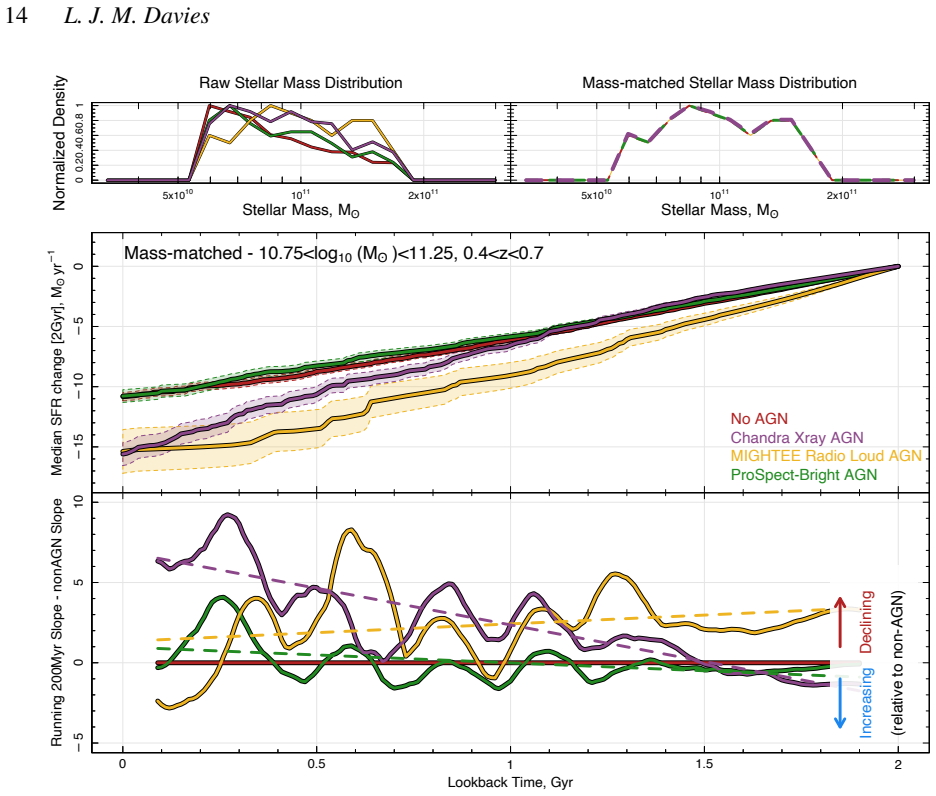
Significance. If the result holds, this is a valuable observational constraint: it directly connects a frequently used aggregate statistic (the sSFR–M* dispersion) to a physical quenching mechanism, and it does so with three independent AGN selections. The paper's strengths include the explicit prior-sensitivity refits (Section 2.3, Figure 2), the SHARK-based recovery validation (median offset 0.01, MAD 0.05), the no-AGN refit checks discussed in Section 3.2.2, and the stellar-mass-matched SFH comparison in Section 3.3. The central caveat is that ΔSFH_200Myr is a parametric quantity derived from a skew-log-normal SFH, and the recovery validation is performed on smooth mock SFHs; if the functional form biases real, more diverse SFHs toward declining shapes, the rapidly quenching class and its AGN association would be partly an artifact. The manuscript is candid about this limitation, but the issue is load-bearing and needs a more demanding test.
major comments (3)
- [Section 3.2.2, paragraph beginning 'One possible issue with this analysis'] The definition of the rapidly quenching class rests entirely on ΔSFH_200Myr values recovered by ProSpect under a truncated skew-log-normal SFH. The paper itself states that the peaked ΔSFH distribution is 'driven by the overall methodology using a skew-log-normal distribution,' and Figure 2 shows that the observed negative-side distribution tracks the distribution generated from random prior draws. The only recovery validation (median offset 0.01, MAD 0.05) is against SHARK mock galaxies whose SFHs are smooth parametric forms, so it does not test whether episodic, step-like, or otherwise non-smooth real SFHs are recovered without a systematic bias toward declining shapes. Because a bias of this kind would create the rapidly declining population and hence the AGN overabundance in Figures 5 and 6, I request an additional recovery test using non-smooth SFHs (or a non-parametric refit of a subset of DEVILS galaxies) and a quantitative statement of how large a ΔSFH bias would be required to erase the observed AGN excess.
- [Section 3.3 / Figure 7] The claim that refitting without an AGN component produces 'almost no difference' in the positions of X-ray and radio AGN in the ΔSFH_200Myr and sSFR planes is asserted but not shown quantitatively. Since this is the key check that the AGN–SFH association is not induced by jointly fitting the AGN component and the SFH, the paper should present the equivalent distributions (or a table of median offsets and AGN fractions) for the no-AGN fits. Without those numbers, the independence of the central result from co-fitting remains a matter of assertion rather than demonstration.
- [Section 3.3 / Figure 7] The stellar-mass-controlled comparison in Figure 7 is used to argue that X-ray AGN are associated with an ongoing quenching event and radio AGN with a past one, based on the running slope of the median SFH relative to the non-AGN sample. The plotted Poisson error polygons on the median SFHs do not directly quantify the uncertainty on the running-slope difference, and no statistical test is given for the divergence at ~1 Gyr in the X-ray panel. Given the small number of radio-loud AGN (497 in the full sample) and the non-unique membership across AGN classes, bootstrap confidence intervals on the running slopes or a formal comparison test are needed to support the different-phases interpretation.
minor comments (5)
- [Abstract] The abstract contains a typo: 'can be be largely split' should read 'can be largely split'.
- [Section 2.3] The sentence 'we are argue that there is no evidence' should be corrected to 'we argue that there is no evidence'.
- [Section 2.2 / Section 4.1.3] The quantity M*_σ-min is used throughout but is not defined in this paper; a one-sentence definition referring to D22 (or Paper I) would make the paper more self-contained.
- [Figure 5 and Figure 6] The axis label 'ΔSFR200Myr' appears in Figure 5's color bar label while the text consistently uses ΔSFH_200Myr; please use a single notation throughout.
- [Appendix A2] The text refers to 'Cook et al (in prep)' while the reference list contains Cook et al. (2025); please unify the citation.
Circularity Check
No constructional circularity: the AGN–SFH association is tested with X-ray and radio AGN independent of the ProSpect fit, and the co-fit degeneracy is explicitly controlled.
full rationale
The central empirical claim is that galaxies with rapidly declining recent SFHs at stellar masses above M*_sigma-min show an overabundance of AGN, and that this supports AGN feedback as the driver of high sSFR dispersion. This is not a self-definitional result: the recent SFH metric DeltaSFH_200Myr is derived from ProSpect SED fitting, while AGN are selected by three independent methods. The X-ray (Chandra COSMOS-Legacy) and radio (MIGHTEE) AGN samples are external catalogues that do not use the ProSpect AGN component, so the AGN–SFH correlation is not forced by construction. The paper explicitly acknowledges the potential degeneracy in Section 3.2.1, where in-situ sSFR, DeltaSFH_200Myr and AGN luminosity are all ProSpect-derived, and then breaks this degeneracy in Section 3.2.2 by repeating the comparison using ProSpect fits without an AGN component, finding almost no difference for X-ray and radio AGN. The M*_sigma-min boundary is imported from the same team's D22 work, but it is a previously measured population property, not a parameter fitted to the AGN–DeltaSFH correlation, and the fact that the AGN overabundance tracks this boundary is a new comparison rather than an identity. The main vulnerability is the parametric skew-log-normal SFH assumption, which the paper itself concedes shapes the DeltaSFH_200Myr distribution (Section 2.3), and the recovery validation is performed on SHARK mock galaxies from same-team simulation papers. This is a genuine methodological limitation and a moderate self-citation load, but it is not a circular reduction: no equation equates the AGN excess to the SFH functional form, and the independent X-ray and radio selections preserve external content. The causal statement that AGN feedback is the 'primary driver' is explicitly framed as a suggestion consistent with theory, not as a derived consequence. Overall, the derivation chain is not circular in the constructional sense; the score of 2 reflects the admitted model dependence and the heavy reliance on same-team validation rather than any by-construction equivalence.
Assumptions & free parameters
free parameters (4)
- ProSpect SFH shape parameters (mSFR, mpeak, mperiod, mskew, Zfinal) =
Fitted per galaxy to broadband photometry (Thorne et al. 2022)
- Common-SFH region boundaries (regions 1 to 6) =
Hand-drawn from binned median ΔSFH in paper I (Figure 1 here)
- AGN fraction threshold =
0.1 (Thorne et al. 2022)
- AGN luminosity thresholds =
10^41 erg/s analysis cut and D'Silva et al. (2023) completeness limits
assumptions (6)
- domain assumption ProSpect's skew-log-normal truncated SFH is an appropriate functional form for galaxy SFHs
- domain assumption Change in SFR over the last 200 Myr (ΔSFH_200Myr) captures a galaxy's trajectory through the sSFR-M★ plane
- domain assumption SHARK semi-analytic model galaxies are a valid proxy for real galaxies in testing SFH recovery
- standard math Bruzual and Charlot (2003) templates with Chabrier (2003) IMF and the Charlot and Fall (2000) and Dale et al. (2014) dust models are valid
- domain assumption The minimum SFR dispersion mass M*_σ-min (D22) is a physically meaningful boundary between evolution regimes
- domain assumption AGN fraction greater than 0.1 from ProSpect and the D'Silva et al. (2023) AGN completeness limits reliably identify AGN in SED fits
Cite this review
Pith. "Pith review of Deep Extragalactic VIsible Legacy Survey (DEVILS): The sSFR-M$_{\star}$ plane part II: Starbursts, SFHs and AGN Feedback." pith.science (2026). https://pith.science/paper/C4VHR2RG
@misc{pith2026250521948,
  author       = {Pith},
  title        = {Pith review of: Deep Extragalactic VIsible Legacy Survey (DEVILS): The sSFR-M$_\star$ plane part II: Starbursts, SFHs and AGN Feedback},
  year         = {2026},
  howpublished = {\url{https://pith.science/paper/C4VHR2RG}},
  note         = {Machine review of arXiv:2505.21948}
}
abstract
In part I of this series we discussed the variation of star-formation histories (SFHs) across the specific star formation rate - stellar mass plane (sSFR-M$_{\star}$) using the Deep Extragalactic VIsible Legacy Survey (DEVILS). Here we explore the physical mechanisms that are likely driving these observational trends, by comparing the properties of galaxies with common recent SFH shapes. Overall, we find that the processes shaping the movement of galaxies through the sSFR-M$_{\star}$ plane can be be largely split into two stellar mass regimes, bounded by the minimum SFR dispersion ($\sigma_{SFR}$) point. At lower stellar masses we find that large $\sigma_{SFR}$ values are likely observed due to a combination of stochastic star-formation processes and a large variety in absolute sSFR values, but relatively constant/flat SFHs. While at higher stellar masses we see strong observational evidence that Active Galactic Nuclei (AGN) are associated with rapidly declining SFHs, and that these galaxies reside in the high $\sigma_{SFR}$ region of the plane. As such, we suggest that AGN feedback, leading to galaxy quenching, is the primary driver of the high $\sigma_{SFR}$ values. These results are consistent with previous theoretical interpretations of the $\sigma_{SFR}$-M$_{\star}$ relation.
Figures


Figures from the paper (5 more)



Reference graph
Works this paper leans on
-
[1]
E., Kelson, D
Abramson, L. E., Kelson, D. D., Dressler, A., et al.\ 2014, , 785, L36
2014
-
[2]
E., Gladders, M
Abramson, L. E., Gladders, M. D., Dressler, A., et al.\ 2016, , 832, 7
2016
-
[3]
Alexander D. M., Hickox R. C., 2012, NewAR, 56, 93. doi:10.1016/j.newar.2011.11.003
-
[4]
Almeida I., Nemmen R., Riffel R. A., 2023, MNRAS, 526, 217. doi:10.1093/mnras/stad2673
-
[5]
Arango-Toro R. C., Ilbert O., Ciesla L., Shuntov M., Aufort G., Mercier W., Laigle C., et al., 2024, arXiv, arXiv:2410.05375. doi:10.48550/arXiv.2410.05375
-
[6]
Asada Y., Sawicki M., Abraham R., Brada c M., Brammer G., Desprez G., Estrada-Carpenter V., et al., 2024, MNRAS, 527, 11372. doi:10.1093/mnras/stad3902
-
[7]
Baldry I. K., Liske J., Brown M. J. I., Robotham A. S. G., Driver S. P., Dunne L., Alpaslan M., et al., 2018, MNRAS, 474, 3875. doi:10.1093/mnras/stx3042
-
[8]
Barro G., Faber S. M., P \'e rez-Gonz \'a lez P. G., Koo D. C., Williams C. C., Kocevski D. D., Trump J. R., et al., 2013, ApJ, 765, 104. doi:10.1088/0004-637X/765/2/104
Show all 261 references
-
[9]
M., 2006, RPPh, 69, 3101
Baugh C. M., 2006, RPPh, 69, 3101
2006
-
[10]
S., Devriendt J., Slyz A., Peirani S., Richardson M
Beckmann R. S., Devriendt J., Slyz A., Peirani S., Richardson M. L. A., Dubois Y., Pichon C., et al., 2017, MNRAS, 472, 949. doi:10.1093/mnras/stx1831
2017 doi
-
[11]
P., Robotham A
Bellstedt S., Driver S. P., Robotham A. S. G., Davies L. J. M., Bogue C. R. J., Cook R. H. W., Hashemizadeh A., et al., 2020, MNRAS, 496, 3235. doi:10.1093/mnras/staa1466
2020 doi
-
[12]
Bellstedt S., Robotham A. S. G., Driver S. P., Thorne J. E., Davies L. J. M., Holwerda B. W., Hopkins A. M., et al., 2021, MNRAS, 503, 3309. doi:10.1093/mnras/stab550
2021 doi
-
[13]
Bellstedt S., Robotham A. S. G., Driver S. P., Lagos C. del P., Davies L. J. M., Cook R. H. W., 2024, MNRAS, 528, 5452. doi:10.1093/mnras/stae394
2024 doi
- [14]
-
[15]
R., Eisenstein D., Hogg D
Blanton M. R., Eisenstein D., Hogg D. W., Schlegel D. J., Brinkmann J., 2005, ApJ, 629, 143. doi:10.1086/422897
2005 doi
-
[16]
F., Satyapal S., Ellison S
Blecha L., Snyder G. F., Satyapal S., Ellison S. L., 2018, MNRAS, 478, 3056. doi:10.1093/mnras/sty1274
2018 doi
-
[17]
Bluck A. F. L., Maiolino R., Brownson S., Conselice C. J., Ellison S. L., Piotrowska J. M., Thorp M. D., 2022, A&A, 659, A160. doi:10.1051/0004-6361/202142643
2022 doi
-
[18]
doi:10.1051/0004-6361/201527436
Bongiorno A., Schulze A., Merloni A., Zamorani G., Ilbert O., La Franca F., Peng Y., et al., 2016, A&A, 588, A78. doi:10.1051/0004-6361/201527436
2016 doi
-
[19]
A., Brinchmann J., Bouch \'e N., Paalvast M., Bacon R., Bouwens R
Boogaard L. A., Brinchmann J., Bouch \'e N., Paalvast M., Bacon R., Bouwens R. J., Contini T., et al., 2018, A&A, 619, A27. doi:10.1051/0004-6361/201833136
2018 doi
-
[20]
Bouch \'e , N., Dekel, A., Genzel, R., et al.\ 2010, , 718, 1001
2010
-
[21]
J., Combes F., 2007, A&A, 476, 1179
Bournaud F., Jog C. J., Combes F., 2007, A&A, 476, 1179. doi:10.1051/0004-6361:20078010
2007 doi
-
[22]
G., Benson A
Bower R. G., Benson A. J., Malbon R., Helly J. C., Frenk C. S., Baugh C. M., Cole S., et al., 2006, MNRAS, 370, 645. doi:10.1111/j.1365-2966.2006.10519.x
2006
-
[23]
Bravo M., Robotham A. S. G., Lagos C. del P., Davies L. J. M., Bellstedt S., Thorne J. E., 2022, MNRAS, 511, 5405. doi:10.1093/mnras/stac321
2022 doi
- [24]
-
[25]
N., Phillipps S., Kelvin L
Bremer M. N., Phillipps S., Kelvin L. S., De Propris R., Kennedy R., Moffett A. J., Bamford S., et al., 2018, MNRAS, 476, 12. doi:10.1093/mnras/sty124
2018 doi
-
[26]
Brinchmann J., Charlot S., White S. D. M., Tremonti C., Kauffmann G., Heckman T., Brinkmann J., 2004, MNRAS, 351, 1151. doi:10.1111/j.1365-2966.2004.07881.x
2004
-
[27]
S., Dav \'e R., Finkelstein S., et al., 2019, ApJ, 873, 74
Broussard A., Gawiser E., Iyer K., Kurczynski P., Somerville R. S., Dav \'e R., Finkelstein S., et al., 2019, ApJ, 873, 74. doi:10.3847/1538-4357/ab04ad
2019 doi
-
[29]
S., Kodama T., Conselice C
Bundy K., Fukugita M., Ellis R. S., Kodama T., Conselice C. J., 2004, ApJ, 601, L123
2004
-
[30]
S., Targett T
Bundy K., Fukugita M., Ellis R. S., Targett T. A., Belli S., Kodama T., 2009, ApJ, 697, 1369
2009
-
[31]
doi:10.1093/mnras/stz1449
Caplar N., Tacchella S., 2019, MNRAS, 487, 3845. doi:10.1093/mnras/stz1449
2019 doi
-
[32]
C., Leja J., Johnson B
Carnall A. C., Leja J., Johnson B. D., McLure R. J., Dunlop J. S., Conroy C., 2019, ApJ, 873, 44. doi:10.3847/1538-4357/ab04a2
2019 doi
-
[33]
S., Ostriker J
Choi E., Somerville R. S., Ostriker J. P., Naab T., Hirschmann M., 2018, ApJ, 866, 91. doi:10.3847/1538-4357/aae076
2018 doi
-
[34]
doi:10.1051/0004-6361/201731036
Ciesla L., Elbaz D., Fensch J., 2017, A&A, 608, A41. doi:10.1051/0004-6361/201731036
2017 doi
-
[35]
doi:10.1051/0004-6361/202140762
Ciesla L., Buat V., Boquien M., Boselli A., Elbaz D., Aufort G., 2021, A&A, 653, A6. doi:10.1051/0004-6361/202140762
2021 doi
- [36]
-
[37]
Handbook of Methods of Applied Statistics, Volume I,
Chakravarti I., Laha R., Roy J., 1967, “Handbook of Methods of Applied Statistics, Volume I,” John Wiley and Sons, Hoboken, pp. 392-394
1967
- [38]
-
[39]
I., 2004, ApJ, 616, 192
Christlein D., Zabludoff A. I., 2004, ApJ, 616, 192. doi:10.1086/424909
2004 doi
-
[41]
C., Elvis M., Cappelluti N., Puccetti S., et al., 2016, ApJ, 819, 62
Civano F., Marchesi S., Comastri A., Urry M. C., Elvis M., Cappelluti N., Puccetti S., et al., 2016, ApJ, 819, 62. doi:10.3847/0004-637X/819/1/62
2016 doi
-
[42]
M., Negus J., M \"u ller-S \'a nchez F., Eracleous M., Wylezalek D., Storchi-Bergmann T., Greene J
Comerford J. M., Negus J., M \"u ller-S \'a nchez F., Eracleous M., Wylezalek D., Storchi-Bergmann T., Greene J. E., et al., 2020, ApJ, 901, 159. doi:10.3847/1538-4357/abb2ae
2020 doi
-
[43]
J., 2014, ARA&A, 52, 291
Conselice C. J., 2014, ARA&A, 52, 291
2014
-
[44]
J., Cotton W
Condon J. J., Cotton W. D., Greisen E. W., Yin Q. F., Perley R. A., Taylor G. B., Broderick J. J., 1998, AJ, 115, 1693
1998
-
[45]
Cook R. H. W., Cortese L., Catinella B., Robotham A., 2020, MNRAS, 493, 5596. doi:10.1093/mnras/staa666
2020 doi
-
[46]
Cook R. H. W., Davies L. J. M., Rhee J., Hale C. L., Bellstedt S., Thorne J. E., Delvecchio I., et al., 2024, MNRAS, 531, 708. doi:10.1093/mnras/stae1215
2024 doi
-
[47]
Cook R. H. W., Davies L. J. M., Bellstedt S., Robotham A. S. G., Driver S. P., Siudek M., Wolf C., 2025, MNRAS.tmp. doi:10.1093/mnras/staf575
2025 doi
-
[48]
Cortese L., Catinella B., Boissier S., Boselli A., Heinis S., 2011, MNRAS, 415, 1797
2011
-
[49]
P., Catinella B., Davies L
Cortese L., van de Sande J., Lagos C. P., Catinella B., Davies L. J. M., Croom S. M., Brough S., et al., 2019, MNRAS, 485, 2656. doi:10.1093/mnras/stz485
2019 doi
-
[50]
A., Schaye, J., Bower, R
Crain, R. A., Schaye, J., Bower, R. G., et al.\ 2015, , 450, 1937
2015
-
[51]
M., Taranu D
Croom S. M., Taranu D. S., van de Sande J., Lagos C. D. P., Harborne K. E., Bland-Hawthorn J., Brough S., et al., 2021, MNRAS, 505, 2247. doi:10.1093/mnras/stab1494
2021 doi
-
[52]
J., Springel V., White S
Croton D. J., Springel V., White S. D. M., De Lucia G., Frenk C. S., Gao L., Jenkins A., et al., 2006, MNRAS, 365, 11. doi:10.1111/j.1365-2966.2005.09675.x
2006
-
[54]
Daddi, E., Bournaud, F., Walter, F., et al.\ 2010, , 713, 686
2010
-
[55]
A., Helou G., Magdis G
Dale D. A., Helou G., Magdis G. E., Armus L., D \' az-Santos T., Shi Y., 2014, ApJ, 784, 83. doi:10.1088/0004-637X/784/1/83
2014 doi
-
[56]
Dalla Vecchia, C., & Schaye, J.\ 2008, , 387, 1431
2008
-
[57]
G., Taylor E
Damen M., Labb \'e I., Franx M., van Dokkum P. G., Taylor E. N., Gawiser E. J., 2009, ApJ, 690, 937. doi:10.1088/0004-637X/690/1/937
2009 doi
-
[58]
J., Geller M
Damjanov I., Zahid H. J., Geller M. J., Fabricant D. G., Hwang H. S., 2018, ApJS, 234, 21
2018
-
[59]
A., Dubois Y., Hartwig T., 2018, MNRAS, 473, 5698
Dashyan G., Silk J., Mamon G. A., Dubois Y., Hartwig T., 2018, MNRAS, 473, 5698. doi:10.1093/mnras/stx2716
2018 doi
-
[60]
doi:10.3847/0004-637X/825/2/113
Darvish B., Mobasher B., Sobral D., Rettura A., Scoville N., Faisst A., Capak P., 2016, ApJ, 825, 113. doi:10.3847/0004-637X/825/2/113
2016 doi
-
[61]
Darvish B., Martin C., Goncalves T., Mobasher B., Scoville N., Sobral D., van der Wel A., 2018, AAS
2018
-
[62]
D., Kollmeier, J
Dav \'e , R., Katz, N., Oppenheimer, B. D., Kollmeier, J. A., & Weinberg, D. H.\ 2013, , 434, 2645
2013
-
[63]
Davies L. J. M., et al., 2015, MNRAS, 447, 1014
2015
-
[64]
Davies L. J. M., et al., 2015, MNRAS, 452, 616
2015
-
[65]
Davies L. J. M., et al., 2016, MNRAS, 455, 4013
2016
-
[66]
Davies L. J. M., et al., 2016, MNRAS, 461, 458
2016
-
[67]
Davies L. J. M., Huynh M. T., Hopkins A. M., Seymour N., Driver S. P., Robotham A. G. R., Baldry I. K., et al., 2017, MNRAS, 466, 2312. doi:10.1093/mnras/stw3080
2017 doi
-
[68]
Davies L. J. M., et al., 2018, MNRAS, 480, 768
2018
-
[69]
Davies L. J. M., Lagos C. del P., Katsianis A., Robotham A. S. G., Cortese L., Driver S. P., Bremer M. N., et al., 2019, MNRAS, 483, 1881. doi:10.1093/mnras/sty2957
2019 doi
-
[70]
Davies L. J. M., Robotham A. S. G., Lagos C. del P., Driver S. P., Stevens A. R. H., Bah \'e Y. M., Alpaslan M., et al., 2019, MNRAS, 483, 5444. doi:10.1093/mnras/sty3393
2019 doi
-
[71]
Davies L. J. M., Thorne J. E., Robotham A. S. G., Bellstedt S., Driver S. P., Adams N. J., Bilicki M., et al., 2021, MNRAS, 506, 256. doi:10.1093/mnras/stab1601
2021 doi
-
[72]
Davies L. J. M., Thorne J. E., Bellstedt S., Bravo M., Robotham A. S. G., Driver S. P., Cook R. H. W., et al., 2022, MNRAS, 509, 4392. doi:10.1093/mnras/stab3145
2022 doi
-
[73]
Dekel, A., & Silk, J.\ 1986, , 303, 39
1986
-
[74]
J., Zamorani G., Pozzi F., Gruppioni C., et al., 2015, MNRAS, 449, 373
Delvecchio I., Lutz D., Berta S., Rosario D. J., Zamorani G., Pozzi F., Gruppioni C., et al., 2015, MNRAS, 449, 373. doi:10.1093/mnras/stv213
2015 doi
-
[75]
Delvecchio I., Smol c i \'c V., Zamorani G., Lagos C. D. P., Berta S., Delhaize J., Baran N., et al., 2017, A&A, 602, A3. doi:10.1051/0004-6361/201629367
2017 doi
-
[76]
de Ravel L., et al., 2009, A&A, 498, 379
2009
-
[77]
doi:10.1093/mnras/stac884
Dimauro P., Daddi E., Shankar F., Cattaneo A., Huertas-Company M., Bernardi M., Caro F., et al., 2022, MNRAS, 513, 256. doi:10.1093/mnras/stac884
2022 doi
-
[78]
E., Torrey P., 2017, ApJ, 839, 26
Diemer B., Sparre M., Abramson L. E., Torrey P., 2017, ApJ, 839, 26. doi:10.3847/1538-4357/aa68e5
2017 doi
-
[79]
Dressler A., 1980, ApJ, 236, 351
1980
-
[80]
P., Robotham A
Driver S. P., Robotham A. S. G., 2010, MNRAS, 407, 2131
2010
-
[81]
P., et al., 2011, MNRAS, 413, 971
Driver S. P., et al., 2011, MNRAS, 413, 971
2011
-
[82]
P., et al., 2016, ApJ, 827, 108
Driver S. P., et al., 2016, ApJ, 827, 108
2016
-
[83]
P., Davies L
Driver S. P., Davies L. J., Meyer M., Power C., Robotham A. S. G., Baldry I. K., Liske J., Norberg P., 2016, ASSP, 42, 205
2016
-
[84]
P., et al., 2018, MNRAS, 475, 2891
Driver S. P., et al., 2018, MNRAS, 475, 2891
2018
-
[85]
P., Liske J., Davies L
Driver S. P., Liske J., Davies L. J. M., Robotham A. S. G., Baldry I. K., Brown M. J. I., Cluver M., et al., 2019, Msngr, 175, 46. doi:10.18727/0722-6691/5126
2019 doi
-
[86]
D'Silva J. C. J., Driver S. P., Lagos C. D. P., Robotham A. S. G., Bellstedt S., Davies L. J. M., Thorne J. E., et al., 2023, MNRAS, 524, 1448. doi:10.1093/mnras/stad1974
2023 doi
-
[87]
doi:10.1111/j.1365-2966.2008.13639.x
Dye S., 2008, MNRAS, 389, 1293. doi:10.1111/j.1365-2966.2008.13639.x
2008
-
[88]
Eales S., et al., 2015, MNRAS, 452, 3489
2015
-
[89]
Eardley E., et al., 2015, MNRAS, 448, 3665
2015
-
[90]
Elbaz D., et al., 2007, A&A, 468, 33
2007
-
[91]
S., et al.\ 2011, , 533, A119
Elbaz, D., Dickinson, M., Hwang, H. S., et al.\ 2011, , 533, A119
2011
-
[92]
L., Patton D
Ellison S. L., Patton D. R., Simard L., McConnachie A. W., 2008, AJ, 135, 1877. doi:10.1088/0004-6256/135/5/1877
2008 doi
-
[93]
L., Viswanathan A., Patton D
Ellison S. L., Viswanathan A., Patton D. R., Bottrell C., McConnachie A. W., Gwyn S., Cuillandre J.-C., 2019, MNRAS, 487, 2491. doi:10.1093/mnras/stz1431
2019 doi
-
[94]
R., Johnson B
Emami N., Siana B., Weisz D. R., Johnson B. D., Ma X., El-Badry K., 2019, ApJ, 881, 71. doi:10.3847/1538-4357/ab211a
2019 doi
-
[95]
Erfanianfar, G., Popesso, P., Finoguenov, A., et al.\ 2016, , 455, 2839
2016
-
[96]
C., 2012, ARA&A, 50, 455
Fabian A. C., 2012, ARA&A, 50, 455. doi:10.1146/annurev-astro-081811-125521
2012 doi
-
[97]
L., Carollo C
Faisst A. L., Carollo C. M., Capak P. L., Tacchella S., Renzini A., Ilbert O., McCracken H. J., et al., 2017, ApJ, 839, 71. doi:10.3847/1538-4357/aa697a
2017 doi
-
[98]
doi:10.1093/mnras/stu2207
Feldmann R., Mayer L., 2015, MNRAS, 446, 1939. doi:10.1093/mnras/stu2207
2015 doi
-
[99]
Fern \'a ndez X., et al., 2013, ApJ, 770, L29
2013
-
[100]
T., Sanders D
Frayer D. T., Sanders D. B., Surace J. A., Aussel H., Salvato M., Le Floc'h E., Huynh M. T., et al., 2009, AJ, 138, 1261. doi:10.1088/0004-6256/138/5/1261
2009 doi
-
[101]
F., Davies L
Fuentealba-Fuentes M. F., Davies L. J. M., Robotham A. S. G., Cook R. H. W., Bellstedt S., Lagos C. D. P., Bravo M., et al., 2025, MNRAS, 539, 1651. doi:10.1093/mnras/staf596
2025 doi
-
[102]
Garilli B., et al., 2014, A&A, 562, A23
2014
-
[103]
doi:10.1093/mnras/stx3078
Genel S., Nelson D., Pillepich A., Springel V., Pakmor R., Weinberger R., Hernquist L., et al., 2018, MNRAS, 474, 3976. doi:10.1093/mnras/stx3078
2018 doi
-
[104]
J., Gracia-Carpio, J., et al.\ 2010, , 407, 2091
Genzel, R., Tacconi, L. J., Gracia-Carpio, J., et al.\ 2010, , 407, 2091
2010
-
[105]
P., 1985, ApJ, 292, 404
Giovanelli R., Haynes M. P., 1985, ApJ, 292, 404
1985
-
[106]
D., Oemler A., Dressler A., Poggianti B., Vulcani B., Abramson L., 2013, ApJ, 770, 64
Gladders M. D., Oemler A., Dressler A., Poggianti B., Vulcani B., Abramson L., 2013, ApJ, 770, 64. doi:10.1088/0004-637X/770/1/64
2013 doi
-
[107]
D., Engelbracht C
Gordon K. D., Engelbracht C. W., Rieke G. H., Misselt K. A., Smith J.-D. T., Kennicutt R. C., 2008, ApJ, 682, 336. doi:10.1086/589567
2008 doi
-
[108]
Z., Fu H., 2013, ApJ, 778, 23
Guo K., Zheng X. Z., Fu H., 2013, ApJ, 778, 23. doi:10.1088/0004-637X/778/1/23
2013 doi
-
[109]
Z., Wang, T., & Fu, H.\ 2015, , 808, L49
Guo, K., Zheng, X. Z., Wang, T., & Fu, H.\ 2015, , 808, L49
2015
-
[110]
W., Tuffs, R
Grootes, M. W., Tuffs, R. J., Popescu, C. C., et al.\ 2014, , 437, 3883
2014
-
[111]
W., Tuffs, R
Grootes, M. W., Tuffs, R. J., Popescu, C. C., et al.\ 2017, , 153, 111
2017
-
[112]
W., Dvornik, A., Laureijs, R
Grootes, M. W., Dvornik, A., Laureijs, R. J., et al.\ 2018, , 477, 1015
2018
-
[113]
E., Gott J
Gunn J. E., Gott J. R., III, 1972, ApJ, 176, 1
1972
-
[114]
K., Choi E., Dav \'e R., Dickey C
Hahn C., Starkenburg T. K., Choi E., Dav \'e R., Dickey C. M., Geha M. C., Genel S., et al., 2019, ApJ, 872, 160. doi:10.3847/1538-4357/aafedd
2019 doi
- [115]
-
[116]
M., Ramos Almeida C., 2024, Galax, 12, 17
Harrison C. M., Ramos Almeida C., 2024, Galax, 12, 17. doi:10.3390/galaxies12020017
2024 doi
-
[117]
P., Davies L
Hashemizadeh A., Driver S. P., Davies L. J. M., Robotham A. S. G., Bellstedt S., Windhorst R. A., Bremer M., et al., 2021, MNRAS, 505, 136. doi:10.1093/mnras/stab600
2021 doi
-
[118]
W., Lindsay S
Hatfield P. W., Lindsay S. N., Jarvis M. J., H \"a u ler B., Vaccari M., Verma A., 2016, MNRAS, 459, 2618
2016
-
[119]
M., et al., 2016, SPIE, 9908, 99088I
Haynes D. M., et al., 2016, SPIE, 9908, 99088I
2016
-
[120]
Head J. T. C. G., Lucey J. R., Hudson M. J., Smith R. J., 2014, MNRAS, 440, 1690. doi:10.1093/mnras/stu325
2014 doi
-
[121]
J., Hale C
Heywood I., Jarvis M. J., Hale C. L., Whittam I. H., Bester H. L., Hugo B., Kenyon J. S., et al., 2022, MNRAS, 509, 2150. doi:10.1093/mnras/stab3021
2022 doi
-
[122]
W., Blyth S., Baker A
Holwerda B. W., Blyth S., Baker A. J., MeerKAT Deep HI Survey Team, 2011, AAS, 43, 433.17
2011
-
[123]
M., Beacom J
Hopkins A. M., Beacom J. F., 2006, ApJ, 651, 142
2006
-
[124]
F., Cox T
Hopkins P. F., Cox T. J., Kere s D., Hernquist L., 2008, ApJS, 175, 390-422
2008
-
[125]
F., Bundy K., Croton D., Hernquist L., Keres D., Khochfar S., Stewart K., et al., 2010, ApJ, 715, 202
Hopkins P. F., Bundy K., Croton D., Hernquist L., Keres D., Khochfar S., Stewart K., et al., 2010, ApJ, 715, 202. doi:10.1088/0004-637X/715/1/202
2010 doi
-
[126]
F., Quataert E., Murray N., 2011, MNRAS, 417, 950
Hopkins P. F., Quataert E., Murray N., 2011, MNRAS, 417, 950. doi:10.1111/j.1365-2966.2011.19306.x
2011
-
[127]
M., Driver S
Hopkins A. M., Driver S. P., Brough S., Owers M. S., Bauer A. E., Gunawardhana M. L. P., Cluver M. E., et al., 2013, MNRAS, 430, 2047. doi:10.1093/mnras/stt030
2013 doi
-
[128]
J., Sinha M., 2023, MNRAS, 522, L11
Houston T., Croton D. J., Sinha M., 2023, MNRAS, 522, L11. doi:10.1093/mnrasl/slad031
2023 doi
-
[129]
doi:10.1051/0004-6361/201425176
Ilbert O., Arnouts S., Le Floc'h E., Aussel H., Bethermin M., Capak P., Hsieh B.-C., et al., 2015, A&A, 579, A2. doi:10.1051/0004-6361/201425176
2015 doi
-
[130]
L., Kodra D., Koekemoer A
Iyer K., Gawiser E., Dav \'e R., Davis P., Finkelstein S. L., Kodra D., Koekemoer A. M., et al., 2018, ApJ, 866, 120. doi:10.3847/1538-4357/aae0fa
2018 doi
-
[131]
G., Gawiser E., Faber S
Iyer K. G., Gawiser E., Faber S. M., Ferguson H. C., Kartaltepe J., Koekemoer A. M., Pacifici C., et al., 2019, ApJ, 879, 116. doi:10.3847/1538-4357/ab2052
2019 doi
-
[132]
R., Deane R
Jarvis M., Taylor R., Agudo I., Allison J. R., Deane R. P., Frank B., Gupta N., et al., 2016, mks..conf, 6. doi:10.22323/1.277.0006
2016 doi
-
[133]
Jogee S., et al., 2009, ApJ, 697, 1971
2009
-
[134]
doi:10.1093/mnras/stv1715
Johnston R., Vaccari M., Jarvis M., Smith M., Giovannoli E., H \"a u ler B., Prescott M., 2015, MNRAS, 453, 2540. doi:10.1093/mnras/stv1715
2015 doi
-
[135]
D., Leja J., Conroy C., Speagle J
Johnson B. D., Leja J., Conroy C., Speagle J. S., 2021, ApJS, 254, 22. doi:10.3847/1538-4365/abef67
2021 doi
-
[136]
S., et al., 2007, ApJS, 172, 320
Kartaltepe J. S., et al., 2007, ApJS, 172, 320
2007
-
[137]
Katsianis, A., Tescari, E., & Wyithe, J. S. B.\ 2016, , 33, e029
2016
-
[138]
P., et al.\ 2017, , 472, 919
Katsianis, A., Blanc, G., Lagos, C. P., et al.\ 2017, , 472, 919
2017
-
[139]
del P., Davies L
Katsianis A., Zheng X., Gonzalez V., Blanc G., Lagos C. del P., Davies L. J. M., Camps P., et al., 2019, ApJ, 879, 11. doi:10.3847/1538-4357/ab1f8d
2019 doi
-
[140]
M., White S
Kauffmann G., Heckman T. M., White S. D. M., Charlot S., Tremonti C., Brinchmann J., Bruzual G., et al., 2003, MNRAS, 341, 33. doi:10.1046/j.1365-8711.2003.06291.x
2003
-
[141]
Kauffmann G., White S. D. M., Heckman T. M., M \'e nard B., Brinchmann J., Charlot S., Tremonti C., Brinkmann J., 2004, MNRAS, 353, 713
2004
-
[142]
M., De Lucia G., Brinchmann J., Charlot S., Tremonti C., White S
Kauffmann G., Heckman T. M., De Lucia G., Brinchmann J., Charlot S., Tremonti C., White S. D. M., Brinkmann J., 2006, MNRAS, 367, 1394
2006
-
[143]
S., 2008, ApJL, 672, L103
Kawata D., Mulchaey J. S., 2008, ApJL, 672, L103. doi:10.1086/526544
2008 doi
-
[144]
C., Evans N
Kennicutt R. C., Evans N. J., 2012, ARA&A, 50, 531
2012
-
[145]
F., Cleri N
Kirkpatrick A., Yang G., Le Bail A., Troiani G., Bell E. F., Cleri N. J., Elbaz D., et al., 2023, ApJL, 959, L7. doi:10.3847/2041-8213/ad0b14
2023 doi
- [146]
-
[147]
C., 2013, ARA&A, 51, 511
Kormendy J., Ho L. C., 2013, ARA&A, 51, 511
2013
-
[148]
Lagos, C. D. P., Lacey, C. G., Baugh, C. M., Bower, R. G., & Benson, A. J.\ 2011, , 416, 1566
2011
-
[149]
Lagos C. d. P., et al., 2018, MNRAS, 473, 4956
2018
-
[150]
del P., Tobar R
Lagos C. del P., Tobar R. J., Robotham A. S. G., Obreschkow D., Mitchell P. D., Power C., Elahi P. J., 2018, MNRAS, 481, 3573. doi:10.1093/mnras/sty2440
2018 doi
-
[151]
del P., Bravo M., Tobar R., Obreschkow D., Power C., Robotham A
Lagos C. del P., Bravo M., Tobar R., Obreschkow D., Power C., Robotham A. S. G., Proctor K. L., et al., 2024, MNRAS, 531, 3551. doi:10.1093/mnras/stae1024
2024 doi
-
[152]
Lange R., et al., 2015, MNRAS, 447, 2603
2015
-
[153]
A., Hopkins A
Lara-L \'o pez M. A., Hopkins A. M., L \'o pez-S \'a nchez A. R., Brough S., Gunawardhana M. L. P., Colless M., Robotham A. S. G., et al., 2013, MNRAS, 434, 451. doi:10.1093/mnras/stt1031
2013 doi
-
[154]
B., Tinsley B
Larson R. B., Tinsley B. M., Caldwell C. N., 1980, ApJ, 237, 692
1980
-
[155]
Laureijs R., et al., 2011, arXiv, arXiv:1110.3193
2011 arXiv
-
[156]
Leauthaud A., et al., 2012, ApJ, 744, 159
2012
-
[157]
Lee N., et al., 2015, ApJ, 801, 80
2015
-
[158]
C., Ferguson H
Lee B., Giavalisco M., Whitaker K., Williams C. C., Ferguson H. C., Acquaviva V., Koekemoer A. M., et al., 2018, ApJ, 853, 131. doi:10.3847/1538-4357/aaa40f
2018 doi
-
[159]
C., Johnson B
Leja J., Carnall A. C., Johnson B. D., Conroy C., Speagle J. S., 2019, ApJ, 876, 3. doi:10.3847/1538-4357/ab133c
2019 doi
-
[160]
K., Schinnerer E., Liu D., Magnelli B., Algera H., Karim A., Davidzon I., et al., 2020, ApJ, 899, 58
Leslie S. K., Schinnerer E., Liu D., Magnelli B., Algera H., Karim A., Davidzon I., et al., 2020, ApJ, 899, 58. doi:10.3847/1538-4357/aba044
2020 doi
-
[161]
Levenson L., et al., 2010, MNRAS, 409, 83
2010
-
[162]
J., et al., 2007, ApJS, 172, 70
Lilly S. J., et al., 2007, ApJS, 172, 70
2007
-
[163]
J., Carollo, C
Lilly, S. J., Carollo, C. M., Pipino, A., Renzini, A., & Peng, Y.\ 2013, , 772, 119
2013
-
[164]
Lin L., et al., 2016, ApJ, 817, 97
2016
-
[165]
Liske J., et al., 2015, MNRAS, 452, 2087
2015
-
[166]
doi:10.3847/1538-4357/ab1ea0
Liu C., Hao L., Wang H., Yang X., 2019, ApJ, 878, 69. doi:10.3847/1538-4357/ab1ea0
2019 doi
-
[167]
J., et al., 2003, PASP, 115, 897
Lonsdale C. J., et al., 2003, PASP, 115, 897
2003
-
[168]
M., Jonsson P., Cox T
Lotz J. M., Jonsson P., Cox T. J., Croton D., Primack J. R., Somerville R. S., Stewart K., 2011, ApJ, 742, 103
2011
-
[169]
D., Conroy C., Dav \'e R., 2020, ApJ, 904, 33
Lower S., Narayanan D., Leja J., Johnson B. D., Conroy C., Dav \'e R., 2020, ApJ, 904, 33. doi:10.3847/1538-4357/abbfa7
2020 doi
-
[170]
Lutz D., et al., 2011, A&A, 532, A90
2011
-
[171]
T., Almaini O., Wild V., Hatch N
Maltby D. T., Almaini O., Wild V., Hatch N. A., Hartley W. G., Simpson C., Rowlands K., et al., 2018, MNRAS, 480, 381. doi:10.1093/mnras/sty1794
2018 doi
-
[172]
doi:10.1038/s41550-018-0558-1
Man A., Belli S., 2018, NatAs, 2, 695. doi:10.1038/s41550-018-0558-1
2018 doi
-
[173]
doi:10.1088/0004-637X/707/1/250
Martig M., Bournaud F., Teyssier R., Dekel A., 2009, ApJ, 707, 250. doi:10.1088/0004-637X/707/1/250
2009 doi
-
[174]
C., Schaller, M., et al.\ 2016, Astronomy and Computing, 15, 72
McAlpine, S., Helly, J. C., Schaller, M., et al.\ 2016, Astronomy and Computing, 15, 72
2016
-
[175]
Madau, P., Pozzetti, L., & Dickinson, M.\ 1998, , 498, 106
1998
-
[176]
Madau P., Dickinson M., 2014, ARA&A, 52, 415
2014
-
[177]
E., Daddi, E., Sargent, M., et al.\ 2012, , 758, L9
Magdis, G. E., Daddi, E., Sargent, M., et al.\ 2012, , 758, L9
2012
-
[178]
G., F \"o rster Schreiber N
Marchesini D., van Dokkum P. G., F \"o rster Schreiber N. M., Franx M., Labb \'e I., Wuyts S., 2009, ApJ, 701, 1765
2009
-
[179]
doi:10.3847/0004-637X/817/1/34
Marchesi S., Civano F., Elvis M., Salvato M., Brusa M., Comastri A., Gilli R., et al., 2016, ApJ, 817, 34. doi:10.3847/0004-637X/817/1/34
2016 doi
-
[180]
Matthee, J., & Schaye, J.\ 2018, , 479, L34
2018
-
[181]
doi:10.1093/mnras/stz030
Matthee J., Schaye J., 2019, MNRAS, 484, 915. doi:10.1093/mnras/stz030
2019 doi
-
[182]
Mauduit J.-C., et al., 2012, PASP, 124, 714
2012
-
[183]
J., et al., 2012, A&A, 544, A156
McCracken H. J., et al., 2012, A&A, 544, A156
2012
-
[184]
B., Kewley L
McPartland C., Sanders D. B., Kewley L. J., Leslie S. K., 2019, MNRAS, 482, L129. doi:10.1093/mnrasl/sly202
2019 doi
-
[185]
McNaught-Roberts T., et al., 2014, MNRAS, 445, 2125
2014
-
[186]
A., et al., 2013, ApJS, 205, 13
Miller N. A., et al., 2013, ApJS, 205, 13
2013
-
[187]
D., Lacey, C
Mitchell, P. D., Lacey, C. G., Baugh, C. M., & Cole, S.\ 2016, , 456, 1459
2016
-
[188]
J., et al., 2016, MNRAS, 462, 4336
Moffett A. J., et al., 2016, MNRAS, 462, 4336
2016
-
[189]
Moore B., Lake G., Katz N., 1998, ApJ, 495, 139
1998
-
[190]
Moore B., Lake G., Quinn T., Stadel J., 1999, MNRAS, 304, 465
1999
-
[191]
A., Montes M., Atek H., Illingworth G
Morselli L., Popesso P., Cibinel A., Oesch P. A., Montes M., Atek H., Illingworth G. D., et al., 2019, A&A, 626, A61. doi:10.1051/0004-6361/201834559
2019 doi
-
[192]
doi:10.1093/mnras/staa1434
Moutard T., Malavasi N., Sawicki M., Arnouts S., Tripathi S., 2020, MNRAS, 495, 4237. doi:10.1093/mnras/staa1434
2020 doi
-
[193]
R., Leslie S
Mulcahey C. R., Leslie S. K., Jackson T. M., Young J. E., Prandoni I., Hardcastle M. J., Roy N., et al., 2022, A&A, 665, A144. doi:10.1051/0004-6361/202142215
2022 doi
-
[194]
Muzzin A., et al., 2013, ApJ, 777, 18
2013
-
[195]
doi:10.1093/mnras/stx3040
Nelson D., Pillepich A., Springel V., Weinberger R., Hernquist L., Pakmor R., Genel S., et al., 2018, MNRAS, 475, 624. doi:10.1093/mnras/stx3040
2018 doi
-
[196]
G., Weiner, B
Noeske, K. G., Weiner, B. J., Faber, S. M., et al.\ 2007, , 660, L43
2007
-
[197]
P., Tremaine S
Ostriker J. P., Tremaine S. D., 1975, ApJ, 202, L113
1975
-
[198]
A., Masters K
Otter J. A., Masters K. L., Simmons B., Lintott C. J., 2020, MNRAS, 492, 2722. doi:10.1093/mnras/stz3626
2020 doi
-
[199]
doi:10.1111/j.1365-2966.2012.20431.x
Pacifici C., Charlot S., Blaizot J., Brinchmann J., 2012, MNRAS, 421, 2002. doi:10.1111/j.1365-2966.2012.20431.x
2012
-
[200]
A., Weiner B
Pacifici C., Kassin S. A., Weiner B. J., Holden B., Gardner J. P., Faber S. M., Ferguson H. C., et al., 2016, ApJ, 832, 79. doi:10.3847/0004-637X/832/1/79
2016 doi
-
[201]
R., Ellison S
Patton D. R., Ellison S. L., Simard L., McConnachie A. W., Mendel J. T., 2011, MNRAS, 412, 591. doi:10.1111/j.1365-2966.2010.17932.x
2011
-
[202]
R., Torrey P., Ellison S
Patton D. R., Torrey P., Ellison S. L., Mendel J. T., Scudder J. M., 2013, MNRAS, 433, L59. doi:10.1093/mnrasl/slt058
2013 doi
-
[203]
Peng Y.-j., et al., 2010, ApJ, 721, 193
2010
-
[204]
N., Hopkins A
Phillipps S., Bremer M. N., Hopkins A. M., De Propris R., Taylor E. N., James P. A., Davies L. J. M., et al., 2019, MNRAS, 485, 5559. doi:10.1093/mnras/stz799
2019 doi
-
[205]
Popesso P., et al., 2012, A&A, 537, A58
2012
-
[206]
doi:10.1093/mnras/stac3214
Popesso P., Concas A., Cresci G., Belli S., Rodighiero G., Inami H., Dickinson M., et al., 2023, MNRAS, 519, 1526. doi:10.1093/mnras/stac3214
2023 doi
-
[207]
V., Saintonge A., Volonteri M., Quinn T., et al., 2017, MNRAS, 465, 547
Pontzen A., Tremmel M., Roth N., Peiris H. V., Saintonge A., Volonteri M., Quinn T., et al., 2017, MNRAS, 465, 547. doi:10.1093/mnras/stw2627
2017 doi
-
[208]
R.,\ 1973, Linear statistical inference and its applications, second Edition, John Wiley & Sons, 625 S
Rao, C. R.,\ 1973, Linear statistical inference and its applications, second Edition, John Wiley & Sons, 625 S
1973
-
[209]
Robotham A., et al., 2010, PASA, 27, 76
2010
-
[210]
Robotham A. S. G., et al., 2011, MNRAS, 416, 2640
2011
-
[211]
Robotham A. S. G., Liske J., Driver S. P., Sansom A. E., Baldry I. K., Bauer A. E., Bland-Hawthorn J., et al., 2013, MNRAS, 431, 167. doi:10.1093/mnras/stt156
2013 doi
-
[212]
Robotham A. S. G., et al., 2014, MNRAS, 444, 3986
2014
-
[213]
Robotham A. S. G., Obreschkow D., 2015, PASA, 32, e033. doi:10.1017/pasa.2015.33
2015 doi
-
[214]
Robotham A. S. G., Taranu D. S., Tobar R., Moffett A., Driver S. P., 2017, MNRAS, 466, 1513. doi:10.1093/mnras/stw3039
2017 doi
-
[215]
Robotham A. S. G., Davies L. J. M., Driver S. P., Koushan S., Taranu D. S., Casura S., Liske J., 2018, arXiv, arXiv:1802.00937
2018 arXiv
-
[216]
Robotham A. S. G., Bellstedt S., Lagos C. del P., Thorne J. E., Davies L. J., Driver S. P., Bravo M., 2020, MNRAS, 495, 905. doi:10.1093/mnras/staa1116
2020 doi
-
[217]
Robotham A. S. G., Bellstedt S., Driver S. P., 2022, MNRAS, 513, 2985. doi:10.1093/mnras/stac1032
2022 doi
-
[218]
Rodighiero, G., Cimatti, A., Gruppioni, C., et al.\ 2010, , 518, L25
2010
-
[219]
S., de Carvalho R
de S \'a -Freitas C., Gon c alves T. S., de Carvalho R. R., Men \'e ndez-Delmestre K., Barchi P. H., Sampaio V. M., Basu-Zych A., et al., 2022, MNRAS, 509, 3889. doi:10.1093/mnras/stab3230
2022 doi
-
[220]
F., Avila-Reese V., Hernandez-Toledo H., Cortes-Su \'a rez E., Rodr \' guez-Puebla A., Ibarra-Medel H., Cano-D \' az M., et al., 2018, RMxAA, 54, 217
S \'a nchez S. F., Avila-Reese V., Hernandez-Toledo H., Cortes-Su \'a rez E., Rodr \' guez-Puebla A., Ibarra-Medel H., Cano-D \' az M., et al., 2018, RMxAA, 54, 217. doi:10.48550/arXiv.1709.05438
-
[221]
Sancisi R., Fraternali F., Oosterloo T., van der Hulst T., 2008, A&ARv, 15, 189
2008
-
[222]
doi:10.3847/1538-4357/aa8874
Santini P., Fontana A., Castellano M., Di Criscienzo M., Merlin E., Amorin R., Cullen F., et al., 2017, ApJ, 847, 76. doi:10.3847/1538-4357/aa8874
2017 doi
-
[223]
M., et al.\ 2005, , 619, L39
Salim, S., Charlot, S., Rich, R. M., et al.\ 2005, , 619, L39
2005
-
[224]
M., Charlot, S., et al.\ 2007, , 173, 267
Salim, S., Rich, R. M., Charlot, S., et al.\ 2007, , 173, 267
2007
-
[225]
M., Lee J
Salim S., Tacchella S., Osborne C., Faber S. M., Lee J. C., Ellison S. L., 2023, ApJ, 958, 183. doi:10.3847/1538-4357/ad04db
2023 doi
-
[226]
B., White, S
Scannapieco, C., Tissera, P. B., White, S. D. M., & Springel, V.\ 2008, , 389, 1137
2008
-
[227]
doi:10.1093/mnras/stae2098
Scharr \'e L., Sorini D., Dav \'e R., 2024, MNRAS, 534, 361. doi:10.1093/mnras/stae2098
2024 doi
-
[228]
M., Simmons B
Schawinski K., Urry C. M., Simmons B. D., Fortson L., Kaviraj S., Keel W. C., Lintott C. J., et al., 2014, MNRAS, 440, 889. doi:10.1093/mnras/stu327
2014 doi
-
[229]
Schaye J., et al., 2010, MNRAS, 402, 1536
2010
-
[230]
A., Bower R
Schaye J., Crain R. A., Bower R. G., Furlong M., Schaller M., Theuns T., Dalla Vecchia C., et al., 2015, MNRAS, 446, 521. doi:10.1093/mnras/stu2058
2015 doi
-
[231]
Schinnerer E., et al., 2007, ApJS, 172, 46
2007
-
[232]
Schreiber, C., Pannella, M., Elbaz, D., et al.\ 2015, , 575, A74
2015
-
[233]
M., Elvis M., Giavalisco M., et al., 2007, ApJS, 172, 1
Scoville N., Aussel H., Brusa M., Capak P., Carollo C. M., Elvis M., Giavalisco M., et al., 2007, ApJS, 172, 1. doi:10.1086/516585
2007 doi
- [235]
-
[236]
P., Bolzonella M., Cucciati O., et al., 2022, A&A, 666, A131
Siudek M., Ma ek K., Pollo A., Iovino A., Haines C. P., Bolzonella M., Cucciati O., et al., 2022, A&A, 666, A131. doi:10.1051/0004-6361/202243613
2022 doi
-
[237]
C., Springel, V., et al.\ 2015, , 447, 3548
Sparre, M., Hayward, C. C., Springel, V., et al.\ 2015, , 447, 3548
2015
-
[238]
L., Jermyn A
Steinhardt C. L., Jermyn A. S., Lodman J., 2020, ApJ, 890, 19. doi:10.3847/1538-4357/ab66b7
2020 doi
-
[239]
M., et al.\ 2016, , 457, 2790
Tacchella, S., Dekel, A., Carollo, C. M., et al.\ 2016, , 457, 2790
2016
-
[240]
J., et al., 2013, ApJ, 768, 74
Tacconi L. J., et al., 2013, ApJ, 768, 74
2013
-
[241]
S., Dubinski J., Yee H
Taranu D. S., Dubinski J., Yee H. K. C., 2013, ApJ, 778, 61. doi:10.1088/0004-637X/778/1/61
2013 doi
-
[242]
E., Robotham A
Thorne J. E., Robotham A. S. G., Davies L. J. M., Bellstedt S., Driver S. P., Bravo M., Bremer M. N., et al., 2021, MNRAS, 505, 540. doi:10.1093/mnras/stab1294
2021 doi
-
[243]
E., Robotham A
Thorne J. E., Robotham A. S. G., Davies L. J. M., Bellstedt S., Brown M. J. I., Croom S. M., Delvecchio I., et al., 2022, MNRAS, 509, 4940. doi:10.1093/mnras/stab3208
2022 doi
-
[244]
E., Robotham A
Thorne J. E., Robotham A. S. G., Bellstedt S., Davies L. J. M., 2023, MNRAS, 522, 6354. doi:10.1093/mnras/stad1361
2023 doi
-
[245]
F., Jimenez R., Panter B., 2007, MNRAS, 381, 1252
Tojeiro R., Heavens A. F., Jimenez R., Panter B., 2007, MNRAS, 381, 1252. doi:10.1111/j.1365-2966.2007.12323.x
2007
-
[246]
R., et al., 2014, ApJ, 783, 85
Tomczak A. R., et al., 2014, ApJ, 783, 85
2014
-
[247]
M., Bower R
van de Voort F., Bah \'e Y. M., Bower R. G., Correa C. A., Crain R. A., Schaye J., Theuns T., 2017, MNRAS, 466, 3460. doi:10.1093/mnras/stw3356
2017 doi
-
[248]
doi:10.1088/2041-8205/748/1/L7
Van Wassenhove S., Volonteri M., Mayer L., Dotti M., Bellovary J., Callegari S., 2012, ApJL, 748, L7. doi:10.1088/2041-8205/748/1/L7
2012 doi
-
[249]
P., Franzetti P., Fumana M., et al., 2022, A&A, 659, A129
Vietri G., Garilli B., Polletta M., Bisogni S., Cassar \`a L. P., Franzetti P., Fumana M., et al., 2022, A&A, 659, A129. doi:10.1051/0004-6361/202141072
2022 doi
-
[250]
J., Carollo C
Vitale M., Mignoli M., Cimatti A., Lilly S. J., Carollo C. M., Contini T., Kneib J.-P., et al., 2013, A&A, 556, A11. doi:10.1051/0004-6361/201220258
2013 doi
-
[251]
doi:10.1093/mnras/stu1536
Vogelsberger M., Genel S., Springel V., Torrey P., Sijacki D., Xu D., Snyder G., et al., 2014, MNRAS, 444, 1518. doi:10.1093/mnras/stu1536
2014 doi
-
[252]
L., 2022, MNRAS, 511, 6126
Walters D., Woo J., Ellison S. L., 2022, MNRAS, 511, 6126. doi:10.1093/mnras/stac283
2022 doi
-
[253]
doi:10.3847/1538-4357/aadb9e
Wang E., Kong X., Pan Z., 2018, ApJ, 865, 49. doi:10.3847/1538-4357/aadb9e
2018 doi
-
[254]
R., Tinker J
Wetzel A. R., Tinker J. L., Conroy C., van den Bosch F. C., 2013, MNRAS, 432, 336. doi:10.1093/mnras/stt469
2013 doi
-
[255]
W., Lintott, C
Willett, K. W., Lintott, C. J., Bamford, S. P., et al.\ 2013, , 435, 2835
2013
-
[256]
W., Schawinski, K., Simmons, B
Willett, K. W., Schawinski, K., Simmons, B. D., et al.\ 2015, , 449, 820
2015
-
[257]
E., van Dokkum, P
Whitaker, K. E., van Dokkum, P. G., Brammer, G., & Franx, M.\ 2012a, , 754, L29
-
[258]
E., Kriek M., van Dokkum P
Whitaker K. E., Kriek M., van Dokkum P. G., Bezanson R., Brammer G., Franx M., Labb \'e I., 2012b, ApJ, 745, 179. doi:10.1088/0004-637X/745/2/179
-
[259]
H., Jarvis M
Whittam I. H., Jarvis M. J., Hale C. L., Prescott M., Morabito L. K., Heywood I., Adams N. J., et al., 2022, MNRAS, 516, 245. doi:10.1093/mnras/stac2140
2022 doi
-
[260]
J., Lagos C
Wright R. J., Lagos C. del P., Davies L. J. M., Power C., Trayford J. W., Wong O. I., 2019, MNRAS, 487, 3740. doi:10.1093/mnras/stz1410
2019 doi
-
[261]
K., Martin D
Wyder T. K., Martin D. C., Schiminovich D., Seibert M., Budav \'a ri T., Treyer M. A., Barlow T. A., et al., 2007, ApJS, 173, 293. doi:10.1086/521402
2007 doi
-
[262]
E., 2016, ApJL, 817, L21
Yano M., Kriek M., van der Wel A., Whitaker K. E., 2016, ApJL, 817, L21. doi:10.3847/2041-8205/817/2/L21
2016 doi
-
[263]
doi:10.1093/mnras/stv740
Zolotov A., Dekel A., Mandelker N., Tweed D., Inoue S., DeGraf C., Ceverino D., et al., 2015, MNRAS, 450, 2327. doi:10.1093/mnras/stv740
2015 doi
-
[264]
N., Chen C.-T., Leja J., Ni Q., Yan W., Yang G., et al., 2022, ApJS, 262, 15
Zou F., Brandt W. N., Chen C.-T., Leja J., Ni Q., Yan W., Yang G., et al., 2022, ApJS, 262, 15. doi:10.3847/1538-4365/ac7bdf mnras
2022 doi
-
[265]
write newline
" write newline "" before.all 'output.state := FUNCTION fin.entry write newline FUNCTION new.block output.state before.all = 'skip after.block 'output.state := if FUNCTION new.sentence output.state after.block = 'skip output.state before.all = 'skip after.sentence 'output.stat...
Reviewed August 7, 2026 · model on record in the stance chip above.
Discussion (0). Continue with ORCID to comment.