REVIEW 4 major objections 4 minor 43 references
Ion-Scale Current Sheets Embedded in Reconnection Jet Shear Layer of the Near-Sun Heliospheric Current Sheet
T0 review · 4 major / 4 minor · reviewed 2026-08-02 · deepseek-v4-flash
Pith's one-line read A reconnection jet's shear layer at the near-Sun heliospheric current sheet hosts a chain of ion-scale current sheets, each only a few ion inertial lengths thick.
desk verdict Solid single-event PSP study; the T6 boundary concern is real but overstated—the core observation of ion-scale CSs in the jet shear layer survives, and the paper should go to review. read the letter →
The pith
A machine-rendered reading of the paper's core claim, the machinery that carries it, and where it could break.
The reading
What carries the argument
The load-bearing tool is a local LMN coordinate frame built by combining the current-sheet normal from the field cross product with the maximum-variance direction from minimum variance analysis. In this frame L is the reconnecting-field direction, M the out-of-plane/guide-field direction, and N the sheet normal; sheet thickness is estimated from spacecraft traversal time and relative velocity along N. The central diagnostic is the behavior of B_M across each transition: a clean bipolar swing is read as the Hall magnetic field of an ion-scale current sheet, a plateau in B_L marks a bifurcated double-layer sheet, and noisy B_M with oscillations above the proton gyrofrequency marks a fragmented
What would settle it
In a statistical sample of near-Sun current-sheet crossings with the same magnetometer cadence, compare the density of ion-scale current sheets inside verified reconnection-jet shear layers with the density in surrounding current-sheet intervals; if the excess disappears, the localization to the shear layer is not real.
Extended reading notes
Core claim
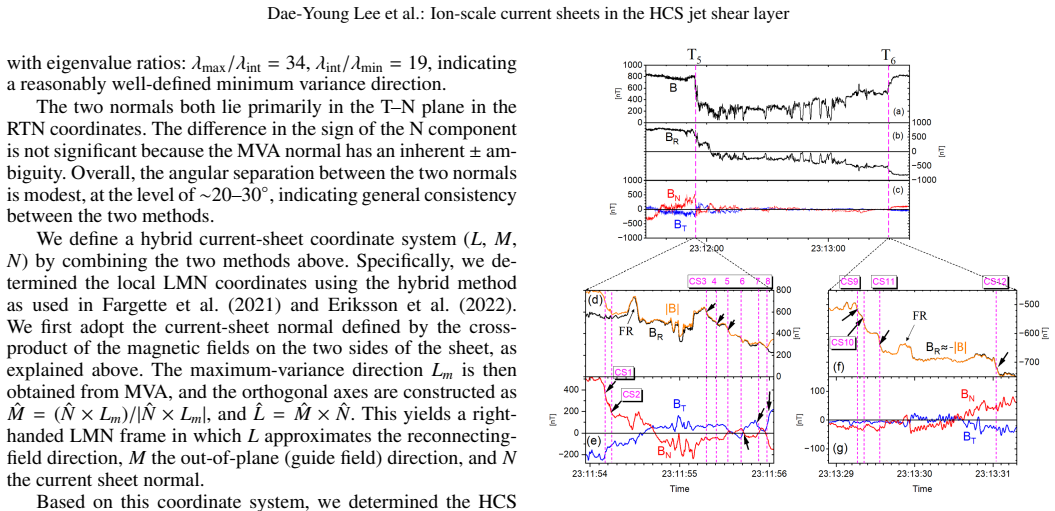
The paper's central claim is that the boundary of a reconnection exhaust, where the jet slides past the surrounding plasma, is not a single smooth magnetic transition but a band packed with ion-scale current sheets. In two 2-second intervals at the entry and exit of a 29 March 2024 HCS crossing, twelve sharp transitions are seen, lasting ~0.06 s and spanning a few ion inertial lengths. They are classified by the out-of-plane field in an LMN frame into three types: clean bipolar signatures, bifurcated profiles with a plateau, and signatures masked by fast transverse oscillations. Bipolar B_M is read as the Hall field, and the jet shear layer hosts a chain of secondary current sheets.
Load-bearing premise
The load-bearing premise is that the two short intervals at the entry and exit really are the boundaries of a reconnection exhaust; if they are instead patches of ambient turbulence inside the heliospheric current sheet, the claim that the observed ion-scale sheets are embedded in the jet shear layer collapses.
Editorial extensions
If this is right
- If the jet shear layer is a genuine host for chains of ion-scale current sheets, the HCS reconnection exhaust is a multiscale system: magnetic energy is dissipated across many small sheets rather than at a single boundary.
- The three morphology types imply that a single clean bipolar Hall signature is not the universal fingerprint of an ion-scale current sheet, so detection methods keyed on that signature will undersample the population.
- The systematic difference in tilt angles (larger at the entry where shear is stronger, smaller at the exit where shear is weaker) indicates that flow shear directly influences the orientation of embedded current sheets.
- Because the strong HCS background field can mask intrinsic shear, some low-shear CSs may actually be high-shear sheets; after local background subtraction, several events show shears of tens of degrees or more.
Reading between the lines
- Editorial inference: If this pattern generalizes, statistical surveys that count ion-scale current sheets only at exhaust boundaries will miss a large population inside the shear layer; a targeted search with the same magnetometer data could quantify the missed fraction.
- Editorial inference: The 33–50 Hz transverse oscillations in Type 3 events, well above the local proton gyrofrequency, may be Doppler-shifted ion-cyclotron waves; measuring their polarization and propagation would test whether kinetic-scale turbulence itself masks the Hall signatures.
- Editorial inference: The same shear-driven cascade mechanism should operate in reconnection exhausts in other collisionless plasmas, so chains of ion-scale current sheets may be a generic feature of jet boundaries rather than a peculiarity of the heliospheric current sheet.
- Editorial inference: A clean test would be to check, across many near-Sun current-sheet crossings, whether ion-scale sheets cluster preferentially in intervals with strong flow shear; if the clustering disappears, the sheets are more likely ordinary turbulence structures.
Editorial analysis
A structured set of objections, weighed in public.
Referee Report
Summary. This paper reports Parker Solar Probe (PSP) magnetometer observations of an HCS crossing on 29 March 2024 at ~11.6 R_sun. The authors identify two ~2-second intervals at the entry (T5) and exit (T6) of a purported reconnection exhaust and find twelve sharp magnetic transitions, which they interpret as ion-scale current sheets with durations ~0.06–0.09 s and thicknesses ~1.5–6 d_i. Using a local hybrid LMN coordinate system, they classify the sheets into three types based on the behavior of the out-of-plane B_M component: Type 1 (bipolar B_M without bifurcation in B_L), Type 2 (bipolar B_M with bifurcated B_L), and Type 3 (strong fluctuations obscuring the bipolar signature). They further estimate current densities, tilt angles, and shear angles, and argue that the reconnection jet shear layer hosts a chain of ion-scale CSs, potentially formed by shear-driven turbulence or secondary reconnection. The paper is a single-event case study and is explicitly hedged with terms such as 'may serve' and 'suggestive'.
Significance. If the localization of the twelve current sheets to the reconnection jet shear layer holds, this would provide a rare observational link between large-scale HCS reconnection and ion-scale kinetic structures, supporting the idea that flow shear at exhaust boundaries generates or organizes secondary current sheets. The paper makes good use of high-cadence MAG data and presents detailed magnetic profiles that are potentially valuable to the community. It is commendably open about limitations, including visual event selection, background-model sensitivity, and the lack of plasma data at the relevant scales. However, the central claim depends on the secure identification of both T5 and T6 as exhaust boundaries, and on the interpretation of B_M bipolar signatures as Hall fields; both points need stronger support before the conclusions can be accepted at face value. The significance is moderate, appropriate for a case study in A&A, and the paper could become a useful reference if the load-bearing assumptions are quantified and caveated more carefully.
major comments (4)
- [Sect. 2 (Walén relation)] The identification of T5 and T6 as the entry and exit boundaries of a reconnection exhaust is load-bearing for the central claim. The Walén test at T5 gives a slope of -0.86, but at T6 only +0.54, with no correlation coefficient or uncertainty given. A slope of 0.54 is not 'broadly Alfvénic' in a quantitative sense; it could equally be produced by a non-Alfvénic, compressional boundary or by noise. Since the T6 interval contains CS9–CS12 and all the entry/exit asymmetry claims (Sect. 3.2, Figs. 10–11), the authors must either provide a stronger quantitative Walén test (e.g., correlation coefficient, regression uncertainty, and a test of the predicted opposite polarity) or reframe the conclusion to apply only to the T5 side. As written, the conclusion that the exhaust shear layer 'hosts a chain' on both sides is not adequately supported.
- [Sect. 3.1 (identification and classification)] The twelve ion-scale CSs are selected visually, as the authors acknowledge. For a case study this is acceptable, but the claims that the T5 sequence 'tends to evolve from Type 1 to Type 3' and that there is a 'clear asymmetry in the distribution of CS types' (Sect. 3.2) rest on a subjective sample. The paper provides no systematic detector (e.g., a PVI threshold) or completeness information for the two 2-s intervals. To make the spatial-organization claim reproducible, the authors should either implement a quantitative detection scheme or report all sharp gradients in the intervals and the criteria for exclusion. Without this, the apparent order and asymmetry could be a selection artifact.
- [Sect. 3.2/3.3 (Hall-field interpretation)] The paper states 'We also assume that the bipolar perturbations in B_M are possibly Hall magnetic fields' (Sect. 3.2) and then uses these perturbations to estimate J_Hall and compare it with J_M (Sect. 3.3, Fig. 9). This is a crucial interpretive step: a bipolar B_M alone does not uniquely identify a Hall field; it could arise from guide-field gradients, crossing geometry, or other kinetic processes. Because no electric-field or high-cadence plasma measurements are available at these scales, the Hall identification is unverified. The authors should either (a) provide a more rigorous test, e.g., the predicted relation between B_M and B_L gradients expected for a particular crossing geometry, or (b) explicitly limit the classification to morphology and remove the physical inference that Hall-scale currents contribute significantly. As it stands, the conclusion in Sect. 4 that 'reconnection
- [Sect. 3.4/4 (localization to shear layer)] The claim that all twelve CSs are 'located within the jet flow shear layer' is based on the approximate highlighting in Fig. 11. At T6 the velocity shear is only ~60 km/s, less than half the ~120 km/s at T5, and the Walén relation is weak (see above). The authors should define the spatial and temporal extent of the shear layer quantitatively (e.g., using the V_R profile and the Alfvén speed) and demonstrate in a table that each CS lies within those boundaries. Otherwise the association of CS9–CS12 with the jet shear layer, and the inferred entry/exit asymmetry in tilt angles and shear strengths, are not clearly established.
minor comments (4)
- [Sect. 3.1] Typo: 'The upper panels (a–c) displays' should be 'display'.
- [Abstract/Sect. 3.1] The abstract says the average CS duration is ~0.06 s, while the text says ~0.07 s. Please unify these values.
- [Sect. 3.1 / Fig. 2] It would help to state explicitly in the text that CS1–CS8 are in the T5 interval and CS9–CS12 in the T6 interval; this is currently implicit in the event numbering and figure labels.
- [Fig. 5/Fig. 6] The manual rotations by 159° (Fig. 5) and 41° (Fig. 6) are coordinate choices that affect the appearance of the bipolar signature. Please state how these angles were selected (e.g., by aligning with MVA) and whether the classification would change for a range of rotation angles.
Circularity Check
No significant circularity: observational analysis is self-contained; only minor non-load-bearing self-citations.
full rationale
The paper is an observational event study rather than a derivation from a fitted model. The reported quantities — the 12 step-like magnetic transitions, their durations (~0.06–0.09 s), thickness range (0.6–9.4 d_i under the explicitly stated CS-speed assumption), the Type 1/2/3 classification based on B_L and B_M profiles, tilt angles, and current-density estimates — are read directly from MAG/SPAN data in standard LMN coordinates; none is generated by fitting a parameter to a target and then renaming the fit as a prediction. The interpretation of bipolar B_M as Hall magnetic field is openly stated as an assumption ('We also assume that the bipolar perturbations in B_M are possibly Hall magnetic fields', Sect. 3.1), and the paper does not present this as a derived result. The coordinate rotations by ~159° and ~41° are used for frame comparison and visualization; they do not by themselves force the thickness or classification claims, which are based on the original field profiles as well. The selection of the two 2-s intervals near T5/T6 because they 'mark the jet shear layer' does make the sentence 'all twelve ion-scale CSs are located within the jet flow shear layer' close to a restatement of the sampling frame, but the detailed structural conclusions are independent of that frame and the paper does not claim a statistical test of localization. The weaker Walén slope at T6 (~+0.54) is an evidentiary weakness for identifying the exit boundary, not a circularity. The self-citations present (e.g., Choi et al. 2024; Lee et al. 2026) appear in contextual or multi-reference lists alongside many independent works and are not load-bearing for the central claim. No circular step is therefore identified; the low score reflects only the presence of minor self-citations, not structural circularity.
Assumptions & free parameters
free parameters (3)
- Current-sheet convection speed V_cs =
V_sw ± V_A with ⟨V_A⟩ = 128 km/s (assumed bound, not measured)
- Manual rotation angle of transverse coordinates about L-axis =
159° for CS4, 41° for CS7
- Local background model for shear-angle correction =
Linear or quadratic trend, fitting window unspecified
assumptions (5)
- domain assumption The HCS crossing interval T5–T6 is a reconnection exhaust, inferred from Walén slopes (-0.86 at T5, +0.54 at T6)
- domain assumption Bipolar variations in B_M are (possibly) Hall magnetic fields
- domain assumption Time-to-space conversion via Taylor/de Hoffmann-Teller assumption with CS speed bounded by V_A
- standard math MVA and cross-product normals give a meaningful local LMN frame for each sub-scale CS
- ad hoc to paper Shear-driven turbulence cascade from MHD shear scale (~100 d_i) to ion scales can create CSs
Cite this review
Pith. "Pith review of Ion-Scale Current Sheets Embedded in Reconnection Jet Shear Layer of the Near-Sun Heliospheric Current Sheet." pith.science (2026). https://pith.science/paper/C5CX5YLV
@misc{pith2026260713534,
  author       = {Pith},
  title        = {Pith review of: Ion-Scale Current Sheets Embedded in Reconnection Jet Shear Layer of the Near-Sun Heliospheric Current Sheet},
  year         = {2026},
  howpublished = {\url{https://pith.science/paper/C5CX5YLV}},
  note         = {Machine review of arXiv:2607.13534}
}
abstract
Context. Magnetic reconnection in the heliospheric current sheet (HCS) plays an important role in restructuring the solar wind magnetic topology and generating plasma jets and magnetic islands. While large-scale signatures of HCS reconnection have been reported in many observational studies, the kinetic-scale structure embedded within reconnection regions remains less well understood. Aims. We investigate the ion-scale currents sheets (CSs) embedded within an HCS reconnection region and their relationship to the flow-shear layer at the edge of a reconnection jet. Methods. We analyzed an HCS crossing observed by the Parker Solar Probe on March 29, 2024, using high-time-resolution magnetic field measurements. We focused on ion-scale magnetic transitions within two brief intervals of flow-shear layer at the edges of the reconnection jet and examined them in a local LMN coordinate system. Results. Twelve representative CSs are identified, whose duration is on average $\sim$0.06 sec, corresponding to spatial scales of only a few ion inertial lengths. They are classified into three types based on the behavior of the out-of-plane magnetic component $B_{M}$: (1) CSs showing clear bipolar $B_{M}$ variations without bifurcation in reconnecting-field ($B_{L}$), (2) CSs with both bipolar $B_{M}$ variations and bifurcated $B_{L}$ profiles characterized by a plateau structure, and (3) CSs where strong fluctuations obscure an otherwise expected bipolar signature. Conclusions. The reconnection jet shear layer in the HCS may serve as an active site that hosts a chain of ion-scale CSs. This provides new insight into the multiscale structure of HCS reconnection and suggests that flow shear layers may play an important role in generating secondary kinetic-scale structures.
Figures


Figures from the paper (8 more)


Reference graph
Works this paper leans on
-
[1]
F., Swisdak, M., et al
Arnold, H., Drake, J. F., Swisdak, M., et al. 2021, Phys. Rev. Lett., 126, 135101 Arró, G., Califano, F., & Lapenta, G. 2020, A&A, 642, A45
2021
-
[2]
D., Goetz, K., Harvey, P
Bale, S. D., Goetz, K., Harvey, P. R., et al. 2016, Space Sci. Rev., 204, 49
2016
-
[3]
2005, Journal of Geophysical Research (Space Physics), 110, A01211
Cattell, C., Dombeck, J., Wygant, J., et al. 2005, Journal of Geophysical Research (Space Physics), 110, A01211
2005
-
[4]
& Lee, D.-Y
Choi, D. & Lee, D.-Y . 2025, The Astrophysical Journal, 987, 59
2025
-
[5]
J., & Kim, K.-C
Choi, D., Lee, D.-Y ., Choi, K.-E., Noh, S. J., & Kim, K.-C. 2024, ApJ, 974, 152
2024
-
[6]
2021, Sol
Choi, K.-E., Lee, D.-Y ., Wang, H.-E., et al. 2021, Sol. Phys., 296, 148
2021
-
[7]
2016, Physics of Plasmas, 23, 100702
Comisso, L., Lingam, M., Huang, Y .-M., & Bhattacharjee, A. 2016, Physics of Plasmas, 23, 100702
2016
-
[8]
I., Drake, J
Desai, M. I., Drake, J. F., Phan, T., et al. 2025, ApJ, 985, L38
2025
Show all 43 references
-
[9]
2018, Phys
Dong, C., Wang, L., Huang, Y .-M., Comisso, L., & Bhattacharjee, A. 2018, Phys. Rev. Lett., 121, 165101
2018
-
[10]
F., Opher, M., Swisdak, M., & Chamoun, J
Drake, J. F., Opher, M., Swisdak, M., & Chamoun, J. N. 2010, The Astrophysical Journal, 709, 963
2010
-
[11]
F., Swisdak, M., Schoeffler, K
Drake, J. F., Swisdak, M., Schoeffler, K. M., Rogers, B. N., & Kobayashi, S. 2006, Geophys. Res. Lett., 33, L13105
2006
-
[12]
M., et al
Eriksson, S., Swisdak, M., Weygand, J. M., et al. 2022, ApJ, 933, 181
2022
-
[13]
2021, A&A, 650, A11
Fargette, N., Lavraud, B., Rouillard, A., et al. 2021, A&A, 650, A11
2021
-
[14]
2015, ApJ, 804, L39
Franci, L., Verdini, A., Matteini, L., Landi, S., & Hellinger, P. 2015, ApJ, 804, L39
2015
-
[15]
T., McComas, D
Gosling, J. T., McComas, D. J., Skoug, R. M., & Smith, C. W. 2006, Geo- phys. Res. Lett., 33, L17102
2006
-
[16]
T., Skoug, R
Gosling, J. T., Skoug, R. M., McComas, D. J., & Smith, C. W. 2005, Geo- phys. Res. Lett., 32, L05105
2005
-
[17]
Higginson, A. K. & Lynch, B. J. 2018, ApJ, 859, 6
2018
-
[18]
C., Abiad, R., Austin, G., et al
Kasper, J. C., Abiad, R., Austin, G., et al. 2016, Space Sci. Rev., 204, 131 Article number, page 8 of 9 Dae-Young Lee et al.: Ion-scale current sheets in the HCS jet shear layer
2016
-
[19]
V ., Vaivads, A., Retinò, A., et al
Khotyaintsev, Y . V ., Vaivads, A., Retinò, A., et al. 2006, Phys. Rev. Lett., 97, 205003
2006
-
[20]
V ., & Newman, D
Lapenta, G., Markidis, S., Goldman, M. V ., & Newman, D. L. 2015, Nature Physics, 11, 690
2015
-
[21]
T., Rouillard, A
Lavraud, B., Gosling, J. T., Rouillard, A. P., et al. 2009, Sol. Phys., 256, 379
2009
-
[22]
Lee, D.-Y ., Choi, D., Choi, K.-E., & Noh, S. J. 2026, A&A, 709, A189
2026
-
[23]
C., Gallagher, B
Liewer, P. C., Gallagher, B. M., Stenborg, G., et al. 2024, ApJ, 970, 79
2024
-
[24]
E., Kasper, J
Livi, R., Larson, D. E., Kasper, J. C., et al. 2022, ApJ, 938, 138
2022
-
[25]
B., Vasko, I
Lotekar, A. B., Vasko, I. Y ., Phan, T., et al. 2022, The Astrophysical Journal, 929, 58
2022
-
[26]
2010, Journal of Geophysical Research (Space Physics), 115, A11208
Lu, Q., Huang, C., Xie, J., et al. 2010, Journal of Geophysical Research (Space Physics), 115, A11208
2010
-
[27]
Matthaeus, W. H. & Lamkin, S. L. 1986, Physics of Fluids, 29, 2513
1986
-
[28]
B., Ford, S., Lepping, R., Slavin, J., & Szabo, A
Moldwin, M. B., Ford, S., Lepping, R., Slavin, J., & Szabo, A. 2000, Geo- phys. Res. Lett., 27, 57
2000
-
[29]
S., Bale, S
Mozer, F. S., Bale, S. D., & Phan, T. D. 2002, Phys. Rev. Lett., 89, 015002
2002
-
[30]
T., Matthaeus, W
Osman, K. T., Matthaeus, W. H., Wan, M., & Rappazzo, A. F. 2012, Physical Review Letters, 110, 261102
2012
-
[31]
Paschmann, G., Papamastorakis, I., Baumjohann, W., et al. 1986, J. Geo- phys. Res., 91, 11099
1986
-
[32]
L., Dorelli, J
Perri, S., Goldstein, M. L., Dorelli, J. C., & Sahraoui, F. 2012, Phys. Rev. Lett., 109, 191101
2012
-
[33]
D., Bale, S
Phan, T. D., Bale, S. D., Eastwood, J. P., et al. 2020, ApJS, 246, 34
2020
-
[34]
D., Drake, J
Phan, T. D., Drake, J. F., Larson, D., et al. 2024, ApJ, 971, L42
2024
-
[35]
D., Lavraud, B., Halekas, J
Phan, T. D., Lavraud, B., Halekas, J. S., et al. 2021, A&A, 650, A13 Retinò, A., Vaivads, A., André, M., et al. 2006, Geophys. Res. Lett., 33, L06101 Réville, V ., Fargette, N., Rouillard, A. P., et al. 2022, A&A, 659, A110 Réville, V ., Velli, M., Rouillard, A. P., et al. 202...
2021
-
[36]
P., Lavraud, B., Kilpua, E., & Davies, J
Sanchez-Diaz, E., Rouillard, A. P., Lavraud, B., Kilpua, E., & Davies, J. A. 2019, ApJ, 882, 51
2019
-
[37]
H., Shay, M
Servidio, S., Matthaeus, W. H., Shay, M. A., Cassak, P. A., & Dmitruk, P. 2009, Phys. Rev. Lett., 102, 115003
2009
-
[38]
A., Drake, J
Shay, M. A., Drake, J. F., Rogers, B. N., & Denton, R. E. 2001, J. Geophys. Res., 106, 3759
2001
-
[39]
2020, ApJS, 246, 47
Szabo, A., Larson, D., Whittlesey, P., et al. 2020, ApJS, 246, 47
2020
-
[40]
Y ., Alimov, K., Phan, T., et al
Vasko, I. Y ., Alimov, K., Phan, T., et al. 2022, ApJ, 926, L19
2022
-
[41]
2013, Geophys
Wang, R., Du, A., Nakamura, R., et al. 2013, Geophys. Res. Lett., 40, 2511
2013
-
[42]
A., Jin, S
Yang, H. A., Jin, S. P., & Zhou, G. C. 2006, Journal of Geophysical Research (Space Physics), 111, A11223
2006
-
[43]
H., Yuan, Z
Zhou, M., Pang, Y ., Deng, X. H., Yuan, Z. G., & Huang, S. Y . 2011, Journal of Geophysical Research (Space Physics), 116, A06222 Article number, page 9 of 9
2011
Reviewed August 2, 2026 · model on record in the stance chip above.
Discussion (0). Continue with ORCID to comment.