Zeta Functions and the Superstring
Pith reviewed 2026-06-27 15:34 UTC · model grok-4.3
The pith
The Mellin transform of the superstring amplitude reduces exactly to the Riemann zeta function in the forward limit.
A machine-rendered reading of the paper's core claim, the machinery that carries it, and where it could break.
Core claim
The Mellin transform in energy of the superstring amplitude at fixed t reduces exactly to the Riemann zeta function when t equals zero. For t not equal to zero the object is a deformation of zeta. Physical features of the string amplitude produce the exact reduction and the other mathematical properties, and the associated dispersion relation with integer subtractions furnishes a new closed-form expression for the EFT expansion of the amplitude order by order in s at finite t.
What carries the argument
The Mellin transform of the superstring amplitude, which converts the amplitude into a zeta-like function whose properties follow from the amplitude's physical attributes.
If this is right
- The dispersion relation defined by the Mellin transform supplies the EFT expansion coefficients order by order in s at any fixed t.
- Integer subtractions in the dispersion relation produce the closed-form expressions for each order.
- At nonzero t the transformed amplitude is a continuous deformation of the zeta function that retains the same physical origin.
- The reduction to zeta occurs precisely when momentum transfer vanishes.
Where Pith is reading between the lines
- The appearance of zeta may indicate that number-theoretic objects organize the low-energy expansion of string amplitudes more generally.
- Similar Mellin transforms could be applied to other string or field-theory amplitudes to search for analogous closed forms.
- The deformation at finite t might be studied as a function of t to reveal how the zeta reduction is lost away from the forward limit.
Load-bearing premise
The physical attributes of the string amplitude are what produce the exact reduction of its Mellin transform to the zeta function in the forward limit.
What would settle it
Direct numerical evaluation of the Mellin transform of the superstring amplitude in the forward limit at several positive real values, checking whether the results match the corresponding values of the Riemann zeta function.
Figures

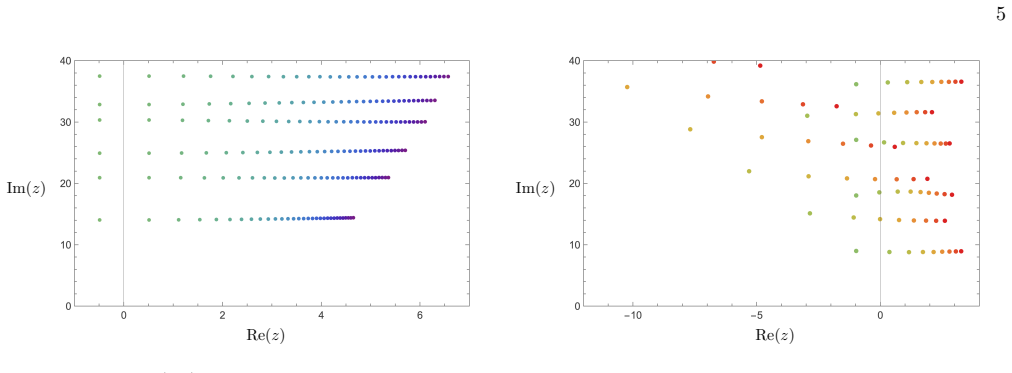
read the original abstract
The superstring amplitude's Mellin transform in energy is computed at fixed momentum transfer. In the forward limit, it is shown that this transformed amplitude reduces to the Riemann zeta function, while for $t\neq 0$ it represents a deformation of $\zeta$. This object exhibits remarkable mathematical properties as a result of physical attributes of the string amplitude. For integer subtractions, the dispersion relation defined by the Mellin transform yields the effective field theory expansion of the string amplitude order by order in $s$ at finite $t$, for which a new closed-form expression is derived.
Editorial analysis
A structured set of objections, weighed in public.
Referee Report
Summary. The manuscript computes the Mellin transform (in the energy variable, at fixed momentum transfer t) of the tree-level superstring amplitude. It asserts that this object reduces exactly to the Riemann zeta function in the forward limit t→0, represents a deformation of zeta for t≠0, and that the associated dispersion relation with integer subtractions supplies a new closed-form expression for the EFT expansion of the amplitude order-by-order in s at finite t.
Significance. If the central reduction and closed-form derivation hold with the stated independence from auxiliary choices, the result would furnish an explicit mathematical bridge between the gamma-function structure of superstring amplitudes and zeta functions, potentially yielding parameter-free expressions for the low-energy expansion that could be checked against known string EFT coefficients.
major comments (1)
- [Abstract] Abstract: the central claim that the Mellin transform reduces exactly to the Riemann zeta function in the forward limit is stated without any definition of the transform (normalization, integration contour, principal-value prescription, or handling of the simple poles of the gamma-function amplitude at positive integers in s). This specification is load-bearing for the subsequent assertion that the dispersion relation yields a new closed-form EFT expansion; without it, one cannot determine whether the reduction is independent or follows by construction from the chosen regularization.
Simulated Author's Rebuttal
We thank the referee for their careful reading of the manuscript and for identifying the need for greater precision in the abstract. We address the major comment below.
read point-by-point responses
-
Referee: [Abstract] Abstract: the central claim that the Mellin transform reduces exactly to the Riemann zeta function in the forward limit is stated without any definition of the transform (normalization, integration contour, principal-value prescription, or handling of the simple poles of the gamma-function amplitude at positive integers in s). This specification is load-bearing for the subsequent assertion that the dispersion relation yields a new closed-form EFT expansion; without it, one cannot determine whether the reduction is independent or follows by construction from the chosen regularization.
Authors: We agree that the abstract, as currently written, does not specify the definition of the Mellin transform. The full manuscript defines the transform in Section 2 as the integral ∫ ds s^{z-1} A(s,t) along a vertical contour in the complex s-plane (Re(s) > 0, indented with a principal-value prescription to avoid the simple poles of the gamma-function factors at positive integers), with normalization chosen so that the forward limit t → 0 recovers the standard Mellin representation of the zeta function. The reduction is derived after this definition and is shown to be independent of the precise indentation provided the contour remains to the right of all poles for the subtracted dispersion relation. We will revise the abstract to include a concise statement of this definition, contour choice, and principal-value handling so that the central claim is self-contained. revision: yes
Circularity Check
No circularity; derivation chain not reducible to inputs from provided text
full rationale
The abstract asserts that the Mellin transform of the superstring amplitude reduces to the Riemann zeta function in the forward limit and yields a closed-form EFT expansion via dispersion relations for integer subtractions. No equations, definitions of the Mellin contour, pole prescriptions, or derivation steps are available in the given material to inspect for self-definitional equivalence, fitted parameters renamed as predictions, or load-bearing self-citations. The claim is presented as following from physical attributes of the amplitude, with no exhibited reduction to its own inputs by construction. The paper is therefore scored as self-contained with no detectable circularity.
Axiom & Free-Parameter Ledger
Reference graph
Works this paper leans on
-
[1]
The pair correlation of zeros of the zeta function,
H. Montgomery, “The pair correlation of zeros of the zeta function,” Analytic number theory, Proc. Sympos. Pure Math.24(1973) 181
1973
-
[2]
Pólya, c
G. Pólya, c. 1913. Unpublished. See A. Odlyzko,Cor- respondence about the origins of the Hilbert-Pólya Con- jecture, Univ. Minnesota
1913
-
[3]
H=xpand the Rie- mann Zeros,
M. V. Berry and J. P. Keating, “H=xpand the Rie- mann Zeros,” inSupersymmetry and Trace Formulae: Chaos and Disorder, I. V. Lerner, J. P. Keating, and D. E. Khmelnitskii, eds., vol. 370 ofNATO ASI Series (Series B: Physics). Springer, Boston, 1999
1999
-
[4]
Nonclassical Degrees of Freedom in the Riemann Hamiltonian,
M. Srednicki, “Nonclassical Degrees of Freedom in the Riemann Hamiltonian,”Phys. Rev. Lett.107(2011) 100201,arXiv:1105.2342 [math-ph]
Pith/arXiv arXiv 2011
-
[5]
Hamilto- nian for the zeros of the Riemann zeta function,
C.M.Bender, D.C.Brody, andM.P.Müller, “Hamilto- nian for the zeros of the Riemann zeta function,”Phys. Rev. Lett.118(2017) 130201,arXiv:1608.03679 [quant- ph]
Pith/arXiv arXiv 2017
-
[6]
Stochasticbehaviorinquantumscat- tering,
M.C.Gutzwiller, “Stochasticbehaviorinquantumscat- tering,”Physica D: Nonlinear Phenomena7(1983) 341
1983
-
[7]
The phase of the Riemann zeta function and the inverted harmonic oscillator,
R. K. Bhaduri, A. Khare, and J. Law, “The phase of the Riemann zeta function and the inverted harmonic oscillator,”Phys. Rev. E52(1995) 486,arXiv:chao- dyn/9406006
arXiv 1995
-
[8]
Generalized Riemann hypothesis, time series and normal distributions,
A. LeClair and G. Mussardo, “Generalized Riemann hypothesis, time series and normal distributions,”J. 6 Stat. Mech.1902(2019) 023203,arXiv:1809.06158 [math.NT]
Pith/arXiv arXiv 1902
-
[9]
Riemann zeros as quan- tized energies of scattering with impurities,
A. LeClair and G. Mussardo, “Riemann zeros as quan- tized energies of scattering with impurities,”JHEP04 (2024) 062,arXiv:2307.01254 [hep-th]
arXiv 2024
-
[10]
Amplitudes and the Riemann Zeta Function,
G. N. Remmen, “Amplitudes and the Riemann Zeta Function,”Phys. Rev. Lett.127(2021) 241602, arXiv:2108.07820 [hep-th]
arXiv 2021
-
[11]
Adelic string ampli- tudes,
P. G. O. Freund and E. Witten, “Adelic string ampli- tudes,”Phys. Lett. B199(1987) 191
1987
-
[12]
From Veneziano to Riemann: A String Theory Statement of the Riemann Hypothesis,
Y.-H. He, V. Jejjala, and D. Minic, “From Veneziano to Riemann: A String Theory Statement of the Riemann Hypothesis,”Int. J. Mod. Phys. A31(2016) 1650201, arXiv:1501.01975 [hep-th]
Pith/arXiv arXiv 2016
-
[13]
Genus-zero and genus-one string amplitudes and special multiple zeta values,
D. Zagier and F. Zerbini, “Genus-zero and genus-one string amplitudes and special multiple zeta values,” Commun. Number Theory Phys.14,arXiv:1906.12339 [math.NT]
arXiv 1906
-
[14]
Motivic Multiple Zeta Values and Superstring Amplitudes,
O. Schlotterer and S. Stieberger, “Motivic Multiple Zeta Values and Superstring Amplitudes,”J. Phys. A46 (2013) 475401,arXiv:1205.1516 [hep-th]
Pith/arXiv arXiv 2013
-
[15]
Superstring amplitudes, uni- tarily, andHankeldeterminantsofmultiplezetavalues,
M. B. Green and C. Wen, “Superstring amplitudes, uni- tarily, andHankeldeterminantsofmultiplezetavalues,” JHEP11(2019) 079,arXiv:1908.08426 [hep-th]
arXiv 2019
-
[16]
Specifically, we are considering the polarization- stripped amplitude of the open superstring [46, 47], which is similar to the Veneziano amplitude of the bosonic string [48], with its characteristic Euler beta functionform.Ofcourse, theKoba-Nielsenintegralform of the string amplitude [49, 50] is a Mellin transform on the worldsheet variables, but here we...
-
[17]
Celestial amplitudes from UV to IR,
N. Arkani-Hamed, M. Pate, A.-M. Raclariu, and A. Strominger, “Celestial amplitudes from UV to IR,” JHEP08(2021) 062,arXiv:2012.04208 [hep-th]
arXiv 2021
-
[18]
The stringy S-matrix bootstrap: maximal spin and superpolynomial soft- ness,
K. Häring and A. Zhiboedov, “The stringy S-matrix bootstrap: maximal spin and superpolynomial soft- ness,”JHEP10(2024) 075,arXiv:2311.13631 [hep-th]
arXiv 2024
-
[19]
C. Cheung, G. N. Remmen, F. Sciotti, and M. Tarquini, “Strings from Almost Nothing,”arXiv:2508.09246 [hep- th]
-
[20]
These two forms ofζ(z)are manifestly the same using the behavior of gamma functions under shifts
In other words, we have constructed two interesting in- tegral forms of the Riemann zeta function, expressed via the definition ofΩ(z,t), ζ(z) =−lim t→0 1 2πi ˛ C ds sz−1 Γ(−s)Γ(−t) Γ(1−s−t) =−lim t→1 1 2πi ˛ C ds sz Γ(−s)Γ(−t) Γ(1−s−t). These two forms ofζ(z)are manifestly the same using the behavior of gamma functions under shifts
-
[21]
Stringy dynamics from an amplitudes bootstrap,
C. Cheung and G. N. Remmen, “Stringy dynamics from an amplitudes bootstrap,”Phys. Rev. D108(2023) 026011,arXiv:2302.12263 [hep-th]
arXiv 2023
-
[22]
Bootstrap Principle for the Spectrum and Scattering of Strings,
C. Cheung, A. Hillman, and G. N. Remmen, “Bootstrap Principle for the Spectrum and Scattering of Strings,” Phys. Rev. Lett.133(2024) 251601,arXiv:2406.02665 [hep-th]
arXiv 2024
-
[23]
Causality, analyticity and an IR obstruction to UV completion,
A. Adams, N. Arkani-Hamed, S. Dubovsky, A. Nico- lis, and R. Rattazzi, “Causality, analyticity and an IR obstruction to UV completion,”JHEP10(2006) 014, arXiv:hep-th/0602178
Pith/arXiv arXiv 2006
-
[24]
Multipositivity bounds for scattering amplitudes,
C. Cheung and G. N. Remmen, “Multipositivity bounds for scattering amplitudes,”Phys. Rev. D112(2025) 016017,arXiv:2505.05553 [hep-th]
arXiv 2025
-
[25]
Energy’s and amplitudes’ positivity,
A. Nicolis, R. Rattazzi, and E. Trincherini, “Energy’s and amplitudes’ positivity,”JHEP05(2010) 095, arXiv:0912.4258 [hep-th]. [Erratum:JHEP11(2011) 128]
Pith/arXiv arXiv 2010
-
[26]
Abramowitz and I
M. Abramowitz and I. A. Stegun,Handbook of Mathe- matical Functions with Formulas, Graphs, and Mathe- matical Tables, vol. 55 ofApplied Mathematics Series. National Bureau of Standards, 1964. See Table 24.2
1964
-
[27]
Analytic con- tinuation of multiple zeta-functions and their values at non-positive integers,
Y. T. Shigeki Akiyama, Shigeki Egami, “Analytic con- tinuation of multiple zeta-functions and their values at non-positive integers,”Acta Arith.98(2001) 107
2001
-
[28]
Analytic properties of multiple zeta- functions in several variables,
K. Matsumoto, “Analytic properties of multiple zeta- functions in several variables,” inNumber Theory, W. Zhang and Y. Tanigawa, eds., p. 153. Springer US, Boston, MA, 2006
2006
-
[29]
Analytic continuation of multiple zeta func- tions,
J. Zhao, “Analytic continuation of multiple zeta func- tions,”Proc. Am. Math. Soc.128(2000) 1275
2000
-
[30]
Global series for height1multiple zeta functions,
P. T. Young, “Global series for height1multiple zeta functions,”Euro. J. Math.9(2023) 99
2023
-
[31]
Series of height one multiple zeta func- tions,
P. T. Young, “Series of height one multiple zeta func- tions,”Integers24(2024) A43
2024
-
[32]
Multiple zeta values of fixed weight, depth, and height,
Y. Ohno and D. Zagier, “Multiple zeta values of fixed weight, depth, and height,”Indag. Mathem.12(2001) 483
2001
-
[33]
Multiple zeta values: Tasting notes,
W. Zudilin, “Multiple zeta values: Tasting notes,” 2025. Unpublished notes
2025
-
[34]
On multiple zeta values of extremal height,
M. Kaneko and M. Sakata, “On multiple zeta values of extremal height,”Bull. Aust. Math. Soc.93(2016) 186
2016
-
[35]
Simple Zeros of the Riemann Zeta-Function,
J. Conrey, A. Ghosh, and S. Gonek, “Simple Zeros of the Riemann Zeta-Function,”Proc. London Math. Soc. 76(1998) 497
1998
-
[36]
Note that throughout this section we have taken(s,t) to be in a region where the sums or integrals converge, and then tacitly analytically continued to all(s,t)
-
[37]
Uniqueness of the Veneziano representa- tion,
D. D. Coon, “Uniqueness of the Veneziano representa- tion,”Phys. Lett. B29(1969) 669
1969
-
[38]
Accumulation-point amplitudes in string theory,
J. Maldacena and G. N. Remmen, “Accumulation-point amplitudes in string theory,”JHEP08(2022) 152, arXiv:2207.06426 [hep-th]
arXiv 2022
-
[39]
Factorization and the generalized Veneziano model with satellites,
D. J. Gross, “Factorization and the generalized Veneziano model with satellites,”Nucl. Phys. B13 (1969) 467
1969
-
[40]
C. Cheung and G. N. Remmen, “Bespoke dual res- onance,”Phys. Rev. D108no. 8, (2023) 086009, arXiv:2308.03833 [hep-th]
arXiv 2023
-
[41]
Multiparticle Factorization and the Rigidity of String Theory,
N. Arkani-Hamed, C. Cheung, C. Figueiredo, and G. N. Remmen, “Multiparticle Factorization and the Rigidity of String Theory,”Phys. Rev. Lett.132no. 9, (2024) 091601,arXiv:2312.07652 [hep-th]
arXiv 2024
-
[42]
Veneziano variations: how unique are string amplitudes?,
C. Cheung and G. N. Remmen, “Veneziano variations: how unique are string amplitudes?,”JHEP01(2023) 122,arXiv:2210.12163 [hep-th]
arXiv 2023
-
[43]
On the Inverse Problem in Effective Field Theory,
F. Calisto, C. Cheung, G. N. Remmen, F. Sciotti, and M. Tarquini, “On the Inverse Problem in Effective Field Theory,”arXiv:2604.15423 [hep-th]
-
[44]
P. D. B. Collins,An Introduction to Regge Theory and High Energy Physics. Cambridge University Press, 1977
1977
-
[45]
(32) is analogous to a Sommerfeld-Watson transform, again keeping only 7 the leading term in the Legendre polynomial
Similarly, the inverse transform in Eq. (32) is analogous to a Sommerfeld-Watson transform, again keeping only 7 the leading term in the Legendre polynomial
-
[46]
Supersymmetrical Dual String Theory. 2. Vertices and Trees,
M. B. Green and J. H. Schwarz, “Supersymmetrical Dual String Theory. 2. Vertices and Trees,”Nucl. Phys. B198(1982) 252
1982
-
[47]
Superstring Theory,
J. H. Schwarz, “Superstring Theory,”Phys. Rept.89 (1982) 223
1982
-
[48]
Construction of a crossing-symmetric, Regge-behaved amplitude for linearly rising trajecto- ries,
G. Veneziano, “Construction of a crossing-symmetric, Regge-behaved amplitude for linearly rising trajecto- ries,”Nuovo Cim. A57(1968) 190
1968
-
[49]
Reaction amplitude for n-mesons: A generalization of the Veneziano-Bardakçi- Ruegg-Virasoro model,
Z. Koba and H. B. Nielsen, “Reaction amplitude for n-mesons: A generalization of the Veneziano-Bardakçi- Ruegg-Virasoro model,”Nucl. Phys. B10(1969) 633
1969
-
[50]
Open string amplitudes: singularities, asymp- totics and new representations,
N. Arkani-Hamed, C. Figueiredo, and G. N. Rem- men, “Open string amplitudes: singularities, asymp- totics and new representations,”JHEP04(2025) 039, arXiv:2412.20639 [hep-th]
arXiv 2025
-
[51]
Symmetries of Bernoulli polynomial se- ries and Arakawa-Kaneko zeta functions,
P. T. Young, “Symmetries of Bernoulli polynomial se- ries and Arakawa-Kaneko zeta functions,”J. Number Theory143(2014) 142
2014
-
[52]
A connec- tion between power series and Dirichlet series,
L. M. Navas, F. J. Ruiz, and J. L. Varona, “A connec- tion between power series and Dirichlet series,”J. Math. Anal. App.493(2021) 124541
2021
-
[53]
The Harmonic Logarithms and the Bino- mial Formula,
S. Roman, “The Harmonic Logarithms and the Bino- mial Formula,”J. Comb. Theory63(1993) 143
1993
-
[54]
Ein Summierungsverfahren für die Rie- mannscheζ-Reihe,
H. Hasse, “Ein Summierungsverfahren für die Rie- mannscheζ-Reihe,”Math. Z.32(1930) 458. Appendix.—While the construction in this paper is novel, involving the fixed-tMellin transform of the string amplitude—i.e., of the Euler beta integral—and its char- acterization as a deformation of the Riemann zeta func- tion, for the sake of completeness it is worthw...
1930
discussion (0)
Sign in with ORCID, Apple, or X to comment. Anyone can read and Pith papers without signing in.