Qubit Readout via State-Dependent Radiative Linewidths
Pith reviewed 2026-07-01 00:57 UTC · model grok-4.3
The pith
A state-dependent radiative linewidth imprints qubit information on the output field at linear order in time from an empty cavity.
A machine-rendered reading of the paper's core claim, the machinery that carries it, and where it could break.
Core claim
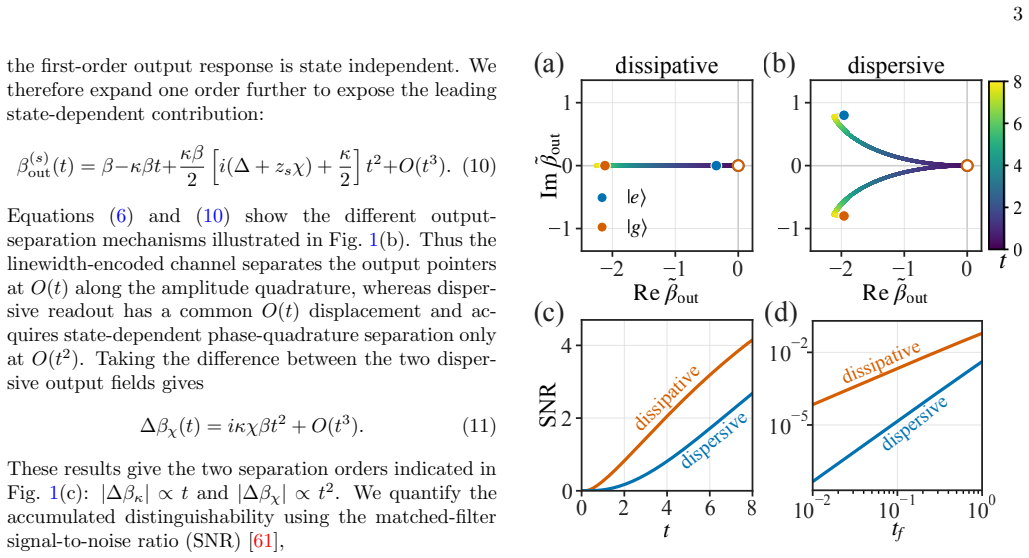
The central claim is that a qubit-state-dependent Lindblad jump operator for cavity decay encodes the qubit state directly into the external radiative amplitude. Starting from vacuum, this dissipative channel therefore imprints measurable state information on the output field at O(t). Standard dispersive readout, by contrast, must first build up an intracavity field and then accumulate a conditional phase, so its signal appears only at O(t squared). The short-time advantage remains under finite-resource constraints that include photon-number limits, external-linewidth budgets, cavity depletion, and pulse-optimized dispersive baselines.
What carries the argument
The state-dependent radiative jump operator, which makes the cavity decay rate depend on the qubit state and thereby encodes information directly in the amplitude of the outgoing field.
If this is right
- Matched-filter signal-to-noise ratio accumulates faster at short times than in dispersive readout.
- The linear-time advantage persists under photon-number limits and external-linewidth budgets.
- The advantage also survives cavity depletion and comparisons against pulse-optimized dispersive baselines.
- An auxiliary-mode construction converts a state-dependent auxiliary susceptibility into the required state-dependent linewidth.
Where Pith is reading between the lines
- If the required jump-operator engineering can be realized in circuit QED, the same dissipative encoding might extend to other open-system measurement tasks where loss channels are already present.
- Hybrid protocols could combine the fast initial linear accumulation with later dispersive phase information to optimize total readout fidelity.
- The scaling argument suggests testing the method first in systems where tunable loss rates are easier to control than dispersive shifts.
Load-bearing premise
The qubit-state dependence can be engineered into the radiative jump operator without introducing additional decoherence, unwanted couplings, or deviations from the Markovian Lindblad form.
What would settle it
A short-time experiment that measures the output-field correlation functions or matched-filter SNR and finds linear rather than quadratic growth in state distinguishability when the cavity begins in vacuum.
Figures



read the original abstract
Fast qubit readout conventionally encodes state information in a dispersive frequency shift. Here we formulate a linewidth-encoded quantum non-demolition measurement channel in which the qubit state enters the external radiative amplitude, equivalently a state-dependent Lindblad jump operator. Starting from an empty cavity, we show analytically that this dissipative channel imprints state information on the output field at $O(t)$, whereas standard dispersive readout starts at $O(t^2)$ because it requires intracavity buildup and conditional phase accumulation. This short-time scaling produces faster matched-filter signal-to-noise ratio accumulation and persists in finite-resource comparisons, including photon-number limits, external-linewidth budgets, cavity depletion, and pulse-optimized dispersive baselines. We further outline an auxiliary-mode route that converts a qubit-state-dependent auxiliary susceptibility into a state-dependent linewidth. These results identify engineered dissipation as an information-carrying resource for fast quantum non-demolition readout.
Editorial analysis
A structured set of objections, weighed in public.
Referee Report
Summary. The manuscript proposes a linewidth-encoded QND readout channel in which the qubit state modulates the amplitude of an external radiative jump operator in the Lindblad master equation. Starting from an empty cavity, analytic arguments show that state information imprints on the output field at linear order in time, O(t), in contrast to the quadratic O(t^2) onset of standard dispersive readout that requires intracavity photon buildup and conditional phase accumulation. An auxiliary-mode construction is outlined to realize the state-dependent linewidth, and the O(t) advantage is shown to persist under photon-number limits, external-linewidth budgets, cavity depletion, and optimized dispersive baselines.
Significance. If the scaling result is confirmed without leading-order contamination from auxiliary-induced shifts or decoherence, the work identifies engineered dissipation as an information-carrying resource that can accelerate matched-filter SNR accumulation for qubit readout. The parameter-free character of the O(t) versus O(t^2) comparison and its persistence across finite-resource constraints constitute clear strengths.
major comments (2)
- [auxiliary-mode route and analytic scaling argument] The central O(t) scaling advantage is load-bearing on the assumption that the qubit state enters solely the amplitude of the external radiative jump operator while preserving the Markovian Lindblad form and QND character from t=0. The auxiliary-mode construction must be accompanied by an explicit effective master equation (or output-field expansion) demonstrating the absence of residual dispersive shifts, state-dependent frequency pulls, or auxiliary-induced decoherence at leading order; any such term would either require subtraction or revert the information accumulation to O(t^2).
- [analytic derivation of scaling] The analytic claim that information imprints at O(t) versus O(t^2) is stated but requires the step-by-step short-time expansion of the output field or integrated homodyne signal, together with an error analysis confirming the regime of validity, to be fully transparent and reproducible.
minor comments (2)
- Notation for the state-dependent jump operator should be introduced once and used consistently; any auxiliary susceptibility parameters should be clearly distinguished from the primary cavity parameters.
- Finite-resource comparisons would benefit from tabulated numerical values (e.g., SNR at fixed photon number or fixed external linewidth) rather than summary statements alone.
Simulated Author's Rebuttal
We thank the referee for the constructive and detailed report. The comments correctly identify areas where the analytic arguments can be made more explicit and reproducible. We address each point below and will revise the manuscript accordingly.
read point-by-point responses
-
Referee: [auxiliary-mode route and analytic scaling argument] The central O(t) scaling advantage is load-bearing on the assumption that the qubit state enters solely the amplitude of the external radiative jump operator while preserving the Markovian Lindblad form and QND character from t=0. The auxiliary-mode construction must be accompanied by an explicit effective master equation (or output-field expansion) demonstrating the absence of residual dispersive shifts, state-dependent frequency pulls, or auxiliary-induced decoherence at leading order; any such term would either require subtraction or revert the information accumulation to O(t^2).
Authors: We agree that the auxiliary-mode construction requires an explicit effective master equation to confirm the absence of leading-order contaminating terms. In the revision we will add a dedicated derivation section that adiabatically eliminates the auxiliary mode, yielding the target Lindblad form with state dependence appearing exclusively in the radiative jump-operator amplitude. The expansion will explicitly track all orders and demonstrate cancellation of dispersive shifts and auxiliary-induced decoherence to the order relevant for the O(t) scaling. revision: yes
-
Referee: [analytic derivation of scaling] The analytic claim that information imprints at O(t) versus O(t^2) is stated but requires the step-by-step short-time expansion of the output field or integrated homodyne signal, together with an error analysis confirming the regime of validity, to be fully transparent and reproducible.
Authors: We accept that the short-time expansion needs to be presented with full intermediate steps and error bounds. The revised manuscript will include a self-contained appendix deriving the output-field expectation value for both channels, showing the linear term for the linewidth-encoded case and the quadratic onset for the dispersive case, together with a remainder estimate that identifies the temporal window of validity. revision: yes
Circularity Check
No significant circularity; scaling follows directly from Lindblad structure
full rationale
The central claim derives the O(t) information imprint analytically from the structure of the Lindblad master equation with a state-dependent jump operator L, starting from an empty cavity. This is a direct consequence of the dissipative term in the master equation and does not rely on fitted parameters, self-citations, or reductions to prior results by the same authors. The auxiliary-mode construction is presented as an outline for engineering the state dependence, not as a load-bearing premise that collapses the scaling argument. No self-definitional loops, renamed empirical patterns, or uniqueness theorems imported via self-citation appear in the provided text. The derivation remains self-contained against the stated Markovian assumptions.
Axiom & Free-Parameter Ledger
axioms (2)
- domain assumption The system obeys a Markovian master equation with a state-dependent jump operator whose form is given by the engineered radiative channel.
- domain assumption The output field can be treated as the primary information carrier without significant back-action or non-Markovian corrections on the short-time scale of interest.
Reference graph
Works this paper leans on
-
[1]
V. B. Braginsky, F. Y. Khalili, and K. S. Thorne,Quan- tum Measurement(Cambridge University Press, Cam- bridge, 1992)
1992
-
[2]
V. B. Braginsky and F. Y. Khalili, Quantum nondemo- lition measurements: the route from toys to tools, Rev. Mod. Phys.68, 1 (1996)
1996
-
[3]
H. M. Wiseman and G. J. Milburn,Quantum Measure- ment and Control(Cambridge University Press, Cam- bridge, 2009)
2009
-
[4]
Gorini, A
V. Gorini, A. Kossakowski, and E. C. G. Sudarshan, Completely positive dynamical semigroups of N-level sys- tems, J. Math. Phys.17, 821 (1976)
1976
-
[5]
Lindblad, On the generators of quantum dynamical semigroups, Commun
G. Lindblad, On the generators of quantum dynamical semigroups, Commun. Math. Phys.48, 119 (1976)
1976
-
[6]
Breuer and F
H.-P. Breuer and F. Petruccione,The Theory of Open Quantum Systems(Oxford University Press, Oxford, 2002)
2002
- [7]
-
[8]
C. W. Gardiner and M. J. Collett, Input and output in damped quantum systems: Quantum stochastic differen- tial equations and the master equation, Phys. Rev. A31, 3761 (1985)
1985
-
[9]
C. W. Gardiner, Driving a quantum system with the output field from another driven quantum system, Phys. Rev. Lett.70, 2269 (1993)
1993
-
[10]
J. Q. You and F. Nori, Quantum information processing with superconducting qubits in a microwave field, Phys. Rev. B68, 064509 (2003)
2003
-
[11]
J. Q. You and F. Nori, Superconducting circuits and quantum information, Phys. Today58, 42 (2005)
2005
-
[12]
X. Gu, A. F. Kockum, A. Miranowicz, Y.-x. Liu, and F. Nori, Microwave photonics with superconducting quantum circuits, Phys. Rep.718–719, 1 (2017)
2017
-
[13]
A. F. Kockum and F. Nori, Quantum bits with josephson junctions, inFundamentals and Frontiers of the Joseph- son Effect, Springer Series in Materials Science, Vol. 286, edited by F. Tafuri (Springer, Cham, 2019) pp. 703–741
2019
-
[14]
Krantz, M
P. Krantz, M. Kjaergaard, F. Yan, T. P. Orlando, S. Gus- tavsson, and W. D. Oliver, A quantum engineer’s guide to superconducting qubits, Appl. Phys. Rev.6, 021318 (2019)
2019
-
[15]
Kjaergaard, M
M. Kjaergaard, M. E. Schwartz, J. Braum¨ uller, P. Krantz, J. I.-J. Wang, S. Gustavsson, and W. D. Oliver, Superconducting qubits: Current state of play, Annu. Rev. Condens. Matter Phys.11, 369 (2020)
2020
-
[16]
Jeffrey, D
E. Jeffrey, D. Sank, J. Y. Mutus, T. C. White, J. Kelly, R. Barends, Y. Chen, Z. Chen, B. Chiaro, A. Dunsworth, A. Megrant, P. J. J. O’Malley, C. Neill, P. Roushan, A. Vainsencher, J. Wenner, A. N. Cleland, and J. M. Martinis, Fast accurate state measurement with super- conducting qubits, Phys. Rev. Lett.112, 190504 (2014)
2014
-
[17]
Walter, P
T. Walter, P. Kurpiers, S. Gasparinetti, P. Mag- nard, A. Potoˇ cnik, Y. Salath´ e, M. Pechal, M. Mondal, M. Oppliger, C. Eichler, and A. Wallraff, Rapid high- fidelity single-shot dispersive readout of superconducting qubits, Phys. Rev. Applied7, 054020 (2017)
2017
-
[18]
Chen, H.-X
L. Chen, H.-X. Li, Y. Lu, C. W. Warren, C. J. Kriˇ zan, S. Kosen, M. Rommel, S. Ahmed, A. Osman, J. Bizn´ arov´ a, A. Fadavi Roudsari, B. Lienhard, M. Ca- puto, K. Grigoras, L. Gr¨ onberg, J. Govenius, A. F. Kockum, P. Delsing, J. Bylander, and G. Tancredi, Transmon qubit readout fidelity at the threshold for quantum error correction without a quantum-lim...
2023
-
[19]
Y. Ye, J. B. Kline, S. Chen, A. Yen, and K. P. O’Brien, Ultrafast superconducting qubit readout with the quar- ton coupler, Sci. Adv.10, eado9094 (2024)
2024
-
[20]
Bengtsson, A
A. Bengtsson, A. Opremcak, M. Khezri, D. Sank, A. Bourassa, K. J. Satzinger, S. Hong, C. Erickson, B. J. Lester, K. C. Miao, A. N. Korotkov, J. Kelly, Z. Chen, and P. V. Klimov, Model-based optimization of super- conducting qubit readout, Phys. Rev. Lett.132, 100603 (2024)
2024
-
[21]
B. Abdo, O. Jinka, N. T. Bronn, S. Olivadese, and M. Brink, High-fidelity qubit readout using interfero- metric directional Josephson devices, PRX Quantum2, 040360 (2021)
2021
-
[22]
Dassonneville, T
R. Dassonneville, T. Ramos, V. Milchakov, L. Planat, ´E. Dumur, F. Foroughi, J. Puertas, S. Leger, K. Bharad- waj, J. Delaforce, C. Naud, W. Hasch-Guichard, J. J. Garc´ ıa-Ripoll, N. Roch, and O. Buisson, Fast high- fidelity quantum nondemolition qubit readout via a nonperturbative cross-Kerr coupling, Phys. Rev. X10, 011045 (2020)
2020
-
[23]
W. Qin, A. Miranowicz, and F. Nori, Exponentially improved dispersive qubit readout with squeezed light, Phys. Rev. Lett.133, 233605 (2024)
2024
-
[24]
B. T. Gard, Z. Parrott, K. Jacobs, J. Aumentado, and R. W. Simmonds, Fast high-fidelity quantum nondemo- lition readout of a superconducting qubit with tunable transverse couplings, Phys. Rev. Applied21, 024008 (2024)
2024
-
[25]
T. V. Stefanski and C. K. Andersen, Flux-pulse-assisted readout of a fluxonium qubit, Phys. Rev. Applied22, 014079 (2024)
2024
-
[26]
A. A. Chapple, O. Benhayoune-Khadraoui, S. Richer, and A. Blais, Balanced cross-Kerr coupling for super- conducting qubit readout, Phys. Rev. Lett.135, 256002 (2025)
2025
-
[27]
Hatridge, S
M. Hatridge, S. Shankar, M. Mirrahimi, F. Schackert, K. Geerlings, T. Brecht, K. M. Sliwa, B. Abdo, L. Frun- zio, S. M. Girvin, R. J. Schoelkopf, and M. H. Devoret, Quantum back-action of an individual variable-strength measurement, Science339, 178 (2013)
2013
-
[28]
K. W. Murch, S. J. Weber, C. Macklin, and I. Siddiqi, Observing single quantum trajectories of a superconduct- ing quantum bit, Nature502, 211 (2013)
2013
-
[29]
Vijay, C
R. Vijay, C. Macklin, D. H. Slichter, S. J. Weber, K. W. Murch, R. Naik, A. N. Korotkov, and I. Siddiqi, Stabi- lizing Rabi oscillations in a superconducting qubit using quantum feedback, Nature490, 77 (2012)
2012
-
[30]
Rist` e, M
D. Rist` e, M. Dukalski, C. A. Watson, G. de Lange, M. J. Tiggelman, Y. M. Blanter, K. W. Lehnert, R. N. Schouten, and L. DiCarlo, Deterministic entanglement of superconducting qubits by parity measurement and feed- back, Nature502, 350 (2013)
2013
-
[31]
Kelly, R
J. Kelly, R. Barends, A. G. Fowler, A. Megrant, E. Jef- frey, T. C. White, D. Sank, J. Y. Mutus, B. Campbell, Y. Chen, Z. Chen, B. Chiaro, A. Dunsworth, I.-C. Hoi, C. Neill, P. J. J. O’Malley, C. Quintana, P. Roushan, A. Vainsencher, J. Wenner, A. N. Cleland, and J. M. Martinis, State preservation by repetitive error detection in a superconducting quantum...
2015
-
[32]
Hinderling, S
M. Hinderling, S. C. ten Kate, D. Z. Haxell, M. Coraiola, S. Paredes, E. Cheah, F. Krizek, R. Schott, W. Wegschei- der, D. Sabonis, and F. Nichele, Flip-chip-based fast in- ductive parity readout of a planar superconducting is- land, PRX Quantum5, 030337 (2024)
2024
-
[33]
Touzard, A
S. Touzard, A. Kou, N. E. Frattini, V. V. Sivak, S. Puri, A. Grimm, L. Frunzio, S. Shankar, and M. H. Devoret, Gated conditional displacement readout of superconduct- ing qubits, Phys. Rev. Lett.122, 080502 (2019)
2019
-
[34]
Boissonneault, J
M. Boissonneault, J. M. Gambetta, and A. Blais, Dis- persive regime of circuit qed: Photon-dependent qubit dephasing and relaxation rates, Phys. Rev. A79, 013819 (2009)
2009
-
[35]
Shillito, A
R. Shillito, A. Petrescu, J. Cohen, J. Beall, M. Hauru, M. Ganahl, A. G. M. Lewis, G. Vidal, and A. Blais, Dy- namics of transmon ionization, Phys. Rev. Applied18, 034031 (2022)
2022
-
[36]
D. Sank, A. Opremcak, A. Bengtsson, M. Khezri, J. Chen, O. Naaman, and A. Korotkov, System character- ization of dispersive readout in superconducting qubits, Phys. Rev. Applied23, 024055 (2025)
2025
-
[37]
Catelani, J
G. Catelani, J. Koch, L. Frunzio, R. J. Schoelkopf, M. H. Devoret, and L. I. Glazman, Quasiparticle relaxation of superconducting qubits in the presence of flux, Phys. Rev. Lett.106, 077002 (2011)
2011
-
[38]
Catelani, R
G. Catelani, R. J. Schoelkopf, M. H. Devoret, and L. I. Glazman, Relaxation and frequency shifts induced by quasiparticles in superconducting qubits, Phys. Rev. B 84, 064517 (2011)
2011
-
[39]
X. Wang, A. Miranowicz, and F. Nori, Ideal quantum nondemolition readout of a flux qubit without Purcell limitations, Phys. Rev. Applied12, 064037 (2019)
2019
-
[40]
Catelani, S
G. Catelani, S. E. Nigg, S. M. Girvin, R. J. Schoelkopf, and L. I. Glazman, Decoherence of superconducting qubits caused by quasiparticle tunneling, Phys. Rev. B 86, 184514 (2012)
2012
-
[41]
Sunada, S
Y. Sunada, S. Kono, J. Ilves, S. Tamate, T. Sugiyama, Y. Tabuchi, and Y. Nakamura, Fast readout and reset of a superconducting qubit coupled to a resonator with an intrinsic Purcell filter, Phys. Rev. Applied17, 044016 (2022)
2022
-
[42]
E. A. Sete, J. M. Martinis, and A. N. Korotkov, Quan- tum theory of a bandpass Purcell filter for qubit readout, Phys. Rev. A92, 012325 (2015)
2015
-
[43]
Sunada, K
Y. Sunada, K. Yuki, Z. Wang, T. Miyamura, J. Ilves, K. Matsuura, P. A. Spring, S. Tamate, S. Kono, and Y. Nakamura, Photon-noise-tolerant dispersive readout of a superconducting qubit using a nonlinear Purcell fil- ter, PRX Quantum5, 010307 (2024)
2024
-
[44]
P. A. Spring, L. Milanovic, Y. Sunada, S. Wang, A. F. van Loo, S. Tamate, and Y. Nakamura, Fast multiplexed superconducting-qubit readout with intrinsic Purcell fil- tering using a multiconductor transmission line, PRX Quantum6, 020345 (2025)
2025
-
[45]
L. C. G. Govia and A. A. Clerk, Enhanced qubit read- out using locally generated squeezing and inbuilt Purcell- decay suppression, New J. Phys.19, 023044 (2017)
2017
-
[46]
S. Kono, K. Koshino, D. Lachance-Quirion, A. F. van Loo, Y. Tabuchi, A. Noguchi, and Y. Nakamura, Break- ing the trade-off between fast control and long lifetime of a superconducting qubit, Nature Communications11, 3683 (2020)
2020
-
[47]
Didier, J
N. Didier, J. Bourassa, and A. Blais, Fast quantum non- demolition readout by parametric modulation of longitu- dinal qubit-oscillator interaction, Phys. Rev. Lett.115, 203601 (2015). 7
2015
-
[48]
Billangeon, J
P.-M. Billangeon, J. S. Tsai, and Y. Nakamura, Circuit- qed-based scalable architectures for quantum information processing with superconducting qubits, Phys. Rev. B 91, 094517 (2015)
2015
-
[49]
Richer and D
S. Richer and D. DiVincenzo, Circuit design implement- ing longitudinal coupling: A scalable scheme for super- conducting qubits, Phys. Rev. B93, 134501 (2016)
2016
-
[50]
Ikonen, J
J. Ikonen, J. Goetz, J. Ilves, A. Ker¨ anen, A. M. Gunyho, M. Partanen, K. Y. Tan, D. Hazra, L. Gr¨ onberg, V. Vesterinen, S. Simbierowicz, J. Hassel, and M. M¨ ott¨ onen, Qubit measurement by multichannel driving, Phys. Rev. Lett.122, 080503 (2019)
2019
-
[51]
C. G. L. Bøttcher, S. P. Harvey, S. Fallahi, G. C. Gard- ner, M. J. Manfra, U. Vool, S. D. Bartlett, and A. Ya- coby, Parametric longitudinal coupling between a high- impedance superconducting resonator and a semiconduc- tor quantum dot singlet-triplet spin qubit, Nat. Commun. 13, 4773 (2022)
2022
-
[52]
Harpt, J
B. Harpt, J. Corrigan, N. Holman, P. Marciniec, D. Rosenberg, D. Yost, R. Das, R. Ruskov, C. Tahan, W. D. Oliver, R. McDermott, M. Friesen, and M. A. Eriksson, Ultra-dispersive resonator readout of a quantum-dot qubit using longitudinal coupling, npj Quantum Inf.11, 7 (2025)
2025
-
[53]
S.-W. Xu, J.-T. Ye, H.-R. Chen, Y.-H. Chen, and Y. Xia, Nondestructive readout of cat-state qubits via longitudinal qubit-oscillator interaction, Commun. Phys. 10.1038/s42005-026-02657-w (2026)
-
[54]
J. F. Poyatos, J. I. Cirac, and P. Zoller, Quantum reser- voir engineering with laser cooled trapped ions, Phys. Rev. Lett.77, 4728 (1996)
1996
-
[55]
Verstraete, M
F. Verstraete, M. M. Wolf, and J. I. Cirac, Quantum computation and quantum-state engineering driven by dissipation, Nat. Phys.5, 633 (2009)
2009
-
[56]
Krauter, C
H. Krauter, C. A. Muschik, K. Jensen, W. Wasilewski, J. M. Petersen, J. I. Cirac, and E. S. Polzik, Entangle- ment generated by dissipation and steady state entangle- ment of two macroscopic objects, Phys. Rev. Lett.107, 080503 (2011)
2011
-
[57]
Shankar, M
S. Shankar, M. Hatridge, Z. Leghtas, K. M. Sliwa, A. Narla, U. Vool, S. M. Girvin, L. Frunzio, M. Mir- rahimi, and M. H. Devoret, Autonomously stabilized en- tanglement between two superconducting quantum bits, Nature504, 419 (2013)
2013
-
[58]
P. M. Harrington, E. J. Mueller, and K. W. Murch, Engi- neered dissipation for quantum information science, Nat. Rev. Phys.4, 660 (2022)
2022
-
[59]
Wang, Y.-X
Y.-Y. Wang, Y.-X. Wang, S. van Geldern, T. Connolly, A. A. Clerk, and C. Wang, Dispersive nonreciprocity be- tween a qubit and a cavity, Sci. Adv.10, eadj8796 (2024)
2024
-
[60]
Gambetta, A
J. Gambetta, A. Blais, D. I. Schuster, A. Wallraff, L. Frunzio, J. Majer, M. H. Devoret, S. M. Girvin, and R. J. Schoelkopf, Qubit-photon interactions in a cavity: Measurement-induced dephasing and number splitting, Phys. Rev. A74, 042318 (2006)
2006
-
[61]
A. A. Clerk, M. H. Devoret, S. M. Girvin, F. Marquardt, and R. J. Schoelkopf, Introduction to quantum noise, measurement, and amplification, Rev. Mod. Phys.82, 1155 (2010)
2010
-
[62]
(2026), supplemental Material of Dissipative Qubit Read- out via State-Dependent Linewidths
2026
-
[63]
C. Zhu, R. H. Byrd, P. Lu, and J. Nocedal, Algorithm 778: L-BFGS-B: Fortran subroutines for large-scale bound-constrained optimization, ACM Trans. Math. Softw.23, 550 (1997)
1997
discussion (0)
Sign in with ORCID, Apple, or X to comment. Anyone can read and Pith papers without signing in.