REVIEW 4 major objections 6 minor 55 references
EDMB: Edge Detector with Mamba
T0 review · 4 major / 6 minor · reviewed 2026-08-10 · deepseek-v4-flash
Pith's one-line read A Mamba-based edge detector reaches top BSDS500 accuracy while generating multi-granularity edges without multi-label data.
desk verdict Solid Mamba-based edge detector with competitive single-granularity results, but the multi-granularity claim rests on unvalidated learned variance and test-set-selected gamma. read the letter →
The pith
A machine-rendered reading of the paper's core claim, the machinery that carries it, and where it could break.
The reading
What carries the argument
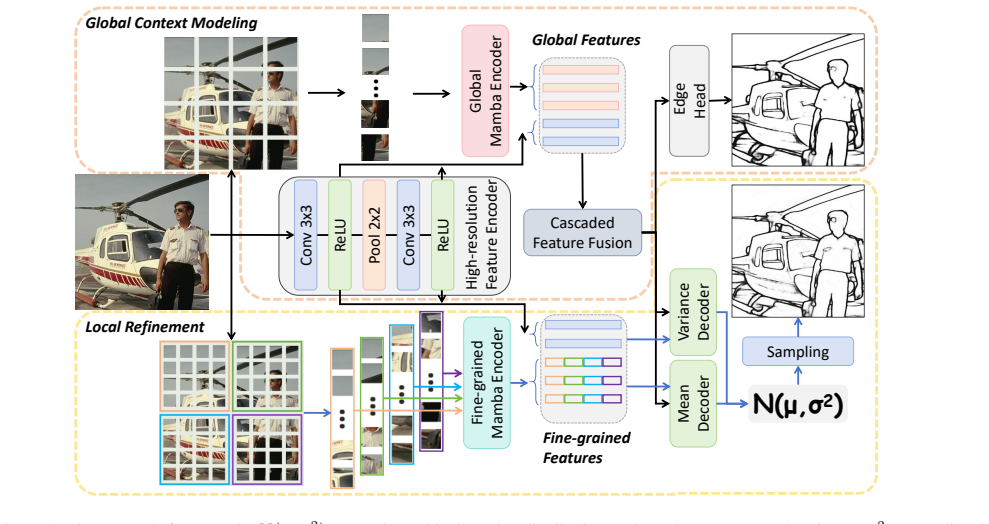
The load-bearing object is the learnable Gaussian distributions (LGD) decoder. It turns fused global, fine-grained, and high-resolution features into per-pixel parameters $(\mu, \sigma^2)$; the edge map is a sample from $\mathcal{N}(\mu, \sigma^2)$, and granularity is controlled by the scalar formula $p_\gamma = \mu + \gamma \sigma^2$. The ELBO loss—a weighted cross-entropy term for the sample plus a KL term that regularizes each pixel distribution toward $\mathcal{N}(0,1)$—is what lets one binary label supervise the variance, removing the need for multiple human annotations. Without this decoder, the network still detects edges but cannot produce multi-granularity outputs.
What would settle it
Train EDMB on BSDS500 and inspect the learned $\sigma^2$: if the average variance on edge pixels is not larger than on non-edge pixels, or if it does not correlate with the spread of human annotations across the 4–9 ground-truth maps, then the learned distribution is not encoding edge uncertainty and the multi-granularity claim fails. A simpler check is to fix $\gamma$ at several values and compute the mean distance between the resulting edge maps; near-zero distance means $\gamma$ does not control granularity.
Extended reading notes
Core claim
EDMB's central claim is that Mamba's selective state-space model can serve as the core of a state-of-the-art edge detector when paired with a global-local architecture and a probabilistic decoder. The network uses a global Mamba encoder for long-range context, a fine-grained Mamba encoder over non-overlapping windows for local detail, and a lightweight CNN high-resolution encoder to preserve precise location information. A learnable Gaussian distributions decoder fuses these features to predict per-pixel means and variances, and multi-granularity edges are obtained by sampling $p_\gamma = \mu + \gamma \sigma^2$. The Evidence Lower Bound loss—weighted cross-entropy on a sampled edge map plus a KL divergence pushing each pixel distribution toward $\mathcal{N}(0,1)$—supervises the distribution so that a single binary label is enough. The paper reports ODS 0.837/0.851 on BSDS500 without multi-scale testing or extra PASCAL-VOC data, and ODS 0.783 on NYUDv2 and 0.906 on BIPED for the multi-granularity version, claiming the first Mamba-based edge detector and the first multi-granularity edge results on single-label datasets.
Load-bearing premise
The multi-granularity capability rests on the assumption that a per-pixel Gaussian variance, learned from a single binary edge label through the ELBO loss, actually captures meaningful edge uncertainty; if the variance is degenerate or unrelated to annotation disagreement, the granularity slider $p_\gamma = \mu + \gamma \sigma^2$ produces no real granularity variation.
Editorial extensions
If this is right
- Mamba can replace Transformers in edge detection: on BSDS500, EDMB reports a higher ODS than DiffusionEdge while using roughly one-third the parameters and about half the GFLOPs.
- Multi-granularity edge maps become available on single-label datasets such as NYUDv2 and BIPED, removing a previous dependency on multiple human annotations.
- Granularity is controlled at inference time by one scalar $\gamma$, so a single trained model can serve tasks that want coarse boundaries or fine detail without retraining.
- The reported gains on BSDS500 are achieved without multi-scale testing or extra PASCAL-VOC data, so they come from the architecture and loss rather than test-time augmentation.
Reading between the lines
- If the learned variance truly reflects per-pixel edge uncertainty, the same $\sigma^2$ could guide active re-annotation by pointing at pixels where annotators most disagree; the paper does not explore this use.
- The $\gamma$ schedule is selected after evaluating several schedules and reporting the best ODS on the test set; a stricter protocol that fixes $\gamma$ on validation data would be needed to know whether the 0.851 multi-granularity number is robust.
- Because the ELBO head resembles a variational autoencoder, a natural extension is to condition $\gamma$ on a task embedding so downstream systems could request coarse or fine edges explicitly instead of tuning a scalar.
- A promising test of the method's generality is to apply it to domains with deliberately coarse annotation styles, such as medical or remote-sensing boundaries, where multi-label training data is rarely available.
Editorial analysis
A structured set of objections, weighed in public.
Referee Report
Summary. The paper proposes EDMB, an edge detector built on vision Mamba, combining a global Mamba encoder, a fine-grained Mamba encoder, and a lightweight CNN high-resolution encoder. A decoder predicts per-pixel Gaussian distributions N(mu, sigma^2), supervised by an ELBO loss composed of a weighted cross-entropy term and a KL divergence to N(0,1). Multi-granularity edges are generated as p_gamma = mu + gamma*sigma^2. Experiments on BSDS500, NYUDv2, and BIPED report single-granularity ODS 0.837 and multi-granularity ODS 0.851 on BSDS500, with further multi-granularity results on single-label datasets. The paper claims to be the first Mamba-based edge detector and the first to produce multi-granularity edges without multi-label training data.
Significance. If the reported results are sound, EDMB is significant in two respects: it demonstrates that a Mamba-based backbone can reach the top of the BSDS500 leaderboard without multi-scale testing or extra PASCAL-VOC data, and it extends multi-granularity edge generation to single-label datasets, removing the multi-label-data requirement of prior work such as UAED and MuGE. The paper is also commendable for providing source code, an honest ablation showing that the proposed decoder alone does not improve single-granularity accuracy, and a correct closed-form KL divergence in Eq. (8). The main risk is that the central multi-granularity claim rests on an unvalidated learned variance and on a gamma schedule chosen directly from test-set performance; these issues need to be resolved before the significance can be fully assessed.
major comments (4)
- [Section 4.3, Table 3] The text states that on BIPED "EDMB* achieves 0.924 ODS, which is the new SOTA method and 0.7% higher than the second best DiffusionEdge," but Table 3 reports EDMB* ODS of 0.906 and DiffusionEdge ODS of 0.899 for BIPED. The two numbers (0.924 and 0.906) are inconsistent, and the claimed 0.7% improvement matches the 0.906 vs. 0.899 difference, not the 0.924 value. Please correct this inconsistency and, if 0.924 was obtained under a different evaluation setting, describe that setting explicitly.
- [Section 3.6, Eq. (14), Table 5] The headline multi-granularity ODS of 0.851 on BSDS500 is obtained by selecting the gamma schedule "Random n/2 - 5" from Table 5, which reports test-set ODS values between 0.845 and 0.851 for different schedules. No held-out validation set is used to select gamma, so the reported improvement from single-granularity 0.837 to multi-granularity 0.851 may reflect test-set overfitting rather than a genuine granularity-control benefit. Please report how gamma was selected (e.g., on a validation split) and, ideally, the variance of the results over multiple runs.
- [Sections 3.4-3.6, Eq. (14)] The multi-granularity mechanism assumes that the learned per-pixel variance sigma^2 encodes meaningful edge uncertainty, so that p_gamma = mu + gamma*sigma^2 produces genuine granularity variation. The paper does not provide any direct evidence for this: no statistics on the learned sigma^2 (e.g., whether it is spatially structured or nearly constant), no correlation with per-pixel annotator disagreement on BSDS500, and no ablation that replaces sigma^2 with a constant or a hand-crafted uncertainty proxy. If sigma^2 is degenerate, Eq. (14) reduces to a global bias and the claimed ability to control granularity on single-label data does not follow. Please add such validation analyses.
- [Section 3.5, Eq. (10)] The ELBO loss depends on "a sampling p of the distributions," but the paper does not state how p is sampled during training, e.g., whether the reparameterization trick is used, how many samples are drawn per iteration, or whether the sampling is performed on the full-resolution output. This implementation detail is essential for reproducing the training procedure and for the claim that Eq. (10) is a valid ELBO. Please clarify the sampling procedure in the implementation details.
minor comments (6)
- [Eq. (8)] The integral derivation of the KL divergence is malformed in the typeset text (missing integral signs and unclear exponent placement). The final closed form is correct, but the derivation should be typeset properly for readability.
- [Section 3.6] The term "sampling" is used both for random draws from the Gaussian during training and for the deterministic operation in Eq. (14), which may confuse readers. Consider using "granularity modulation" or "deterministic shifting" for the inference-time operation.
- [Section 4.3, Table 3] The text says EDMB* "can match" RankED on NYUDv2, but Table 3 shows EDMB* ODS 0.783 above RankED's 0.780; this could be phrased more precisely as a slight improvement.
- [Section 4.3] The statement that ODS and OIS are improved by "0.3%" over DiffusionEdge should say "0.3 percentage points" (i.e., 0.003 in the reported metrics), to avoid ambiguity between relative and absolute improvement.
- [Figure 3] The caption of Figure 3 appears to be duplicated, and some subfigure labels (e.g., (g), (m)) are repeated. Please clean up the figure caption and subfigure numbering.
- [Section 1] The claim that EDMB is "the first Mamba-based edge detector" should be verified against concurrent work, since the field is rapidly evolving; if any prior Mamba-based edge detector exists, the claim should be adjusted.
Circularity Check
No significant circularity: the multi-granularity formula and ELBO loss are standard/external, and the empirical benchmark claims are self-contained.
full rationale
The paper's derivation chain is self-contained and not circular. The learnable Gaussian decoder (Sec. 3.4, Eq. 7) predicts means and variances from global and fine-grained features; the ELBO loss (Sec. 3.5, Eq. 10) combines a standard closed-form KL divergence (Eq. 8) with a weighted cross-entropy term (Eq. 9); multi-granularity outputs are then obtained by the explicitly inherited shift rule p_gamma = mu + gamma sigma^2 (Eq. 14), which the paper attributes to the external MuGE method [53], not to the authors' own prior work. No equation defines its output in terms of the reported ODS/OIS numbers, and no fitted parameter is relabeled as a prediction. The only self-citations ([27], [37], [38] by co-author Xavier Soria Poma) concern dataset details and implementation practice and are not load-bearing for the central novelty. The main weaknesses are empirical rather than circular: the learned variance sigma^2 is not directly validated as encoding per-pixel uncertainty, and the headline multi-granularity ODS 0.851 in Table 5 is obtained by selecting the best gamma schedule on the BSDS500 test set. These are validation/test-selection concerns, not reductions of the claimed result to its inputs. The appended limitation statement notes a lack of downstream-task discussion, which is a scope limitation, not a circular step.
Assumptions & free parameters
free parameters (4)
- lambda (WCE balance) =
1.1 (BSDS500/BIPED), 1.3 (NYUDv2)
- phi (KL weight in ELBO loss) =
not reported
- alpha2 (auxiliary ELBO weight) =
0.4
- gamma (granularity control) =
n/2 - 5, n in {0..10} for the best result
assumptions (4)
- domain assumption Edge granularity can be controlled by p_gamma = mu + gamma * sigma^2
- ad hoc to paper A single binary label plus ELBO loss yields a meaningful per-pixel variance
- domain assumption Vision Mamba (ViM) is an effective backbone for edge detection
- standard math The closed-form KL divergence between two Gaussians is correct
Cite this review
Pith. "Pith review of EDMB: Edge Detector with Mamba." pith.science (2026). https://pith.science/paper/C75U6HFH
@misc{pith2026250104846,
  author       = {Pith},
  title        = {Pith review of: EDMB: Edge Detector with Mamba},
  year         = {2026},
  howpublished = {\url{https://pith.science/paper/C75U6HFH}},
  note         = {Machine review of arXiv:2501.04846}
}
read the original abstract
Transformer-based models have made significant progress in edge detection, but their high computational cost is prohibitive. Recently, vision Mamba have shown excellent ability in efficiently capturing long-range dependencies. Drawing inspiration from this, we propose a novel edge detector with Mamba, termed EDMB, to efficiently generate high-quality multi-granularity edges. In EDMB, Mamba is combined with a global-local architecture, therefore it can focus on both global information and fine-grained cues. The fine-grained cues play a crucial role in edge detection, but are usually ignored by ordinary Mamba. We design a novel decoder to construct learnable Gaussian distributions by fusing global features and fine-grained features. And the multi-grained edges are generated by sampling from the distributions. In order to make multi-granularity edges applicable to single-label data, we introduce Evidence Lower Bound loss to supervise the learning of the distributions. On the multi-label dataset BSDS500, our proposed EDMB achieves competitive single-granularity ODS 0.837 and multi-granularity ODS 0.851 without multi-scale test or extra PASCAL-VOC data. Remarkably, EDMB can be extended to single-label datasets such as NYUDv2 and BIPED. The source code is available at https://github.com/Li-yachuan/EDMB.
Figures


Figures from the paper (1 more)

Reference graph
Works this paper leans on
-
[1]
Contour detection and hierarchical image seg- mentation
Pablo Arbelaez, Michael Maire, Charless Fowlkes, and Ji- tendra Malik. Contour detection and hierarchical image seg- mentation. IEEE transactions on pattern analysis and ma- chine intelligence, 33(5):898–916, 2010. 2, 6, 7
work page 2010
-
[2]
A computational approach to edge detection
John Canny. A computational approach to edge detection. IEEE Transactions on pattern analysis and machine intelli- gence, 8(6):679–698, 1986. 1, 2, 6, 7
work page 1986
-
[3]
Ranked: Addressing imbalance and uncertainty in edge detection using ranking-based losses
Bedrettin Cetinkaya, Sinan Kalkan, and Emre Akbas. Ranked: Addressing imbalance and uncertainty in edge detection using ranking-based losses. In Proceedings of the IEEE/CVF Conference on Computer Vision and Pattern Recognition, pages 3239–3249, 2024. 2, 7
work page 2024
-
[4]
Chi-Sheng Chen, Guan-Ying Chen, Dong Zhou, Di Jiang, and Dai-Shi Chen. Res-vmamba: Fine-grained food category visual classification using selective state space models with deep residual learning. arXiv preprint arXiv:2402.15761 ,
-
[5]
A survey of edge detection techniques
Larry S Davis. A survey of edge detection techniques. Com- puter graphics and image processing , 4(3):248–270, 1975. 1, 2
work page 1975
-
[6]
Deep structural contour de- tection
Ruoxi Deng and Shengjun Liu. Deep structural contour de- tection. In Proceedings of the 28th ACM international con- ference on multimedia, pages 304–312, 2020. 7
work page 2020
-
[7]
Learning to decode con- textual information for efficient contour detection
Ruoxi Deng, Shengjun Liu, Jinxin Wang, Huibing Wang, Hanli Zhao, and Xiaoqin Zhang. Learning to decode con- textual information for efficient contour detection. In Pro- ceedings of the 29th ACM International Conference on Mul- timedia, pages 4435–4443, 2021. 7
work page 2021
-
[8]
Learning to predict crisp boundaries
Ruoxi Deng, Chunhua Shen, Shengjun Liu, Huibing Wang, and Xinru Liu. Learning to predict crisp boundaries. In Pro- ceedings of the European Conference on Computer Vision (ECCV), pages 562–578, 2018. 7
work page 2018
Show all 55 references
-
[9]
Fast edge detection us- ing structured forests
Piotr Doll ´ar and C Lawrence Zitnick. Fast edge detection us- ing structured forests. IEEE transactions on pattern analysis and machine intelligence, 37(8):1558–1570, 2014. 7
2014
-
[10]
Fast edge detection using structured forests
Piotr Doll ´ar and C.Lawrence Zitnick. Fast edge detection using structured forests. arXiv: Computer Vision and Pattern Recognition, Jun 2014. 2
2014
-
[11]
An image is worth 16x16 words: Trans- formers for image recognition at scale
Alexey Dosovitskiy, Lucas Beyer, Alexander Kolesnikov, Dirk Weissenborn, Xiaohua Zhai, Thomas Unterthiner, Mostafa Dehghani, Matthias Minderer, Georg Heigold, Syl- vain Gelly, et al. An image is worth 16x16 words: Trans- formers for image recognition at scale. arXiv preprint a...
2010 arXiv
-
[12]
Practical edge detection via ro- bust collaborative learning
Yuanbin Fu and Xiaojie Guo. Practical edge detection via ro- bust collaborative learning. In Proceedings of the 31st ACM International Conference on Multimedia, pages 2526–2534,
-
[13]
Mamba: Linear-time sequence modeling with selective state spaces
Albert Gu and Tri Dao. Mamba: Linear-time sequence modeling with selective state spaces. arXiv preprint arXiv:2312.00752, 2023. 2
2023 arXiv
-
[14]
Sam Hallman and CharlessC. Fowlkes. Oriented edge forests for boundary detection. Cornell University - arXiv , Dec
-
[15]
Oriented edge forests for boundary detection
Sam Hallman and Charless C Fowlkes. Oriented edge forests for boundary detection. In Proceedings of the IEEE con- ference on computer vision and pattern recognition , pages 1732–1740, 2015. 6, 7
2015
-
[16]
Bdcn: Bi-directional cascade network for per- ceptual edge detection
Jianzhong He, Shiliang Zhang, Ming Yang, Yanhu Shan, and Tiejun Huang. Bdcn: Bi-directional cascade network for per- ceptual edge detection. IEEE Transactions on Pattern Anal- ysis and Machine Intelligence, 44(1):100–113, 2022. 1, 2, 6, 7
2022
-
[17]
Deep residual learning for image recognition
Kaiming He, Xiangyu Zhang, Shaoqing Ren, and Jian Sun. Deep residual learning for image recognition. In Proceed- ings of the IEEE conference on computer vision and pattern recognition, pages 770–778, 2016. 4
2016
-
[18]
Mobilenets: Efficient convolu- tional neural networks for mobile vision applications
Andrew G Howard, Menglong Zhu, Bo Chen, Dmitry Kalenichenko, Weijun Wang, Tobias Weyand, Marco An- dreetto, and Hartwig Adam. Mobilenets: Efficient convolu- tional neural networks for mobile vision applications. arXiv preprint arXiv:1704.04861, 2017. 4, 5
2017 arXiv
-
[19]
Localmamba: Visual state space model with windowed selective scan
Tao Huang, Xiaohuan Pei, Shan You, Fei Wang, Chen Qian, and Chang Xu. Localmamba: Visual state space model with windowed selective scan. arXiv preprint arXiv:2403.09338,
-
[20]
Pushing the boundaries of bound- ary detection using deep learning
Kokkinos Iasonas. Pushing the boundaries of bound- ary detection using deep learning. arXiv preprint arXiv:1511.07386, 2015. 7
2015 arXiv
-
[21]
Auto-encoding varia- tional bayes
Diederik P Kingma and Max Welling. Auto-encoding varia- tional bayes. arXiv preprint arXiv:1312.6114, 2013. 5
2013 arXiv
-
[22]
Beta net- work for boundary detection under nondeterministic labels
Mingchun Li, Dali Chen, and Shixin Liu. Beta net- work for boundary detection under nondeterministic labels. Knowledge-Based Systems, 266:110389, 2023. 2
2023
-
[23]
Lightm-unet: Mamba assists in lightweight unet for medical image segmentation
Weibin Liao, Yinghao Zhu, Xinyuan Wang, Cehngwei Pan, Yasha Wang, and Liantao Ma. Lightm-unet: Mamba assists in lightweight unet for medical image segmentation. arXiv preprint arXiv:2403.05246, 2024. 3
2024 arXiv
-
[24]
Richer convolutional features for edge detection
Yun Liu, Ming-Ming Cheng, Xiaowei Hu, Jia-Wang Bian, Le Zhang, Xiang Bai, and Jinhui Tang. Richer convolutional features for edge detection. IEEE Transactions on Pattern Analysis & Machine Intelligence , 41(08):1939–1946, 2019. 1, 2, 6, 7, 8
1939
-
[25]
Learning relaxed deep su- pervision for better edge detection
Yu Liu and Michael S Lew. Learning relaxed deep su- pervision for better edge detection. In Proceedings of the IEEE conference on computer vision and pattern recogni- tion, pages 231–240, 2016. 7
2016
-
[26]
Understanding the effective receptive field in deep convolu- tional neural networks
Wenjie Luo, Yujia Li, Raquel Urtasun, and Richard Zemel. Understanding the effective receptive field in deep convolu- tional neural networks. Advances in neural information pro- cessing systems, 29, 2016. 1
2016
-
[27]
Dense extreme inception network: Towards a robust cnn model for edge detection
Xavier Soria Poma, Edgar Riba, and Angel Sappa. Dense extreme inception network: Towards a robust cnn model for edge detection. In Proceedings of the IEEE/CVF Win- ter Conference on Applications of Computer Vision , pages 1923–1932, 2020. 2, 6
1923
-
[28]
Edter: Edge detection with transformer
Mengyang Pu, Yaping Huang, Yuming Liu, Qingji Guan, and Haibin Ling. Edter: Edge detection with transformer. In Proceedings of the IEEE/CVF Conference on Computer Vision and Pattern Recognition, pages 1402–1412, 2022. 1, 2, 4, 6, 7
2022
-
[29]
Discriminatively trained sparse code gradients for contour detection
Xiaofeng Ren and Liefeng Bo. Discriminatively trained sparse code gradients for contour detection. In Proceedings 9 of the 25th International Conference on Neural Information Processing Systems-Volume 1, pages 584–592, 2012. 6, 7
2012
-
[30]
U- net: Convolutional networks for biomedical image segmen- tation
Olaf Ronneberger, Philipp Fischer, and Thomas Brox. U- net: Convolutional networks for biomedical image segmen- tation. In International Conference on Medical image com- puting and computer-assisted intervention , pages 234–241. Springer, 2015. 4
2015
-
[31]
A classified and comparative study of edge de- tection algorithms
Mohsen Sharifi, Mahmood Fathy, and Maryam Tayefeh Mahmoudi. A classified and comparative study of edge de- tection algorithms. In Proceedings. International conference on information technology: Coding and computing , pages 117–120. IEEE, 2002. 1, 2
2002
-
[32]
Deepcontour: A deep convolutional feature learned by positive-sharing loss for contour detection
Wei Shen, Xinggang Wang, Yan Wang, Xiang Bai, and Zhi- jiang Zhang. Deepcontour: A deep convolutional feature learned by positive-sharing loss for contour detection. In Proceedings of the IEEE conference on computer vision and pattern recognition, pages 3982–3991, 2015. 7
2015
-
[33]
The edge of depth: Explicit constraints between segmentation and depth
Zhu Shengjie, Brazil Garrick, and Liu Xiaoming. The edge of depth: Explicit constraints between segmentation and depth. In Proceedings of the IEEE/CVF Conference on Com- puter Vision and Pattern Recognition , pages 13116–13125,
-
[34]
Indoor segmentation and support inference from rgbd images
Nathan Silberman, Derek Hoiem, Pushmeet Kohli, and Rob Fergus. Indoor segmentation and support inference from rgbd images. In Computer Vision–ECCV 2012: 12th Eu- ropean Conference on Computer Vision, Florence, Italy, Oc- tober 7-13, 2012, Proceedings, Part V 12 , pages 746–760...
2012
-
[35]
Very deep convo- lutional networks for large-scale image recognition
Karen Simonyan and Andrew Zisserman. Very deep convo- lutional networks for large-scale image recognition. arXiv preprint arXiv:1409.1556, 2014. 4
2014 arXiv
-
[36]
A 3x3 isotropic gradient operator for image processing
Irwin Sobel, Gary Feldman, et al. A 3x3 isotropic gradient operator for image processing. a talk at the Stanford Artifi- cial Project in, pages 271–272, 1968. 1, 2
1968
-
[37]
Ldc: Lightweight dense cnn for edge detection.IEEE Access, 10:68281–68290, 2022
Xavier Soria, Gonzalo Pomboza-Junez, and Angel Domingo Sappa. Ldc: Lightweight dense cnn for edge detection.IEEE Access, 10:68281–68290, 2022. 1
2022
-
[38]
Dense extreme inception network for edge detec- tion
Xavier Soria, Angel Sappa, Patricio Humanante, and Arash Akbarinia. Dense extreme inception network for edge detec- tion. Pattern Recognition, 139:109461, 2023. 6
2023
-
[39]
Lightweight pixel dif- ference networks for efficient visual representation learning
Zhuo Su, Jiehua Zhang, Longguang Wang, Hua Zhang, Zhen Liu, Matti Pietik ¨ainen, and Li Liu. Lightweight pixel dif- ference networks for efficient visual representation learning. IEEE Transactions on Pattern Analysis and Machine Intelli- gence, 2023. 7
2023
-
[40]
State space model for new-generation net- work alternative to transformers: A survey
Xiao Wang, Shiao Wang, Yuhe Ding, Yuehang Li, Wentao Wu, Yao Rong, Weizhe Kong, Ju Huang, Shihao Li, Haoxi- ang Yang, et al. State space model for new-generation net- work alternative to transformers: A survey. arXiv preprint arXiv:2404.09516, 2024. 2
2024 arXiv
-
[41]
Deep crisp bound- aries
Yupei Wang, Xin Zhao, and Kaiqi Huang. Deep crisp bound- aries. In Proceedings of the IEEE conference on computer vision and pattern recognition, pages 3892–3900, 2017. 7
2017
-
[42]
Ultralight vm-unet: Parallel vision mamba significantly reduces parameters for skin lesion segmentation
Renkai Wu, Yinghao Liu, Pengchen Liang, and Qing Chang. Ultralight vm-unet: Parallel vision mamba significantly reduces parameters for skin lesion segmentation. arXiv preprint arXiv:2403.20035, 2024. 3
2024 arXiv
-
[43]
Holistically-nested edge de- tection
Saining Xie and Zhuowen Tu. Holistically-nested edge de- tection. International Journal of Computer Vision, 125(1):3– 18, 2017. 1, 2, 6, 7
2017
-
[44]
Learning deep struc- tured multi-scale features using attention-gated crfs for con- tour prediction
Dan Xu, Wanli Ouyang, Xavier Alameda-Pineda, Elisa Ricci, Xiaogang Wang, and Nicu Sebe. Learning deep struc- tured multi-scale features using attention-gated crfs for con- tour prediction. Advances in neural information processing systems, 30, 2017. 7
2017
-
[45]
Pidnet: A real-time semantic segmentation network inspired from pid controller
Jiacong Xu, Zixiang Xiong, and Shankar P Bhattacharyya. Pidnet: A real-time semantic segmentation network inspired from pid controller. arXiv preprint arXiv:2206.02066, 2022. 1
2022 arXiv
-
[46]
Fcl- net: Towards accurate edge detection via fine-scale correc- tive learning
Wenjie Xuan, Shaoli Huang, Juhua Liu, and Bo Du. Fcl- net: Towards accurate edge detection via fine-scale correc- tive learning. Neural Networks, 145:248–259, 2022. 2, 7
2022
-
[47]
Object contour detection with a fully convolutional encoder-decoder network
Jimei Yang, Brian Price, Scott Cohen, Honglak Lee, and Ming-Hsuan Yang. Object contour detection with a fully convolutional encoder-decoder network. In Proceedings of the IEEE conference on computer vision and pattern recog- nition, pages 193–202, 2016. 7
2016
-
[48]
Remamber: Referring image segmentation with mamba twister
Yuhuan Yang, Chaofan Ma, Jiangchao Yao, Zhun Zhong, Ya Zhang, and Yanfeng Wang. Remamber: Referring image segmentation with mamba twister. arXiv preprint arXiv:2403.17839, 2024. 2
2024 arXiv
-
[49]
Diffusionedge: Diffusion probabilistic model for crisp edge detection
Yunfan Ye, Kai Xu, Yuhang Huang, Renjiao Yi, and Zhiping Cai. Diffusionedge: Diffusion probabilistic model for crisp edge detection. arXiv preprint arXiv:2401.02032, 2024. 1, 2, 7
2024 arXiv
-
[50]
Sketch me that shoe
Qian Yu, Feng Liu, Yi-Zhe Song, Tao Xiang, Timothy M Hospedales, and Chen-Change Loy. Sketch me that shoe. In Proceedings of the IEEE Conference on Computer Vision and Pattern Recognition, pages 799–807, 2016. 1
2016
-
[51]
A survey on visual mamba
Hanwei Zhang, Ying Zhu, Dan Wang, Lijun Zhang, Tianx- iang Chen, Ziyang Wang, and Zi Ye. A survey on visual mamba. Applied Sciences, 14(13):5683, 2024. 2
2024
-
[52]
Egnet: Edge guid- ance network for salient object detection
Jia-Xing Zhao, Jiang-Jiang Liu, Deng-Ping Fan, Yang Cao, Jufeng Yang, and Ming-Ming Cheng. Egnet: Edge guid- ance network for salient object detection. In Proceedings of the IEEE/CVF international conference on computer vision, pages 8779–8788, 2019. 1
2019
-
[53]
Muge: Multiple granularity edge detection
Caixia Zhou, Yaping Huang, Mengyang Pu, Qingji Guan, Ruoxi Deng, and Haibin Ling. Muge: Multiple granularity edge detection. In Proceedings of the IEEE/CVF Conference on Computer Vision and Pattern Recognition, pages 25952– 25962, 2024. 1, 2, 4, 5, 6, 7, 8
2024
-
[54]
The treasure beneath multiple an- notations: An uncertainty-aware edge detector
Caixia Zhou, Yaping Huang, Mengyang Pu, Qingji Guan, Li Huang, and Haibin Ling. The treasure beneath multiple an- notations: An uncertainty-aware edge detector. In Proceed- ings of the IEEE/CVF Conference on Computer Vision and Pattern Recognition, pages 15507–15517, 2023. 1, ...
2023
-
[55]
Vision mamba: Efficient visual representation learning with bidirectional state space model
Lianghui Zhu, Bencheng Liao, Qian Zhang, Xinlong Wang, Wenyu Liu, and Xinggang Wang. Vision mamba: Efficient visual representation learning with bidirectional state space model. arXiv preprint arXiv:2401.09417, 2024. 2, 3 10
2024 arXiv
Reviewed August 10, 2026 · model on record in the stance chip above.
Discussion (0). Continue with ORCID to comment.