Achieving Heisenberg limit under noisy conditions with quantum Zeno dynamics and dynamical decoupling
Pith reviewed 2026-06-27 06:28 UTC · model grok-4.3
The pith
Quantum Zeno dynamics and dynamical decoupling together enable the Heisenberg limit in metrology under specific noise conditions.
A machine-rendered reading of the paper's core claim, the machinery that carries it, and where it could break.
Core claim
QZD and DD provide necessary and sufficient conditions for noise suppression and achieving the Heisenberg limit, with their combination enabling saturation of the limit even when each is imperfect, and outperforming QEC in some Markovian cases.
What carries the argument
Necessary and sufficient conditions for the utility of QZD and DD in suppressing noise and achieving Heisenberg limit in quantum metrology.
If this is right
- In the Markovian regime, QZD/DD can achieve HL where current QEC methods may not.
- The combination of QZD and DD allows individually imperfect strategies to saturate HL.
- These conditions determine when noise can be suppressed using these tools.
Where Pith is reading between the lines
- This approach may extend to designing hybrid protocols for quantum sensors in realistic noisy environments.
- Future work could test these conditions in specific physical systems like trapped ions or superconducting qubits.
- Combining with other techniques might further broaden the applicability beyond Markovian noise.
Load-bearing premise
The analysis assumes specific models of system-bath interaction and control Hamiltonians under which QZD and DD are defined; deviations in actual noise could invalidate the conditions.
What would settle it
An experiment measuring whether the Heisenberg limit is achieved or noise is suppressed under the derived conditions for QZD and DD, versus when they are not applied.
Figures
read the original abstract
Quantum Zeno dynamics (QZD) and dynamical decoupling (DD) are useful tools that enable the effective suppression of noise in quantum systems. We consider the problem of when (i) noise can be suppressed and (ii) Heisenberg limit (HL) can be achieved in quantum metrology, and prove necessary and sufficient conditions for when QZD and DD are useful for achieving these two goals. We also show that in the Markovian regime, there are scenarios where preventing errors using QZD/DD may enable HL to be achieved where current QEC methods may not. Finally, we demonstrate that the combination of both techniques can allow individually imperfect QZD and DD strategies to saturate HL.
Editorial analysis
A structured set of objections, weighed in public.
Referee Report
Summary. The paper claims to prove necessary and sufficient conditions under which quantum Zeno dynamics (QZD) and dynamical decoupling (DD) suppress noise and achieve the Heisenberg limit (HL) in quantum metrology. It further shows that, in the Markovian regime, QZD/DD can enable HL in scenarios where quantum error correction (QEC) may fail, and that combining individually imperfect QZD and DD strategies can saturate HL.
Significance. If the derivations hold under the stated models, the work supplies explicit necessary-and-sufficient conditions for when QZD and DD are useful for HL metrology, together with a comparative advantage over QEC in selected Markovian cases and a demonstration that imperfect instances of the two techniques can be combined to reach optimality. These are concrete, falsifiable results that could guide experimental design in noisy quantum sensing.
major comments (2)
- [section deriving nec+suff conditions] The necessary and sufficient conditions are derived only for specific Markovian system-bath interaction Hamiltonians and control fields. The manuscript must state these assumptions explicitly in the section proving the conditions (and again when claiming comparative advantage over QEC) so that the scope of the “when” statement is unambiguous; without this, the central claim that the conditions identify precisely when QZD/DD achieve HL is not fully supported.
- [Markovian-regime comparison and combination demonstration] The claim that QZD/DD enable HL where current QEC methods may not, and that their combination saturates HL even when each is imperfect, rests on the same model-specific derivations. The paper should supply an explicit side-by-side comparison (same Hamiltonian, same noise parameters) showing where QEC fails while QZD/DD succeeds; otherwise the comparative statement remains illustrative rather than load-bearing.
minor comments (1)
- Notation for the system-bath coupling operators and the control Hamiltonians should be introduced once and used consistently; currently the abstract and later text appear to employ slightly different symbols for the same objects.
Simulated Author's Rebuttal
We thank the referee for the constructive and detailed comments. We agree that the scope of our necessary-and-sufficient conditions and the comparative claims require clearer framing, and we will revise the manuscript accordingly to make these points unambiguous and load-bearing.
read point-by-point responses
-
Referee: [section deriving nec+suff conditions] The necessary and sufficient conditions are derived only for specific Markovian system-bath interaction Hamiltonians and control fields. The manuscript must state these assumptions explicitly in the section proving the conditions (and again when claiming comparative advantage over QEC) so that the scope of the “when” statement is unambiguous; without this, the central claim that the conditions identify precisely when QZD/DD achieve HL is not fully supported.
Authors: We agree. The derivations are performed under the stated class of Markovian Hamiltonians and control fields, and the manuscript will be revised to state these assumptions explicitly at the start of the relevant section and again in the discussion of QEC comparisons. This will make the scope of the necessary-and-sufficient conditions unambiguous. revision: yes
-
Referee: [Markovian-regime comparison and combination demonstration] The claim that QZD/DD enable HL where current QEC methods may not, and that their combination saturates HL even when each is imperfect, rests on the same model-specific derivations. The paper should supply an explicit side-by-side comparison (same Hamiltonian, same noise parameters) showing where QEC fails while QZD/DD succeeds; otherwise the comparative statement remains illustrative rather than load-bearing.
Authors: We accept the point. While the manuscript already contains illustrative scenarios, an explicit side-by-side comparison under identical Hamiltonians and noise parameters will strengthen the claim. The revised version will include such a direct comparison (e.g., in a new subsection or table) demonstrating cases where QEC fails to reach HL while the QZD/DD strategies succeed, and where their combination saturates HL even when applied individually imperfectly. revision: yes
Circularity Check
No significant circularity; derivations are model-specific but self-contained
full rationale
The paper derives necessary and sufficient conditions for QZD/DD to suppress noise and reach HL directly from assumed Markovian system-bath interactions and control Hamiltonians. These proofs and demonstrations (including comparative claims versus QEC and imperfect-strategy combinations) are presented as consequences of the stated models without parameter fitting, self-definitional loops, or load-bearing self-citations. No reduction of a 'prediction' to an input by construction is exhibited, and the analysis remains within its explicit assumptions.
Axiom & Free-Parameter Ledger
Reference graph
Works this paper leans on
-
[1]
1 and verify that for high projection frequencies, the QFI curve does indeed approach HL
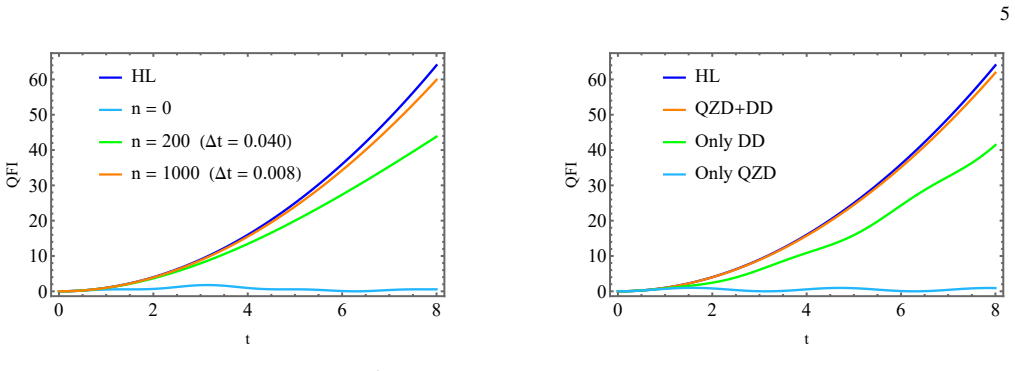
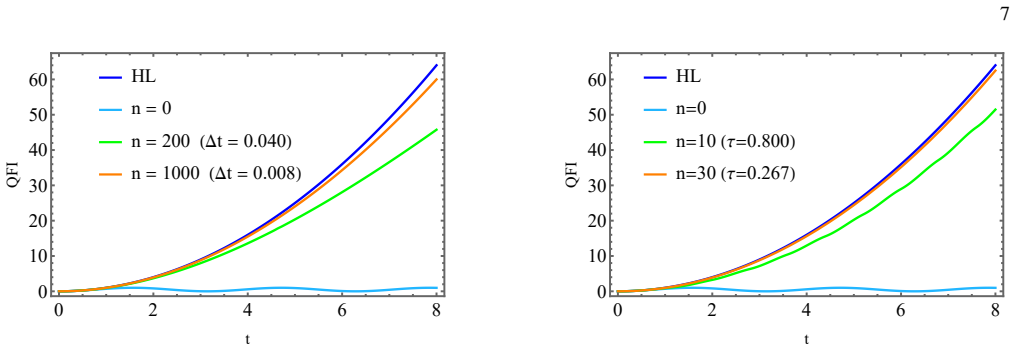
We plot the QFI for various projection fre- quencies over time in Fig. 1 and verify that for high projection frequencies, the QFI curve does indeed approach HL. The re- maining gap when the number of projections isn= 1000can be attributed to leakage due to the finite number of projections, which vanishes in the Zeno limit. Recall that the effective Zeno H...
-
[2]
C. M. Caves, Quantum-mechanical noise in an interferometer, Phys. Rev. D23, 1693 (1981)
1981
-
[3]
Giovannetti, S
V . Giovannetti, S. Lloyd, and L. Maccone, Quantum-enhanced measurements: Beating the standard quantum limit, Science 306, 1330 (2004)
2004
-
[4]
Pezz `e, A
L. Pezz `e, A. Smerzi, M. K. Oberthaler, R. Schmied, and P. Treutlein, Quantum metrology with nonclassical states of atomic ensembles, Rev. Mod. Phys.90, 035005 (2018)
2018
-
[5]
Breuer and F
H.-P. Breuer and F. Petruccione,The Theory of Open Quantum Systems(Oxford University Press, Oxford, 2002)
2002
-
[6]
V on Neumann,Mathematische Grundlagen der Quanten- mechanik, V ol
J. V on Neumann,Mathematische Grundlagen der Quanten- mechanik, V ol. 38 (Springer-Verlag, Berlin, 2013)
2013
-
[7]
J. J. Sakurai and J. Napolitano,Modern Quantum Mechanics (Cambridge University Press, Cambridge, 2020)
2020
-
[8]
Presilla, R
C. Presilla, R. Onofrio, and U. Tambini, Measurement quan- tum mechanics and experiments on quantum Zeno effect, Ann. Phys.248, 95 (1996)
1996
-
[9]
Nakazato, M
H. Nakazato, M. Namiki, and S. Pascazio, Temporal behavior of quantum mechanical systems, Int. J. Mod. Phys. B10, 247 (1996)
1996
-
[10]
A. D. Panov, Quantum Zeno effect, nuclear conversion and pho- toionization in solids, Ann. Phys.249, 1 (1996)
1996
-
[11]
Koshino and A
K. Koshino and A. Shimizu, Quantum Zeno effect by general measurements, Phys. Rep.412, 191 (2005)
2005
-
[12]
Beskow and J
A. Beskow and J. Nilsson, Concept of wave function and the irreducible representations of the Poincar ´e group. II. unsta- ble systems and the exponential decay law, Ark. Fys.34, 561 (1967)
1967
-
[13]
L. A. Khalfin, Phenomenological theory ofK 0 mesons and the non-exponential character of the decay, JETP Lett.8, 65 (1968)
1968
-
[14]
Misra and E
B. Misra and E. C. G. Sudarshan, The Zeno’s paradox in quan- tum theory, J. Math. Phys.18, 756 (1977)
1977
-
[15]
C. B. Chiu, E. C. G. Sudarshan, and B. Misra, Time evolution of unstable quantum states and a resolution of Zeno’s paradox, Phys. Rev. D16, 520 (1977)
1977
-
[16]
Facchi and S
P. Facchi and S. Pascazio, Quantum Zeno dynamics: Mathemat- ical and physical aspects, J. Phys. A: Math. Theor.41, 493001 (2008)
2008
-
[17]
Smerzi, Zeno dynamics, indistinguishability of state, and en- tanglement, Phys
A. Smerzi, Zeno dynamics, indistinguishability of state, and en- tanglement, Phys. Rev. Lett.109, 150410 (2012)
2012
-
[18]
Lerner, Quantum Zeno effect at finite measurement strength and frequency, Phys
L. Lerner, Quantum Zeno effect at finite measurement strength and frequency, Phys. Rev. A98, 052132 (2018)
2018
-
[19]
Sch ¨afer, I
F. Sch ¨afer, I. Herrera, S. Cherukattil, C. Lovecchio, F. S. Catal- iotti, F. Caruso, and A. Smerzi, Experimental realization of quantum Zeno dynamics, Nat. Commun.5, 3194 (2014)
2014
-
[20]
A. W. Chin, S. F. Huelga, and M. B. Plenio, Quantum metrology in non-Markovian environments, Phys. Rev. Lett.109, 233601 (2012). 8
2012
-
[21]
Matsuzaki, S
Y . Matsuzaki, S. C. Benjamin, and J. Fitzsimons, Magnetic field sensing beyond the standard quantum limit under the effect of decoherence, Phys. Rev. A84, 012103 (2011)
2011
-
[22]
R. Liu, X. Yang, X. Lv, X. Long, H. Liu, D. Lu, Y . Dong, and J. Li, Experimental realization of quantum Zeno dynam- ics for robust quantum metrology, Phys. Rev. Lett.135, 250805 (2025)
2025
-
[23]
Viola and S
L. Viola and S. Lloyd, Dynamical suppression of decoherence in two-state quantum systems, Phys. Rev. A58, 2733 (1998)
1998
-
[24]
Viola, Quantum control via encoded dynamical decoupling, Phys
L. Viola, Quantum control via encoded dynamical decoupling, Phys. Rev. A66, 012307 (2002)
2002
-
[25]
Cappellaro, J
P. Cappellaro, J. S. Hodges, T. F. Havel, and D. G. Cory, Princi- ples of control for decoherence-free subsystems, J. Chem. Phys. 125, 044514 (2006)
2006
-
[26]
G. S. Uhrig, Keeping a quantum bit alive by optimizedπ-pulse sequences, Phys. Rev. Lett.98, 100504 (2007)
2007
-
[27]
Facchi, D
P. Facchi, D. A. Lidar, and S. Pascazio, Unification of dynam- ical decoupling and the quantum Zeno effect, Phys. Rev. A69, 032314 (2004)
2004
-
[28]
A. Hahn, D. Burgarth, and K. Yuasa, Unification of random dy- namical decoupling and the quantum Zeno effect, New J. Phys. 24, 063027 (2022)
2022
-
[29]
Reed and B
M. Reed and B. Simon,Methods of Modern Mathematical Physics: Functional Analysis, V ol. 1 (Gulf Professional Pub- lishing, New York, 1980)
1980
-
[30]
Burgarth, P
D. Burgarth, P. Facchi, H. Nakazato, S. Pascazio, and K. Yuasa, Quantum Zeno dynamics from general quantum operations, Quantum4, 289 (2020)
2020
-
[31]
Kato, On the adiabatic theorem of quantum mechanics, J
T. Kato, On the adiabatic theorem of quantum mechanics, J. Phys. Soc. Jpn.5, 435 (1950)
1950
-
[32]
Burgarth, P
D. Burgarth, P. Facchi, H. Nakazato, S. Pascazio, and K. Yuasa, Generalized adiabatic theorem and strong-coupling limits, Quantum3, 152 (2019)
2019
-
[33]
Burgarth, P
D. Burgarth, P. Facchi, H. Nakazato, S. Pascazio, and K. Yuasa, Eternal adiabaticity in quantum evolution, Phys. Rev. A103, 032214 (2021)
2021
-
[34]
S. Zhou, M. Zhang, J. Preskill, and L. Jiang, Achieving the Heisenberg limit in quantum metrology using quantum error correction, Nat. Commun.9, 78 (2018)
2018
-
[35]
Z. Mann, N. Cao, R. Laflamme, and S. Zhou, Quantum error- corrected non-Markovian metrology, PRX Quantum6, 030321 (2025)
2025
-
[36]
Manzano, A short introduction to the Lindblad master equa- tion, AIP Adv.10, 025106 (2020)
D. Manzano, A short introduction to the Lindblad master equa- tion, AIP Adv.10, 025106 (2020)
2020
-
[37]
Watrous,The Theory of Quantum Information(Cambridge University Press, 2018)
J. Watrous,The Theory of Quantum Information(Cambridge University Press, 2018)
2018
-
[38]
C. R. Rao, Information and the accuracy attainable in the es- timation of statistical parameters, inBreakthroughs in Statis- tics: Foundations and Basic Theory, edited by S. Kotz and N. L. Johnson (Springer-Verlag, New York, 1992) pp. 235–247
1992
-
[39]
Lindblad, On the generators of quantum dynamical semi- groups, Commun
G. Lindblad, On the generators of quantum dynamical semi- groups, Commun. Math. Phys.48, 119 (1976)
1976
-
[40]
Lahcen, K
B. Lahcen, K. Zeng, Y . Jiang, and K. C. Tan, Restoring Heisenberg-limited precision in non-Markovian open quantum systems via dynamical decoupling, COMPANION PAPER
-
[41]
Khodjasteh and D
K. Khodjasteh and D. A. Lidar, Performance of determinis- tic dynamical decoupling schemes: Concatenated and periodic pulse sequences, Phys. Rev. A75, 062310 (2007)
2007
discussion (0)
Sign in with ORCID, Apple, or X to comment. Anyone can read and Pith papers without signing in.