REVIEW 3 major objections 6 minor 170 references
A four-dimensional data-driven map of binary black hole masses and spins reveals four mass-based subpopulations with new spin correlations that constrain which formation channels dominate where.
Reviewed by Pith at T0; open to challenge. T0 means a machine referee read the full paper against a public rubric. the ladder, T0–T4 →
T0 review · grok-4.5
2026-07-31 01:52 UTC pith:CE7G5T4K
load-bearing objection First real 4D data-driven BBH map on GWTC-5; the density work holds, the channel story is still qualitative. the 3 major comments →
A Four-dimensional Model-agnostic Probe into the Astrophysical Origins of Binary Black Hole Subpopulations
The pith
A machine-rendered reading of the paper's core claim, the machinery that carries it, and where it could break.
Core claim
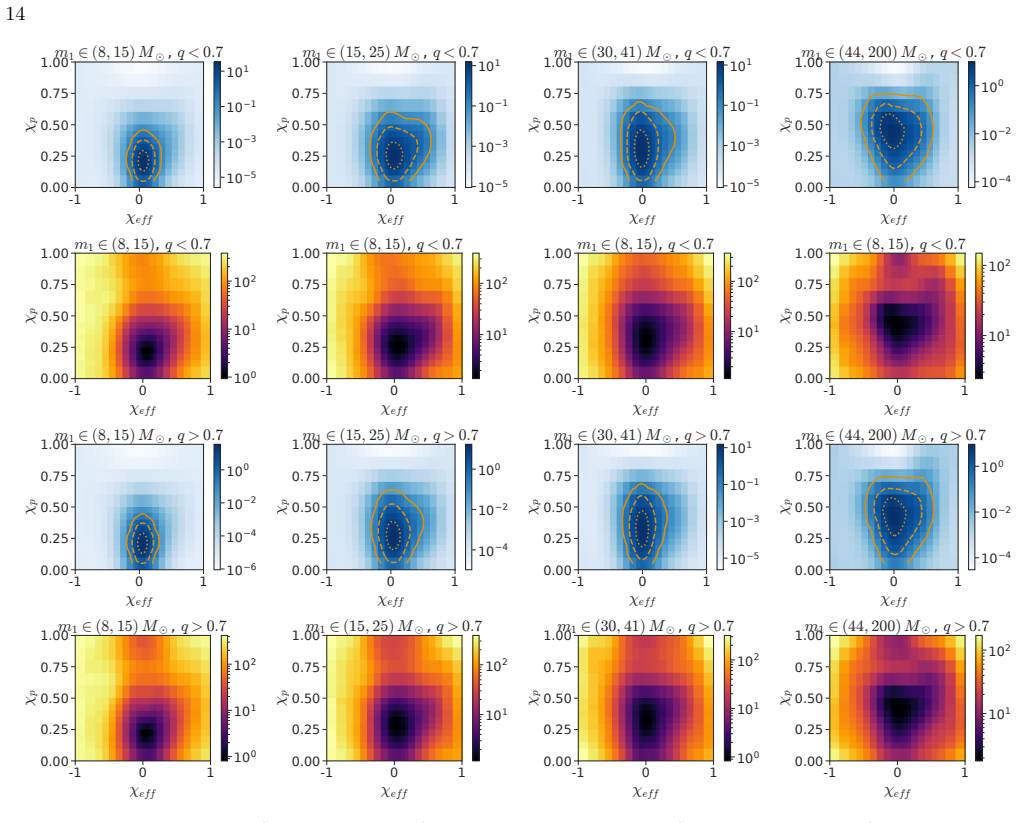
The first fully data-driven reconstruction of the joint four-dimensional BBH distribution in primary mass, mass ratio, effective inspiral spin, and effective precessing spin shows four distinct mass-spanning subpopulations, each with its own mass-ratio and spin structure, plus new mass-restricted correlations (most notably a broadening of effective inspiral spin with effective precessing spin above roughly 44 solar masses that is not produced by marginalizing over mass or mass ratio). These features supply model-agnostic constraints on the relative contributions of isolated evolution, dynamical first-generation assembly, and hierarchical mergers in each mass window.
What carries the argument
GPU-accelerated binned Gaussian processes: the merger-rate density is a piecewise-constant function on a four-dimensional grid whose logarithmic values are drawn from a Gaussian-process prior with an exponential-quadratic kernel; Hamiltonian Monte Carlo on GPUs samples the high-dimensional hyperposterior while the Kronecker structure of the kernel keeps the covariance factorization tractable.
Load-bearing premise
The mapping from observed shapes in effective spins and mass ratio onto named formation channels is qualitative and can be degenerate; if those fingerprints are incomplete, the abundance claims fail even when the four-dimensional density is correctly recovered.
What would settle it
A larger catalog or a targeted mixture model that recovers a clean elliptical feature in the high-mass effective-spin plane, or that erases the reported chi-eff broadening with chi-p inside every high-mass and mass-ratio slice, would directly contradict the channel assignments drawn from the four-dimensional map.
If this is right
- The ~10 solar-mass peak is dominated by slowly spinning, preferentially aligned systems consistent with isolated evolution, with only a modest anti-aligned or in-plane fraction that may admit some dynamical or hierarchical contribution.
- The 15–25 solar-mass window favors unequal masses and positively skewed aligned spins, requiring a mixture of hierarchical (likely AGN-disk) mergers and isolated sub-channels rather than either alone.
- The 30–40 solar-mass window is consistent with isotropic, slowly spinning, equal-mass first-generation dynamical assembly, with possible triple-system contributions indicated by elevated precessing spin.
- Above ~44 solar masses the population is not exclusively hierarchical: isotropic high- and moderate-spin components coexist, with hierarchical mergers growing in relative abundance toward higher mass but never monopolizing the slice.
- No statistically significant pair-instability mass gap or exclusive hierarchical onset near 45 solar masses is required by the present four-dimensional reconstruction.
Where Pith is reading between the lines
- Because the high-mass chi-eff–chi-p broadening survives every mass and mass-ratio cut, future parametric mixture models should treat it as an intrinsic two-component isotropic feature rather than a marginalization artifact.
- The absence of a recovered pair-instability cut-off implies that claims of a sharp ~45 solar-mass edge in strongly modeled analyses are prior-sensitive and should be re-tested against the same four-dimensional nonparametric density.
- Scaling the same binned-GP machinery to five dimensions that include redshift would directly measure how the relative channel abundances evolve with cosmic time, a measurement the present Letter flags as already computationally feasible.
Editorial analysis
A structured set of objections, weighed in public.
Referee Report
Summary. This Letter presents the first fully data-driven reconstruction of the joint four-dimensional BBH distribution in (m1, q, χeff, χp) from GWTC-5, using GPU-accelerated binned Gaussian processes with a Kronecker-separable exponential-quadratic kernel, injection-based selection correction, and a Monte Carlo variance penalty on the hierarchical likelihood (Eq. 1; App. D–E). From the inferred rate densities the authors identify four mass-spanning subpopulations (m1 windows in §3.2), quantify differences via Jensen–Shannon divergences (Fig. 2), and report mass-restricted correlations—most notably χeff broadening with χp for m1 ≳ 44 M⊙ that persists after slicing in m1 (Fig. 4) and q (Fig. 5). Section 4 maps these features onto relative contributions of isolated binary evolution, 1G+1G dynamical assembly, and hierarchical mergers across mass, arguing against exclusively hierarchical high-mass origins and against a clear pair-instability onset near ∼45 M⊙ in the current data.
Significance. If the 4D reconstruction and the reported conditional correlations hold, the work is a genuine methodological and empirical step beyond existing 3D non-parametric and strongly modeled mixture analyses. Scaling flexible population inference to four BBH parameters with publicly released code (gppop), Kronecker GP structure (App. E), variance-penalized likelihood (Eq. D8), and documented robustness to κ and binning (App. C) is a concrete technical contribution. The mass-conditional χeff–χp structure at high mass, checked against marginalization artifacts in m1 and q, is a falsifiable empirical result that can guide subsequent parametric mixture models. The channel-abundance narrative in §4 is more interpretive than quantitative, but the density reconstruction itself is of clear interest to the GW population community.
major comments (3)
- [§4, Abstract] §4 and the Abstract claim “novel insights into the abundances of specific subchannels” and several exclusionary statements (e.g., §4.2: hierarchical AGN mergers “cannot be the only channel”; §4.4: high-mass subpopulation “inconsistent with… exclusively hierarchical” origin; no concrete PI cut-off). These rest on qualitative spin/q fingerprints and visual reading of posterior-median heatmaps, not a quantitative mixture likelihood or comparison to theory grids. The 4D density results can stand without those abundance claims; please either (i) reframe §4/Abstract as hypothesis-generating consistency arguments with explicit degeneracy caveats (super-Eddington/tidal isolated channels vs AGN hierarchical; triples vs clusters), or (ii) add a minimal quantitative comparison (e.g., posterior predictive checks or mixture weights against published channel predictions) so that “abundance” language i
- [§3.2] §3.2 defines four subpopulation windows—(8,15), (15,25), (30,41), (44,200) M⊙—by eye around clusters in the m1–χeff plane, with a gap between 25–30 M⊙ and 41–44 M⊙ left unassigned. JS divergences (Fig. 2) show the conditional distributions differ, but do not justify the precise edges or the number of components. Because every subsequent correlation and channel assignment is conditioned on these windows, please either demonstrate stability under reasonable edge shifts / an extra intermediate bin, or replace fixed windows with a data-driven change-point or clustering criterion and show that the key claims (especially high-mass χeff–χp broadening and the SP2 unequal-q / positive-χeff features) survive.
- [Appendix A; Figs. 3–5] Appendix A notes that unphysical regions of the χeff–χp plane are not zeroed a priori, contrary to the physical support of those parameters. The authors argue sparse neighboring data make the bias negligible, but this is untested. Because the headline high-mass result is precisely a χeff–χp correlation (Figs. 3–5), please either impose the physical support constraint (set nγ=0 on unphysical bins) and rerun, or provide a controlled test showing that posterior medians and credible regions in the physical high-mass region are unchanged when unphysical bins are removed or heavily down-weighted.
minor comments (6)
- [Table 1; Appendix C] Table 1 and the default binning use highly irregular χeff/χp edges; App. C shows Model Z with uniform spin bins yields consistent 1D conditionals and key 2D features, which is good—please state the default vs Z comparison more prominently in the main text (one sentence near Table 1) so readers need not dig into the appendix for reassurance.
- [§3.1–3.2; Appendix B] Fig. 1 caption and main text refer to “four distinct clusters” in m1–χeff; the heatmaps are posterior medians only. Pointing readers explicitly to the fractional-uncertainty panels in App. B (Figs. 6–9) when each new correlation is introduced would strengthen the significance claims.
- [§2; §5] κ is fixed to the GWTC-5 median (2.7) with robustness at 1.9 and 3.9 (Models X,Y). A brief statement that redshift evolution is not jointly inferred, and that (m1,q,χeff,χp,z) is left to future work (§5), would clarify scope in §2.
- [Throughout] Typographical/formatting issues: “F our-dimensional” in the title block; “L VK” spacing; “bear 0.2” → “near 0.2” (§3.1); “sunject” → “subject” (App. A); “two-dimenstional” (§3.3); inconsistent “χ ef f” spacing throughout. Clean these before acceptance.
- [§4.1; §4.4] §4.1 quotes a 22.4+11.5−9.7% anti-aligned fraction and §4.4 a 30.6+21.2−15.4% q>0.7 fraction; please define exactly how these percentages are computed from the binned posterior (which bins, which mass slice, prior volume) in the text or appendix.
- [§1; §3] The parallel strongly modeled analysis by Guttman et al. (2026) is cited; a short explicit comparison of which mass-conditional features agree or disagree would help place the model-agnostic results.
Circularity Check
No significant circularity: 4D BGP reconstruction is a standard hierarchical inference from GWTC-5; channel claims are post-hoc interpretation, not inputs renamed as predictions.
full rationale
The load-bearing empirical chain is Eq. (1) piecewise rate densities under a GP prior, sampled from the variance-penalized hierarchical likelihood (D6–D8) on public GWTC-5 PE and injection sets. Conditional densities, JS divergences, and the χeff–χp checks in Figs. 4–5 are functionals of that posterior, not quantities fitted then re-labeled as predictions. Mass-slice edges in §3.2 are analyst-chosen around visual clusters—a methodological choice that can bias interpretation, but not a definitional reduction of output to input. §4 channel-abundance statements are qualitative mappings from spin/q shapes to formation scenarios; they do not claim a first-principles derivation that algebraically equals those fingerprints. Self-citations (Sridhar et al. 2025; Ray et al. 2026) supply prior 3D motivation and comparison baselines; they are not uniqueness theorems or ansatze that force the 4D density. Appendix C robustness to binning/κ further shows the reported features are not forced by a single prior choice. No step reduces by construction to its own inputs.
Axiom & Free-Parameter Ledger
free parameters (6)
- GP length scales λ_θ for (m1, q, χeff, χp) =
Inferred (not numerically tabulated in text)
- GP covariance amplitude σ_GP and mean μ_GP =
Inferred
- Redshift evolution index κ =
2.7 (default)
- Four subpopulation mass window edges =
8,15,25,30,41,44,200 M⊙
- Spin and mass-ratio bin edges =
Table 1 default grid
- MC variance penalty exponent n =
30
axioms (5)
- domain assumption Detected BBHs are an inhomogeneous Poisson process with selection effects correctable by found injections above a FAR threshold.
- ad hoc to paper Log rate densities across bins are drawn from a Gaussian process with exponential-quadratic kernel (Kronecker-separable across parameters).
- domain assumption Redshift factors as (1+z)^{κ-1} with κ independent of m1,q,χeff,χp in the default model.
- domain assumption Effective-spin and mass-ratio morphologies map qualitatively onto isolated vs dynamical 1G+1G vs hierarchical (and AGN vs cluster) channels.
- ad hoc to paper Nonzero model support in unphysical χeff–χp regions does not materially bias physical-region posteriors given sparse neighboring data.
invented entities (1)
-
Four mass-based BBH subpopulations (SP1–SP4)
no independent evidence
read the original abstract
There is strong evidence of multiple binary black hole~(BBH) subpopulations in the cumulative gravitational wave catalog by the LIGO-Virgo-KAGRA collaboration that likely originate through distinct evolutionary channels. The astrophysical interpretation of this complex underlying population is subject to theoretical uncertainties in treatments of binary stellar evolution, core collapse, and host environments. Due to a lack of robust predictions and the sheer diversity of plausible features, strongly modelled population analyses often lead to prior-driven conclusions. On the other hand, flexible alternatives are often difficult to scale in higher dimensions, which can lead to a loss of critical information on astrophysically meaningful correlations. In this \textit{Letter}, we present the first data-driven reconstruction of the joint four-dimensional distribution of BBH primary masses, mass ratios, effective inspiral and effective precessing spin parameters, which yields novel model-agnostic constraints on the astrophysical origins of BBH subpopulations. We characterize four distinct subpopulations spanning different ranges of BBH masses and report new correlations in these specific mass ranges that are beyond the reach of strongly modeled parametrizations and lower-dimensional data-driven frameworks. Our results unveil novel insights into the abundances of specific subchannels of isolated binary evolution, dynamical assembly, and hierarchical mergers across various mass ranges in the astrophysical BBH population.
Figures




Reference graph
Works this paper leans on
-
[1]
Thrane, Eric and Talbot, Colm. An introduction to Bayesian inference in gravitational-wave astronomy: parameter estimation, model selection, and hierarchical models. Publ. Astron. Soc. Austral. 2019. doi:10.1017/pasa.2019.2. arXiv:1809.02293
Pith/arXiv arXiv 2019
-
[2]
Thomas J. Loredo , title =. 2004 , publisher =. doi:10.1063/1.1835214 , url =
-
[3]
Vitale, Salvatore and Gerosa, Davide and Farr, Will M. and Taylor, Stephen R. Inferring the properties of a population of compact binaries in presence of selection effects. 2020. doi:10.1007/978-981-15-4702-7\_45-1. arXiv:2007.05579
Pith/arXiv arXiv 2020
-
[4]
Reconstructing phenomenological distributions of compact binaries via gravitational wave observations , author =. Phys. Rev. D , volume =. 2019 , month =. doi:10.1103/PhysRevD.100.043012 , url =
-
[5]
Mandel, Ilya and Farr, Will M. and Gair, Jonathan R. Extracting distribution parameters from multiple uncertain observations with selection biases. Mon. Not. Roy. Astron. Soc. 2019. doi:10.1093/mnras/stz896. arXiv:1809.02063
Pith/arXiv arXiv 2019
-
[6]
Will M. Farr , title =. Research Notes of the AAS , abstract =. 2019 , month =. doi:10.3847/2515-5172/ab1d5f , url =
-
[7]
2022 , eprint=
Precision Requirements for Monte Carlo Sums within Hierarchical Bayesian Inference , author=. 2022 , eprint=
2022
-
[8]
Journal of Open Source Software , doi =
Colm Talbot and Amanda Farah and Shanika Galaudage and Jacob Golomb and Hui Tong , title =. Journal of Open Source Software , doi =. 2025 , publisher =
2025
-
[9]
Ray, Anarya and Maga \ n a Hernandez, Ignacio and Mohite, Siddharth and Creighton, Jolien and Kapadia, Shasvath. Nonparametric Inference of the Population of Compact Binaries from Gravitational-wave Observations Using Binned Gaussian Processes. Astrophys. J. 2023. doi:10.3847/1538-4357/acf452. arXiv:2304.08046
Pith/arXiv arXiv 2023
-
[10]
Ray, Anarya and Maga \ n a Hernandez, Ignacio and Breivik, Katelyn and Creighton, Jolien. Searching for Binary Black Hole Subpopulations in Gravitational-wave Data Using Binned Gaussian Processes. Astrophys. J. 2025. doi:10.3847/1538-4357/adf22a. arXiv:2404.03166
Pith/arXiv arXiv 2025
-
[11]
Sridhar, Omkar and Ray, Anarya and Kalogera, Vicky. Characterizing Binary Black Hole Subpopulations in GWTC-4 with Binned Gaussian Processes: On the Origins of the 35M_ Peak. 2025. arXiv:2511.22093
Pith/arXiv arXiv 2025
-
[12]
2022 , url =
Mohite, Siddharth , title =. 2022 , url =
2022
-
[13]
Farr and Andrea Colonna and Simon Stevenson and Peter Ti
Ilya Mandel and Will M. Farr and Andrea Colonna and Simon Stevenson and Peter Ti. Model-independent inference on compact-binary observations , journal =. 2017 , doi =
2017
-
[14]
and Morton, Timothy D
Foreman-Mackey, Daniel and Hogg, David W. and Morton, Timothy D. , title =. The Astrophysical Journal , volume =. 2014 , doi =
2014
-
[15]
Abac, A. G. and others. GWTC-5.0: Observations from the Second Part of the Fourth LIGO-Virgo-KAGRA Observing Run and Updates to the Gravitational-Wave Transient Catalog. 2026. arXiv:2605.27225
Pith/arXiv arXiv 2026
-
[16]
GWTC-5.0 : Parameter estimation data release (Part 2 of 2)
LIGO Scientific Collaboration and Virgo Collaboration and KAGRA Collaboration. GWTC-5.0 : Parameter estimation data release (Part 2 of 2)
-
[17]
GWTC-5.0 : Cumulative search sensitivity estimates
LIGO Scientific Collaboration and Virgo Collaboration and KAGRA Collaboration. GWTC-5.0 : Cumulative search sensitivity estimates
-
[18]
Abac, A. G. and others. GWTC-5.0: Population Properties of Merging Compact Binaries. 2026. arXiv:2605.27226
Pith/arXiv arXiv 2026
-
[19]
PyTorch: An Imperative Style, High-Performance Deep Learning Library
Paszke, Adam and others. PyTorch: An Imperative Style, High-Performance Deep Learning Library. 2019. arXiv:1912.01703
Pith/arXiv arXiv 2019
-
[20]
Pyro: Deep Universal Probabilistic Programming. arXiv e-prints , keywords =. doi:10.48550/arXiv.1810.09538 , archivePrefix =. 1810.09538 , primaryClass =
-
[21]
Handbook of Markov Chain Monte Carlo , ISBN=
Brooks, Steve and Gelman, Andrew and Jones, Galin and Meng, Xiao-Li , year=. Handbook of Markov Chain Monte Carlo , ISBN=. doi:10.1201/b10905 , publisher=
-
[22]
Journal of Machine Learning Research , volume =
The No-U-Turn Sampler: Adaptively Setting Path Lengths in Hamiltonian Monte Carlo , author =. Journal of Machine Learning Research , volume =. 2014 , url =
2014
-
[23]
On the Astrophysical Origin of Binary Black Hole Subpopulations: A Tale of Three Channels?
Ray, Anarya and Mukherjee, Shirsha and Zevin, Michael and Kalogera, Vicky. On the Astrophysical Origin of Binary Black Hole Subpopulations: A Tale of Three Channels?. Astrophys. J. Lett. 2026. doi:10.3847/2041-8213/ae80cb. arXiv:2603.17987
Pith/arXiv arXiv 2026
-
[24]
Alvarez-Lopez, Sofia and Heinzel, Jack and Vitale, Salvatore. Evidence for additional structure in the effective spin distribution hints at multiple formation pathways in GWTC-5.0. 2026. arXiv:2606.12205
Pith/arXiv arXiv 2026
-
[25]
Reversible-jump MCMC reveals binary black hole subpopulations with distinct redshift evolution
Cheng, April Qiu and Toubiana, Alexandre and Biscoveanu, Sylvia and Gair, Jonathan. Reversible-jump MCMC reveals binary black hole subpopulations with distinct redshift evolution. 2026. arXiv:2605.25980
Pith/arXiv arXiv 2026
-
[26]
Fishbach, Maya and Holz, Daniel E. and Farr, Will M. Does the Black Hole Merger Rate Evolve with Redshift?. Astrophys. J. Lett. 2018. doi:10.3847/2041-8213/aad800. arXiv:1805.10270
Pith/arXiv arXiv 2018
-
[27]
Evidence for Three Subpopulations of Merging Binary Black Holes at Different Primary Masses
Banagiri, Sharan and Thrane, Eric and Lasky, Paul D. Evidence for Three Subpopulations of Merging Binary Black Holes at Different Primary Masses. 2025. arXiv:2509.15646
Pith/arXiv arXiv 2025
-
[28]
Antonini, Fabio and Romero-Shaw, Isobel M. and Callister, Thomas. Star Cluster Population of High Mass Black Hole Mergers in Gravitational Wave Data. Phys. Rev. Lett. 2025. doi:10.1103/PhysRevLett.134.011401. arXiv:2406.19044
Pith/arXiv arXiv 2025
-
[29]
and Colonna, Andrea and Stevenson, Simon and Ti n o, Peter and Veitch, John
Mandel, Ilya and Farr, Will M. and Colonna, Andrea and Stevenson, Simon and Ti n o, Peter and Veitch, John. Model-independent inference on compact-binary observations. Mon. Not. Roy. Astron. Soc. 2017. doi:10.1093/mnras/stw2883. arXiv:1608.08223
Pith/arXiv arXiv 2017
-
[30]
Fishbach, Maya and Farr, Will M. and Holz, Daniel E. The Most Massive Binary Black Hole Detections and the Identification of Population Outliers. Astrophys. J. Lett. 2020. doi:10.3847/2041-8213/ab77c9. arXiv:1911.05882
Pith/arXiv arXiv 2020
-
[31]
Sadiq, Jam and Dent, Thomas and Wysocki, Daniel. Flexible and fast estimation of binary merger population distributions with an adaptive kernel density estimator. Phys. Rev. D. 2022. doi:10.1103/PhysRevD.105.123014. arXiv:2112.12659
Pith/arXiv arXiv 2022
-
[32]
and Vijaykumar, Aditya and Fishbach, Maya
Farah, Amanda M. and Vijaykumar, Aditya and Fishbach, Maya. The steep redshift evolution of the hierarchical merger rate may cause the z - _ eff correlation. 2026. arXiv:2601.03456
Pith/arXiv arXiv 2026
-
[33]
Guttman, Nir and Lasky, Paul D. and Thrane, Eric. Revealing Four Subpopulations of Binary Black-Hole Mergers with the Fifth Gravitational-Wave Transient Catalog. 2026. arXiv:2607.22011
Pith/arXiv arXiv 2026
-
[34]
BBH-Genesis: Disentangling Binary Black Hole Formation Channels with GWTC-4
Padhyegurjar, Shaunak and Mukherjee, Suvodip. BBH-Genesis: Disentangling Binary Black Hole Formation Channels with GWTC-4. 2026. arXiv:2606.00234
Pith/arXiv arXiv 2026
-
[35]
Spin Doctors: How to Diagnose a Hierarchical Merger Origin
Payne, Ethan and Kremer, Kyle and Zevin, Michael. Spin Doctors: How to Diagnose a Hierarchical Merger Origin. Astrophys. J. Lett. 2024. doi:10.3847/2041-8213/ad3e82. arXiv:2402.15066
Pith/arXiv arXiv 2024
-
[36]
Padhyegurjar, Shaunak and Mukherjee, Suvodip. The First Detection of Sub-Populations in the Delay-Time Distribution of Binary Black Holes in GWTC-4 of LIGO-Virgo-KAGRA. 2026. arXiv:2606.02318
Pith/arXiv arXiv 2026
-
[37]
Reexamining Evidence of a Pair-instability Mass Gap in the Binary Black Hole Population
Ray, Anarya and Kalogera, Vicky. Reexamining Evidence of a Pair-instability Mass Gap in the Binary Black Hole Population. Astrophys. J. Lett. 2026. doi:10.3847/2041-8213/ae374d. arXiv:2510.18867
arXiv 2026
-
[38]
Antonini, Fabio and Romero-Shaw, Isobel and Callister, Thomas and Dosopoulou, Fani and Chattopadhyay, Debatri and Gieles, Mark and Mapelli, Michela. Gravitational waves reveal the pair-instability mass gap and constrain nuclear burning in massive stars. 2025. arXiv:2509.04637
Pith/arXiv arXiv 2025
-
[39]
Evidence of the pair instability gap in the distribution of black hole masses
Tong, Hui and others. Evidence of the pair instability gap in the distribution of black hole masses. 2025. arXiv:2509.04151
Pith/arXiv arXiv 2025
-
[40]
Afroz, Samsuzzaman and Mukherjee, Suvodip. Phase space of binary black holes from gravitational wave observations to unveil its formation history. Phys. Rev. D. 2025. doi:10.1103/7zc2-g9vq. arXiv:2411.07304
Pith/arXiv arXiv 2025
-
[41]
Binary Black Hole Phase Space Discovers the Signature of Pair Instability Supernovae Mass Gap
Afroz, Samsuzzaman and Mukherjee, Suvodip. Binary Black Hole Phase Space Discovers the Signature of Pair Instability Supernovae Mass Gap. 2025. arXiv:2509.09123
Pith/arXiv arXiv 2025
-
[42]
Vijaykumar, Aditya and Farah, Amanda M. and Fishbach, Maya. The maximum mass ratio of hierarchical mergers may cause the q - _ eff correlation. 2026. arXiv:2601.03457
arXiv 2026
-
[43]
In-plane Black-hole Spin Measurements Suggest Most Gravitational-wave Mergers Form in Triples
Stegmann, Jakob and Antonini, Fabio and Olejak, Aleksandra and Biscoveanu, Sylvia and Raymond, Vivien and Rinaldi, Stefano and Flanagan, Beth. In-plane Black-hole Spin Measurements Suggest Most Gravitational-wave Mergers Form in Triples. 2025. arXiv:2512.15873
arXiv 2025
-
[44]
Signatures of a subpopulation of hierarchical mergers in the GWTC-4 gravitational-wave dataset
Plunkett, Cailin and Callister, Thomas and Zevin, Michael and Vitale, Salvatore. Signatures of a subpopulation of hierarchical mergers in the GWTC-4 gravitational-wave dataset. 2026. arXiv:2601.07908
Pith/arXiv arXiv 2026
-
[45]
Tong, Hui and Callister, Thomas A. and Fishbach, Maya and Thrane, Eric and Antonini, Fabio and Stevenson, Simon and Romero-Shaw, Isobel M. and Dosopoulou, Fani. A subpopulation of low-mass, spinning black holes: signatures of dynamical assembly. 2025. arXiv:2511.05316
arXiv 2025
-
[46]
Galaudage, Shanika. Compactness Peaks and Subpopulations: Probing Stellar Physics and Formation Channels of Merging Binary Black Holes. 2026. arXiv:2605.25994
Pith/arXiv arXiv 2026
-
[47]
Paola and Mislimi, Elvir and Hannuksela, Otto A
Rinaldi, Stefano and Wong, Charmaine and Vaccaro, M. Paola and Mislimi, Elvir and Hannuksela, Otto A. and Leong, Samson H. W. and Mapelli, Michela. When the black holes align: a subpopulation of aligned massive binary black holes observed via gravitational waves. 2026. arXiv:2606.23305
Pith/arXiv arXiv 2026
-
[48]
Aligned Hierarchical Black Hole Mergers in Active-Galactic-Nuclei Disks Revealed by GWTC-4
Li, Yin-Jie and Wang, Yuan-Zhu and Tang, Shao-Peng and Fan, Yi-Zhong. Aligned Hierarchical Black Hole Mergers in Active-Galactic-Nuclei Disks Revealed by GWTC-4. Phys. Rev. Lett. 2026. doi:10.1103/qyfv-wkv1. arXiv:2509.23897
Pith/arXiv arXiv 2026
-
[49]
Aasi, J. and others. Advanced LIGO. Class. Quant. Grav. 2015. doi:10.1088/0264-9381/32/7/074001. arXiv:1411.4547
Pith/arXiv arXiv 2015
-
[50]
Acernese, F. and others. Advanced Virgo: a second-generation interferometric gravitational wave detector. Class. Quant. Grav. 2015. doi:10.1088/0264-9381/32/2/024001. arXiv:1408.3978
Pith/arXiv arXiv 2015
-
[51]
Akutsu, T. and others. Overview of KAGRA: Calibration, detector characterization, physical environmental monitors, and the geophysics interferometer. PTEP. 2021. doi:10.1093/ptep/ptab018. arXiv:2009.09305
arXiv 2021
-
[52]
A new group of low-spin 50-70M_ Black Holes and the high pair-instability mass cutoff
Wang, Yuan-Zhu and Li, Yin-Jie and Gao, Shi-Jie and Tang, Shao-Peng and Fan, Yi-Zhong. A new group of low-spin 50-70M_ Black Holes and the high pair-instability mass cutoff. 2025. arXiv:2510.22698
Pith/arXiv arXiv 2025
-
[53]
Rates of compact object coalescences
Mandel, Ilya and Broekgaarden, Floor S. Rates of compact object coalescences. Living Rev. Rel. 2022. doi:10.1007/s41114-021-00034-3. arXiv:2107.14239
Pith/arXiv arXiv 2022
-
[54]
Population Synthesis of Gravitational Wave Sources
Breivik, Katelyn. Population Synthesis of Gravitational Wave Sources. 2025. doi:10.1016/B978-0-443-21439-4.00115-2. arXiv:2502.03523
Pith/arXiv arXiv 2025
-
[55]
Merging stellar-mass binary black holes
Mandel, Ilya and Farmer, Alison. Merging stellar-mass binary black holes. Phys. Rept. 2022. doi:10.1016/j.physrep.2022.01.003. arXiv:1806.05820
Pith/arXiv arXiv 2022
-
[56]
Formation Channels of Single and Binary Stellar-Mass Black Holes
Mapelli, Michela. Formation Channels of Single and Binary Stellar-Mass Black Holes. 2021. doi:10.1007/978-981-15-4702-7_16-1. arXiv:2106.00699
Pith/arXiv arXiv 2021
-
[57]
Zevin, Michael and Bavera, Simone S. and Berry, Christopher P. L. and Kalogera, Vicky and Fragos, Tassos and Marchant, Pablo and Rodriguez, Carl L. and Antonini, Fabio and Holz, Daniel E. and Pankow, Chris. One Channel to Rule Them All? Constraining the Origins of Binary Black Holes Using Multiple Formation Pathways. Astrophys. J. 2021. doi:10.3847/1538-4...
Pith/arXiv arXiv 2021
-
[58]
Colloms, Storm and Berry, Christopher P. L. and Veitch, John and Zevin, Michael. Exploring the Evolution of Gravitational-wave Emitters with Efficient Emulation: Constraining the Origins of Binary Black Holes Using Normalizing Flows. Astrophys. J. 2025. doi:10.3847/1538-4357/ade546. arXiv:2503.03819
Pith/arXiv arXiv 2025
-
[59]
Cheng, April Qiu and Zevin, Michael and Vitale, Salvatore. What You Don t Know Can Hurt You: Use and Abuse of Astrophysical Models in Gravitational-wave Population Analyses. Astrophys. J. 2023. doi:10.3847/1538-4357/aced98. arXiv:2307.03129
Pith/arXiv arXiv 2023
-
[60]
Black-hole kicks from numerical-relativity surrogate models
Gerosa, Davide and H \'e bert, Fran c ois and Stein, Leo C. Black-hole kicks from numerical-relativity surrogate models. Phys. Rev. D. 2018. doi:10.1103/PhysRevD.97.104049. arXiv:1802.04276
Pith/arXiv arXiv 2018
-
[61]
Hierarchical mergers of stellar-mass black holes and their gravitational-wave signatures
Gerosa, Davide and Fishbach, Maya. Hierarchical mergers of stellar-mass black holes and their gravitational-wave signatures. Nature Astron. 2021. doi:10.1038/s41550-021-01398-w. arXiv:2105.03439
Pith/arXiv arXiv 2021
-
[62]
Fuller, Jim and Piro, Anthony L. and Jermyn, Adam S. Slowing the spins of stellar cores. Mon. Not. Roy. Astron. Soc. 2019. doi:10.1093/mnras/stz514. arXiv:1902.08227
Pith/arXiv arXiv 2019
-
[63]
Angular momentum transport in massive stars and natal neutron star rotation rates
Ma, Linhao and Fuller, Jim. Angular momentum transport in massive stars and natal neutron star rotation rates. Mon. Not. Roy. Astron. Soc. 2019. doi:10.1093/mnras/stz2009. arXiv:1907.03713
Pith/arXiv arXiv 2019
-
[64]
Most Black Holes are Born Very Slowly Rotating
Fuller, Jim and Ma, Linhao. Most Black Holes are Born Very Slowly Rotating. Astrophys. J. Lett. 2019. doi:10.3847/2041-8213/ab339b. arXiv:1907.03714
Pith/arXiv arXiv 2019
-
[65]
Woosley, Stanford Earl and Blinnikov, S. and Heger, Alexander. Pulsational pair instability as an explanation for the most luminous supernovae. Nature. 2007. doi:10.1038/nature06333. arXiv:0710.3314
Pith/arXiv arXiv 2007
-
[66]
Heger, A. and Woosley, S. E. The nucleosynthetic signature of population III. Astrophys. J. 2002. doi:10.1086/338487. arXiv:astro-ph/0107037
Pith/arXiv arXiv 2002
-
[67]
Belczynski, K. and others. The Effect of Pair-Instability Mass Loss on Black Hole Mergers. Astron. Astrophys. 2016. doi:10.1051/0004-6361/201628980. arXiv:1607.03116
Pith/arXiv arXiv 2016
-
[68]
Farmer, Robert and Renzo, Mathieu and de Mink, Selma and Fishbach, Maya and Justham, Stephen. Constraints from gravitational wave detections of binary black hole mergers on the ^ 12 C ( , )^ 16 \! O rate. Astrophys. J. Lett. 2020. doi:10.3847/2041-8213/abbadd. arXiv:2006.06678
Pith/arXiv arXiv 2020
-
[69]
van Son, L. A. C. and de Mink, S. E. and Broekgaarden, F. S. and Renzo, M. and Justham, S. and Laplace, E. and Moran-Fraile, J. and Hendriks, D. D. and Farmer, R. Polluting the pair-instability mass gap for binary black holes through super-Eddington accretion in isolated binaries. Astrophys. J. 2020. doi:10.3847/1538-4357/ab9809. arXiv:2004.05187
Pith/arXiv arXiv 2020
-
[70]
Ziegler, Joshua and Freese, Katherine. Filling the black hole mass gap: Avoiding pair instability in massive stars through addition of nonnuclear energy. Phys. Rev. D. 2021. doi:10.1103/PhysRevD.104.043015. arXiv:2010.00254
Pith/arXiv arXiv 2021
-
[71]
Very massive stars, pair-instability supernovae and intermediate-mass black holes with the SEVN code
Spera, Mario and Mapelli, Michela. Very massive stars, pair-instability supernovae and intermediate-mass black holes with the SEVN code. Mon. Not. Roy. Astron. Soc. 2017. doi:10.1093/mnras/stx1576. arXiv:1706.06109
Pith/arXiv arXiv 2017
-
[72]
Hendriks, D. D. and van Son, L. A. C. and Renzo, M. and Izzard, R. G. and Farmer, R. Pulsational pair-instability supernovae in gravitational-wave and electromagnetic transients. Mon. Not. Roy. Astron. Soc. 2023. doi:10.1093/mnras/stad2857. arXiv:2309.09339
Pith/arXiv arXiv 2023
-
[73]
Farmer, R. and Renzo, M. and de Mink, S. E. and Marchant, P. and Justham, S. Mind the gap: The location of the lower edge of the pair instability supernovae black hole mass gap. 2019. doi:10.3847/1538-4357/ab518b. arXiv:1910.12874
Pith/arXiv arXiv 2019
-
[74]
Cosmological black hole spin evolution by mergers and accretion
Berti, Emanuele and Volonteri, Marta. Cosmological black hole spin evolution by mergers and accretion. Astrophys. J. 2008. doi:10.1086/590379. arXiv:0802.0025
Pith/arXiv arXiv 2008
-
[75]
The final spin from binary black holes in quasi-circular orbits
Hofmann, Fabian and Barausse, Enrico and Rezzolla, Luciano. The final spin from binary black holes in quasi-circular orbits. Astrophys. J. Lett. 2016. doi:10.3847/2041-8205/825/2/L19. arXiv:1605.01938
Pith/arXiv arXiv 2016
-
[76]
Rodriguez, Carl L. and Zevin, Michael and Amaro-Seoane, Pau and Chatterjee, Sourav and Kremer, Kyle and Rasio, Frederic A. and Ye, Claire S. Black holes: The next generation repeated mergers in dense star clusters and their gravitational-wave properties. Phys. Rev. D. 2019. doi:10.1103/PhysRevD.100.043027. arXiv:1906.10260
Pith/arXiv arXiv 2019
-
[77]
Borchers, Angela and Ye, Claire S. and Fishbach, Maya. Gravitational-wave Kicks Impact the Spins of Black Holes from Hierarchical Mergers. Astrophys. J. 2025. doi:10.3847/1538-4357/addec6. arXiv:2503.21278
Pith/arXiv arXiv 2025
-
[78]
Portegies Zwart, Simon F. and McMillan, Stephen. Black hole mergers in the universe. Astrophys. J. Lett. 2000. doi:10.1086/312422. arXiv:astro-ph/9910061
Pith/arXiv arXiv 2000
-
[79]
Fitchett, M. J. The influence of gravitational wave momentum losses on the centre of mass motion of a Newtonian binary system. Mon. Not. Roy. Astron. Soc. 1983. doi:10.1093/mnras/203.4.1049
-
[80]
Favata, Marc and Hughes, Scott A. and Holz, Daniel E. How black holes get their kicks: Gravitational radiation recoil revisited. Astrophys. J. Lett. 2004. doi:10.1086/421552. arXiv:astro-ph/0402056
Pith/arXiv arXiv 2004
discussion (0)
Sign in with ORCID, Apple, or X to comment. Anyone can read and Pith papers without signing in.