Faraday waves covered by a viscoelastic sheet
Pith reviewed 2026-05-20 00:14 UTC · model grok-4.3
The pith
Viscoelastic covers on fluid increase in-plane membrane tension scaling as d to the 3/2, explaining Faraday wave dispersion shifts.
A machine-rendered reading of the paper's core claim, the machinery that carries it, and where it could break.
Core claim
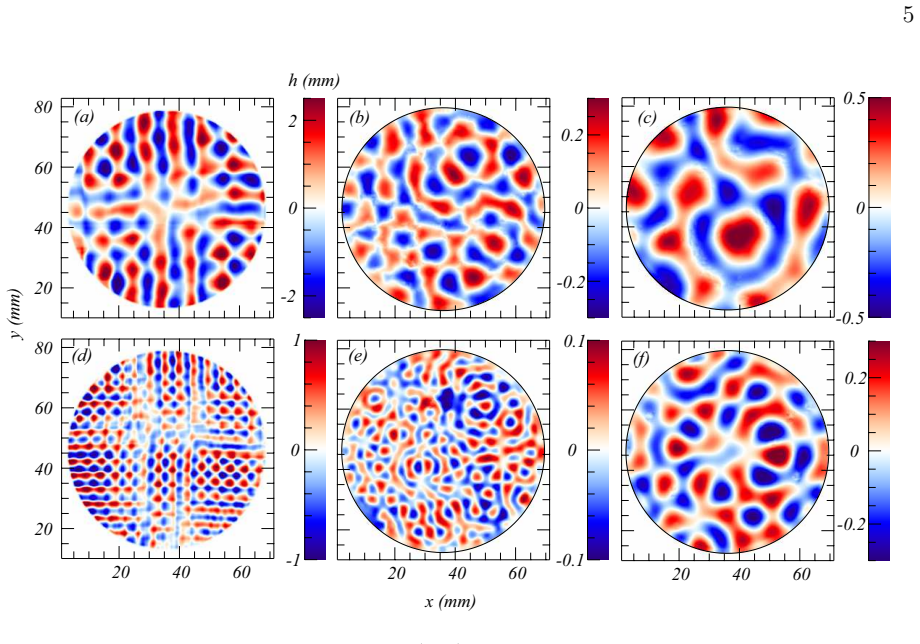
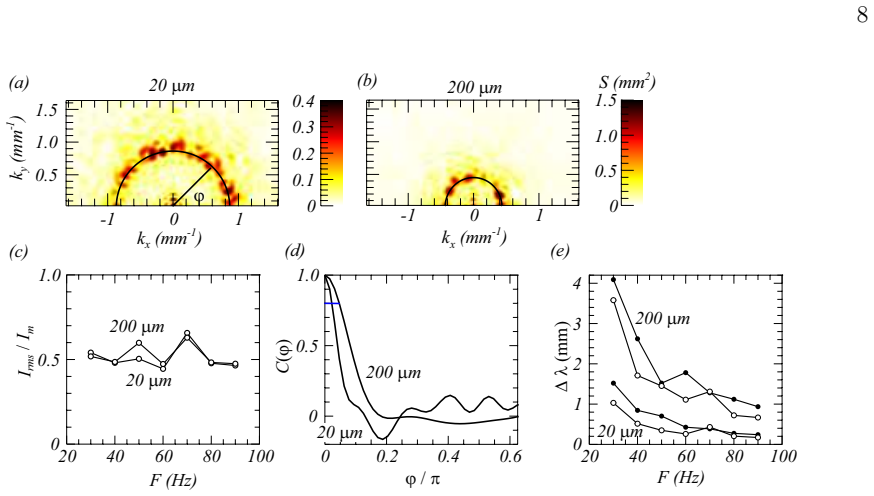
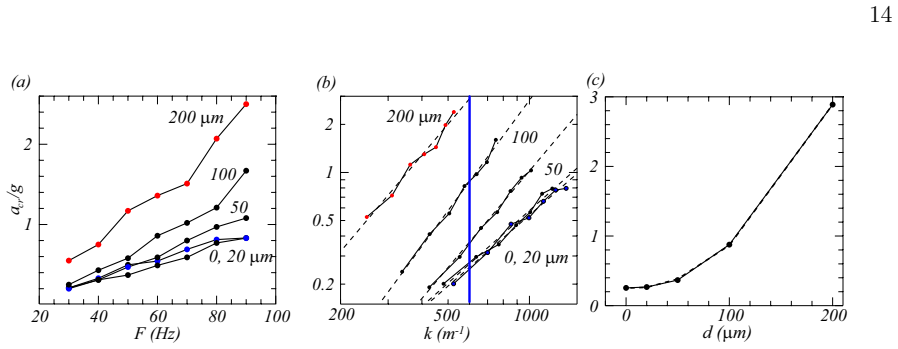
The hydroelastic response of free floating viscoelastic covers is measured using Faraday waves on the surface of a vertically oscillated fluid layer. Systematically varying the thickness d of the covers shows a significant difference from the theoretical dispersion relation. This is explained by an increase in the in-plane membrane tension, which scales with d^{3/2}. For thin covers the onset amplitude and damping can be explained by dissipation in the bulk and boundary layer, while the membrane affects wave amplitude through nonlinear interaction.
What carries the argument
In-plane membrane tension that increases with cover thickness as d to the power 3/2, used to reconcile measured wave dispersion with theory.
If this is right
- The wave dispersion can be modeled by including this thickness-dependent tension term.
- Damping rates are largely unaffected beyond the thin cover limit where bulk dissipation dominates.
- Wave amplitudes are modulated by nonlinear interactions caused by the cover.
- Wave patterns lose isotropy and order compared to uncovered surfaces.
Where Pith is reading between the lines
- This d^{3/2} scaling may stem from how the viscoelastic material deforms and stores tension under oscillatory flow.
- Similar tension adjustments could be needed when modeling waves under other thin floating films in oceans or lakes.
- Further tests with controlled tension or different materials could isolate whether contact line effects contribute to the mismatch.
Load-bearing premise
That the baseline theoretical dispersion relation without added tension accurately describes the waves, so that any difference must come from the membrane tension alone.
What would settle it
Measuring the actual in-plane tension in the viscoelastic sheets independently and finding it does not follow a d to the 3/2 dependence, or finding that including it still fails to predict the wavelengths.
Figures





read the original abstract
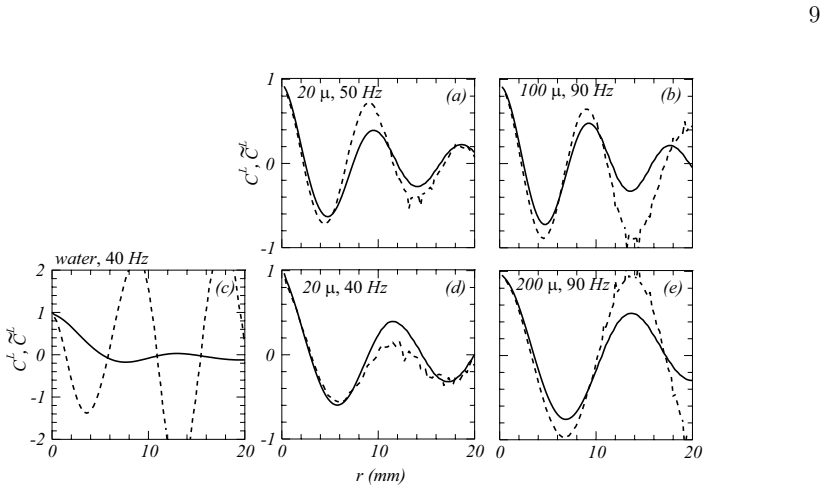
The hydroelastic response of free floating viscoelastic covers is measured using Faraday waves on the surface of a vertically oscillated fluid layer. We systematically vary the thickness $d$ of the covers to investigate its effect on the hydroelastic dispersion relation, the damping and the isotropy of the waves. Compared to bare fluids, the wave patterns are disordered. Various methods are explored to define and analyze the wavelengths, the isotropy, and shape of the waves. We find a significant difference between the measurements and the theoretical dispersion relation. Over all thicknesses $d$, this is explained by an increase in the in-plane membrane tension, which scales with $d^{3/2}$. Covering waves also has a large efect on their damping. Only for thin covers ($d = 20\: \mu{\rm m}$) the onset amplitude (and thus the damping) can be explained by dissipation in the bulk and in the boundary layer of the water beneath the cover. The same was found for bare water due to the presence of an immobile surface layer. Lastly, we find a large effect of the membrane on the ampitude of the waves, which we attribute to nonlinear wave interaction.
Editorial analysis
A structured set of objections, weighed in public.
Referee Report
Summary. The manuscript reports experimental measurements of Faraday waves on a vertically oscillated fluid layer covered by free-floating viscoelastic sheets of varying thickness d. It compares the observed hydroelastic dispersion to theoretical predictions, attributes the mismatch to an added in-plane membrane tension that scales as d^{3/2}, examines damping (finding bulk plus boundary-layer dissipation sufficient for d=20 μm, akin to bare water with an immobile layer), and notes large effects on wave amplitude attributed to nonlinear interactions. Multiple analysis methods are used to quantify wavelengths, isotropy, and wave shapes, with patterns described as disordered relative to bare fluids.
Significance. If the central attribution holds after verification, the empirical d^{3/2} tension scaling would supply a concrete relation for hydroelastic models of thin floating viscoelastic covers, extending prior work on bare Faraday waves and membrane-covered systems. The systematic thickness variation and damping comparison to the immobile-layer case for bare water are useful benchmarks; the disordered patterns and multi-method analysis may interest the Faraday-wave community. Independent confirmation of the tension scaling would raise the result's impact.
major comments (3)
- [Abstract; dispersion analysis] Abstract and dispersion results: the claim of a significant mismatch with the baseline hydroelastic dispersion relation (without added tension) is used to introduce an effective in-plane tension whose d^{3/2} scaling is then reported. No error bars on extracted wavelengths, no quantitative fit residuals (with vs. without the tension term), and no details on the wavelength-extraction algorithms or isotropy metrics are provided, so the statistical significance of the residuals and the necessity of the single-parameter correction cannot be assessed.
- [Results on dispersion and tension] Tension scaling paragraph: the in-plane tension is introduced post-hoc to reconcile measured wavelengths with theory and is subsequently found to follow d^{3/2}. Because the baseline dispersion is assumed accurate and all d-dependent deviations are absorbed into this one fitted parameter, the scaling could equally capture unmodeled effects (contact-line pinning, sheet inhomogeneity, or bending stiffness variations). An independent tension measurement or a first-principles derivation from the viscoelastic constitutive law is needed to establish that the scaling originates from membrane tension.
- [Damping analysis] Damping and onset-amplitude section: for d=20 μm the onset is said to match bulk-plus-boundary-layer dissipation (as for bare water). A direct comparison of predicted vs. measured onset amplitudes across the full d range, including the contribution of the fitted tension to the dispersion and thus to the threshold, would clarify whether the tension term is load-bearing for the damping claim or merely an auxiliary fit.
minor comments (2)
- [Abstract] Abstract contains two typographical errors: 'efect' should read 'effect' and 'ampitude' should read 'amplitude'.
- [Notation and methods] Notation for thickness (d) and any derived tension parameter should be introduced once and used consistently; clarify whether the reported tension is an effective value per unit length or a stress.
Simulated Author's Rebuttal
We thank the referee for the thorough review and insightful comments on our manuscript. We address each of the major comments point by point below, providing clarifications and indicating revisions where appropriate.
read point-by-point responses
-
Referee: [Abstract; dispersion analysis] Abstract and dispersion results: the claim of a significant mismatch with the baseline hydroelastic dispersion relation (without added tension) is used to introduce an effective in-plane tension whose d^{3/2} scaling is then reported. No error bars on extracted wavelengths, no quantitative fit residuals (with vs. without the tension term), and no details on the wavelength-extraction algorithms or isotropy metrics are provided, so the statistical significance of the residuals and the necessity of the single-parameter correction cannot be assessed.
Authors: We agree that additional quantitative details would strengthen the presentation. In the revised manuscript, we have added error bars to the wavelength data points, derived from repeated measurements and analysis of isotropy. We have also included a new supplementary figure showing the fit residuals for the dispersion relation both with and without the tension term, demonstrating a clear improvement with the added parameter. Details on the wavelength extraction algorithms and isotropy metrics have been expanded in the Methods section. revision: yes
-
Referee: [Results on dispersion and tension] Tension scaling paragraph: the in-plane tension is introduced post-hoc to reconcile measured wavelengths with theory and is subsequently found to follow d^{3/2}. Because the baseline dispersion is assumed accurate and all d-dependent deviations are absorbed into this one fitted parameter, the scaling could equally capture unmodeled effects (contact-line pinning, sheet inhomogeneity, or bending stiffness variations). An independent tension measurement or a first-principles derivation from the viscoelastic constitutive law is needed to establish that the scaling originates from membrane tension.
Authors: We acknowledge that the tension is determined empirically from the data. While we cannot provide an independent measurement within the scope of this study, the consistent d^{3/2} scaling observed across a range of thicknesses supports our interpretation as arising from membrane tension in the viscoelastic sheets. We have added a paragraph discussing potential physical mechanisms, such as in-plane stretching induced by the sheet's weight and oscillatory motion, consistent with viscoelastic behavior. A full first-principles derivation would require advanced constitutive modeling beyond the current experimental focus. revision: partial
-
Referee: [Damping analysis] Damping and onset-amplitude section: for d=20 μm the onset is said to match bulk-plus-boundary-layer dissipation (as for bare water). A direct comparison of predicted vs. measured onset amplitudes across the full d range, including the contribution of the fitted tension to the dispersion and thus to the threshold, would clarify whether the tension term is load-bearing for the damping claim or merely an auxiliary fit.
Authors: We thank the referee for this suggestion. In the revised manuscript, we now include a direct comparison of predicted and measured onset amplitudes for all sheet thicknesses. The predictions incorporate the effect of the fitted tension on the dispersion relation and the resulting threshold. This analysis shows that the tension term does influence the threshold, and for d=20 μm it aligns well with bulk and boundary layer dissipation, while for thicker sheets additional effects are evident. revision: yes
- Independent measurement of the in-plane membrane tension or a complete first-principles derivation from the viscoelastic constitutive law.
Circularity Check
Membrane tension scaling obtained by fitting dispersion mismatch to baseline theory
specific steps
-
fitted input called prediction
[Abstract]
"We find a significant difference between the measurements and the theoretical dispersion relation. Over all thicknesses d, this is explained by an increase in the in-plane membrane tension, which scales with d^{3/2}."
The tension value is introduced specifically to reconcile the measured dispersion data with the baseline theory for each d. The d^{3/2} scaling is then read off from the set of fitted tension values, so the reported 'explanation' is equivalent to the fitting step by construction.
full rationale
The paper measures a mismatch between observed Faraday wave dispersion and the unmodified hydroelastic relation, then introduces an effective in-plane tension parameter to absorb the residuals for each thickness d. The reported d^{3/2} scaling is extracted directly from these fitted tension values. This matches the fitted_input_called_prediction pattern: the functional form is not independently derived or measured but follows from the choice to attribute all deviations to a single adjustable tension term. The abstract states the explanation explicitly, and no independent tension measurement or quantitative residual comparison (with vs. without the term) is described in the provided text. The central claim therefore reduces to the fitting procedure rather than a first-principles derivation.
Axiom & Free-Parameter Ledger
free parameters (1)
- in-plane membrane tension
axioms (1)
- domain assumption Standard hydroelastic dispersion relation for a fluid layer with a thin cover holds in the absence of additional in-plane tension.
Reference graph
Works this paper leans on
-
[1]
80 × 10− 2 Nm− 1 and measured membrane elasticity E = 0 . 58 × 106 Nm− 2. (b): Same data as in panel (a), but now plotted in a way to elucidate scaling beh avior. The yellow dots indicate the cross-over from stretching to bending modes. The red dots in dicate the cross-over from gravity to stretching. Dashed lines: fits to large k (small λ) behavior, red l...
-
[2]
the full hydrodynamic approach
who found a shift of the wavelength as a function of the forcing amplitude for a sheet clamped at its circumference. Nonlinearity is gauged by the wave ste epness k a . In our experiment we can tune the wave amplitude a through variation of the excitation amplitude 13 (a) F (Hz) (b) /c108/c32/c40 /c41 mm acr / g 20 40 60 80 100 5 10 15 20 40 60 80 1000 0....
work page 2000
-
[3]
K. Trapani, D. L. Millar, and H. C. M. Smith, Novel offshore a pplication of photovoltaics in comparison to conventional marine renewable energy tech nologies, Renew. Energy 50, 879 (2013). 18
work page 2013
-
[4]
G. Liu, J. Guo, H. Peng, H. Ping, and Q. Ma, Review of recent offshore floating photovoltaic systems, J. Mar. Sc. Eng. 12, 10.3390/jmse12111942 (2024)
-
[5]
M. Zhang and S. Schreier, Review of wave interaction with continuous flexible floating struc- tures, Ocean Eng. 264, 112404 (2022)
work page 2022
-
[6]
L. G. Bennetts, C. M. Bitz, D. L. Feltham, A. L. Kohout, and M. H. Meylan, Theory, modelling and observations of marginal ice zone dynamics: multidisci plinary perspectives and outlooks, Phil. Trans. R. Soc. A 380, 10.1098/rsta.2021.0265 (2022)
-
[7]
D. K. K. Sree, A. W. Law, and H. H. Shen, An experimental stu dy on gravity waves through a floating viscoelastic cover, Cold Regions Sience and Techn ology 155, 289 (2018)
work page 2018
-
[8]
S. Benjamins, B. Williamson, S. L. Billing, Z. Yuan, M. Co llu, C. Fox, L. Hobbs, E. A. Masden, E. J. Cottier-Cook, and B. Wils on, Potential environmental impacts of floating solar photovol taic systems (2024)
work page 2024
-
[9]
P. Denis, A. Capet, J. Vanaverbeke, T. R. Kerkhove, G. Lac roix, and S. Legrand, Hydrody- namic alterations induced by floating solar structures co-l ocated with an offshore wind farm, Front. Mar. Sci. 12, 10.3389/fmars.2025.1674859 (2025)
- [10]
- [11]
-
[12]
E. Ventsel and T. Krauthammer, Thin plates and shells , 2001st ed. (Marcel Dekker, Inc., New York, Basel, 2001) Chap. 7
work page 2001
-
[13]
M. Vernet and E. Falcon, Thermodyamic and statistical e quilibrium of large-scale hydroelastic wave turbulence, Phys. Rev. Lett. 135, 024004 (2025)
work page 2025
-
[14]
L. Deike, J.-C. Bacri, and E. Falcon, Nonlinear waves on the surface of a fluid covered by an elastic sheet, Journal of Fluid Mechanics 733, 394 (2013)
work page 2013
-
[15]
K. A. Legge and N. H. Fletcher, Nonlinear generation of m issing modes on a vibrating string, J. Acoustr. Soc. Am. 76, 5 (1984)
work page 1984
-
[16]
N. Peake and S. V. Sorokin, A nonlinear model of the dynam ics of a large elastic plate with heavy fluid loading, Proc. R. Soc. A, 462, 2205 (2006)
work page 2006
-
[17]
V. Zakharov, Turbulence in hamiltonian systems, in Nonlinear Waves and Weak Turbulence with Applications in Oceanography and Condensed Matter Phys cis, Vol. II, edited by N. F. et al. (Birkh¨ auser, 1993) pp. 3–18
work page 1993
- [18]
-
[19]
V. Zakharov and N. Filonenko, Weak turbulence of capill ary waves, J. Appl. Mech. Tech. Phys. 4, 37 (1967)
work page 1967
-
[20]
Nazarenko, Wave Turbulence, 1st ed
S. Nazarenko, Wave Turbulence, 1st ed. (Springer, Berlin, Heidelberg, 2011)
work page 2011
-
[21]
J. Ono-dit-Biot, M. Trejo, E. Loukiantcheko, M. Lauch, E. Rapha¨ el, K. Dalnoki- Veress, and T. Salez, Hydroelastic wake on a thin elastic she et floating on water, Phys. Rev. Fluids 4, 014808 (2019)
work page 2019
-
[22]
S. Michele, S. Zheng, F. Buriani, A. G. L. Borthwick, and D. M. Greaves, Floating hydroelastic circular plate in regular and irregular waves, Eur. J. Mech. / B Fluids 99, 148 (2023)
work page 2023
-
[23]
T. Kristiansen, P. Gron, and O. M. Faltinsen, A floating m embrane solar island study, Proc. 9th Int. Conf. Hydroelasticity Mar. Technol. , 445 (2022). 19
work page 2022
-
[24]
H. Pot, J. Westerweel, and S. Schreier, Stereoscopic di gital image correlation for hydroelastic waves of floating membranes, Measurement S cience and Technology 10.1088/1361-6501/ae2348 (2025)
- [25]
-
[26]
F. Montiel, F. Bonnefoy, P. Ferrant, L. G. Bennetts, V. A . Squire, and P. Marsault, Hydroe- lastic response of floating elastic discs to regular waves pa rt 1: wave basin experiments, J. Fluid Mech. 723, 604 (2013)
work page 2013
-
[27]
M. Faraday, On the forms and states assumed by fluids in co ntact with vibrating elastical surfaces, Phil. Trans. R. Soc. Lond. 121, 319 (1831), (Appendix to: On a peculiar class of acoustical figures; and on certain forms assumed by groups of particles upon vibrating elastic surfaces, ibid. pp.299–340)
- [28]
- [29]
- [30]
-
[31]
A. Liberzon, T. K¨ aufer, A. Bauer, P. Vennemann, and E. Z immer, OpenPIV-Python v0.23.4 (2021)
work page 2021
- [32]
-
[33]
R. Savelsberg and W. van de Water, Experiments on free-s urface turbulence, J. Fluid Mech. 619, 95 (2009)
work page 2009
-
[34]
Douady, Experimental study of the Faraday instabili ty, J
S. Douady, Experimental study of the Faraday instabili ty, J. Fluid Mech. 221, 383 (1990)
work page 1990
-
[35]
K. Kumar and L. Tuckerman, Parametric instability of th e interface between two fluids, J. Fluid Mech. 279, 49 (1994)
work page 1994
-
[36]
Batchelor, An Introduction to Fluid Dynamics , 19th ed
G. Batchelor, An Introduction to Fluid Dynamics , 19th ed. (Cambridge University Press, Cambridge, 1967)
work page 1967
-
[37]
Lighthill, Waves in fluids , 1980th ed
J. Lighthill, Waves in fluids , 1980th ed. (Cambridge University Press, Cambridge, 1978) Chap. 3, p. 231
work page 1978
-
[38]
H. W. Muller, H. Wittmer, C. Wagner, J. Albers, and K. Kno rr, Analytic stability theory for Faraday waves and the observation of the harmonic surface re sponse., Phys. Rev. Lett. 78, 2357 (1997)
work page 1997
-
[39]
J. Vi˜ nals and P. Chen, Numerical study of pattern forma tion in weakly damped parametric surface waves, Physica D 116, 225 (1998)
work page 1998
-
[40]
P. Chen and J. Vi˜ nals, Amplitude equations and pattern selection in Faraday waves, Phys. Rev. E 60, 559 (1999)
work page 1999
discussion (0)
Sign in with ORCID, Apple, or X to comment. Anyone can read and Pith papers without signing in.