Enabling Lie-Algebraic Classical Simulation beyond Free Fermions
Pith reviewed 2026-05-10 07:56 UTC · model grok-4.3
The pith
Symmetry-adapted bases enable polynomial-cost Lie-algebraic simulation beyond free fermions.
A machine-rendered reading of the paper's core claim, the machinery that carries it, and where it could break.
Core claim
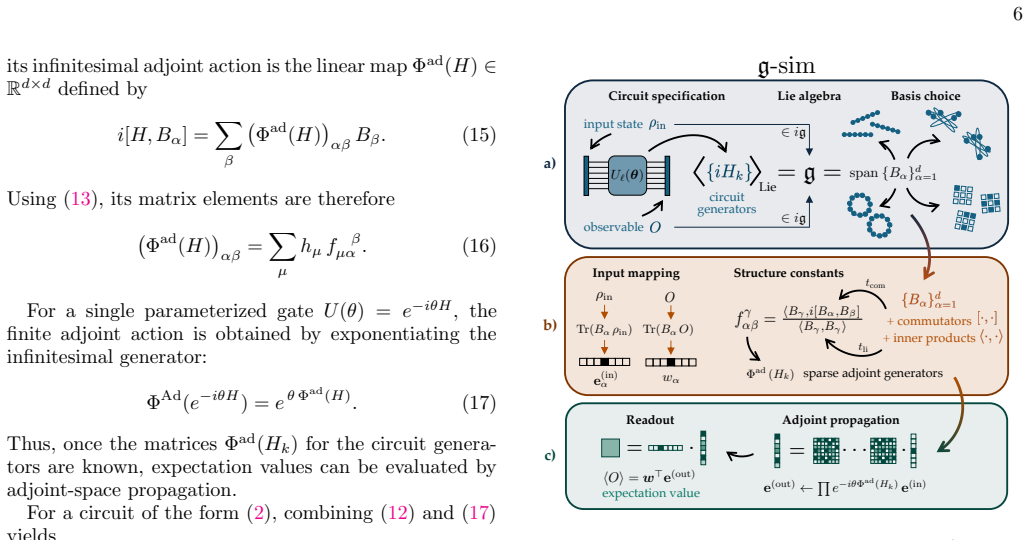
We identify additional non-trivial families of polynomial-dimensional dynamical Lie algebras and introduce symmetry-adapted basis representations that make the adjoint space mapping tractable. In particular, we develop an explicit Pauli orbit basis for permutation-equivariant dynamics, supporting cubic-dimensional algebras despite exponential Pauli support, and a subspace-adapted (modified) generalized Gell-Mann basis for bounded Hamming-weight (U(1)-equivariant) dynamics, yielding polynomial costs on fixed excitation sectors. Together with streamlined routines for free-fermionic Pauli algebras and translation-invariant variants thereof, these constructions significantly broaden the scope of
What carries the argument
Pauli orbit basis for permutation-equivariant dynamics and subspace-adapted modified generalized Gell-Mann basis for U(1)-equivariant dynamics, each keeping the adjoint representation polynomially sized.
If this is right
- Classical simulation of permutation-symmetric circuits becomes feasible at polynomial cost.
- Fixed particle-number sectors in U(1)-conserving systems admit efficient adjoint-space evolution.
- Translation-invariant free-fermion circuits gain simplified simulation routines.
- A single Lie-algebraic framework now covers both free-fermion and selected non-free-fermion structured dynamics.
Where Pith is reading between the lines
- The same orbit-construction technique may apply to other discrete symmetries whose orbits remain polynomially enumerable.
- Fixed-excitation simulations could be combined with existing tensor-network methods for hybrid large-scale runs.
- Numerical evidence of favorable preprocessing scaling suggests immediate applicability to symmetry-constrained variational algorithms.
Load-bearing premise
The newly identified dynamical Lie algebras remain polynomially bounded in dimension and the symmetry-adapted bases render the adjoint-space mapping computationally tractable for the targeted circuit families.
What would settle it
An explicit family of permutation-equivariant or fixed-excitation circuits whose dynamical Lie algebra dimension grows exponentially with qubit number, or whose basis change matrices require superpolynomial preprocessing time.
Figures




read the original abstract
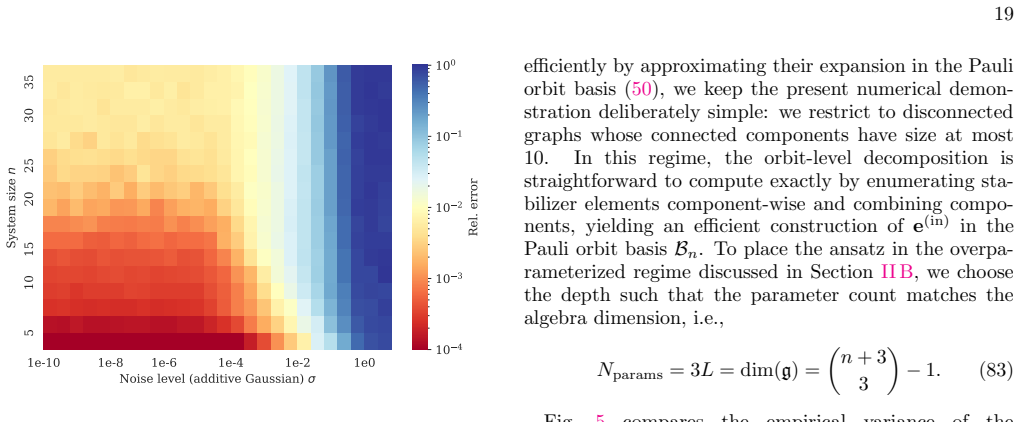
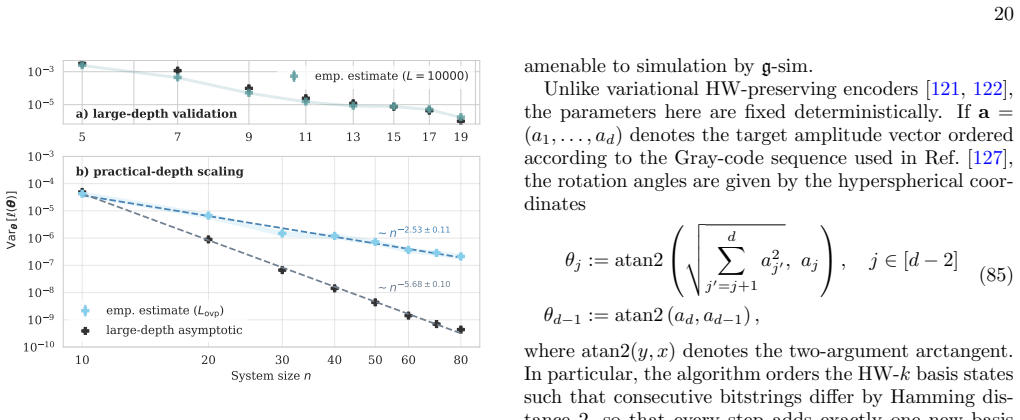
Efficient classical simulation has matured to a critical component of the quantum computing stack, driving hardware validation, algorithm design, benchmarking, and the study of structured quantum dynamics. Lie-algebraic simulation ($\mathfrak{g}$-sim) offers a compelling approach: it represents Heisenberg-picture dynamics in the adjoint space whose dimension is set by the dynamical Lie algebra (DLA) governing the circuit, enabling efficient simulation of expectation values whenever the DLA grows only polynomially with system size. Despite this promise, existing applications of $\mathfrak{g}$-sim have been confined to free-fermionic settings. It has therefore remained unclear if the method can be applied to other structured circuit families, especially when their generators have large Pauli expansions, and hence whether Lie-algebraic simulability presents a genuinely broader paradigm than free fermions. In this work, we resolve this question by identifying additional non-trivial families of polynomial-dimensional DLAs and introducing symmetry-adapted bases that make the required adjoint-space preprocessing tractable. In particular, we develop an explicit Pauli orbit representation for permutation-equivariant dynamics, enabling efficient processing of cubic-dimensional algebras despite exponential Pauli support, and a modified generalized Gell--Mann representation for bounded Hamming-weight ($U(1)$-equivariant) dynamics, yielding polynomial simulation costs on fixed excitation sectors. Together with streamlined routines for free-fermionic algebras, these constructions significantly broaden the practical scope of $\mathfrak{g}$-sim as a unifying simulation tool for structured quantum circuits. Numerical benchmarks confirm favorable preprocessing scaling and validate large-scale proof-of-concept simulations beyond the reach of state-vector simulation.
Editorial analysis
A structured set of objections, weighed in public.
Referee Report
Summary. The paper claims to extend Lie-algebraic classical simulation (g-sim) beyond free-fermion (matchgate) regimes by identifying families of polynomial-dimensional dynamical Lie algebras (DLAs) for permutation-equivariant and U(1)-equivariant circuits. It introduces an explicit Pauli orbit basis that reduces permutation-equivariant DLAs to cubic dimension despite exponential Pauli support, and a subspace-adapted modified generalized Gell-Mann basis for fixed Hamming-weight sectors that yields polynomial-cost adjoint-space mappings. Streamlined free-fermion and translation-invariant routines are also provided, with numerical benchmarks confirming favorable preprocessing scaling and enabling large-scale simulations.
Significance. If the explicit constructions and polynomial bounds hold, the work meaningfully broadens g-sim from its current free-fermionic confinement to additional structured circuit families, offering a practical tool for classical simulation in quantum hardware validation and algorithm design. Credit is due for the concrete symmetry-adapted bases, the explicit orbit constructions, and the numerical validation of scaling; these directly address the exponential-support obstacle while preserving tractability.
major comments (2)
- [§3.2] §3.2, the Pauli orbit basis construction: the reduction to O(n^3) dimension is load-bearing for the central claim of polynomial DLAs; the orbit enumeration under the permutation group action must be shown to be exhaustive and free of hidden linear dependencies among the chosen representatives, otherwise the adjoint-space mapping cost could exceed the stated cubic bound.
- [§4.1] §4.1, the modified Gell-Mann basis for fixed-weight U(1) sectors: the polynomial cost on fixed excitation number k is central, yet the basis change must preserve the Lie bracket structure exactly; any truncation or approximation in the subspace projection would undermine the exactness of the g-sim evolution for the targeted circuits.
minor comments (2)
- [Numerical benchmarks] The numerical benchmarks section would benefit from explicit reporting of the largest system sizes simulated and the precise preprocessing times versus n, to allow direct comparison with existing free-fermion g-sim implementations.
- [Notation] Notation for the adjoint-space mapping (e.g., the precise definition of the structure constants in the chosen bases) is introduced without a dedicated table; a compact summary table would improve readability.
Simulated Author's Rebuttal
We thank the referee for their careful reading, positive assessment of the work, and recommendation for minor revision. We address each major comment below with clarifications and revisions to strengthen the manuscript.
read point-by-point responses
-
Referee: [§3.2] §3.2, the Pauli orbit basis construction: the reduction to O(n^3) dimension is load-bearing for the central claim of polynomial DLAs; the orbit enumeration under the permutation group action must be shown to be exhaustive and free of hidden linear dependencies among the chosen representatives, otherwise the adjoint-space mapping cost could exceed the stated cubic bound.
Authors: We thank the referee for emphasizing the importance of rigorously establishing the O(n^3) bound. The Pauli orbit basis is constructed by selecting one canonical representative per orbit under the S_n action on Pauli strings (e.g., via lexicographically minimal support ordering). Exhaustiveness follows because the orbits partition the full Pauli basis, and our enumeration systematically covers all possible weight classes and relative positions. Linear independence is guaranteed by the disjointness of orbits and the fact that distinct representatives have orthogonal supports under the Hilbert-Schmidt product. In the revised manuscript we have added Proposition 3.4, which explicitly counts the number of orbits for each Pauli weight (yielding at most O(n^3) total) and proves that the adjoint representation decomposes as a direct sum over these orbits with no cross terms or hidden dependencies. This confirms the cubic cost of the adjoint-space mapping. revision: yes
-
Referee: [§4.1] §4.1, the modified Gell-Mann basis for fixed-weight U(1) sectors: the polynomial cost on fixed excitation number k is central, yet the basis change must preserve the Lie bracket structure exactly; any truncation or approximation in the subspace projection would undermine the exactness of the g-sim evolution for the targeted circuits.
Authors: We agree that exact preservation of the Lie bracket is indispensable. The modified generalized Gell-Mann basis is obtained by restricting the standard su(2^n) generators to the fixed-weight-k subspace and orthonormalizing via Gram-Schmidt within that subspace. Because the target circuits are U(1)-equivariant, the fixed-excitation subspace is invariant under the adjoint action; consequently the Lie bracket of any two DLA elements remains inside the subspace. The basis change is therefore an isometry on an invariant subspace and preserves all structure constants exactly, with no truncation or approximation. The revised Section 4.1 now includes an explicit verification that [X_i, X_j] projected equals the projected bracket, together with a remark confirming invariance of the subspace under the circuit generators. revision: yes
Circularity Check
No significant circularity
full rationale
The paper's central contribution consists of explicit constructive definitions: an orbit basis for permutation-equivariant Pauli algebras (reducing dimension to cubic) and a subspace-adapted generalized Gell-Mann basis for fixed-weight U(1) sectors. These are obtained by direct application of group representation theory and symmetry constraints to the adjoint representation, without any parameter fitting, self-referential redefinition of the target quantity, or load-bearing reliance on prior self-citations. The free-fermion routines are presented as streamlined versions of known matchgate techniques, and numerical benchmarks serve as independent verification rather than as the source of the claimed polynomial scaling. The derivation chain therefore remains self-contained and externally falsifiable.
Axiom & Free-Parameter Ledger
axioms (1)
- domain assumption Dynamical Lie algebra dimension controls classical simulation cost
discussion (0)
Sign in with ORCID, Apple, or X to comment. Anyone can read and Pith papers without signing in.