Quantum Geometric Origin of Non-Adiabatic Instability in Driven Bosonic Systemss
Pith reviewed 2026-05-25 05:57 UTC · model grok-4.3
The pith
The Adiabatic Mode Transition parameter equals the instantaneous Fubini-Study speed of a driven quantum state in projective Hilbert space.
A machine-rendered reading of the paper's core claim, the machinery that carries it, and where it could break.
Core claim
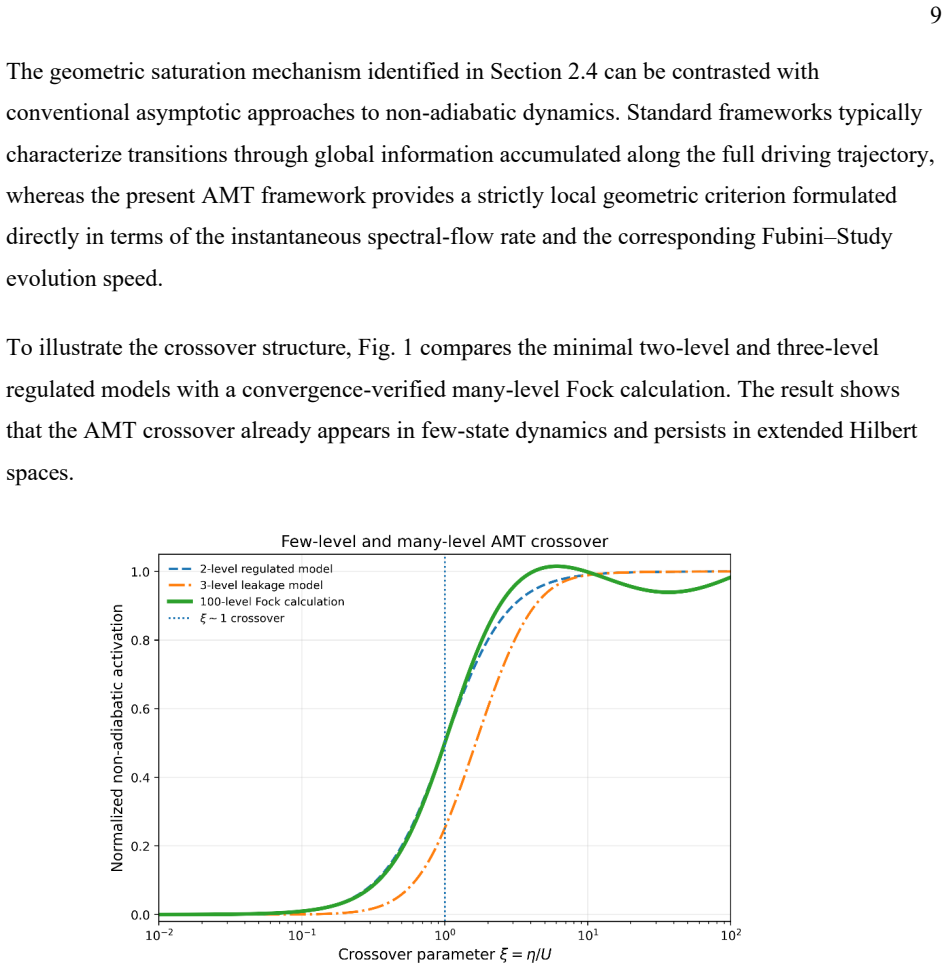
The Adiabatic Mode Transition parameter admits a direct geometric interpretation as the instantaneous evolution speed of a driven quantum state in projective Hilbert space under the Fubini-Study metric. Equivalently, the AMT parameter defines the tt-component of the quantum geometric tensor governing the local geometric evolution rate of the instantaneous vacuum state. An occupation-dependent nonlinear regulator U suppresses the effective geometric evolution speed, leading to bounded low-occupancy dynamics whose crossover parameter supplies a compact criterion for self-limited nonadiabatic instability.
What carries the argument
The Adiabatic Mode Transition parameter, reinterpreted as the squared Fubini-Study speed in dimensionless local time (or equivalently the tt-component of the quantum geometric tensor).
If this is right
- Nonadiabatic instability can be evaluated continuously at every stage of the driven evolution rather than only asymptotically.
- The nonlinear regulator U produces bounded low-occupancy dynamics by lowering the effective geometric speed.
- The crossover parameter supplies a compact, local test for when instability remains self-limited.
- Local geometric criteria replace conventional asymptotic approaches for assessing stability in driven nonlinear bosonic systems.
Where Pith is reading between the lines
- If the speed-suppression relation holds, the same local geometric test could be applied to other driven quantum systems that possess a well-defined instantaneous vacuum.
- The framework may link nonadiabatic bosonic instability to existing geometric quantities such as Berry curvature without requiring global time evolution.
- Experimental protocols that track state evolution in projective space could directly measure the AMT parameter and test the predicted crossover.
Load-bearing premise
That an occupation-dependent nonlinear regulator directly reduces the Fubini-Study speed of the driven state.
What would settle it
Numerically integrate the Fubini-Study distance traveled by the instantaneous vacuum state over successive short time steps in a driven bosonic Hamiltonian and test whether those distances match the values of the Adiabatic Mode Transition parameter at each step.
Figures

read the original abstract
We establish that the Adiabatic Mode Transition parameter admits a direct geometric interpretation as the instantaneous evolution speed of a driven quantum state in projective Hilbert space under the Fubini Study metric. In dimensionless local time, the corresponding squared Fubini Study speed. Equivalently, the AMT parameter defines the tt-component of the quantum geometric tensor governing the local geometric evolution rate of the instantaneous vacuum state. In contrast to conventional asymptotic approaches, the proposed framework provides a strictly local geometric criterion that allows nonadiabatic instability and its nonlinear suppression to be evaluated continuously at each stage of the driven evolution. We further show that an occupation dependent nonlinear regulator U suppresses the effective geometric evolution speed, leading to bounded low-occupancy dynamics. The resulting crossover parameter provides a compact criterion for selflimited nonadiabatic instability in driven nonlinear bosonic systems.
Editorial analysis
A structured set of objections, weighed in public.
Referee Report
Summary. The paper claims that the Adiabatic Mode Transition (AMT) parameter admits a direct geometric interpretation as the instantaneous evolution speed of a driven quantum state in projective Hilbert space under the Fubini-Study metric; equivalently, the AMT parameter is the tt-component of the quantum geometric tensor for the instantaneous vacuum state. It further asserts that an occupation-dependent nonlinear regulator U suppresses this effective geometric evolution speed, producing bounded low-occupancy dynamics and a compact crossover parameter that furnishes a strictly local geometric criterion for self-limited nonadiabatic instability in driven nonlinear bosonic systems.
Significance. If the claimed geometric equivalence and the suppression relation hold with explicit derivations, the work would supply a local-in-time geometric diagnostic for nonadiabatic effects that complements conventional asymptotic analyses, potentially aiding the design of stable driven bosonic systems. The introduction of a crossover parameter derived from the regulator U would be a compact, falsifiable criterion if the mapping to the Fubini-Study speed is rigorously established.
major comments (2)
- [Abstract] Abstract: the central claim that the AMT parameter equals the instantaneous Fubini-Study speed (and the tt-component of the quantum geometric tensor) is stated without any derivation, explicit expression for the metric or tensor, or reference to the instantaneous state vector from which the speed would be computed.
- [Abstract] Abstract: the assertion that the occupation-dependent regulator U suppresses the effective geometric evolution speed (thereby yielding the crossover parameter and self-limited instability) is presented without a shown mapping, equation, or calculation demonstrating how U enters the Fubini-Study metric or reduces the speed; this relation is load-bearing for the local criterion.
minor comments (2)
- [Abstract] The sentence fragment 'In dimensionless local time, the corresponding squared Fubini Study speed.' is incomplete and should be completed or removed.
- [Abstract] Inconsistent hyphenation: 'Fubini Study' versus 'Fubini-Study' and 'selflimited' versus 'self-limited' should be standardized.
Simulated Author's Rebuttal
We thank the referee for the careful reading of the manuscript and the constructive comments. We address each major comment below and will revise the abstract accordingly to improve clarity regarding the derivations, which are detailed in the main text.
read point-by-point responses
-
Referee: [Abstract] Abstract: the central claim that the AMT parameter equals the instantaneous Fubini-Study speed (and the tt-component of the quantum geometric tensor) is stated without any derivation, explicit expression for the metric or tensor, or reference to the instantaneous state vector from which the speed would be computed.
Authors: The abstract presents the result at a summary level, as is conventional. The explicit derivation begins from the Fubini-Study metric on projective Hilbert space, identifies the instantaneous vacuum state as the relevant vector, and shows that the AMT parameter equals the squared speed (equivalently, the tt-component of the quantum geometric tensor); these steps appear in Section II with the metric expression and state-vector definition given explicitly. We will revise the abstract to add a parenthetical reference to Section II and the defining equation to direct readers to the derivation. revision: yes
-
Referee: [Abstract] Abstract: the assertion that the occupation-dependent regulator U suppresses the effective geometric evolution speed (thereby yielding the crossover parameter and self-limited instability) is presented without a shown mapping, equation, or calculation demonstrating how U enters the Fubini-Study metric or reduces the speed; this relation is load-bearing for the local criterion.
Authors: We agree the abstract does not display the mapping. Section III derives how the occupation-dependent nonlinear regulator U modifies the effective dynamics, enters the expression for the instantaneous Fubini-Study speed, and produces the reduced speed together with the crossover parameter that bounds the instability. The explicit calculation for low-occupancy regimes is given there. We will revise the abstract to reference Section III and the resulting suppressed-speed equation. revision: yes
Circularity Check
No significant circularity identified
full rationale
The abstract claims that the AMT parameter equals the instantaneous Fubini-Study speed (and tt-component of the quantum geometric tensor) and that the regulator U suppresses this speed to yield a crossover criterion. No equations, definitions, or derivations are supplied that would make the AMT parameter identical to the FS speed by construction, nor is U shown to be fitted or chosen so that the suppression relation holds tautologically. No self-citations, uniqueness theorems, or renamings of known results appear. The presented claims therefore remain independent of their inputs and do not reduce to self-definition or fitted-input prediction.
Axiom & Free-Parameter Ledger
free parameters (1)
- nonlinear regulator U
axioms (2)
- standard math Fubini-Study metric on projective Hilbert space and the quantum geometric tensor are the correct geometric structures for the driven state
- domain assumption The nonlinear regulator U suppresses effective geometric evolution speed in a manner that bounds occupancy
invented entities (1)
-
crossover parameter
no independent evidence
Lean theorems connected to this paper
-
IndisputableMonolith/Foundation/AlexanderDuality.leanalexander_duality_circle_linking echoes?
echoesECHOES: this paper passage has the same mathematical shape or conceptual pattern as the Recognition theorem, but is not a direct formal dependency.
g_tt = 1/8 (Ω̇/Ω)^2 ... (ds_FS/dτ)^2 = η^{2}/8 ... Q_tt = g_tt = η^{2}Ω^{2}/8
-
IndisputableMonolith/Cost/FunctionalEquation.leanwashburn_uniqueness_aczel unclear?
unclearRelation between the paper passage and the cited Recognition theorem.
occupation-dependent nonlinear regulator U suppresses the effective geometric evolution speed ... ξ=η/U
What do these tags mean?
- matches
- The paper's claim is directly supported by a theorem in the formal canon.
- supports
- The theorem supports part of the paper's argument, but the paper may add assumptions or extra steps.
- extends
- The paper goes beyond the formal theorem; the theorem is a base layer rather than the whole result.
- uses
- The paper appears to rely on the theorem as machinery.
- contradicts
- The paper's claim conflicts with a theorem or certificate in the canon.
- unclear
- Pith found a possible connection, but the passage is too broad, indirect, or ambiguous to say the theorem truly supports the claim.
Reference graph
Works this paper leans on
-
[1]
L. D. Landau, On the Theory of Transfer of Energy at Collisions II, Phys. Z. Sowjetunion 2, 46–51 (1932)
work page 1932
-
[2]
Zener, Non-Adiabatic Crossing of Energy Levels, Proc
C. Zener, Non-Adiabatic Crossing of Energy Levels, Proc. R. Soc. Lond. A 137, 696–702 (1932). http://dx.doi.org/10.1098/rspa.1932.0165
-
[3]
M. V. Berry, Quantal Phase Factors Accompanying Adiabatic Changes, Proc. R. Soc. Lond. A 392, 45–57 (1984). https://doi.org/10.1098/rspa.1984.0023
-
[4]
A. J. Lichtenberg and M. A. Lieberman, Regular and Chaotic Dynamics, 2nd ed. (Springer, New York, 692p.,1992)
work page 1992
-
[5]
I. Carusotto and C. Ciuti, Quantum fluids of light, Rev. Mod. Phys. 85, 299–366 (2013). https://doi.org/10.1103/RevModPhys.85.299
-
[6]
A. V. Chumak, V. I. Vasyuchka, A. A. Serga, and B. Hillebrands, Magnon spintronics, Nat. Phys. 11, 453–461 (2015). doi:10.1038/nphys3347
-
[7]
A. M. Tishin An Effective Scaling Framework for Non-Adiabatic Mode Dynamics (2026) Preprint available at https://arxiv.org/abs/2605.13376 [cond-mat.mes-hall] https://doi.org/10.48550/arXiv.2605.13376
work page internal anchor Pith review Pith/arXiv arXiv doi:10.48550/arxiv.2605.13376 2026
-
[8]
J. P. Provost and G. Vallée, Riemannian structure on manifolds of quantum states, Communications in Mathematical Physics 76, 289–301 (1980). DOI: 10.1007/BF02193559
-
[9]
Quantum Geometric Origin of Non-Adiabatic Instability in Driven Bosonic Systemss
M. Kolodrubetz, D. Sels, P. Mehta, and A. Polkovnikov, Geometry and non-adiabatic response in quantum and classical systems, Physics Reports 697, 1–88 (2017). DOI: 10.1016/j.physrep.2017.07.001 14 2026 Reprint available at arXiv:2605.22796 [quant-ph] https://arxiv.org/abs/2605.22796 Supplement 1. Numerical method and Hilbert-space convergence The numerica...
work page internal anchor Pith review Pith/arXiv arXiv doi:10.1016/j.physrep.2017.07.001 2017
discussion (0)
Sign in with ORCID, Apple, or X to comment. Anyone can read and Pith papers without signing in.