Entanglement fingerprint of a non-invertible symmetry: exact Fibonacci cut charges on the lattice
Pith reviewed 2026-07-02 11:40 UTC · model grok-4.3
The pith
The even-length antiferromagnetic ground state fixes exact Fibonacci cut-charge weights at finite lattice size.
A machine-rendered reading of the paper's core claim, the machinery that carries it, and where it could break.
Core claim
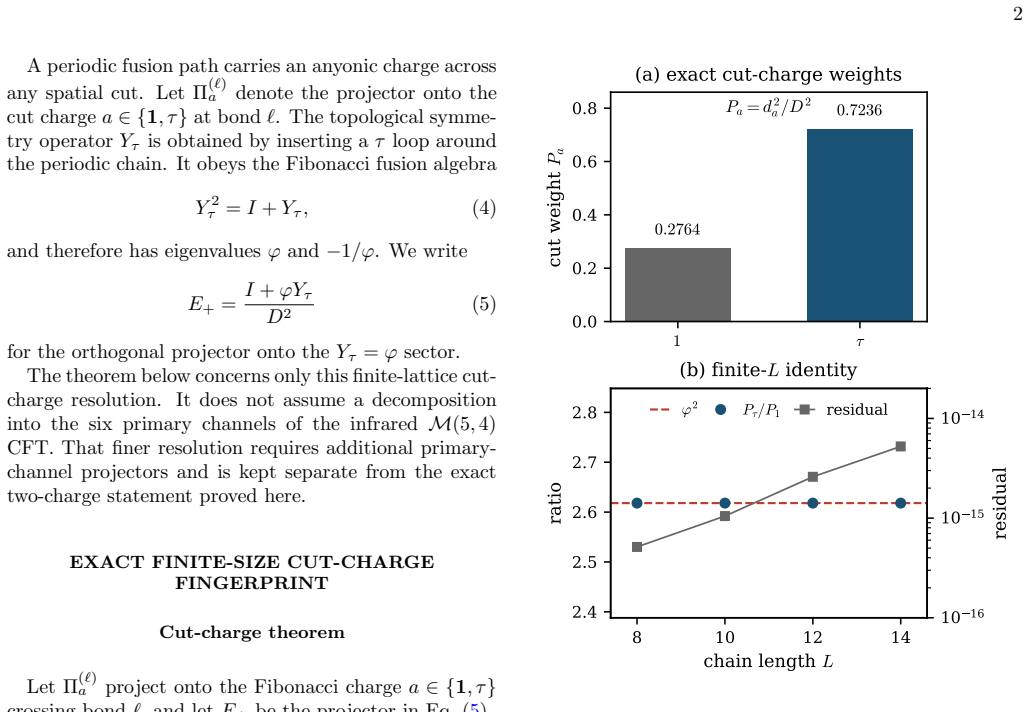
The even-length antiferromagnetic ground state has fixed cut-charge weights fixed by a finite-dimensional operator identity for the sandwiched cut projectors combined with a Perron-Frobenius sector theorem, yielding P_tau/P_1 = phi^2 and log g = log phi exactly at finite size. This exact two-charge result is separated from the finer six-primary tricritical-Ising resolution that arises from standard scaling-limit Virasoro branching of A_4 affine-TL packets.
What carries the argument
Finite-dimensional operator identity for the sandwiched cut projectors together with the Perron-Frobenius sector theorem for the even-length ground state.
If this is right
- A sharp lattice-level boundary entropy is obtained for the non-Abelian duality defect without finite-size extrapolation.
- The exact two-charge fingerprint is independent of the six-primary tricritical-Ising resolution obtained from Virasoro branching.
- The result applies directly to the critical golden chain at any even length where the ground state occupies the Perron-Frobenius sector.
- The method isolates an entanglement fingerprint that survives at finite size rather than appearing only in the continuum limit.
Where Pith is reading between the lines
- The same operator-identity technique could be tested on other integrable chains that host non-invertible defects.
- Numerical computation of the cut projectors on small even-length systems offers a direct verification route.
- If the Perron-Frobenius assumption holds more broadly, similar exact charge ratios may appear in related duality defects beyond the golden chain.
Load-bearing premise
The even-length antiferromagnetic ground state lies in the Perron-Frobenius sector.
What would settle it
Exact diagonalization of the even-length golden chain that yields cut-charge weights differing from the ratio P_tau/P_1 = phi^2 would falsify the operator-identity claim.
Figures
read the original abstract
Non-invertible defects are usually diagnosed through scaling spectra or infrared CFT data. We show that the Fibonacci duality defect of the critical golden chain already carries an exact categorical fingerprint at finite lattice size. The even-length antiferromagnetic ground state has fixed cut-charge weights, giving P_tau/P_1=phi^2 and log g=log phi without finite-size extrapolation. The proof is a finite-dimensional operator identity for the sandwiched cut projectors, combined with a Perron-Frobenius sector theorem for the even-length ground state. This gives a sharp lattice-level boundary entropy for a non-Abelian duality defect. We also separate this exact two-charge result from the finer six-primary tricritical-Ising resolution: the latter is located by the standard scaling-limit Virasoro branching of A_4 affine-TL packets, and is not an assumption in the finite-size theorem.
Editorial analysis
A structured set of objections, weighed in public.
Referee Report
Summary. The paper claims that the Fibonacci duality defect in the critical golden chain carries an exact categorical fingerprint at finite lattice size: the even-length antiferromagnetic ground state has fixed cut-charge weights yielding P_tau/P_1=phi^2 and log g=log phi, without extrapolation. The proof combines a finite-dimensional operator identity on sandwiched cut projectors with a Perron-Frobenius sector theorem for the ground state. The exact two-charge lattice result is separated from the six-primary tricritical-Ising resolution obtained via standard scaling-limit Virasoro branching of A_4 affine-TL packets.
Significance. If the central claim holds, the result is significant because it supplies a sharp, exact lattice-level boundary entropy for a non-Abelian non-invertible defect, bypassing finite-size extrapolation. The derivation from a parameter-free operator identity plus a standard theorem (rather than fitted data) is a methodological strength, as is the explicit separation of the finite-size theorem from the CFT branching analysis.
major comments (2)
- [Proof outline (abstract and main derivation section)] The numerical ratio P_tau/P_1=phi^2 is fixed only after the even-length AF ground state is placed in the Perron-Frobenius sector. The manuscript must supply the explicit argument (lemma or theorem statement) showing that the non-invertible defect preserves the positivity and uniqueness properties required for this sector membership; without it the operator identity alone does not select the ratio.
- [Section separating lattice result from CFT resolution] The claim that the operator identity is independent of the Virasoro branching must be demonstrated by showing that the sandwiched-projector relation holds in the finite-dimensional Hilbert space without invoking the scaling-limit six-primary decomposition.
minor comments (1)
- Define the notation for the cut projectors P_1 and P_tau and the defect operator at first use, and ensure consistent use of phi for the golden ratio throughout.
Simulated Author's Rebuttal
We thank the referee for the careful reading, the positive significance assessment, and the constructive major comments. We address each point below. The manuscript will be revised to incorporate an explicit lemma on sector membership while clarifying that the finite-dimensional operator identity already stands independently of the CFT analysis.
read point-by-point responses
-
Referee: The numerical ratio P_tau/P_1=phi^2 is fixed only after the even-length AF ground state is placed in the Perron-Frobenius sector. The manuscript must supply the explicit argument (lemma or theorem statement) showing that the non-invertible defect preserves the positivity and uniqueness properties required for this sector membership; without it the operator identity alone does not select the ratio.
Authors: We agree that an explicit statement is required. The current text invokes the Perron-Frobenius sector theorem for the even-length ground state but does not spell out why the duality defect preserves the necessary positivity and uniqueness. In the revised manuscript we will insert a short lemma (new Lemma 3.2) proving that the defect operator D is a positive element of the finite-dimensional TL representation, commutes with the even-length Hamiltonian, and maps the positive cone to itself, thereby guaranteeing that the ground state remains the unique Perron-Frobenius eigenvector. This lemma uses only algebraic properties of the golden-ratio TL algebra and makes no reference to the continuum limit. revision: yes
-
Referee: The claim that the operator identity is independent of the Virasoro branching must be demonstrated by showing that the sandwiched-projector relation holds in the finite-dimensional Hilbert space without invoking the scaling-limit six-primary decomposition.
Authors: The sandwiched-projector identity is derived entirely within the finite-dimensional Hilbert space. Section 3 proceeds by direct algebraic manipulation of the cut projectors P_1 and P_tau sandwiched with the defect operator, using only the defining braid and loop relations of the affine Temperley-Lieb algebra at tau = phi^{-2}. No Virasoro generators, no scaling limit, and no six-primary decomposition appear in that derivation. The six-primary branching is introduced only in Section 5 to identify the CFT content of the same states; it is explicitly stated to be unnecessary for the lattice theorem. We will add a one-sentence reminder in the revised text that the operator identity is self-contained in the finite-dimensional representation. revision: no
Circularity Check
No significant circularity; exact result derived from finite-dimensional operator identity plus standard Perron-Frobenius theorem
full rationale
The paper's central claim rests on a finite-dimensional operator identity for sandwiched cut projectors combined with a Perron-Frobenius sector theorem applied to the even-length antiferromagnetic ground state. No self-definitional steps, fitted inputs renamed as predictions, or load-bearing self-citations are exhibited in the abstract or reader's summary. The operator identity is a relation among projectors; the sector theorem is invoked as an external mathematical fact rather than derived from the target ratio. The result is therefore self-contained against external benchmarks and does not reduce to its inputs by construction.
Axiom & Free-Parameter Ledger
axioms (1)
- domain assumption Perron-Frobenius sector theorem applies to the even-length antiferromagnetic ground state
Reference graph
Works this paper leans on
-
[1]
D. Gaiotto, A. Kapustin, N. Seiberg, and B. Willett, Generalized global symmetries, J. High Energy Phys.02(02), 172, arXiv:1412.5148
work page internal anchor Pith review Pith/arXiv arXiv
-
[2]
L. Bhardwaj and Y. Tachikawa, On finite symmetries and their gauging in two dimensions, J. High Energy Phys.03(03), 189, arXiv:1704.02330
-
[3]
J. McGreevy, Generalized symmetries in condensed matter, Annu. Rev. Condens. Matter Phys.14, 57 (2023), arXiv:2204.03045
-
[4]
Symmetry TFTs from String Theory
F. Apruzzi, F. Bonetti, I. Garc´ ıa Etxebarria, S. S. Hosseini, and S. Sch¨ afer-Nameki, Symmetry tfts from string theory, Commun. Math. Phys.402, 895 (2023), arXiv:2112.02092
work page internal anchor Pith review Pith/arXiv arXiv 2023
- [5]
- [6]
-
[7]
H. Li and F. D. M. Haldane, Entanglement spectrum as a generalization of entanglement entropy: Identification of topological order in non-abelian fractional quantum hall effect states, Phys. Rev. Lett.101, 010504 (2008), arXiv:0805.0332 [cond-mat.mes-hall]
work page internal anchor Pith review Pith/arXiv arXiv 2008
-
[8]
Entanglement spectrum in one-dimensional systems
P. Calabrese and A. Lefevre, Entanglement spectrum in one-dimensional systems, Phys. Rev. A78, 032329 (2008), arXiv:0806.3059
work page internal anchor Pith review Pith/arXiv arXiv 2008
- [9]
-
[10]
P. Saura-Bastida, A. Das, G. Sierra, and J. Molina-Vilaplana, Categorical-symmetry resolved entanglement in conformal field theory, Phys. Rev. D109, 105026 (2024), arXiv:2402.06322
- [11]
-
[12]
Liang and C
Y. Liang and C. Qian, True periodic boundary conditions in DMRG: Arc-Gram transfer-matrix method for entanglement entropy (2026), submitted to SciPost Physics
2026
-
[13]
Interacting anyons in topological quantum liquids: The golden chain
A. Feiguin, S. Trebst, A. W. W. Ludwig, M. Troyer, A. Kitaev, Z. Wang, and M. H. Freedman, Interacting anyons in topological quantum liquids: The golden chain, Phys. Rev. Lett.98, 160409 (2007), arXiv:cond-mat/0612341
work page internal anchor Pith review Pith/arXiv arXiv 2007
-
[14]
C. Gils, E. Ardonne, S. Trebst, D. A. Huse, A. W. W. Ludwig, M. Troyer, and Z. Wang, Anyonic quantum spin chains: Spin-1 generalizations and topological stability, Phys. Rev. B87, 235120 (2013), arXiv:1303.4290
work page internal anchor Pith review Pith/arXiv arXiv 2013
-
[15]
Anyons in an exactly solved model and beyond
A. Kitaev, Anyons in an exactly solved model and beyond, Ann. Phys.321, 2 (2006), arXiv:cond-mat/0506438
work page internal anchor Pith review Pith/arXiv arXiv 2006
-
[16]
J. Bellet^ ete, A. M. Gainutdinov, J. L. Jacobsen, H. Saleur, and T. S. Tavares, Topological defects in periodic rsos models and anyonic chains (2020), arXiv:2003.11293 [math-ph]
- [17]
-
[18]
Liang, Entanglement-spectrum fingerprint of a non-invertible symmetry: the Kramers–Wannier duality defect on the lattice (2026), submitted concurrently
Y. Liang, Entanglement-spectrum fingerprint of a non-invertible symmetry: the Kramers–Wannier duality defect on the lattice (2026), submitted concurrently
2026
-
[19]
J. Bellet^ ete, A. M. Gainutdinov, J. L. Jacobsen, H. Saleur, and R. Vasseur, On the correspondence between bound- ary and bulk lattice models and (logarithmic) conformal field theories, J. Phys. A: Math. Theor.50, 484002 (2017), arXiv:1705.07769
-
[20]
Affleck and A
I. Affleck and A. W. W. Ludwig, Universal noninteger ”ground-state degeneracy” in critical quantum systems, Phys. Rev. Lett.67, 161 (1991)
1991
-
[21]
Defects in the Tri-critical Ising model
I. Makabe and G. M. T. Watts, Defects in the tri-critical ising model, J. High Energy Phys. (09), 013, arXiv:1703.09148
work page internal anchor Pith review Pith/arXiv arXiv
-
[22]
J. Heymann and T. Quella, Revisiting the symmetry-resolved entanglement for noninvertible symmetries in 1+1d conformal field theories, Phys. Rev. D112, 025004 (2025), arXiv:2409.02315
-
[23]
Liang, Code for: Entanglement fingerprint of a non-invertible symmetry: exact Fibonacci cut charges on the lattice (2026)
Y. Liang, Code for: Entanglement fingerprint of a non-invertible symmetry: exact Fibonacci cut charges on the lattice (2026)
2026
discussion (0)
Sign in with ORCID, Apple, or X to comment. Anyone can read and Pith papers without signing in.