Learning the Universe: Posterior Reliability of Neural Generative Models in High-Dimensional Field-Level Inference of Cosmic Initial Conditions
Pith reviewed 2026-06-27 15:20 UTC · model grok-4.3
The pith
Matching posterior means and correlations does not ensure correct uncertainty structure in neural generative models for cosmic initial conditions.
A machine-rendered reading of the paper's core claim, the machinery that carries it, and where it could break.
Core claim
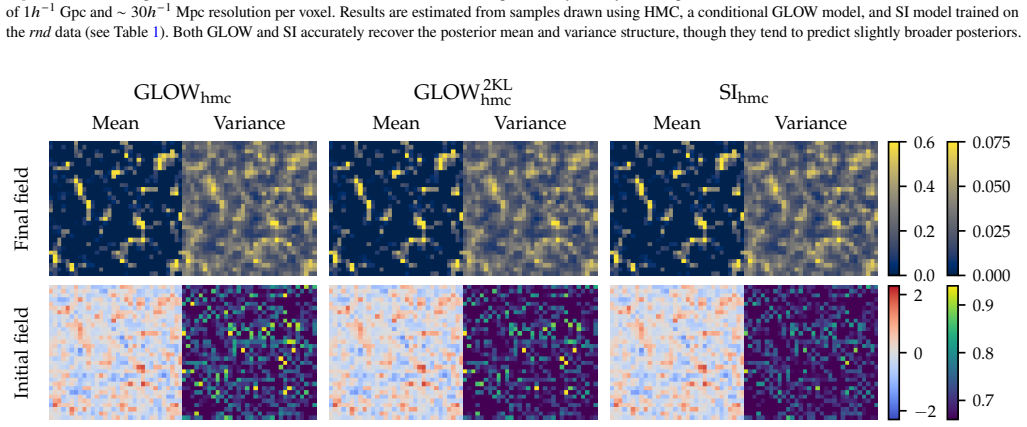
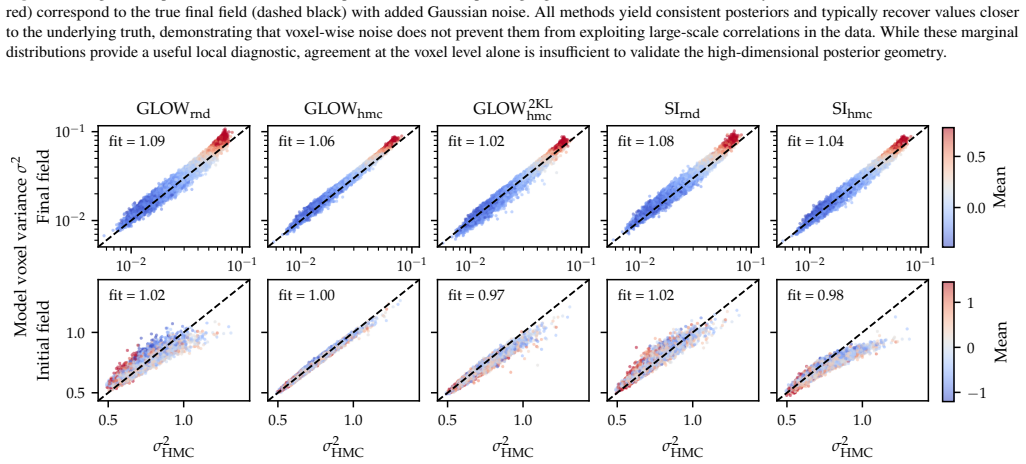
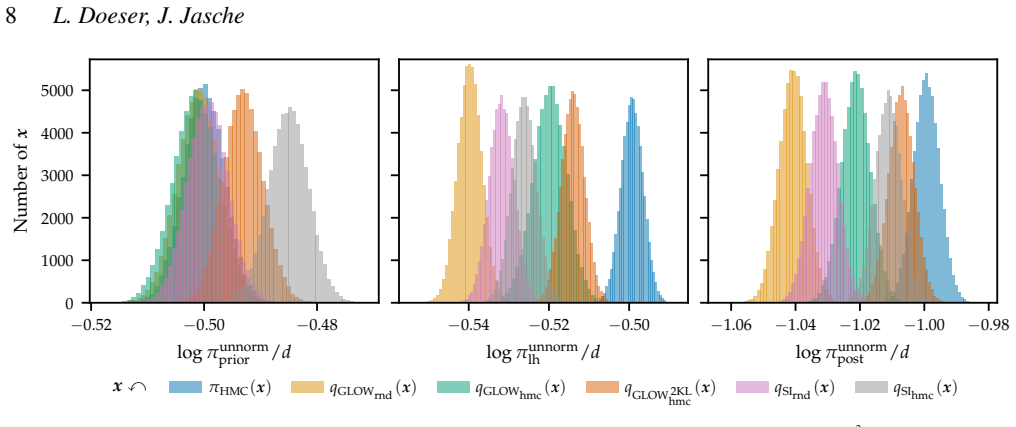
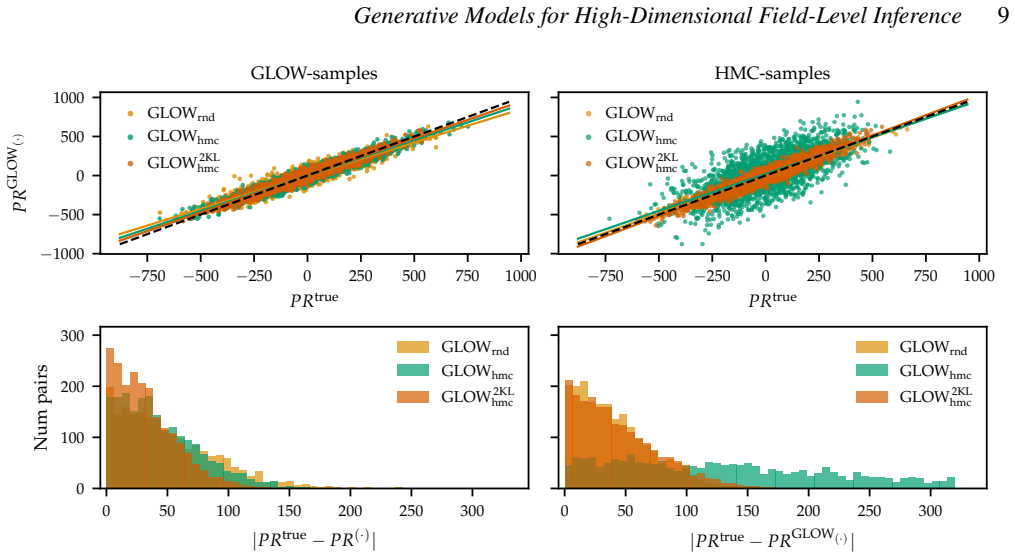
In the cosmological inverse problem of recovering initial conditions, both the stochastic interpolants model and the GLOW model reproduce posterior means and achieve high cross-correlations with reference samples, yet produce posterior variance fields that differ from the Hamiltonian Monte Carlo reference and fail sample-based tests of uncertainty structure.
What carries the argument
Posterior variance fields and sample-based evaluations, which expose geometry failures in the inferred posteriors that are invisible to mean-matching or correlation metrics.
If this is right
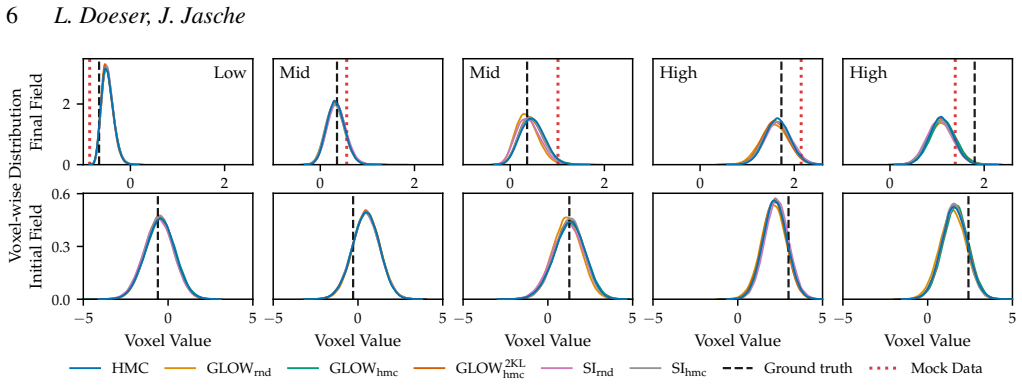
- Agreement on posterior means, marginal distributions, or cross-correlations alone is insufficient to confirm that a generative model has recovered the correct uncertainty structure.
- Field-level inference with neural generative models requires validation against reference samples that probe the full posterior geometry, not just summary statistics.
- Generative models can handle non-differentiable simulators in cosmology, but only after explicit checks confirm that uncertainty estimates remain reliable.
- Standard metrics commonly used to assess amortized inference can give misleading signals of success in high-dimensional field problems.
Where Pith is reading between the lines
- The same variance-field diagnostic could be applied to test posterior reliability in other high-dimensional inverse problems that use amortized generative models.
- If variance mismatches prove systematic, it may restrict the precision of downstream cosmological parameter constraints derived from these models.
- Extending the evaluation to include higher-order statistics or information content metrics could further clarify when generative models preserve the necessary posterior structure.
Load-bearing premise
Hamiltonian Monte Carlo produces sufficiently accurate reference posterior samples to serve as ground truth for testing the generative models.
What would settle it
A direct side-by-side comparison in which the generative models' posterior variance fields match the Hamiltonian Monte Carlo variance fields across the simulated volume while means and correlations also agree.
Figures





read the original abstract
Accurate posterior estimation is central to scientific inference, as uncertainties determine what can be reliably learned from observational data. While Markov chain Monte Carlo methods provide asymptotic convergence guarantees, they are computationally demanding in high-dimensional settings. Neural network-based generative models for entire discretized 3D fields enable fast amortized inference but often lack convergence guarantees and principled accuracy assessment. Using Hamiltonian Monte Carlo to obtain reference posterior samples, we conduct a controlled field-level evaluation of an implicit generative model (Stochastic Interpolants) and an explicit likelihood-based model (GLOW normalizing flows). This comparison, unavailable in typical applications, enables the detection of posterior geometry failures that standard metrics cannot capture. As a case study, we consider the cosmological inverse problem of inferring cosmic initial conditions from present-day large-scale structure. To match the precision of modern cosmological data, this problem increasingly relies on complex, non-linear, and non-differentiable simulators, which are incompatible with gradient-based inference frameworks. Generative models offer a route to address these challenges, provided their inferred posteriors are reliable. In this work, we show that matching posterior means, marginal distributions, or achieving high cross-correlation does not imply correct uncertainty structure, as revealed by posterior variance fields and sample-based evaluations. Through this work, we aim to raise awareness of the challenges of uncertainty estimation in high-dimensional field-level settings, highlighting the importance of careful design and validation of neural generative approaches for scientific applications.
Editorial analysis
A structured set of objections, weighed in public.
Referee Report
Summary. The manuscript claims that in the high-dimensional field-level inference of cosmic initial conditions from large-scale structure, agreement between neural generative models (Stochastic Interpolants and GLOW normalizing flows) and HMC reference samples on posterior means, marginal distributions, or cross-correlations does not guarantee correct uncertainty structure. This is demonstrated via discrepancies in posterior variance fields and sample-based evaluations, using a controlled comparison enabled by HMC references that is unavailable in typical applications.
Significance. If the central claim holds, the work is significant for highlighting limitations of standard posterior diagnostics in amortized inference for cosmology. It provides a concrete case study showing that conventional metrics can miss geometry failures in generative models, which could inform validation practices for high-dimensional scientific applications where simulators are non-differentiable.
major comments (2)
- [Abstract / Evaluation design] The central claim that generative models exhibit failures in uncertainty structure (revealed by variance fields and sample-based evaluations) rests on HMC samples serving as faithful ground truth. However, no convergence diagnostics, effective sample sizes, or cross-validation against an independent sampler are described, which is load-bearing in this high-dimensional, non-Gaussian, non-linear setting.
- [Abstract] The abstract states that modern simulators are non-differentiable and thus incompatible with gradient-based inference frameworks, yet HMC (a gradient-based method) is used to generate the reference posterior samples for the controlled comparison. Clarification is required on how gradients are obtained or approximated to support the validity of the reference.
minor comments (1)
- [Abstract] The abstract supplies no quantitative results, error bars, dataset sizes, or specific metrics for the claimed discrepancies, which limits immediate assessment of effect sizes.
Simulated Author's Rebuttal
We thank the referee for their careful reading and constructive comments, which help strengthen the manuscript. We address each major comment below and will incorporate clarifications and additional diagnostics in the revised version.
read point-by-point responses
-
Referee: [Abstract / Evaluation design] The central claim that generative models exhibit failures in uncertainty structure (revealed by variance fields and sample-based evaluations) rests on HMC samples serving as faithful ground truth. However, no convergence diagnostics, effective sample sizes, or cross-validation against an independent sampler are described, which is load-bearing in this high-dimensional, non-Gaussian, non-linear setting.
Authors: We agree that explicit convergence diagnostics are essential to substantiate the HMC reference samples as reliable ground truth. The revised manuscript will include Gelman-Rubin statistics, effective sample size estimates for field-level and summary statistics, and autocorrelation times. These will be added to the methods and supplementary sections to address this point directly. revision: yes
-
Referee: [Abstract] The abstract states that modern simulators are non-differentiable and thus incompatible with gradient-based inference frameworks, yet HMC (a gradient-based method) is used to generate the reference posterior samples for the controlled comparison. Clarification is required on how gradients are obtained or approximated to support the validity of the reference.
Authors: The abstract highlights the general challenge with non-differentiable simulators in modern cosmology. For the controlled experiment, however, we used a differentiable particle-mesh forward model (with adjoint gradients) to enable HMC sampling and obtain reference posteriors. This setup isolates the comparison while the generative models are evaluated in a setting where only non-differentiable simulators would be available in practice. We will revise the abstract and methods to explicitly distinguish the reference model from the general case. revision: yes
Circularity Check
No significant circularity; HMC reference samples provide independent ground truth for model evaluation
full rationale
The paper's central claim—that standard posterior metrics (means, marginals, cross-correlations) fail to guarantee correct uncertainty structure—is demonstrated by direct comparison of generative model outputs against separately generated HMC reference samples. No equations reduce any claimed result to quantities defined by the models under test, no parameters are fitted and then relabeled as predictions, and no load-bearing steps rely on self-citations or imported uniqueness theorems. The evaluation chain is self-contained against an external MCMC benchmark whose convergence properties are treated as given rather than derived from the neural models.
Axiom & Free-Parameter Ledger
Reference graph
Works this paper leans on
-
[1]
ascl , howpublished =:1811.008 , adsnote =
Pylians:. ascl , howpublished =:1811.008 , adsnote =
-
[2]
Journal of Machine Learning Research , volume =
Stochastic Interpolants: A Unifying Framework for Flows and Diffusions , author =. Journal of Machine Learning Research , volume =
-
[3]
Alokda, Toka and Porciani, Cristiano and Eggemeier, Alexander , year = 2026, month = may, number =. Coverage Is Not Enough:. doi:10.48550/arXiv.2605.00980 , urldate =. arXiv , keywords =:2605.00980 , primaryclass =
work page internal anchor Pith review Pith/arXiv arXiv doi:10.48550/arxiv.2605.00980 2026
-
[4]
Fast likelihood-free cosmology with neural density estimators and active learning
Fast Likelihood-Free Cosmology with Neural Density Estimators and Active Learning , author =. Monthly Notices of the Royal Astronomical Society , volume =. doi:10.1093/mnras/stz1960 , urldate =. arXiv , keywords =:1903.00007 , pages =
work page internal anchor Pith review Pith/arXiv arXiv doi:10.1093/mnras/stz1960 1903
-
[5]
Cosmology and Fundamental Physics with the
Amendola, Luca and Appleby, Stephen and Avgoustidis, Anastasios and Bacon, David and Baker, Tessa and Baldi, Marco and Bartolo, Nicola and Blanchard, Alain and Bonvin, Camille and Borgani, Stefano and Branchini, Enzo and Burrage, Clare and Camera, Stefano and Carbone, Carmelita and Casarini, Luciano and Cropper, Mark and. Cosmology and Fundamental Physics...
-
[6]
Solving Inverse Problems Using Data-Driven Models , author =. Acta Numerica , volume =. doi:10.1017/S0962492919000059 , urldate =
-
[7]
and Kashino, Daichi and Cucciati, Olga and
Ata, Metin and Kitaura, Francisco Shu and Lee, Khee Gan and Lemaux, Brian C. and Kashino, Daichi and Cucciati, Olga and. Monthly Notices of the Royal Astronomical Society , volume =. doi:10.1093/mnras/staa3318 , urldate =. arXiv , keywords =:2004.11027 , pages =
-
[8]
, year = 2024, month = jul, number =
Augustine, Midhun T. , year = 2024, month = jul, number =. A. doi:10.48550/arXiv.2407.12895 , urldate =. arXiv , keywords =:2407.12895 , primaryclass =
-
[9]
How Many Simulations Do We Need for Simulation-Based Inference in Cosmology? , author =. Astronomy & Astrophysics , volume =. doi:10.1051/0004-6361/202554602 , urldate =. arXiv , keywords =:2503.13755 , primaryclass =
-
[10]
and Chiarenza, Marco and Doeser, Ludvig and Leclercq, Florent , year = 2025, month = sep, journal =
Bartlett, Deaglan J. and Chiarenza, Marco and Doeser, Ludvig and Leclercq, Florent , year = 2025, month = sep, journal =. arXiv , file =:2409.02154 , pages =
arXiv 2025
-
[11]
and Seljak, Uros and Modi, Chirag , year = 2023, month = jul, eprint =
Bayer, Adrian E. and Seljak, Uros and Modi, Chirag , year = 2023, month = jul, eprint =. Field-
2023
-
[12]
Bayer, Adrian E. and Parker, Liam and Valcin, David and Chen, Shi-Fan and Modi, Chirag and Seljak, Uros , year = 2026, month = mar, number =. Field-. doi:10.48550/arXiv.2603.15732 , urldate =. arXiv , keywords =:2603.15732 , primaryclass =
-
[13]
Benning, Martin and Burger, Martin , year = 2018, month = jan, number =. Modern. doi:10.48550/arXiv.1801.09922 , urldate =. arXiv , keywords =:1801.09922 , primaryclass =
work page internal anchor Pith review Pith/arXiv arXiv doi:10.48550/arxiv.1801.09922 2018
-
[14]
Large-Scale Structure of the Universe and Cosmological Perturbation Theory
Bernardeau, F. and Colombi, S. and Gaztanaga, E. and Scoccimarro, R. , year = 2002, month = sep, journal =. Large-. doi:10.1016/S0370-1573(02)00135-7 , urldate =. arXiv , keywords =:astro-ph/0112551 , pages =
work page internal anchor Pith review Pith/arXiv arXiv doi:10.1016/s0370-1573(02)00135-7 2002
-
[15]
Neural Network Reconstruction of Non-Gaussian Initial Conditions from Dark Matter Halos , author =. arXiv: 2502.11846 , eprint =
-
[16]
Proceedings of the National Academy of Sciences , volume =
Mining Gold from Implicit Models to Improve Likelihood-Free Inference , author =. Proceedings of the National Academy of Sciences , volume =. doi:10.1073/pnas.1915980117 , urldate =. arXiv , keywords =:1805.12244 , primaryclass =
-
[17]
doi:10.48550/arXiv.2508.02602 , urldate =
Trustworthy Scientific Inference with Generative Models , author =. doi:10.48550/arXiv.2508.02602 , urldate =. arXiv , keywords =:2508.02602 , primaryclass =
-
[18]
Monthly Notices of the Royal Astronomical Society , volume =
Effective Cosmic Density Field Reconstruction with Convolutional Neural Network , author =. Monthly Notices of the Royal Astronomical Society , volume =. doi:10.1093/mnras/stad1868 , abstract =. arXiv , keywords =:2306.10538 , pages =
-
[19]
Chen, Xinyi and Padmanabhan, Nikhil and Eisenstein, Daniel J. , year = 2024, journal =. Probing Primordial Non-. 2412.00968 , archiveprefix =
arXiv 2024
-
[20]
Chen, Shu-Fan and Chen, Kai-Feng and Dvorkin, Cora , year = 2025, month = nov, journal =. Field-Level. doi:10.1088/1475-7516/2025/11/082 , urldate =. arXiv , keywords =:2508.13265 , primaryclass =
-
[21]
Proceedings of the National Academy of Sciences , volume =
The Frontier of Simulation-Based Inference , author =. Proceedings of the National Academy of Sciences , volume =. doi:10.1073/pnas.1912789117 , urldate =. arXiv , keywords =:1911.01429 , primaryclass =
-
[22]
Joint Cosmological Parameter Inference and Initial Condition Reconstruction with
-
[23]
Mathematics of Control, Signals and Systems , volume =
Approximation by Superpositions of a Sigmoidal Function , author =. Mathematics of Control, Signals and Systems , volume =. doi:10.1007/BF02551274 , abstract =
-
[24]
Dai, Biwei and Seljak, Uros , year = 2024, month = feb, number =. Multiscale. doi:10.48550/arXiv.2306.04689 , urldate =. arXiv , langid =:2306.04689 , primaryclass =
-
[25]
Dax, Maximilian and Wildberger, Jonas and Buchholz, Simon and Green, Stephen R. and Macke, Jakob H. and Sch. Flow. doi:10.48550/arXiv.2305.17161 , urldate =. arXiv , keywords =:2305.17161 , primaryclass =
-
[26]
Deistler, Michael and Boelts, Jan and Steinbach, Peter and Moss, Guy and Moreau, Thomas and Gloeckler, Manuel and Rodrigues, Pedro L. C. and Linhart, Julia and Lappalainen, Janne K. and Miller, Benjamin Kurt and Gon. Simulation-. doi:10.48550/arXiv.2508.12939 , urldate =. arXiv , keywords =:2508.12939 , primaryclass =
- [27]
-
[28]
Density estimation using Real NVP
Dinh, Laurent and. Density Estimation Using. doi:10.48550/arXiv.1605.08803 , urldate =. arXiv , keywords =:1605.08803 , primaryclass =
work page internal anchor Pith review Pith/arXiv arXiv doi:10.48550/arxiv.1605.08803
-
[29]
NICE: Non-linear Independent Components Estimation
Dinh, Laurent and Krueger, David and Bengio, Yoshua , year = 2015, month = apr, number =. doi:10.48550/arXiv.1410.8516 , urldate =. arXiv , keywords =:1410.8516 , primaryclass =
work page internal anchor Pith review Pith/arXiv arXiv doi:10.48550/arxiv.1410.8516 2015
-
[30]
doi:10.48550/arXiv.2403.18514 , urldate =
Djahnine, Aissam and Popoff, Alexandre and. doi:10.48550/arXiv.2403.18514 , urldate =. arXiv , keywords =:2403.18514 , primaryclass =
-
[31]
Bayesian Inference of Initial Conditions from Non-Linear Cosmic Structures Using Field-Level Emulators , author =. MNRAS , volume =. doi:10.1093/mnras/stae2429 , abstract =. https://academic.oup.com/mnras/article-pdf/535/2/1258/60481350/stae2429.pdf , pages =
-
[32]
Doeser, Ludvig and Ata, Metin and Jasche, Jens , year = 2025, month = aug, journal =. Learning the. doi:10.1093/mnras/staf1289 , urldate =. arXiv , keywords =:2502.13243 , primaryclass =
- [33]
-
[34]
Dor. Science. arXiv , file =:1805.05489 , urldate =
-
[35]
Duane, Simon and Kennedy, A. D. and Pendleton, Brian J. and Roweth, Duncan , year = 1987, month = sep, journal =. Hybrid. doi:10.1016/0370-2693(87)91197-X , urldate =
-
[36]
FastPM: a new scheme for fast simulations of dark matter and halos
Feng, Yu and Chu, Man Yat and Seljak, Uro. Monthly Notices of the Royal Astronomical Society , volume =. doi:10.1093/mnras/stw2123 , abstract =. arXiv , keywords =:1603.00476 , pages =
work page internal anchor Pith review Pith/arXiv arXiv doi:10.1093/mnras/stw2123
-
[37]
Exploring the posterior surface of the large scale structure reconstruction
Exploring the Posterior Surface of the Large Scale Structure Reconstruction , author =. Journal of Cosmology and Astroparticle Physics , volume =. doi:10.1088/1475-7516/2018/07/043 , abstract =. arXiv , arxivid =:1804.09687 , issn =
work page internal anchor Pith review Pith/arXiv arXiv doi:10.1088/1475-7516/2018/07/043 2018
-
[38]
Improving Constraints on Primordial Non-
Fl. Improving Constraints on Primordial Non-. Journal of Cosmology and Astroparticle Physics , volume =. doi:10.1088/1475-7516/2024/02/031 , urldate =
-
[39]
doi:10.48550/arXiv.2211.12724 , urldate =
Friedman, Roy and Hassan, Sultan , year = 2022, month = nov, number =. doi:10.48550/arXiv.2211.12724 , urldate =. arXiv , keywords =:2211.12724 , primaryclass =
-
[40]
On the Approximate Realization of Continuous Mappings by Neural Networks , author =. Neural Networks , volume =. doi:10.1016/0893-6080(89)90003-8 , urldate =
-
[41]
Training Deep Neural Density Estimators to Identify Mechanistic Models of Neural Dynamics , author =. eLife , volume =. doi:10.7554/eLife.56261 , urldate =
-
[42]
Goodfellow, Ian and Bengio, Yoshua and Courville, Aaron , year = 2016, publisher =. Deep
2016
-
[43]
Automatic Posterior Transformation for Likelihood-Free Inference
Greenberg, David S. and Nonnenmacher, Marcel and Macke, Jakob H. , year = 2019, month = may, number =. Automatic. doi:10.48550/arXiv.1905.07488 , urldate =. arXiv , keywords =:1905.07488 , primaryclass =
work page internal anchor Pith review Pith/arXiv arXiv doi:10.48550/arxiv.1905.07488 2019
-
[44]
Proceedings of the National Academy of Sciences of the United States of America , volume =
Learning to Predict the Cosmological Structure Formation , author =. Proceedings of the National Academy of Sciences of the United States of America , volume =. doi:10.1073/pnas.1821458116 , abstract =. arXiv , arxivid =:1811.06533 , pages =
-
[45]
Hermans, Joeri and Begy, Volodimir and Louppe, Gilles , year = 2020, month = jun, number =. Likelihood-Free. doi:10.48550/arXiv.1903.04057 , urldate =. arXiv , keywords =:1903.04057 , primaryclass =
-
[46]
Denoising Diffusion Probabilistic Models
Ho, Jonathan and Jain, Ajay and Abbeel, Pieter , year = 2020, month = dec, number =. Denoising. doi:10.48550/arXiv.2006.11239 , urldate =. arXiv , keywords =:2006.11239 , primaryclass =
work page internal anchor Pith review Pith/arXiv arXiv doi:10.48550/arxiv.2006.11239 2020
-
[47]
Ho, Matthew and Bartlett, Deaglan J. and Chartier, Nicolas and. The Open Journal of Astrophysics , volume =. doi:10.33232/001c.120559 , urldate =. arXiv , keywords =:2402.05137 , primaryclass =
-
[48]
Multilayer Feedforward Networks Are Universal Approximators , author =. Neural Networks , volume =. doi:10.1016/0893-6080(89)90020-8 , urldate =
-
[49]
doi:10.3847/1538-4357/ab4d4c , abstract =
Horowitz, Benjamin and Lee, Khee-Gan and White, Martin and Krolewski, Alex and Ata, Metin , year = 2019, journal =. doi:10.3847/1538-4357/ab4d4c , abstract =. arXiv , arxivid =:1903.09049v3 , pages =
-
[50]
Monthly Notices of the Royal Astronomical Society , volume =
Joint Cosmic Density Reconstruction from Photometric and Spectroscopic Samples , author =. Monthly Notices of the Royal Astronomical Society , volume =. arXiv , arxivid =:2311.18738 , pages =
-
[51]
doi:10.48550/arXiv.2510.19224 , urldate =
Horowitz, Benjamin and. doi:10.48550/arXiv.2510.19224 , urldate =. arXiv , keywords =:2510.19224 , primaryclass =
-
[52]
, year = 2025, month = dec, number =
Horowitz, Benjamin and Bayer, Adrian E. , year = 2025, month = dec, number =. doi:10.48550/arXiv.2510.26851 , urldate =. arXiv , keywords =:2510.26851 , primaryclass =
-
[53]
LSST: from Science Drivers to Reference Design and Anticipated Data Products
Ivezi. The Astrophysical Journal , volume =. doi:10.3847/1538-4357/ab042c , abstract =. arXiv , arxivid =:0805.2366 , pages =
work page internal anchor Pith review Pith/arXiv arXiv doi:10.3847/1538-4357/ab042c
-
[54]
Field Level Neural Network Emulator for Cosmological N-Body Simulations , author =. arXiv: 2206.04594 , eprint =
-
[55]
Jamieson, Drew and Li, Yin and. Field-Level. JCAP , volume =. arXiv , file =:2408.07699 , doi =
-
[56]
Bayesian physical reconstruction of initial conditions from large scale structure surveys
Bayesian Physical Reconstruction of Initial Conditions from Large-Scale Structure Surveys , author =. MNRAS , volume =. doi:10.1093/mnras/stt449 , urldate =. arXiv , keywords =:1203.3639 , pages =
work page internal anchor Pith review Pith/arXiv arXiv doi:10.1093/mnras/stt449
-
[57]
Past and present cosmic structure in the SDSS DR7 main sample
Jasche, J. and Leclercq, F. and Wandelt, B. D. , year = 2015, journal =. Past and Present Cosmic Structure in the. doi:10.1088/1475-7516/2015/01/036 , abstract =. arXiv , keywords =:1409.6308 , issn =
work page internal anchor Pith review Pith/arXiv arXiv doi:10.1088/1475-7516/2015/01/036 2015
-
[58]
Jasche, J. and Lavaux, G. , year = 2019, journal =. Physical. doi:10.1051/0004-6361/201833710 , abstract =. arXiv , keywords =:1806.11117 , issn =
work page internal anchor Pith review Pith/arXiv arXiv doi:10.1051/0004-6361/201833710 2019
-
[59]
Jiang, Heinrich , year = 2017, month = jul, pages =. Uniform. Proceedings of the 34th
2017
-
[60]
Predicting the Initial Conditions of the Universe Using Deep Learning , author =. arXiv: 2303.13056 , eprint =
-
[61]
doi:10.48550/arXiv.2507.11842 , urldate =
Kannan, Sidharth and Qiu, Tian and. doi:10.48550/arXiv.2507.11842 , urldate =. arXiv , keywords =:2507.11842 , primaryclass =
-
[62]
Karras, Tero and Laine, Samuli and Aittala, Miika and Hellsten, Janne and Lehtinen, Jaakko and Aila, Timo , year = 2020, month = mar, number =. Analyzing and. doi:10.48550/arXiv.1912.04958 , urldate =. arXiv , keywords =:1912.04958 , primaryclass =
-
[64]
The Astrophysical Journal , volume =
Kaushal, Neerav and. The Astrophysical Journal , volume =. doi:10.3847/1538-4357/ac5c4a , abstract =
-
[65]
Glow: Generative Flow with Invertible 1x1 Convolutions
Kingma, Diederik P. and Dhariwal, Prafulla , year = 2018, month = jul, number =. Glow:. doi:10.48550/arXiv.1807.03039 , urldate =. arXiv , keywords =:1807.03039 , primaryclass =
work page internal anchor Pith review Pith/arXiv arXiv doi:10.48550/arxiv.1807.03039 2018
-
[66]
and Salimans, Tim and Poole, Ben and Ho, Jonathan , year = 2023, month = apr, number =
Kingma, Diederik P. and Salimans, Tim and Poole, Ben and Ho, Jonathan , year = 2023, month = apr, number =. Variational. doi:10.48550/arXiv.2107.00630 , urldate =. arXiv , keywords =:2107.00630 , primaryclass =
-
[67]
Monthly Notices of the Royal Astronomical Society: Letters , volume =
The Initial Conditions of the Universe from Constrained Simulations , author =. Monthly Notices of the Royal Astronomical Society: Letters , volume =. doi:10.1093/mnrasl/sls029 , urldate =
-
[68]
Krouglova, Anastasia N. and Johnson, Hayden R. and Confavreux, Basile and Deistler, Michael and Gon. Multifidelity. doi:10.48550/arXiv.2502.08416 , urldate =. arXiv , keywords =:2502.08416 , primaryclass =
-
[69]
Hybrid Physical-Neural Odes for Fast n-Body Simulations , author =. arXiv: 2207.05509 , eprint =
-
[70]
Euclid Definition Study Report , author =. arXiv: 1110.3193 , eprint =
-
[71]
Unmasking the Masked Universe: the 2M++ catalogue through Bayesian eyes
Lavaux, Guilhem and Jasche, Jens , year = 2016, journal =. Unmasking the Masked Universe:. doi:10.1093/mnras/stv2499 , abstract =. arXiv , arxivid =:1509.05040 , pages =
work page internal anchor Pith review Pith/arXiv arXiv doi:10.1093/mnras/stv2499 2016
-
[72]
Bayesian analysis of the dynamic cosmic web in the SDSS galaxy survey
Leclercq, Florent and Jasche, Jens and Wandelt, Benjamin , year = 2015, journal =. Bayesian Analysis of the Dynamic Cosmic Web in the. doi:10.1088/1475-7516/2015/06/015 , abstract =. arXiv , arxivid =:1502.02690 , pages =
work page internal anchor Pith review Pith/arXiv arXiv doi:10.1088/1475-7516/2015/06/015 2015
-
[73]
Legin, Ronan and Ho, Matthew and Lemos, Pablo and. Posterior. MNRAS , volume =. doi:10.1093/mnrasl/slad152 , urldate =. arXiv , keywords =:2304.03788 , pages =
-
[74]
Lemos, Pablo and Coogan, Adam and Hezaveh, Yashar and. Sampling-. doi:10.48550/arXiv.2302.03026 , urldate =. arXiv , keywords =:2302.03026 , primaryclass =
-
[75]
Lipman, Yaron and Chen, Ricky T. Q. and. Flow. doi:10.48550/arXiv.2210.02747 , urldate =. arXiv , keywords =:2210.02747 , primaryclass =
work page internal anchor Pith review Pith/arXiv arXiv doi:10.48550/arxiv.2210.02747
-
[76]
arXiv , arxivid =:2310.19910 , abstract =
Bayesian Simulation-Based Inference for Cosmological Initial Conditions , author =. arXiv , arxivid =:2310.19910 , abstract =
-
[77]
DISCO-DJ II: a differentiable particle-mesh code for cosmology
List, Florian and Hahn, Oliver and Fl. doi:10.48550/arXiv.2510.05206 , urldate =. arXiv , keywords =:2510.05206 , primaryclass =
work page internal anchor Pith review Pith/arXiv arXiv doi:10.48550/arxiv.2510.05206
-
[78]
Large Synoptic Survey Telescope:. arXiv: 1211.0310 , eprint =
-
[79]
arXiv , arxivid =:0912.0201 , abstract =
arXiv: 0912.0201 , number =. arXiv , arxivid =:0912.0201 , abstract =
-
[80]
Benchmarking
Lueckmann, Jan-Matthis and Boelts, Jan and Greenberg, David S and Gon. Benchmarking
-
[81]
Lu, Zhou and Pu, Hongming and Wang, Feicheng and Hu, Zhiqiang and Wang, Liwei , year = 2017, month = nov, number =. The. doi:10.48550/arXiv.1709.02540 , urldate =. arXiv , keywords =:1709.02540 , primaryclass =
work page internal anchor Pith review Pith/arXiv arXiv doi:10.48550/arxiv.1709.02540 2017
discussion (0)
Sign in with ORCID, Apple, or X to comment. Anyone can read and Pith papers without signing in.