REVIEW 3 major objections 4 minor 38 references
Do Tabular Foundation Models Agree with Themselves?
T0 review · 3 major / 4 minor · reviewed 2026-08-07 · deepseek-v4-flash
Pith's one-line read Every tabular foundation model tested fails basic probability checks
desk verdict Crisp negative result on TFM consistency; the classification half is exact and convincing, but the regression half overclaims the rigor of its discretization argument. read the letter →
The pith
A machine-rendered reading of the paper's core claim, the machinery that carries it, and where it could break.
The reading
What carries the argument
The load-bearing objects are two consistency conditions stated for a pair of targets $A$ and $B$. Marginalization consistency (C1) requires the directly predicted marginal of $A$ to equal the mixture of the conditional of $A$ given $B$ weighted by the marginal of $B$, i.e. the law of total probability. Factorization consistency (C2) requires the two chain-rule products, $A$-then-$B$ and $B$-then-$A$, to be equal, i.e. compatibility of conditionals and marginals. The argument runs on these identities: if a model satisfied (C2), integrating over $B$ would reduce the mixture to the direct marginal, yielding (C1) by normalization; the contrapositive makes the cheaper univariate check a certificate of order-dependence. Violations are quantified by total-variation distance between the two sides of each identity, computed exactly for classification and via deterministic quantile-based discretization for regression; because total-variation distance is non-increasing under coarsening, the regression gaps are lower bounds.
What would settle it
Run the paper's two consistency checks on a model whose predictive conditionals are computed exactly from a single joint distribution (e.g., a hand-built graphical model); if the total-variation distance is not exactly zero, the measurement procedure rather than the model is producing the violation. Alternatively, any current TFM that scores exactly zero on both checks for a dataset with two dependent targets would falsify the paper's universal claim.
Extended reading notes
Core claim
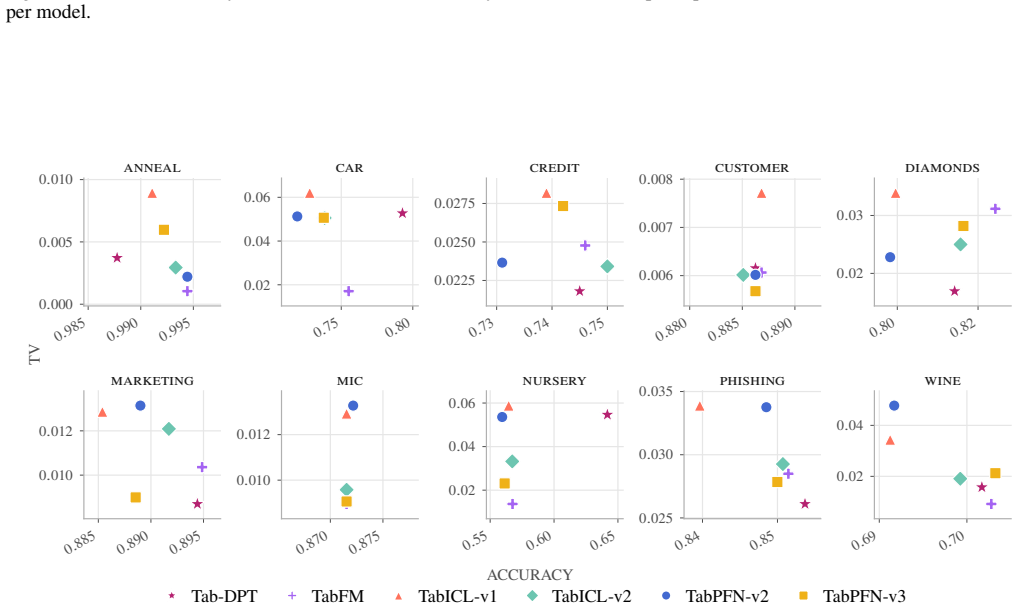
The paper's central discovery is a universal negative result: every tabular foundation model evaluated — TabPFNv2/v3, TabICLv1/v2, TabDPTv1.2, and TabFM — violates both marginalization consistency (C1) and factorization consistency (C2) on all ten classification and seven regression datasets. The violations are systematic and measurable from the models' own outputs: for classification, the checks are exact finite sums; for regression, they are evaluated on discretized grids with total-variation distance, giving lower bounds. As a corollary, the autoregressive joint constructed by sampling one target and conditioning on it is order-dependent: choosing which target to sample first changes the predicted distribution. The paper also proves that factorization consistency implies marginalization consistency, so each observed marginalization failure already certifies that the two factorization orders disagree.
Load-bearing premise
For regression, the conclusion assumes that the $K=1{,}000$ equal-mass atom quadrature and the 20-cell or $128\times128$ discretization faithfully represent the continuous predictive distributions; the paper argues that coarsening can only hide discrepancies, but no formal error bound for the quadrature is given.
Editorial extensions
If this is right
- Autoregressive data generation with current TFMs produces order-dependent joints: the distribution over a generated row changes with the sampling order of the columns.
- Marginalization consistency is a cheap, label-free diagnostic (it compares only univariate heads) and, by the paper's contrapositive, a detected violation certifies that factorization also fails.
- Benchmarks that rank TFMs by accuracy or RMSE do not capture this axis; the paper finds no systematic correlation between predictive quality and consistency, so a state-of-the-art model can be among the most inconsistent.
- Training a TFM with a self-supervised objective that swaps target and feature roles (as TabDPT does) does not in itself yield factorization-consistent conditionals.
- The two consistency conditions extend from a pair of targets to arbitrary subsets, so future models with native multivariate heads would still need to align the directly predicted joint with the joint induced by one-target-at-a-time factorization.
Reading between the lines
- If the result holds across more models and datasets, consistency should become a standard evaluation axis alongside accuracy and calibration for any TFM used as a joint density estimator.
- The two consistency conditions suggest a concrete training target: penalize the marginalization or factorization gap directly, or derive all univariate heads from a shared latent joint so coherence holds by construction.
- The same label-free TV-measurement lens transfers to any conditionally specified predictor, including large language models, whose autoregressive token probabilities have been separately suspected of violating probability laws.
- Once a TFM emits classification and regression from shared weights, the mixed categorical-continuous test the paper outlines would probe coherence across the two heads — a boundary current models cannot cross.
Signed reviews
Editorial analysis
A structured set of objections, weighed in public.
Referee Report
Summary. The paper asks whether the univariate predictive distributions issued by tabular foundation models (TFMs) can be the marginals and conditionals of any single joint distribution over the columns of a table. It formalizes two necessary conditions: marginalization consistency (C1), which requires the model's direct marginal for a target to equal the mixture of its conditionals over an intermediate target, and factorization consistency (C2), which requires the two autoregressive chain-rule orders to produce the same joint. The paper proves that (C2) implies (C1), gives a counterexample showing the converse fails, and then evaluates six TFMs on ten classification and seven regression datasets. Classification checks are exact finite sums; regression checks discretize continuous predictive distributions via quantile heads, using K=1,000 equal-mass atoms and a 20-cell or 128x128 grid. The reported result is that every evaluated TFM violates both conditions on every dataset, for both classification and regression, and that the two violation measures correlate strongly.
Significance. If the claims were fully established, the paper would make a valuable contribution: it provides label-free, ground-truth-free consistency diagnostics for TFMs, it draws a clean logical connection between the two forms of inconsistency, and the classification-side experiments are exact finite-sum checks that give mathematically certain violations. The proposed metrics could become a useful additional evaluation axis alongside accuracy and calibration. The paper is also careful in places: the proof of Proposition 1 is a direct calculation, the counterexample in Appendix A correctly separates the two properties, and the classification methodology leaves no room for sampling noise. The main weakness is that the regression-side evidence, which is needed for the abstract's universal claim, relies on discretization and quadrature steps whose error is not bounded and whose preservability of zero-TV for known-consistent models is not validated.
major comments (3)
- [§4.2 and Appendix C] The inference from a nonzero discretized TV to a violation of the continuous marginalization condition (C1) is not justified. The experiment computes TV between the S-cell coarsening of the direct marginal and the S-cell coarsening of the K-atom mixture. Coarsening is non-expansive, so TV(q_dir^S, q_mixK^S) is at most TV(q_dir, q_mixK), and the triangle inequality gives TV(q_dir, q_mixK) ≤ TV(q_dir, q_mix) + TV(q_mix, q_mixK). The observed quantity is therefore not a lower bound on TV(q_dir, q_mix); a large value can be produced entirely by quadrature error TV(q_mix, q_mixK). The paper asserts the contrary in §4.2 ('The resulting value for TV is therefore a lower bound ... in particular for the TV between the underlying continuous distributions'), but that assertion holds only for the K-atom approximation, not for the true mixture. A formal bound on the quadrature error, or a controlled experiment with a model known to be continuous-consistent, is needed before the regression violations can be claimed.
- [§4.3 and Appendix C] In the factorization check, the two discretized joints are computed by evaluating conditionals at cell representatives (midpoint quadrature in probability space, Appendix C). For a continuous model that is exactly factorization-consistent, the true continuous joints coincide, but the two discretized tables need not coincide, because each cell mass in order a→b uses p(a|b*_l,x) evaluated at a single representative rather than averaged over the cell. Hence a nonzero table TV does not establish a violation of (C2). This is not a minor technicality: the regression factorization violations in Table 2 are the main evidence for the regression part of the abstract's universal claim. The authors should either bound the discretization error, demonstrate that a known-consistent model yields zero table TV on these datasets, or present the numbers as violations of the discretized conditions only.
- [Abstract and §4.4] The central conclusion as stated in the abstract and §4.4 ('Every TFM that we evaluate violates both of these requirements for both classification and regression across all datasets') is too strong relative to the evidence. The classification side is exact, but the regression side is not yet rigorously connected to the continuous conditions on (C1) and (C2). Since this is the paper's headline claim, the manuscript needs a major revision either to supply the missing error analysis or validation, or to restrict the claim to the classification results and to the discretized regression checks.
minor comments (4)
- [Abstract and §4.1] The phrase 'for both classification and regression' is imprecise because TabICLv1 and TabFM lack probabilistic regression heads; the claim should specify that it applies to the models that provide probabilistic regression.
- [Appendix D] The decision to drop instances with NLL below 0.05 is a post hoc filtering step that can affect the reported per-row analysis; it should be described in the main text and accompanied by a sensitivity check over the threshold.
- [General] A code or data release link would aid reproducibility of the exact finite-sum classification checks and the deterministic regression pipeline described in Appendix C.
- [Table 3] The column header 'Feat. num./cat.' is ambiguous; splitting it into two separate columns for numerical and categorical feature counts would make the table easier to read.
Circularity Check
No circularity: the consistency checks compare a model's own predictions against other predictions of the same model via standard probability identities, with no fitted input being renamed as a prediction.
full rationale
The paper's derivation chain is self-contained. The central comparison evaluates necessary conditions for any joint distribution (law of total probability for (C1), compatibility of conditionals for (C2)) directly from TFM outputs. No parameter is fitted to produce the headline result; pretrained models are used as-is and the metrics are computed in closed form for classification and by a deterministic discretization for regression. Proposition 1 is an algebraic proof that (C2) implies (C1) using only the normalization of the conditional density, and Proposition 2 is an explicit counterexample; neither assumes the empirical conclusion. The only self-citation (Yalavarthi et al. 2026) appears in related work and is not load-bearing. The regression-side quadrature issue (the S=20 coarse-grid TV is a lower bound for the K-atom mixture versus the direct marginal, but not rigorously for the true continuous mixture) is a potential validity/approximation caveat, not a circularity: the observed nonzero TV is not forced by construction, and the paper does not fit a parameter and then call it a prediction. Accordingly, the circularity score is 0.
Assumptions & free parameters
free parameters (1)
- Regression discretization resolutions =
K=1000, S=20, grid=128x128, L=2000
assumptions (4)
- standard math Law of total probability and chain rule
- domain assumption Predicted densities are normalized
- domain assumption Context sets differing in target/feature role represent the same underlying table
- standard math Total variation distance is non-increasing under coarsening
Cite this review
Pith. "Pith review of Do Tabular Foundation Models Agree with Themselves?." pith.science (2026). https://pith.science/paper/CLXHSH5P
@misc{pith2026260806004,
  author       = {Pith},
  title        = {Pith review of: Do Tabular Foundation Models Agree with Themselves?},
  year         = {2026},
  howpublished = {\url{https://pith.science/paper/CLXHSH5P}},
  note         = {Machine review of arXiv:2608.06004}
}
read the original abstract
Tabular Foundation Models (TFMs) are currently the best approach to tabular prediction problems. They are constructed as transformers that approximate the Bayesian posterior predictive distribution based on a pre-training prior. These univariate predictors can be converted into multivariate ones autoregressively by sampling one target and adding it to the features. However, the faithfulness of the resulting joint has not been investigated. Furthermore, TFMs cannot be evaluated against the posterior itself, at least not on real-world datasets, because the ground-truth distribution is unknown. We therefore propose asking a different question: could a model's predictions result from any joint distribution? To answer this question, we pose two requirements that any such model must satisfy. The first is marginalization consistency, which demands that marginalized conditionals are equal to directly predicted marginals. The second is factorization consistency, which demands that different factorization orders result in equal joint distributions. Every TFM that we evaluate violates both of these requirements for both classification and regression across all datasets.
Figures


Figures from the paper (7 more)




Reference graph
Works this paper leans on
-
[1]
doi:10.1007/0-387-28678-0 , isbn =
An Introduction to Copulas , author =. doi:10.1007/0-387-28678-0 , isbn =
-
[2]
doi:10.48550/arXiv.2602.11139 , urldate =
Qu, Jingang and Holzm. doi:10.48550/arXiv.2602.11139 , urldate =. arXiv , keywords =:2602.11139 , primaryclass =
-
[3]
doi:10.48550/arXiv.2605.13986 , urldate =
Grinsztajn, L. doi:10.48550/arXiv.2605.13986 , urldate =. arXiv , keywords =:2605.13986 , primaryclass =
-
[4]
Transformers Can Do Bayesian Inference , booktitle =
Samuel M. Transformers Can Do Bayesian Inference , booktitle =. 2022 , url =
2022
-
[5]
Accurate Predictions on Small Data with a Tabular Foundation Model , author =. Nature , volume =. doi:10.1038/s41586-024-08328-6 , urldate =
-
[6]
Vetter, Julius and Gloeckler, Manuel and Gedon, Daniel and Macke, Jakob H , year = 2025, volume =. Effortless,. Advances in
work page 2025
-
[7]
doi:10.1007/978-3-642-14394-6 , urldate =
Stochastic. doi:10.1007/978-3-642-14394-6 , urldate =
-
[8]
Journal of Statistical Planning and Inference , volume =
Energy Statistics: A Class of Statistics Based on Distances , author =. Journal of Statistical Planning and Inference , volume =
Show all 38 references
-
[9]
Journal of the Royal Statistical Society: Series B (Methodological) , volume =
Spatial Interaction and the Statistical Analysis of Lattice Systems , author =. Journal of the Royal Statistical Society: Series B (Methodological) , volume =
-
[10]
Journal of the American Statistical Association , volume =
Compatible Conditional Distributions , author =. Journal of the American Statistical Association , volume =
-
[11]
Statistical Science , volume =
Conditionally Specified Distributions: An Introduction , author =. Statistical Science , volume =
-
[12]
Journal of Machine Learning Research , volume =
Dependency Networks for Inference, Collaborative Filtering, and Data Visualization , author =. Journal of Machine Learning Research , volume =
-
[13]
The Annals of Probability , volume =
Limit Theorems for a Class of Identically Distributed Random Variables , author =. The Annals of Probability , volume =. doi:10.1214/009117904000000676 , urldate =
-
[14]
Journal of the Royal Statistical Society Series B: Statistical Methodology , volume=
Martingale posterior distributions , author=. Journal of the Royal Statistical Society Series B: Statistical Methodology , volume=. 2023 , publisher=
2023
-
[15]
Reliable
Yalavarthi, Vijaya Krishna and Scholz, Randolf and Kl. Reliable. International Conference on Learning Representations , volume =
-
[16]
Uria, Benigno and Murray, Iain and Larochelle, Hugo , year = 2014, month = jan, pages =. A. Proceedings of the 31st
2014
-
[17]
and Bastings, Jasmijn and Poole, Ben and van den Berg, Rianne and Salimans, Tim , year = 2022, month = oct, urldate =
Hoogeboom, Emiel and Gritsenko, Alexey A. and Bastings, Jasmijn and Poole, Ben and van den Berg, Rianne and Salimans, Tim , year = 2022, month = oct, urldate =. Autoregressive. International
2022
-
[18]
Training and
Shih, Andy and Sadigh, Dorsa and Ermon, Stefano , year = 2022, volume =. Training and. Advances in
2022
-
[19]
Is In-Context Learning in Large Language Models
Falck, Fabian and Wang, Ziyu and Holmes, Chris , year = 2024, booktitle =. Is In-Context Learning in Large Language Models
2024
-
[20]
Proceedings of the 61st Annual Meeting of the Association for Computational Linguistics (Volume 2: Short Papers) , publisher =
Deriving Language Models from Masked Language Models , author =. Proceedings of the 61st Annual Meeting of the Association for Computational Linguistics (Volume 2: Short Papers) , publisher =
-
[21]
arXiv preprint arXiv:2301.00068 , year=
Inconsistencies in masked language models , author=. arXiv preprint arXiv:2301.00068 , year=
- [22]
- [23]
-
[24]
Young, Robin , year = 2026, month = feb, journal =. On the
2026
-
[25]
Proceedings of the workshop on methods for optimizing and evaluating neural language generation , pages=
BERT has a mouth, and it must speak: BERT as a Markov random field language model , author=. Proceedings of the workshop on methods for optimizing and evaluating neural language generation , pages=
-
[26]
Garnelo, Marta and Rosenbaum, Dan and Maddison, Christopher and Ramalho, Tiago and Saxton, David and Shanahan, Murray and Teh, Yee Whye and Rezende, Danilo and Eslami, S. M. Ali , year = 2018, month = jul, pages =. Conditional. Proceedings of the 35th
2018
-
[27]
Incoherent Probability Judgments in Large Language Models , booktitle =
Jian. Incoherent Probability Judgments in Large Language Models , booktitle =. 2024 , url =
2024
-
[28]
Zhang, Xiyuan and Maddix Robinson, Danielle and Yin, Junming and Erickson, Nick and Ansari, Abdul Fatir and Han, Boran and Zhang, Shuai and Akoglu, Leman and Faloutsos, Christos and Mahoney, Michael and Hu, Tony and Rangwala, Huzefa and Karypis, George and Wang, Yuyang (Bernie...
2025
-
[29]
Forty-Third
Wang, Yuanrui and Zhang, Xingxuan and Yu, Han and Hao, Mingchao and Ren, Gang and Yuan, Hao and Mao, Li and Zhang, Yunjia and Yuan, Chun and Cui, Peng , year = 2026, month = jun, urldate =. Forty-Third
2026
-
[30]
Management Science , volume =
Is It Better to Average Probabilities or Quantiles? , author =. Management Science , volume =
-
[31]
Introducing
Kong, Weihao and Das, Abhimanyu , year=2026, urldate =. Introducing
2026
-
[32]
and Kadra, Arlind and Gijsbers, Pieter and Mallik, Neeratyoy and Ravi, Sahithya and M
Feurer, Matthias and van Rijn, Jan N. and Kadra, Arlind and Gijsbers, Pieter and Mallik, Neeratyoy and Ravi, Sahithya and M. Journal of Machine Learning Research , volume =
-
[33]
Proceedings of the 42nd
Qu, Jingang and Holzm. Proceedings of the 42nd
-
[34]
Advances in
Ma, Junwei and Thomas, Valentin and Hosseinzadeh, Rasa and Labach, Alex and Cresswell, Jesse and Golestan, Keyvan and Yu, Guangwei and Caterini, Anthony L and Volkovs, Maks , year = 2025, volume =. Advances in
2025
-
[35]
Information Theory and Statistics:
Csisz. Information Theory and Statistics:. Foundations and Trends in Communications and Information Theory , volume =. 2004 , doi =
2004
-
[36]
Guaranteed Deterministic Bounds on the
Nielsen, Frank and Sun, Ke , year = 2018, month = sep, pages =. Guaranteed Deterministic Bounds on the. 2018. doi:10.1109/MLSP.2018.8517093 , urldate =
2018
-
[37]
, year = 2026, month = may, urldate =
Hosseinzadeh, Rasa and Labach, Alex and Xue, Zexin and Han, Shuyi and Thomas, Valentin and Caterini, Anthony L. , year = 2026, month = may, urldate =. 2nd
2026
-
[38]
Advances in Neural Information Processing Systems , volume =
Erickson, Nick and Purucker, Lennart and Tschalzev, Andrej and Holzm. Advances in Neural Information Processing Systems , volume =
Reviewed August 7, 2026 · model on record in the stance chip above.
Discussion (0). Continue with ORCID to comment.