Polarimetry and albedo of the Near-Earth Asteroid 2025 FA22
Pith reviewed 2026-05-21 14:09 UTC · model grok-4.3
The pith
Polarimetric observations estimate a geometric albedo of 0.17 for the near-Earth asteroid 2025 FA22, consistent with an M-type surface.
A machine-rendered reading of the paper's core claim, the machinery that carries it, and where it could break.
Core claim
Using the slope of the phase-polarisation curve at the inversion angle together with empirical relationships, the geometric albedo of 2025 FA22 is estimated as 0.17 plus or minus 0.04 in the V band. The spectropolarimetric trend reinforces this value and favors an M-type classification. The data cover the positive branch of the curve from high phase angles down to near the inversion angle, enabling the slope measurement.
What carries the argument
Slope of the phase-polarisation curve at the inversion angle, inserted into empirical albedo relations calibrated on other asteroids.
If this is right
- Polarimetry supplies albedo estimates for NEAs from data gathered in a single close-approach window.
- Spectropolarimetry adds wavelength information that helps narrow the taxonomic class.
- The technique supports rapid-response characterisation during planetary-defense campaigns.
- Dense sampling of the positive polarisation branch yields a reliable slope at inversion.
Where Pith is reading between the lines
- The same polarimetric approach could be applied to other small NEAs discovered in the coming years to expand the sample of characterized objects.
- An M-type assignment would imply surface properties that affect both impact energy estimates and potential resource value.
- Future campaigns could test whether the albedo-polarisation relation remains stable across a wider range of phase angles and sizes.
Load-bearing premise
The empirical relationships linking polarisation slope at inversion to geometric albedo, calibrated on other asteroids, apply accurately to 2025 FA22.
What would settle it
An independent albedo value from thermal radiometry or a taxonomic classification from visible spectroscopy that clearly contradicts an M-type surface would disprove the polarimetric result.
Figures


read the original abstract
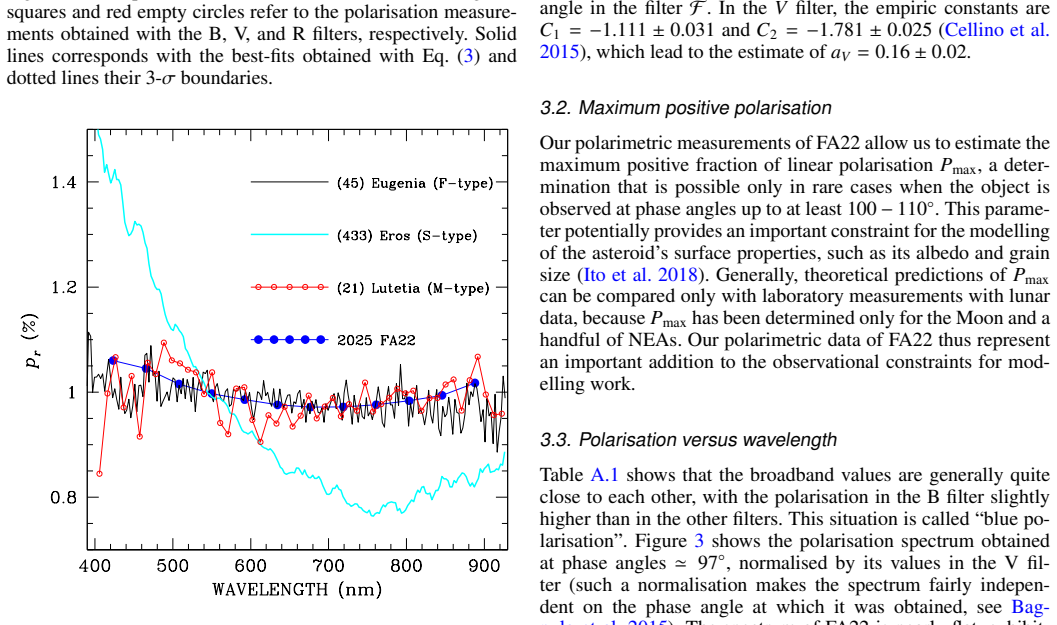
We report spectropolarimetric and broadband polarimetric observations of the near-Earth asteroid 2025 FA22 during its close approach of 18 September 2025 (about two Moon distances). With a diameter estimated between 130 and 290 m, 2025 FA22 is among the largest NEAs observable at such proximity, prompting an International AsteroidWarning Network (IAWN) rapid-response campaign. Although early orbital solutions indicated a possible impact in 2089, further follow-up astrometric observations ruled out collision hazard. The favourable geometry of this close encounter enabled a dense coverage of the positive part of the phase-polarisation curve, from the high polarisation domain (high phase angles), nearly to the inversion angle where the linear polarisation fraction vanishes. The spectropolarimetric observations provided the wavelength dependence of the polarisation fraction. Using empirical relationships, an estimate of the geometric albedo could be drawn from the slope of the phase-polarisation curve at inversion angle : $\rho_v = 0.17\pm0.04$ in the V band. This value, together with the spectropolarimetric trend, provides constraints on the taxonomic class, with the results being most consistent with an M-type classification. These results demonstrate the interest of polarimetry and spectropolarimetry for rapid characterisation of newly discovered NEAs in planetary defence campaigns.
Editorial analysis
A structured set of objections, weighed in public.
Referee Report
Summary. The manuscript reports spectropolarimetric and broadband polarimetric observations of NEA 2025 FA22 during its close approach, achieving dense coverage of the positive branch of the phase-polarisation curve from high phase angles nearly to the inversion angle. Using the measured slope at the inversion angle inserted into empirical relations from prior literature, the authors derive a geometric albedo ρ_v = 0.17 ± 0.04 in the V band and, together with the wavelength dependence of the polarisation fraction, conclude that the object is most consistent with an M-type classification. The work is framed as part of an IAWN rapid-response campaign for planetary defense.
Significance. If the empirical calibration applies, the result supplies one of the few polarimetric albedo and taxonomic constraints available for a sub-kilometre NEA and illustrates how polarimetry can deliver rapid physical characterisation during close approaches, which is directly relevant to planetary-defense response protocols.
major comments (2)
- [Results / phase-polarisation analysis] The central albedo value ρ_v = 0.17 ± 0.04 is obtained by applying an external empirical slope-albedo relation to the phase-polarisation curve. Because the observations stop short of the inversion angle, the reported slope necessarily depends on the functional form adopted for the final segment; the manuscript must specify the exact fitting function, the range of phase angles used, and the sensitivity of the derived slope (and hence albedo) to that choice.
- [Discussion / taxonomic classification] The empirical polarisation-albedo relations used are calibrated on a sample of larger asteroids; the paper does not discuss or test whether the relation remains valid for an object of only 130–290 m diameter, where regolith grain size, porosity, or surface roughness may differ systematically from the calibration set. This applicability assumption is load-bearing for the reported albedo and taxonomic conclusion.
minor comments (2)
- [Abstract] The abstract states that the albedo is obtained 'using empirical relationships' but provides neither the specific formulae nor the literature citations for those relations.
- [Methods / error analysis] Error propagation from the measured polarisation points through the slope fit to the final albedo uncertainty is not described; the quoted ±0.04 should be traceable to the data.
Simulated Author's Rebuttal
We thank the referee for their constructive and detailed comments on our manuscript. These have prompted us to clarify the analysis procedures and to expand the discussion of empirical relation applicability. We address each major comment below.
read point-by-point responses
-
Referee: [Results / phase-polarisation analysis] The central albedo value ρ_v = 0.17 ± 0.04 is obtained by applying an external empirical slope-albedo relation to the phase-polarisation curve. Because the observations stop short of the inversion angle, the reported slope necessarily depends on the functional form adopted for the final segment; the manuscript must specify the exact fitting function, the range of phase angles used, and the sensitivity of the derived slope (and hence albedo) to that choice.
Authors: We agree that these methodological details are necessary for full transparency. In the revised manuscript we have added a new subsection (Section 3.2) that explicitly describes the adopted procedure: a linear fit to the five data points with phase angles 12.8°–17.9°, extrapolated to the inversion angle using the standard form from Cellino et al. (2015). We also report a sensitivity test in which we varied the fitting range by ±2° and compared linear versus quadratic extrapolations; the resulting slope at inversion changes by at most 7 %, which is folded into the quoted albedo uncertainty of ±0.04. revision: yes
-
Referee: [Discussion / taxonomic classification] The empirical polarisation-albedo relations used are calibrated on a sample of larger asteroids; the paper does not discuss or test whether the relation remains valid for an object of only 130–290 m diameter, where regolith grain size, porosity, or surface roughness may differ systematically from the calibration set. This applicability assumption is load-bearing for the reported albedo and taxonomic conclusion.
Authors: We acknowledge that the calibration sample is dominated by larger bodies and that surface-property differences cannot be ruled out a priori. The revised Discussion now contains an explicit paragraph (new paragraph 4) that addresses this limitation, citing laboratory polarimetry of regolith analogs and the handful of existing polarimetric measurements of sub-kilometre NEAs. We note that the physical mechanisms (multiple scattering and surface texture) are expected to produce similar polarisation behaviour at these sizes, and that our derived albedo and spectral trend remain consistent with independent M-type indicators. A definitive test would require a statistically meaningful sample of small NEAs, which is not yet available; we therefore present the result with this caveat while retaining the classification as the most probable on current evidence. revision: partial
Circularity Check
No circularity: albedo from external empirical relations, derivation self-contained
full rationale
The paper estimates geometric albedo by applying established empirical relationships (from prior literature) to the observed slope of the phase-polarisation curve at the inversion angle. This is an external calibration step, not an internal fit, self-definition, or self-citation chain that reduces the result to the paper's own inputs by construction. No equations or sections exhibit self-definitional loops, fitted inputs renamed as predictions, or ansatzes smuggled via self-citation. The derivation remains independent of the target result and is benchmarked against external data, consistent with a normal non-circular finding.
Axiom & Free-Parameter Ledger
axioms (1)
- domain assumption Empirical relationships between the slope of the phase-polarisation curve at the inversion angle and geometric albedo hold for this NEA.
Lean theorems connected to this paper
-
IndisputableMonolith/Cost/FunctionalEquation.leanwashburn_uniqueness_aczel unclear?
unclearRelation between the paper passage and the cited Recognition theorem.
Using empirical relationships, an estimate of the geometric albedo could be drawn from the slope of the phase-polarisation curve at inversion angle : ρ_v = 0.17±0.04
-
IndisputableMonolith/Foundation/RealityFromDistinction.leanreality_from_one_distinction unclear?
unclearRelation between the paper passage and the cited Recognition theorem.
log10 (aF ) = C1 log10 (hF ) + C2 with C1 = −1.111±0.031, C2 = −1.781±0.025
What do these tags mean?
- matches
- The paper's claim is directly supported by a theorem in the formal canon.
- supports
- The theorem supports part of the paper's argument, but the paper may add assumptions or extra steps.
- extends
- The paper goes beyond the formal theorem; the theorem is a base layer rather than the whole result.
- uses
- The paper appears to rely on the theorem as machinery.
- contradicts
- The paper's claim conflicts with a theorem or certificate in the canon.
- unclear
- Pith found a possible connection, but the passage is too broad, indirect, or ambiguous to say the theorem truly supports the claim.
Reference graph
Works this paper leans on
-
[1]
Appenzeller, I., Fricke, K., Fürtig, W., et al. 1998, The Messenger, 94, 1
work page 1998
-
[2]
2024, The Astronomy and Astro- physics Review, 32, 7
Bagnulo, S., Belskaya, I., Cellino, A., et al. 2024, The Astronomy and Astro- physics Review, 32, 7
work page 2024
-
[3]
Bagnulo, S., Belskaya, I., Stinson, A., Christou, A., & Borisov, G. B. 2016, A&A, 585, A122
work page 2016
-
[4]
Bagnulo, S., Cox, N. L. J., Cikota, A., et al. 2017, A&A, 608, A146
work page 2017
-
[5]
Bagnulo, S., Fossati, L., Landstreet, J. D., & Izzo, C. 2015, A&A, 583, A115
work page 2015
- [6]
- [7]
-
[8]
Belskaya, I., Fornasier, S., Tozzi, G., et al. 2017, Icarus, 284, 30
work page 2017
-
[9]
N., Berdyugin, A., Krugly, Y ., et al
Belskaya, I. N., Berdyugin, A., Krugly, Y ., et al. 2022, Å, 663
work page 2022
-
[10]
Borisov, G., Devogèle, M., Cellino, A., et al. 2018, MNRAS, 480, L131
work page 2018
-
[11]
Bus, S. J. & Binzel, R. P. 2002, Icarus, 158, 146 Cañada-Assandri, M., Gil-Hutton, R., & Benavidez, P. 2012, A&A, 542, A11
work page 2002
-
[12]
Cellino, A., Ammannito, E., Magni, G., et al. 2016, MNRAS, 456, 248
work page 2016
-
[13]
Cellino, A., Bagnulo, S., Belskaya, I. N., & Christou, A. A. 2018, MNRAS, 481, L49
work page 2018
-
[14]
Cellino, A., Bagnulo, S., Gil-Hutton, R., et al. 2015, MNRAS, 451, 3473
work page 2015
-
[15]
2016, Monthly Notices of the Royal Astronomical Society, 455, 2091
Cellino, A., Bagnulo, S., Gil-Hutton, R., et al. 2016, Monthly Notices of the Royal Astronomical Society, 455, 2091
work page 2016
-
[16]
Cellino, A., Belskaya, I. N., Bendjoya, P., et al. 2006, Icarus, 180, 565
work page 2006
-
[17]
2012, Journal of Quantitative Spectroscopy and Radiative Transfer, 113, 2552
Cellino, A., Gil-Hutton, R., Dell’Oro, A., et al. 2012, Journal of Quantitative Spectroscopy and Radiative Transfer, 113, 2552
work page 2012
-
[18]
DeMeo, F. E., Binzel, R. P., Slivan, S. M., & Bus, S. J. 2009, Icarus, 202, 160
work page 2009
-
[19]
DeMeo, F. E., Binzel, R. P., Slivan, S. M., & Bus, S. J. 2009, Icarus, 202, 160 Devogèle, M., Cellino, A., Borisov, G., et al. 2018, MNRAS, 479, 3498 Devogèle, M., McGilvray, A., MacLennan, E., et al. 2024, The Planetary Science Journal, 5, 44
work page 2009
-
[20]
Fornasier, S., Clark, B. E., Dotto, E., et al. 2010, Icarus, 210, 655
work page 2010
- [21]
-
[22]
2018, Nature Communications, 9, 2486
Ito, T., Ishiguro, M., Arai, T., et al. 2018, Nature Communications, 9, 2486
work page 2018
-
[23]
2010, in Society of Photo-Optical Instru- mentation Engineers (SPIE) Conference Series, V ol
Izzo, C., de Bilbao, L., Larsen, J., et al. 2010, in Society of Photo-Optical Instru- mentation Engineers (SPIE) Conference Series, V ol. 7737, Observatory Op- erations: Strategies, Processes, and Systems III, ed. D. R. Silva, A. B. Peck, & B. T. Soifer, 773729
work page 2010
-
[24]
2000, Kinematika i Fizika Nebesnykh Tel Supplement, 3, 13
Jockers, K., Credner, T., Bonev, T., et al. 2000, Kinematika i Fizika Nebesnykh Tel Supplement, 3, 13
work page 2000
-
[25]
Kiselev, N. N., Savushkin, A. A., Petrov, D. V ., et al. 2024, MNRAS, 527, 3174
work page 2024
- [26]
-
[27]
Lumme, K. & Muinonen, K. 1993, in Abstracts for the IAU Symposium 160: As- teroids, Comets, Meteors 1993, ed. A. Milani, M. Di Martino, & A. Cellino, 194
work page 1993
-
[28]
Matter, A., Delbo, M., Carry, B., & Ligori, S. 2013, Icarus, 226, 419
work page 2013
-
[29]
Penttila, A., Lumme, K., Hadamcic, E., & Levasseur-Regourd, A.-C. 2005, å, 432, 1081
work page 2005
-
[30]
Piirola, V ., Kosenkov, I. A., Berdyugin, A. V ., Berdyugina, S. V ., & Poutanen, J. 2021, AJ, 161, 20
work page 2021
-
[31]
Shcherbina, M. P., Kiselev, N. N., Karpov, N. V ., & Zhuzhulina, E. A. 2025, Solar System Research, 59, 61
work page 2025
-
[32]
2015, in Polarime- try of Stars and Planetary Systems, ed
Shkuratov, Y ., Opanasenko, N., Korokhin, V ., & Videen, G. 2015, in Polarime- try of Stars and Planetary Systems, ed. L. Kolokolova, J. Hough, & A.-C. Levasseur-Regourd, 303
work page 2015
-
[33]
Tholen, D. J. 1984, PhD thesis, University of Arizona
work page 1984
-
[34]
Umov, N. A. 1905, Phis. Zeits., 6, 674–676
work page 1905
-
[35]
Wiktorowicz, S. J. & Nofi, L. A. 2015, ApJ, 800, L1 Article number, page 6 of 8 J.-P. Rivet et al.: Polarimetry of NEA 2025 FA22 Appendix A: Observing log of the polarimetric measurements Table A.1: Observing log. FORS2 observations in spectropolarimetric mode (PMOS) are reported giving the polarisation values convolved with the response curves of the fil...
work page 2015
discussion (0)
Sign in with ORCID, Apple, or X to comment. Anyone can read and Pith papers without signing in.