REVIEW 3 major objections 5 minor 52 references
Disentangling Instance and Scene Contexts for 3D Semantic Scene Completion
T0 review · 3 major / 5 minor · reviewed 2026-08-06 · deepseek-v4-flash
Pith's one-line read Separating a 3D scene's classes into instance and scene streams, each with its own queries and decoder, produces state-of-the-art semantic scene completion, and with a single input frame it outperforms multi-frame methods.
desk verdict A solid dual-stream BEV SSC paper with consistent but small mIoU gains; the load-bearing instance/scene taxonomy is under-justified, so the strong instance-level claims need sensitivity analysis before the central story is accepted. read the letter →
The pith
A machine-rendered reading of the paper's core claim, the machinery that carries it, and where it could break.
The reading
What carries the argument
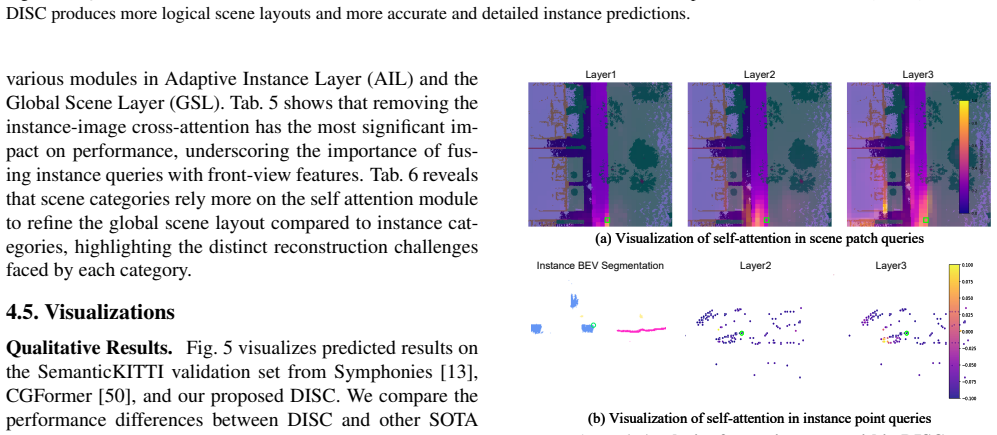
The load-bearing mechanism is the pair of query sets produced by the Discriminative Query Generator (DQG) and refined by the Dual-Attention Class Decoder (DACD). Instance queries are seeded by detecting candidate object locations in the image and projecting them into BEV space, so they keep geometric priors tied to small, sparse, long-tail objects; scene queries are seeded from upsampled BEV patches, so each query carries a local layout context. The decoder then routes these queries through different layers: the Adaptive Instance Layer samples several candidate heights per query and runs deformable cross-attention between the instance query, the image feature map, and the scene features, while the Global Scene Layer runs self-attention between patch queries and a randomly masked global image query set to simulate occlusion. The two refined feature maps are fused in 3D with separately predicted height distributions, which the paper argues resolves the vertical ambiguity that arises when instance and scene categories share the same BEV grid.
What would settle it
Train and test DISC with the instance/scene labels randomly permuted while keeping the architecture unchanged, and compare InsM, ScnM, and mIoU against the fixed taxonomy. If large gains over the unified baseline persist under arbitrary permutations, the claimed cause, intrinsic instance-versus-scene properties, is not what drives the results; if gains vanish under every permutation except the hand-chosen one, the taxonomy is doing the load-bearing work.
Extended reading notes
Core claim
The central claim is that a dual-stream, class-query design outperforms all unified voxel-query decoders for camera-based 3D semantic scene completion. The paper reports state-of-the-art results on two benchmarks, and its ablations attribute the gain to the architecture: adding the instance stream alone raises instance mean IoU by 3.73 points over the baseline, adding the scene stream alone raises scene mean IoU by 6.66 points, and combining them gives balanced gains plus the best overall IoU and mIoU. The paper defines instance mean IoU (InsM) and scene mean IoU (ScnM) over the two class groups to expose where gains come from. It further claims that instance categories benefit from image-guided height sampling that recovers occluded and misprojected objects, while scene categories benefit from global self-attention over masked image queries that keeps layout coherent.
Load-bearing premise
The whole design rests on the hand-defined split of the 19 classes into instance and scene groups; if that grouping does not match the actual failure modes, the separate query generation, the separate decoder layers, and the custom InsM and ScnM metrics lose their justification even if the overall mIoU stays high.
Editorial extensions
If this is right
- Single-frame camera pipelines can match or beat multi-frame temporal fusion on IoU, mIoU, and instance mIoU, making cheaper inference feasible without losing scene completion quality.
- Instance mIoU improves by 17.9% over the prior best method on SemanticKITTI, so long-tail object classes such as traffic signs and motorcycles are where the class-query design pays off most.
- Scene coherence becomes a separately optimizable objective: global patch self-attention produces more complete roads and avoids road-terrain intersections, which is directly relevant to downstream planning.
- Reporting InsM and ScnM alongside mIoU will be needed for meaningful comparisons of future methods, because the overall mIoU hides the two distinct failure modes.
Reading between the lines
- An editor-level extension is to learn the instance/scene split from per-class error statistics instead of fixing it by hand; if an automatically chosen grouping gives the same gains, the mechanism is disentanglement itself rather than the particular taxonomy.
- The height decoupling in the fusion step suggests the same dual-stream idea could transfer to 3D occupancy prediction, where pedestrian/road height conflicts in shared BEV cells are a known failure mode.
- A head-to-head test with temporal inputs added to DISC would show whether single-frame class reasoning and temporal fusion compound or are substitutes; the paper only claims to beat multi-frame methods with single frames, not to combine them.
- The custom metrics depend on the class split, so future benchmarks would need to standardize the taxonomy before InsM and ScnM numbers from different papers can be compared directly.
Editorial analysis
A structured set of objections, weighed in public.
Referee Report
Summary. The paper proposes DISC, a dual-stream architecture for 3D semantic scene completion that replaces voxel queries with separate instance and scene class queries. The method initializes queries with geometric and semantic priors (Discriminative Query Generator) and decodes them through two specialized modules (Adaptive Instance Layer and Global Scene Layer), then fuses the two streams in 3D space. On SemanticKITTI and SSCBench-KITTI-360, the authors report state-of-the-art IoU and mIoU (17.35 and 20.55, respectively), and they claim that single-frame DISC surpasses multi-frame methods on mIoU, IoU, and instance mIoU. The central narrative is that explicitly disentangling instance and scene categories is what drives these gains.
Significance. If the results are correct, the paper makes a useful contribution: it demonstrates that class-aware BEV query designs can outperform voxel-based baselines and even multi-frame methods from a single input, while being memory-efficient. The architecture is clearly described, the code is released, and the ablation tables cover the major components. The significance is qualified, however, by the fact that the headline instance gains are measured on a custom instance/scene class split whose definition and sensitivity are not presented in the main text, and by the absence of repeated-seed statistics. The contribution is therefore promising but not yet fully established.
major comments (3)
- [Section 4.2 and Section 4.1] The InsM and ScnM metrics and the instance/scene class taxonomy are load-bearing for the paper's main claim, but the exact class split is not defined in the main text: Section 4.2 gives only 'generally, categories such as car, bicycle, and traffic sign are classified as instances' and defers 'detailed category definitions' to the supplementary. As submitted, the version I reviewed contains no supplementary document, so the headline InsM/ScnM numbers are not reproducible from the manuscript alone. Moreover, no sensitivity analysis is provided: if classes such as fence, pole, or other-vehicle were moved between sets, the reported 17.9% instance-mIoU advantage could change materially. I request that the full split be stated in the main text or an included appendix, that a criterion for the split be given, and that an ablation varying the taxonomy (e.g., moving ambiguous classes between sets) be added to show that the instance-stream advantage is not an artifact of the chosen grouping.
- [Table 3 (Ablation study on architecture)] Table 3 shows that adding the Scene Stream to the Instance-Stream model reduces InsM from 9.79 to 8.75, while adding the Instance Stream to the Scene-Stream model reduces ScnM from 25.80 to 26.27? Actually the latter increases ScnM, but the InsM decrease is substantial. The text describes this as a 'balanced improvement,' but the drop in InsM indicates that the two streams interfere with each other rather than being cleanly disentangled. Since the central claim is that instance and scene contexts can be optimized separately without harmful coupling, this interference should be analyzed and explained; if the interaction is inherent, the 'disentangling' narrative needs to be qualified.
- [Tables 3-6 (Ablation studies)] The ablation tables do not state which dataset or split they use, nor do they report variance or multiple seeds. The main comparison in Table 1 is on the SemanticKITTI hidden test, so the ablations are presumably on a validation split, but this is not stated. Since the paper makes claims such as 'optimal comprehensive performance' and 'proves critical for scene reconstruction,' the reader needs to know whether these differences are stable. I ask that the dataset/split be explicitly identified in every table caption and that at least one repeated-seed or standard-deviation experiment be reported for the key comparisons.
minor comments (5)
- [Figure 3 caption] The caption refers to 'Discriminative Query Generator (DQI)' while the body and Section 3.2 use 'DQG'; please make the abbreviation consistent.
- [Equation (1)] The set-builder notation in Eq. (1) is malformed: the expression 'Top-N{Max(B_i_{k×k})}_{s}^{i=1}' is missing an index and a formal definition of the Top-N selection over the candidate set; please rewrite it cleanly.
- [Equation (8)] The text says 'N denotes broadcasted element-wise multiplication,' but the symbol shown is likely intended to be ⊙; please correct the notation.
- [References] References [38] and [39] appear to be the same paper (HASSC: 'Not all voxels are equal: Hardness-aware semantic scene completion with self-distillation'); this duplicate should be removed or one of them renumbered.
- [Tables 1-2] The dataset name is written inconsistently as 'SSCBench-KITTI360' in Table 2 and 'SSCBench-KITTI-360' elsewhere; please unify the spelling.
Circularity Check
No significant circularity: the paper's claims are empirical benchmark results; the custom InsM/ScnM metrics are definitionally aligned with the design but do not force the reported improvements.
full rationale
The paper contains no derivation chain that reduces to its inputs. The central claims are empirical: DISC achieves state-of-the-art mIoU of 17.35 on SemanticKITTI and 20.55 on SSCBench-KITTI-360, using the standard metric, and it outperforms multi-frame methods on IoU and mIoU. These results are not implied by any definition or fitted parameter. The only definitional coupling is the hand-chosen instance/scene taxonomy used both to motivate the dual-stream design and to define the custom InsM and ScnM metrics. However, the reported InsM and ScnM improvements are measured model outputs, not consequences of the class-split definition; a different split could change the metric values, but that is a robustness and justification concern, not circularity. The paper does not fit a parameter to a subset and then predict a closely related quantity, nor does it rely on a load-bearing self-citation or an imported uniqueness theorem. Author self-citations appear only in related-work contexts and are not used to justify the method's central premise. The ablations, while aligned with the design goals, provide empirical evidence rather than tautological support. Overall, the derivation chain is self-contained with respect to the benchmarks, and no significant circularity is present.
Assumptions & free parameters
free parameters (5)
- Loss weights λ1, λ2, λh, λd =
1, 1, 5, 0.01
- Scene query patch size =
4
- Neighbor suppression block size k
- Number of candidate heights N and Top-N selection in Adaptive Instance Layer
- Instance and scene query counts N_ins, N_scn
assumptions (4)
- domain assumption SemanticKITTI's 19 classes can be cleanly divided into instance and scene groups for the dual-stream design.
- domain assumption Depth estimates from pretrained MobileStereoNet are accurate enough to supervise depth prediction and localize projected points.
- domain assumption Pretrained MaskDINO weights provide class-level semantic priors that transfer to semantic scene completion.
- standard math Lift-Splat-Shoot and deformable attention behave as standard literature components.
Cite this review
Pith. "Pith review of Disentangling Instance and Scene Contexts for 3D Semantic Scene Completion." pith.science (2026). https://pith.science/paper/CO4FKULS
@misc{pith2026250708555,
  author       = {Pith},
  title        = {Pith review of: Disentangling Instance and Scene Contexts for 3D Semantic Scene Completion},
  year         = {2026},
  howpublished = {\url{https://pith.science/paper/CO4FKULS}},
  note         = {Machine review of arXiv:2507.08555}
}
read the original abstract
3D Semantic Scene Completion (SSC) has gained increasing attention due to its pivotal role in 3D perception. Recent advancements have primarily focused on refining voxel-level features to construct 3D scenes. However, treating voxels as the basic interaction units inherently limits the utilization of class-level information, which is proven critical for enhancing the granularity of completion results. To address this, we propose \textbf{D}isentangling Instance and Scene Contexts (DISC), a novel dual-stream paradigm that enhances learning for both instance and scene categories through separated optimization. Specifically, we replace voxel queries with discriminative class queries, which incorporate class-specific geometric and semantic priors. Additionally, we exploit the intrinsic properties of classes to design specialized decoding modules, facilitating targeted interactions and efficient class-level information flow. Experimental results demonstrate that DISC achieves state-of-the-art (SOTA) performance on both SemanticKITTI and SSCBench-KITTI-360 benchmarks, with mIoU scores of 17.35 and 20.55, respectively. Remarkably, DISC even outperforms multi-frame SOTA methods using only single-frame input and significantly improves instance category performance, surpassing both single-frame and multi-frame SOTA instance mIoU by 17.9\% and 11.9\%, respectively, on the SemanticKITTI hidden test. The code is available at https://github.com/Enyu-Liu/DISC.
Figures


Figures from the paper (3 more)


Reference graph
Works this paper leans on
-
[1]
Se- mantickitti: A dataset for semantic scene understanding of lidar sequences
Jens Behley, Martin Garbade, Andres Milioto, Jan Quen- zel, Sven Behnke, Cyrill Stachniss, and Jurgen Gall. Se- mantickitti: A dataset for semantic scene understanding of lidar sequences. InProceedings of the IEEE/CVF inter- national conference on computer vision, pages 9297–9307, 2019
work page 2019
-
[2]
Monoscene: Monoc- ular 3d semantic scene completion
Anh-Quan Cao and Raoul De Charette. Monoscene: Monoc- ular 3d semantic scene completion. InProceedings of the IEEE/CVF Conference on Computer Vision and Pattern Recognition, pages 3991–4001, 2022
work page 2022
-
[3]
Persformer: 3d lane detection via perspec- tive transformer and the openlane benchmark
Li Chen, Chonghao Sima, Yang Li, Zehan Zheng, Jiajie Xu, Xiangwei Geng, Hongyang Li, Conghui He, Jianping Shi, Yu Qiao, et al. Persformer: 3d lane detection via perspec- tive transformer and the openlane benchmark. InEuropean Conference on Computer Vision, pages 550–567. Springer, 2022
work page 2022
-
[4]
Delving into the trajectory long-tail distribution for muti-object track- ing
Sijia Chen, En Yu, Jinyang Li, and Wenbing Tao. Delving into the trajectory long-tail distribution for muti-object track- ing. InProceedings of the IEEE/CVF Conference on Com- puter Vision and Pattern Recognition, pages 19341–19351, 2024
work page 2024
-
[5]
Cross-view referring multi-object tracking
Sijia Chen, En Yu, and Wenbing Tao. Cross-view referring multi-object tracking. InProceedings of the AAAI Confer- ence on Artificial Intelligence, pages 2204–2211, 2025
2025
-
[6]
S3cnet: A sparse semantic scene completion net- work for lidar point clouds
Ran Cheng, Christopher Agia, Yuan Ren, Xinhai Li, and Liu Bingbing. S3cnet: A sparse semantic scene completion net- work for lidar point clouds. InConference on Robot Learn- ing, pages 2148–2161. PMLR, 2021
work page 2021
-
[7]
Gitnet: Geometric prior- based transformation for birds-eye-view segmentation
Shi Gong, Xiaoqing Ye, Xiao Tan, Jingdong Wang, Errui Ding, Yu Zhou, and Xiang Bai. Gitnet: Geometric prior- based transformation for birds-eye-view segmentation. In European Conference on Computer Vision, pages 396–411. Springer, 2022
work page 2022
-
[8]
Adam W Harley, Zhaoyuan Fang, Jie Li, Rares Ambrus, and Katerina Fragkiadaki. Simple-bev: What really mat- ters for multi-sensor bev perception? In2023 IEEE Inter- national Conference on Robotics and Automation (ICRA), pages 2759–2765. IEEE, 2023
work page 2023
Show all 52 references
-
[9]
Deep residual learning for image recognition
Kaiming He, Xiangyu Zhang, Shaoqing Ren, and Jian Sun. Deep residual learning for image recognition. InProceed- ings of the IEEE conference on computer vision and pattern recognition, pages 770–778, 2016
2016
-
[10]
Fas- tocc: Accelerating 3d occupancy prediction by fusing the 2d bird’s-eye view and perspective view.arXiv preprint arXiv:2403.02710, 2024
Jiawei Hou, Xiaoyan Li, Wenhao Guan, Gang Zhang, Di Feng, Yuheng Du, Xiangyang Xue, and Jian Pu. Fas- tocc: Accelerating 3d occupancy prediction by fusing the 2d bird’s-eye view and perspective view.arXiv preprint arXiv:2403.02710, 2024
2024 arXiv
-
[11]
Planning-oriented autonomous driving
Yihan Hu, Jiazhi Yang, Li Chen, Keyu Li, Chonghao Sima, Xizhou Zhu, Siqi Chai, Senyao Du, Tianwei Lin, Wenhai Wang, et al. Planning-oriented autonomous driving. InPro- ceedings of the IEEE/CVF conference on computer vision and pattern recognition, pages 17853–17862, 2023
2023
-
[12]
Tri-perspective view for vision- based 3d semantic occupancy prediction
Yuanhui Huang, Wenzhao Zheng, Yunpeng Zhang, Jie Zhou, and Jiwen Lu. Tri-perspective view for vision- based 3d semantic occupancy prediction. InProceedings of the IEEE/CVF conference on computer vision and pattern recognition, pages 9223–9232, 2023
2023
-
[13]
Sym- phonize 3d semantic scene completion with contextual in- stance queries
Haoyi Jiang, Tianheng Cheng, Naiyu Gao, Haoyang Zhang, Tianwei Lin, Wenyu Liu, and Xinggang Wang. Sym- phonize 3d semantic scene completion with contextual in- stance queries. InProceedings of the IEEE/CVF Conference on Computer Vision and Pattern Recognition, pages 20258– 20267, 2024
2024
-
[14]
Polarformer: Multi- camera 3d object detection with polar transformer
Yanqin Jiang, Li Zhang, Zhenwei Miao, Xiatian Zhu, Jin Gao, Weiming Hu, and Yu-Gang Jiang. Polarformer: Multi- camera 3d object detection with polar transformer. InPro- ceedings of the AAAI conference on Artificial Intelligence, pages 1042–1050, 2023
2023
-
[15]
Tod3cap: Towards 3d dense captioning in outdoor scenes
Bu Jin, Yupeng Zheng, Pengfei Li, Weize Li, Yuhang Zheng, Sujie Hu, Xinyu Liu, Jinwei Zhu, Zhijie Yan, Haiyang Sun, et al. Tod3cap: Towards 3d dense captioning in outdoor scenes. InEuropean Conference on Computer Vision, pages 367–384. Springer, 2024
2024
-
[16]
Vpocc: Exploiting vanishing point for monoc- ular 3d semantic occupancy prediction.arXiv preprint arXiv:2408.03551, 2024
Junsu Kim, Junhee Lee, Ukcheol Shin, Jean Oh, and Kyung- don Joo. Vpocc: Exploiting vanishing point for monoc- ular 3d semantic occupancy prediction.arXiv preprint arXiv:2408.03551, 2024
2024 arXiv
-
[17]
Stereoscene: Bev-assisted stereo match- ing empowers 3d semantic scene completion.arXiv preprint arXiv:2303.13959, 1(3):6, 2023
Bohan Li, Yasheng Sun, Xin Jin, Wenjun Zeng, Zheng Zhu, Xiaoefeng Wang, Yunpeng Zhang, James Okae, Hang Xiao, and Dalong Du. Stereoscene: Bev-assisted stereo match- ing empowers 3d semantic scene completion.arXiv preprint arXiv:2303.13959, 1(3):6, 2023
2023 arXiv
-
[18]
Hierarchical temporal context learning for camera-based semantic scene comple- tion
Bohan Li, Jiajun Deng, Wenyao Zhang, Zhujin Liang, Da- long Du, Xin Jin, and Wenjun Zeng. Hierarchical temporal context learning for camera-based semantic scene comple- tion. InEuropean Conference on Computer Vision, pages 131–148. Springer, 2025
2025
-
[19]
Mask dino: Towards a unified transformer-based framework for object detection and segmentation
Feng Li, Hao Zhang, Huaizhe Xu, Shilong Liu, Lei Zhang, Lionel M Ni, and Heung-Yeung Shum. Mask dino: Towards a unified transformer-based framework for object detection and segmentation. InProceedings of the IEEE/CVF Con- ference on Computer Vision and Pattern Recognition, pag...
2023
-
[20]
Delving into the devils of bird’s- eye-view perception: A review, evaluation and recipe.IEEE Transactions on Pattern Analysis and Machine Intelligence, 2023
Hongyang Li, Chonghao Sima, Jifeng Dai, Wenhai Wang, Lewei Lu, Huijie Wang, Jia Zeng, Zhiqi Li, Jiazhi Yang, Hanming Deng, et al. Delving into the devils of bird’s- eye-view perception: A review, evaluation and recipe.IEEE Transactions on Pattern Analysis and Machine Intellige...
2023
-
[21]
Ovtr: End-to-end open-vocabulary multiple object tracking with transformer
Jinyang Li, En Yu, Sijia Chen, and Wenbing Tao. Ovtr: End-to-end open-vocabulary multiple object tracking with transformer. InThe Thirteenth International Conference on Learning Representations
-
[22]
Bevstereo: Enhancing depth estimation in multi-view 3d object detection with temporal stereo
Yinhao Li, Han Bao, Zheng Ge, Jinrong Yang, Jianjian Sun, and Zeming Li. Bevstereo: Enhancing depth estimation in multi-view 3d object detection with temporal stereo. InPro- ceedings of the AAAI Conference on Artificial Intelligence, pages 1486–1494, 2023
2023
-
[23]
Bevdepth: Acquisition of reliable depth for multi-view 3d object detec- tion
Yinhao Li, Zheng Ge, Guanyi Yu, Jinrong Yang, Zengran Wang, Yukang Shi, Jianjian Sun, and Zeming Li. Bevdepth: Acquisition of reliable depth for multi-view 3d object detec- tion. InProceedings of the AAAI Conference on Artificial Intelligence, pages 1477–1485, 2023
2023
-
[24]
Sscbench: A large-scale 3d semantic scene com- pletion benchmark for autonomous driving.arXiv preprint arXiv:2306.09001, 2023
Yiming Li, Sihang Li, Xinhao Liu, Moonjun Gong, Kenan Li, Nuo Chen, Zijun Wang, Zhiheng Li, Tao Jiang, Fisher Yu, et al. Sscbench: A large-scale 3d semantic scene com- pletion benchmark for autonomous driving.arXiv preprint arXiv:2306.09001, 2023
2023 arXiv
-
[25]
V oxformer: Sparse voxel transformer for camera- based 3d semantic scene completion
Yiming Li, Zhiding Yu, Christopher Choy, Chaowei Xiao, Jose M Alvarez, Sanja Fidler, Chen Feng, and Anima Anand- kumar. V oxformer: Sparse voxel transformer for camera- based 3d semantic scene completion. InProceedings of the IEEE/CVF conference on computer vision and pattern ...
2023
-
[26]
Bevformer: Learning bird’s-eye-view representation from multi-camera images via spatiotemporal transformers
Zhiqi Li, Wenhai Wang, Hongyang Li, Enze Xie, Chong- hao Sima, Tong Lu, Yu Qiao, and Jifeng Dai. Bevformer: Learning bird’s-eye-view representation from multi-camera images via spatiotemporal transformers. InEuropean con- ference on computer vision, pages 1–18. Springer, 2022
2022
-
[27]
Decoupled weight decay regularization.arXiv preprint arXiv:1711.05101, 2017
I Loshchilov. Decoupled weight decay regularization.arXiv preprint arXiv:1711.05101, 2017
2017 arXiv
-
[28]
Occdepth: A depth-aware method for 3d semantic scene completion
Ruihang Miao, Weizhou Liu, Mingrui Chen, Zheng Gong, Weixin Xu, Chen Hu, and Shuchang Zhou. Occdepth: A depth-aware method for 3d semantic scene completion. arXiv preprint arXiv:2302.13540, 2023
2023 arXiv
-
[29]
Lift, splat, shoot: Encoding images from arbitrary camera rigs by implicitly unproject- ing to 3d
Jonah Philion and Sanja Fidler. Lift, splat, shoot: Encoding images from arbitrary camera rigs by implicitly unproject- ing to 3d. InComputer Vision–ECCV 2020: 16th European Conference, Glasgow, UK, August 23–28, 2020, Proceed- ings, Part XIV 16, pages 194–210. Springer, 2020
2020
-
[30]
Categorical depth distribution network for monocular 3d object detection
Cody Reading, Ali Harakeh, Julia Chae, and Steven L Waslander. Categorical depth distribution network for monocular 3d object detection. InProceedings of the IEEE/CVF Conference on Computer Vision and Pattern Recognition, pages 8555–8564, 2021
2021
-
[31]
Lmscnet: Lightweight multiscale 3d semantic completion
Luis Roldao, Raoul de Charette, and Anne Verroust-Blondet. Lmscnet: Lightweight multiscale 3d semantic completion. In2020 International Conference on 3D Vision (3DV), pages 111–119. IEEE, 2020
2020
-
[32]
U- net: Convolutional networks for biomedical image segmen- tation
Olaf Ronneberger, Philipp Fischer, and Thomas Brox. U- net: Convolutional networks for biomedical image segmen- tation. InMedical image computing and computer-assisted intervention–MICCAI 2015: 18th international conference, Munich, Germany, October 5-9, 2015, proceedings, par...
2015
-
[33]
Focal loss for dense ob- ject detection
T-YLPG Ross and GKHP Doll ´ar. Focal loss for dense ob- ject detection. Inproceedings of the IEEE conference on computer vision and pattern recognition, pages 2980–2988, 2017
2017
-
[34]
Translating images into maps
Avishkar Saha, Oscar Mendez, Chris Russell, and Richard Bowden. Translating images into maps. In2022 Interna- tional conference on robotics and automation (ICRA), pages 9200–9206. IEEE, 2022
2022
-
[35]
Mobilestereonet: Towards lightweight deep net- works for stereo matching
Faranak Shamsafar, Samuel Woerz, Rafia Rahim, and An- dreas Zell. Mobilestereonet: Towards lightweight deep net- works for stereo matching. InProceedings of the ieee/cvf winter conference on applications of computer vision, pages 2417–2426, 2022
2022
-
[36]
Semantic scene com- pletion from a single depth image
Shuran Song, Fisher Yu, Andy Zeng, Angel X Chang, Mano- lis Savva, and Thomas Funkhouser. Semantic scene com- pletion from a single depth image. InProceedings of the IEEE conference on computer vision and pattern recogni- tion, pages 1746–1754, 2017
2017
-
[37]
Occ3d: A large-scale 3d occupancy prediction benchmark for autonomous driving.Advances in Neural Information Processing Systems, 36:64318–64330, 2023
Xiaoyu Tian, Tao Jiang, Longfei Yun, Yucheng Mao, Huitong Yang, Yue Wang, Yilun Wang, and Hang Zhao. Occ3d: A large-scale 3d occupancy prediction benchmark for autonomous driving.Advances in Neural Information Processing Systems, 36:64318–64330, 2023
2023
-
[39]
Not all voxels are equal: Hardness-aware semantic scene completion with self- distillation
Song Wang, Jiawei Yu, Wentong Li, Wenyu Liu, Xiaolu Liu, Junbo Chen, and Jianke Zhu. Not all voxels are equal: Hardness-aware semantic scene completion with self- distillation. InProceedings of the IEEE/CVF Conference on Computer Vision and Pattern Recognition, pages 14792– 14...
2024
-
[40]
Bevspread: Spread voxel pooling for bird’s-eye- view representation in vision-based roadside 3d object detec- tion
Wenjie Wang, Yehao Lu, Guangcong Zheng, Shuigen Zhan, Xiaoqing Ye, Zichang Tan, Jingdong Wang, Gaoang Wang, and Xi Li. Bevspread: Spread voxel pooling for bird’s-eye- view representation in vision-based roadside 3d object detec- tion. InProceedings of the IEEE/CVF Conference o...
2024
-
[41]
H2gformer: Horizontal-to-global voxel transformer for 3d semantic scene completion
Yu Wang and Chao Tong. H2gformer: Horizontal-to-global voxel transformer for 3d semantic scene completion. InPro- ceedings of the AAAI Conference on Artificial Intelligence, pages 5722–5730, 2024
2024
-
[42]
Surroundocc: Multi-camera 3d occu- pancy prediction for autonomous driving
Yi Wei, Linqing Zhao, Wenzhao Zheng, Zheng Zhu, Jie Zhou, and Jiwen Lu. Surroundocc: Multi-camera 3d occu- pancy prediction for autonomous driving. InProceedings of the IEEE/CVF International Conference on Computer Vi- sion, pages 21729–21740, 2023
2023
-
[43]
Instance-aware monocular 3d semantic scene comple- tion.IEEE Transactions on Intelligent Transportation Sys- tems, 2024
Haihong Xiao, Hongbin Xu, Wenxiong Kang, and Yuqiong Li. Instance-aware monocular 3d semantic scene comple- tion.IEEE Transactions on Intelligent Transportation Sys- tems, 2024
2024
-
[44]
Cobevt: Cooperative bird’s eye view semantic segmentation with sparse transformers.arXiv preprint arXiv:2207.02202, 2022
Runsheng Xu, Zhengzhong Tu, Hao Xiang, Wei Shao, Bolei Zhou, and Jiaqi Ma. Cobevt: Cooperative bird’s eye view semantic segmentation with sparse transformers.arXiv preprint arXiv:2207.02202, 2022. 10
2022 arXiv
-
[45]
Sparse single sweep lidar point cloud segmentation via learning contextual shape priors from scene completion
Xu Yan, Jiantao Gao, Jie Li, Ruimao Zhang, Zhen Li, Rui Huang, and Shuguang Cui. Sparse single sweep lidar point cloud segmentation via learning contextual shape priors from scene completion. InProceedings of the AAAI Conference on Artificial Intelligence, pages 3101–3109, 2021
2021
-
[46]
Depthssc: Depth- spatial alignment and dynamic voxel resolution for monoc- ular 3d semantic scene completion.arXiv preprint arXiv:2311.17084, 2023
Jiawei Yao and Jusheng Zhang. Depthssc: Depth- spatial alignment and dynamic voxel resolution for monoc- ular 3d semantic scene completion.arXiv preprint arXiv:2311.17084, 2023
2023 arXiv
-
[47]
Motrv3: Release-fetch super- vision for end-to-end multi-object tracking.arXiv preprint arXiv:2305.14298, 2023
En Yu, Tiancai Wang, Zhuoling Li, Yuang Zhang, Xiangyu Zhang, and Wenbing Tao. Motrv3: Release-fetch super- vision for end-to-end multi-object tracking.arXiv preprint arXiv:2305.14298, 2023
2023 arXiv
-
[48]
Merlin: Empowering multimodal llms with foresight minds
En Yu, Liang Zhao, Yana Wei, Jinrong Yang, Dongming Wu, Lingyu Kong, Haoran Wei, Tiancai Wang, Zheng Ge, Xi- angyu Zhang, et al. Merlin: Empowering multimodal llms with foresight minds. InEuropean Conference on Computer Vision, pages 425–443. Springer, 2024
2024
-
[49]
Flashocc: Fast and memory-efficient occupancy prediction via channel-to-height plugin.arXiv preprint arXiv:2311.12058, 2023
Zichen Yu, Changyong Shu, Jiajun Deng, Kangjie Lu, Zong- dai Liu, Jiangyong Yu, Dawei Yang, Hui Li, and Yan Chen. Flashocc: Fast and memory-efficient occupancy prediction via channel-to-height plugin.arXiv preprint arXiv:2311.12058, 2023
2023 arXiv
-
[50]
Context and geometry aware voxel transformer for semantic scene completion
Zhu Yu, Runmin Zhang, Jiacheng Ying, Junchen Yu, Xiaohai Hu, Lun Luo, Si-Yuan Cao, and Hui-liang Shen. Context and geometry aware voxel transformer for semantic scene completion. InAdvances in Neural Information Processing Systems, pages 1531–1555, 2024
2024
-
[51]
Sa-bev: Generating semantic-aware bird’s-eye-view feature for multi-view 3d object detection
Jinqing Zhang, Yanan Zhang, Qingjie Liu, and Yunhong Wang. Sa-bev: Generating semantic-aware bird’s-eye-view feature for multi-view 3d object detection. InProceedings of the IEEE/CVF International Conference on Computer Vi- sion, pages 3348–3357, 2023
2023
-
[52]
Occformer: Dual-path transformer for vision-based 3d semantic occu- pancy prediction
Yunpeng Zhang, Zheng Zhu, and Dalong Du. Occformer: Dual-path transformer for vision-based 3d semantic occu- pancy prediction. InProceedings of the IEEE/CVF Inter- national Conference on Computer Vision, pages 9433–9443, 2023
2023
-
[53]
Monoocc: Digging into monocular semantic occu- pancy prediction
Yupeng Zheng, Xiang Li, Pengfei Li, Yuhang Zheng, Bu Jin, Chengliang Zhong, Xiaoxiao Long, Hao Zhao, and Qichao Zhang. Monoocc: Digging into monocular semantic occu- pancy prediction. In2024 IEEE International Conference on Robotics and Automation (ICRA), pages 18398–18405. IE...
2024
Reviewed August 6, 2026 · model on record in the stance chip above.
Discussion (0). Sign in to comment.