REVIEW 4 major objections 4 minor 64 references
DispBench: Benchmarking Disparity Estimation to Synthetic Corruptions
T0 review · 4 major / 4 minor · reviewed 2026-08-15 · deepseek-v4-flash
Pith's one-line read The paper claims that synthetic corruptions applied to synthetic datasets do not predict how disparity-estimation models behave under the same corruptions on real data, and that driving simulators therefore cannot stand in for real-world…
desk verdict Useful benchmark artifact, but the paper's central claim about synthetic-to-real proxies is built on a confounded comparison and doesn't survive scrutiny. read the letter →
The pith
A machine-rendered reading of the paper's core claim, the machinery that carries it, and where it could break.
The reading
What carries the argument
The load-bearing mechanism is DispBench, a benchmark harness wrapping four disparity-estimation architectures, two datasets (FlyingThings3D and KITTI2015), five white-box adversarial attacks (FGSM, BIM, PGD, APGD, and CosPGD), and fifteen 2D Common Corruptions at five severities, reported through mean End-Point Error. The decisive analytical move is the correlation comparison: for each architecture, robustness on corrupted synthetic data is plotted against robustness on corrupted real data at each severity, and the absence of correlation is what carries the no-proxy conclusion.
What would settle it
Train several stereo-matching architectures on the same synthetic data, evaluate them on corrupted synthetic data, then fine-tune the same architectures on real data and evaluate them on corrupted real data; if their robustness rankings correlate strongly across a larger pool of models, the no-proxy conclusion would be refuted.
Extended reading notes
Core claim
The paper's central discovery is that synthetic corruptions on synthetic datasets do not represent synthetic corruptions on real-world datasets, and by extension do not represent real-world corruptions. The evidence is a per-architecture comparison: for the same stereo-matching architecture, mean End-Point Error on corrupted FlyingThings3D is plotted against mean End-Point Error on corrupted KITTI2015 at several corruption severities, and no correlation appears. The authors conclude that performance on corrupted synthetic images cannot be used as a proxy for performance on corrupted real images, and therefore synthetic driving simulators cannot be used to validate disparity-estimation methods for real-world deployment. A second finding is that the newer transformer-based methods STTR and STTR-light are significantly more non-robust than older CNN-based methods under weather corruptions such as snow, frost, and fog on FlyingThings3D.
Load-bearing premise
The conclusion that synthetic corruptions do not predict real-world corruptions compares models trained on different datasets, so the synthetic and real results differ in both the corruption target and the training data; the lack of correlation could therefore reflect training-domain differences rather than a synthetic-versus-real corruption gap.
Editorial extensions
If this is right
- If the no-proxy claim is correct, robustness results reported only on corrupted synthetic datasets should not be read as evidence of real-world reliability.
- Synthetic driving simulators cannot substitute for corrupted real-world data when validating disparity-estimation models for safety-critical uses.
- Newer transformer-based disparity-estimation methods need explicit attention to weather-corruption robustness before deployment.
- Benchmarking effort should shift toward collecting or generating corrupted real-world stereo pairs with ground truth, since synthetic corruption alone cannot certify generalization.
Reading between the lines
- A natural extension is that the no-proxy result would likely also apply to other geometric vision tasks such as optical flow, since the mechanism is about the gap between synthetic and real image distributions rather than about stereo matching specifically.
- A stronger test of the paper's claim would compute rank correlations across a larger pool of models, training seeds, and checkpoints; the current comparison has only two or four architectures per severity, so the observed lack of correlation may partly reflect training-distribution differences.
- If the synthetic-to-real corruption gap is the real driver, then domain-randomized simulators that add realistic sensor noise and weather effects could partially restore predictivity, offering a testable path to cheaper real-world validation.
Signed reviews
Editorial analysis
A structured set of objections, weighed in public.
Referee Report
Summary. The paper introduces DispBench, an open-source benchmarking tool for evaluating stereo disparity estimation methods under synthetic 2D common corruptions and white-box adversarial attacks. The authors benchmark four architectures (CFNet, GWCNet-G, STTR, STTR-light) on FlyingThings3D and, where checkpoints exist, on KITTI2015, reporting mean end-point error under fifteen common corruptions at five severity levels. The main empirical findings are that transformer-based methods are less robust than CNN-based methods to weather corruptions on FlyingThings3D, and that the relative robustness ordering is not preserved on KITTI2015. Based on a scatter-plot correlation between FlyingThings3D and KITTI2015 evaluations, Section 5 concludes that synthetic corruptions on synthetic datasets do not represent real-world corruptions, and the conclusion then infers that synthetic simulators such as CARLA, LGSVL, and AirSim are unsuitable for real-world applications.
Significance. The paper's strongest contribution is a reproducible evaluation harness with released code and logs, enabling standardized robustness testing for disparity estimation; the measurements themselves appear carefully computed with standard metrics. If the proxy-failure claim were established, it would have substantial implications for the use of synthetic simulators and synthetic corruptions in stereo robustness research. However, the central claim rests on a comparison that confounds training distribution with corruption target domain and on a two-point correlation per severity level, so the evidence as presented does not support the headline conclusion. The finding that transformer-based STTR variants degrade more than older CNN methods under weather corruptions on FlyingThings3D is interesting and better supported, though it too would benefit from additional architectures and repeated seeds.
major comments (4)
- [Section 5, Figure 6] The claim that synthetic corruptions on synthetic datasets do not represent synthetic corruptions on real-world datasets is based on correlating EPE on corrupted FlyingThings3D obtained with FlyingThings3D-pretrained checkpoints against EPE on corrupted KITTI2015 obtained with KITTI2015-pretrained checkpoints. This varies two factors at once (the corruption target domain and the training distribution), so the observed lack of correlation cannot be uniquely attributed to the synthetic-versus-real nature of the corruption; the effect may instead reflect the different training domains. A controlled comparison, such as evaluating the same checkpoint on both datasets or training identical architectures on both datasets, is needed.
- [Section 4.2, Figure 6, Figure 9] Because only GWCNet-G and STTR have public KITTI2015 checkpoints, each severity panel in Figure 6 contains only two points, and each per-corruption panel in Figure 9 contains only two points as well. With two points, a Pearson correlation coefficient is necessarily either +1 or -1, so the figures cannot support the conclusion that there is 'no correlation in performance.' Reporting a correlation statistic over the full set of corruptions, or benchmarking additional architectures with KITTI2015 checkpoints, would be required to support the proxy-failure claim.
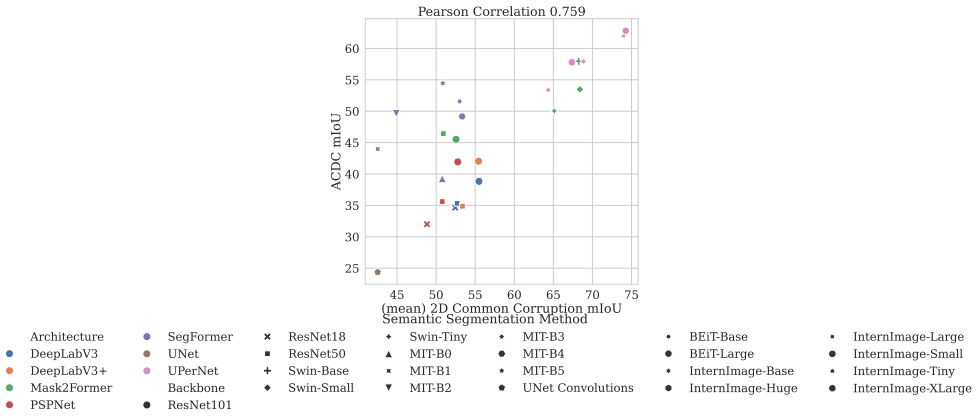
- [Appendix A, Section 5] The transitivity argument that 'synthetic corruptions on real-world datasets represent real-world corruptions' is imported from Agnihotri et al. [7], which demonstrates a correlation between Cityscapes Common Corruptions and ACDC for semantic segmentation. No evidence is provided that this proxy relation transfers to disparity estimation; the cited work is by the same authors and concerns a different task. Since this assumption is load-bearing for the central claim, the conclusion in Section 5 is not established by the experiments in this manuscript.
- [Section 6, Conclusion] The conclusion that the findings 'eliminate the possibility of using synthetic simulators like CARLA, LGSVL, AirSim' overreaches the evidence: the experiments only compare 2D corruptions applied to FlyingThings3D and KITTI2015 images, not the use of simulators for generating training data or novel scenes. Even if the proxy-failure claim were supported, the conclusion should be limited to the use of 2D Common Corruptions on synthetic datasets as proxies for real-world corruptions.
minor comments (4)
- [Appendix B] Appendix B says 'we focus on generating 3D Common Corruptions for now,' but no 3D corruption results appear anywhere in the paper, and the abstract and contributions only mention 2D Common Corruptions; this inconsistency should be resolved.
- [Appendix C and Section 2.4] Appendix C lists MPI Sintel as a supported dataset, while Section 2.4 and the contribution list state that two datasets are supported; these counts should be harmonized.
- [Throughout] There are typos in the article and figures, including 'Lipshitz' for 'Lipschitz,' 'Syntheticc Corrruptions' in Figure 1, 'GWCNet-C' in the Figure 5 caption, and 'dispcbench' in the code example in Section 2.2; these should be corrected.
- [Section 2.3] The code example in Section 2.3 for 2D Common Corruptions appears to be a copy of the adversarial-attack example with a different configuration; it should be checked so that the shown call matches the intended threat model.
Circularity Check
No circularity: DispBench reports new benchmark measurements, and the proxy-failure conclusion, while confounded, is not constructed from its own inputs.
full rationale
DispBench is an empirical benchmark rather than a derivation: the reported i.i.d., corruption, and adversarial results are EPE measurements on publicly available checkpoints and datasets, with no fitted parameter relabeled as a prediction. The central Section 5 claim that synthetic corruptions on synthetic datasets do not represent synthetic corruptions on real-world datasets is an interpretation of the correlation plot in Figure 6, not a quantity defined in terms of itself. That comparison is indeed confounded because the FlyingThings3D measurement uses an FT3D-trained checkpoint while the KITTI2015 measurement uses a KITTI-trained checkpoint, and only two architectures are available, but this is an experimental-validity concern, not circularity. The transitivity step ('As known from [7], synthetic corruptions on real-world datasets represent real-world corruptions. By extension, ...') relies on a prior paper with overlapping authors, yet that prior result is externally falsifiable and presented with its own data in Appendix A; self-citation alone does not make the argument circular. Appendix A explicitly states that transferring the semantic-segmentation correlation to disparity estimation is 'a safe assumption,' so the assumption is disclosed rather than smuggled in. No definitional equivalence, fitted-input renaming, or ansatz-by-citation was found.
Assumptions & free parameters
assumptions (4)
- domain assumption 2D Common Corruptions applied to both images of a stereo pair are a valid proxy for real-world distribution shifts in disparity estimation.
- domain assumption White-box adversarial attacks such as PGD and CosPGD serve as a proxy for the worst-case reliability of a disparity method.
- ad hoc to paper Comparing an architecture trained on FlyingThings3D and evaluated on corrupted FlyingThings3D against the same architecture trained on KITTI2015 and evaluated on corrupted KITTI2015 detects whether synthetic-dataset corruption robustness predicts real-dataset corruption robustness.
- domain assumption KITTI2015's automated ground-truth labels and FlyingThings3D's synthetic ground truth are accurate enough to support EPE comparisons across methods.
Cite this review
Pith. "Pith review of DispBench: Benchmarking Disparity Estimation to Synthetic Corruptions." pith.science (2026). https://pith.science/paper/COWJKWEY
@misc{pith2026250505091,
  author       = {Pith},
  title        = {Pith review of: DispBench: Benchmarking Disparity Estimation to Synthetic Corruptions},
  year         = {2026},
  howpublished = {\url{https://pith.science/paper/COWJKWEY}},
  note         = {Machine review of arXiv:2505.05091}
}
read the original abstract
Deep learning (DL) has surpassed human performance on standard benchmarks, driving its widespread adoption in computer vision tasks. One such task is disparity estimation, estimating the disparity between matching pixels in stereo image pairs, which is crucial for safety-critical applications like medical surgeries and autonomous navigation. However, DL-based disparity estimation methods are highly susceptible to distribution shifts and adversarial attacks, raising concerns about their reliability and generalization. Despite these concerns, a standardized benchmark for evaluating the robustness of disparity estimation methods remains absent, hindering progress in the field. To address this gap, we introduce DispBench, a comprehensive benchmarking tool for systematically assessing the reliability of disparity estimation methods. DispBench evaluates robustness against synthetic image corruptions such as adversarial attacks and out-of-distribution shifts caused by 2D Common Corruptions across multiple datasets and diverse corruption scenarios. We conduct the most extensive performance and robustness analysis of disparity estimation methods to date, uncovering key correlations between accuracy, reliability, and generalization. Open-source code for DispBench: https://github.com/shashankskagnihotri/benchmarking_robustness/tree/disparity_estimation/final/disparity_estimation
Figures


Figures from the paper (6 more)




Reference graph
Works this paper leans on
-
[7]
Shashank Agnihotri, David Schader, Nico Sharei, Mehmet Ege Kac ¸ar, and Margret Keuper. Are Synthetic Corruptions A Reliable Proxy For Real-World Corruptions? In CVPR Workshop On Synthetic Data for Computer Vision,
-
[1]
On the unreasonable vulnerability of transformers for image restoration-and an easy fix
Shashank Agnihotri, Kanchana Vaishnavi Gandikota, Julia Grabinski, Paramanand Chandramouli, and Margret Keuper. On the unreasonable vulnerability of transformers for image restoration-and an easy fix. In Proc. of the IEEE/CVF In- ternational Conference on Computer Vision (ICCV) , pages 3707–3717, 2023. 1
work page 2023
-
[2]
Improving stability during upsampling – on the importance of spatial context, 2023
Shashank Agnihotri, Julia Grabinski, and Margret Keuper. Improving stability during upsampling – on the importance of spatial context, 2023. 1
work page 2023
-
[3]
Beware of aliases–signal preservation is crucial for robust image restoration
Shashank Agnihotri, Julia Grabinski, Janis Keuper, and Margret Keuper. Beware of aliases–signal preservation is crucial for robust image restoration. arXiv preprint arXiv:2406.07435, 2024. 1
arXiv 2024
-
[4]
CosPGD: an efficient white-box adversarial attack for pixel- wise prediction tasks
Shashank Agnihotri, Steffen Jung, and Margret Keuper. CosPGD: an efficient white-box adversarial attack for pixel- wise prediction tasks. In Proc. International Conference on Machine Learning (ICML), 2024. 2, 5, 13, 14, 15
work page 2024
-
[5]
Roll the dice: Monte carlo downsampling as a low-cost adversarial defence, 2024
Shashank Agnihotri, Shashank Priyadarshi, Hendrik Som- merhoff, Julia Grabinski, Andreas Kolb, and Margret Keu- per. Roll the dice: Monte carlo downsampling as a low-cost adversarial defence, 2024. 1
work page 2024
-
[6]
Flowbench: A robustness benchmark for optical flow estimation, 2025
Shashank Agnihotri, Julian Yuya Caspary, Luca Schwarz, Xinyan Gao, Jenny Schmalfuss, Andres Bruhn, and Mar- gret Keuper. Flowbench: A robustness benchmark for optical flow estimation, 2025. 14
work page 2025
-
[8]
Frod: Robust object detection for free
Muhammad Awais, Weiming Zhuang, Lingjuan Lyu, and Sung-Ho Bae. Frod: Robust object detection for free. CoRR,
Show all 64 references
-
[9]
Butler, Jonas Wulff, Garrett B
Daniel J. Butler, Jonas Wulff, Garrett B. Stanley, and Michael J. Black. A naturalistic open source movie for opti- cal flow evaluation. In Proc. European Conference on Com- puter Vision (ECCV), pages 611–625, 2012. 13
2012
-
[10]
Deep learning-based incorporation of planar constraints for robust stereo depth estimation in au- tonomous vehicle applications
Weiqin Chuah, Ruwan Tennakoon, Reza Hoseinnezhad, and Alireza Bab-Hadiashar. Deep learning-based incorporation of planar constraints for robust stereo depth estimation in au- tonomous vehicle applications. IEEE Transactions on Intel- ligent Transportation Systems, 23(7):6654–6...
2021
-
[11]
The cityscapes dataset for semantic urban scene understanding, 2016
Marius Cordts, Mohamed Omran, Sebastian Ramos, Timo Rehfeld, Markus Enzweiler, Rodrigo Benenson, Uwe Franke, Stefan Roth, and Bernt Schiele. The cityscapes dataset for semantic urban scene understanding, 2016. 12, 13
2016
-
[12]
RobustBench: a standardized adversarial robustness benchmark
Francesco Croce, Maksym Andriushchenko, Vikash Se- hwag, Edoardo Debenedetti, Nicolas Flammarion, Mung Chiang, Prateek Mittal, and Matthias Hein. RobustBench: a standardized adversarial robustness benchmark. InAdvances in Neural Information Processing Systems (NeurIPS), 2021. 2, 4, 14
2021
-
[13]
Sp2 net for generalized zero-label seman- tic segmentation
Anurag Das, Yongqin Xian, Yang He, Bernt Schiele, and Zeynep Akata. Sp2 net for generalized zero-label seman- tic segmentation. In DAGM German Conference on Pattern Recognition, pages 235–249. Springer, 2021. 1
2021
-
[14]
Weakly-supervised domain adaptive semantic segmentation with prototypical contrastive learning
Anurag Das, Yongqin Xian, Dengxin Dai, and Bernt Schiele. Weakly-supervised domain adaptive semantic segmentation with prototypical contrastive learning. In Proceedings of the IEEE/CVF Conference on Computer Vision and Pattern Recognition, pages 15434–15443, 2023. 1
2023
-
[15]
Robust object detection in extreme construction conditions
Yuexiong Ding, Ming Zhang, Jia Pan, Jinxing Hu, and Xi- aowei Luo. Robust object detection in extreme construction conditions. Automation in Construction, 165:105487, 2024. 2
2024
-
[16]
Adversarially-aware robust object detector
Ziyi Dong, Pengxu Wei, and Liang Lin. Adversarially-aware robust object detector. InEuropean Conference on Computer Vision, pages 297–313. Springer, 2022. 2
2022
-
[17]
Flownet: Learning optical flow with convolutional networks
Alexey Dosovitskiy, Philipp Fischer, Eddy Ilg, Philip Hausser, Caner Hazirbas, Vladimir Golkov, Patrick Van Der Smagt, Daniel Cremers, and Thomas Brox. Flownet: Learning optical flow with convolutional networks. In Proc. of the IEEE international conference on computer vision ...
2015
-
[18]
CARLA: An open urban driving simulator
Alexey Dosovitskiy, German Ros, Felipe Codevilla, Antonio Lopez, and Vladlen Koltun. CARLA: An open urban driving simulator. In Proceedings of the 1st Annual Conference on Robot Learning, pages 1–16, 2017. 7
2017
-
[19]
How do training methods influence the utiliza- tion of vision models? arXiv preprint arXiv:2410.14470 ,
Paul Gavrikov, Shashank Agnihotri, Margret Keuper, and Ja- nis Keuper. How do training methods influence the utiliza- tion of vision models? arXiv preprint arXiv:2410.14470 ,
-
[20]
Imagenet-trained cnns are biased towards texture; increasing shape bias improves accuracy and robustness
Robert Geirhos, Patricia Rubisch, Claudio Michaelis, Matthias Bethge, Felix A Wichmann, and Wieland Brendel. Imagenet-trained cnns are biased towards texture; increasing shape bias improves accuracy and robustness. In Interna- tional Conference on Learning Representations, 2018. 1
2018
-
[21]
Wichmann
Robert Geirhos, J ¨orn-Henrik Jacobsen, Claudio Michaelis, Richard Zemel, Wieland Brendel, Matthias Bethge, and Fe- lix A. Wichmann. Shortcut learning in deep neural networks. Nature Machine Intelligence, 2(11):665–673, 2020. 1
2020
-
[22]
Explaining and harnessing adversarial examples
Ian Goodfellow, Jonathon Shlens, and Christian Szegedy. Explaining and harnessing adversarial examples. InProc. In- ternational Conference on Learning Representations (ICLR),
-
[23]
Robust models are less over-confident
Julia Grabinski, Paul Gavrikov, Janis Keuper, and Margret Keuper. Robust models are less over-confident. NeurIPS,
-
[24]
Frequencylowcut pooling-plug and play against catas- trophic overfitting
Julia Grabinski, Steffen Jung, Janis Keuper, and Margret Ke- uper. Frequencylowcut pooling-plug and play against catas- trophic overfitting. In European Conference on Computer Vision, pages 36–57. Springer, 2022. 1
2022
-
[25]
Alias- ing and adversarial robust generalization of cnns
Julia Grabinski, Janis Keuper, and Margret Keuper. Alias- ing and adversarial robust generalization of cnns. Machine Learning, pages 1–27, 2022. 1
2022
-
[26]
Group-wise correlation stereo network
Xiaoyang Guo, Kai Yang, Wukui Yang, Xiaogang Wang, and Hongsheng Li. Group-wise correlation stereo network. In Proceedings of the IEEE Conference on Computer Vision and Pattern Recognition, pages 3273–3282, 2019. 1, 5
2019
-
[27]
Openstereo: 9 A comprehensive benchmark for stereo matching and strong baseline
Xianda Guo, Chenming Zhang, Juntao Lu, Yiqi Wang, Yiqun Duan, Tian Yang, Zheng Zhu, and Long Chen. Openstereo: 9 A comprehensive benchmark for stereo matching and strong baseline. arXiv preprint arXiv:2312.00343, 2023. 2, 7
2023 arXiv
-
[28]
Lightstereo: Channel boost is all your need for efficient 2d cost aggregation
Xianda Guo, Chenming Zhang, Dujun Nie, Wenzhao Zheng, Youmin Zhang, and Long Chen. Lightstereo: Channel boost is all your need for efficient 2d cost aggregation. arXiv preprint arXiv:2406.19833, 2024. 7
2024 arXiv
-
[29]
Stereo anything: Unifying stereo matching with large- scale mixed data
Xianda Guo, Chenming Zhang, Youmin Zhang, Dujun Nie, Ruilin Wang, Wenzhao Zheng, Matteo Poggi, and Long Chen. Stereo anything: Unifying stereo matching with large- scale mixed data. arXiv preprint arXiv:2411.14053, 2024. 7, 13
2024
-
[30]
Robust object detection in challeng- ing weather conditions
Himanshu Gupta, Oleksandr Kotlyar, Henrik Andreasson, and Achim J Lilienthal. Robust object detection in challeng- ing weather conditions. In Proceedings of the IEEE/CVF Winter Conference on Applications of Computer Vision , pages 7523–7532, 2024. 2
2024
-
[31]
Benchmarking neu- ral network robustness to common corruptions and perturba- tions
Dan Hendrycks and Thomas Dietterich. Benchmarking neu- ral network robustness to common corruptions and perturba- tions. In Proc. International Conference on Learning Repre- sentations (ICLR), 2019. 1, 2, 12, 13, 14
2019
-
[32]
Cubuk, Barret Zoph, Justin Gilmer, and Balaji Lakshminarayanan
Dan Hendrycks, Norman Mu, Ekin D. Cubuk, Barret Zoph, Justin Gilmer, and Balaji Lakshminarayanan. AugMix: A simple data processing method to improve robustness and uncertainty. Proc. of the International Conference on Learn- ing Representations (ICLR), 2020. 1, 4
2020
-
[33]
Towards improving robustness of compressed cnns
J Hoffmann, S Agnihotri, Tonmoy Saikia, and Thomas Brox. Towards improving robustness of compressed cnns. InICML Workshop on Uncertainty and Robustness in Deep Learning (UDL), 2021. 1, 4
2021
-
[34]
3d common corruptions and data augmentation
O ˘guzhan Fatih Kar, Teresa Yeo, Andrei Atanov, and Amir Zamir. 3d common corruptions and data augmentation. In Proc. IEEE/CVF Conference on Computer Vision and Pat- tern Recognition (CVPR), pages 18963–18974, 2022. 13
2022
-
[35]
Goodfellow, and Samy Bengio
Alexey Kurakin, Ian J. Goodfellow, and Samy Bengio. Ad- versarial machine learning at scale. In Proc. International Conference on Learning Representations (ICLR) , 2017. 2, 13, 14
2017
-
[36]
Ad- versarial examples in the physical world
Alexey Kurakin, Ian J Goodfellow, and Samy Bengio. Ad- versarial examples in the physical world. In Artificial In- telligence Safety and Security, pages 99–112. Chapman and Hall/CRC, 2018. 2, 13, 14
2018
-
[37]
Intra-source style augmentation for improved domain gener- alization
Yumeng Li, Dan Zhang, Margret Keuper, and Anna Khoreva. Intra-source style augmentation for improved domain gener- alization. In Proceedings of the IEEE/CVF Winter Confer- ence on Applications of Computer Vision , pages 509–519,
-
[38]
Adversarial supervision makes layout-to-image diffusion models thrive
Yumeng Li, Margret Keuper, Dan Zhang, and Anna Khoreva. Adversarial supervision makes layout-to-image diffusion models thrive. In The Twelfth International Conference on Learning Representations, 2024. 1
2024
-
[39]
Creighton, Russell H
Zhaoshuo Li, Xingtong Liu, Nathan Drenkow, Andy Ding, Francis X. Creighton, Russell H. Taylor, and Mathias Un- berath. Revisiting stereo depth estimation from a sequence- to-sequence perspective with transformers. In Proc. of the IEEE/CVF International Conference on Computer V...
2021
-
[40]
Global occlusion-aware transformer for robust stereo matching
Zihua Liu, Yizhou Li, and Masatoshi Okutomi. Global occlusion-aware transformer for robust stereo matching. In Proceedings of the IEEE/CVF Winter Conference on Appli- cations of Computer Vision, pages 3535–3544, 2024. 2
2024
-
[41]
A large dataset to train convolutional networks for disparity, optical flow, and scene flow estimation
Nikolaus Mayer, Eddy Ilg, Philip Hausser, Philipp Fischer, Daniel Cremers, Alexey Dosovitskiy, and Thomas Brox. A large dataset to train convolutional networks for disparity, optical flow, and scene flow estimation. In Proc. IEEE/CVF Conference on Computer Vision and Pattern R...
2016
-
[42]
Towards class-wise robustness analysis
Tejaswini Medi, Julia Grabinski, and Margret Keuper. Towards class-wise robustness analysis. arXiv preprint arXiv:2411.19853, 2024. 1
2024 arXiv
-
[43]
Fair-tat: Improving model fairness using targeted adversarial train- ing
Tejaswini Medi, Steffen Jung, and Margret Keuper. Fair-tat: Improving model fairness using targeted adversarial train- ing. In 2025 IEEE/CVF Winter Conference on Applications of Computer Vision (WACV), pages 7827–7836. IEEE, 2025. 1
2025
-
[44]
Object scene flow for au- tonomous vehicles
Moritz Menze and Andreas Geiger. Object scene flow for au- tonomous vehicles. In Proc. IEEE/CVF Conference on Com- puter Vision and Pattern Recognition (CVPR), pages 3061– 3070, 2015. 2, 4, 13
2015
-
[45]
Benchmarking ro- bustness in object detection: Autonomous driving when win- ter is coming
Claudio Michaelis, Benjamin Mitzkus, Robert Geirhos, Evgenia Rusak, Oliver Bringmann, Alexander S Ecker, Matthias Bethge, and Wieland Brendel. Benchmarking ro- bustness in object detection: Autonomous driving when win- ter is coming. arXiv preprint arXiv:1907.07484, 2019. 2
1907 arXiv
-
[46]
Fast high-resolution disparity estimation for laparoscopic surgery
Jan M ¨uller, Reuben Docea, Matthias Hardner, Katja Krug, Paul Riedel, and Ronald Tetzlaff. Fast high-resolution disparity estimation for laparoscopic surgery. In 2022 IEEE Biomedical Circuits and Systems Conference (Bio- CAS), pages 573–577. IEEE, 2022. 2
2022
-
[47]
Towards Robust and Resilient Machine Learning
Adarsh Prasad. Towards Robust and Resilient Machine Learning. PhD thesis, Carnegie Mellon University, 2022. 1
2022
-
[48]
Msdesis: Multitask stereo disparity estimation and surgical instrument segmen- tation
Dimitrios Psychogyios, Evangelos Mazomenos, Francisco Vasconcelos, and Danail Stoyanov. Msdesis: Multitask stereo disparity estimation and surgical instrument segmen- tation. IEEE transactions on medical imaging, 41(11):3218– 3230, 2022. 2
2022
-
[49]
Lgsvl simulator: A high fidelity simulator for autonomous driving
Guodong Rong, Byung Hyun Shin, Hadi Tabatabaee, Qiang Lu, Steve Lemke, M ¯artin ¸ˇs Mo ˇzeiko, Eric Boise, Geehoon Uhm, Mark Gerow, Shalin Mehta, et al. Lgsvl simulator: A high fidelity simulator for autonomous driving. arXiv preprint arXiv:2005.03778, 2020. 7
2005 arXiv
-
[50]
ACDC: The adverse conditions dataset with correspondences for se- mantic driving scene understanding
Christos Sakaridis, Dengxin Dai, and Luc Van Gool. ACDC: The adverse conditions dataset with correspondences for se- mantic driving scene understanding. In Proceedings of the IEEE/CVF International Conference on Computer Vision (ICCV), 2021. 5, 12, 13
2021
-
[51]
Detection defenses: An empty promise against adver- sarial patch attacks on optical flow
Erik Scheurer, Jenny Schmalfuss, Alexander Lis, and Andr´es Bruhn. Detection defenses: An empty promise against adver- sarial patch attacks on optical flow. InProc. IEEE/CVF Win- ter Conference on Applications of Computer Vision (WACV),
-
[52]
At- tacking motion estimation with adversarial snow
Jenny Schmalfuss, Lukas Mehl, and Andr ´es Bruhn. At- tacking motion estimation with adversarial snow. In Proc. ECCV Workshop on Adversarial Robustness in the Real World (AROW), 2022. 10
2022
-
[53]
A perturbation-constrained adversarial attack for evaluating the robustness of optical flow
Jenny Schmalfuss, Philipp Scholze, and Andr ´es Bruhn. A perturbation-constrained adversarial attack for evaluating the robustness of optical flow. In Proc. European Conference on Computer Vision (ECCV), pages 183–200, 2022. 1, 5
2022
-
[54]
Airsim: High-fidelity visual and physical simula- tion for autonomous vehicles
Shital Shah, Debadeepta Dey, Chris Lovett, and Ashish Kapoor. Airsim: High-fidelity visual and physical simula- tion for autonomous vehicles. In Field and Service Robotics,
-
[55]
Cfnet: Cascade and fused cost volume for robust stereo matching
Zhelun Shen, Yuchao Dai, and Zhibo Rao. Cfnet: Cascade and fused cost volume for robust stereo matching. In Pro- ceedings of the IEEE/CVF Conference on Computer Vision and Pattern Recognition (CVPR), pages 13906–13915, 2021. 1, 5, 13
2021
-
[56]
Differentiable sensor layouts for end-to-end learn- ing of task-specific camera parameters
Hendrik Sommerhoff, Shashank Agnihotri, Mohamed Saleh, Michael Moeller, Margret Keuper, and Andreas Kolb. Differentiable sensor layouts for end-to-end learn- ing of task-specific camera parameters. arXiv preprint arXiv:2304.14736, 2023. 1
2023 arXiv
-
[57]
Task driven sensor layouts-joint optimiza- tion of pixel layout and network parameters
Hendrik Sommerhoff, Shashank Agnihotri, Mohamed Saleh, Michael Moeller, Margret Keuper, Bhaskar Choubey, and Andreas Kolb. Task driven sensor layouts-joint optimiza- tion of pixel layout and network parameters. In 2024 IEEE International Conference on Computational Photography...
2024
-
[58]
Torr, and Dacheng Tao
Shiyu Tang, Ruihao Gong, Yan Wang, Aishan Liu, Jiakai Wang, Xinyun Chen, Fengwei Yu, Xianglong Liu, Dawn Song, Alan Yuille, Philip H.S. Torr, and Dacheng Tao. Ro- bustart: Benchmarking robustness on architecture design and training techniques. https://arxiv.org/pdf/2109.05211.pdf,
-
[59]
Zico Kolter
Eric Wong, Leslie Rice, and J. Zico Kolter. Fast is better than free: Revisiting adversarial training. ArXiv, abs/2001.03994,
2001 arXiv
-
[60]
Disparity estimation of stereo-endoscopic images us- ing deep generative network
Bo Yang, Siyuan Xu, Lirong Yin, Chao Liu, and Wenfeng Zheng. Disparity estimation of stereo-endoscopic images us- ing deep generative network. ICT Express, 2024. 2
2024
-
[61]
Improving 2d feature representations by 3d-aware fine-tuning
Yuanwen Yue, Anurag Das, Francis Engelmann, Siyu Tang, and Jan Eric Lenssen. Improving 2d feature representations by 3d-aware fine-tuning. In European Conference on Com- puter Vision, pages 57–74. Springer, 2024. 1
2024
-
[62]
Robust synthetic-to-real transfer for stereo matching
Jiawei Zhang, Jiahe Li, Lei Huang, Xiaohan Yu, Lin Gu, Jin Zheng, and Xiao Bai. Robust synthetic-to-real transfer for stereo matching. In Proceedings of the IEEE/CVF Con- ference on Computer Vision and Pattern Recognition, pages 20247–20257, 2024. 2
2024
-
[63]
Robust stereo matching with surface normal prediction
Shuangli Zhang, Weijian Xie, Guofeng Zhang, Hujun Bao, and Michael Kaess. Robust stereo matching with surface normal prediction. In 2017 IEEE International Confer- ence on Robotics and Automation (ICRA), pages 2540–2547,
2017
-
[2017]
in the wild
2 11 45 50 55 60 65 70 75 (mean) 2D Common Corruption mIoU 25 30 35 40 45 50 55 60ACDC mIoU Pearson Correlation 0.759 Semantic Segmentation Method Architecture DeepLabV3 DeepLabV3+ Mask2Former PSPNet SegFormer UNet UPerNet Backbone ResNet101 ResNet18 ResNet50 Swin-Base Swin-Sm...
Reviewed August 15, 2026 · model on record in the stance chip above.
Discussion (0). Continue with ORCID to comment.