A framework for low-overhead quantum fault tolerance via spacetime lifting
Pith reviewed 2026-06-28 01:00 UTC · model grok-4.3
The pith
Spacetime lifting produces fault complexes whose fault distance grows almost linearly with total spacetime cost.
A machine-rendered reading of the paper's core claim, the machinery that carries it, and where it could break.
Core claim
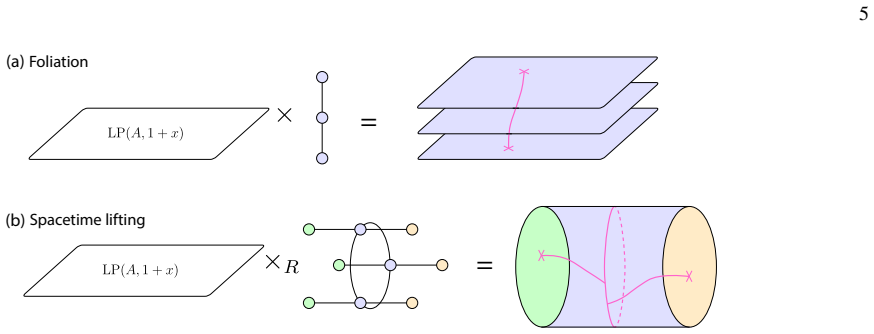
Spacetime lifting constructs fault complexes from symmetry-reduced product structures beyond standard foliation. It yields spacetime-lifted memory experiments whose fault distance is almost linear in the total spacetime cost, substantially outperforming existing constructions. The resulting complexes can be read as measurement-based cluster-state protocols that realize fault-tolerant logical teleportation under general conditions identified in the work.
What carries the argument
spacetime lifting, a construction that lifts symmetry-reduced product structures to fault complexes whose homological properties determine the fault distance scaling
If this is right
- Memory experiments become possible with spacetime overhead that grows much more slowly than in prior foliated or product constructions.
- The same complexes support measurement-based implementations of fault-tolerant logical teleportation.
- The framework extends to general complex constructions that treat spacetime as a single object rather than separate code and circuit layers.
- Operational schemes combine the improved scaling with existing cluster-state hardware approaches.
Where Pith is reading between the lines
- Similar lifting techniques might apply to other symmetry-reduced codes, potentially producing efficient protocols for gates beyond memory.
- Small-scale numerical checks of the distance scaling could be performed on modest hardware before attempting larger implementations.
- The approach suggests examining whether existing quantum architectures can host these lifted complexes with reduced calibration overhead.
Load-bearing premise
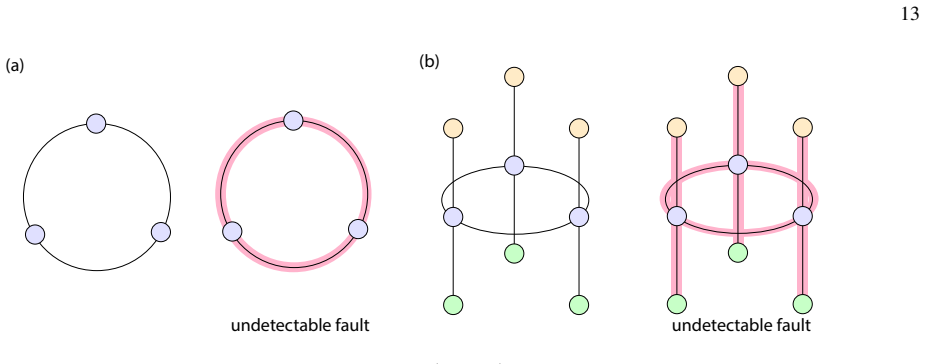
The lifted structures remain valid fault complexes whose homological properties produce the claimed almost-linear distance without introducing undetected error mechanisms or hidden overhead.
What would settle it
A concrete calculation or simulation of one spacetime-lifted memory experiment in which the minimum weight of any logical error is substantially sub-linear in the spacetime volume, or an explicit error chain that evades detection despite the distance claim.
Figures
read the original abstract
Fault-tolerant quantum computation is inherently a spacetime problem, requiring not merely good static quantum error-correcting codes but also low-overhead protocols for protecting and manipulating encoded quantum information over time. Fault complexes provide a homological framework for treating such protocols as single spacetime objects. In this work, we initiate the study of low-overhead fault complexes by introducing {spacetime lifting}, a method that constructs fault complexes from symmetry-reduced product structures beyond standard foliation. We show that spacetime lifting yields fault complexes and in particular {spacetime-lifted} memory experiments with almost-linear fault distance in the total spacetime cost, which substantially outperforms existing constructions. We further interpret fault complexes as measurement-based cluster-state protocols and identify general conditions under which they realize fault-tolerant logical teleportation, showing that spacetime-lifted constructions combine favorable scaling with operational schemes. Our study opens a path toward more efficient quantum fault tolerance through general complex constructions.
Editorial analysis
A structured set of objections, weighed in public.
Referee Report
Summary. The paper introduces spacetime lifting as a construction method for fault complexes starting from symmetry-reduced product structures (beyond standard foliation). It claims that the resulting spacetime-lifted memory experiments achieve almost-linear fault distance relative to total spacetime cost and substantially outperform prior constructions; it further maps fault complexes to measurement-based cluster-state protocols and gives conditions under which they implement fault-tolerant logical teleportation.
Significance. If the lifting map is shown to preserve the required homological distance without introducing new low-weight undetectable errors, the framework would supply a general route to lower spacetime overhead in fault-tolerant quantum protocols, extending beyond foliated constructions and potentially enabling more efficient logical operations.
major comments (2)
- [spacetime lifting definition and § on memory experiments] Abstract and the spacetime-lifting construction: the central claim of almost-linear fault distance in total spacetime volume is load-bearing for the outperformance statement, yet the manuscript must explicitly exhibit the lifting map and prove that it introduces neither new boundaries nor cycles that produce lower-weight logical operators undetected by the homological distance metric.
- [memory experiments] § on spacetime-lifted memory experiments: the scaling claim requires a concrete accounting of all overhead incurred by the symmetry reduction step and the subsequent lift; without this, it is unclear whether the reported distance remains almost linear once the full spacetime cost (including any auxiliary qubits or measurements) is included.
minor comments (2)
- [framework section] Clarify the precise relationship between the symmetry-reduced product structures and the input to the lifting procedure; a short diagram or pseudocode would aid readability.
- [introduction] Ensure that all new terminology (e.g., 'spacetime-lifted memory experiment') is defined before first use and that the distinction from foliated constructions is stated explicitly.
Simulated Author's Rebuttal
We thank the referee for the careful and constructive report. The two major comments raise important points about explicitness and overhead accounting. We address each below and will incorporate clarifications in a revised manuscript.
read point-by-point responses
-
Referee: Abstract and the spacetime-lifting construction: the central claim of almost-linear fault distance in total spacetime volume is load-bearing for the outperformance statement, yet the manuscript must explicitly exhibit the lifting map and prove that it introduces neither new boundaries nor cycles that produce lower-weight logical operators undetected by the homological distance metric.
Authors: The spacetime-lifting map is defined explicitly in Section 3 as a symmetry-based construction applied to reduced product structures. Theorem 4.2 establishes that the map is a chain homomorphism inducing an injection on the relevant homology groups, which directly implies that no new boundaries or cycles of lower weight are created; the proof proceeds by showing that any cycle in the lifted complex projects to a cycle in the base complex whose weight is at least as large. To make the argument more immediately accessible we will add a short subsection containing a worked example of the map on a small complex together with a one-paragraph summary of the homology-injection argument. revision: yes
-
Referee: § on spacetime-lifted memory experiments: the scaling claim requires a concrete accounting of all overhead incurred by the symmetry reduction step and the subsequent lift; without this, it is unclear whether the reported distance remains almost linear once the full spacetime cost (including any auxiliary qubits or measurements) is included.
Authors: The total spacetime volume used in the distance scaling already incorporates every qubit and measurement appearing in the lifted complex; the symmetry-reduction step contributes only a constant-factor overhead, as stated in Proposition 5.2. Nevertheless, we agree that an itemized breakdown would improve transparency. We will revise the memory-experiments section to include an explicit table enumerating the contributions from symmetry reduction, the lift itself, and any auxiliary elements, confirming that the almost-linear scaling holds with respect to the summed cost. revision: yes
Circularity Check
No circularity; claims rest on explicit construction not shown to reduce to inputs
full rationale
The provided abstract and context contain no equations, fitted parameters, or self-citations that would make the claimed almost-linear fault distance equivalent to its inputs by definition. The spacetime-lifting construction is presented as a new method whose homological properties are asserted to yield the distance scaling, but no reduction (e.g., distance defined via the lift itself) is exhibited. This is the common case of a self-contained claim whose verification lies outside the text shown; no load-bearing step collapses to a tautology or prior self-result.
Axiom & Free-Parameter Ledger
axioms (1)
- domain assumption Fault complexes provide a valid homological framework for spacetime error correction protocols
invented entities (1)
-
spacetime lifting
no independent evidence
Reference graph
Works this paper leans on
-
[1]
twisted product
, respectively. In contrast, the fault distance arises from (co)homology groups at differ- ent (adjacent) levels of the fault complex, as seen from (3). A classic illustration is provided by the correspondence be- tween the foliated 2D toric code and 3D toric code. Consider ad×dtoric code tensor product with a length-drepetition code. When the resulting c...
-
[2]
Google Quantum AI and Collaborators, Quantum error correc- tion below the surface code threshold, Nature638, 920 (2025)
2025
-
[3]
Bluvstein, A
D. Bluvstein, A. A. Geim, S. H. Li, S. J. Evered, J. P. Bonilla Ataides, G. Baranes, A. Gu, T. Manovitz, M. Xu, M. Kalinowski, S. Majidy, C. Kokail, N. Maskara, E. C. Trapp, L. M. Stewart, S. Hollerith, H. Zhou, M. J. Gullans, S. F. Yelin, M. Greiner, V . Vuleti´c, M. Cain, and M. D. Lukin, A fault- tolerant neutral-atom architecture for universal quantum...
2026
-
[4]
Yamasaki and M
H. Yamasaki and M. Koashi, Time-efficient constant-space- overhead fault-tolerant quantum computation, Nat. Phys.20, 247 (2024)
2024
-
[5]
Q. Xu, J. P. Bonilla Ataides, C. A. Pattison, N. Raveendran, D. Bluvstein, J. Wurtz, B. Vasi ´c, M. D. Lukin, L. Jiang, and H. Zhou, Constant-overhead fault-tolerant quantum com- putation with reconfigurable atom arrays, Nat. Phys.20, 1084 (2024)
2024
-
[6]
B. Ide, M. G. Gowda, P. J. Nadkarni, and G. Dauphinais, Fault- tolerant logical measurements via homological measurement, Phys. Rev. X15, 021088 (2025)
2025
-
[7]
Q. Xu, H. Zhou, D. Bluvstein, M. Cain, M. Kalinowski, J. Preskill, M. D. Lukin, and N. Maskara, Batched high- rate logical operations for quantum LDPC codes (2025), arXiv:2510.06159 [quant-ph]
arXiv 2025
-
[8]
H. Zhou, C. Zhao, M. Cain, D. Bluvstein, N. Maskara, C. Duck- ering, H.-Y . Hu, S.-T. Wang, A. Kubica, and M. D. Lukin, Low- overhead transversal fault tolerance for universal quantum com- putation, Nature646, 303 (2025)
2025
-
[9]
S. J. S. Tan, Y . Hong, T.-C. Lin, M. J. Gullans, and M.-H. Hsieh, Single-shot universality in quantum LDPC codes via code-switching (2025), arXiv:2510.08552 [quant-ph]
arXiv 2025
- [10]
-
[11]
Z. He, A. Cowtan, D. J. Williamson, and T. J. Yoder, Extrac- tors: QLDPC architectures for efficient Pauli-based computa- tion (2025), arXiv:2503.10390 [quant-ph]
arXiv 2025
- [12]
-
[13]
Tamiya, M
S. Tamiya, M. Koashi, and H. Yamasaki, Fault-tolerant quan- tum computation with polylogarithmic time and constant space overheads, Nat. Phys.22, 27 (2026)
2026
-
[14]
D. J. Williamson and T. J. Yoder, Low-overhead fault-tolerant quantum computation by gauging logical operators, Nat. Phys. 22, 598 (2026)
2026
-
[15]
Cowtan, Z
A. Cowtan, Z. He, D. J. Williamson, and T. J. Yoder, Parallel logical measurements via quantum code surgery, PRX Quantum 7, 020325 (2026). 8
2026
- [16]
-
[17]
Hillmann, G
T. Hillmann, G. Dauphinais, I. Tzitrin, and M. Vasmer, Single- shot and measurement-based quantum error correction via fault complexes, Phys. Rev. A112, L040401 (2025)
2025
-
[18]
Raussendorf, S
R. Raussendorf, S. Bravyi, and J. Harrington, Long-range quan- tum entanglement in noisy cluster states, Phys. Rev. A71, 062313 (2005)
2005
-
[19]
Raussendorf, J
R. Raussendorf, J. Harrington, and K. Goyal, A fault-tolerant one-way quantum computer, Ann. Phys.321, 2242 (2006)
2006
-
[20]
Raussendorf, J
R. Raussendorf, J. Harrington, and K. Goyal, Topological fault- tolerance in cluster state quantum computation, New J. Phys.9, 199 (2007)
2007
-
[21]
N. Nickerson and H. Bombín, Measurement based fault toler- ance beyond foliation (2018), arXiv:1810.09621 [quant-ph]
Pith/arXiv arXiv 2018
-
[22]
Newman, L
M. Newman, L. A. de Castro, and K. R. Brown, Generating fault-tolerant cluster states from crystal structures, Quantum4, 295 (2020)
2020
- [23]
-
[24]
A. Bolt, G. Duclos-Cianci, D. Poulin, and T. M. Stace, Foliated quantum error-correcting codes, Phys. Rev. Lett.117, 070501 (2016)
2016
-
[25]
B. J. Brown and S. Roberts, Universal fault-tolerant measurement-based quantum computation, Phys. Rev. Res.2, 033305 (2020)
2020
-
[26]
Bacon, S
D. Bacon, S. T. Flammia, A. W. Harrow, and J. Shi, Sparse quantum codes from quantum circuits, IEEE Trans. Inf. Theory 63, 2464 (2017)
2017
-
[27]
D. Gottesman, Opportunities and challenges in fault-tolerant quantum computation (2022), arXiv:2210.15844 [quant-ph]
arXiv 2022
-
[28]
N. Delfosse and A. Paetznick, Spacetime codes of Clifford cir- cuits (2023), arXiv:2304.05943 [quant-ph]
arXiv 2023
- [29]
- [30]
-
[31]
M. Rüsch, B. Rodatz, and A. Kissinger, Completeness for fault equivalence of Clifford ZX diagrams (2025), arXiv:2510.08477 [quant-ph]
Pith/arXiv arXiv 2025
-
[32]
Panteleev and G
P. Panteleev and G. Kalachev, Quantum LDPC codes with al- most linear minimum distance, IEEE Trans. Inf. Theory68, 213 (2022)
2022
-
[33]
Panteleev and G
P. Panteleev and G. Kalachev, Degenerate quantum LDPC codes with good finite length performance, Quantum5, 585 (2021)
2021
-
[34]
N. P. Breuckmann and J. N. Eberhardt, Balanced product quan- tum codes, IEEE Trans. Inf. Theory67, 6653 (2021)
2021
-
[35]
Panteleev and G
P. Panteleev and G. Kalachev, Asymptotically good quantum and locally testable classical LDPC codes, inProceedings of the 54th Annual ACM SIGACT Symposium on Theory of Com- puting(2022) pp. 375–388
2022
-
[36]
M. B. Hastings, J. Haah, and R. O’Donnell, Fiber bundle codes: Breaking theN 1/2 polylog(N)barrier for quantum LDPC codes, inProceedings of the 53rd Annual ACM SIGACT Sym- posium on Theory of Computing(2021) pp. 1276–1288
2021
-
[37]
A. O. Quintavalle, M. Vasmer, J. Roffe, and E. T. Campbell, Single-shot error correction of three-dimensional homological product codes, PRX Quantum2, 020340 (2021)
2021
-
[38]
Bombín, C
H. Bombín, C. Dawson, R. V . Mishmash, N. Nickerson, F. Pastawski, and S. Roberts, Logical blocks for fault-tolerant topological quantum computation, PRX Quantum4, 020303 (2023)
2023
-
[39]
M. E. Beverland, S. Huang, and V . Kliuchnikov, Fault tolerance of stabilizer channels (2024), arXiv:2401.12017 [quant-ph]
arXiv 2024
-
[40]
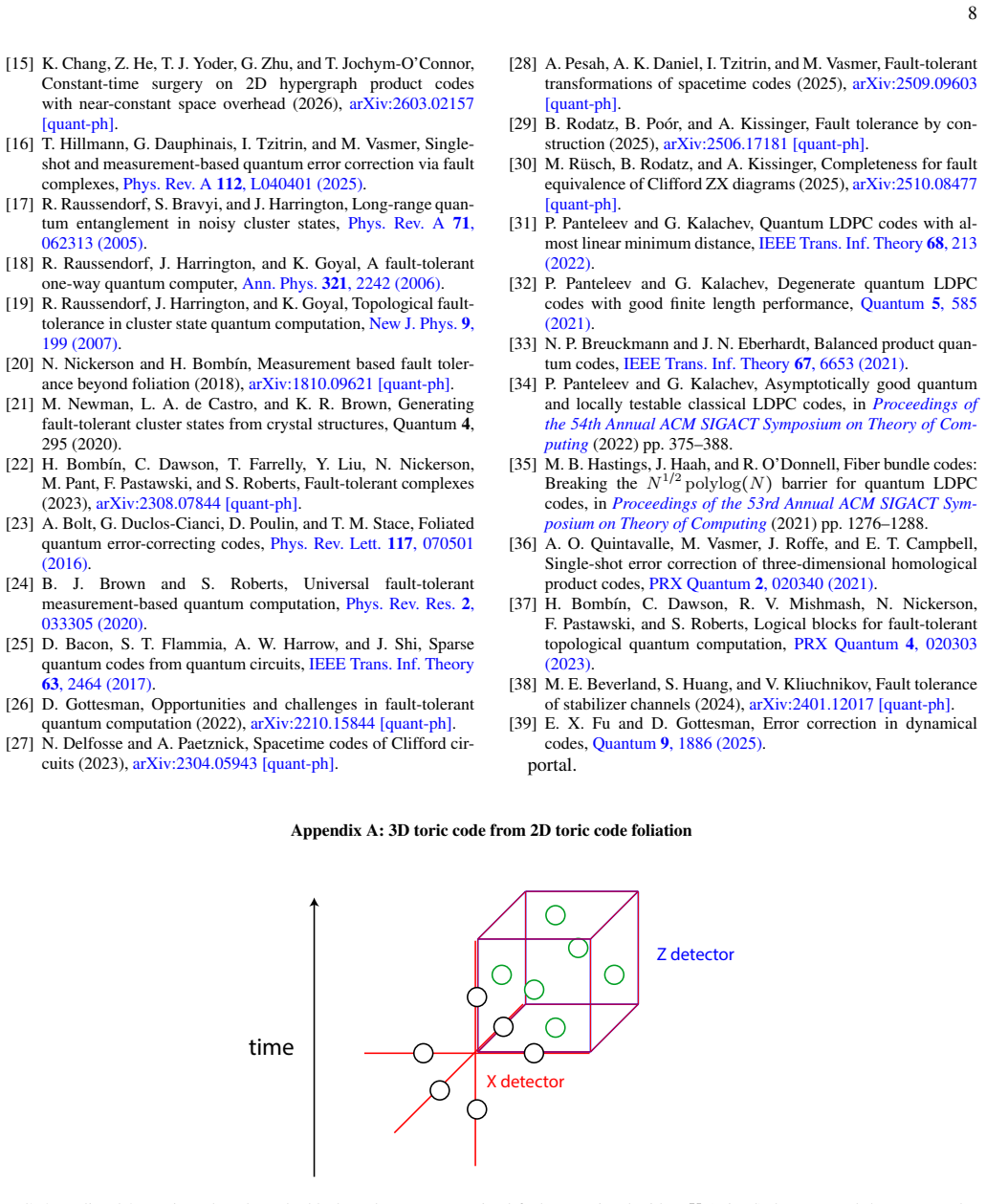
E. X. Fu and D. Gottesman, Error correction in dynamical codes, Quantum9, 1886 (2025). portal. Appendix A: 3D toric code from 2D toric code foliation time X detector Z detector FIG. 2. Foliated 2D toric code, where the black cycles represent primal faults associated with aX(primal) detector, and the green cycles represent dual faults associated with aZ(du...
2025
-
[41]
Ifu(1)≠0, we have∣c∣=∣u∣+∣v∣+∣w∣≥γ1ℓnwhereγ 1 =min{ α 2 , αβ 4 }
-
[42]
primal” and “dual
Ifu(1)=0, we have∣c∣=∣u∣+∣v∣+∣w∣≥γ2ℓnwhereγ 2 = α 4∆ min{β,1}. For the first case:If∣u∣≥αℓn 2 , then it is done. Otherwise, we show that if∣u∣≤αℓn/2, then∣v∣+∣w∣is greater and equal than αβℓn 4 . We define u(t)=j tu, s(t)=Au (t), (C14) wherej t =∑t−1 k=0 xk. Using the kernel conditionAu+(1+x)(v+w)=0, s(t)=Auj t =(1+x)(v+w)j t =(1+x t)(v+w). (C15) Because∣...
discussion (0)
Sign in with ORCID, Apple, or X to comment. Anyone can read and Pith papers without signing in.