REVIEW 4 major objections 5 minor 43 references
EndoFinder: Online Lesion Retrieval for Explainable Colorectal Polyp Diagnosis Leveraging Latent Scene Representations
T0 review · 4 major / 5 minor · reviewed 2026-08-06 · deepseek-v4-flash
Pith's one-line read Treating a polyp as a three-dimensional scene rather than a single image lets a retrieval system identify the polyp across views and infer its pathology from similar past cases.
desk verdict Solid retrieval framework with a valuable dataset, but the unstated train/test split undercuts the headline numbers. read the letter →
The pith
A machine-rendered reading of the paper's core claim, the machinery that carries it, and where it could break.
The reading
What carries the argument
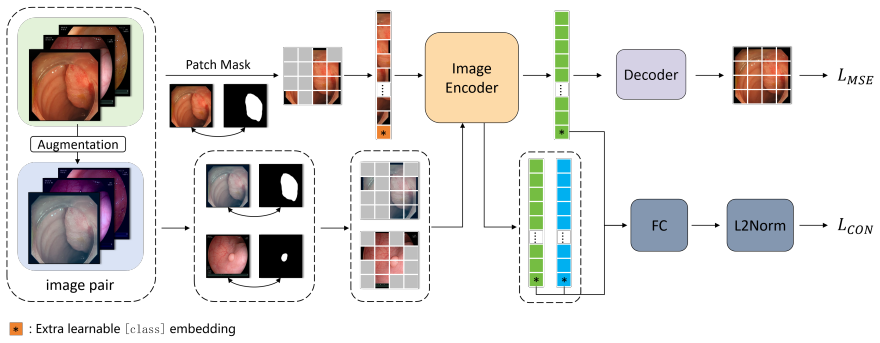
The load-bearing component is the Scene Representation Transformer: a one-layer Transformer that takes the [CLS] tokens produced by a frozen ViT-L/16 image encoder for each of four endoscopic views and fuses them, via self-attention and a learnable scene token, into one latent scene vector $S$. The scene encoder is trained with a scene-level InfoNCE loss, an entropy regularizer that pushes representations apart, and a masked-reconstruction objective in which the remaining views reconstruct a masked view through cross-attention, a pose-free mechanism. At inference, $S$ is sign-binarized into a hash code in $\{-1,1\}^K$, and a ball tree over Hamming distance retrieves the nearest historical cases. This design carries the argument because every re-identification and pathology result is a property of this fused scene space, not of any single-view feature.
What would settle it
A decisive check is to compare polyp identities across the three PolypScene datasets: if any training polyp from PolypScene-2k also appears in PolypScene-250 or PolypScene-80, the claim as stated is unsupported. The cleaner experiment is to retrain the scene encoder on a polyp-disjoint subset and evaluate on held-out polyps, or to test on an external multi-view polyp dataset; the re-identification and pathology numbers should stay close to the reported µAP 0.71 and AUC 85.59 if the result is real generalization.
Extended reading notes
Core claim
The central claim is that polyps with similar latent scene representations share clinical characteristics, and that a retrieval-based system built on that assumption can match or beat conventional supervised classifiers while staying interpretable. The evidence is EndoFinder-S, the variant that fuses four views with a Scene Representation Transformer: on PolypScene-250 it reaches µAP 0.71 and Acc@1 0.74 for re-identifying the same polyp across views, against 0.68/0.70 for simple feature averaging, and on PolypScene-80 it reaches AUC 85.59, ACC 78.75, and F1 81.00 for pathology classification, above the best fine-tuned supervised model (ViT-L at 81.74/78.75/80.08). The same representation, binarized into hash codes and searched through a ball tree with Hamming distance, gives a 4x retrieval speedup with a 6.7% µAP drop. The authors interpret this as evidence that moving from single images to multi-view scene representations is the decisive step: the model does not learn a direct image-to-label mapping, it learns an embedding space in which historical cases with known outcomes are the explanation.
Load-bearing premise
The evaluation assumes that no polyp used to train the scene encoder on PolypScene-2k appears in the PolypScene-250 or PolypScene-80 evaluation sets; the paper never states this training/evaluation split, and if the sets overlap, the reported gains over baselines would be inflated by memorization rather than generalization.
Editorial extensions
If this is right
- During colonoscopy, the system can show the clinician the most similar already-diagnosed polyps behind each predicted label, making the AI output checkable against real cases.
- Diagnostic knowledge is stored in a searchable database: adding a newly confirmed polyp is an insert, and deleting a patient's case removes its retrieval influence, with no model retraining.
- Recording several views of a polyp becomes clinically useful, since multi-view scene fusion is what lifts re-identification and classification above single-view features.
- Hash-based search gives a 4x speedup over cosine similarity on float features with only a small drop in µAP, which is the evidence that real-time use is feasible.
- The paper's authors propose extending the same scene-retrieval paradigm to other lesion types and to additional inputs such as patient history in future work.
Reading between the lines
- Editorial inference: the cleanest test of the 'similar scene, similar label' hypothesis would be an external multi-view polyp dataset with pathology labels, since the three PolypScene datasets described in the paper come from the same data family.
- Editorial inference: a deployment-oriented follow-up should measure how performance degrades when only one or two views can be captured during a real procedure; the paper's ablations vary view count within the same four-view dataset.
- Editorial inference: the privacy argument for retrieval applies fully only to the database stage; deleting a row removes that case from retrieval, but the image encoder was pretrained on all of Polyp-18k, so information from those images remains in the model weights.
- Editorial inference: the framework could be evaluated as a clinician-in-the-loop decision aid, asking whether access to retrieved reference images changes a doctor's management decision or time-to-decision, not just the model's AUC.
Editorial analysis
A structured set of objections, weighed in public.
Referee Report
Summary. The manuscript proposes EndoFinder, a retrieval-based framework for explainable colorectal polyp diagnosis. The method first trains a ViT-based image encoder using contrastive learning and masked reconstruction guided by polyp segmentation masks, then a Scene Representation Transformer that fuses multiple endoscopic views of a polyp into a latent scene representation. This representation is binarized into hash codes to enable efficient Hamming-distance retrieval from a database of historical cases, and the final diagnosis is obtained by a k-NN majority vote. The authors introduce the PolypScene-250 dataset (with the PolypScene-80 pathology-labeled subset), report re-identification and classification experiments, and claim that EndoFinder outperforms existing methods while offering interpretable diagnostic references.
Significance. The paper addresses a clinically relevant problem and offers a plausible direction for interpretable AI in colonoscopy. The release of a new multi-view polyp dataset and the source code are valuable contributions, and the idea of modeling a polyp as a 2.5D/3D scene rather than a single image is a reasonable and well-motivated extension. If the empirical results are robust, the work would show a meaningful advance for retrieval-based polyp diagnosis. However, the central 'outperforms' claims currently depend on an unstated data-split assumption and on comparisons lacking statistical justification, so the significance is not yet fully established.
major comments (4)
- [Section 4 / Table 1] The manuscript never states whether the 250 polyps in PolypScene-250, and its subset PolypScene-80, are disjoint from the 2,219 polyps in PolypScene-2k used to train the Scene Representation Transformer (Section 3.4, Algorithm 1). Because PolypScene-2k is described as containing 2,219 polyps and PolypScene-250 as containing 250, the evaluation sets could be subsets of the training set. If so, the re-identification results in Table 4 (µAP 0.71, Acc@1 0.74) and the classification results in Table 5 (AUC 85.59, ACC 78.75, F1 81.00) would be inflated by the model having seen the exact polyp identities during training, and the comparison to fine-tuned classifiers that were not pretrained on these scenes would be unfair. Please state explicitly whether the splits are disjoint, and if they are not, re-run the evaluation on held-out polyps or provide a clear justification for why the overlap does not affect the conclusions.
- [Section 5.2 / Table 5] The classification experiment on PolypScene-80 uses five-fold cross-validation on just 80 polyps, yet no error bars, confidence intervals, or significance tests are reported. With roughly 16 test samples per fold, the observed improvement of EndoFinder-S (AUC 85.59) over the best fine-tuned baseline ViT-L (AUC 81.74) may not be statistically reliable. In addition, the k-NN parameter k=6 is selected without sensitivity analysis. Please report per-fold results with standard deviations, conduct a significance test (e.g., paired bootstrap or Wilcoxon), and include an ablation over k.
- [Section 5.3 / Figure 5] The hash length K, which is a key hyperparameter of the binarization in Section 3.5, is never stated in the experimental section, although the speed-accuracy trade-off reported in Figure 5 depends on it. The paper also reports only a relative '4x speed improvement' without absolute query times. Please specify K and provide absolute timings (e.g., milliseconds per query) for both the float and binary retrieval cases to support the real-time claim.
- [Section 3.3, Eq. (4) and Section 3.4, Eq. (9)] The 'entropy' regularization term is defined as the negative logarithm of the minimum distance to any negative sample. This is not the standard entropy regularizer, the logarithm becomes negative when the minimum distance exceeds 1, and the gradient is singular as the minimum distance approaches zero. The paper provides no motivation or ablation for this choice, and the naming is misleading. Please clarify the intended behavior and either provide a theoretical or empirical justification or replace the term with a well-understood uniformity loss.
minor comments (5)
- [Table 3] The checkmark symbols used in Table 3 are not defined in the caption; please add an explicit statement such as '√ indicates that the corresponding view is used.'
- [Section 5.1.2] The sentence 'Each polyp in the PolypScence dataset has four views, which are randomly labeled as Q1, Q2, R1, and R2' should specify the random seed or the exact partition, because the re-identification results depend on which views are assigned to the query and reference groups.
- [Section 6] The limitations paragraph discusses dependence on segmentation masks and the need for multiple views, but it does not mention the possibility of training/evaluation overlap; once the data-split issue is resolved, this should be addressed explicitly.
- [Figure 5] The axis labels are not clearly readable in the figure; please add explicit axis titles and units.
- [References] A few references are cited in the text but appear incomplete or inconsistently formatted (e.g., the citation to 'Brearley et al., 2022' in the Introduction); please proofread the reference list.
Circularity Check
No significant circularity: the central claims are empirical benchmark results against external baselines, and the minor self-citation of the authors' earlier EndoFinder is contextual rather than load-bearing.
full rationale
The paper's derivation chain is self-contained and empirically benchmarked. The image encoder is pretrained on Polyp-18k, the scene encoder is trained on PolypScene-2k, and evaluation is performed on PolypScene-250 and PolypScene-80. The re-identification and pathology-classification results are measured against external baselines (DINO, SSCD, MAE, ResNet, DenseNet, ViT) under reported protocols and metrics, so the central claims do not reduce to the method's own definitions. The only self-citation is Yang et al. 2024a, the authors' earlier EndoFinder paper; it is cited as a preliminary version and as the origin of the polyp-aware image encoder, but the current framework retrains that encoder and adds a scene transformer, hashing, and new evaluation datasets. No uniqueness theorem, fitted parameter, or definitional equivalence is imported from that citation to force the reported outcomes. The unstated relationship between PolypScene-2k and PolypScene-250/80 is a data-split transparency concern that could affect validity if the sets overlap, but the paper does not assert a split or lack thereof, and circularity requires exhibiting a specific reduction from the paper's own equations or citations. No such reduction is present. Accordingly, the circularity score is 0.
Assumptions & free parameters
free parameters (3)
- kNN neighborhood size k =
6
- Loss weights lambda, gamma, lambda_ent, lambda_rec =
not reported
- Hash code length K =
not specified
assumptions (4)
- domain assumption Polyps with similar latent scene representations likely share similar clinical labels.
- domain assumption The polyp segmentation masks used in pretraining are accurate enough to guide masking.
- domain assumption The four views assigned to each polyp in the PolypScene datasets belong to the same physical lesion, and the training and evaluation sets are disjoint.
- domain assumption Sign binarization with Hamming distance preserves enough ranking fidelity for retrieval.
Cite this review
Pith. "Pith review of EndoFinder: Online Lesion Retrieval for Explainable Colorectal Polyp Diagnosis Leveraging Latent Scene Representations." pith.science (2026). https://pith.science/paper/CV57VQFI
@misc{pith2026250717323,
  author       = {Pith},
  title        = {Pith review of: EndoFinder: Online Lesion Retrieval for Explainable Colorectal Polyp Diagnosis Leveraging Latent Scene Representations},
  year         = {2026},
  howpublished = {\url{https://pith.science/paper/CV57VQFI}},
  note         = {Machine review of arXiv:2507.17323}
}
read the original abstract
Colorectal cancer (CRC) remains a leading cause of cancer-related mortality, underscoring the importance of timely polyp detection and diagnosis. While deep learning models have improved optical-assisted diagnostics, they often demand extensive labeled datasets and yield "black-box" outputs with limited interpretability. In this paper, we propose EndoFinder, an online polyp retrieval framework that leverages multi-view scene representations for explainable and scalable CRC diagnosis. First, we develop a Polyp-aware Image Encoder by combining contrastive learning and a reconstruction task, guided by polyp segmentation masks. This self-supervised approach captures robust features without relying on large-scale annotated data. Next, we treat each polyp as a three-dimensional "scene" and introduce a Scene Representation Transformer, which fuses multiple views of the polyp into a single latent representation. By discretizing this representation through a hashing layer, EndoFinder enables real-time retrieval from a compiled database of historical polyp cases, where diagnostic information serves as interpretable references for new queries. We evaluate EndoFinder on both public and newly collected polyp datasets for re-identification and pathology classification. Results show that EndoFinder outperforms existing methods in accuracy while providing transparent, retrieval-based insights for clinical decision-making. By contributing a novel dataset and a scalable, explainable framework, our work addresses key challenges in polyp diagnosis and offers a promising direction for more efficient AI-driven colonoscopy workflows. The source code is available at https://github.com/ku262/EndoFinder-Scene.
Figures


Figures from the paper (3 more)


Reference graph
Works this paper leans on
-
[1]
author Apley, D.W. , author Zhu, J. , year 2020 . title Visualizing the effects of predictor variables in black box supervised learning models . journal Journal of the Royal Statistical Society Series B: Statistical Methodology volume 82 , pages 1059--1086
work page 2020
-
[2]
author Barua, I. , author Wieszczy, P. , author Kudo, S.e. , author Misawa, M. , author Holme, . , author Gulati, S. , author Williams, S. , author Mori, K. , author Itoh, H. , author Takishima, K. , et al., year 2022 . title Real-time artificial intelligence--based optical diagnosis of neoplastic polyps during colonoscopy . journal NEJM evidence volume 1...
work page 2022
-
[3]
author Brearley, B.J. , author Bose, K.R. , author Senthil, K. , author Ayyappan, G. , year 2022 . title Knn approaches by using ball tree searching algorithm with minkowski distance function on smart grid data . journal Indian Journal of Computer Science and Engineering volume 13 , pages 1210--1226
work page 2022
-
[4]
author Cai, L. , author Chen, L. , author Huang, J. , author Wang, Y. , author Zhang, Y. , year 2024 . title Know your orientation: A viewpoint-aware framework for polyp segmentation . journal Medical Image Analysis volume 97 , pages 103288
work page 2024
-
[5]
author Cao, Y. , author Long, M. , author Liu, B. , author Wang, J. , year 2018 . title Deep cauchy hashing for hamming space retrieval , in: booktitle Proceedings of the IEEE conference on computer vision and pattern recognition , pp. pages 1229--1237
work page 2018
-
[6]
author Chandran, S. , author Parker, F. , author Lontos, S. , author Vaughan, R. , author Efthymiou, M. , year 2015 . title Can we ease the financial burden of colonoscopy? using real-time endoscopic assessment of polyp histology to predict surveillance intervals . journal Internal medicine journal volume 45 , pages 1293--1299
work page 2015
-
[7]
author Chen, Y. , author Tang, Y. , author Huang, J. , author Xiong, S. , year 2023 . title Multi-scale triplet hashing for medical image retrieval . journal Computers in Biology and Medicine volume 155 , pages 106633
work page 2023
-
[8]
author Doerrich, S. , author Archut, T. , author Di Salvo, F. , author Ledig, C. , year 2024 . title Integrating knn with foundation models for adaptable and privacy-aware image classification , in: booktitle 2024 IEEE International Symposium on Biomedical Imaging (ISBI) , organization IEEE . pp. pages 1--5
work page 2024
Show all 43 references
-
[9]
, author Neverova, N
author El-Nouby, A. , author Neverova, N. , author Laptev, I. , author J \'e gou, H. , year 2021 . title Training vision transformers for image retrieval . journal arXiv preprint arXiv:2102.05644
2021 arXiv
-
[10]
, author Liu, L
author Guan, A. , author Liu, L. , author Fu, X. , author Liu, L. , year 2022 . title Precision medical image hash retrieval by interpretability and feature fusion . journal Computer Methods and Programs in Biomedicine volume 222 , pages 106945
2022
-
[11]
, author Tamaki, T
author H \"a fner, M. , author Tamaki, T. , author Tanaka, S. , author Uhl, A. , author Wimmer, G. , author Yoshida, S. , year 2015 . title Local fractal dimension based approaches for colonic polyp classification . journal Medical image analysis volume 26 , pages 92--107
2015
-
[12]
, author Hsu, C.C
author Hsu, C.M. , author Hsu, C.C. , author Hsu, Z.M. , author Shih, F.Y. , author Chang, M.L. , author Chen, T.H. , year 2021 . title Colorectal polyp image detection and classification through grayscale images and deep learning . journal Sensors volume 21 , pages 5995
2021
-
[13]
, author Xiao, Y
author Hu, K. , author Xiao, Y. , author Zhang, Y. , author Gao, X. , year 2024 . title Multi-view masked contrastive representation learning for endoscopic video analysis . journal Advances in Neural Information Processing Systems volume 37 , pages 47987--48014
2024
-
[14]
, author Lee, D
author Jin, E.H. , author Lee, D. , author Bae, J.H. , author Kang, H.Y. , author Kwak, M.S. , author Seo, J.Y. , author Yang, J.I. , author Yang, S.Y. , author Lim, S.H. , author Yim, J.Y. , et al., year 2020 . title Improved accuracy in optical diagnosis of colorectal polyps...
2020
-
[15]
, author Handa, H
author Komeda, Y. , author Handa, H. , author Watanabe, T. , author Nomura, T. , author Kitahashi, M. , author Sakurai, T. , author Okamoto, A. , author Minami, T. , author Kono, M. , author Arizumi, T. , et al., year 2017 . title Computer-aided diagnosis based on convolutiona...
2017
-
[16]
, author Olofson, A.M
author Korbar, B. , author Olofson, A.M. , author Miraflor, A.P. , author Nicka, C.M. , author Suriawinata, M.A. , author Torresani, L. , author Suriawinata, A.A. , author Hassanpour, S. , year 2017 . title Deep learning for classification of colorectal polyps on whole-slide i...
2017
-
[17]
, author Heil, S
author Krenzer, A. , author Heil, S. , author Fitting, D. , author Matti, S. , author Zoller, W.G. , author Hann, A. , author Puppe, F. , year 2023 . title Automated classification of polyps using deep learning architectures and few-shot learning . journal BMC Medical Imaging ...
2023
-
[18]
, author Tighe, J
author Kundu, K. , author Tighe, J. , year 2020 . title Exploiting weakly supervised visual patterns to learn from partial annotations . journal Advances in Neural Information Processing Systems volume 33 , pages 561--572
2020
-
[19]
, author Chang, L
author Li, X. , author Chang, L. , author Liu, X. , year 2021 . title Qhash: An efficient hashing algorithm for low-variance image deduplication , in: booktitle 2021 IEEE 23rd Int Conf on High Performance Computing & Communications; 7th Int Conf on Data Science & Systems; 19th...
2021
-
[20]
, author Gao, Y
author Liao, S. , author Gao, Y. , author Oto, A. , author Shen, D. , year 2013 . title Representation learning: a unified deep learning framework for automatic prostate mr segmentation , in: booktitle Medical Image Computing and Computer-Assisted Intervention--MICCAI 2013: 16...
2013
-
[21]
, author Srinivasan, P.P
author Mildenhall, B. , author Srinivasan, P.P. , author Tancik, M. , author Barron, J.T. , author Ramamoorthi, R. , author Ng, R. , year 2021 . title Nerf: Representing scenes as neural radiance fields for view synthesis . journal Communications of the ACM volume 65 , pages 99--106
2021
-
[22]
, author Zhou, H
author Nan, Y. , author Zhou, H. , author Xing, X. , author Papanastasiou, G. , author Zhu, L. , author Gao, Z. , author Frangi, A.F. , author Yang, G. , year 2025 . title Revisiting medical image retrieval via knowledge consolidation . journal Medical Image Analysis , pages 103553
2025
-
[23]
, year 2021
author \"O zt \"u rk, S . , year 2021 . title Class-driven content-based medical image retrieval using hash codes of deep features . journal Biomedical Signal Processing and Control volume 68 , pages 102601
2021
-
[24]
, author Lodhia, N
author Pamudurthy, V. , author Lodhia, N. , author Konda, V.J. , year 2020 . title Advances in endoscopy for colorectal polyp detection and classification , in: booktitle Baylor University Medical Center Proceedings , organization Taylor & Francis . pp. pages 28--35
2020
-
[25]
, author Li, K
author Patel, K. , author Li, K. , author Tao, K. , author Wang, Q. , author Bansal, A. , author Rastogi, A. , author Wang, G. , year 2020 . title A comparative study on polyp classification using convolutional neural networks . journal PloS one volume 15 , pages e0236452
2020
-
[26]
, author Roy, S.D
author Pizzi, E. , author Roy, S.D. , author Ravindra, S.N. , author Goyal, P. , author Douze, M. , year 2022 . title A self-supervised descriptor for image copy detection , in: booktitle Proceedings of the IEEE/CVF Conference on Computer Vision and Pattern Recognition , pp. p...
2022
-
[27]
, author Uhl, A
author Ribeiro, E. , author Uhl, A. , author H \"a fner, M. , year 2016 a. title Colonic polyp classification with convolutional neural networks , in: booktitle 2016 IEEE 29th international symposium on computer-based medical systems (CBMS) , organization IEEE . pp. pages 253--258
2016
-
[28]
, author Uhl, A
author Ribeiro, E. , author Uhl, A. , author Wimmer, G. , author H \"a fner, M. , year 2016 b. title Exploring deep learning and transfer learning for colonic polyp classification . journal Computational and mathematical methods in medicine volume 2016 , pages 6584725
2016
-
[29]
, author Mahendran, A
author Sajjadi, M.S. , author Mahendran, A. , author Kipf, T. , author Pot, E. , author Duckworth, D. , author Lu c i \'c , M. , author Greff, K. , year 2023 . title Rust: Latent neural scene representations from unposed imagery , in: booktitle Proceedings of the IEEE/CVF Conf...
2023
-
[30]
, author Meyer, H
author Sajjadi, M.S. , author Meyer, H. , author Pot, E. , author Bergmann, U. , author Greff, K. , author Radwan, N. , author Vora, S. , author Lu c i \'c , M. , author Duckworth, D. , author Dosovitskiy, A. , et al., year 2022 . title Scene representation transformer: Geomet...
2022
-
[31]
, author Forster, F
author Schmalz, C. , author Forster, F. , author Schick, A. , author Angelopoulou, E. , year 2012 . title An endoscopic 3d scanner based on structured light . journal Medical image analysis volume 16 , pages 1063--1072
2012
-
[32]
, author Schraedley-Desmond, P
author Shi, R. , author Schraedley-Desmond, P. , author Napel, S. , author Olcott, E.W. , author Jeffrey Jr, R.B. , author Yee, J. , author Zalis, M.E. , author Margolis, D. , author Paik, D.S. , author Sherbondy, A.J. , et al., year 2006 . title Ct colonography: influence of ...
2006
-
[33]
, author Giaquinto, A.N
author Siegel, R.L. , author Giaquinto, A.N. , author Jemal, A. , year 2024 . title Cancer statistics, 2024. journal CA: a cancer journal for clinicians volume 74
2024
-
[34]
, author Reitsma, J.B
author Van Rijn, J.C. , author Reitsma, J.B. , author Stoker, J. , author Bossuyt, P.M. , author Van Deventer, S.J. , author Dekker, E. , year 2006 . title Polyp miss rate determined by tandem colonoscopy: a systematic review . journal Official journal of the American College ...
2006
-
[35]
, author Du, Y
author Wang, X. , author Du, Y. , author Yang, S. , author Zhang, J. , author Wang, M. , author Zhang, J. , author Yang, W. , author Huang, J. , author Han, X. , year 2023 . title Retccl: Clustering-guided contrastive learning for whole-slide image retrieval . journal Medical ...
2023
-
[36]
, author Tamaki, T
author Wimmer, G. , author Tamaki, T. , author Tischendorf, J.J. , author H \"a fner, M. , author Yoshida, S. , author Tanaka, S. , author Uhl, A. , year 2016 a. title Directional wavelet based features for colonic polyp classification . journal Medical image analysis volume 3...
2016
-
[37]
, author Uhl, A
author Wimmer, G. , author Uhl, A. , author H \"a fner, M. , year 2016 b. title A novel filterbank especially designed for the classification of colonic polyps , in: booktitle 2016 23rd International Conference on Pattern Recognition (ICPR) , organization IEEE . pp. pages 2150--2155
2016
-
[38]
, author Shino, R
author Yamada, M. , author Shino, R. , author Kondo, H. , author Yamada, S. , author Takamaru, H. , author Sakamoto, T. , author Bhandari, P. , author Imaoka, H. , author Kuchiba, A. , author Shibata, T. , et al., year 2022 . title Robust automated prediction of the revised vi...
2022
-
[39]
, author Zhu, Y
author Yang, R. , author Zhu, Y. , author Fu, P. , author Zhang, Y. , author Wang, Z. , author Li, Q. , author Zhou, P. , author Yang, X. , author Wang, S. , year 2024 a. title Endofinder: Online image retrieval for explainable colorectal polyp diagnosis . journal arXiv prepri...
2024 arXiv
-
[40]
, author Dai, J
author Yang, Z. , author Dai, J. , author Pan, J. , year 2024 b. title 3d reconstruction from endoscopy images: A survey . journal Computers in biology and medicine , pages 108546
2024
-
[41]
, author Usman, M
author Younas, F. , author Usman, M. , author Yan, W.Q. , year 2023 . title A deep ensemble learning method for colorectal polyp classification with optimized network parameters . journal Applied Intelligence volume 53 , pages 2410--2433
2023
-
[42]
, author Cheng, X
author Zha, R. , author Cheng, X. , author Li, H. , author Harandi, M. , author Ge, Z. , year 2023 . title Endosurf: Neural surface reconstruction of deformable tissues with stereo endoscope videos , in: booktitle International conference on medical image computing and compute...
2023
-
[43]
write newline
" write newline "" before.all 'output.state := FUNCTION n.dashify 't := "" t empty not t #1 #1 substring "-" = t #1 #2 substring "--" = not "--" * t #2 global.max substring 't := t #1 #1 substring "-" = "-" * t #2 global.max substring 't := while if t #1 #1 substring * t #2 gl...
Reviewed August 6, 2026 · model on record in the stance chip above.
Discussion (0). Continue with ORCID to comment.