Deformed and undeformed localized wave solutions for the two-component (2+1)-dimensional Fokas-Lenells equation
Pith reviewed 2026-05-08 05:07 UTC · model grok-4.3
The pith
Generalized Darboux transformation produces deformed solitons, positons, breathers, and rogue waves for the two-component Fokas-Lenells equation.
A machine-rendered reading of the paper's core claim, the machinery that carries it, and where it could break.
Core claim
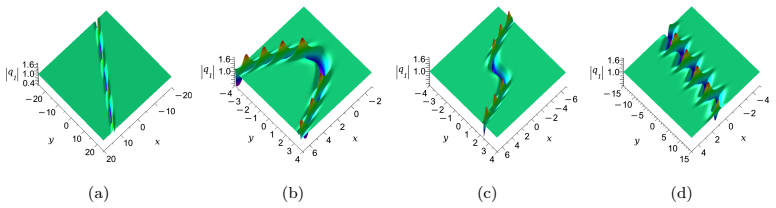
The determinant form of the generalized Darboux transformation is constructed for the two-component (2+1)-dimensional Fokas-Lenells equation. Applying the standard DT generates deformed solitons, deformed positons on zero background, deformed breathers and deformed Y-shaped breathers on nonzero backgrounds. The generalized DT produces undeformed higher-order rogue wave solutions and breather-rogue wave solutions.
What carries the argument
The determinant-form generalized Darboux transformation, which iteratively generates new solutions from seed solutions of the equation's Lax pair.
If this is right
- Explicit expressions for deformed localized waves on different backgrounds are now available.
- The solutions can be used to study pulse propagation in multi-component nonlinear optical systems.
- Higher-order rogue waves describe potential extreme events in such media.
- The approach shows how DT methods scale to multi-dimensional multi-component cases.
Where Pith is reading between the lines
- Similar transformations could generate solutions for related equations like the nonlinear Schrödinger system in higher dimensions.
- The deformed solutions might exhibit distinct stability properties compared to their undeformed counterparts in numerical simulations.
- These findings could guide experimental design in fiber optics for observing such wave phenomena.
Load-bearing premise
That the constructed determinant-form generalized Darboux transformation indeed maps solutions of the linear system to solutions of the nonlinear Fokas-Lenells equation.
What would settle it
Substituting one of the derived deformed soliton expressions into the original two-component Fokas-Lenells PDE and finding that it fails to satisfy the equation for arbitrary parameters.
Figures



read the original abstract
In this paper, we focus on the two-component (2+1)-dimensional Fokas-Lenells equation, which models the propagation of ultrashort optical pulses in nonlinear media with multi-mode interactions and multi-dimensional effects. Firstly, we construct the determinant form of the generalized Darboux transformation (DT). Secondly, we obtain deformed solitons, deformed positons on the zero background and deformed breathers, deformed Y-shaped breathers on the nonzero backgrounds by DT method. Finally, the undeformed solutions including higher-order rogue wave solutions and breather-rogue wave solutions are derived by generalized DT. This work enriches the solution family associated with the equation, but also illustrates the efficiency of DT method in multi-dimensional and multi-component systems.
Editorial analysis
A structured set of objections, weighed in public.
Referee Report
Summary. The paper constructs a determinant-form generalized Darboux transformation for the two-component (2+1)-dimensional Fokas-Lenells equation. It applies the ordinary DT to generate families of deformed solitons and positons on the zero background together with deformed breathers and Y-shaped breathers on nonzero backgrounds, and employs the generalized DT to produce undeformed higher-order rogue-wave and breather-rogue-wave solutions.
Significance. If the constructions are rigorously verified, the work enlarges the catalog of explicit localized solutions for this integrable model of ultrashort optical pulses and illustrates the systematic use of DT techniques in multi-component, multi-dimensional settings. The explicit distinction between deformed (ordinary DT) and undeformed (generalized DT) families is a useful organizational device.
major comments (2)
- [Section 4 (generalized DT solutions)] The central claim that the constructed solutions satisfy the original PDE rests on the correctness of the determinant-form generalized DT; however, the manuscript does not provide an explicit substitution of the derived expressions back into the Fokas-Lenells equation or a reference to an independent verification step (e.g., in the section presenting the higher-order rogue waves).
- [Section 2 (Lax pair and DT construction)] The Lax pair stated for the two-component system is used to derive the DT, but the paper does not demonstrate that the spectral parameter and the resulting eigenfunctions remain consistent with the (2+1)-dimensional structure after the transformation; this step is load-bearing for all subsequent solution families.
minor comments (2)
- [Throughout] Notation for the two-component fields (u,v) and the auxiliary functions in the DT matrices should be introduced once and used uniformly; occasional redefinition of symbols in later sections reduces readability.
- [Abstract and §1] The abstract and introduction refer to “deformed” versus “undeformed” solutions without a concise definition; adding one sentence clarifying the distinction (e.g., presence or absence of a phase shift induced by the DT) would help readers.
Simulated Author's Rebuttal
We thank the referee for the careful reading of our manuscript and the constructive comments. We address each major point below and will revise the paper accordingly to improve clarity and rigor.
read point-by-point responses
-
Referee: [Section 4 (generalized DT solutions)] The central claim that the constructed solutions satisfy the original PDE rests on the correctness of the determinant-form generalized DT; however, the manuscript does not provide an explicit substitution of the derived expressions back into the Fokas-Lenells equation or a reference to an independent verification step (e.g., in the section presenting the higher-order rogue waves).
Authors: We agree that an explicit back-substitution of the high-order determinant expressions into the PDE is impractical and would not be illuminating. The generalized DT is derived from the Lax pair such that, by the standard theory of Darboux transformations for integrable systems, any solution generated from a valid seed automatically satisfies the nonlinear equation. We will revise Section 4 to include a concise reference to this by-construction property (citing the relevant general theorem for the Fokas-Lenells equation) together with an explicit verification outline for the lowest-order rogue-wave case, thereby addressing the concern. revision: yes
-
Referee: [Section 2 (Lax pair and DT construction)] The Lax pair stated for the two-component system is used to derive the DT, but the paper does not demonstrate that the spectral parameter and the resulting eigenfunctions remain consistent with the (2+1)-dimensional structure after the transformation; this step is load-bearing for all subsequent solution families.
Authors: The Lax pair is written in (2+1) dimensions, and the DT is constructed precisely so that the spectral parameter λ remains invariant while the eigenfunctions are updated via the standard dressing procedure that preserves the compatibility condition of the Lax pair. This invariance is what ensures the transformed fields satisfy the original (2+1)D equation. We will add a short explanatory paragraph in Section 2 that explicitly states the invariance of λ, writes the form of the transformed eigenfunction, and confirms consistency with the multi-dimensional structure, thereby making this step transparent. revision: yes
Circularity Check
No significant circularity; derivation is self-contained
full rationale
The paper constructs the determinant-form generalized Darboux transformation directly from the Lax pair of the two-component (2+1)-dimensional Fokas-Lenells equation and applies it to generate families of explicit localized solutions (deformed solitons/positons/breathers on zero and nonzero backgrounds, plus higher-order rogue waves via generalized DT). This is a standard constructive workflow for integrable systems: the DT is derived algebraically rather than fitted or assumed by self-reference, and the resulting solutions are presented as satisfying the original PDE by direct substitution. No load-bearing step reduces to a self-citation chain, parameter fit renamed as prediction, or ansatz smuggled via prior work. The central claim remains independent of its own outputs, consistent with the absence of any quoted reduction in the provided text.
Axiom & Free-Parameter Ledger
axioms (1)
- domain assumption The two-component (2+1)-dimensional Fokas-Lenells equation admits a Lax pair or integrable structure that permits construction of a generalized Darboux transformation in determinant form.
discussion (0)
Sign in with ORCID, Apple, or X to comment. Anyone can read and Pith papers without signing in.