Observational constraints on Luciano-Saridakis entropic cosmology
Pith reviewed 2026-05-21 11:08 UTC · model grok-4.3
The pith
The Luciano-Saridakis entropic cosmology fits combined observational datasets and excludes the LambdaCDM limit at the 2 sigma level.
A machine-rendered reading of the paper's core claim, the machinery that carries it, and where it could break.
Core claim
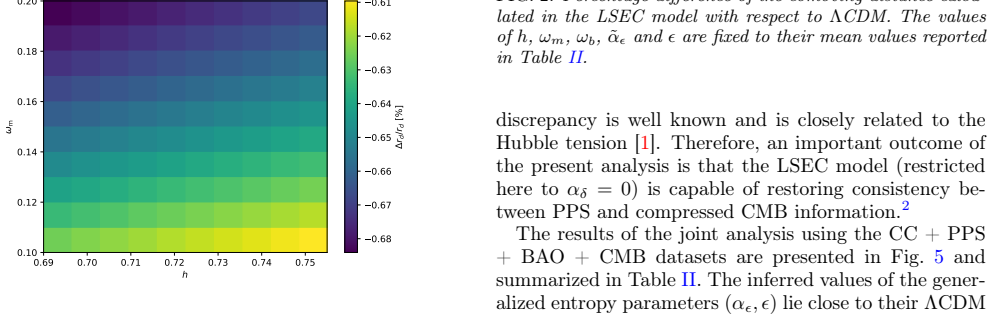
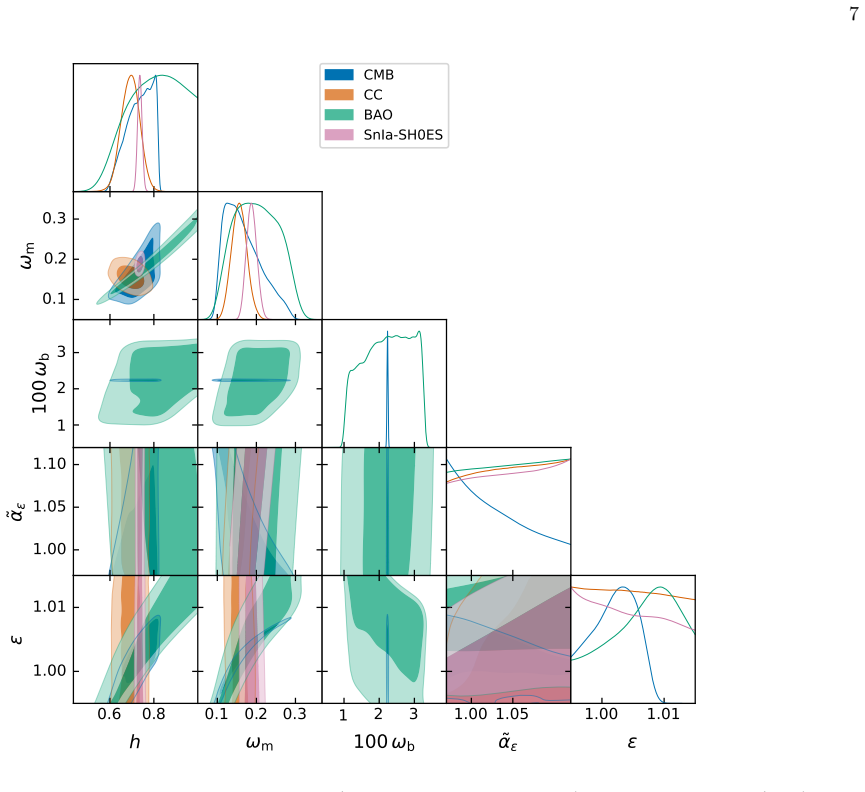
The Luciano-Saridakis generalized entropy, when inserted into the gravity-thermodynamics correspondence, yields modified Friedmann equations that can be read as an effective dark energy component. Confronted at background level with Cosmic Chronometers, Pantheon+ Type Ia supernovae, DESI BAO measurements and compressed Planck 2018 CMB information, the model delivers a good fit to the combined data and satisfies the Pantheon+, SH0ES and CMB constraints simultaneously, unlike LambdaCDM. The LambdaCDM limit is excluded at the 2 sigma level in the restricted parameter space examined.
What carries the argument
A microscopically motivated generalized entropy with two independent entropic exponents that, via the gravity-thermodynamics correspondence, generates modified Friedmann equations interpreted as an effective dark energy sector.
If this is right
- The model simultaneously accommodates Pantheon+ supernovae calibrated with SH0ES, BAO measurements and CMB shift parameters.
- The LambdaCDM limit is ruled out at 2 sigma in the restricted parameter space.
- The entropic parameters remain close to their standard values yet still produce a better joint fit than LambdaCDM.
- The construction offers a background-level route to easing the Hubble tension without introducing new fields.
Where Pith is reading between the lines
- If the correspondence between entropy and gravitational dynamics holds at cosmological scales, entropic modifications could supply a statistical-mechanical origin for the observed acceleration.
- Extension of the same entropy to linear perturbations would test whether the background success survives at the level of structure growth.
- Comparison with other two-parameter entropic or modified-gravity models could reveal whether the present exclusion of LambdaCDM is unique to this construction.
- Future surveys with tighter Hubble-constant anchors could decide whether the small deviations from standard entropy persist or shrink further.
Load-bearing premise
The gravity-thermodynamics correspondence converts the generalized entropy into modified Friedmann equations that act as an effective dark energy sector, and the analysis is restricted to the alpha_delta equals zero case.
What would settle it
A new data combination that forces the best-fit entropic parameters to coincide with their standard Boltzmann-Gibbs and Bekenstein-Hawking values within 1 sigma, or that prevents the model from fitting the combined Pantheon+, SH0ES and CMB data while LambdaCDM succeeds, would falsify the reported preference.
Figures



read the original abstract
A recently proposed generalized entropy by Luciano and Saridakis extends the standard Boltzmann-Gibbs and Bekenstein-Hawking framework through a microscopically motivated construction involving two independent entropic exponents. When applied within the gravity-thermodynamics correspondence, this entropy leads to a modified cosmological dynamics that can be interpreted as an effective dark energy sector of entropic origin, while recovering $\Lambda$CDM in appropriate limits. In this work, we perform the first observational confrontation of the resulting entropic cosmology at the background level. Focusing on the case $\alpha_\delta=0$, we constrain the model using Cosmic Chronometers, Pantheon$^+$ Type Ia supernovae calibrated with SH0ES, BAO measurements from DESI DR2 and compressed Planck 2018 CMB information. We find that the model yields a statistically robust fit to the combined data sets and can simultaneously satisfy Pantheon$^+$, SH0ES and CMB shift-parameter constraints, unlike $\Lambda$CDM. Although the entropic parameters remain close to their standard values, the $\Lambda$CDM limit is excluded at the $2\sigma$ level within the restricted parameter space considered. These results indicate that the Luciano-Saridakis entropic cosmology offers a viable extension of the standard model with the potential to alleviate the Hubble tension at the background level.
Editorial analysis
A structured set of objections, weighed in public.
Referee Report
Summary. The manuscript presents the first observational constraints on Luciano-Saridakis generalized entropic cosmology at the background level. Restricting to the α_δ=0 slice, the authors use Cosmic Chronometers, Pantheon+ supernovae calibrated with SH0ES, DESI DR2 BAO, and compressed Planck 2018 CMB shift parameters to constrain the entropic exponents. They report a statistically robust fit that simultaneously accommodates Pantheon+, SH0ES, and CMB constraints (unlike ΛCDM) and excludes the ΛCDM limit at 2σ within the restricted parameter space.
Significance. If the gravity-thermodynamics correspondence produces unambiguous modified Friedmann equations and the statistical pipeline is fully reproducible, the work would show that an entropic effective dark-energy sector can accommodate the Hubble tension at background level while remaining close to standard entropy values. The explicit 2σ exclusion of the ΛCDM limit inside the chosen slice is a concrete, falsifiable result that merits follow-up.
major comments (3)
- [§3] §3 (model derivation): The mapping from the Luciano-Saridakis entropy to the modified Friedmann equations is stated to follow from the standard gravity-thermodynamics correspondence, yet no explicit verification is given that the α_δ=0 restriction eliminates all ambiguities in horizon temperature or first-law application. Because the effective dark-energy sector and all subsequent likelihoods rest on this step, a short derivation or reference confirming uniqueness for α_δ=0 is required.
- [§4.2–4.3] §4.2–4.3 (data and likelihood): The manuscript provides no information on covariance-matrix treatment for the combined CC+Pantheon++SH0ES+DESI+CMB-shift data, the exact priors on the entropic parameters, or whether the α_δ=0 restriction was fixed before or after inspecting the posterior. These details are load-bearing for the claimed 2σ exclusion and the assertion of a “statistically robust fit.”
- [Results (Tables 1–2 and §5)] Results (Tables 1–2 and §5): The simultaneous satisfaction of SH0ES (higher H0), Pantheon+, and CMB shift constraints is obtained by fitting the entropic parameters to precisely the datasets that encode the Hubble tension. The manuscript should clarify whether this is presented as an independent alleviation or as a successful accommodation within a two-parameter extension.
minor comments (2)
- [Abstract] Abstract: the phrase “within the restricted parameter space considered” should explicitly name the restriction (α_δ=0) for immediate clarity.
- [Figures] Figure captions: several panels would benefit from an overlaid dashed line or shaded band indicating the pure ΛCDM limit for direct visual comparison.
Simulated Author's Rebuttal
We thank the referee for the constructive and detailed report. We address each major comment point by point below, indicating where revisions will be made to strengthen the manuscript.
read point-by-point responses
-
Referee: [§3] §3 (model derivation): The mapping from the Luciano-Saridakis entropy to the modified Friedmann equations is stated to follow from the standard gravity-thermodynamics correspondence, yet no explicit verification is given that the α_δ=0 restriction eliminates all ambiguities in horizon temperature or first-law application. Because the effective dark-energy sector and all subsequent likelihoods rest on this step, a short derivation or reference confirming uniqueness for α_δ=0 is required.
Authors: We agree that an explicit verification would improve clarity. In the revised manuscript we will add a short derivation (or appendix) confirming that, for the α_δ=0 slice, the standard gravity-thermodynamics correspondence produces unique modified Friedmann equations with no remaining ambiguities in the horizon temperature or first-law application. This follows directly from the original Luciano-Saridakis construction and will be referenced accordingly. revision: yes
-
Referee: [§4.2–4.3] §4.2–4.3 (data and likelihood): The manuscript provides no information on covariance-matrix treatment for the combined CC+Pantheon++SH0ES+DESI+CMB-shift data, the exact priors on the entropic parameters, or whether the α_δ=0 restriction was fixed before or after inspecting the posterior. These details are load-bearing for the claimed 2σ exclusion and the assertion of a “statistically robust fit.”
Authors: We acknowledge that these methodological details were insufficiently explicit. The α_δ=0 restriction was fixed a priori on theoretical grounds before any posterior inspection. In the revision we will add the precise covariance-matrix treatment for the joint dataset, the exact priors adopted for the entropic parameters, and an explicit statement confirming the restriction was chosen prior to the analysis. revision: yes
-
Referee: [Results (Tables 1–2 and §5)] Results (Tables 1–2 and §5): The simultaneous satisfaction of SH0ES (higher H0), Pantheon+, and CMB shift constraints is obtained by fitting the entropic parameters to precisely the datasets that encode the Hubble tension. The manuscript should clarify whether this is presented as an independent alleviation or as a successful accommodation within a two-parameter extension.
Authors: We thank the referee for this clarification request. The results are presented as a successful accommodation within the two-parameter entropic extension that permits a joint fit to the datasets exhibiting tension under ΛCDM. We do not claim an independent alleviation outside this fitting procedure. In the revised §5 and conclusions we will state this distinction explicitly while preserving the reported findings. revision: yes
Circularity Check
No significant circularity in derivation or claims
full rationale
The paper defines the Luciano-Saridakis generalized entropy from prior theoretical work, applies the standard gravity-thermodynamics correspondence to obtain modified Friedmann equations (recovering LambdaCDM in limits), restricts to the alpha_delta=0 slice, and performs a standard parameter fit plus likelihood analysis against external datasets (CC, Pantheon+ with SH0ES, DESI BAO, compressed Planck CMB shift parameters). No claimed result (robust fit, simultaneous satisfaction of constraints, 2-sigma exclusion of LambdaCDM limit) reduces by construction to a fitted input, self-definition, or unverified self-citation chain. The observational conclusions are falsifiable against the cited data and are not equivalent to the model setup. Self-citation for the entropy proposal is normal model definition and does not load-bear the data-driven claims.
Axiom & Free-Parameter Ledger
free parameters (1)
- entropic exponents
axioms (1)
- domain assumption Gravity-thermodynamics correspondence converts the generalized entropy into modified cosmological dynamics interpretable as effective dark energy.
invented entities (1)
-
effective dark energy sector of entropic origin
no independent evidence
Lean theorems connected to this paper
-
IndisputableMonolith/Cost/FunctionalEquation.leanwashburn_uniqueness_aczel unclear?
unclearRelation between the paper passage and the cited Recognition theorem.
When applied within the gravity-thermodynamics correspondence, this entropy leads to a modified cosmological dynamics... ρ_DE = 3/8πG [H²(1−α_δ H^{2(1−δ)}−α_ε H^{2(1−ε)})+C]
-
IndisputableMonolith/Foundation/RealityFromDistinction.leanreality_from_one_distinction unclear?
unclearRelation between the paper passage and the cited Recognition theorem.
Focusing on the case α_δ=0... the ΛCDM limit is excluded at the 2σ level
What do these tags mean?
- matches
- The paper's claim is directly supported by a theorem in the formal canon.
- supports
- The theorem supports part of the paper's argument, but the paper may add assumptions or extra steps.
- extends
- The paper goes beyond the formal theorem; the theorem is a base layer rather than the whole result.
- uses
- The paper appears to rely on the theorem as machinery.
- contradicts
- The paper's claim conflicts with a theorem or certificate in the canon.
- unclear
- Pith found a possible connection, but the passage is too broad, indirect, or ambiguous to say the theorem truly supports the claim.
Forward citations
Cited by 2 Pith papers
-
Cosmologically viable non-polynomial quasi-topological gravity: explicit models, $\Lambda$CDM limit and observational constraints
Non-polynomial quasi-topological gravity models reproduce the standard thermal history, generate dynamical dark energy of geometric origin, and fit supernova, cosmic chronometer, and BAO data competitively with ΛCDM.
-
Viaggiu holographic dark energy in light of DESI DR2
The Viaggiu holographic dark energy model fits late-time data similarly to Lambda CDM, yielding Omega_m0 around 0.24 and a model parameter of 0.27-0.33, with AIC showing statistical indistinguishability.
Reference graph
Works this paper leans on
-
[1]
the above procedure was performed, however using the generalized entropy (7) instead of the standard one. We consider a homogeneous and isotropic spacetime described by the FRW metric ds2 =−dt 2 +a 2(t) dr2 1−kr 2 +r 2dΩ2 ,(9) witha(t)the scale factor, and wherek= 0,+1,−1de- notes flat, close and open spatial geometry respectively. Additionally, we consid...
-
[2]
with TT, TE, EE + low E data from the Planck 2018 release [103]. The observables discussed above are intrinsically re- lated to three fundamental cosmological quantities: the Hubble parameter, the transverse comoving distance, and the sound horizon at the recombination/drag epoch. Discrepancies between the theoretical predictions of the ΛCDM model and the...
work page 2018
- [3]
-
[4]
S. Capozziello and M. De Laurentis, Phys. Rept.509, 167 (2011), arXiv:1108.6266 [gr-qc]
work page internal anchor Pith review Pith/arXiv arXiv 2011
-
[5]
Y.-F. Cai, S. Capozziello, M. De Laurentis, and E. N. Saridakis, Rept. Prog. Phys.79, 106901 (2016), arXiv:1511.07586 [gr-qc]
work page internal anchor Pith review Pith/arXiv arXiv 2016
-
[6]
A. A. Starobinsky, Phys. Lett. B91, 99 (1980)
work page 1980
-
[7]
Unified cosmic history in modified gravity: from F(R) theory to Lorentz non-invariant models
S. Nojiri and S. D. Odintsov, Phys. Rept.505, 59 (2011), arXiv:1011.0544 [gr-qc]
work page internal anchor Pith review Pith/arXiv arXiv 2011
-
[8]
Modified Gauss-Bonnet theory as gravitational alternative for dark energy
S. Nojiri and S. D. Odintsov, Phys. Lett. B631, 1 (2005), arXiv:hep-th/0508049 [hep-th]
work page internal anchor Pith review Pith/arXiv arXiv 2005
-
[9]
Construction of cosmologically viable f(G) gravity models
A. De Felice and S. Tsujikawa, Phys. Lett. B675, 1 (2009), arXiv:0810.5712 [hep-th]
work page internal anchor Pith review Pith/arXiv arXiv 2009
- [10]
- [11]
-
[12]
P. D. Mannheim and D. Kazanas, Astrophys. J.342, 635 (1989)
work page 1989
-
[13]
Ã. Ã. Flanagan, Phys. Rev. D74, 023002 (2006), arXiv:astro-ph/0605504 [astro-ph]
work page internal anchor Pith review Pith/arXiv arXiv 2006
-
[14]
G. R. Bengochea and R. Ferraro, Phys. Rev. D79, 124019 (2009), arXiv:0812.1205 [astro-ph]
work page internal anchor Pith review Pith/arXiv arXiv 2009
-
[15]
E. V. Linder, Phys. Rev. D81, 127301 (2010), arXiv:1005.3039 [astro-ph.CO]
work page internal anchor Pith review Pith/arXiv arXiv 2010
-
[16]
G.KofinasandE.N.Saridakis,Phys.Rev.D90,084044 (2014), arXiv:1404.2249 [gr-qc]
work page internal anchor Pith review Pith/arXiv arXiv 2014
-
[17]
Modified teleparallel theories of gravity
S. Bahamonde, C. G. Böhmer, and M. Wright, Phys. Rev. D92, 104042 (2015), arXiv:1508.05120 [gr-qc]
work page internal anchor Pith review Pith/arXiv arXiv 2015
-
[18]
S. Bahamonde, K. F. Dialektopoulos, and J. Levi Said, Phys. Rev. D100, 064018 (2019), arXiv:1904.10791 [gr- qc]
-
[19]
J. Beltrán Jiménez, L. Heisenberg, and T. Koivisto, Phys. Rev. D98, 044048 (2018), arXiv:1710.03116 [gr- qc]
work page internal anchor Pith review Pith/arXiv arXiv 2018
-
[20]
L. Heisenberg, Phys. Rept.1066, 1 (2024), arXiv:2309.15958 [gr-qc]
- [21]
-
[22]
K. A. Olive, Phys. Rept.190, 307 (1990)
work page 1990
-
[23]
Non-Gaussianity from Inflation: Theory and Observations
N. Bartolo, E. Komatsu, S. Matarrese, and A. Riotto, Phys. Rept.402, 103 (2004), arXiv:astro-ph/0406398 [astro-ph]
work page internal anchor Pith review Pith/arXiv arXiv 2004
-
[24]
E. J. Copeland, M. Sami, and S. Tsujikawa, Int. J. Mod. Phys. D15, 1753 (2006), arXiv:hep-th/0603057 [hep-th]
work page internal anchor Pith review Pith/arXiv arXiv 2006
-
[25]
Y.-F. Cai, E. N. Saridakis, M. R. Setare, and J.-Q. Xia, Phys. Rept.493, 1 (2010), arXiv:0909.2776 [hep-th]
work page internal anchor Pith review Pith/arXiv arXiv 2010
-
[26]
T. Jacobson, Phys. Rev. Lett.75, 1260 (1995), arXiv:gr- qc/9504004
-
[27]
T. Padmanabhan, Phys. Rept.406, 49 (2005), arXiv:gr- qc/0311036
-
[28]
Thermodynamical Aspects of Gravity: New insights
T. Padmanabhan, Rept. Prog. Phys.73, 046901 (2010), arXiv:0911.5004 [gr-qc]
work page internal anchor Pith review Pith/arXiv arXiv 2010
-
[29]
A. V. Frolov and L. Kofman, JCAP05, 009 (2003), arXiv:hep-th/0212327
work page internal anchor Pith review Pith/arXiv arXiv 2003
-
[30]
First Law of Thermodynamics and Friedmann Equations of Friedmann-Robertson-Walker Universe
R.-G. Cai and S. P. Kim, JHEP02, 050 (2005), arXiv:hep-th/0501055
work page internal anchor Pith review Pith/arXiv arXiv 2005
-
[31]
Thermodynamic Behavior of Friedmann Equation at Apparent Horizon of FRW Universe
M. Akbar and R.-G. Cai, Phys. Rev. D75, 084003 (2007), arXiv:hep-th/0609128
work page internal anchor Pith review Pith/arXiv arXiv 2007
-
[32]
Unified First Law and Thermodynamics of Apparent Horizon in FRW Universe
R.-G. Cai and L.-M. Cao, Phys. Rev. D75, 064008 (2007), arXiv:gr-qc/0611071 [gr-qc]
work page internal anchor Pith review Pith/arXiv arXiv 2007
-
[33]
M. Akbar and R.-G. Cai, Phys. Lett. B635, 7 (2006), arXiv:hep-th/0602156
work page internal anchor Pith review Pith/arXiv arXiv 2006
-
[34]
Thermodynamic route to Field equations in Lanczos-Lovelock Gravity
A. Paranjape, S. Sarkar, and T. Padmanabhan, Phys. Rev. D74, 104015 (2006), arXiv:hep-th/0607240
work page internal anchor Pith review Pith/arXiv arXiv 2006
-
[35]
Thermodynamics of dark energy interacting with dark matter and radiation
M. Jamil, E. N. Saridakis, and M. R. Setare, Phys. Rev. D81, 023007 (2010), arXiv:0910.0822 [hep-th]
work page internal anchor Pith review Pith/arXiv arXiv 2010
-
[36]
Horizon Thermodynamics and Gravitational Field Equations in Horava-Lifshitz Gravity
R.-G. Cai and N. Ohta, Phys. Rev. D81, 084061 (2010), arXiv:0910.2307 [hep-th]
work page internal anchor Pith review Pith/arXiv arXiv 2010
-
[37]
M. Wang, J. Jing, C. Ding, and S. Chen, Phys. Rev. D 81, 083006 (2010), arXiv:0912.4832 [gr-qc]
work page internal anchor Pith review Pith/arXiv arXiv 2010
-
[38]
Y. Gim, W. Kim, and S.-H. Yi, JHEP07, 002 (2014), arXiv:1403.4704 [hep-th]
work page internal anchor Pith review Pith/arXiv arXiv 2014
-
[39]
Thermodynamical First Laws of Black Holes in Quadratically-Extended Gravities
Z.-Y. Fan and H. Lu, Phys. Rev. D91, 064009 (2015), arXiv:1501.00006 [hep-th]
work page internal anchor Pith review Pith/arXiv arXiv 2015
-
[40]
A. Rényi,Proceedings of the Fourth Berkeley Sympo- sium on Mathematical Statistics and Probability1, 547 (1961)
work page 1961
- [41]
-
[42]
M. L. Lyra and C. Tsallis, Phys. Rev. Lett.80, 53 (1998)
work page 1998
-
[43]
B. D. Sharma and D. P. Mittal, J. Math. Sci.10, 28 (1975)
work page 1975
-
[44]
Statistical mechanics in the context of special relativity
G. Kaniadakis, Phys. Rev. E66, 056125 (2002), arXiv:cond-mat/0210467
work page internal anchor Pith review Pith/arXiv arXiv 2002
- [45]
- [46]
- [47]
-
[48]
Modified cosmology through nonextensive horizon thermodynamics
A. Lymperis and E. N. Saridakis, Eur. Phys. J. C78, 993 (2018), arXiv:1806.04614 [gr-qc]
work page internal anchor Pith review Pith/arXiv arXiv 2018
- [49]
- [50]
-
[51]
A. Lymperis, S. Basilakos, and E. N. Saridakis, Eur. Phys. J. C81, 1037 (2021), arXiv:2108.12366 [gr-qc]
-
[52]
A. Hernández-Almada, G. Leon, J. Magaña, M. A. García-Aspeitia, V. Motta, E. N. Saridakis, K. Yesmakhanova, and A. D. Millano, Mon. Not. Roy. Astron. Soc.512, 5122 (2022), arXiv:2112.04615 [astro-ph.CO]
- [53]
- [54]
-
[55]
G. G. Luciano, Eur. Phys. J. C82, 314 (2022)
work page 2022
-
[56]
P. Jizba and G. Lambiase, Eur. Phys. J. C82, 1123 (2022), arXiv:2206.12910 [hep-th]
-
[57]
M. Dheepika, H. B. V. T., and T. K. Mathew, Phys. Scripta99, 015014 (2024), arXiv:2211.14039 [gr-qc]
-
[58]
G. G. Luciano, Phys. Lett. B838, 137721 (2023)
work page 2023
- [59]
-
[60]
Z. Teimoori, K. Rezazadeh, and A. Rostami, Eur. Phys. J. C84, 80 (2024), arXiv:2307.11437 [gr-qc]
- [61]
-
[62]
S. Jalalzadeh, H. Moradpour, and P. V. Moniz, Phys. Dark Univ.42, 101320 (2023), arXiv:2308.12089 [gr-qc]
-
[63]
S. Basilakos, A. Lymperis, M. Petronikolou, and E. N. Saridakis, Eur. Phys. J. C84, 297 (2024), arXiv:2308.01200 [gr-qc]
-
[64]
M. Naeem and A. Bibi, Annals Phys.462, 169618 (2024), arXiv:2308.02936 [gr-qc]
- [65]
-
[66]
J. Saavedra and F. Tello-Ortiz, Eur. Phys. J. Plus139, 657 (2024), arXiv:2310.08781 [gr-qc]
-
[67]
R. Nakarachinda, C. Pongkitivanichkul, D. Samart, L. Tannukij, and P. Wongjun, Fortsch. Phys.72, 2400073 (2024), arXiv:2312.16901 [gr-qc]
-
[68]
P. Jizba and G. Lambiase, Entropy25, 1495 (2023), arXiv:2310.19045 [gr-qc]
- [69]
- [70]
-
[71]
R. Jalalzadeh, S. Jalalzadeh, A. S. Jahromi, and H. Moradpour, Phys. Dark Univ.44, 101498 (2024), arXiv:2404.06986 [gr-qc]
- [72]
-
[73]
E. Ebrahimi and A. Sheykhi, Phys. Dark Univ.45, 101518 (2024), arXiv:2405.13096 [gr-qc]
-
[74]
O. Trivedi, A. Bidlan, and P. Moniz, Phys. Lett. B858, 139074 (2024), arXiv:2407.16685 [gr-qc]
-
[75]
S. Ghaffari, G. G. Luciano, and S. Capozziello, Eur. Phys. J. Plus138, 82 (2023), arXiv:2209.00903 [gr-qc]
-
[76]
Ö. Ökcü and E. Aydiner, Gen. Rel. Grav.56, 87 (2024), arXiv:2407.14685 [gr-qc]
-
[77]
M. F. Karabat, Mod. Phys. Lett. A39, 2450109 (2024)
work page 2024
- [78]
- [79]
-
[80]
U. Ualikhanova, A. Altaibayeva, and S. Chattopad- hyay, Indian J. Phys.99, 4433 (2025), arXiv:2501.04028 [physics.gen-ph]
discussion (0)
Sign in with ORCID, Apple, or X to comment. Anyone can read and Pith papers without signing in.