REVIEW 4 minor 103 references
On the Design of Mixture-of-Experts for Dynamic Gaussian Splatting
T0 review · 0 major / 4 minor · reviewed 2026-07-14 · grok-4.5
Pith's one-line read Two different MoE integration strategies for multi-deformation Gaussian models outperform any single deformation prior on dynamic scenes.
desk verdict Solid design-space paper: two concrete MoE integration strategies for dynamic 3DGS, with real gains and honest trade-offs, not a universal claim. read the letter →
The pith
A machine-rendered reading of the paper's core claim, the machinery that carries it, and where it could break.
The reading
What carries the argument
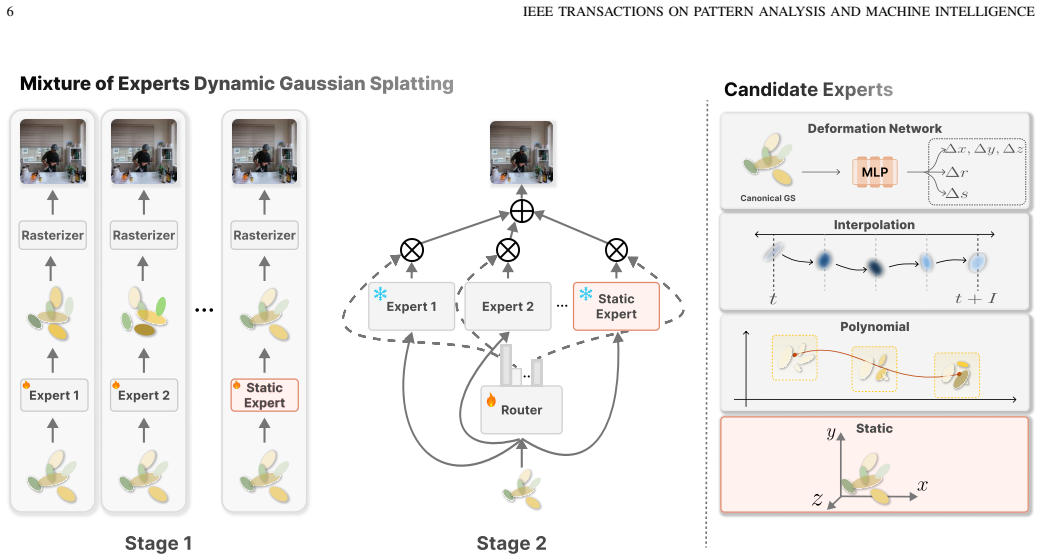
Two integration constraints that decide when experts interact: MoDE (shared canonical Gaussians + spline temporal gating + baseline-only gradient flow) versus MoE-GS (independent experts + volume-aware pixel router that splat per-Gaussian routing weights then blends images).
What would settle it
Find a dynamic scene (or large ROI set) in which one fixed deformation model already wins every spatial region and every timestamp; on that data both MoDE and MoE-GS must then match or fall below that single expert’s PSNR rather than improve it.
Extended reading notes
Core claim
Performance gaps among existing dynamic Gaussian Splatting methods arise from reliance on one deformation prior, not from lack of capacity. Combining multiple specialized deformation experts under either joint canonical optimization (MoDE) or decoupled optimization plus volume-aware routing (MoE-GS) systematically improves novel-view quality by exploiting complementary motion behaviors across space and time.
Load-bearing premise
The chosen experts keep complementary, non-interfering motion priors under the proposed gating so the mixture reliably beats the strongest single expert instead of averaging or destabilizing.
Editorial extensions
If this is right
- When a shared canonical space exists, MoDE gives multi-deformation modeling with only modest extra training time and direct 3D Gaussian output.
- When experts are heterogeneous or already trained, MoE-GS yields larger PSNR gains by full specialization, at the price of multiple training runs and a routing stage.
- Gate-aware pruning and distillation recover real-time speed while retaining most of the mixture’s quality.
- Image-space routing can still be lifted to a coherent post-hoc 3D Gaussian model whose multi-view depth consistency matches or exceeds single experts.
Reading between the lines
- The same joint-versus-decoupled design choice likely applies to other explicit dynamic representations (meshes, particles, hash grids) whose motion models also carry conflicting inductive biases.
- An online residual-driven expert pool that can add or drop deformation modules mid-training would reduce the need for hand-selected candidate sets.
- Volume-aware routing may serve as a general post-hoc calibration layer for any ensemble of 3D renderers that lack direct primitive correspondence.
Editorial analysis
A structured set of objections, weighed in public.
Referee Report
Summary. The paper studies multi-deformation modeling for dynamic 3D Gaussian Splatting under two integration constraints, framed as Mixture-of-Experts. MoDE jointly optimizes multiple canonical deformation experts (HexPlane, hash-grid, per-Gaussian embeddings) on a shared canonical Gaussian representation with spline-based temporal Top-K gating and asymmetric gradient flow. MoE-GS independently trains heterogeneous experts (including non-canonical polynomial and keyframe-interpolation models plus static experts) then combines them via a volume-aware pixel router that lifts per-Gaussian routing weights; efficiency is recovered by single-pass multi-expert rendering, gate-aware pruning, and distillation. Extensive experiments on N3V, Technicolor, HyperNeRF, PanopticSports and D-NeRF, plus ablations of routers, pruning, distillation, expert candidates, run-to-run stability and multi-view depth consistency, demonstrate that both strategies improve robustness over single-deformation baselines while exposing complementary trade-offs in 3D fidelity, training stability and cost (Tables I–XI, Figs. 5–11).
Significance. If the reported gains and trade-offs hold, the work supplies a clear design-space map for multi-deformation dynamic Gaussian representations rather than a single new SOTA method. The explicit contrast between joint canonical composition (MoDE) and decoupled expert-plus-router composition (MoE-GS), the geometry-aware lifting analysis, the efficiency mechanisms, and the released code (https://github.com/cvsp-lab/MoE-GS-studio) make the contribution reusable for future dynamic GS research. The empirical breadth—multiple datasets, large-motion benchmarks, repeated-run stability, and static-region degradation analysis—raises the bar for claims about deformation priors in this literature.
minor comments (4)
- [Sec. IV-B3 / Fig. 6] Table II and Fig. 6: the static-region degradation for E-D3DGS-based MoDE is shown for one illustrative case; a short quantitative summary of static vs. dynamic ROI PSNR across all six N3V scenes would make the trade-off fully transparent.
- [Sec. III-C2] Eqs. (12)–(15) and Fig. 4: the residual MLP Φ that refines the splatted routing features is described only at a high level; a one-sentence statement of its layer count / channel width would aid exact re-implementation.
- [Appendix D3 / Fig. 11] Appendix D3: the Multi-view Depth Consistency formula is clear, yet the precise set of viewpoint pairs and the depth-map resolution used for the curves in Fig. 11 are not stated; adding them would strengthen reproducibility of the geometry claim.
- [Throughout] A few typographical inconsistencies remain (e.g., “V olume-aware”, occasional missing spaces after citations). A final proof-reading pass would polish the manuscript.
Circularity Check
No significant circularity: empirical design-space comparison of two MoE integration strategies, with results measured on held-out views against external baselines.
-
self citation load bearing
[Sec. II-C Related Works (Mixture of Experts) and abstract/intro framing of MoE-GS]
"Inspired by this perspective, MoE-GS [78] applies mixture-of-experts to Dynamic Gaussian Splatting through rendering-level expert routing. ... Building upon this line of research, the present work introduces MoDE ..."
The paper cites the authors’ own prior MoE-GS work as the foundation for one of the two integration strategies under study. This is ordinary incremental research and is fully disclosed; it is not load-bearing for any derivation, uniqueness claim, or numerical result in the present paper, which re-implements, re-evaluates, and contrasts MoE-GS with the new MoDE formulation on independent benchmarks.
full rationale
This is a standard computer-vision systems/engineering paper. Its central claims are comparative empirical results (PSNR/SSIM/LPIPS tables, qualitative figures, efficiency ablations, multi-view depth consistency) obtained by training and evaluating MoDE and MoE-GS on public dynamic-scene benchmarks (N3V, Technicolor, HyperNeRF, PanopticSports, D-NeRF). Routing/gating weights are optimized from data under standard L1+SSIM losses; they are not defined to equal any target metric. The only self-citation is the authors’ prior MoE-GS conference paper, which is openly disclosed as the starting point for one of the two integration strategies and is not used as a uniqueness theorem, ansatz, or definitional premise that forces the new results. No equation reduces a claimed prediction to a fitted input by construction, no uniqueness is imported from the authors’ own prior work, and no known empirical pattern is merely renamed. The paper is therefore self-contained against external benchmarks; the minor self-citation does not raise the score above 1.
Assumptions & free parameters
free parameters (4)
- number of experts N and Top-K gating
- spline control points Nw and warm-up iterations
- router learning rates and pruning threshold τ
- distillation balance λ
assumptions (3)
- domain assumption Standard 3D Gaussian Splatting rasterization and optimization (Kerbl et al.) correctly approximate the radiance field for novel-view synthesis.
- domain assumption Distinct deformation formulations (HexPlane, per-Gaussian embedding, polynomial, keyframe interpolation) induce complementary motion priors that can be usefully specialized.
- ad hoc to paper Image-space blending of independently trained experts can be made geometry-aware via per-Gaussian routing weights that are liftable back to 3D.
invented entities (3)
-
Mixture of Deformation Experts (MoDE)
-
Volume-aware Pixel Router (and associated lifting)
-
Gate-aware Gaussian pruning + single-pass multi-expert rendering
Cite this review
Pith. "Pith review of On the Design of Mixture-of-Experts for Dynamic Gaussian Splatting." pith.science (2026). https://pith.science/paper/CYE7VFYL
@misc{pith2026260708250,
  author       = {Pith},
  title        = {Pith review of: On the Design of Mixture-of-Experts for Dynamic Gaussian Splatting},
  year         = {2026},
  howpublished = {\url{https://pith.science/paper/CYE7VFYL}},
  note         = {Machine review of arXiv:2607.08250}
}
read the original abstract
Dynamic scene reconstruction remains challenging due to the heterogeneous and spatially varying nature of real-world motion. Although recent 3D Gaussian Splatting methods have introduced diverse deformation formulations for dynamic novel view synthesis, each method typically relies on a single deformation model within its representation, which limits robustness across diverse dynamic scenarios. In this work, we study a fundamental problem-multi-deformation modeling for dynamic 3D Gaussian representations-under two distinct integration constraints that differ in when and how multiple deformation experts interact during training. From a Mixture-of-Experts (MoE) perspective, we view multi-deformation modeling as the problem of combining multiple specialized deformation models within a unified 3D representation. We first introduce Mixture of Deformation Experts (MoDE), which integrates multiple deformation experts directly into the deformable Gaussian Splatting pipeline through joint optimization. In MoDE, experts operate on a shared canonical Gaussian representation, enabling multi-deformation modeling without introducing additional training stages or modifying the original optimization schedule. In contrast, we further present Mixture of Experts for Dynamic Gaussian Splatting (MoE-GS) under a different integration constraint, where deformation experts are optimized independently and combined through a separate routing stage. As a result, expert interaction occurs over non-canonical Gaussian representations after individual optimization. Together, these two approaches provide alternative strategies for multi-deformation modeling, clarifying how integration constraints shape the design and behavior of deformation experts in dynamic 3D Gaussian representations. Our code is available at: https://github.com/cvsp-lab/MoE-GS-studio.
Figures


Figures from the paper (15 more)


Reference graph
Works this paper leans on
-
[1]
Nerf: Representing scenes as neural radiance fields for view synthesis,
B. Mildenhall, P. P. Srinivasan, M. Tancik, J. T. Barron, R. Ramamoorthi, and R. Ng, “Nerf: Representing scenes as neural radiance fields for view synthesis,”Communications of the ACM, vol. 65, pp. 99–106, 2021
2021
-
[2]
3d gaussian splatting for real-time radiance field rendering,
B. Kerbl, G. Kopanas, T. Leimk ¨uhler, and G. Drettakis, “3d gaussian splatting for real-time radiance field rendering,”ACM Transactions on Graphics, vol. 42, pp. 139–1, 2023
2023
-
[3]
4d gaussian splatting for real-time dynamic scene rendering,
G. Wu, T. Yi, J. Fang, L. Xie, X. Zhang, W. Wei, W. Liu, Q. Tian, and X. Wang, “4d gaussian splatting for real-time dynamic scene rendering,” inProceedings of the IEEE/CVF Conference on Computer Vision and Pattern Recognition, 2024, pp. 20 310–20 320
2024
-
[4]
Spacetime gaussian feature splatting for real-time dynamic view synthesis,
Z. Li, Z. Chen, Z. Li, and Y . Xu, “Spacetime gaussian feature splatting for real-time dynamic view synthesis,” inProceedings of the IEEE/CVF Conference on Computer Vision and Pattern Recognition, 2024, pp. 8508–8520
2024
-
[5]
Per-gaussian embedding-based deformation for deformable 3d gaussian splatting,
J. Bae, S. Kim, Y . Yun, H. Lee, G. Bang, and Y . Uh, “Per-gaussian embedding-based deformation for deformable 3d gaussian splatting,” in European Conference on Computer Vision. Springer, 2024, pp. 321–335
2024
-
[6]
Fully explicit dynamic gaussian splatting,
J. Lee, C. Won, H. Jung, I. Bae, and H.-G. Jeon, “Fully explicit dynamic gaussian splatting,”Advances in Neural Information Processing Systems, vol. 37, pp. 5384–5409, 2024
2024
-
[7]
Grid4d: 4d decomposed hash encoding for high-fidelity dynamic gaussian splatting,
J. Xu, Z. Fan, J. Yang, and J. Xie, “Grid4d: 4d decomposed hash encoding for high-fidelity dynamic gaussian splatting,” inAdvances in Neural Information Processing Systems, vol. 37, 2024, pp. 123 787–123 811
2024
-
[8]
The plenoptic function and the elements of early vision,
J. R. Bergen and E. H. Adelson, “The plenoptic function and the elements of early vision,”Computational models of visual processing, vol. 1, no. 8, p. 3, 1991
1991
Show all 103 references
-
[9]
Light field rendering,
M. Levoy and P. Hanrahan, “Light field rendering,” inSeminal Graphics Papers: Pushing the Boundaries, Volume 2, 2023, pp. 441–452
2023
-
[10]
Ms-nerf: Multi- space neural radiance fields,
Z.-X. Yin, P.-Y . Jiao, J. Qiu, M.-M. Cheng, and B. Ren, “Ms-nerf: Multi- space neural radiance fields,”IEEE Transactions on Pattern Analysis and Machine Intelligence, 2025
2025
-
[11]
Ref-nerf: Structured view-dependent appearance for neural radiance fields,
D. Verbin, P. Hedman, B. Mildenhall, T. Zickler, J. T. Barron, and P. P. Srinivasan, “Ref-nerf: Structured view-dependent appearance for neural radiance fields,”IEEE Transactions on Pattern Analysis and Machine Intelligence, vol. 47, no. 11, pp. 9426–9437, 2024
2024
-
[12]
Forward flow for novel view synthesis of dynamic scenes,
X. Guo, J. Sun, Y . Dai, G. Chen, X. Ye, X. Tan, E. Ding, Y . Zhang, and J. Wang, “Forward flow for novel view synthesis of dynamic scenes,” in Proceedings of the IEEE/CVF International Conference on Computer Vision, 2023, pp. 16 022–16 033
2023
-
[13]
Devrf: Fast deformable voxel radiance fields for dynamic scenes,
J.-W. Liu, Y .-P. Cao, W. Mao, W. Zhang, D. J. Zhang, J. Keppo, Y . Shan, X. Qie, and M. Z. Shou, “Devrf: Fast deformable voxel radiance fields for dynamic scenes,”Advances in Neural Information Processing Systems, vol. 35, pp. 36 762–36 775, 2022
2022
-
[14]
Hypernerf: A higher-dimensional representation for topologically varying neural radiance fields,
K. Park, U. Sinha, P. Hedman, J. T. Barron, S. Bouaziz, D. B. Goldman, R. Martin-Brualla, and S. M. Seitz, “Hypernerf: A higher-dimensional representation for topologically varying neural radiance fields,” in SIGGRAPH Asia, 2021, pp. 1–12
2021
-
[15]
D- nerf: Neural radiance fields for dynamic scenes,
A. Pumarola, E. Corona, G. Pons-Moll, and F. Moreno-Noguer, “D- nerf: Neural radiance fields for dynamic scenes,” inProceedings of the IEEE/CVF conference on computer vision and pattern recognition, 2021, pp. 10 318–10 327
2021
-
[16]
Nerfplayer: A streamable dynamic scene representation with decomposed neural radiance fields,
L. Song, A. Chen, Z. Li, Z. Chen, L. Chen, J. Yuan, Y . Xu, and A. Geiger, “Nerfplayer: A streamable dynamic scene representation with decomposed neural radiance fields,”IEEE Transactions on Visualization and Computer Graphics, vol. 29, no. 5, pp. 2732–2742, 2023
2023
-
[17]
Neural trajectory fields for dynamic novel view synthesis,
C. Wang, B. Eckart, S. Lucey, and O. Gallo, “Neural trajectory fields for dynamic novel view synthesis,”arXiv preprint arXiv:2105.05994, 2021
2021 arXiv
-
[18]
Nerfies: Deformable neural radiance fields,
K. Park, U. Sinha, J. T. Barron, S. Bouaziz, D. B. Goldman, S. M. Seitz, and R. Martin-Brualla, “Nerfies: Deformable neural radiance fields,” in Proceedings of the IEEE/CVF international conference on computer vision, 2021, pp. 5865–5874
2021
-
[19]
Deformgs: Scene flow in highly deformable scenes for deformable object manipulation,
B. P. Duisterhof, M. Zhao, Y . Yao, J.-W. Liu, J. Seidenschwarz, M. Z. Shou, D. Ramanan, S. Song, S. Birchfield, B. Wenet al., “Deformgs: Scene flow in highly deformable scenes for deformable object manipulation,” inInternational Workshop on the Algorithmic Foundations of Robo...
2024
-
[20]
Hexplane: A fast representation for dynamic scenes,
A. Cao and J. Johnson, “Hexplane: A fast representation for dynamic scenes,” inProceedings of the IEEE/CVF Conference on Computer Vision and Pattern Recognition, 2023, pp. 130–141
2023
-
[21]
K-planes: Explicit radiance fields in space, time, and appearance,
S. Fridovich-Keil, G. Meanti, F. R. Warburg, B. Recht, and A. Kanazawa, “K-planes: Explicit radiance fields in space, time, and appearance,” in Proceedings of the IEEE/CVF Conference on Computer Vision and Pattern Recognition, 2023, pp. 12 479–12 488
2023
-
[22]
High-fidelity and real-time novel view synthesis for dynamic scenes,
H. Lin, S. Peng, Z. Xu, T. Xie, X. He, H. Bao, and X. Zhou, “High-fidelity and real-time novel view synthesis for dynamic scenes,” inSIGGRAPH Asia 2023 Conference Papers, 2023, pp. 1–9
2023
-
[23]
Tensor4d: Efficient neural 4d decomposition for high-fidelity dynamic reconstruction and rendering,
R. Shao, Z. Zheng, H. Tu, B. Liu, H. Zhang, and Y . Liu, “Tensor4d: Efficient neural 4d decomposition for high-fidelity dynamic reconstruction and rendering,” inProceedings of the IEEE/CVF Conference on Computer Vision and Pattern Recognition, 2023, pp. 16 632–16 642
2023
-
[24]
Masked space-time hash encoding for efficient dynamic scene reconstruction,
F. Wang, Z. Chen, G. Wang, Y . Song, and H. Liu, “Masked space-time hash encoding for efficient dynamic scene reconstruction,”Advances in neural information processing systems, vol. 36, pp. 70 497–70 510, 2023
2023
-
[25]
Neural residual radiance fields for streamably free-viewpoint videos,
L. Wang, Q. Hu, Q. He, Z. Wang, J. Yu, T. Tuytelaars, L. Xu, and M. Wu, “Neural residual radiance fields for streamably free-viewpoint videos,” inProceedings of the IEEE/CVF Conference on Computer Vision and Pattern Recognition, 2023, pp. 76–87
2023
-
[26]
Hac++: Towards 100x compression of 3d gaussian splatting,
Y . Chen, Q. Wu, W. Lin, M. Harandi, and J. Cai, “Hac++: Towards 100x compression of 3d gaussian splatting,”IEEE Transactions on Pattern Analysis and Machine Intelligence, 2025
2025
-
[27]
Z-splat: Z-axis gaussian splatting for camera-sonar fusion,
Z. Qu, O. Vengurlekar, M. Qadri, K. Zhang, M. Kaess, C. Metzler, S. Jayasuriya, and A. Pediredla, “Z-splat: Z-axis gaussian splatting for camera-sonar fusion,”IEEE Transactions on Pattern Analysis and Machine Intelligence, 2024
2024
-
[28]
3dgstream: On- the-fly training of 3d gaussians for efficient streaming of photo-realistic free-viewpoint videos,
J. Sun, H. Jiao, G. Li, Z. Zhang, L. Zhao, and W. Xing, “3dgstream: On- the-fly training of 3d gaussians for efficient streaming of photo-realistic free-viewpoint videos,” inProceedings of the IEEE/CVF Conference on Computer Vision and Pattern Recognition, 2024, pp. 20 675–20 685
2024
-
[29]
Dynamics-aware gaussian splatting streaming towards fast on-the-fly 4d reconstruction,
Z. Liu, Y . Hu, X. Zhang, R. Song, J. Shao, Z. Lin, and J. Zhang, “Dynamics-aware gaussian splatting streaming towards fast on-the-fly 4d reconstruction,”IEEE Transactions on Visualization and Computer Graphics, 2026
2026
-
[30]
4d gaussian splatting with scale- aware residual field and adaptive optimization for real-time rendering of temporally complex dynamic scenes,
J. Yan, R. Peng, L. Tang, and R. Wang, “4d gaussian splatting with scale- aware residual field and adaptive optimization for real-time rendering of temporally complex dynamic scenes,” inProceedings of the 32nd ACM International Conference on Multimedia, 2024, pp. 7871–7880. JI...
2024
-
[31]
Swings: Sliding window gaussian splatting for volumetric video streaming with arbitrary length,
B. Liu and S. Banerjee, “Swings: Sliding window gaussian splatting for volumetric video streaming with arbitrary length,”arXiv preprint arXiv:2409.07759, vol. 2409, pp. 1–12, 2024
2024 arXiv
-
[32]
4d-rotor gaussian splatting: towards efficient novel view synthesis for dynamic scenes,
Y . Duan, F. Wei, Q. Dai, Y . He, W. Chen, and B. Chen, “4d-rotor gaussian splatting: towards efficient novel view synthesis for dynamic scenes,” in ACM SIGGRAPH 2024 Conference Papers, 2024, pp. 1–11
2024
-
[33]
Gaussian-flow: 4d reconstruction with dynamic 3d gaussian particle,
Y . Lin, Z. Dai, S. Zhu, and Y . Yao, “Gaussian-flow: 4d reconstruction with dynamic 3d gaussian particle,” inProceedings of the IEEE/CVF Conference on Computer Vision and Pattern Recognition, 2024, pp. 21 136–21 145
2024
-
[34]
Dynamic 3d gaussians: Tracking by persistent dynamic view synthesis,
J. Luiten, G. Kopanas, B. Leibe, and D. Ramanan, “Dynamic 3d gaussians: Tracking by persistent dynamic view synthesis,” in2024 International Conference on 3D Vision (3DV). IEEE, 2024, pp. 800–809
2024
-
[35]
Deformable 3d gaussians for high-fidelity monocular dynamic scene reconstruction,
Z. Yang, X. Gao, W. Zhou, S. Jiao, Y . Zhang, and X. Jin, “Deformable 3d gaussians for high-fidelity monocular dynamic scene reconstruction,” inProceedings of the IEEE/CVF Conference on Computer Vision and Pattern Recognition, 2024, pp. 20 331–20 341
2024
-
[36]
Dynmf: Neural motion factorization for real-time dynamic view synthesis with 3d gaussian splatting,
A. Kratimenos, J. Lei, and K. Daniilidis, “Dynmf: Neural motion factorization for real-time dynamic view synthesis with 3d gaussian splatting,” inEuropean Conference on Computer Vision. Springer, 2024, pp. 252–269
2024
-
[37]
Gaufre: Gaussian deformation fields for real-time dynamic novel view synthesis,
Y . Liang, N. Khan, Z. Li, T. Nguyen-Phuoc, D. Lanman, J. Tompkin, and L. Xiao, “Gaufre: Gaussian deformation fields for real-time dynamic novel view synthesis,” in2025 IEEE/CVF Winter Conference on Applications of Computer Vision (WACV). IEEE, 2025, pp. 2642–2652
2025
-
[38]
Sc-gs: Sparse-controlled gaussian splatting for editable dynamic scenes,
Y .-H. Huang, Y .-T. Sun, Z. Yang, X. Lyu, Y .-P. Cao, and X. Qi, “Sc-gs: Sparse-controlled gaussian splatting for editable dynamic scenes,” in Proceedings of the IEEE/CVF conference on computer vision and pattern recognition, 2024, pp. 4220–4230
2024
-
[39]
Cogs: Controllable gaussian splatting,
H. Yu, J. Julin, Z. ´A. Milacski, K. Niinuma, and L. A. Jeni, “Cogs: Controllable gaussian splatting,” inProceedings of the IEEE/CVF Conference on Computer Vision and Pattern Recognition, 2024, pp. 21 624–21 633
2024
-
[40]
Dash: 4d hash encoding with self-supervised decomposition for real-time dynamic scene rendering,
J. Chen, Z. Hu, P. Wu, H. Zhu, H. Li, and X. Sun, “Dash: 4d hash encoding with self-supervised decomposition for real-time dynamic scene rendering,” inProceedings of the IEEE/CVF International Conference on Computer Vision, 2025, pp. 26 349–26 359
2025
-
[41]
Localdygs: Multi-view global dynamic scene modeling via adaptive local implicit feature decoupling,
J. Wu, R. Peng, J. Jiao, J. Yang, L. Tang, K. Xiong, J. Liang, J. Yan, R. Liu, and R. Wang, “Localdygs: Multi-view global dynamic scene modeling via adaptive local implicit feature decoupling,” inProceedings of the IEEE/CVF International Conference on Computer Vision, 2025, pp...
2025
-
[42]
Haif-gs: Hierarchical and induced flow-guided gaussian splatting for dynamic scene,
J. Chen, Z. Li, Y . Cai, H. Jiang, C. Qian, J. Kang, S. Gao, H. Zhao, T. Mao, and Y . Zhang, “Haif-gs: Hierarchical and induced flow-guided gaussian splatting for dynamic scene,”Advances in Neural Information Processing Systems, vol. 38, pp. 125 539–125 563, 2026
2026
-
[43]
Timeformer: Capturing temporal relationships of deformable 3d gaussians for robust re- construction,
D. Jiang, Z. Hou, Z. Ke, X. Yang, X. Zhou, and T. Qiu, “Timeformer: Capturing temporal relationships of deformable 3d gaussians for robust re- construction,” inProceedings of the IEEE/CVF International Conference on Computer Vision, 2025, pp. 8721–8732
2025
-
[44]
Freetimegs: Free gaussian primitives at anytime anywhere for dynamic scene reconstruction,
Y . Wang, P. Yang, Z. Xu, J. Sun, Z. Zhang, Y . Chen, H. Bao, S. Peng, and X. Zhou, “Freetimegs: Free gaussian primitives at anytime anywhere for dynamic scene reconstruction,” inProceedings of the Computer Vision and Pattern Recognition Conference, 2025, pp. 21 750–21 760
2025
-
[45]
7dgs: Unified spatial-temporal-angular gaussian splatting,
Z. Gao, B. Planche, M. Zheng, A. Choudhuri, T. Chen, and Z. Wu, “7dgs: Unified spatial-temporal-angular gaussian splatting,” inProceedings of the IEEE/CVF International Conference on Computer Vision, 2025, pp. 26 316–26 325
2025
-
[46]
Modgs: Dynamic gaussian splatting from casually-captured monocular videos with depth priors,
Q. Liu, Y . Liu, J. Wang, X. Lyu, P. Wang, W. Wang, and J. Hou, “Modgs: Dynamic gaussian splatting from casually-captured monocular videos with depth priors,” inInternational Conference on Learning Representations, vol. 2025, 2025, pp. 97 048–97 074
2025
-
[47]
Real-time photorealistic dynamic scene representation and rendering with 4d gaussian splatting,
Z. Yang, H. Yang, Z. Pan, and L. Zhang, “Real-time photorealistic dynamic scene representation and rendering with 4d gaussian splatting,” inInternational Conference on Learning Representations, vol. 2024, 2024, pp. 9142–9159
2024
-
[48]
4d gaussian splatting: Modeling dynamic scenes with native 4d primitives,
Z. Yang, Z. Pan, X. Zhu, L. Zhang, J. Feng, Y .-G. Jiang, and P. H. Torr, “4d gaussian splatting: Modeling dynamic scenes with native 4d primitives,”arXiv preprint arXiv:2412.20720, 2024
2024 arXiv
-
[49]
Mega: Memory-efficient 4d gaussian splatting for dynamic scenes,
X. Zhang, Z. Liu, Y . Zhang, X. Ge, D. He, T. Xu, Y . Wang, Z. Lin, S. Yan, and J. Zhang, “Mega: Memory-efficient 4d gaussian splatting for dynamic scenes,” inProceedings of the IEEE/CVF International Conference on Computer Vision, 2025, pp. 27 828–27 838
2025
-
[50]
4d scaffold gaussian splatting with dynamic-aware anchor growing for efficient and high-fidelity dynamic scene reconstruction,
W. O. Cho, I. Cho, S. Kim, J. Bae, Y . Uh, and S. J. Kim, “4d scaffold gaussian splatting with dynamic-aware anchor growing for efficient and high-fidelity dynamic scene reconstruction,” inProceedings of the AAAI Conference on Artificial Intelligence, vol. 40, no. 5, 2026, pp....
2026
-
[51]
Shape of motion: 4d reconstruction from a single video,
Q. Wang, V . Ye, H. Gao, W. Zeng, J. Austin, Z. Li, and A. Kanazawa, “Shape of motion: 4d reconstruction from a single video,” inProceedings of the IEEE/CVF International Conference on Computer Vision, 2025, pp. 9660–9672
2025
-
[52]
Slowfast networks for video recognition,
C. Feichtenhofer, H. Fan, J. Malik, and K. He, “Slowfast networks for video recognition,” inProceedings of the IEEE/CVF international conference on computer vision, 2019, pp. 6202–6211
2019
-
[53]
R. H. Bartels, J. C. Beatty, and B. A. Barsky,An introduction to splines for use in computer graphics and geometric modeling. Morgan Kaufmann, 1995
1995
-
[54]
Animating rotation with quaternion curves,
K. Shoemake, “Animating rotation with quaternion curves,” inProceed- ings of the 12th annual conference on Computer graphics and interactive techniques, 1985, pp. 245–254
1985
-
[55]
Simple and scalable predictive uncertainty estimation using deep ensembles,
B. Lakshminarayanan, A. Pritzel, and C. Blundell, “Simple and scalable predictive uncertainty estimation using deep ensembles,”Advances in neural information processing systems, vol. 30, 2017
2017
-
[56]
Outrageously large neural networks: The sparsely-gated mixture-of-experts layer,
N. Shazeer, A. Mirhoseini, K. Maziarz, A. Davis, Q. Le, G. Hinton, and J. Dean, “Outrageously large neural networks: The sparsely-gated mixture-of-experts layer,” inInternational Conference on Learning Representations, 2017, pp. 1–14
2017
-
[57]
Switch transformers: Scaling to trillion parameter models with simple and efficient sparsity,
W. Fedus, B. Zoph, and N. Shazeer, “Switch transformers: Scaling to trillion parameter models with simple and efficient sparsity,”Journal of Machine Learning Research, vol. 23, no. 120, pp. 1–39, 2022
2022
-
[58]
Mod-squad: Designing mixtures of experts as modular multi-task learners,
Z. Chen, Y . Shen, M. Ding, Z. Chen, H. Zhao, E. G. Learned-Miller, and C. Gan, “Mod-squad: Designing mixtures of experts as modular multi-task learners,” inProceedings of the IEEE/CVF Conference on Computer Vision and Pattern Recognition, 2023, pp. 11 828–11 837
2023
-
[59]
Base layers: Simplifying training of large, sparse models,
M. Lewis, S. Bhosale, T. Dettmers, N. Goyal, and L. Zettlemoyer, “Base layers: Simplifying training of large, sparse models,” inInternational Conference on Machine Learning. PMLR, 2021, pp. 6265–6274
2021
-
[60]
Dselect-k: Differentiable selection in the mixture of experts with applications to multi-task learning,
H. Hazimeh, Z. Zhao, A. Chowdhery, M. Sathiamoorthy, Y . Chen, R. Mazumder, L. Hong, and E. Chi, “Dselect-k: Differentiable selection in the mixture of experts with applications to multi-task learning,”Advances in Neural Information Processing Systems, vol. 34, pp. 29 335–29 347, 2021
2021
-
[61]
Modeling task relationships in multi-task learning with multi-gate mixture-of-experts,
J. Ma, Z. Zhao, X. Yi, J. Chen, L. Hong, and E. H. Chi, “Modeling task relationships in multi-task learning with multi-gate mixture-of-experts,” inProceedings of the 24th ACM SIGKDD International Conference on Knowledge Discovery & Data Mining, 2018, pp. 1930–1939
2018
-
[62]
On the representation collapse of sparse mixture of experts,
Z. Chi, L. Dong, S. Huang, D. Dai, S. Ma, B. Patra, S. Singhal, P. Bajaj, X. Song, X.-L. Maoet al., “On the representation collapse of sparse mixture of experts,”Advances in Neural Information Processing Systems, vol. 35, pp. 34 600–34 613, 2022
2022
-
[63]
Fastmoe: A fast mixture-of-expert training system,
J. He, J. Qiu, A. Zeng, Z. Yang, J. Zhai, and J. Tang, “Fastmoe: A fast mixture-of-expert training system,”arXiv preprint arXiv:2103.13262, 2021
2021 arXiv
-
[64]
Deepspeed-moe: Advancing mixture-of-experts inference and training to power next-generation ai scale,
S. Rajbhandari, C. Li, Z. Yao, M. Zhang, R. Y . Aminabadi, A. A. Awan, J. Rasley, and Y . He, “Deepspeed-moe: Advancing mixture-of-experts inference and training to power next-generation ai scale,” inInternational conference on machine learning. PMLR, 2022, pp. 18 332–18 346
2022
-
[65]
Moesys: A distributed and efficient mixture-of-experts training and inference system for internet services,
D. Yu, L. Shen, H. Hao, W. Gong, H. Wu, J. Bian, L. Dai, and H. Xiong, “Moesys: A distributed and efficient mixture-of-experts training and inference system for internet services,”IEEE Transactions on Services Computing, vol. 17, no. 5, pp. 2626–2639, 2024
2024
-
[66]
Fastermoe: modeling and optimizing training of large-scale dynamic pre-trained models,
J. He, J. Zhai, T. Antunes, H. Wang, F. Luo, S. Shi, and Q. Li, “Fastermoe: modeling and optimizing training of large-scale dynamic pre-trained models,” inProceedings of the 27th ACM SIGPLAN Symposium on Principles and Practice of Parallel Programming, 2022, pp. 120–134
2022
-
[67]
A hybrid tensor-expert-data parallelism approach to optimize mixture-of- experts training,
S. Singh, O. Ruwase, A. A. Awan, S. Rajbhandari, Y . He, and A. Bhatele, “A hybrid tensor-expert-data parallelism approach to optimize mixture-of- experts training,” inProceedings of the 37th International Conference on Supercomputing, 2023, pp. 203–214
2023
-
[68]
Flexmoe: Scaling large-scale sparse pre-trained model training via dynamic device placement,
X. Nie, X. Miao, Z. Wang, Z. Yang, J. Xue, L. Ma, G. Cao, and B. Cui, “Flexmoe: Scaling large-scale sparse pre-trained model training via dynamic device placement,”Proceedings of the ACM on Management of Data, vol. 1, no. 1, pp. 1–19, 2023
2023
-
[69]
{SmartMoE}: Efficiently training {Sparsely-Activated} models through combining offline and online parallelization,
M. Zhai, J. He, Z. Ma, Z. Zong, R. Zhang, and J. Zhai, “ {SmartMoE}: Efficiently training {Sparsely-Activated} models through combining offline and online parallelization,” in2023 USENIX Annual Technical Conference (USENIX ATC 23), 2023, pp. 961–975
2023
-
[70]
Gshard: Scaling giant models with conditional computation and automatic sharding,
D. Lepikhin, H. Lee, Y . Xu, D. Chen, O. Firat, Y . Huang, M. Krikun, N. Shazeer, and Z. Chen, “Gshard: Scaling giant models with conditional computation and automatic sharding,” inInternational Conference on Learning Representations, 2021, pp. 1–14
2021
-
[71]
Uni-moe: Scaling unified multimodal llms with mixture of experts,
Y . Li, S. Jiang, B. Hu, L. Wang, W. Zhong, W. Luo, L. Ma, and M. Zhang, “Uni-moe: Scaling unified multimodal llms with mixture of experts,”IEEE Transactions on Pattern Analysis and Machine Intelligence, 2025. 18 IEEE TRANSACTIONS ON PATTERN ANALYSIS AND MACHINE INTELLIGENCE
2025
-
[72]
Moe-adapters++: Towards more efficient continual learning of vision-language models via dynamic mixture-of-experts adapters,
J. Yu, Z. Huang, Y . Zhuge, L. Zhang, P. Hu, D. Wang, H. Lu, and Y . He, “Moe-adapters++: Towards more efficient continual learning of vision-language models via dynamic mixture-of-experts adapters,”IEEE Transactions on Pattern Analysis and Machine Intelligence, 2025
2025
-
[73]
Boosting continual learning of vision-language models via mixture-of-experts adapters,
J. Yu, Y . Zhuge, L. Zhang, P. Hu, D. Wang, H. Lu, and Y . He, “Boosting continual learning of vision-language models via mixture-of-experts adapters,” inProceedings of the IEEE/CVF Conference on Computer Vision and Pattern Recognition, 2024, pp. 23 219–23 230
2024
-
[74]
Efficient face forgery detection with mixture of experts,
Y . Kong, X. Lu, J. Shen, L. Liu, and B. Chen, “Efficient face forgery detection with mixture of experts,” inEuropean Conference on Computer Vision, 2022, pp. 1–12
2022
-
[75]
Moead: A parameter-efficient model for multi-class anomaly detection,
S. Meng, W. Meng, Q. Zhou, S. Li, W. Hou, and S. He, “Moead: A parameter-efficient model for multi-class anomaly detection,” inEuropean Conference on Computer Vision. Springer, 2024, pp. 345–361
2024
-
[76]
Learning heterogeneous mixture of scene experts for large-scale neural radiance fields,
Z. Mi, P. Yin, X. Xiao, and D. Xu, “Learning heterogeneous mixture of scene experts for large-scale neural radiance fields,”IEEE Transactions on Pattern Analysis and Machine Intelligence, 2025
2025
-
[77]
Mocae: Mixture of calibrated experts significantly improves object detection,
K. Oksuz, S. Kalkan, and E. Akbas, “Mocae: Mixture of calibrated experts significantly improves object detection,”arXiv preprint arXiv:2309.14976, 2023
2023 arXiv
-
[78]
Moe-gs: Mixture of experts for dynamic gaussian splatting,
I.-H. Jin, H. Mun, J. Kim, K. Yun, and K. Kong, “Moe-gs: Mixture of experts for dynamic gaussian splatting,” inInternational Conference on Learning Representations, 2026
2026
-
[79]
3d gaussian splatting as markov chain monte carlo,
S. Kheradmand, D. Rebain, G. Sharma, W. Sun, Y .-C. Tseng, H. Isack, A. Kar, A. Tagliasacchi, and K. M. Yi, “3d gaussian splatting as markov chain monte carlo,”Advances in Neural Information Processing Systems, vol. 37, pp. 80 965–80 986, 2024
2024
-
[80]
Distilling the knowledge in a neural network,
G. Hinton, O. Vinyals, and J. Dean, “Distilling the knowledge in a neural network,”arXiv preprint arXiv:1503.02531, vol. 1503, pp. 1–9, 2015
2015 arXiv
-
[81]
Mode: A mixture-of-experts model with mutual distillation among the experts,
Z. Xie, Y . Zhang, C. Zhuang, Q. Shi, Z. Liu, J. Gu, and G. Zhang, “Mode: A mixture-of-experts model with mutual distillation among the experts,” inProceedings of the AAAI Conference on Artificial Intelligence, 2024, pp. 16 067–16 075
2024
-
[82]
Model compression, in proceedings of the 12 th acm sigkdd international conference on knowledge discovery and data mining,
C. Bucilua, R. Caruana, and A. Niculescu-Mizil, “Model compression, in proceedings of the 12 th acm sigkdd international conference on knowledge discovery and data mining,”New York, NY, USA, vol. 3, 2006
2006
-
[83]
Do deep nets really need to be deep?
J. Ba and R. Caruana, “Do deep nets really need to be deep?”Advances in neural information processing systems, vol. 27, 2014
2014
-
[84]
Neural 3d video synthesis from multi-view video,
T. Li, M. Slavcheva, M. Zollhoefer, S. Green, C. Lassner, C. Kim, T. Schmidt, S. Lovegrove, M. Goesele, R. Newcombeet al., “Neural 3d video synthesis from multi-view video,” inProceedings of the IEEE/CVF Conference on Computer Vision and Pattern Recognition, 2022, pp. 5521–5531
2022
-
[85]
Dataset and pipeline for multi-view light-field video,
N. Sabater, G. Boisson, B. Vandame, P. Kerbiriou, F. Babon, M. Hog, R. Gendrot, T. Langlois, O. Bureller, A. Schubertet al., “Dataset and pipeline for multi-view light-field video,” inProceedings of the IEEE Conference on Computer Vision and Pattern Recognition Workshops, 2017...
2017
-
[86]
Image quality assessment: from error visibility to structural similarity,
Z. Wang, A. C. Bovik, H. R. Sheikh, and E. P. Simoncelli, “Image quality assessment: from error visibility to structural similarity,”IEEE transactions on image processing, vol. 13, no. 4, pp. 600–612, 2004
2004
-
[87]
The unreasonable effectiveness of deep features as a perceptual metric,
R. Zhang, P. Isola, A. A. Efros, E. Shechtman, and O. Wang, “The unreasonable effectiveness of deep features as a perceptual metric,” in Proceedings of the IEEE conference on computer vision and pattern recognition, 2018, pp. 586–595
2018
-
[88]
Hyperreel: High-fidelity 6-dof video with ray-conditioned sampling,
B. Attal, J.-B. Huang, C. Richardt, M. Zollhoefer, J. Kopf, M. O’Toole, and C. Kim, “Hyperreel: High-fidelity 6-dof video with ray-conditioned sampling,” inProceedings of the IEEE/CVF Conference on Computer Vision and Pattern Recognition, 2023, pp. 16 610–16 620
2023
-
[89]
Mixed neural voxels for fast multi-view video synthesis,
F. Wang, S. Tan, X. Li, Z. Tian, Y . Song, and H. Liu, “Mixed neural voxels for fast multi-view video synthesis,” inProceedings of the IEEE/CVF International Conference on Computer Vision, 2023, pp. 19 706–19 716
2023
-
[90]
Panoptic studio: A massively multiview system for social motion capture,
H. Joo, H. Liu, L. Tan, L. Gui, B. Nabbe, I. Matthews, T. Kanade, S. Nobuhara, and Y . Sheikh, “Panoptic studio: A massively multiview system for social motion capture,” inProceedings of the IEEE interna- tional conference on computer vision, 2015, pp. 3334–3342. In-Hwan Jinis...
2015
-
[91]
Implementation Details This section provides implementation and training details of the proposed MoE-GS framework
Referenced in the Main Paper:The sections listed below are directly referenced in the main paper for further details: •Optimization strategy of MoE-GS (Appendix A1) • Implementation details of Expert Training (Appendix A2) • Implementation details of Router Training (Appendix ...
-
[92]
Two-Stage Training Strategy:To ensure stable conver- gence and balanced optimization, we adopt a two-stage training strategy that decouples expert training from router optimization. Jointly training both components can lead to suboptimal convergence, as faster-converging exper...
-
[93]
Since MoE- GS reconstructs dynamic scenes by blending the outputs of multiple experts, it is critical that each expert achieves its Fig
Stage 1: Expert Training:In the first step of MoE- GS training, each expert model is independently optimized before integration into the MoE framework. Since MoE- GS reconstructs dynamic scenes by blending the outputs of multiple experts, it is critical that each expert achiev...
-
[94]
This allows the router to focus solely on learning effective expert blending strategies without being influenced by the convergence rate of individual experts
Stage 2: Router Training:In the second stage of training, we optimize the V olume-aware Pixel Router while keeping all expert models frozen. This allows the router to focus solely on learning effective expert blending strategies without being influenced by the convergence rate...
-
[95]
Single-Pass Multi-Expert Rendering:To efficiently de- ploy MoE-GS, we complement our design with an optimized rendering pipeline. In particular, independently rasterizing each expert triggers repeated kernel launches and separate memory traversal over each expert’s Gaussian bu...
-
[96]
Quantitative results:To comprehensively evaluate MoE- GS across perceptual, structural, and pixel-wise metrics, Ta- bles XII and XIII present per-scene quantitative results on the N3V [84] and Technicolor [85] datasets. Table XII reports N3V results using a 4-expert configurat...
-
[97]
MoE-GS effectively routes scene regions to the most suitable experts, resulting in high-fidelity reconstructions that outper- form individual models
Qualitative results:Figures 13, 14 present additional qualitative comparisons of MoE-GS across different datasets. MoE-GS effectively routes scene regions to the most suitable experts, resulting in high-fidelity reconstructions that outper- form individual models. These result...
-
[98]
Evaluation on Large-Motion Benchmarks:To further val- idate the effectiveness of MoE-GS under challenging dynamic scenarios, we additionally evaluate the proposed framework on two large-motion benchmarks: PanopticSports [90] and D- NeRF [15]. Compared to N3V [84] and Technicol...
-
[99]
Partial expert training.Table XVIII reports the effect of partial expert training under different training budgets
Training Cost and Budget Sensitivity:We further analyze the training efficiency of MoE-GS from the perspectives of expert training budgets and router overhead. Partial expert training.Table XVIII reports the effect of partial expert training under different training budgets. A...
-
[100]
Distillation Weighting Strategies:Distillation in our framework aims to transfer the complementary reconstruction JIN et al.: ON THE DESIGN OF MIXTURE-OF-EXPERTS FOR DYNAMIC GAUSSIAN SPLATTING 21 strengths identified by MoE-GS back into a single expert. We explore whether assi...
-
[101]
We first define the raw volumetric contribution of Gaussiang k,j as Ck,j(u) =T k,j(u)α k,j(u),(19) which measures how much Gaussian j influences the ray at pixel u
Per-Gaussian Contributions and Responsibilities:As described in Section III-C, the router outputs per-pixel expert weights G′ k(u), while each Gaussian j of expert k contributes to pixel u through its volumetric transmittance Tk,j(u) and opacity αk,j(u). We first define the ra...
-
[102]
Post-hoc Gaussian Fusion using Lifting Weights:Using the normalized responsibilities ¯Rk,j from Section D1, we construct a post-hoc unified Gaussian model without any retraining. For each Gaussian j in expert k, we keep all geometry attributes— position, scale, rotation, and S...
-
[103]
free-form
Multi-view Depth Consistency Evaluation:To quantita- tively evaluate the geometry of our post-hoc fused Gaussian model, we compute the Multi-view Depth Consistency (MDC), defined as the mean reprojection error between depth maps across all viewpoint pairs at the same timestamp...
Reviewed July 14, 2026 · model on record in the stance chip above.
Discussion (0). Sign in to comment.