REVIEW 5 major objections 5 minor 1 cited by
Cross-modal Context Fusion and Adaptive Graph Convolutional Network for Multimodal Conversational Emotion Recognition
T0 review · 5 major / 5 minor · reviewed 2026-08-10 · deepseek-v4-flash
Pith's one-line read A model that aligns audio, visual, and textual cues before encoding speaker relationships achieves state-of-the-art emotion recognition accuracy on the IEMOCAP and MELD benchmarks.
desk verdict Plausible architecture, unverifiable SOTA claim: the feature mismatch alone could explain the margins, and the loss equations are not implementable as printed. read the letter →
The pith
A machine-rendered reading of the paper's core claim, the machinery that carries it, and where it could break.
The reading
What carries the argument
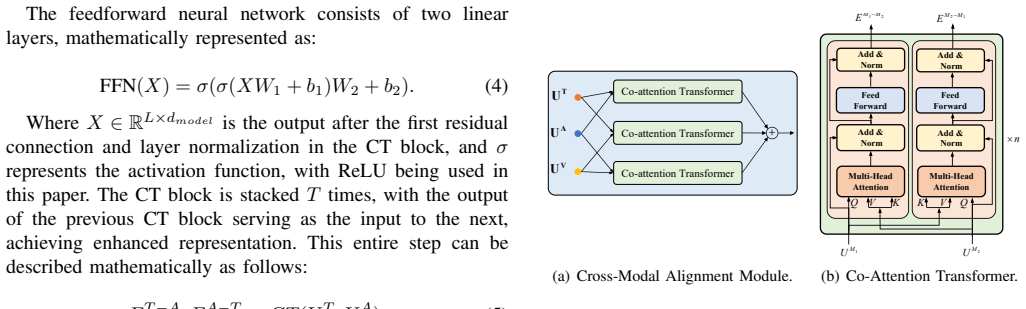
The load-bearing machinery is the pairing of three co-attention transformers (CTs), one per modality pair, each built from stacked multi-head attention blocks with symmetric query/key/value exchange; a directed dialogue graph in which every utterance node is connected by attention-weighted edges to a past window of p=10 and a future window of f=10 utterances, processed by two graph convolutional layers with DropMessage; and a two-term training objective $L = \alpha L_C + (1-\alpha)L_F + \lambda\|\theta\|$ that couples coarse-grained and fine-grained cross-entropy losses. The CTs perform modality alignment and noise reduction, the graph encodes conversational directionality and speaker dependencies, and the multi-task loss balances the emotion categories. The ablation study reports that removing either of the first two modules drops accuracy from 68.98% to roughly 66-67%.
What would settle it
Run MERC-GCN on IEMOCAP with α=0.7 chosen on a validation split and compare the weighted test accuracy to 68.98%; a reproducible drop below the best baseline would refute the state-of-the-art claim. A prior check is whether the paper's own training objective can be implemented at all, since Eqs. (22)-(24) use an undefined indexing scheme and cannot be compiled as written.
Extended reading notes
Core claim
The central claim is that MERC-GCN, a pipeline of cross-modal context fusion, adaptive graph convolutional encoding, and emotion classification, achieves state-of-the-art results on two standard multimodal conversation benchmarks. The author's position is that the improvement comes from two design choices: three co-attention transformers that let each pair of modalities attend to each other, reducing mutual interference, and a directed dialogue graph whose attention-weighted edges connect each utterance to nearby past and future utterances, capturing both inter-speaker and self-dependencies. A multi-task loss that combines coarse-grained and fine-grained emotion labels is added to stabilize per-class performance. The reported outcome is 68.98% weighted accuracy on IEMOCAP and 62.54% on MELD, with the IEMOCAP figure described as about 3% better than MMGCN and DialogueGCN and at least 10% better than the other listed baselines.
Load-bearing premise
The reported improvements assume a fair and reproducible evaluation: the same input features, train/test splits, and accuracy metric across MERC-GCN and every baseline, with the multi-task weight α chosen without seeing test labels.
Editorial extensions
If this is right
- If the reported accuracy holds, explicit pairwise cross-modal alignment before fusion is a viable way to reduce the interference that hurts naive multimodal concatenation.
- Speaker-level graph encoding is at least as important as cross-modal fusion: removing it costs more accuracy than removing the fusion module, according to the ablation study.
- Multi-task learning with coarse-grained labels narrows the accuracy gap across emotion classes, shown by the lower standard deviation of 7.83 versus 12.65 for DialogueGCN and 10.04 for DialogueRNN.
- The model's best results come from using all three modalities together; single modalities and pairs perform worse, indicating that full multimodal input is necessary for the claimed gain.
- On both datasets the optimal coarse-grained loss weight differs (0.7 on IEMOCAP, 0.5 on MELD), so the multi-task balance must be tuned per dataset.
Reading between the lines
- The comparison is made against baselines published between 2017 and 2021; a natural next test is whether the same margin holds against more recent conversation-emotion models, which the paper does not include.
- The per-dataset choice of α, reported as 0.7 for IEMOCAP and 0.5 for MELD, raises the question of whether the multi-task benefit would persist if α were fixed or selected on a validation set; this is testable by re-running with a validation-based selection.
- The architecture's co-attention blocks scale quadratically in the number of modalities, so extending beyond text, audio, and video would require a sparser alignment scheme.
- The coarse/fine label split used for IEMOCAP can be mapped onto MELD's seven classes (positive/neutral/negative), so the multi-task strategy is directly testable on other benchmark datasets.
Signed reviews
Editorial analysis
A structured set of objections, weighed in public.
Referee Report
Summary. The paper proposes MERC-GCN, a three-module architecture for multimodal emotion recognition in conversation (ERC): a cross-modal context fusion module built from co-attention transformers, an adaptive graph convolutional encoding module with DropMessage for modeling speaker dependencies, and a multi-task emotion classification module that combines coarse-grained and fine-grained losses. The authors report state-of-the-art weighted accuracy on IEMOCAP (68.98%) and MELD (62.54%), comparing against pre-2021 baselines, and they include ablations over the main modules, the context encoder, the coarse-loss weight alpha, and modality combinations. The central claim is that the proposed architectural combination yields large gains over prior methods.
Significance. If the reported results were reproducible and the comparisons were feature-controlled, the gains over MMGCN and DialogueGCN would be a useful contribution to ERC. The paper contains several commendable elements: a clearly structured three-stage design, a multi-task coarse/fine objective, ablation studies for the main components, and an explicit choice of unimodal encoders. However, the manuscript as submitted does not provide code, feature files, evaluation splits, or a matched-feature baseline comparison, and the loss equations are not implementable as printed. The significance of the empirical claim therefore cannot be assessed from the paper alone.
major comments (5)
- [Section III.B and V.A, Table I] The state-of-the-art comparison is not feature-controlled. MERC-GCN uses RoBERTa 200-d text, openSMILE 100-d audio, and DenseNet 100-d visual features, whereas the Table I baseline numbers (bc-LSTM, CMN, ICON, DialogueRNN, DialogueGCN, MMGCN) are cited from earlier publications that used different feature extractors and preprocessing. No sentence states that the baselines were retrained on the same feature sets, and no code or feature files are provided. Since unimodal features are a known dominant factor in ERC, the 3.42-point margin over MMGCN (68.98 vs 65.56) and the 3.44-point margin over DialogueGCN (68.98 vs 65.54) may be feature-backbone artifacts rather than evidence for the proposed architecture. The 'new state-of-the-art' claim is therefore not established.
- [Section III.D, Eqs. (22)-(24)] The loss functions cannot be implemented as written. Eq. (22) uses c(s) both as the number of utterances in conversation s and as the upper limit of a sum over s; the indices i and j are inconsistent between the definition of P_{i,j} and the label y^C_{j,i}, and the sums over conversations and utterances are mixed. Eq. (23) has the same problem, and Eq. (24) repeats the index swap while defining alpha only after it is used. Because the multi-task objective is one of the paper's stated contributions, this is a reproducibility defect, not a mere typographical issue.
- [Section V.A and Tables I-III] The headline metric is internally inconsistent. Table I reports IEMOCAP average accuracy as 68.98, while Tables II and III report the full-model accuracy as 69.18. The paper does not explain whether these are different runs, different metrics (weighted vs unweighted), or different test folds. Without a consistent definition of the reported metric and the evaluation split, the claimed state-of-the-art value is ambiguous.
- [Section IV and V.C.2] The evaluation protocol is underspecified. The paper does not state the train/validation/test split for IEMOCAP or MELD, does not report standard deviations across random seeds, and tunes the coarse-grained loss weight alpha separately for each dataset (0.7 for IEMOCAP, 0.5 for MELD; Section V.C.2) without saying whether the selection used a held-out validation set. If alpha was chosen on the test set, the reported improvements are not an unbiased estimate of generalization performance.
- [Section V.A] The claim that MERC-GCN is 'at least 10% better than all other models' on IEMOCAP is numerically incorrect: the gap over bc-LSTM is 9.40 points (68.98 - 59.58), and the comparison set includes models with different features and protocols. In addition, the sentence about MELD says the model achieves 62.54% 'across four emotional dimensions,' although MELD is defined in Section IV.A as having seven emotion labels. These statements should be corrected or removed.
minor comments (5)
- [Eq. (11)] The softmax in Eq. (11) is written over a row vector g_i^T W_e [g_{i-p}, ..., g_{i+f}], but the normalization dimension is not specified; please clarify whether it is over the p+f+1 context positions.
- [Eqs. (12)-(13)] The masking notation is unclear: \tilde{g} is not defined before use, and Eq. (13) mixes \alpha_{ij}, e_{ij}, and \phi_M without specifying how the mask is applied to edges.
- [Section III.C.2, Eq. (14)] The sum in Eq. (14) includes both \sum_{k\in R} and \sum_{r\in R}, but R is later used for edge types; please align the notation with the graph definition G=(V,E,R,W).
- [Fig. 1] The figure contains label artifacts ('Speak 1', 'Speak 2') that should be corrected to 'Speaker 1' and 'Speaker 2'.
- [Table I and Section IV.A] The MELD columns are not defined: the table reports only an 'Average(w)' column while the text says the model performs well 'across four emotional dimensions'; please clarify the metric and the class subset used for MELD.
Circularity Check
No significant circularity: the central claim is an external benchmark comparison using standard cited components; the flagged issues are evaluation-validity and reproducibility concerns, not circular derivation.
full rationale
The paper's core claim is an empirical accuracy comparison on IEMOCAP and MELD against externally published baselines (bc-LSTM, CMN, ICON, DialogueRNN, DialogueGCN, MMGCN). The proposed architecture combines a co-attention transformer, a BiGRU context encoder, and a graph convolutional encoder, each citing prior external work (Lu et al. [31], Chung et al. [32], Kipf and Welling [23]). There is no load-bearing self-citation: the authors do not cite their own prior work to justify a central premise, and the references listed as [10]–[15] and [21]–[22] are by Shen et al., not by the present authors. The multi-task loss uses coarse-grained labels that are defined from the fine-grained emotion labels (Section III.D), but this is a standard auxiliary-task construction, not a claim that the coarse labels are independently derived from the model. The per-dataset tuning of the coarse-grained weight alpha (0.7 for IEMOCAP, 0.5 for MELD) is ordinary hyperparameter selection; the paper does not present alpha as a fitted parameter that is then renamed a prediction. The malformed loss equations (22)–(24) and the possible feature mismatch between the proposed model and the baselines in Table I are legitimate reproducibility and evaluation-validity concerns, but they are not circularity: they do not make the reported result equivalent to the input by construction. The paper is self-contained against external benchmarks, so the appropriate finding is no significant circularity.
Assumptions & free parameters
free parameters (5)
- alpha (coarse-grained loss weight) =
0.7 (IEMOCAP), 0.5 (MELD)
- past/future context window p, f =
10 each
- number of co-attention transformer blocks T
- GCN hidden dimension and DropMessage ratio
- lambda (L2 regularization weight)
assumptions (5)
- domain assumption Emotional expressions are conveyed through language, facial expression, and vocal tone, and these modalities are complementary and interdependent.
- domain assumption Conversations are sequential, and contextual information flows along the sequence.
- domain assumption Every utterance affects and is affected by all other utterances, including itself.
- ad hoc to paper Emotions can be mapped to coarse classes: happy/excited are positive, neutral is neutral, others are negative.
- domain assumption RoBERTa, openSMILE, and DenseNet features are sufficient and comparable for the ERC task across IEMOCAP and MELD.
Cite this review
Pith. "Pith review of Cross-modal Context Fusion and Adaptive Graph Convolutional Network for Multimodal Conversational Emotion Recognition." pith.science (2026). https://pith.science/paper/CYU2DK7M
@misc{pith2026250115063,
  author       = {Pith},
  title        = {Pith review of: Cross-modal Context Fusion and Adaptive Graph Convolutional Network for Multimodal Conversational Emotion Recognition},
  year         = {2026},
  howpublished = {\url{https://pith.science/paper/CYU2DK7M}},
  note         = {Machine review of arXiv:2501.15063}
}
read the original abstract
Emotion recognition has a wide range of applications in human-computer interaction, marketing, healthcare, and other fields. In recent years, the development of deep learning technology has provided new methods for emotion recognition. Prior to this, many emotion recognition methods have been proposed, including multimodal emotion recognition methods, but these methods ignore the mutual interference between different input modalities and pay little attention to the directional dialogue between speakers. Therefore, this article proposes a new multimodal emotion recognition method, including a cross modal context fusion module, an adaptive graph convolutional encoding module, and an emotion classification module. The cross modal context module includes a cross modal alignment module and a context fusion module, which are used to reduce the noise introduced by mutual interference between different input modalities. The adaptive graph convolution module constructs a dialogue relationship graph for extracting dependencies and self dependencies between speakers. Our model has surpassed some state-of-the-art methods on publicly available benchmark datasets and achieved high recognition accuracy.
Figures


Figures from the paper (1 more)

Forward citations
Cited by 1 Pith paper
-
Multimodal Emotion Recognition in Conversations: A Survey of Methods, Trends, Challenges and Prospects
A structured review of multimodal emotion recognition in conversations, covering datasets, feature processing, methods, and open challenges, with emphasis on recent LLM-based approaches.
Reference graph
Works this paper leans on
-
[1]
Erc dmsp: Emotion recognition in conversation based on dynamic modeling of speaker personalities,
X. Li, Z. Yang, Z. Li, and Y . Li, “Erc dmsp: Emotion recognition in conversation based on dynamic modeling of speaker personalities,” in 2024 International Joint Conference on Neural Networks (IJCNN), 2024, pp. 1–10
work page 2024
-
[2]
Modeling sentiment-speaker- dependency for emotion recognition in conversation,
L. Ge, F. Huang, Q. Li, and Y . Ye, “Modeling sentiment-speaker- dependency for emotion recognition in conversation,” in 2024 Inter- national Joint Conference on Neural Networks (IJCNN) , 2024, pp. 1–8
work page 2024
-
[3]
D-man: a distance- based multi-channel attention network for erc,
F. Xu, G. Li, Z. Zhong, Y . Zhou, and W. Zhou, “D-man: a distance- based multi-channel attention network for erc,” in 2024 International Joint Conference on Neural Networks (IJCNN) , 2024, pp. 1–8
work page 2024
-
[4]
Ctf-erc: Coarse-to-fine rea- soning for emotion recognition in conversations,
F. Xu, T. Sun, W. Zhou, Z. Yu, and J. Lu, “Ctf-erc: Coarse-to-fine rea- soning for emotion recognition in conversations,” in 2024 International Joint Conference on Neural Networks (IJCNN) , 2024, pp. 1–8
work page 2024
-
[5]
M. Jagadeesh, S. Viswanathan, and S. Varadarajan, “Deep learning approaches for effective human computer interaction: A comprehensive survey on single and multimodal emotion detection,” in 2024 IEEE 9th International Conference for Convergence in Technology (I2CT). IEEE, 2024, pp. 1–8
work page 2024
-
[6]
Deep learning in digital marketing: brand detection and emotion recognition,
B. Ribeiro, G. Oliveira, A. Laranjeira, and J. P. Arrais, “Deep learning in digital marketing: brand detection and emotion recognition,” Interna- tional Journal of Machine Intelligence and Sensory Signal Processing , vol. 2, no. 1, pp. 32–50, 2017
work page 2017
-
[7]
Cnn based face emotion recognition system for healthcare application,
R. K. Kanna, B. S. Panigrahi, S. K. Sahoo, A. R. Reddy, Y . Manchala, and N. K. Swain, “Cnn based face emotion recognition system for healthcare application,” EAI Endorsed Transactions on Pervasive Health and Technology, vol. 10, 2024
work page 2024
-
[8]
S. K. Khare, V . Blanes-Vidal, E. S. Nadimi, and U. R. Acharya, “Emotion recognition and artificial intelligence: A systematic review (2014–2023) and research recommendations,” Information fusion , vol. 102, p. 102019, 2024
work page 2014
Show all 35 references
-
[9]
Multimodal emotion recognition with deep learning: advancements, challenges, and future directions,
A. Geetha, T. Mala, D. Priyanka, and E. Uma, “Multimodal emotion recognition with deep learning: advancements, challenges, and future directions,” Information Fusion, vol. 105, p. 102218, 2024
2024
-
[10]
Enhancing aerial object detec- tion with selective frequency interaction network,
W. Weng, M. Wei, J. Ren, and F. Shen, “Enhancing aerial object detec- tion with selective frequency interaction network,” IEEE Transactions on Artificial Intelligence , vol. 1, no. 01, pp. 1–12, 2024
2024
-
[11]
Lr-fpn: Enhancing remote sensing object detection with location refined feature pyramid network,
H. Li, R. Zhang, Y . Pan, J. Ren, and F. Shen, “Lr-fpn: Enhancing remote sensing object detection with location refined feature pyramid network,” arXiv preprint arXiv:2404.01614 , 2024
2024 arXiv
-
[12]
Triplet contrastive learning for unsupervised vehicle re-identification,
F. Shen, X. Du, L. Zhang, and J. Tang, “Triplet contrastive learning for unsupervised vehicle re-identification,” arXiv preprint arXiv:2301.09498, 2023
2023 arXiv
-
[13]
Imagdressing-v1: Customizable virtual dressing,
F. Shen, X. Jiang, X. He, H. Ye, C. Wang, X. Du, Z. Li, and J. Tang, “Imagdressing-v1: Customizable virtual dressing,” arXiv preprint arXiv:2407.12705, 2024
2024 arXiv
-
[14]
Imagpose: A unified conditional framework for pose-guided person generation,
F. Shen and J. Tang, “Imagpose: A unified conditional framework for pose-guided person generation,” in The Thirty-eighth Annual Conference on Neural Information Processing Systems , 2024
2024
-
[15]
Boosting consistency in story visualization with rich-contextual condi- tional diffusion models,
F. Shen, H. Ye, S. Liu, J. Zhang, C. Wang, X. Han, and W. Yang, “Boosting consistency in story visualization with rich-contextual condi- tional diffusion models,” arXiv preprint arXiv:2407.02482 , 2024
2024 arXiv
-
[16]
Context-dependent sentiment analysis in user-generated videos
S. Poria, E. Cambria, D. Hazarika, N. Majumder, A. Zadeh, and L.- P. Morency, “Context-dependent sentiment analysis in user-generated videos.” in Proceedings of the 55th Annual Meeting of the Association for Computational Linguistics (Volume 1: Long Papers) , Jan 2017
2017
-
[17]
Conversational memory network for emotion recognition in dyadic dialogue videos
D. Hazarika, S. Poria, A. Zadeh, E. Cambria, L.-P. Morency, and R. Zim- mermann, “Conversational memory network for emotion recognition in dyadic dialogue videos.” in Proceedings of the 2018 Conference of the North American Chapter of the Association for Computational Linguist...
2018
-
[18]
Dialoguernn: An attentive rnn for emotion detection in conversations,
N. Majumder, S. Poria, D. Hazarika, R. Mihalcea, A. Gelbukh, and E. Cambria, “Dialoguernn: An attentive rnn for emotion detection in conversations,” Proceedings of the AAAI Conference on Artificial Intelligence, p. 6818–6825, Aug 2019
2019
-
[19]
Dia- loguegcn: A graph convolutional neural network for emotion recognition in conversation,
D. Ghosal, N. Majumder, S. Poria, N. Chhaya, and A. Gelbukh, “Dia- loguegcn: A graph convolutional neural network for emotion recognition in conversation,” International Joint Conference on Natural Language Processing,International Joint Conference on Natural Language Pro- ces...
2019
-
[20]
Mmgcn: Multimodal fusion via deep graph convolution network for emotion recognition in conversation,
J. Hu, Y . Liu, J. Zhao, and Q. Jin, “Mmgcn: Multimodal fusion via deep graph convolution network for emotion recognition in conversation,” in Proceedings of the 59th Annual Meeting of the Association for Computational Linguistics and the 11th International Joint Conference on...
2021
-
[21]
Git: Graph interactive transformer for vehicle re-identification,
F. Shen, Y . Xie, J. Zhu, X. Zhu, and H. Zeng, “Git: Graph interactive transformer for vehicle re-identification,” IEEE Transactions on Image Processing, 2023
2023
-
[22]
Pedestrian-specific bipartite-aware similarity learning for text-based person retrieval,
F. Shen, X. Shu, X. Du, and J. Tang, “Pedestrian-specific bipartite-aware similarity learning for text-based person retrieval,” in Proceedings of the 31th ACM International Conference on Multimedia , 2023
2023
-
[23]
Semi-supervised classification with graph convolutional networks,
T. Kipf and M. Welling, “Semi-supervised classification with graph convolutional networks,” arXiv: Learning,arXiv: Learning , Sep 2016
2016
-
[24]
Inductive representation learn- ing on large graphs,
W. Hamilton, Z. Ying, and J. Leskovec, “Inductive representation learn- ing on large graphs,” Neural Information Processing Systems,Neural Information Processing Systems , Jun 2017
2017
-
[25]
Liu and J
Z. Liu and J. Zhou, Graph Attention Networks , Jan 2020, p. 39–41
2020
-
[26]
Z. Liu, W. Lin, Y . Shi, and J. Zhao, A Robustly Optimized BERT Pre- training Approach with Post-training , Jan 2021, p. 471–484
2021
-
[27]
Bert: Pre-training of deep bidirectional transformers for language understanding,
J. Devlin, M.-W. Chang, K. Lee, and K. Toutanova, “Bert: Pre-training of deep bidirectional transformers for language understanding,” in Pro- ceedings of the 2019 Conference of the North , Jan 2019
2019
-
[28]
Opensmile: the munich versatile and fast open-source audio feature extractor,
F. Eyben, M. W ¨ollmer, and B. Schuller, “Opensmile: the munich versatile and fast open-source audio feature extractor,” in Proceedings of the 18th ACM international conference on Multimedia , 2010, pp. 1459–1462
2010
-
[29]
Densely connected convolutional networks,
G. Huang, Z. Liu, L. Van Der Maaten, and K. Q. Weinberger, “Densely connected convolutional networks,” in 2017 IEEE Conference on Com- puter Vision and Pattern Recognition (CVPR) , Jul 2017
2017
-
[30]
Deep residual learning for image recognition,
K. He, X. Zhang, S. Ren, and J. Sun, “Deep residual learning for image recognition,” in 2016 IEEE Conference on Computer Vision and Pattern Recognition (CVPR), Jun 2016
2016
-
[31]
Hierarchical question-image co- attention for visual question answering,
J. Lu, J. Yang, D. Batra, and D. Parikh, “Hierarchical question-image co- attention for visual question answering,” Neural Information Processing Systems,Neural Information Processing Systems , Jan 2016
2016
-
[32]
Empirical evaluation of gated recurrent neural networks on sequence modeling,
J.-Y . Chung, C. Gulcehre, K. Cho, and Y . Bengio, “Empirical evaluation of gated recurrent neural networks on sequence modeling,” arXiv: Neural and Evolutionary Computing,arXiv: Neural and Evolutionary Computing, Dec 2014
2014
-
[33]
Iemocap: interactive emotional dyadic motion capture database,
C. Busso, M. Bulut, C.-C. Lee, A. Kazemzadeh, E. Mower, S. Kim, J. N. Chang, S. Lee, and S. S. Narayanan, “Iemocap: interactive emotional dyadic motion capture database,” Language Resources and Evaluation , p. 335–359, Dec 2008
2008
-
[34]
Icon: Interactive conversational memory network for multimodal emo- tion detection,
D. Hazarika, S. Poria, R. Mihalcea, E. Cambria, and R. Zimmermann, “Icon: Interactive conversational memory network for multimodal emo- tion detection,” in Proceedings of the 2018 Conference on Empirical Methods in Natural Language Processing , Jan 2018
2018
-
[35]
Meld: A multimodal multi-party dataset for emotion recognition in conversations,
S. Poria, D. Hazarika, N. Majumder, G. Naik, E. Cambria, and R. Mihal- cea, “Meld: A multimodal multi-party dataset for emotion recognition in conversations,” arXiv preprint arXiv:1810.02508 , 2018
2018 arXiv
Reviewed August 10, 2026 · model on record in the stance chip above.
Discussion (0). Continue with ORCID to comment.