Probing String-Theory-Inspired Topologies of the Early Universe through CMB Temperature and Polarization Anisotropies
Pith reviewed 2026-05-20 03:59 UTC · model grok-4.3
The pith
Planck CMB data may indicate six extra dimensions compactified before inflation via parity breaking signals.
A machine-rendered reading of the paper's core claim, the machinery that carries it, and where it could break.
Core claim
Within the current experimental and theoretical uncertainties, we identify a possible indication closely related to spatial-parity breaking, consistent with the presence of six spatial extra dimensions in the early Universe, compactified at the GUT epoch before the start of inflation. The work reexamines temperature and polarization angular correlations as probes of pre-inflationary geometry and topology, analyzing the impact of toroidal compactification on the primordial power spectrum provided by Planck.
What carries the argument
Toroidal compactification of six extra dimensions and its resulting effects on large-angular-scale two-point correlation functions in the CMB temperature and polarization power spectra.
If this is right
- Nontrivial spatial topology signatures may survive in large-angular-scale CMB correlations as relics of primordial physics.
- B-mode polarization measurements could act as a sensitive probe in forthcoming ground-based and space-borne experiments.
- The primordial power spectrum receives modifications from string-theory-inspired toroidal compactifications.
- Compactification at the GUT epoch before inflation can produce observable parity-breaking effects consistent with current data uncertainties.
Where Pith is reading between the lines
- Confirmation would constrain the relative timing of extra-dimension compactification and the onset of inflation in string models.
- Future experiments with better large-scale sensitivity could separate this signal from conventional inflationary explanations.
- The approach links specific CMB anomalies to fundamental topology questions beyond the paper's direct analysis.
- Extensions might test similar effects in other cosmological observables like large-scale structure.
Load-bearing premise
The observed large-angular-scale two-point correlations in Planck temperature and polarization data are relics of nontrivial spatial topology from extra dimensions rather than standard inflationary fluctuations, foregrounds, or statistical fluctuations.
What would settle it
Higher-precision future CMB polarization data at large scales showing no parity-breaking signal or fully matching standard predictions without extra dimensions would falsify the proposed indication.
Figures





read the original abstract
TeV string-mass-scale strings have been excluded experimentally at colliders, as their effects have not been observed at the Large Hadron Collider (CERN). On the other hand, higher-scale string theory, with mass scales typically close to the Planck scale, is often regarded as experimentally inaccessible due to the enormous energies required for direct tests, and far beyond the reach of present or foreseeable particle accelerators. Nevertheless, the early Universe may provide an indirect observational window for high-string scale through imprints left on the Cosmic Microwave Background (CMB). In this work, building on previous studies, we reexamine temperature and polarization angular correlations as probes of the geometry and topology of the pre-inflationary Universe. We focus in particular on two-point correlation functions at large angular scales, where signatures of nontrivial spatial topology may survive as relics of primordial physics. We investigate the observational consequences of toroidal compactification and analyze their impact on the primordial power spectrum of the CMB provided by the Planck satellite. Within the current experimental and theoretical uncertainties, we identify a possible indication closely related to spatial-parity breaking, consistent with the presence of six spatial extra dimensions in the early Universe, compactified at the GUT epoch before the start of inflation. Finally, we extend our framework to B-mode polarization, highlighting its potential as a sensitive probe in forthcoming ground-based and space-borne experiments with unprecedented precision.
Editorial analysis
A structured set of objections, weighed in public.
Referee Report
Summary. The paper reexamines large-angular-scale two-point correlations in Planck CMB temperature and polarization data as potential relics of nontrivial spatial topology in the pre-inflationary Universe. Building on prior studies, it analyzes the effects of toroidal compactification with six extra dimensions on the primordial power spectrum, identifying a possible spatial-parity-breaking signature consistent with compactification at the GUT epoch before inflation. The framework is extended to B-mode polarization as a probe for future experiments.
Significance. If the parity-odd correlations at low multipoles are shown to arise specifically from the proposed extra-dimensional topology rather than standard inflationary fluctuations or systematics, the result would provide a rare indirect cosmological window on high-scale string theory, constraining the number and epoch of compactified dimensions in a manner not accessible to colliders.
major comments (2)
- [§3] §3: The modified primordial power spectrum with parity-breaking terms is introduced as arising from the six-dimensional toroidal compactification, but no explicit derivation from the compactification geometry or transfer function is provided to establish why this signature is unique to six dimensions or distinguishable from generic parity-violating extensions.
- [§4] §4: The consistency claim with six extra dimensions relies on an after-the-fact interpretation of low-ℓ Planck correlations without a parameter-free prediction for the amplitude or a quantitative assessment of how the GUT-epoch scale maps to the observed parity-odd signal strength, leaving the result vulnerable to alternative explanations such as residual systematics.
minor comments (2)
- [Introduction] The distinction between results from the current analysis and those in the cited prior works by overlapping authors should be stated more explicitly in the introduction to clarify the incremental advance.
- Notation for the parity-odd components of the power spectra (e.g., TT, TE, EE) should be aligned with standard conventions in the CMB literature to improve readability.
Simulated Author's Rebuttal
We thank the referee for their careful reading and insightful comments on our manuscript. We address each of the major comments below and have incorporated revisions to improve the clarity and rigor of the presentation.
read point-by-point responses
-
Referee: [§3] §3: The modified primordial power spectrum with parity-breaking terms is introduced as arising from the six-dimensional toroidal compactification, but no explicit derivation from the compactification geometry or transfer function is provided to establish why this signature is unique to six dimensions or distinguishable from generic parity-violating extensions.
Authors: We acknowledge that an explicit derivation from the compactification geometry was not detailed in the main text. The form of the modified power spectrum is derived from the Kaluza-Klein mode expansion on a six-dimensional toroidal manifold, leading to parity-odd terms that affect the low-multipole correlations in a manner specific to the number of compact dimensions. To address this concern, we will add an appendix providing the key steps of this derivation, including how the transfer function incorporates the topology-induced modifications. This helps distinguish the signature from generic parity-violating extensions, which lack the specific dependence on the compactification scale at the GUT epoch. revision: yes
-
Referee: [§4] §4: The consistency claim with six extra dimensions relies on an after-the-fact interpretation of low-ℓ Planck correlations without a parameter-free prediction for the amplitude or a quantitative assessment of how the GUT-epoch scale maps to the observed parity-odd signal strength, leaving the result vulnerable to alternative explanations such as residual systematics.
Authors: The referee correctly points out that our analysis involves fitting the observed parity-odd correlations to the model rather than a blind prediction. The amplitude is not parameter-free as it depends on the exact value of the compactification radius and the duration of the pre-inflationary phase. In the revised version, we will include a quantitative estimate of how the GUT-scale compactification radius translates to the angular scale and amplitude of the signal, along with a discussion of how this could be distinguished from systematics. We have also revised the language in the abstract and conclusions to describe this as a 'possible indication' consistent with the model, rather than a stronger claim. revision: partial
Circularity Check
Parity-breaking CMB signature and six-extra-dimension claim reduce to self-cited prior framework without independent derivation.
specific steps
-
self citation load bearing
[Abstract]
"In this work, building on previous studies, we reexamine temperature and polarization angular correlations as probes of the geometry and topology of the pre-inflationary Universe. We focus in particular on two-point correlation functions at large angular scales, where signatures of nontrivial spatial topology may survive as relics of primordial physics. We investigate the observational consequences of toroidal compactification and analyze their impact on the primordial power spectrum of the CMB provided by the Planck satellite. Within the current experimental and theoretical uncertainties, we "
The toroidal-compactification framework and the specific parity-breaking terms in the primordial spectrum are imported via the 'building on previous studies' clause. The claimed consistency with six extra dimensions compactified at the GUT epoch is therefore a reinterpretation of quantities already fixed in the cited prior work rather than a derivation from the topology in this manuscript.
-
ansatz smuggled in via citation
[Sections 3-4 (per skeptic description)]
"Section 3 and 4 appear to postulate a modified primordial power spectrum with parity-breaking terms induced by the extra-dimensional torus"
The parity-odd modification is postulated rather than derived from the six-torus geometry; the paper treats the form as given by the earlier self-cited framework, so the 'indication' of six dimensions is not a necessary consequence but a fit to the imported ansatz.
full rationale
The paper's central result identifies a 'possible indication' of six extra dimensions via parity-odd large-scale correlations. This rests on a modified primordial power spectrum whose parity-breaking terms are introduced by building on previous studies by the same authors. No first-principles derivation or uniqueness argument appears in the present text; the consistency claim is therefore an after-the-fact mapping onto the earlier ansatz rather than a new prediction.
Axiom & Free-Parameter Ledger
axioms (1)
- domain assumption Toroidal compactification of six spatial extra dimensions occurs at the GUT epoch before inflation
Lean theorems connected to this paper
-
IndisputableMonolith/Foundation/AlexanderDuality.leanalexander_duality_circle_linking contradicts?
contradictsCONTRADICTS: the theorem conflicts with this paper passage, or marks a claim that would need revision before publication.
we identify a possible indication ... consistent with the presence of six spatial extra dimensions in the early Universe, compactified at the GUT epoch
-
IndisputableMonolith/Foundation/AlexanderDuality.leanD3_admits_circle_linking contradicts?
contradictsCONTRADICTS: the theorem conflicts with this paper passage, or marks a claim that would need revision before publication.
N_extra = 2 N_tori ... N_tori = 3 ... six compactified extra dimensions
What do these tags mean?
- matches
- The paper's claim is directly supported by a theorem in the formal canon.
- supports
- The theorem supports part of the paper's argument, but the paper may add assumptions or extra steps.
- extends
- The paper goes beyond the formal theorem; the theorem is a base layer rather than the whole result.
- uses
- The paper appears to rely on the theorem as machinery.
- contradicts
- The paper's claim conflicts with a theorem or certificate in the canon.
- unclear
- Pith found a possible connection, but the passage is too broad, indirect, or ambiguous to say the theorem truly supports the claim.
Reference graph
Works this paper leans on
-
[1]
Geometry and topology of extra dimensions and the rise of Infrared cutoffs Starting from a primordial scalar field in the early Universe, we adopt essentially the same assumptions as in [2, 3], whereby infrared (IR) cutoffs arise naturally from the geometry and topology of the early Universe. The key difference here is that, instead of a single energy (or...
-
[2]
flat” torus is constructed from a rectangle with its opposite sides identified (“glued
Layout of the Article The structure of this article is as follows. In Section II, we review the basic features of toroidal-orbifold compacti- fications of ten-dimensional superstrings down to (3+1) large (uncompactified) spacetime dimensions, and show how the aforementioned infrared cutoffs arise in the spectrum of a scalar field (e.g., the inflaton in re...
-
[3]
The case of one extra dimension and IR cutoffs, as a warm up Before proceeding with the KK spectrum, and the relevance t our IR cutoff discussion here, let us first review the instructive case of one extra dimensional case of [2, 3] where the extra dimension is a circle of radiusR, but the segment is orbifoldised, that is, it is viewed as afundamentalregi...
-
[4]
KK mass spectrum in theT 6/(Z2 ⊗Z 2)case Extension to theT 6/(Z2 ⊗Z 2) case is straightforward, yielding the KK mass spectrum: M2 = 3X i=1 κ2 i R2 i , κ i = ni,Neumann ni,Dirichlet (n i ≥1). ni + 1 2 ,Mixed (2.17) Hence, the Neumann boundary condition allows for a zero mode, whilst the Dirichlet one removes it. The Mixed boundary conditions, on ...
-
[5]
The Geometry The compact coordinates satisfy the periodic identifications yA ∼y A + 2πRA, A= 1, . . . ,6.(2.18) The metric of the compact space can be written as ds2 = 6X A=1 (dyA)2.(2.19) The total volume of the six–torus is therefore V6 = 6Y A=1 (2πRA) = (2π)6 6Y A=1 RA.(2.20) We next proceed to discuss the KK spectrum
-
[6]
Kaluza–Klein Expansion ands Mass spectrum Consider a scalar fieldϕ(x, y) propagating onM 4 ⊗T 6, whereM 4 is the (3+1)-dimensional spacetime, which in the case of the early Universe describes the appropriate cosmological time. For our purposes here we ignore details of the cosmological expansion, and assume the spaceM 4 flat, for all practical purposes. T...
-
[7]
Scalar power spectrum In studies of CMB temperature anisotropies, the primordial power spectrum characterizes the statistical distribution of the initial cosmological perturbations generated in the early Universe, typically during inflation. It is defined in Fourier space as the variance of the primordial curvature (or density) perturbation amplitudes per...
-
[8]
Tensor power spectrum For tensor modes, an expression analogous to Eq. (III A 1) applies: P T (k) =A t k k∗ nt (3.3) where, for historical reasons, the spectral index is defined without the−1 offset. The relative weight of tensor to scalar modes is conveniently parametrized by the ratior(k ∗) =P T /P S. This quantity plays a fundamental role in CMB polari...
work page 2000
-
[9]
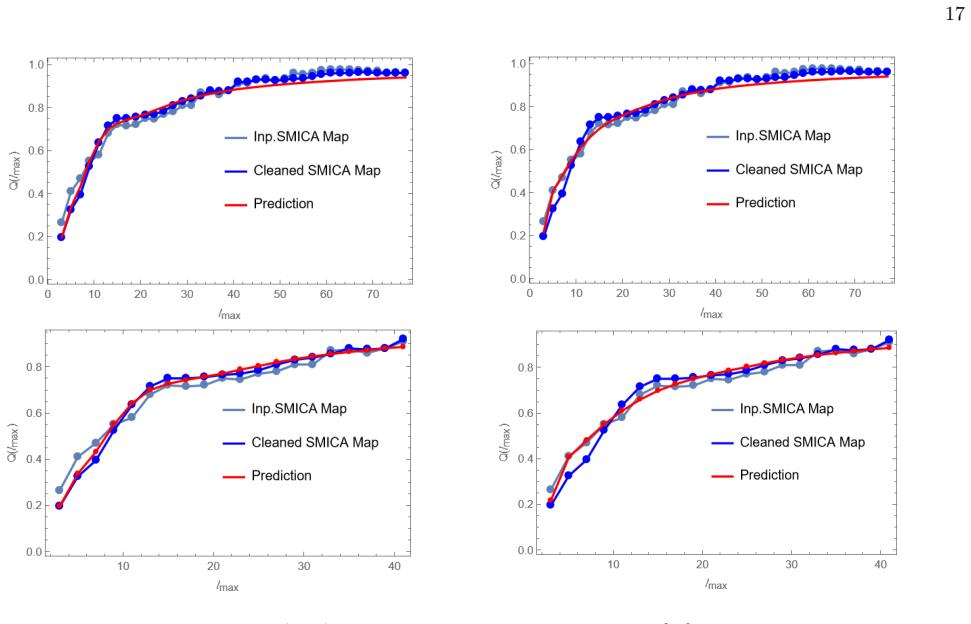
In both panels, the observed and theoretical points are connected by straight segments to better visualize the postulated underlying sawtooth structure, characterized by successive peaks and valleys, as a consequence of the IR cutoffs. IV. NEW ANALYSIS OF ANGULAR CORRELATIONS In this work, we reexamine large angular scales detail. The main differences wit...
-
[10]
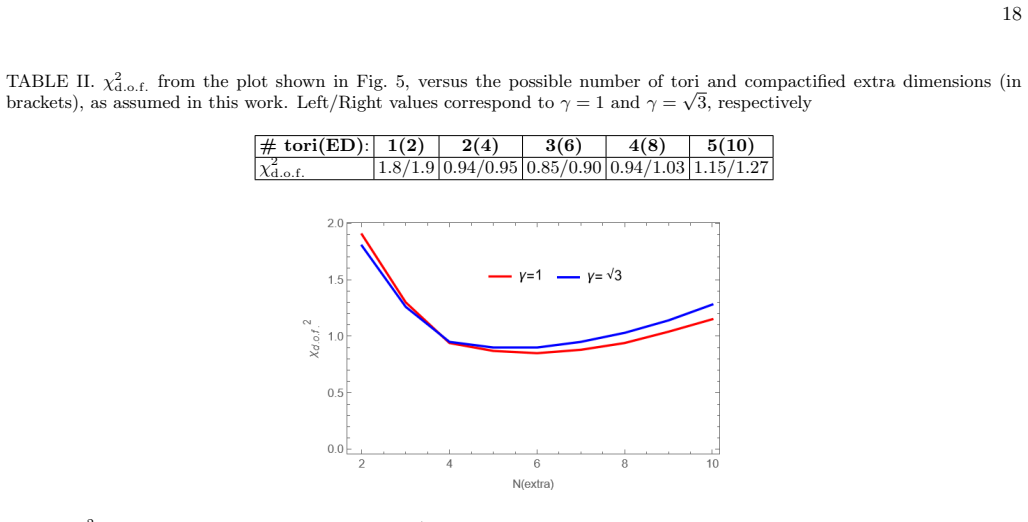
Lower panels: the same forℓ <41. FIG. 7. Parity statisticQ(ℓ max) versusℓ max for different SMICA masks [41], versus the theoretical prediction forγ01. Left panel:ℓ <77 and right panelℓ <41. V. TESTING THE NUMBER OF EXTRA DIMENSIONS In the analysis below, we allow for the possibility that the number of tori (N tori) differs from three, and therefore that ...
-
[11]
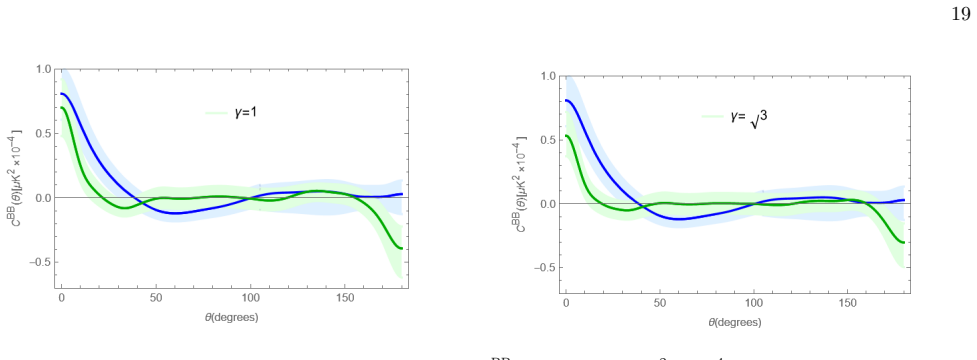
The blue curve corresponds to the case without cutoffs, while the green curve includes tensor IR cutoffs obtained from previous fits to the temperature power spectrum. The shaded bands represent cosmic variance, assuming ideal performance without instrumental noise or gravitational lensing. A distinctive signature emerges when comparing small and large an...
-
[12]
Addressing observational tensions in cosmology with systematics and fundamental physics (CosmoVerse)
for the case of a single extra dimension; here, we extend the analysis to six compactified dimensions. We stress that although the underlying physics is common to both temperature and B-mode polarization anal- yses, the associated phenomenology and detection methodologies differ. Consequently, the observation of a similar asymmetry in polarization would p...
-
[13]
Sanchis-Lozano, Universe8, 396 (2022), arXiv:2205.13257 [astro-ph.CO]
M.-A. Sanchis-Lozano, Universe8, 396 (2022), arXiv:2205.13257 [astro-ph.CO]
-
[14]
Sanchis-Lozano, Universe11, 306 (2025), arXiv:2509.22106 [astro-ph.CO]
M.-A. Sanchis-Lozano, Universe11, 306 (2025), arXiv:2509.22106 [astro-ph.CO]
-
[15]
M.-A. Sanchis-Lozano and V. Sanz, Phys. Rev. D109, 063529 (2024), arXiv:2312.02740 [astro-ph.CO]
-
[17]
2-Point Correlations in the COBE DMR 4-Year Anisotropy Maps
G. Hinshaw, A. J. Banday, C. L. Bennett, K. M. Gorski, A. Kogut, C. H. Lineweaver, G. F. Smoot, and E. L. Wright, Astrophys. J. Lett.464, L25 (1996), arXiv:astro-ph/9601061
work page internal anchor Pith review Pith/arXiv arXiv 1996
-
[18]
C. L. Bennettet al.(WMAP), Astrophys. J. Suppl.208, 20 (2013), arXiv:1212.5225 [astro-ph.CO]
work page internal anchor Pith review Pith/arXiv arXiv 2013
-
[19]
P. A. R. Adeet al.(Planck), Astron. Astrophys.594, A18 (2016), arXiv:1502.01593 [astro-ph.CO]
work page internal anchor Pith review Pith/arXiv arXiv 2016
-
[20]
Lack of angular correlation and odd-parity preference in CMB data
J. Kim and P. Naselsky, Astrophys. J.739, 79 (2011), arXiv:1011.0377 [astro-ph.CO]
work page internal anchor Pith review Pith/arXiv arXiv 2011
-
[21]
K. Land and J. Magueijo, Phys. Rev. D72, 101302 (2005), arXiv:astro-ph/0507289
work page internal anchor Pith review Pith/arXiv arXiv 2005
- [22]
-
[23]
J. F. Donoghue, E. Golowich, and B. R. Holstein,Dynamics of the Standard Model: Second edition(Cambridge University Press, 2022)
work page 2022
- [24]
-
[25]
Models of Scherk-Schwarz Symmetry Breaking in 5D: Classification and Calculability
R. Barbieri, L. J. Hall, and Y. Nomura, Nucl. Phys. B624, 63 (2002), arXiv:hep-th/0107004
work page internal anchor Pith review Pith/arXiv arXiv 2002
-
[26]
M. Z. Hasan and C. L. Kane, Rev. Mod. Phys.82, 3045 (2010), arXiv:1002.3895 [cond-mat.mes-hall]
work page internal anchor Pith review Pith/arXiv arXiv 2010
-
[27]
R. Gabbrielli, Y. Jiao, and S. Torquato, Physical Review E89, 10.1103/physreve.89.022133 (2014)
-
[28]
String Amplitudes and N=2, d=4 Prepotential in Heterotic K3 x T^2 Compactifications
K. Forger and S. Stieberger, Nucl. Phys. B514, 135 (1998), arXiv:hep-th/9709004
work page internal anchor Pith review Pith/arXiv arXiv 1998
- [29]
-
[30]
Classification of symmetric toroidal orbifolds
M. Fischer, M. Ratz, J. Torrado, and P. K. S. Vaudrevange, JHEP1, 84, arXiv:1209.3906 [hep-th]
work page internal anchor Pith review Pith/arXiv arXiv
-
[31]
${\cal N}=2$ heterotic string compactifications on orbifolds of $K3\times T^2$
A. Chattopadhyaya and J. R. David, JHEP1, 37, arXiv:1611.01893 [hep-th]
work page internal anchor Pith review Pith/arXiv arXiv
-
[32]
Asymmetric orbifolds with vanishing one-loop vacuum energy
V. Larotonda, M. Montero, and M. Tartaglia, 1 (2026), arXiv:2602.07113 [hep-th]
work page internal anchor Pith review Pith/arXiv arXiv 2026
-
[33]
M. B. Green, J. H. Schwarz, and E. Witten,Superstring Theory Vol. 1: 25th Anniversary Edition, Cambridge Monographs on Mathematical Physics (Cambridge University Press, 2012)
work page 2012
-
[34]
J. E. Lidsey, D. Wands, and E. J. Copeland, Phys. Rept.337, 343 (2000), arXiv:hep-th/9909061
work page internal anchor Pith review Pith/arXiv arXiv 2000
-
[35]
Y. Akramiet al.(Planck), Astron. Astrophys.641, A7 (2020), arXiv:1906.02552 [astro-ph.CO]
-
[36]
Observational Signatures and Non-Gaussianities of General Single Field Inflation
X. Chen, M.-x. Huang, S. Kachru, and G. Shiu, JCAP1, 2, arXiv:hep-th/0605045
work page internal anchor Pith review Pith/arXiv arXiv
-
[37]
Primordial non-gaussianities from multiple-field inflation
D. Seery and J. E. Lidsey, JCAP9, 11, arXiv:astro-ph/0506056
work page internal anchor Pith review Pith/arXiv arXiv
-
[38]
Non-Gaussianities in two-field inflation
F. Vernizzi and D. Wands, JCAP5, 19, arXiv:astro-ph/0603799
work page internal anchor Pith review Pith/arXiv arXiv
-
[39]
Exploring Two-Field Inflation in the Wess-Zumino Model
J. Ellis, N. E. Mavromatos, and D. J. Mulryne, JCAP5, 12, arXiv:1401.6078 [astro-ph.CO]
work page internal anchor Pith review Pith/arXiv arXiv
-
[40]
Testing Parity-Violating Mechanisms with Cosmic Microwave Background Experiments
V. Gluscevic and M. Kamionkowski, Phys. Rev. D81, 123529 (2010), arXiv:1002.1308 [astro-ph.CO]
work page internal anchor Pith review Pith/arXiv arXiv 2010
- [41]
-
[42]
F. Melia and M. Lopez-Corredoira, Astron. Astrophys.610, A87 (2018), arXiv:1712.07847 [astro-ph.CO]
work page internal anchor Pith review Pith/arXiv arXiv 2018
-
[43]
Planck 2018 results. X. Constraints on inflation
Y. Akramiet al.(Planck), Astron. Astrophys.641, A10 (2020), arXiv:1807.06211 [astro-ph.CO]
work page internal anchor Pith review Pith/arXiv arXiv 2020
-
[44]
Planck 2018 results. VI. Cosmological parameters
N. Aghanimet al.(Planck), Astron. Astrophys.641, A6 (2020), [Erratum: Astron.Astrophys. 652, C4 (2021)], arXiv:1807.06209 [astro-ph.CO]
work page internal anchor Pith review Pith/arXiv arXiv 2020
-
[45]
Mukhanov,Physical Foundations of Cosmology(Cambridge University Press, Oxford, 2005)
V. Mukhanov,Physical Foundations of Cosmology(Cambridge University Press, Oxford, 2005)
work page 2005
- [46]
-
[47]
C. Hogan and S. S. Meyer, Class. Quant. Grav.39, 055004 (2022), arXiv:2109.11092 [gr-qc]
-
[48]
C. R. Contaldi, M. Peloso, L. Kofman, and A. D. Linde, JCAP07, 002, arXiv:astro-ph/0303636
work page internal anchor Pith review Pith/arXiv arXiv
- [49]
- [50]
-
[51]
C. J. Copi, D. Huterer, D. J. Schwarz, and G. D. Starkman, Adv. Astron.2010, 847541 (2010), arXiv:1004.5602 [astro- ph.CO]
work page internal anchor Pith review Pith/arXiv arXiv 2010
-
[52]
J. Creswell and P. Naselsky, JCAP03, 103, arXiv:2102.13442 [astro-ph.CO]
- [53]
-
[54]
P. K. Aluri and P. Jain, Mon. Not. Roy. Astron. Soc.419, 3378 (2012), arXiv:1108.5894 [astro-ph.CO]. 25
work page internal anchor Pith review Pith/arXiv arXiv 2012
- [55]
-
[56]
The Quest for B Modes from Inflationary Gravitational Waves
M. Kamionkowski and E. D. Kovetz, Ann. Rev. Astron. Astrophys.54, 227 (2016), arXiv:1510.06042 [astro-ph.CO]
work page internal anchor Pith review Pith/arXiv arXiv 2016
-
[57]
Ach´ ucarroet al., Inflation: Theory and Observations (2022), arXiv:2203.08128 [astro-ph.CO]
A. Ach´ ucarroet al., Inflation: Theory and Observations (2022), arXiv:2203.08128 [astro-ph.CO]
-
[58]
Causality and Primordial Tensor Modes
D. Baumann and M. Zaldarriaga, JCAP06, 013, arXiv:0901.0958 [astro-ph.CO]
work page internal anchor Pith review Pith/arXiv arXiv
- [59]
-
[60]
Allyset al.(LiteBIRD), PTEP2023, 042F01 (2023), arXiv:2202.02773 [astro-ph.IM]
E. Allyset al.(LiteBIRD), PTEP2023, 042F01 (2023), arXiv:2202.02773 [astro-ph.IM]
-
[61]
M. Alvarezet al., Bull. Am. Astron. Soc.51, 194 (2019), arXiv:1908.07495 [astro-ph.IM]
- [62]
- [63]
-
[64]
The EBEX Balloon-Borne Experiment - Gondola, Attitude Control, and Control Software
A. Aboobakeret al.(EBEX), Astrophys. J. Suppl.239, 9 (2018), arXiv:1702.07020 [astro-ph.IM]
work page internal anchor Pith review Pith/arXiv arXiv 2018
-
[65]
Cosmological Signature of New Parity-Violating Interactions
A. Lue, L.-M. Wang, and M. Kamionkowski, Phys. Rev. Lett.83, 1506 (1999), arXiv:astro-ph/9812088
work page internal anchor Pith review Pith/arXiv arXiv 1999
-
[66]
B. Feng, H. Li, M.-z. Li, and X.-m. Zhang, Phys. Lett. B620, 27 (2005), arXiv:hep-ph/0406269
work page internal anchor Pith review Pith/arXiv arXiv 2005
-
[67]
G.-C. Liu, S. Lee, and K.-W. Ng, Phys. Rev. Lett.97, 161303 (2006), arXiv:astro-ph/0606248
work page internal anchor Pith review Pith/arXiv arXiv 2006
-
[68]
Probing polarization states of primordial gravitational waves with CMB anisotropies
S. Saito, K. Ichiki, and A. Taruya, JCAP09, 002, arXiv:0705.3701 [astro-ph]
work page internal anchor Pith review Pith/arXiv arXiv
-
[69]
C. R. Contaldi, J. Magueijo, and L. Smolin, Phys. Rev. Lett.101, 141101 (2008), arXiv:0806.3082 [astro-ph]
work page internal anchor Pith review Pith/arXiv arXiv 2008
-
[70]
M. Abramowitz and I. Stegun,Handbook of Mathematical Functions with Formulas, Graphs, and Mathematical Tables. (Dover Publications, New York, 1964)
work page 1964
-
[71]
A. Ashtekar, B. Gupt, and V. Sreenath, Front. Astron. Space Sci.8, 76 (2021), arXiv:2103.14568 [gr-qc]
discussion (0)
Sign in with ORCID, Apple, or X to comment. Anyone can read and Pith papers without signing in.